Tag Archives: elephant

Samuel L. Jackson Champions Sanctuary For LA Elephants

LOS ANGELES/TULSA, Okla. (March, 2026) — For more than 30 years, Billy the elephant was one of Los Angeles’ most famous residents. When the Los Angeles Zoo secretly shipped him and his zoo mate, Tina, to Oklahoma in the dead of night last May, it broke the hearts of Angelenos. Now, as Tina battles a serious, life-threatening uterine infection, Hollywood titan Samuel L. Jackson is stepping in to help bring them to the sanctuary they deserve before it’s too late.

Jackson, known for his narration of wildlife documentaries like African Cats and his recent visit to Kenya’s Reteti Elephant Sanctuary, has joined an international coalition led by In Defense of Animals pressuring the Tulsa Zoo to immediately release Billy and Tina. The Tulsa Zoo was recently named the No. 10 Worst Zoo for Elephants in North America for its high-mortality breeding program. 

“Billy and Tina have sanctuaries willing to take them in,” said the producer and one of the world’s highest-grossing actors, Samuel L. Jackson. “Continued exploitation and denial of their freedom is making them worse, and time is running out! Join me in supporting In Defense of Animals and urge the Tulsa Zoo to retire these elephants before it’s too late.” 

With Tina’s life in immediate peril, advocates say it is vital for the zoo to have her urgently assessed for transport and, if she is able to be moved, sent as soon as feasible to sanctuary. Two different sanctuaries have offered homes to Billy and Tina.

The movement to free Billy and Tina has rapidly gained global traction. Jackson is the latest of more than 10,000 people who have signed a letter to Tulsa Zoo President and CEO Lindsay Hutchison, urging her to release all the elephants, including Billy and Tina.

“It’s not surprising to any of us that Tina’s health is failing at the Tulsa Zoo,” said Courtney Scott, veteran elephant consultant with In Defense of Animals, the world’s leading international animal protection organization advocating for all elephants globally. “True compassion would be sending Tina and her longtime buddy, Billy, to an elephant sanctuary. This really is a no-brainer. Tina will receive top-notch medical care at a sanctuary, and peace which will have a direct impact on her health. Living in a large, stress-free environment is the best medicine for Tina. In fact, it’s the best medicine for all captive elephants.”

Billy and Tina are at the center of a bi-state controversy. Their clandestine move in May 2025 betrayed scores of Los Angeles activists, celebrities, city and state officials, and attorneys who fought for years to have the long-suffering elephants retired to a sanctuary. Instead, they were transferred to Tulsa to be used as commodities in a high-pressure breeding program that forces elephants into unnaturally early, rapid reproduction and invasive procedures.

Ignacia Fernández, Miss World Chile, has also joined the call, stating: “Zoos breed elephants into lives of impoverishment. Born as prisoners, treated as playthings and profit-drivers, they fade away without ever truly living… I stand with In Defense of Animals to stop zoo breeding and free elephants to sanctuaries.”

The Tulsa Zoo currently holds seven elephants, all of whom exhibit profound zoochotic stress behaviors. Video (above) captured by Elephant Guardians of Los Angeles reveals another resident elephant, Sneezy, attempting a breakout, while Billy and Tina display ongoing signs of brain damage caused by severe mental distress — swaying and bobbing endlessly.

At the Tulsa Zoo, Billy and Tina join Hank, a bull who was shuttled between four facilities and is now slated as a sperm donor for artificial insemination (AI). Billy himself has already been subjected to more than 50 sperm extractions in Los Angeles, and could face more at Tulsa. Bulls are restrained and subjected to highly invasive rectal procedures to extract the semen needed for a chance to make a ticket-boosting baby elephant.

Breeding loans are just as bad for elephants, spreading elephant TB, a leading cause of death in captive elephants. A new scientific review (see pdf below) shows frequent relocations, such as for breeding, cause transfer trauma and drastically raise the risk of premature death.

“We are deeply grateful to Hollywood icon Samuel L. Jackson for supporting our efforts to free Billy, as well as Tina and all elephants begging for freedom from the Tulsa Zoo,” added Scott. “We cannot let Billy, Tina or the other elephants die in this place of suffering, loss, and broken lives.”

Tulsa Zoo has earned a place on the 10 Worst Zoos for Elephants list for the second time. Its highly promoted 10-acre “preserve” was already inadequate before Billy and Tina arrived. Their visible zoochotic behaviors suggest conditions are even more harmful now — not only for them, but for the other five elephants already confined there.

“For Billy and Tina, the pattern is clear — and so is the solution,” said Fleur Dawes, Director of Communications and International Partnerships for In Defense of Animals. “Sanctuaries are waiting. The harm is ongoing. And the chance to do the right thing is slipping away. Billy and Tina should be immediately released from the Tulsa Zoo, where elephants are treated as commodities instead of living beings. True conservation happens in the wild, not behind bars. The only ethical path forward for Tulsa Zoo is to end captive breeding and move its elephants, starting with Billy and Tina, to a spacious, true sanctuary.”

2025 List of the 10 Worst Zoos for Elephants:

  • Houston Zoo, Houston, Texas
  • Sedgwick County Zoo, Wichita, Kan.
  • Omaha’s Henry Doorly Zoo & Aquarium, Omaha, Neb.
  • African Lion Safari, Hamilton, Ontario, Canada
  • Denver Zoo, Denver, Colo.
  • Columbus Zoo and Aquarium, Powell, Ohio
  • ABQ BioPark, Albuquerque, N.M.
  • Oklahoma City Zoo, Oklahoma City, Okla.
  • Fresno Chaffee Zoo, Fresno, Calif.
  • Tulsa Zoo, Tulsa, Okla.

Hall of Shame: Oregon Zoo, Portland, Ore.

Path to Progress Award: Louisville Zoo, Louisville, Ky.

Close-up photo of Samuel L. Jackson standing in front of a herd of elephants while on a recent trip to Kenya’s Reteti Elephant Sanctuary, the world’s first Indigenous community-owned elephant sanctuary. The Jan. 29 caption reads, “Me & da herd!”

Samuel L. Jackson shared multiple photos of his African adventure including this one of a mother and her baby in tow at the expansive Reteti Elephant Sanctuary in Kenya.

For the Silo, Jarrod Barker.

Feature image- Art Streiber.

Supplemental

In Defense of Animals’ list of the 10 Worst Zoos for Elephants in North America has been featured in The New York Times, Esquire and theDaily Mail, and supported by celebrities including Bill Maher and Ricky Gervais. It draws global attention to how zoos condemn elephants to lifetimes of deprivation, disease, and premature death. Rankings are determined based on in-person visits and data analysis of elephant mortality, health records, transfer history and enclosure conditions. This year’s list heavily weighted the intensity of breeding programs and infant mortality rates. Explore two decades of rankings at idausa.org/10worstzoos

In Defense of Animals is an international animal protection organization with over 250,000 supporters and a history of defending animals, people and the environment since 1983.
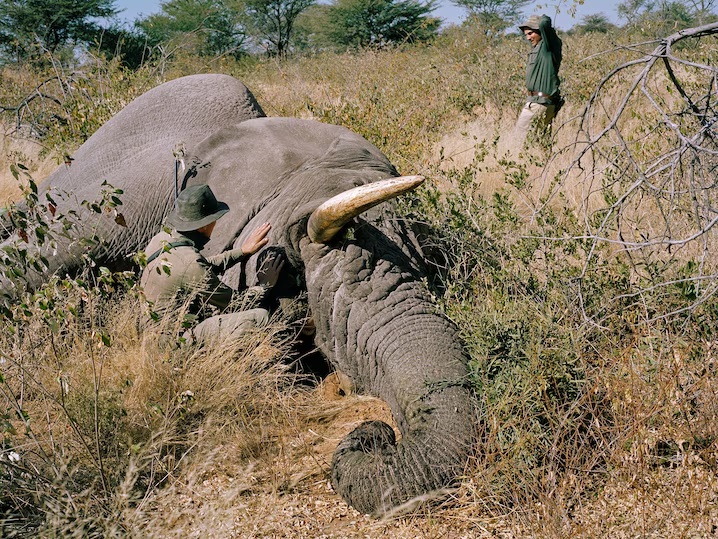
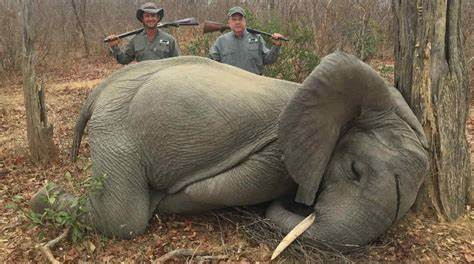
Botswana Elephant Trophy Hunt Still Shockingly Legal

Botswana’s president recently threatened to send 20,000 elephants from Botswana to Germany in a feud over stricter regulations on trophy imports. Find out why President Mokgweetsi Masisi’s claims about hunting simply don’t stack up and how animal-friendly approaches in Botswana actually help conservation goals and the economy.

Earlier this year, Germany proposed stricter limits on trophy imports, which led to controversy and claims from President Masisi that it would further impoverish Botswanans. 

Trophy hunters worldwide are attempting to justify their killing by making outlandish claims to hide their conservation harms and economic exploitation. 

According to Dr. Keith Lindsay, a renowned conservation biologist with over 30 years of research and hands-on experience conserving African elephants, including population management, nothing could be further from the truth.

While there are challenges for African countries that have elephant/human conflicts, many have found proven solutions that respect elephants without killing or trapping them.

The way to create harmony with elephants is to know the facts first.

  • Elephant populations have not “exploded,” as President Masisi claims. Botswana’s elephant population has not increased significantly for about two decades.
  • Trophy hunting funds corruption and does not bring in significant net revenue for conservation. The ones that profit are sports hunting companies, a few government officials, and community trust members who siphon off funds. Very little goes to the hundreds of households sharing the meager proceeds, which Dr. Lindsay says is “enough for a pair of socks.”
  • According to the numbers, hunting does not keep elephant populations in check, as President Masisi claims. A 2022 survey of elephants in Botswana indicated there were about 132,000. The hunting quota in 2024 is 400 elephants, which is less than 0.3%. It’s not enough to make a dent in their population, even if all 400 were killed, but it is a risk to all older male elephants and large-tusked elephants, who hunters target despite their vitally important role in elephant societies.
  • Botswana banned trophy hunting in 2014 but lifted it in 2019 to give the impression it would boost the economy, but elephants are much more valuable alive.
  • Live elephants contribute a much greater amount to the economy than dead ones. Per Dr. Lindsay, “Photographic ecotourism, even in Botswana, employs more people and contributes more to the national economy, including through multiplier effects on value chains of suppliers to the industry than does the minimal amount from trophy companies.” Only a few countries in southern Africa exploit wild animals as a resource through killing and consumption.
  • Conflicts from elephants eating crops and killing people are not due to elephant overpopulation but to human populations expanding into elephant territories and growing vegetation that elephants like to eat.
  • Many conservation experts advocate against killing keystone species on ecological grounds. The minority who stand to gain from trophy hunting often attempt to marginalize all who oppose hunting and killing elephants as “extremists” despite being the vast majority. 
  • Organizations like Ecoexist and Elephants Without Borders are working successfully with local farmers on practical approaches to human-elephant coexistence to resolve conflicts where they exist.

Elephants are not products to buy and sell. They are majestic living beings who deserve to live free as they have for thousands of years on the lands of their ancestors.

For the Silo, Courtney Scott / In Defense Of Animals.

Featured image: German sport hunter kills old Bull elephant in Botswana. image courtesy of National Geographic.

10 Worst Zoos For Elephants In Captivity

SAN RAFAEL, Calif. (Jan 9, 2018) – The shocking hidden suffering of captive elephants has been exposed today by In Defense of Animals on its respected annual list of the Ten Worst Zoos For Elephants in North America. The 2017 list reveals premature deaths, brutal breeding procedures, and flagrant violations of the Animal Welfare Act. Zoos all over the US and one zoo in Canada appear on the Ten Worst Zoos list, with Topeka Zoo in Kansas shamed as the #1 Worst Zoo for “gross neglect” of a dying elephant.

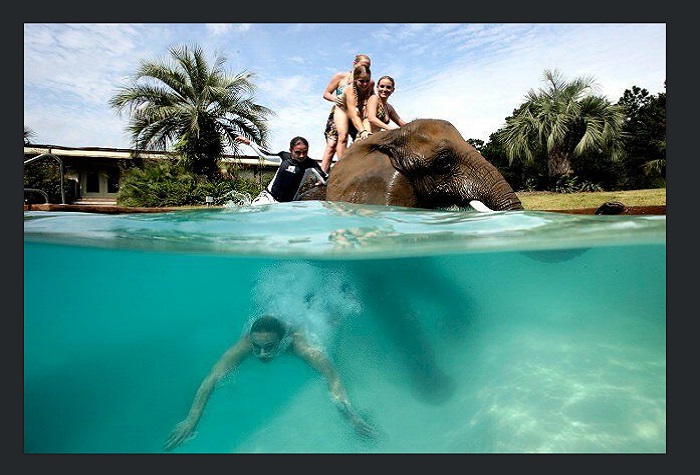
Bubbles the Elephant at Myrtle Beach Safari
Bubbles the Elephant at Myrtle Beach Safari.

“Elephants have suffered horrendously in North American zoos in 2017,” said In Defense of Animals elephant scientist, Toni Frohoff Ph.D. “Zoos violate elephants’ rights and submit them to horrific and unnecessary abuses. Urgent action is needed to shut down the archaic zoo exhibits on this list, and retire the elephants to sanctuaries where they can live in peace.”

Elephants in zoos across North America are being subjected to barbaric bullhooks, sexual mistreatment, grossly inadequate conditions, egregious disregard for their needs, forced performances, captivity-caused health problems, unsuitable enclosures, cold climates, incompatible companions, and crushing solitary confinement.

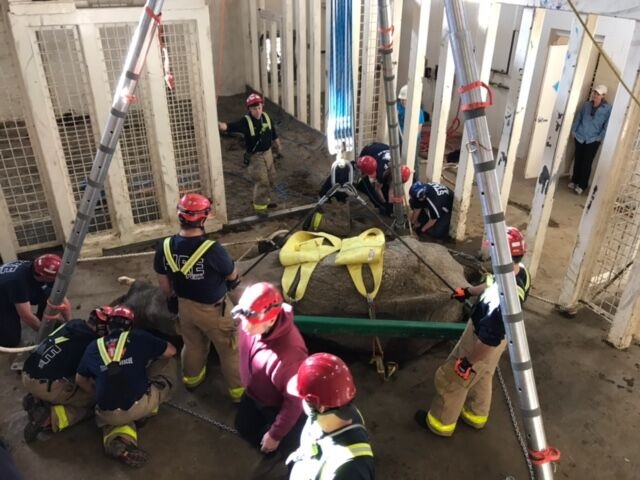
Topeka Zoo, named worst in 2017, has a long history of violating the Animal Welfare Act. The zoo failed miserably to adequately care for Shannon, a 35-year-old African elephant who died on December 11, 2017, after spending ten brutal hours down on her side without any monitoring from zoo staff who had left for the night. Shannon had to be hoisted to her feet by firefighters the day before, after enduring a lengthy “downed” ordeal.

Topeka Zoo Director Brendan Wiley himself admitted that for elephants, “lying down for several hours can potentially be fatal, given their body mass.” On the day of her death, Wiley said on camera, “We think she was down for a total of about 10 hours yesterday and… probably about the same amount of time today.” “That’s a lot of time for an elephant to be down.”

Shannon the Elephant Topeka Zoo
Shannon the Elephant at Topeka Zoo

The zoo chose not to keep someone on site to monitor Shannon’s video feed and staff went home for the night. Given the seriousness of Shannon’s condition, the zoo’s actions were nothing short of gross neglect and blatantly inadequate care.

“The gross neglect and death of Shannon at Topeka Zoo is only the tip of an iceberg that threatens the lives of all elephants who remain there”, said Dr. Frohoff. “It should be patently obvious that a severely sick elephant must be watched closely around the clock. Not bothering to check Shannon’s video feed for over 9 hours, the night after an emergency ordeal, is inexcusable. Proper observation would have likely minimized Shannon’s suffering, and could possibly have prevented her death. At 35-years old, Shannon should have been living some of her best years, yet she was sick and died at Topeka Zoo.”

Medical records indicate that Shannon was suffering for weeks, showing signs of pain, tremors, and weakness. Topeka Zoo reports that it has now bought a new video monitoring system, which is far too little – far too late.

Shannon’s death is indicative of the longtime problems that continue to plague Topeka Zoo and its animals. The zoo has been cited numerous times for violations of Federal Animal Welfare regulations which include animal deaths, injuries, and lack of proper veterinary care. In 2013, the zoo paid a $45,000 usd civil penalty to settle charges brought against it by the USDA for at least 51 willful violations of the Animal Welfare Act. The charges included failure to provide adequate veterinary care for elephants Tembo and Sunda, including problems with their skin, feet, and nutrition.

The elephants remaining at Topeka Zoo are at risk. Asian elephant Sunda has a history of chronic foot disease caused by lack of movement and standing on hard surfaces throughout many years. Topeka’s sub-freezing winters exacerbate health problems, as the elephants are forced to remain indoors for excessively long periods with minimal exercise. Cora, an Asian elephant, who came to the zoo in 2016 with Shannon, is particularly at risk because of the health issues associated with performing unnatural circus tricks, which she did for many years before coming to the zoo.

In Defense of Animals is calling for the urgent relocation of the Topeka Zoo elephants for their safety and wellbeing. Dr. Frohoff said, “We urge Topeka Zoo and the USDA to avert further tragedy and release elephants, Cora, Tembo and Sunda to an accredited sanctuary where they can receive the professional health care they need and deserve.”

10 WORST ZOOS

1. Topeka Zoo, Topeka, Kansas

2. Pittsburgh Zoo and International Conservation Center, Pittsburgh, Pennsylvania

3. Omaha’s Henry Doorly Zoo and Aquarium, Omaha, Nebraska

4. Louisville Zoo, Louisville, Kentucky

5. Oregon Zoo, Portland, Oregon

6. Myrtle Beach Safari, Myrtle Beach, South Carolina

7. Two Tails Ranch, Williston, Florida

8. St. Louis Zoo, St. Louis, Missouri

9. Natural Bridge Zoo, Rockbridge County, Virginia

10. Riverbanks Zoo and Garden, Columbia, South Carolina

DISHONORABLE MENTION – Repeat Offenders

Calgary Zoo Elephant Lucy
Calgary Zoo elephant “Lucy”- image: savelucy.ca

Edmonton Valley Zoo, Alberta, Canada

Bronx Zoo, Bronx, New York

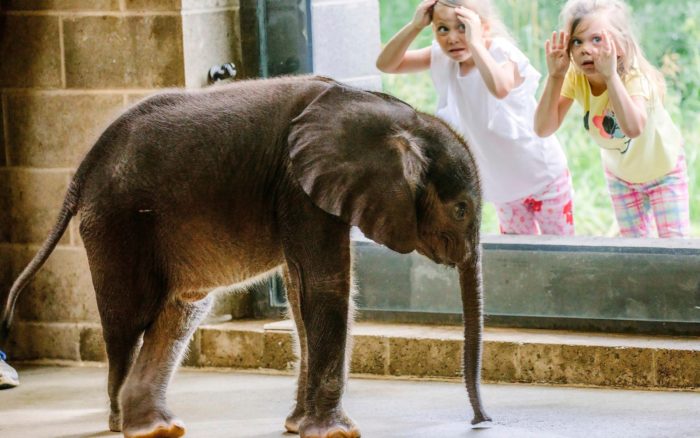
Featured image- Infant elephant at Pittsburgh Zoo by Andrew Rush/ AP

Discover the full list of the Ten Worst Zoos For Elephants in North America 2017

In Defense of Animals is an international animal protection organization with over 250,000 supporters and a 30-year history of fighting for animals, people and the environment through education, campaigns and hands-on rescue facilities in India, Africa, and rural Mississippi.

IN DEFENSE OF ANIMALS • 3010 KERNER BLVD. • SAN RAFAEL, CA 94901 • 415-448-0048