Tag Archives: fighting poverty

President Trump At UN Assembly Counsels Courage To Meet Today’s Challenges

A 5 MINUTE READ from our friends at ShareAmerica.

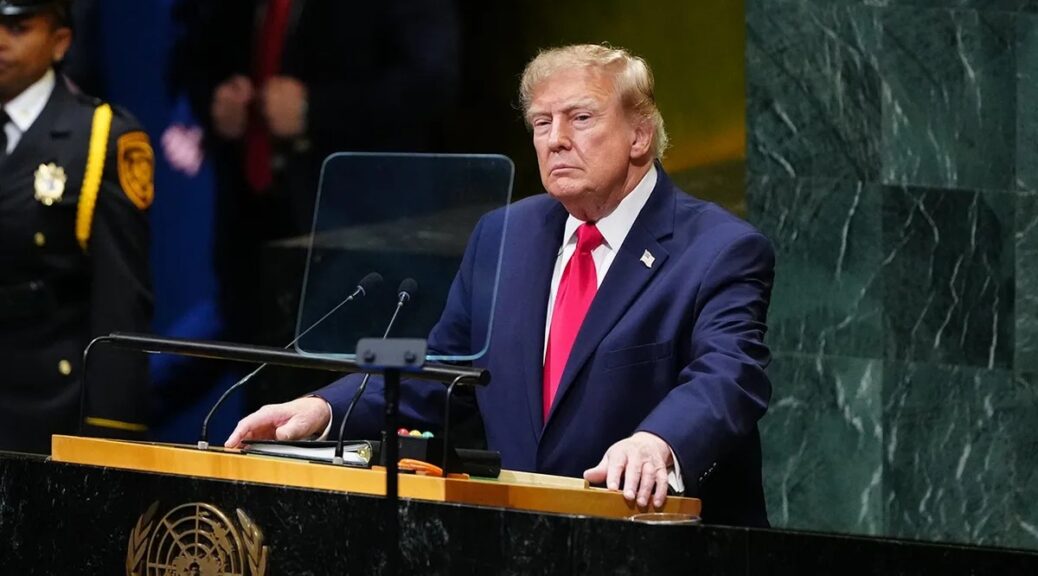
President Trump speaking at United Nations (© Michael M. Santiago/Getty Images)
President Trump speaks to leaders at the 81st session of the United Nations General Assembly September 22 in New York. (© Michael M. Santiago/Getty Images)

Heralding America’s “golden age” — as his administration has brought more jobs, lower poverty rates and less crime to the United States — President Trump encouraged world leaders to join him in building “a future for our people that is brighter, more hopeful and more magnificent than ever before.”

Speaking at the U.N. General Assembly yesterday September 22, Trump listed peace deals he has brokered. “While others have spoken of peace, I have made peace,” he said. He cited thank-you letters from leaders in Pakistan, Azerbaijan, Armenia, Cambodia and Rwanda.

Recalling the upcoming anniversary of the October 7 massacre in which Hamas killed 1,200 innocent civilians in Israel, Trump noted his administration’s work to free the hostages and called out Iran’s celebration of the massacre. To applause, Trump said that the Islamic Republic of Iran, “the bully of the Middle East … will never have a nuclear weapon.”

Shifting to the Western Hemisphere, the president said, “Our actions in Venezuela are proof that the United States will no longer permit threats to America to gain a foothold.” He commended the January 3 removal of Venezuela’s criminal leader, Nicolás Maduro, and subsequent release of political prisoners.

Today, he said, “we’re working closely with the leaders of Venezuela to forge a much better future for the Venezuelan people” and mentioned the recent U.S.-Venezuela deal to bring 65 billion barrels of oil to market.

After noting his administration’s designation of drug cartels as Foreign Terrorist Organizations, successful strikes on “drug boats” and successful mission with Venezuela to kill the leader of Tren de Aragua, Trump said the U.S. still faces threats from the hemisphere. He cited Cuban communist influence over U.S. groups and threats from Mexican drug cartels. “Communism will never be coming to America, but freedom will be coming to Cuba,” he said. “And safety and security will be coming to Mexico.”

‘A safer future’

While in New York, the president signed an agreement with Denmark and the people of Greenland to improve security in the Arctic for the United States, North America and Europe. The agreement enables the U.S. to review foreign military investments in Greenland for security risks. “This deal also protects Europe, in addition to America, and … very much enhances NATO,” Trump said, while commending NATO nations for increasing defense spending.

Noting the U.N.’s “great potential,” Trump said it must rein in globalist agendas that threaten the sovereignty of member nations.

He praised the defeat of the U.N.’s maritime agency proposal to charge shippers a carbon tax. “There is no global government, and while I’m president, there will be no global taxes.”

Trump vowed that the U.S. will remain at the forefront of artificial intelligence (AI) innovation and suggested that “super intelligence,” or SI, would be a better name for the promising technology. Cautioning against slowing the pace of SI development, he said, “I’m not going to stifle growth of something that will be bigger than the industrial revolution … or the internet itself.”

“We’re reasserting American power,” Trump said, “including American military power where necessary in our region and around the world to create a safer future for all of us.”
United Nations Sustainable Development Goals Are Shared Vision Of Humanity

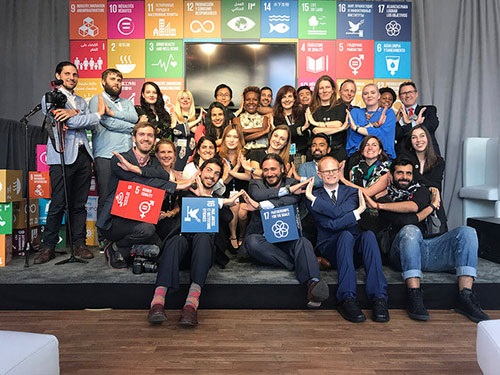
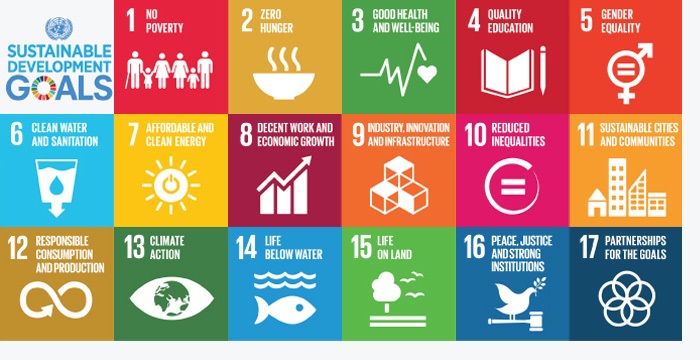
A few years ago, in September 2015, 193 countries signed up to support the UN’s 17 sustainable development goals for our planet and the people that live on it. The all-encompassing plan included promises to end poverty, feed everyone, create stability and peace, provide quality education and protect the future of our world. Every man, woman and child on the planet were invited to play their part to turn 17 goals into action and the promises into reality.

Goal 4 promised to achieve inclusive and equitable quality education for all. “OECD countries have generally been successful in guaranteeing adequate infrastructure and near-universal access to basic education,” says Andreas Schleicher, Director for Education and Skills at the OECD. But he notes that participation in education is not enough “to ensure the knowledge, competence, skills and attitudes that are necessary to increase individuals’ well-being and the prosperity of modern societies.” He adds that the OECD’s programs have a key role to play “in the achievement of – and measuring progress towards – SDG 4 and its targets, as well as other education-related SDG targets.”

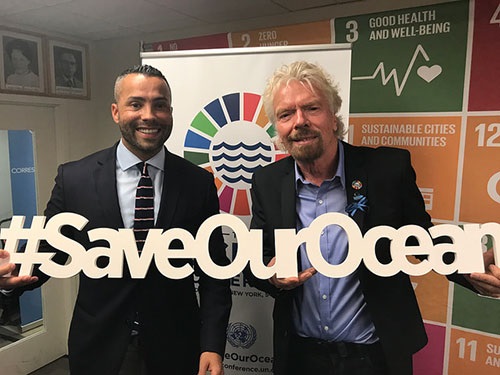
Richard Branson Save Our Oceans

“Just because poverty or pollution or climate change happen in another country far away, that does not mean that we are not part of the cause of these problems and their necessary solution.” — Thomas Gass
Since September 2015, education leaders and other influencers around the world have encouraged schools to promote all the goals. We’ve talked to teachers that acknowledge there’s nothing like real world challenges and case studies which allow students to apply the knowledge skills and dispositions they will need to succeed in an interconnected world.

How are we all doing so far? What have leaders learned from the implementation journey, and as a new school year begins, how can we build on those lessons to improve our efforts to achieve our planet’s plan moving forward?

Thomas Gass was appointed by the UN Secretary-General as Assistant Secretary-General for Policy Coordination and Inter-Agency Affairs in UN DESA and he took office on 3 September 2013. The Global Search for Education welcomes Thomas Gass.

Educators Have Sustainability Role

“Educators have an essential role in making sure the SDGs become a real social contract with the people.” — Thomas Gass

Thomas, please share one or two of the most important lessons you have personally learned spearheading the SDG’s implementation process thus far? It’s simple: The SDG’s are not a run-off-the-mill development strategy for big international organisations to fix the problems in the South… The SDGs are a shared vision of humanity – they are the missing (vision) piece of our globalization puzzle! This means that they can only be implemented if everyone is involved: Governments of course, but also municipalities, private companies, schools and universities, local organisations and individuals – everyone. Now, that can only happen if the people know about them… So mobilization and advocacy are crucial. The SDGs must become a new social contract between leaders and the people.

Leaders agreed that we must change the way we deal with the weakest among us, i.e. that we take the greatest care of those who are weak. What more would you ask of the leaders of rich and poor countries in terms of being good role models for this important part of the vision?

The promise to leave no one behind is the most difficult commitment of this new social contract. It requires that we all seek to understand who the most vulnerable people are and what risks they face, and then systematically empower these people and build their resilience. Political as well as economic leaders need to understand that sustainability has been redefined: If a significant economic or social group is left behind, our development is not sustainable. By the same token, we are fooling ourselves if we think that any single country or private company can be “sustainable” by itself. The SDGs demand that we are honest with ourselves about our ecological and social footprint! Just because poverty or pollution or climate change happen in another country far away, that does not mean that we are not part of the cause of these problems and their necessary solution.

United Nations Global Goals

“Know your #SDGs/#GlobalGoals and hold adults and leaders accountable for them, push back if they try to make you believe that your country, language, tribe or family is greater or more deserving than the others, and look for opportunities to make a difference yourselves.” — Thomas Gass

What more would you ask of educators in the work that lies ahead?

Educators have an essential role in making sure the SDGs become a real social contract with the people. I have the highest esteem for those committed educators who are bringing the SDGs into the classrooms, and educating younger generations to become global citizens. I firmly believe that this can be done as part of any teaching subject or class. I encourage all educators to join movements and co-create resources such as teachsdgs.org, GCEDclearinghouse.org, etc., and to encourage OECD/PISA to align their Global Competency criteria to the SDGs by 2018.

And finally, perhaps most important – what is your message to youth for the school year ahead on their part in the planet’s plan?

C.M. RubinHere is my message: This world is your world to share and enjoy. As Mahatma Gandhi said: “The world has enough for everyone’s need, but not enough for everyone’s greed.” Know your #SDGs/#GlobalGoals and hold adults and leaders accountable for them, push back if they try to make you believe that your country, language, tribe or family is greater or more deserving than the others, and look for opportunities to make a difference yourselves. Thank you Thomas.  For the Silo, C. M. Rubin.

Supplemental- Is Canada following United Nations Global Sustainable Development Goals?  

Global Search for Education