Tag Archives: Global

World Economic Forum Report- Technology Convergence Is Redefining Competitive Advantage

  • A World Economic Forum report finds competitive advantage is shifting from owning key technologies to combining them across data, people and ecosystems.  
  • The biggest barriers to scaling innovative solutions are no longer individual breakthroughs but connecting a combination of AI and digital tools with real-world operations.
  • The research shows how technology convergence is already reshaping value chains in healthcare, manufacturing, energy, life sciences, wearable electronics and more.
  • Read the full report here.

Geneva, Switzerland, April 2026 – The next wave of competitive advantage will come not from individual breakthrough technologies but from the ability to combine and scale multiple technologies across entire operating systems, according to a World Economic Forum report released today. As artificial intelligence, robotics, advanced materials, spatial computing and next-generation energy systems mature simultaneously, the organizations and countries moving fastest to apply these technologies together in intelligent systems are already pulling ahead.

The report, Technology Convergence: The New Logic for Competitive Advantage, produced in collaboration with Capgemini, draws on cross-industry research and real-world case studies in 12 sectors, identifying recurring patterns, including the blending of mature and experimental technologies and the blurring of industry boundaries, that determine whether convergence scales or stalls.

“Breakthrough technologies are advancing rapidly, and value is created when they are applied together,” said Cathy Li, Head of the Centre for AI Excellence and Member of the Executive Committee, World Economic Forum. “The real differentiator is not who owns the most advanced tools, but who can combine them across systems and applications at scale.”

As advanced technologies scale, the main bottlenecks to competitive advantage are no longer time or materials but how well organizations connect digital tools with physical operations. This is already playing out across sectors and geographies. From operating rooms to factory floors, power grids to research labs, converging technologies are reshaping how systems perform worldwide.

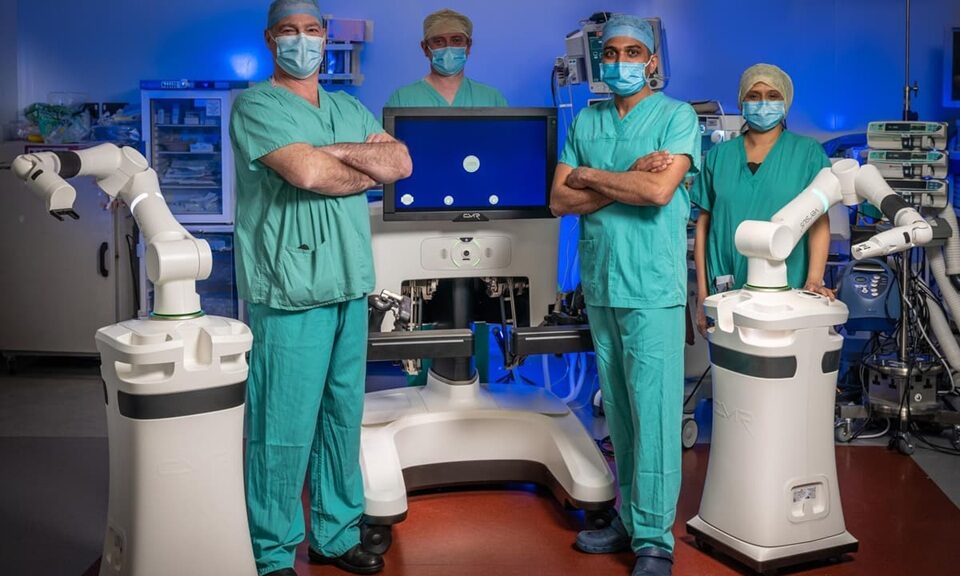
In the United Kingdom, novel surgical robots are extending clinician capacity (this article’s feature image shows robots with surgeons at West Hertfordshire Teaching Hospitals NHS Trust first used in 2022) while preserving workflow continuity across care teams. In China, automated labs are linking robotics, AI and data platforms to accelerate discovery while coordinating workflows across research networks.

“Technology convergence has evolved from a technical discussion into a strategic leadership mandate with direct operational impact,” said Aiman Ezzat, CEO of Capgemini Group. “Competitive advantage increasingly depends on an organization’s ability to integrate technologies, teams, partners and operating processes into coherent systems that deliver value at scale. Leaders who master orchestration, not just adoption, are the ones translating convergence into sustained performance and growth.”

“This shift has implications not only for companies but also for national growth strategies and industrial policy,” said Jeremy Jurgens, Managing Director, World Economic Forum. “Economies that align talent, infrastructure, data and policy will be better positioned to capture the benefits of converging technologies amid a fast-shifting global landscape.”

The report is part of the World Economic Forum’s Technology Convergence Initiative, launched in 2024, and builds on the first edition published in 2025. It draws on two years of cross-industry research, including expert interviews, workshops and case studies in healthcare, manufacturing, energy, life sciences and emerging fields such as brain-computer interfaces. The analysis examines how eight advanced technology domains interact, using the Forum’s 3C framework (combination, convergence and compounding) and the Technology Maturity Index to track how technologies move from experimentation to real-world impact.

Over Fifty Nature Positive Investible Opportunities via World Economic Forum

New Analysis Identifies 50+ Investible Opportunities Delivering Financial Returns

  • More than 50 investible opportunities, across 13 sectors, that are already generating revenue or cost savings for industry and investors have been identified by new World Economic Forum research.
  • Though more than half of global GDP is highly or moderately dependent on nature, capital continues to flow disproportionately towards nature-negative activities, leading to potential systemic risks and undervalued business opportunities.
  • From precision agriculture and sustainable cement to battery recycling and industrial water management, growing numbers of investment opportunities can both protect nature and deliver returns for investors.
  • Learn more about the report here.

Geneva, Switzerland, March 2026 – More than 50 investible opportunities could turn capital flows into lucrative nature-positive business practices and contribute up to $10.1 trillion in annual business revenues and cost savings by 2030, according to a new World Economic Forum report just launched.

The report, 50 Investible Opportunities for a New Nature Economy, developed in collaboration with Oliver Wyman, also highlights how nature risk and capital flow misalignment represents a growing systemic economic risk and a significant missed commercial opportunity for business.


This comes at a time when global capital flows remain deeply misaligned. According to the United National Environment Programme (UNEP), an estimated $7.3 trillion continues to be invested annually in activities that degrade ecosystems, compared to roughly $220 billion invested in nature-based solutions. The report’s 50 investible opportunities offer revenue-generating and cost-saving approaches to close this gap.

Who Is Falling Behind?


Similar to the Paris Agreement for climate targets, the international community is falling behind on biodiversity targets. Renewed action and novel strategies are needed to meet goals of halting and reversing nature loss by 2030.

“We need to transition towards an economic system that delivers prosperity within planetary boundaries,” said Sebastian Buckup, Managing Director, World Economic Forum. “Industries, including the financial sector, will pursue this not just as an act of corporate social responsibility or impact investing but because it makes good business sense to do so.”

As companies face increasing exposure to water scarcity, soil degradation, pollution and tightening environmental regulation, nature-related risks are no longer abstract sustainability concerns but material financial issues affecting long-term profitability.

Drawing on analysis of approximately 250 business activities, the report identifies 50+ investment-ready opportunities across 13 high-impact sectors to support halting and reversing nature loss by 2030.
From precision agriculture and sustainable concrete to battery recycling and industrial water management, these solutions reduce pressure on land, water and resources while generating revenue growth, cost savings and risk mitigation.

Case Study: Sustainable Cement and Concrete Blends


For example, the report looks at sustainable concrete blends as an investible opportunity. These blends reduce reliance on newly quarried raw materials by substituting a portion with recycled industrial byproducts or recovered construction materials. They provide similar structural performance to traditional concrete while helping companies meet regulatory standards and growing market demand for low-impact building solutions.

These blends also have an array of nature benefits, including reducing new quarrying, lowering pollution and reducing the energy intensity needed for new concrete.

While these products are commercially viable today and can often be integrated into existing production facilities with moderate capital investment, many sustainable blends retail at a higher price than conventional concrete, as the latter benefits from established logistics, economies of scale and similar factors that lower costs. As economies of scale are built and business models are derisked, sustainable concrete offers an opportunity for investors to put capital towards a business-ready, nature-positive solution that can generate returns.

“At its core, this is a capital allocation challenge,” said Derek Baraldi, Head of Sustainable Finance, World Economic Forum. “Financial institutions and businesses that integrate nature into strategy today are not just managing risk but positioning themselves for competitive advantage.”

The Role of Capital and Financial Institutions

Financial institutions can help scale these solutions by providing the capital companies need to invest in new production processes and facilities. They can also reduce risk through tools such as sustainability-linked loans, guarantees or blended financing, helping innovative materials reach the market faster.

To support financial institutions looking to invest in nature-positive solutions, the report outlines five priority actions for financial institutions to mobilize capital into nature-positive opportunities. By strengthening internal “nature fluency”, innovating financial products, building coalitions, improving data use and leveraging nature transition conversations to surface investible opportunities, financiers can build a robust pipeline of nature-positive opportunities to deliver both mainstream and sustainable finance.


Business depends on reliable water supplies, fertile soils, biomass and ecosystem services such as pollination and flood protection. Industry successes are already delivering value while supporting nature-positive goals, such as industrial water management to tackle water shortages and precision agriculture techniques that save farmers input costs while reducing fertilizer run-off into waterways. Realigning capital flows with nature-positive investments that protect biodiversity and offer financial returns is essential to safeguarding the natural systems which underpin the global economy.

More about Nature-Positive Transitions


The World Economic Forum’s Nature-Positive Transitions report series explores transformative pathways to halt and reverse nature loss by 2030. Focusing on critical sectors, the series highlights the dual impacts and dependencies of these industries on nature, alongside the priority actions businesses can take to avoid and reduce negative impacts, mitigate nature-related risks, build resilience and unlock opportunities across value chains. Nine sectors have been involved: technology, automotive, cement and concrete, chemicals, household and personal care products, mining and metals, ports and offshore wind.

The World Economic Forum provides a global, impartial, not-for-profit platform and insights to support meaningful connections between political, business, academic, civil society and other leaders. (www.weforum.org).

For the Silo, Jarrod Barker.

How Cell Phone Behavioral Data Can Help Save Our Planet

Zurich, Switzerland- A report from a few years ago deserves a second look. That study demonstrated how leveraging mobile network data can estimate levels of carbon emissions and air pollution in cities, an approach that could substantially reduce the cost of implementing the Paris Agreement.

  • The study analyses mobility patterns derived from mobile network data to estimate the usage of different transport modes within a city and derive conclusions about the respective pollution they cause.

  • This innovative methodology allowed scientists to estimate the concentration of air pollutants in urban areas with up to 77% accuracy.

  • The method could provide a scale-able and cost effective way to help understand and combat greenhouse gas (GHG) emissions in cities worldwide.

Big data analytics company and ETH Zurich spin-off Teralytics, Telefónica NEXT and sustainability solution provider South Pole Group conducted the  study in Nuremberg, Germany and revealed the analysis of mobile network data is an effective way to estimate CO2 and NOX emissions in urban areas at very low cost. To achieve this, Teralytics examined aggregated and anonymized data, which is generated when mobile devices communicate with Telefónica’s mobile communication cells during user calls, text messages or while using phones to browse the internet. Teralytics was able to refine this raw data into human mobility patterns to understand how the different modes of transport, for instance trains or cars, are frequented. Combining this information with data on the emissions of the different transport modes, the three entities were able to estimate air pollution and GHG emissions in the city.

As each form of transportation produces a unique amount of CO2 and NOX emissions, understanding urban mobility patterns is vital to understand the source of emissions. The study in Nuremberg used this information to estimate with up to 77 per cent accuracy the concentration of air pollutants in the city. These findings encourage further exploration of how big data can be used to understand and ultimately solve environmental issues such as air pollution in cities across the world. This is particularly interesting with regards to the lower cost of analyzing and interpreting data compared to the higher cost of production and maintenance of elaborate measuring stations. The novel approach could thus allow an ongoing analysis on a nationwide scale.

George Polzer

“While our contemporary urban lifestyles result in the generation of harmful greenhouse gasses, it also generates large amounts of behavioural data. Our mission at Teralytics is to use this data for the benefit of society,” says Georg Polzer, CEO of Teralytics. “Our findings from Nuremberg showed that this data can be used to give city planners insights into how human mobility contributes to pollution. This is a vital part to efficiently design and implement clean air and low carbon strategies. We are looking forward to further exploring this opportunity.”

Using a three-level process, the fully anonymized and aggregated data was first transformed into movement flows by the data scientists at Teralytics, identifying over 1.2 million transportation routes during the analyzed time period, as depicted in Figure 2. The sustainability solution expert South Pole Group then used an atmospheric model to estimate air pollution levels caused by the usage of the different modes of transportation, taking into account meteorological data and information on the respective traffic carriers’ emission levels from the German Federal Ministry for the Environment (BMUB). In the third step, the accuracy of the method was examined by comparing the findings with existing data from air pollution measuring stations. The values measured at these stations were found to correlate up to 77 per cent with those from the Teralytics’ calculations.

The results of this pilot study in Nuremberg constitute a sound basis to further develop the methodology.

Following its success, the consortium was able to secure financial support from Climate KIC’s Low Carbon City Lab (LoCaL), an initiative that brings together cities, business, academia and NGO’s to deliver high environmental and societal impact. With this backing, the research partnership will expand and improve the methodology, focusing on short travel routes and taking into account local emission factors like airports, large-scale events, and types of vehicles on the road (i.e. electric cars and SUVs). Moreover, the influence of factors such as traffic jams and red lights will be taken into account in order to make even more accurate estimations of the air pollution levels in a city.

“The results from this pilot study exceed our expectations,” says Maximilian Groth, responsible for Business Development & Partnerships at Teralytics. “We are confident that we will soon be able to scale this product to cities worldwide to support urban planners in making our air cleaner and achieving the goals of the Paris Agreement at the lowest possible cost.”

This research follows other successful studies on usage of mobile network data, including a smart data analysis for transport in Stuttgart by Teralytics, Telefónica Germany, and Fraunhofer IAO.

Renat Heuberger

“Approximately 70 per cent of global greenhouse gas emissions are generated in cities, meaning that they play a key role in climate protection. We see great potential in the use of continuously generated data, such as mobile network data, to measure and reduce pollution levels in cities.” States Renat Heuberger, CEO of South Pole Group.

Florian Marquart

Florian Marquart, Managing Director of Telefónica NEXT for Advanced Data Analytics: “The pilot project in Nuremberg has clearly shown the specific added value of anonymised mobile network data for the environment. This is data from people for people. We see great potential in the results and will start the next phase of our research. The goal is to develop a product that German cities, German states and the German federal government can use to better face the challenges of emissions pollution”.  For the Silo, Ricky Sutton.

About Teralytics

Teralytics is the trusted data analytics partner for some of the largest telecom operators in North America, Europe and Asia. Using technology built for operators by data scientists, they have perfected the ingestion, modelling and transformation of raw signals from subscriber actions and movements on operator networks to deliver meaningful and actionable insights, that delivers new value to our mobile operator partners. By unlocking and processing a massive scale of device movement and consumer intelligence data from location and behavioral signals, they can analyze people, places and things and offer actual insights to help city planners, venue owners, retailers, NGOs and media companies make informed decisions, optimize operations and maximize ROI. Headquartered in Zurich, Teralytics has offices in New York, and Singapore.