
Tag Archives: biomass

Over Fifty Nature Positive Investible Opportunities via World Economic Forum

New Analysis Identifies 50+ Investible Opportunities Delivering Financial Returns

  • More than 50 investible opportunities, across 13 sectors, that are already generating revenue or cost savings for industry and investors have been identified by new World Economic Forum research.
  • Though more than half of global GDP is highly or moderately dependent on nature, capital continues to flow disproportionately towards nature-negative activities, leading to potential systemic risks and undervalued business opportunities.
  • From precision agriculture and sustainable cement to battery recycling and industrial water management, growing numbers of investment opportunities can both protect nature and deliver returns for investors.
  • Learn more about the report here.

Geneva, Switzerland, March 2026 – More than 50 investible opportunities could turn capital flows into lucrative nature-positive business practices and contribute up to $10.1 trillion in annual business revenues and cost savings by 2030, according to a new World Economic Forum report just launched.

The report, 50 Investible Opportunities for a New Nature Economy, developed in collaboration with Oliver Wyman, also highlights how nature risk and capital flow misalignment represents a growing systemic economic risk and a significant missed commercial opportunity for business.

This comes at a time when global capital flows remain deeply misaligned. According to the United National Environment Programme (UNEP), an estimated $7.3 trillion continues to be invested annually in activities that degrade ecosystems, compared to roughly $220 billion invested in nature-based solutions. The report’s 50 investible opportunities offer revenue-generating and cost-saving approaches to close this gap.

Who Is Falling Behind?


Similar to the Paris Agreement for climate targets, the international community is falling behind on biodiversity targets. Renewed action and novel strategies are needed to meet goals of halting and reversing nature loss by 2030.

“We need to transition towards an economic system that delivers prosperity within planetary boundaries,” said Sebastian Buckup, Managing Director, World Economic Forum. “Industries, including the financial sector, will pursue this not just as an act of corporate social responsibility or impact investing but because it makes good business sense to do so.”

As companies face increasing exposure to water scarcity, soil degradation, pollution and tightening environmental regulation, nature-related risks are no longer abstract sustainability concerns but material financial issues affecting long-term profitability.

Drawing on analysis of approximately 250 business activities, the report identifies 50+ investment-ready opportunities across 13 high-impact sectors to support halting and reversing nature loss by 2030.
From precision agriculture and sustainable concrete to battery recycling and industrial water management, these solutions reduce pressure on land, water and resources while generating revenue growth, cost savings and risk mitigation.

Case Study: Sustainable Cement and Concrete Blends


For example, the report looks at sustainable concrete blends as an investible opportunity. These blends reduce reliance on newly quarried raw materials by substituting a portion with recycled industrial byproducts or recovered construction materials. They provide similar structural performance to traditional concrete while helping companies meet regulatory standards and growing market demand for low-impact building solutions.

These blends also have an array of nature benefits, including reducing new quarrying, lowering pollution and reducing the energy intensity needed for new concrete.

While these products are commercially viable today and can often be integrated into existing production facilities with moderate capital investment, many sustainable blends retail at a higher price than conventional concrete, as the latter benefits from established logistics, economies of scale and similar factors that lower costs. As economies of scale are built and business models are derisked, sustainable concrete offers an opportunity for investors to put capital towards a business-ready, nature-positive solution that can generate returns.

“At its core, this is a capital allocation challenge,” said Derek Baraldi, Head of Sustainable Finance, World Economic Forum. “Financial institutions and businesses that integrate nature into strategy today are not just managing risk but positioning themselves for competitive advantage.”

The Role of Capital and Financial Institutions

Financial institutions can help scale these solutions by providing the capital companies need to invest in new production processes and facilities. They can also reduce risk through tools such as sustainability-linked loans, guarantees or blended financing, helping innovative materials reach the market faster.

To support financial institutions looking to invest in nature-positive solutions, the report outlines five priority actions for financial institutions to mobilize capital into nature-positive opportunities. By strengthening internal “nature fluency”, innovating financial products, building coalitions, improving data use and leveraging nature transition conversations to surface investible opportunities, financiers can build a robust pipeline of nature-positive opportunities to deliver both mainstream and sustainable finance.


Business depends on reliable water supplies, fertile soils, biomass and ecosystem services such as pollination and flood protection. Industry successes are already delivering value while supporting nature-positive goals, such as industrial water management to tackle water shortages and precision agriculture techniques that save farmers input costs while reducing fertilizer run-off into waterways. Realigning capital flows with nature-positive investments that protect biodiversity and offer financial returns is essential to safeguarding the natural systems which underpin the global economy.

More about Nature-Positive Transitions


The World Economic Forum’s Nature-Positive Transitions report series explores transformative pathways to halt and reverse nature loss by 2030. Focusing on critical sectors, the series highlights the dual impacts and dependencies of these industries on nature, alongside the priority actions businesses can take to avoid and reduce negative impacts, mitigate nature-related risks, build resilience and unlock opportunities across value chains. Nine sectors have been involved: technology, automotive, cement and concrete, chemicals, household and personal care products, mining and metals, ports and offshore wind.

The World Economic Forum provides a global, impartial, not-for-profit platform and insights to support meaningful connections between political, business, academic, civil society and other leaders. (www.weforum.org).

For the Silo, Jarrod Barker.

Fuel From Garbage Is Answer To Airline Industry CO2 Emission Woes

Our friends at ExpertFlyer sat with Environmental and Air Transportation Experts to Learn How Airlines are Reducing Their Carbon Footprint Today and Where They are Investing Resources for Tomorrow.

NEW YORK, 2022 /PRNewswire-PRWeb/ —  When it comes to carbon emissions, no industry absorbs more attention or criticism than the air travel industry. Our friends at ExpertFlyer recently spoke with experts in the environmental and air transportation industries to get a sense of what is actually happening in the U.S. and Canada to address aircraft CO2 emissions now and for the future.

ExpertFlyer went One-on-One with Steve Creedy, editor and Asia-Pacific bureau chief for AirlineRatings.com, a one-stop airline safety and product rating review website, and Nancy Young who heads up environmental affairs for Airlines for America, a U.S. trade association and lobby group that represents North American airlines, to learn more about how and where airlines are investing their time and money on behalf of the environment.

When it comes to “going green,” Steve Creedy says that North American based airlines aren’t quite bringing their A-game yet, citing a 2017 Newsweek report ranking the top 500 global companies according to their green credentials. While the report may not reflect a stellar performance by U.S. airlines, three made the top half of the list – United (100), Delta (137), and Southwest (179) – and American came in at 284. Canadian airlines see similar data points.

“The rankings measured the companies against general principles such as transparency, objectivity, publicly available data and comparability with their industry peers,” Creedy explained. “That matched my less scientifically rigorous view that United and Delta seemed more active in this space than some others,” he added.

Image result for sustainable jet fuel from flexible waste biomass
Biofuel made from municipal waste. Image: Smithsonian Magazine

For example, Creedy noted that United was the first airline to incorporate sustainable aviation fuel, such as waste oils from biological origin (biofuels), in regular operations on a continuous basis. This initiative marked a significant milestone in the industry by moving beyond test programs and demonstrations to the everyday use of low-carbon fuel in ongoing operations. “In 2015, United invested $30 million USD / $38,490,000 CAD in alternative aviation fuel development and signed an offtake agreement in 2019 with Boston’s World Energy for up to 10 million gallons of biofuel over two years.”

But the airline industry, in general, continues to make enormous investments in technology, including the purchase of new, more efficient aircrafts. “In the end, what we’re really striving for is fuel efficiency and ways to increase that efficiency, thus reducing carbon emissions and investing in newer, more efficient planes is certainly a great start,” said Nancy Young who shared some of the things airlines are doing now to reduce emissions. “The airline industry is the first to have a global market-based measure applied to itself and we are very proud of our work and unwavering commitment to that,” she added.

Creedy concurs and added that airlines are also investing significant research dollars in electric aircraft, which could be used for commercial air transport for short-haul routes in the next 10-15 years. He also noted that airlines are beginning to use electric ground vehicles and introducing recyclable flatware on board while reducing single-use plastics to address other environmental concerns.

While the airline industry itself has a goal to reduce CO2 emissions 50% by 2050 (relative to 2005 levels), the International Civil Aviation Organization (ICAO) is currently focused on short-term goals from 2020 and beyond, including its MRV plan (Measurement, Reporting, and Verification) requiring aircraft operators around the world (with international operations) to report fuel burn to their respective governments to help measure carbon emissions. Ms. Young says the plan, known as the Carbon Offsetting Reduction Scheme for International Aviation (CORSIA), is not mandatory until appropriate regulations can be implemented, but says that U.S. and soon Canadian airlines are voluntarily complying with its guidelines.

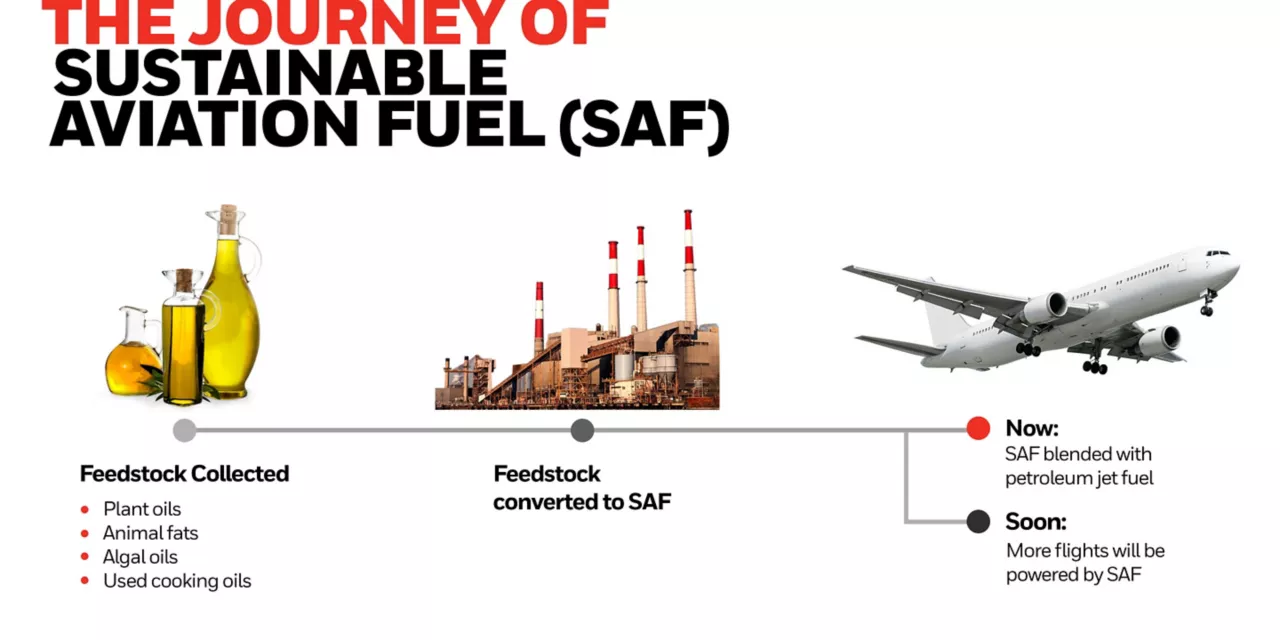
And when it comes to alternative fuels, the “Flux Capacitor,” made famous in the film, Back to the Future, doesn’t seem so far-fetched anymore. “We’re really excited about transitioning our liquid fuels to sustainable aviation fuels, which can come from a number of sources, including municipal solid waste,” Ms. Young said. “In fact, a couple of our members have agreements for future supply literally from garbage, but right now United Airlines is taking supply of alternative fuels from waste oils at LAX. We can take these biomaterials and process them to be equivalent to jet fuel and they can bring up to an 80% reduction in carbon dioxide,” she added.

“The airline industry is making incredible strides to reduce carbon emissions through investments in a variety of new technologies, investments in bio-fuel research, and commonsense practices such as the use of recycled papers and plastics on board flights,” says Chris Lopinto, president of ExpertFlyer.com. “I believe that the airline industry will follow in the footsteps of NASA in the sense that its sizeable investment in research will yield numerous products that will become commonplace among general consumers around the world, thus furthering the environmental initiative.

Creating Cleaner Air in Ontario Province Has Eliminated Coal Fired Generation

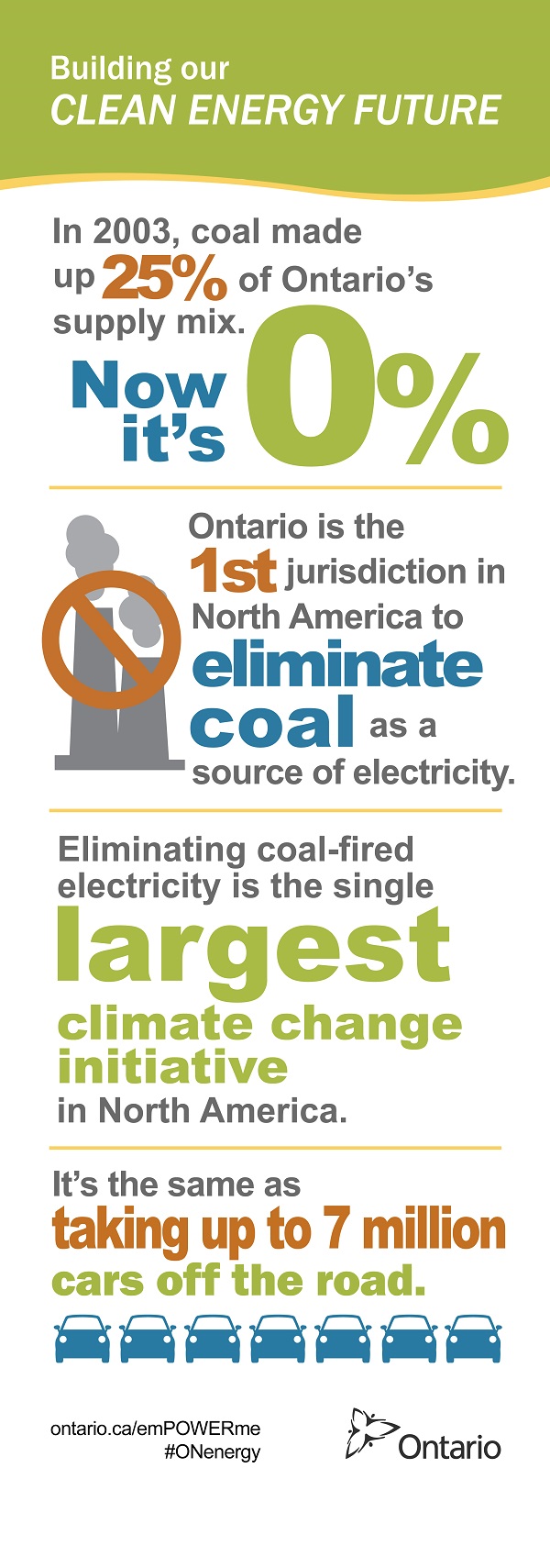
Bob Chiarelli, Minister of Energy "Getting off coal is the single largest climate change initiative undertaken in North America and is equivalent to taking up to seven million cars off the road."
Bob Chiarelli, Minister of Energy “Getting off coal is the single largest climate change initiative undertaken in
North America and is equivalent to taking up to seven million cars off the road.”

Ontario is now the first jurisdiction in North America to fully eliminate coal as a source of electricity generation. The Thunder Bay Generating Station, Ontario’s last remaining coal-fired facility, has burned its last supply of coal. Operated by Ontario Power Generation, Thunder Bay Generating Station was the oldest coal-fired station in the province.  The plant is scheduled to be converted to burn advanced biomass, a renewable fuel source. The province has replaced coal generation with a mix of emission-free electricity sources like nuclear, waterpower, wind and solar, along with lower-emission electricity sources like natural gas and biomass. Read more below the following infographic.

Ontario Energy Infographic

Ontario has fulfilled its commitment to end coal generation in advance of its target of the end of 2014. A coal-free electricity supply mix has led to a significant reduction in harmful emissions, as well as cleaner air and a healthier environment.

Providing clean, reliable and affordable power is part of the government’s economic plan that is creating jobs for today and tomorrow. The comprehensive plan and its six priorities focus on Ontario’s greatest strengths – its people and strategic
partnerships.

QUICK FACTS

*   Thunder Bay Generating Station came into service in 1963.
*   Converting the station to advanced biomass will retain 60 jobs in Thunder Bay.
*   Last year, Ontario introduced the Ending Coal for Cleaner Air
Act http://news.ontario.ca/ene/en/2013/11/ending-coal-for-cleaner-air-in-ontario.html , which would ensure coal-fired generation as a source of electricity in the province never happens again.
*   Since 2003, Ontario’s coal closure plan has eliminated up to 30 megatonnes of emissions annually. The closure of Thunder Bay Generating Station marks the end of coal fired emissions from electricity generation in Ontario.
*   According to a 2005 independent study, “Cost Benefit Analysis: Replacing Ontario’s Coal-Fired Electricity Generation http://www.energy.gov.on.ca/docs/en/coal_cost_benefit_analysis_april2005.pdf ,” the estimated cost of coal generation was approximately $4.4 billion annually when health, environmental, and financial costs were taken into consideration.

LEARN MORE

*   Learn more about the financial, environmental and health impacts of dirty coal.<http://www.energy.gov.on.ca/docs/en/coal_cost_benefit_analysis_april2005.pdf>
*   Learn more about how Ontario’s air quality is improving in the Air Quality in Ontario Report for
2011.<http://www.ene.gov.on.ca/stdprodconsume/groups/lr/@ene/@resources/documents/resource/stdprod_104486.pdf>
*   Read the International Agency for Research on Cancer (IARC) study on outdoor
air pollution as a leading environmental cause of cancer deaths<http://www.iarc.fr/en/media-centre/pr/2013/pdfs/pr221_E.pdf>.

QUOTES

“Getting off coal is the single largest climate change initiative undertaken in
North America and is equivalent to taking up to seven million cars off the road.
Today we celebrate a cleaner future for our children and grandchildren while
embracing the environmental benefits that our cleaner energy sources will bring.”
— Bob Chiarelli, Minister of Energy


Creating Stability For Clean Energy Projects

CREATING STABILITY FOR CLEAN ENERGY PROJECTS

To maintain momentum and ensure Ontario remains competitive in North America’s emerging clean energy economy, the province is taking a number of actions to make it easier for energy developers and manufacturers to do business in the province.


These changes are part of ongoing efforts to provide stability and create jobs in Ontario’s clean energy sector and protect the health and safety of Ontarians and the environment.


To date more than 20,000 clean energy jobs have been created in Ontario, and the province is on track to create 50,000 by 2012.


Changes to Feed in Tariff (FIT) Contract Terms


A new process is being introduced to help provide stability for developers to move clean energy projects forward. FIT contract holders with projects seeking project financing and a manufacturing partner now have the opportunity to request the Ontario Power Authority (OPA) to waive its termination rights if they meet certain conditions. This means:

  • Large developers must submit a Domestic Content Plan and have it approved by the OPA by December 31, 2011. As well they must submit evidence of an agreement to purchase equipment by December 31, 2011.


  • For medium sized projects, a Domestic Content Plan must be submitted by December 31, 2011.


  • Developers of clean energy programs that do not require Domestic Content plans — hydro, biogas, landfill gas and biomass — may also request that the OPA waive its termination rights.


This will give clean energy developers more stability in planning and more flexibility to obtain financing and place orders for equipment.


Developers still need to obtain regulatory approvals, provide a completed Financing Plan, and documentation related to completed grid impact assessments, as well as pay the required security, before they are able to move to the construction phase.


Improving the Renewable Energy Approval Process


The Renewable Energy Approval (REA) is a single approval that integrates environmental and health and safety matters.
The purpose of the REA is to avoid duplication, set clear, upfront provincial rules and encourage the development of more clean energy projects. The rules ensure all clean energy projects built in Ontario are subject to the same requirements to protect human health and the environment. The province has made a number of improvements to streamline the process even further.


The Ministry of the Environment has reduced the amount of time it takes for the initial screening review of application from 90 days to 40 days by:

  • Establishing a dedicated REA team focused only on the management and review of REA applications.


  • Holding over 250 pre-consultation meetings with proponents to ensure awareness of REA requirements. Key documents and resources related to the process are available on a dedicated      business website for easy access.


These process improvements will be further enhanced by:


  • The release of a new Technical Guide to Renewable Energy Approvals to help renewable energy developers meet the requirements of the Renewable Energy Approvals regulation (O. Reg. 359/09).


    • This will provide clear guidance on how to prepare the required technical and scientific reports as well as conduct more effective consultations with municipalities, the public and Aboriginal communities.


  • Releasing an aboriginal consultation guide for proponents that has been developed by consulting with technical experts within key First Nations organizations and other ministries. The draft is now posted for broader consultation.


The Ministry of Natural Resources has also introduced a number of steps and new tools to save developers time:


  • Developing technical guidelines on protection of natural heritage and significant wildlife habitat that provide clear rules for the renewable energy industry.


  • Delivering intensive training sessions to more than 100 industry environmental consultants on implementing technical guidelines.


  • Releasing new tools, templates and resources to streamline processes for completing REA approval requirements, including rapid assessment tools for significant wildlife habitat and wetlands.


  • Focusing staff resources on reviewing and approving Feed-in Tariff projects, resulting approval of over 75 per cent of natural heritage assessments submitted to the ministry.


  • Establishing a regional team of specialists to focus on the new Bruce to Milton Feed-in-Tariff projects – developers will be contacted by the ministry within three weeks of receiving their FIT contracts to begin the regulatory review process.


In addition, the Ministry of Tourism and Culture considers the review of all REA heritage and archaeological assessment reports as a priority, with the highest focus on those projects with FIT contracts. That’s why the ministry will implement a 60-day service guarantee for written comments on final assessment reports. As well, this June the ministry posted an Information Bulletin on its website; it helps applicants navigate through meeting the cultural heritage requirements of the REA process by clarifying all requirements for proponents and provides a step-by-step outline of the process. This will help ensure applications are completed and improve the quality of self-assessments.


The ministry also:

  • Released Standards and Guidelines for Consultant Archaeologists (2011) and associated training for consultant archaeologists.
  • Is in the process of developing technical guidance for heritage consultants on conducting and preparing heritage assessments


Together these guidance materials will help lead to a more rapid review process.


Changes to Property Tax Treatment of Renewable Energy Facilities


Regulatory amendments are being proposed to Ontario Regulation 282/98 regarding the property tax treatment of renewable energy facilities.


The Assessment Act and Ontario Regulation 282/98 currently provide rules governing the property tax treatment of energy generation facilities; however, in some situations, these rules may not be sufficiently detailed to address issues relating to emerging types of energy installations.


The objective of the proposed regulatory amendments is to provide clarity and certainty to property owners, municipalities and the Municipal Property Assessment Corporation, and to ensure that property tax does not act as a disincentive to energy generation, particularly small-scale generation by persons who are not ordinarily in the business of generation.


More information

Read more about Ontario’s Green Energy Act.


Read more about the Renewable Energy Approvals Process


Read the Minister of Energy’s Directive to the Ontario Power Authority


Read the Regulatory Registry posting of proposed changes to Property Tax Treatment of Renewable Energy Facilities.


To Learn more about renewable energy in Ontario visit  http://www.ontario.ca/renewableenergy


Andrew Block, Minister’s Office, 416-327-6747Paul Gerard, Communications Branch, 416-326-7226

ontario.ca/energy-news

Disponible en français