Tag Archives: Zurich Insurance Group

Leaders & Fastest Risers In World Tourism Via World Economic Forum Excludes Canada

Tourism Conditions Improve Across Most Economies, Despite Global Headwinds, WEF Index Finds

I 中文 I 日本語 I

  • Travel and tourism development conditions are at their strongest since 2019: 92% of the 110 economies in the 2026 Travel & Tourism Development Index (TTDI) improved their score since 2024, with Japan taking the top position.
  • Advanced economies hold nine of the top 10 spots, while the largest emerging tourism economies have improved their scores more than twice as fast as the Top 20 since 2019.
  • The Index will launch at Beyond Tourism Day in Geneva, bringing together senior leaders from business, government and civil society under the theme “Resilient Growth. Renewed Impact”.
  • Read the full report and learn about the initiative. 
Geneva, Switzerland, September 2026– Travel and tourism conditions have strengthened across most of the world, a new World Economic Forum report finds, but destinations face a growing challenge: turning record demand into lasting value amid rising costs, geopolitical and climate disruption, workforce shortages and mounting pressure on infrastructure and communities.

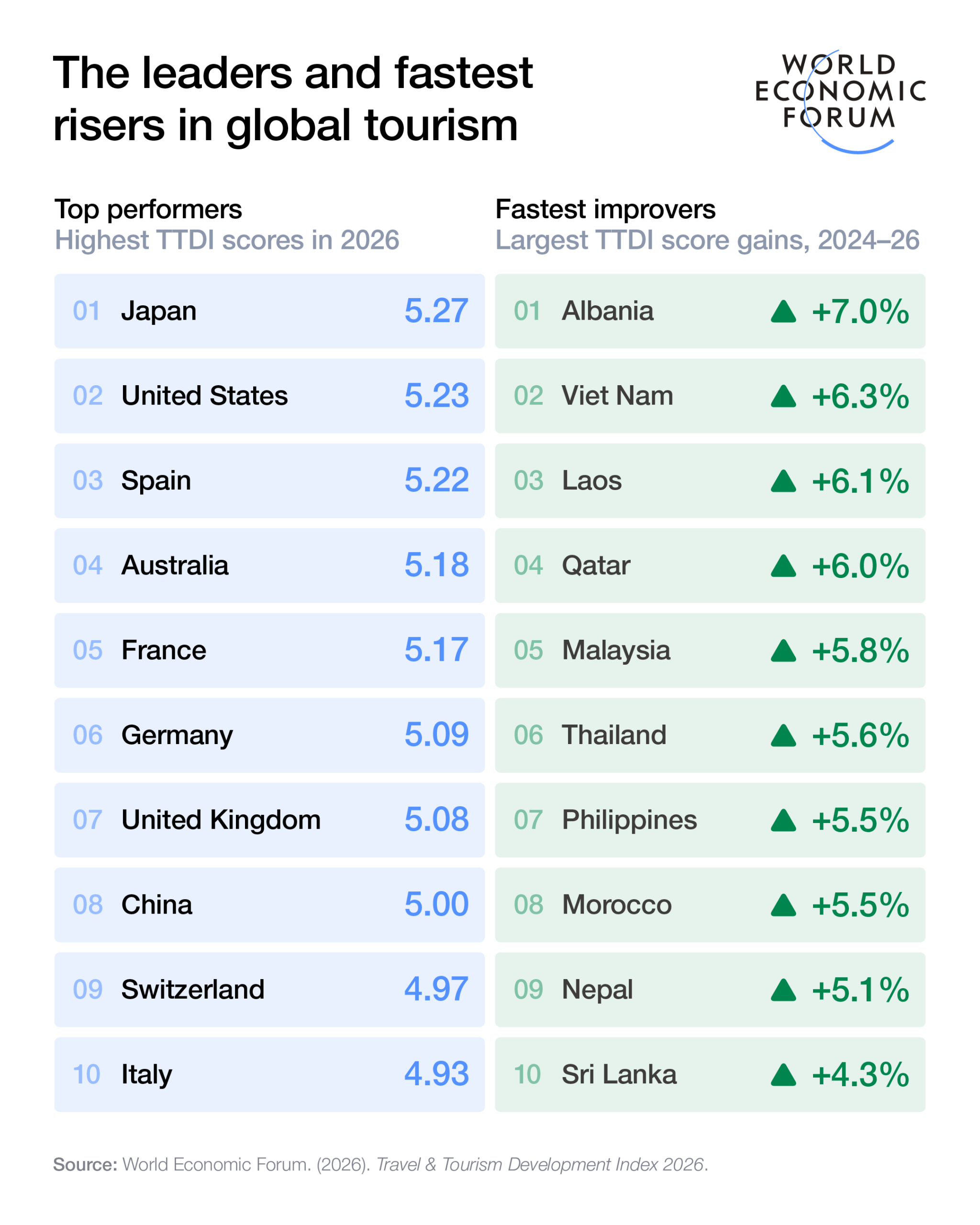
Developed in collaboration with Zurich Insurance Group, the 10th edition of the Travel & Tourism Development Index (TTDI) 2026, launched recentlat Beyond Tourism Day, finds that 101 of 110 ranked economies improved their scores between 2024 and 2026, with the average rising 2.1% – the fastest pace since 2019. Gains were driven by increased cultural resources, tourism infrastructure and services, and air connectivity and business travel. Japan leads the Index, followed by the United States, Spain, Australia and France.

“The latest Travel & Tourism Development Index shows that the enabling conditions for travel and tourism are at their strongest since the pandemic, with 92% of economies improving since 2024,” said Ramya Krishnaswamy, Head of Experience Economy and Cities, World Economic Forum. “The next chapter is not simply about attracting more visitors, but it is going to be about creating greater value by investing in people, infrastructure and stronger public-private collaboration so tourism delivers lasting benefits for communities, businesses and destinations.”

The Index also shows that tourism is facing growing challenges.

Between 2024 and 2026, travel became less affordable in three out of four economies, while tourism investment failed to keep pace with rising demand and labour shortages threatened further growth. Benefits for local communities also weakened during this period, highlighting that more visitors do not automatically translate into better livelihoods or higher quality jobs, particularly in destinations where tourism is highly seasonal.

Despite these pressures, emerging tourism economies are gaining ground. Since 2019, the largest emerging economies have improved their TTDI scores more than twice as fast as the Top 20, with Asia-Pacific economies accounting for seven of the 10 fastest-improving performers. Albania recorded the largest overall gain between 2024 and 2026.

“Tourism is a major part of the global economy, and the TTDI makes clear that resilience is what keeps that value intact when conditions change,” said Cara Morton, CEO Global Businesses and Operations, Zurich Insurance Group. “That kind of resilience requires business and governments to take responsibility together.”

Beyond Tourism Day: bringing the ecosystem together
The Index will be launched at the World Economic Forum’s inaugural Beyond Tourism Day in Geneva, convening senior leaders from business, government and civil society under the theme “Resilient Growth. Renewed Impact”. Discussions will focus on strengthening competitiveness and resilience through workforce readiness, technology and innovation, investment and scalable solutions.

The Forum also announced today the first-ever cohort of Beyond Tourism Impact Stars, recognizing six private sector-led solutions addressing systemic challenges facing travel and tourism.

Beyond Tourism Day takes place two days ahead of World Tourism Day on 27 September, providing a platform to carry the conversation from Geneva to a broader global discussion on how travel and tourism can strengthen economic resilience, create quality jobs and opportunities, and deliver greater value to communities and destinations.

About the Travel & Tourism Development Index 2026
Drawing on nearly two decades of WEF benchmarking, the TTDI measures the factors and policies that enable the sustainable and resilient development of travel and tourism. It does not measure tourism performance directly – such as arrivals, spending, or revenue – but the underlying conditions that enable destinations to attract, support and sustain tourism in ways that benefit economies and societies. The 2026 edition covers 110 economies and is organized around 17 pillars and 102 indicators. It was produced in collaboration with Zurich Insurance Group and informed by the Beyond Tourism Insights Council.

For the Silo, Jarrod Barker.

Featured image- Kyoto, Japan -DaiGoji Temple

Disinformation Tops Global Risks 2024 

  • Misinformation and disinformation are biggest short-term risks, while extreme weather and critical change to Earth systems are greatest long-term concern, according to Global Risks Report 2024.
  • Two-thirds of global experts anticipate a multipolar or fragmented order to take shape over the next decade.
  • Report warns that cooperation on urgent global issues could be in short supply, requiring new approaches and solutions.
  • Read the Global Risks Report 2024 here, discover the Global Risks Initiative, watch the press conference here, and join the conversation using #risks24.

Geneva, Switzerland, January 2024 – Drawing on nearly two decades of original risks perception data, the World Economic Forum’s Global Risks Report 2024 warns of a global risks landscape in which progress in human development is being chipped away slowly, leaving states and individuals vulnerable to new and resurgent risks. Against a backdrop of systemic shifts in global power dynamics, climate, technology and demographics, global risks are stretching the world’s adaptative capacity to its limit.

These are the findings of the Global Risks Report 2024, released today, which argues that cooperation on urgent global issues could be in increasingly short supply, requiring new approaches to addressing risks. Two-thirds of global experts anticipate a multipolar or fragmented order to take shape over the next decade, in which middle and great powers contest and set – but also enforce – new rules and norms.

The report, produced in partnership with Zurich Insurance Group and Marsh McLennan, draws on the views of over 1,400 global risks experts, policy-makers and industry leaders surveyed in September 2023. Results highlight a predominantly negative outlook for the world in the short term that is expected to worsen over the long term. While 30% of global experts expect an elevated chance of global catastrophes in the next two years, nearly two thirds expect this in the next 10 years.

“An unstable global order characterized by polarizing narratives and insecurity, the worsening impacts of extreme weather and economic uncertainty are causing accelerating risks – including misinformation and disinformation – to propagate,” said Saadia Zahidi, Managing Director, World Economic Forum. “World leaders must come together to address short-term crises as well as lay the groundwork for a more resilient, sustainable, inclusive future.” 

Rise of disinformation and conflict

Concerns over a persistent cost-of-living crisis and the intertwined risks of AI-driven misinformation and disinformation, and societal polarization dominated the risks outlook for 2024. The nexus between falsified information and societal unrest will take centre stage amid elections in several major economies that are set to take place in the next two years. Interstate armed conflict is a top five concern over the next two years. With several live conflicts under way, underlying geopolitical tensions and corroding societal resilience risk are creating conflict contagion.

Economic uncertainty and development in decline
The coming years will be marked by persistent economic uncertainty and growing economic and technological divides. Lack of economic opportunity is ranked sixth in the next two years. Over the longer term, barriers to economic mobility could build, locking out large segments of the population from economic opportunities. Conflict-prone or climate-vulnerable countries may increasingly be isolated from investment, technologies and related job creation. In the absence of pathways to safe and secure livelihoods, individuals may be more prone to crime, militarization or radicalization.

Planet in peril


Environmental risks continue to dominate the risks landscape over all timeframes. Two-thirds of global experts are worried about extreme weather events in 2024. Extreme weather, critical change to Earth systems, biodiversity loss and ecosystem collapse, natural resource shortages and pollution represent five of the top 10 most severe risks perceived to be faced over the next decade. However, expert respondents disagreed on the urgency of risks posed – private sector respondents believe that most environmental risks will materialize over a longer timeframe than civil society or government, pointing to the growing risk of getting past a point of no return.

Responding to risks


The report calls on leaders to rethink action to address global risks. The report recommends focusing global cooperation on rapidly building guardrails for the most disruptive emerging risks, such as agreements addressing the integration of AI in conflict decision-making. However, the report also explores other types of action that need not be exclusively dependent on cross-border cooperation, such as shoring up individual and state resilience through digital literacy campaigns on misinformation and disinformation, or fostering greater research and development on climate modelling and technologies with the potential to speed up the energy transition, with both public and private sectors playing a role.

Carolina Klint, Chief Commercial Officer, Europe, Marsh McLennan, said: “Artificial intelligence breakthroughs will radically disrupt the risk outlook for organizations with many struggling to react to threats arising from misinformation, disintermediation and strategic miscalculation. At the same time, companies are having to negotiate supply chains made more complex by geopolitics and climate change and cyber threats from a growing number of malicious actors. It will take a relentless focus to build resilience at organizational, country and international levels – and greater cooperation between the public and private sectors – to navigate this rapidly evolving risk landscape.”

John Scott, Head of Sustainability Risk, Zurich Insurance Group, said: “The world is undergoing significant structural transformations with AI, climate change, geopolitical shifts and demographic transitions. Ninety-one per cent of risk experts surveyed express pessimism over the 10-year horizon. Known risks are intensifying and new risks are emerging – but they also provide opportunities. Collective and coordinated cross-border actions play their part, but localized strategies are critical for reducing the impact of global risks. The individual actions of citizens, countries and companies can move the needle on global risk reduction, contributing to a brighter, safer world.”

About the Global Risks Initiative


The Global Risks Report is a key pillar of the Forum’s Global Risks Initiative, which works to raise awareness and build consensus on the risks the world faces, to enable learning on risk preparedness and resilience. The Global Risks Consortium, a group of business, government and academic leaders, plays a critical role in translating risk foresight into ideas for proactive action and supporting leaders with the knowledge and tools to navigate emerging crises and shape a more stable, resilient world.