Category Archives: Vintage

Canadian Actor Relished Role In Fan Made Series Star Trek Continues

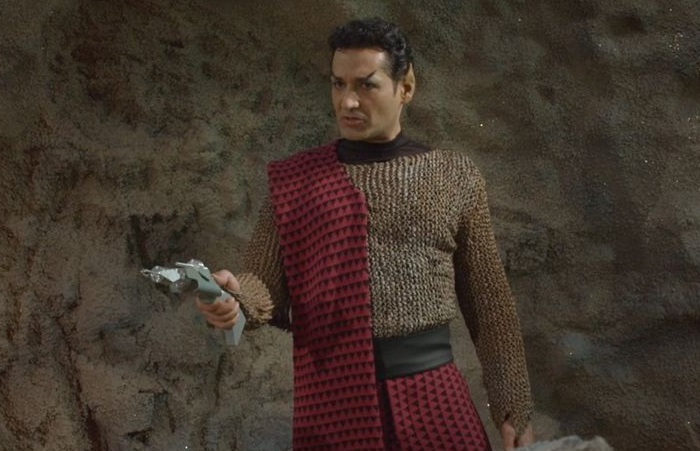
CAS ANVAR RELISHES HIS “VULCULAN” ROLE- Silver screen and small screen actor Cas Anvar couldn’t believe he was stepping onto a soundstage in a STAR TREK CONTINUES  episode when he first emerged in costume as Sentek in Episode 10 (“To Boldly Go: Part I”).

After playing opposite Ben Affleck in Argo, an Oscar winner for Best Picture, Anvar has stayed busy with Hollywood in film and TV roles in productions like the Princess Diana biopic Diana, the sci-fi adventure Source Code and suspense thriller The Factory. He has also appeared in Steve Spielberg’s The Terminal and then there’s a long list of TV roles on Anvar’s resume, including appearances on NCIS:LA, In Plain Sight, Boston Legal, Castle, and 24.

But to emerge in full Romulan garb on a planet set in rural Georgia? That was one of his personal career highlights – so far.

“On my very first scene, they brought me to the planet set. And it was amazing. I’d never really seen a real STAR TREK set before. You don’t realize how those sets were constructed back then. This thing was so authentic with its fake boulders and sparkly mineral dust and the elevator on the surface of the planet. Then I had my first exposure to holding a disruptor and doing the big fight scene. It was everything you’ve ever imagined when you watch STAR TREK!”

Cas Anvar Anvar is a Canadian born and trained actor whose big break came with his role 2003’s Shattered Glass with Hayden Christiansen, and his professional career began following graduation from Canada’s prestigious National Theatre School. Anvar is also a well-known voice actor, whose talents can be heard in some of the world’s most popular video games (including Call of Duty: BO2, Halo 4, and Assassins Creed: Revelations.)

As a voice actor, he was familiar with STAR TREK CONTINUES executive producer Vic Mignogna. Anvar learned about the opportunity to join the cast as a guest star following a fortuitous meeting with STC director James Kerwin and through a connection with STC make-up artist Lisa Hansell.

“I’d been exposed to STAR TREK CONTINUES before I found out about the opportunity to participate. Their reputation was very high, and the production really is amazingly impressive and very high quality. I like the way STC uses technology to make it possible to produce ‘new’ episodes of The Original Series without losing authenticity,” Anvar said.

Anvar is a fan of all flavors of STAR TREK, noting that “there’s not one that I’ve missed. I’m a Roddenberry fan – a fan of the universe that he created. But each of the STAR TREK series is like a movement in a symphony. Each one has a place and a purpose and its own unique flavor.”

The “Vulculan”

To prepare for the role of Sentek (“I call him a ‘Vulculan,” says Anvar), he thought about what would be required for a cool and collected Vulcan to appear as a hot-headed Romulan.
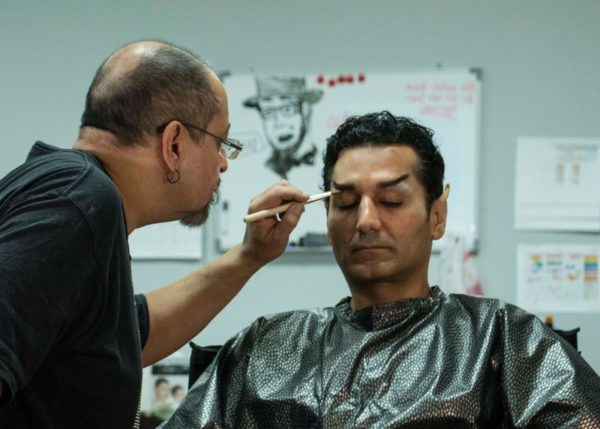
Cas Anvar in makeup chair for Star Trek Continues

“This is a character who grew up on Vulcan with emotional suppression. And he’s masquerading as a Romulan, who is much more emotional and volatile. So how does this character allow himself to pass as a Romulan? He has to behave in a way that is a little less Vulcan, trying to find the balance. You have a lot of imagery and a wealth of knowledge of Vulcans by watching Leonard Nimoy as Spock. Of course, Sentek was performing in a very non-Vulcan way. That made for an interesting challenge to try to figure out how he could rationalize such impulsive and dangerous behavior. It was fun to figure it out.”

In the Steps of Bill Shatner

“I studied psychology and sciences at McGill, and I think Bill Shatner did as well. He started in theater and did some Shakespeare, and of course everyone knew that he was an alumnus of the school. He went on to perform at Stratford in Toronto.”

That connection to Shakespeare proved very fortuitous.
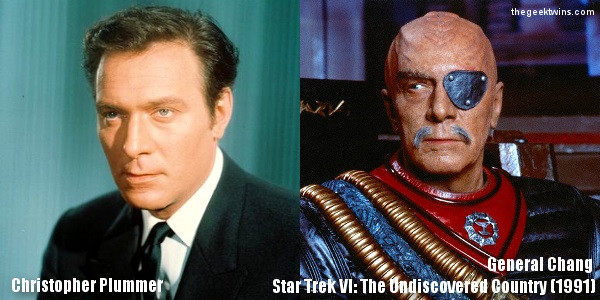
Christopher Plummer as Star Trek villain Chang

“I actually got Bill Shatner to endorse a fundraising effort for a Shakespeare campaign, along with Christopher Plummer (an honorary McGill graduate.) Both of these famous actors came from my hometown. But after 9/11, our Shakespeare company had a financial problem. These great actors were sympathetic and helped us raise the money we needed. Later, of course, I also worked with Shatner on Boston Legal and saw him as the incredible Denny Crane.”

“Honestly, it was a surreal experience. Ever since I was a kid I wanted to be on STAR TREK and play some sort of an alien – ever since I was a kid. To getting to realize that dream was exciting,” Anvar says.

Supplemental-
Questions & Answers with STC Director James Kerwin

How did you get involved with STC and express your interest in directing an episode — something that led to directing several episodes?

I’d known Vic Mignogna for several years, and cast him in a short film I directed. While we were on set, he mentioned that he was producing a STAR TREK fan series, and asked me to check out “Pilgrim of Eternity.” To be honest, I was wary at first. Although I wasn’t very familiar with fan films, those which I’d happened to catch ranged from great to amateur, from a production perspective. That’s not a “knock” at all — God bless anyone with the gumption to make a fan film. So Vic opened his laptop and said “Just watch.” I did, and I was hooked! The production value was top-notch.

While we were in post-production on the short, Vic mentioned that he was thinking about doing a “Mirror Universe” story for STC episode 3, and asked me if I’d like to come aboard. I was drawn in by his overall goal and philosophy for the show: namely, to produce a Trek webseries made by fans who also happened to be film and TV industry professionals, both behind the camera and in front of it… professionals who agreed to set their busy schedules aside, without fame or financial incentives, to express their love of TOS and share it with the world. So we tossed around a couple plot ideas, but ultimately felt that his initial instinct — to do a fast-paced story that picks up moments after “Mirror, Mirror” and explores Spock’s immediate actions — was the strongest. The rest is history.

That episode still holds a special place in my heart because it was my first — and the Mirror Universe is just so much fun! Wired came to set for that one and shot “behind-the-scenes” footage of the project; I encourage everyone to check that out as well:

I assumed “Fairest of Them All” would be my sole trip on the TOS Enterprise… but a few months later, Vic asked if I’d be interested in coming back to direct episode 4. At that point, I needed to make a decision as to whether I’d be willing to set aside my career for a couple years to focus on STC, because writing and directing episodes isn’t a part-time job. It wasn’t a difficult decision, simply because this entire endeavor was so rewarding!

After “The White Iris,” I settled in as the series’ “story editor” — that’s the person who works creatively with the showrunner (executive producer) to decide on overall storylines and which scripts to produce. I eventually became a co-producer (and later producer) on the show. In addition to directing and/or co-writing most of the episodes, it was necessary for me to work in post as well, helping Vic decide on music and sound cues, etc. I performed what’s called the “online edit” — I took Vic’s cut of each episode and readied it for color grading by our cinematographer Matt Bucy — and then performed the “DI conform” after the graded footage was returned. That involved adding film grain, comping in ungraded opticals (i.e., viewscreen shots), and even adding “judder” to the end titles to simulate the 1969 optical film printing process. I also scheduled shoots, helped Lisa Hansell and Linda Zaruches with some of the social media and publicity, cut together “blooper” reels, and authored the DVDs and Blu-ray discs. But my focus remained primarily on directing. I’m quite proud of what we accomplished, needless to say!

How do you describe the role and activity of a director to someone not familiar with filmmaking. In other words, what does a director do?

The director makes the creative decisions about what’s seen on-screen. He or she works with the actors to craft performances, and composes the shots (i.e., collaborates with the director of photography to determine camera angles, lighting, etc.). The overall “feel” and “pace” of the piece is the responsibility of the director.

Now, there are significant differences between directing for film — which was my primary background before STC — and directing for series television. On a film, the director is usually “top dog,” so to speak. The buck stops with him or her. He or she establishes the overall vision and style of the movie, from the broad strokes to the finest details. That involves making decisions in every department — makeup, costumes, art / set design, sound, camera, lighting, acting, editing, music. A film director is basically the general in charge of a large army. It requires a lot of pre-planning; and that involves everything from casting roles to storyboarding (drawing) shots to making judgment calls on wardrobe. Time is money when you’re on-set or on-location, and — while it’s important to be malleable and be able to think on one’s feet — films ultimately run much more smoothly if the director has pre-visualized everything (either on paper, digitally/virtually using pre-vis software, or even simply in his/her mind). Films involve large crews and complex camera moves, lighting, and shot composition. One typically shoots about 2 or 3 script pages a day on a feature or short — and even that is pushing the limits at times. A theatrical film can have a shooting schedule anywhere from a few weeks to a few months.

Directing for TV is rather different. By the time a director comes onto a series, many of the creative decisions have already been made: primary cast, sets, costumes, and — perhaps most importantly — the overall “style” and “feel” of both the camerawork and the actors’ performances. With few exceptions, most series have multiple directors, and each one can’t bring his/her own personal vision to the table — you’d have a show that looks totally different from one episode to the next! That’s why, in TV, the executive producer is ultimately in charge. Individual directors must conform their styles to the overall vision of the showrunner. In the case of STC, I also had to honor the rich legacy of TOS, and shoot the episodes in a style reminiscent of 1969 network television. So a lot of my 21st-century directorial instincts had to “take a back seat” in order to serve the overall series. On top of that, unlike films, a television episode has a much quicker production schedule. On STC, we usually shot 5 or 6 pages a day — sometimes even 7 or more! That’s definitely a challenge to pull off.

How does the all-volunteer aspect of a fan production like STC make things more difficult — or easier — for a director?

Fortunately, on STC, our so-called “above the line” positions (main cast and guest stars, producers, writers, directors) and our primary department heads had a lot of experience working in film and/or television, and that helped tremendously. I didn’t have to “reinvent the wheel” or show people the ropes.

That cut both ways, though. Since we were dealing with working industry pros, getting everyone together on a volunteer basis was often quite difficult. For example, unlike a “normal” series, we didn’t have the luxury of putting our main cast under series-regular contracts. So if certain actors were working on another film or TV series at any given time, we either couldn’t film during those weeks, or I’d have to shoot “around” their absence. Same thing for our behind-the-scenes crew.

Plus, understandably, we just didn’t have the budget to put our people up in hotels in Georgia — and feed them — for weeks on end. So our production schedule was often pretty tight. The more script pages one must shoot per day, the more stress one is under. There’s no way to avoid that. I suppose that having a background in indie film — where one often must work with lower budgets and tighter schedules — helped me cope!

Ultimately, though, having people who came together out of love for the material was a huge plus. Our team members were all motivated to do their best work, simply because that’s why they were there. And every night after photography, we’d all go out for dinner and drinks together. It really was a family… and one that I already miss.

What are some of the films and television series which influence you as a director?

I think Kubrick is probably my all-time hero. I love the specificity and patience of his films, and how his composition and pacing both inform and reflect his actors’ performances. 2001 is wonderful. I also love both Blade Runner movies, Solaris… but in addition, I have a soft spot for the late-60s aesthetic. The early Bond films, Flint, Barbarella… there’s a fun, sexy style there that we don’t see often any longer. As for television, I thought Ronald D. Moore’s version of Battlestar Galactica was wonderful. And there’s so much great content on right now. Black Mirror, for example. And Mr. Robot just blows me away.

What’s your background, and what are you doing professionally now that STC has finished its final episode?

Growing up, I used to make Doctor Who fan films and amateur movies with our family’s old video camera. If I was assigned to do a term paper, rather than writing a boring old report, I’d shoot it as a narrative film! So it was probably around high school when I first started thinking seriously about a career in directing. I also had — and still have — a passion for cosmology, so I was a bit indecisive. I went to T.C.U. in Dallas / Fort Worth, and started a double-major… but when I realized I’d be in college for many, many years, I ultimately decided to focus on filmmaking (although I did earn a minor degree in astrophysics). My student thesis film wound up winning a first-place Telly Award, so I stayed in Texas for a few years after that, directing shorts, music videos for local bands, etc.

When one of my films started to make a splash on the festival circuit, an assistant agent at talent agency APA offered to rep me, and I moved to Los Angeles. When I first got here, I wound up falling into a lot of stage directing, both classical and modern — which was unusual for me because I had relatively little background in live theatre at the time. But it’s an amazing process, and very different from filmmaking. My work at the Blank Theatre Company in Hollywood — a wonderful venue run by Daniel Henning and Noah Wyle — gave me a lot of “in the field” experience with actors, including many accomplished television and film veterans who’ve retained their passion for live theatre despite their on-screen success.

Ultimately, though, film is my first love, and I was fortunate to get the opportunity to direct a cerebral science fiction noir feature for Entertainment One studios called Yesterday Was a Lie (www.yesterdaywasalie.com), starring Kipleigh Brown as well as Chase Masterson from STAR TREK: Deep Space Nine. After YWAL, we started working on a film based on the science fiction Czech play R.U.R. from 1919. We originally shot a short (www.rurfilm.com) loosely based on the story — that’s where Vic and I first connected re: STC — and we’re developing it into a high-concept feature set in an alt-history, late-60s world. And Kipleigh and I have a couple other things in the works as well. But immediately next for both of us (as well as for Vic and Lisa) is a short psychological character drama called When the Train Stops — also starring Trek actors Michael Forest and John de Lancie. Lisa’s producing, and she did an excellent job successfully crowdfunding the film. We’ll be shooting in 2018, and I’m very much looking forward to it!

Website: www.jameskerwin.com
Twitter: @jameskerwin
Facebook: /jameskerwin

Supplemental-

A Profile with Producer and Make-Up Supervisor Lisa Hansell
How did you get involved with STC, and how did that relationship grow to be more than providing make-up services?

Once upon a time, August of 2012 actually, I was in the process of turning Tim Russ into Tuvok when this guy named Vic Mignogna walked in. We were introduced, exchanged pleasantries and went about our business. At the end of the day, he asked for my business card. The very next day, he called and asked to have lunch to discuss a project he was launching.

Over lunch, he began to explain his vision for STAR TREK CONTINUES. His excitement for STC was palpable, and we established that we both dearly loved STAR TREK and had been lifelong fans. Now, I have been a professional in the entertainment industry for years and had been pitched “passion projects” many times (read: no pay). I had to turn them down because my bills don’t get paid with “great opportunities for exposure,” but this felt different somehow…special. Vic’s passion was contagious!

In The Beginning, there weren’t very many people on board, but all the usual pre-production details needed to be handled. Vic was trying to do it all himself, so I volunteered to take over social media for starters and helped source costumes for our first shoot, which was the final scene for “Pilgrim of Eternity.” There were a million details to take care of, and I offered to help share the load. Over time, this deepened my friendship with Vic and my involvement with STC. I have given input on script and story development (the ending for “Lolani” was my idea, for example), wardrobe choices, sound design, etc. I did whatever needed to be done without regard to whether or not it was “my department” all for love of the project.

What are some of the challenges you faced as Makeup Supervisor on STC?

Of course, the whole series was a period piece with the goal of recreating the look and feel of late 1960’s STAR TREK. They used heavier, more theatrical makeup back in the day, but we were shooting in HD which is much less forgiving than film. Finding a balance of makeup looks that would fit the period and yet not be distractingly obvious was not an easy task!

Several episodes brought their own unique challenges, which I LOVE! In Episode 1 we had to vary the age appearance of Apollo several times throughout the story. Episode 2 was a LOT of green for our Orions, and that green had to be something that wouldn’t transfer onto costumes, props and sets. We custom mixed something called PAX, which is a combination of medical grade adhesive and acrylic color. Consequently, it was very time consuming to apply and remove. Episode 3 was all about recreating every character’s look from “Mirror, Mirror.” In Episode 4, we recreated three known loves from Kirk’s past.

Then there was Episode 8. The ‘Old Kirk’ prosthetic makeup was equal parts long, hard work and a lot of fun! Special effects makeup is my absolute favorite thing because I get to watch the actor use my work to enhance and inform their performance. Episode 9 was a color theory workout! I tested many color combinations for our guests stars before settling on schemes that would read ‘normal’ in black and white and not look completely ridiculous in color. Me to Vic: “I can’t have our guest stars looking like a bowl of hard candies.” For our finale episodes, I got to create an Andorian and…Romulans! So many pointed eartips…glorious! I’m incredibly proud of the work my team and I did throughout the series.

What’s involved in being the Social Media Manager and keeping people informed about STC activities – on Facebook and otherwise?

I could really write a novel here, but I’ll try to summarize. Our main Facebook fan page has grown to nearly 200K “Likes,” and our Facebook Group now has 14.5K members. We have a Twitter following of nearly 22K and 4.5K on Instagram. That’s a lot of eyeballs on our activities! For our main Facebook page, I have an angel volunteer named Linda (I LOVE you, Linda!) who combs through our behind-the-scenes photos and schedules out a ton of posts. I go in daily and check through them, tag people, monitor comments, etc. I check in on the group, and the other platforms several times a day, and have done so every day for the last 5 years.

Social media really is our main liaison with our fans, which is incredibly important. Early on, I wanted to establish a ‘voice’ for STC that included professionalism, class, courtesy, enthusiasm and the principles of IDIC. How STC is perceived is extremely important to me because I believe it reflects on everyone involved – on our family – so I’m very protective of it. I have been so gratified when hearing from fans that we have achieved an excellent public perception.

Vic consults with James Kerwin and myself pretty much daily on STC activities and decisions that he has to make regarding the direction of the production. You could say James and I are the “Bones” and “Spock” to his “Kirk” off-screen. Ha! (We’ve had a group Facebook chat going since episode 4!) Whenever we have an event coming up, we three hash out the plan of execution and release, Take our Christmas gift of downloads for the fans, for example. That has been in the works for months! Then it’s all about choosing the right wording, imagery, etc., and coordinating the exact date and time of release so that it happens as seamlessly as possible.

I’m sure you’ve been touched by the stories that people have told about how STC has affected them. What are a couple of examples that really stand out?

I’m always thrilled to hear stories about STC bringing people together. Parents and children reconnecting to watch new Star Trek episodes like they did years ago, or fans who may no longer have that parent around but can feel their presence each time they watch STC are some of my favorites.

I have to say, though, that the messages and emails I received after “Come Not Between the Dragons” were the most profoundly moving. We had adults who were abused as children write in to say that they were able to heal and let go of the anger they had harbored for years against an abuser who had long since passed. We even had abusers write to us and tell us they finally saw themselves through their children’s frightened eyes and vowed to change – to break the cycle. We never could have imagined having the affect we have had on some of our fans, and I find it profoundly humbling to be a part of something that could invoke that in others.

Is working on STC like working on other fan productions?

There are similarities in that almost any fan production is driven by a passion and love for the source material. I have very much enjoyed working on other things and have made lifelong friendships as a result.

That said, STC is unlike any other production I’ve worked on, fan or otherwise. I’ve been fortunate enough to work on quite a few films that were filled with wonderful professionals who’ve become friends and had a fantastic time doing it, but STC is very different. Everyone is doing it for love and not for money. When you’re pouring your heart into something vs waiting for a paycheck, it shows!

Also, from very early on I have had a much deeper involvement with STC than on most other productions. As a producer, I have input on the final product that I wouldn’t normally have as a makeup artist, and I find that I am much more invested as a result. This has moved me to pursue more of an active role in producing other things as well, because I enjoy being a part of the creative team for the whole project and not just for one department.

When you look back on your experiences with STC, what has been most personally rewarding?

I would have to say that the relationships I’ve built with the cast and crew of STC are #1 for me. We throw the word “family” around a lot, but there just isn’t a better word for it. I deeply and sincerely LOVE each and every one of the crazy nerds on our team, and I know that is for life – there’s no question in my mind. This is my ‘chosen’ family.

A close second would have to be the chance to spend so much time living INSIDE my lifelong love of Star Trek. I’ve walked the corridor of the Enterprise. I’ve sat in the Captain’s chair, stared into Spock’s scanner, dusted the table in Kirk’s quarters, climbed the ladder in engineering and even got to ‘drive the ship’ in a couple of episodes. I’ve napped in sickbay, on the transporter pad, in a turbolift, and in the warp core (yes, really)! I’ve stood at the monitor watching new STAR TREK being created before my very eyes. It doesn’t get any better than that!

What’s your background in the entertainment world, and what’s next on your professional horizon?

I began doing special effects and beauty makeup 11 years ago. I’ve worked on everything from micro budget independent films to multi-million dollar theatrically released features. I’ve worked with names like Ed Begely, Jr., Sean Young, Eric Roberts, Martin Kove…and I absolutely love what I do. The artistry of it combined with storytelling is what I find most compelling.

I’m currently in pre-production on a short film with some STC alumni. The film is called When the Train Stops, and it stars John de Lancie, Michael Forest, Vic Mignogna, Kipleigh Brown, and my dear friend Darren Jacobs. Darren is a Shakespearean Theater-trained actor whose talent always blows me away. I can’t wait for you to see him in action! Of course, our readers already know what brilliance the rest of the cast is capable of. I’m excited to also bring back Emie Morissette, who you will recognize as the relief navigator from STC’s finale episodes.

The film will be directed by our very own James Kerwin, and I’m producing it. It’s a drama with a twist – think Twilight Zone. We will no doubt bring on more STC folks as we get closer to production and start filling out the crew. When you find your “A” team for filmmaking, why look any further! You can check out our website for more info: www.whenthetrainstops.com

In closing, I’d like to thank Vic for bringing me aboard this wonderful journey. His vision gave birth to STC, and my time working on it has truly been one of the most memorable and remarkable experiences of my life. Thank you, Vic, for being a wonderfully insane geek to the extent that you created this beloved masterpiece, and for letting me play on your starship! It was a great ride…

Frequently Asked STC Questions
Weren’t you going to make 13 episodes? Did CBS make you stop?

CBS is not responsible for the decision to end the series. We are doing 11 episodes instead of 13 because another fan group took advantage of the good graces of the copyright holders forcing them to protect their property and the interests of their license holders. In deference and gratitude to CBS, we wrapped up earlier than planned and are very proud of what we’ve accomplished.

What will happen to the studio/sets? Will set visits/tours be available?

We don’t have a definitive answer on this right now, but we’re considering all our options.

So, you can’t make more full-length episodes due to the guidelines, but can you make more vignettes?

Yes, short films are allowed by CBS’s guidelines, but the run time is not the only limitation that would preclude us from continuing. We finished our mission and are grateful to have been able to do so.

How about making some other fan film (Firefly, Battlestar Galactica, Lost in Space, etc?)

STC was born from Vic Mignogna’s love of STAR TREK and not any other franchise. It’s the kind of love required to do this kind of work for 5 years for free. While the other shows are favorites, they aren’t “devote-5-years-of-your-life” favorites!


Stunning Art Deco Tear Drop Coupe Features In Auction

THE MONTEREY JET CENTER AUCTION

When Anthony Lago went to Suresnes in September 1933 to salvage Automobiles Talbot-Darracq, he took on a company with massive financial problems and a rather ho-hum range of cars.

The mechanical legacy left by his predecessor Owen Clegg and chief engineer Walter Becchia was staid and pedestrian. The nicest thing that could be said about the cars was that they did no one any harm. Sporty, stylish or chic, they definitely were not. In addition, models had been allowed to proliferate needlessly: too many engine sizes were served up in a bewildering number of chassis lengths and body styles, none of which were selling. One could say that while Talbot could produce a car for every occasion, there was unfortunately not an occasion for every car. Something needed to be done, and quickly.

While the many problems had seemed daunting to Lago’s predecessors, he was not going to let them or anything else stand in his way. Full of confidence, he had just completed the careful construction of the absolute deal of his life with Talbot’s British owners. Now at the age of 40, Lago was a dapper Anglo-Italian gentleman with little in the way of money, but of some sophistication: full of energy and vision for the disintegrating French company that now confronted him. In addition, he was an accomplished wheeler-dealer, who had worked very hard to get where he was.

By late 1932, Automobiles Talbot-Darracq S.A. in Suresnes just outside Paris, which was owned by the British Sunbeam-Talbot-Darracq combine (STD), was on the verge of bankruptcy.

Lago presented himself to the STD board as the “man to the rescue” and was sent from England to look Talbot-Darracq over and make a report as to what could be done. Upon examination of the moribund Talbot factory, Lago found a shambles. Chief engineer and fellow Italian Walter Becchia was on the verge of leaving, and the workers were uncaring and demoralized. The few cars being turned out were poorly put together. But beneath the dust and the cobwebs, Lago could see a plum ripe for the picking. So he went back to England, and instead of recommending liquidation, Lago suggested that he be made managing director of Talbot in France for a two-year period with a put option to buy the company and its holdings at any time at the 1933 value. Not knowing how hoodwinked they were, the STD directors accepted.

Lago then returned to France in the early fall of 1933 to rake the coals out of the fire with that doozy of a contract in his back pocket: potentially it would hand everything over to him if he played his cards right—which he did. The coals were raked out so ruthlessly that Antonio Lago, who in England had changed his name to Anthony, ended up owning Automobiles Talbot-Darracq S.A, once again without paying anyone anything.

When Lago finally exercised his option in 1935, he requested as payment that he might assume an old £500,000 debt that STD still owed the bank due to a loan taken in 1924, with the French factory as collateral. As the debt exceeded the book value of the company as well as that of the real estate, once again the STD directors accepted eagerly. Imagine: not only had Lago become a car maker without a centime to his name, but through this carefully laid out deal, he had also just become STD’s biggest creditor. And that was the devious plan. In 1936, Lago then let Talbot go bankrupt in connection with the great strikes in France. STD couldn’t very well call its remaining debt in with the liquidators, as Lago was first creditor in line, and his £500,000 would wipe the estate clean. In the end, Lago obtained Talbot scot-free.

While conducting these scurrilous financial dealings, he had set about transforming the company.

The plethora of available models, engines and chassis was pared down. Walter Becchia was given the job of redesigning the existing 14-CV six-cylinder engine in order to extract some much-needed extra power. The clunky non-synchronized three-speed gearboxes were supplanted by the advanced four-speed Wilson pre-selector for which Lago so conveniently held the patent rights.

And most important of all, in the summer of 1934, Lago paid a visit to his friend Joseph Figoni and talked him into designing a series of new, lithe and beautifully proportioned bodies to be built at the Talbot factory. As a result, the Talbot stand at the October 1934 Paris Salon featured a new, rakish Talbot prototype cabriolet by Figoni mounted on a 295 cm wheelbase chassis, fitted with a 3-liter engine redesigned by Becchia. It was called the T150 Grand Sport, and it was the talk of the Salon. Then, Lago went racing. Suddenly, Talbots were a hot commodity, and it is no exaggeration to say that the rest is history.

The T150 C and T150 C-SS Chassis

The T150 Grand Sport remained in production for roughly 18 months. At the October 1936 Salon, Anthony Lago and Walter Becchia presented the fruits of their continued labors in the form of two new and spectacular chassis. The first was an out-and-out sportscar chassis fitted with Walter Becchia’s new 4.0-liter high-performance development of the 3.0-liter six: the Lago T150 C-SS, placed at the very top of the market and only available as a bare chassis for the trade.

In all, less than 30 were made, yet the Lago C-SS would go down in history as one of the great pre-war chassis, on par with the legendary Bugatti 57S and Alfa Romeo 8C 2300. Wheelbase was 265 centimeters, which was identical to the Talbot T150 C GP cars from which the chassis was developed, and it was wide enough to accommodate two-passenger bodies with side-by-side seating.

The second chassis, named the T150 C, was equally formidable as it was mechanically identical to the C-SS, and fitted with the same great engine, but stretched 30 centimeters to a wheelbase of 295 centimeters. The benefits were two-fold. On the one hand, the extra length meant that two rows of seats could be accommodated if a four-to-five-passenger configuration was desired. But more importantly, the longer wheelbase made it possible for coachbuilders to achieve beautiful and harmoniously flowing lines of great elegance—especially on closed bodies with a single bench seat, such as 90034. The engine, gearbox, electrics and suspension specification would remain unchanged for the entire production run.

The construction and layout, as well as the mechanicals, were conventional and represented classic mid-1930s fast-car thinking. Both chassis were low, as the two rails passed under the rear axle and suspension. The engine, gearbox, firewall and suspension components were bolted directly onto the chassis. The steering was worm and nut, and the front suspension was independent with a transverse leaf spring. The live rear axle was suspended by half-elliptic leaf springs, with the suspension mounts on top of the chassis rails.

There was a short transaxle between the engine and the Wilson gearbox, followed by the driveshaft. The gearbox created a hump in the middle of the floor of the cabin just in front of the seats. For repairs and maintenance, the gearbox could be accessed through the floor in the interior of the car. The chassis had a foot operated one-shot lubrication system with a pedal actuated by the driver. The gas tank was a large 120 liter affair mounted on the chassis rails behind the rear axle. The complete T150 C chassis with all components, Wilson gearbox and ancillaries remained relatively light. It was a genuine 100 mph car.

The T150 C-SS and T150 C Engine and Gearbox

Lago’s first brief for Walther Becchia had been the job of developing the 14-CV Talbot six. This engine was bored and stroked to 78 x 104.5 mm, giving 2,996 cc, or 17 fiscal CV, and mounted in a 295 centimeter Talbot chassis. This chassis had already been fitted with an independent transverse leaf front suspension since 1932, which had been patented by Becchia in 1928. Dubbed La Solution Talbot, this suspension gave the chassis the makings of a sports car. The chassis was also given the Wilson gearbox, and the Talbot T150 Grand Sport was born.

For the T150 engine, Becchia designed a new cylinder head with a pent roof that created a nearly hemispherical combustion chamber, inclined valves operated by a single camshaft in the crank case, pushrods and rocker arms. This T150 3-liter put out a very satisfactory 100 horsepower at 4,200 rpm on a 7.4:1 compression ratio with one carburetor, and 110 horsepower with three. It compared well to the 18-CV Delahaye 3.2-liter engine, which Lago saw as his main competition. Whether it was a reflection of the true build costs or Lago’s chronic need for money, the new model carried a peppery price tag. At 78,000 francs, the T150 was not much cheaper than an eight-cylinder Bugatti T57 and a lot more than a six-cylinder 18-CV Delahaye.

Racing was a major motivation driving the development of the new engine. In mid-1935 however, the Automobile Club de France published their new rules for the 1936 season, which stipulated a blown 2.0-liter and an unblown 4.0-liter class. Therefore, in August of 1935, Lago demanded of Becchia that he design a new T150 C racing car from “scratch” for the 4.0-liter formula. Becchia now increased the bore of the 17 CV to 90 mm, but retained the stroke of 104.5 mm. Capacity was increased to 3,988 cc, which equated 23 fiscal CV. The light alloy hemi head remained, and the crank now ran in seven main bearings. In racing trim with three carburetors, power was a considerable 175 horsepower from this normally aspirated engine, permitting a top speed around 210 km/h on the circuits when the chassis was fitted with a light barquette body.

T150 C racers premiered on the French circuits in spring and summer of 1936, while the long and short wheelbase race-derived road-going versions of the 4.0-liter T150 C and T150 C-SS were shown at the October 1936 Paris Salon. In all cases, the “C” was short for Compétition. In the spring of 1937, the long chassis was renamed Lago-Spécial and the short Lago SS. Both featured Rudge knock-off wire wheels and a slightly detuned version of the 23-CV T150 C engine, now putting out 140 horsepower for road use. Lago had entered the Bugatti, Delage and Delahaye market for bespoke, stylish grand routières and sports cars.

By 1939, the Lago SS engine could be ordered in various stages of tune, delivering as much as 200 horsepower for competition and 165 horsepower for road use, which made a top speed of up to 200 km/h possible. This was an absolutely extraordinary figure for a road car at the time. From 1937 through 1939 and the breakout of hostilities, close to 25 T150 C-SS chassis were built, along with approximately 40 to 50 T150 C. Both types were, and are, very rare cars indeed.

Figoni, the Coachbuilder

Guiseppe Herménegilde Louis Figoni was born on 29 December 1892 in a tiny crossroads named Le Moline di Montereggio, about 45 km southwest of Piacenza in the province of Parma in the Emilia-Romagna region. Life was hard, people were poor, and in 1906, like many from northern Italy, the Figoni family emigrated to France to find work. They ended up in Boulogne-sur-Seine, the “Little Italy” of Paris, a working-class suburb far removed from what has now become posh and trendy Boulogne-Billancourt. After having served in the Great War on the Italian side, Joseph was apprenticed as a panel beater, or tôlier, to the well-known coachbuilder Lavocat et Marsaud. In 1923, he opened a modest carrosserie under his own name in Boulogne-sur-Seine.

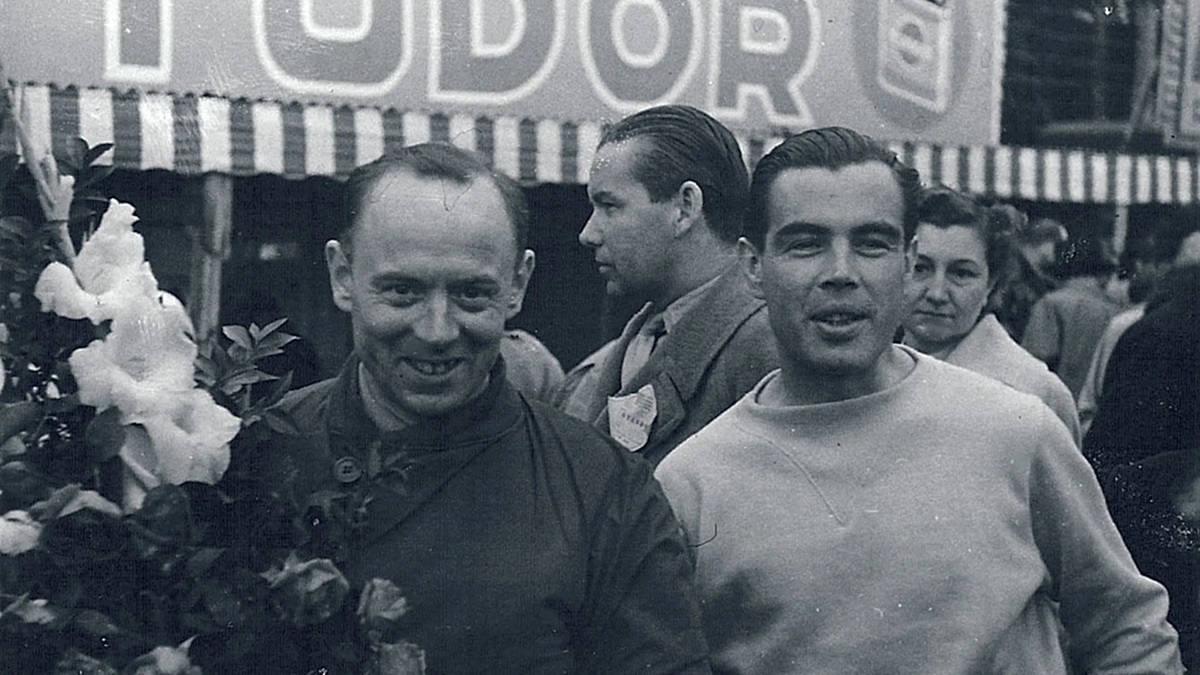
Sometime around 1931, Joseph became a personal friend of Luigi Chinetti who ran the small and underfunded Alfa-Romeo operation in Paris. In 1932, Chinetti sent the famous racing driver Raymond Sommer to Figoni to have his Alfa-Romeo 8C 2300 chassis 2111018 rebodied to Le Mans specifications. The car won the 1932 race with Chinetti and Sommer at the wheel. For 1933, Sommer’s body was transferred to 8C 2300 chassis 2211109 that then proceeded to win Le Mans once again, driven by Tazio Nuvolari and Sommer. Suddenly, Figoni was the hottest name in French racing circles. Clients became a who’s who of legendary drivers, and for the next three years, the Figoni works virtually became an extension of the French Alfa-Romeo enterprise.

Joseph’s 1934 collaboration with Anthony Lago was another major breakthrough, not only in terms of securing clients that wanted a custom-built Talbot, but also in making the Figoni name world famous—at least in France at any rate. With all this activity, the small Figoni premises were bursting at the seams. Still, profits were not sufficient to allow for necessary expansion, and financial restrictions made it necessary to find an investor. This investor was Ovidio Falaschi, a fellow Italian who became partner in May of 1935. The company was reorganized as the Établissements Figoni et Falaschi, and several surrounding premises were leased so that bodies could now be manufactured at a rate that was a good deal faster than before. It should be noted that Ovidio Falaschi took a strictly financial interest and was not involved in the designs made by the company.

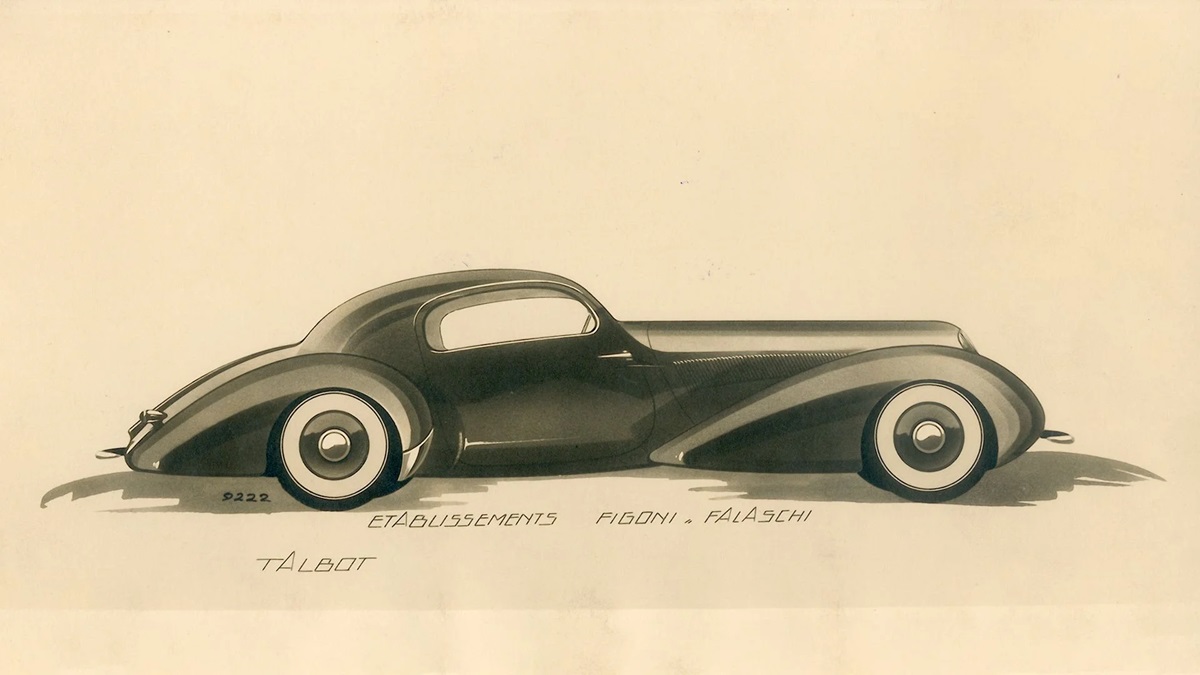
Design 9222

The star, the Figoni design that eclipses all else, remains the streamlined, two-seater coupé body that has become universally known as the Goutte d’Eau, which means water drop in French, now translated as Teardrop. It is a design of such breathtaking beauty that it has become one of the most iconic automobiles of all time. A maximum of thirteen are believed to have been built on the T150 C-SS chassis, two on the T23 Baby 4.0 Liters chassis, and only one T150 C, namely chassis 90034, the subject of this discussion.

Yet it is a body that more than 85 years after its inception, and despite its age, is instantly recognizable to automotive enthusiasts all over the world. It is one of the very few designs that is aesthetically correct, balanced and in equilibrium from any angle. This absolute harmony of line is a rare achievement indeed, and one that the Goutte d’Eau shares with only a minute number of other automotive design statements that are equally famous and universally revered, such as the “coffin-nosed” Cord 810, the Ferrari 250 GT California Spyder, the Lamborghini Miura or the first series Jaguar E-Type. Exalted company indeed.

Interestingly, it was the media who gave the Goutte d’Eau its name. While no one will dispute that it was fitting, the design was simply called a Faux Cabriolet by Figoni, and this in spite of the fact that the style has no elements that relate to the look of a classic (faux) cabriolet. Two versions existed of Figoni’s basic faux cabriolet design, a fastback and a notchback, which makes definitions even more confusing: the designations Coupé Amérique or Modèle New York were used indiscriminately by Figoni for the fastback, named so because it was first shown at the 1937 New York Auto Show, and Coupé Jeancart for the notchback as an industrialist named Jeancart bought the first body constructed to this style.

There were three Jeancart designs: no. 9220 with enclosed fenders front and rear, 9221 with exposed front wheels and enclosed rear wheels with fender skirts, and 9222 with no fender skirts and all four wheels exposed. On T150 C chassis 90034 the wheels are exposed, and it was therefore bodied to design 9222 and not 9221 as has been stated elsewhere.

Enter Antoine Schumann

In 1925, Luigi Chinetti was working as a mechanic for the Alfa-Romeo racing team. Like Anthony Lago, he was unhappy with the rise of fascism in Italy. After the team had completed its racing efforts in France and was on the cusp of returning to the home country, Chinetti decided to stay. As mentioned above, he then worked out of the premises Alfa-Romeo had established in Paris in the rue Marbeuf, just off the Champs-Élysées, which led him to sell an 8C 2300 to up-and-coming race driver Raymond Sommer. Chinetti had the car rebodied to Le Mans regulations by Figoni, and being the consummate wheeler-dealer that he was, he secured the position as Sommer’s co-driver in the 1932 Le Mans race which they won.

This marked the beginning of a lifelong friendship between Luigi Chinetti and Joseph Figoni. After he left Alfa-Romeo, Chinetti became a sales agent for Talbot-Lago, and Joseph Figoni gave Chinetti the exclusive rights for France to sell Talbot-Lago chassis fitted with teardrop bodies by Figoni et Falaschi. As a result, it was Luigi Chinetti who sold 90034 to wealthy banker and gentleman racer Antoine Schumann for the princely sum of 165,000 francs.

The car was delivered to Schumann in Paris in January 1939. Antoine Marc Philippe Jacques Schumann was born on November 26, 1905, in the home of his parents who lived in an imposing building at no. 5 rue Beaujon in the 8th arrondissement of Paris. It was a family of means. Antoine’s father, Robert Schumann, was a banker, and his mother Alice, née Lehmann, also came out of a banking family. Antoine’s birth certificate was witnessed by Paul Jaillot and Gaston Grainger, both employees of the bank: it was in the cards that baby Antoine would eventually follow in everyone’s footsteps and enter the world of finance.

Antoine married Eliane Louis-Dreyfus on April 13, 1929. It may well have been true love, but the marriage certainly buttressed the coffers of the young couple, as the Louis-Dreyfus family was equally well-to-do. Charles Louis-Dreyfus, Elaine’s father was a shipping merchant, while her grandfather was a banker, a former member of parliament and a recipient of the Croix de Guerre, a military decoration given for valor during World War I.

Important for this discussion, however, is that by this marriage, Antoine Schumann became brother-in-law to Pierre Louis-Dreyfus, as he was Eliane’s younger brother. Pierre was already a repeat customer of the Figoni and making his mark as a gentleman racer. Soon Antoine shared his passion for fast cars.

But before that, Pierre Louis-Dreyfus and Antoine Schumann had become their own racing team, a secretive privateer racing duo that would garner fame in French racing circles. As gentleman racers they desired no publicity surrounding their names. In addition, daredevil antics on the tracks could reflect negatively on their careers in business, and as a result they camouflaged themselves with a number of pseudonyms. However, since these pseudonyms were in the nature of acronyms, it is moot whether many, if any, were actually fooled.

As he was more active over the years than Antoine Schumann, Pierre Louis-Dreyfus had more than one of these assumed names. When racing alone or with other co-drivers, he used the acronym Heldé, which was a transcription of the French pronunciation of the initials of the Louis-Dreyfus surname: LD. But when Pierre and Antoine raced together, the duo facetiously called themselves Ano (Pierre) and Nime (Antoine) for driver and co-driver, a play on Anonime, which means Anonymous in French.

As this daring duo they raced at Le Mans in a Bugatti Type 43 in 1931, an Alfa Romeo 8C 2300 LM in 1932 and a Talbot T150 C in 1939—not with outstanding results unfortunately as they were forced to retire on all three occasions. But that is the nature of gentleman racing. You are up against factory-sponsored teams, and it is the sportsmanship, the participation and the thrill of the race that is the essence of it all. It can therefore come as no surprise that Antoine Schumann was a connoisseur of fast road cars too. This included a massive 5-liter Bugatti Type 50 that was sold by the Bugatti factory to him on February 19, 1932.

Luigi Chinetti sold Talbot-Lago chassis 90034 to Antoine Schumann in September 1938. It was delivered that same month to the Figoni et Falaschi works at no. 14 rue Lemoine in Boulogne-Billancourt. The Carrosserie assigned body order number 738 to the build, and this number can be found stamped on body parts of the car. Perhaps Schumann bought the car for himself as a consolation prize of sorts, as by this time, his marriage to Eliane was on the rocks: they were divorced on 12 November 1938 by order of the civil court. He ended as the second of her four husbands. If this was his motivation for buying 90034, one may say that Antoine Schumann certainly knew how to defuse bad feelings!

For this very special chassis, Schumann selected Figoni et Falaschi design no. 9222, which with its open rear fender style was a good deal more sporting than the enclosed rear fender of design 9221. But while sportsmanlike, 9222 is nevertheless a style which in many ways remains the most elegant and tasteful of all Joseph Figoni’s streamlined efforts in the late 1930s. Features that link the exquisite body on chassis 90034 to the other Teardrops built by Figoni include the split windshield, integrated doorhandles, the smooth execution of the grille and front fender tips, the double row of side louvers on the hood, as well as the judicious use of chromed scallops.

The extra 30 centimeters of wheelbase compared to the T150 C-SS chassis made it possible for Joseph Figoni to create smooth, flowing lines of unparalleled harmony which in their execution were simply captivating to the eye. The length of the hood and the front fenders were much the same as the proportions used on the shorter chassis, but the notchback of the Jeancart greenhouse was subtly refined and the rear deck was transformed into a long delicately sloping tail that was a masterclass in balance and proportion. Longer, lower and wider than its siblings, the sporting stance of the T150 C Jeancart coupé is unparalleled. No one could be in any doubt that 90034 was a fast car.

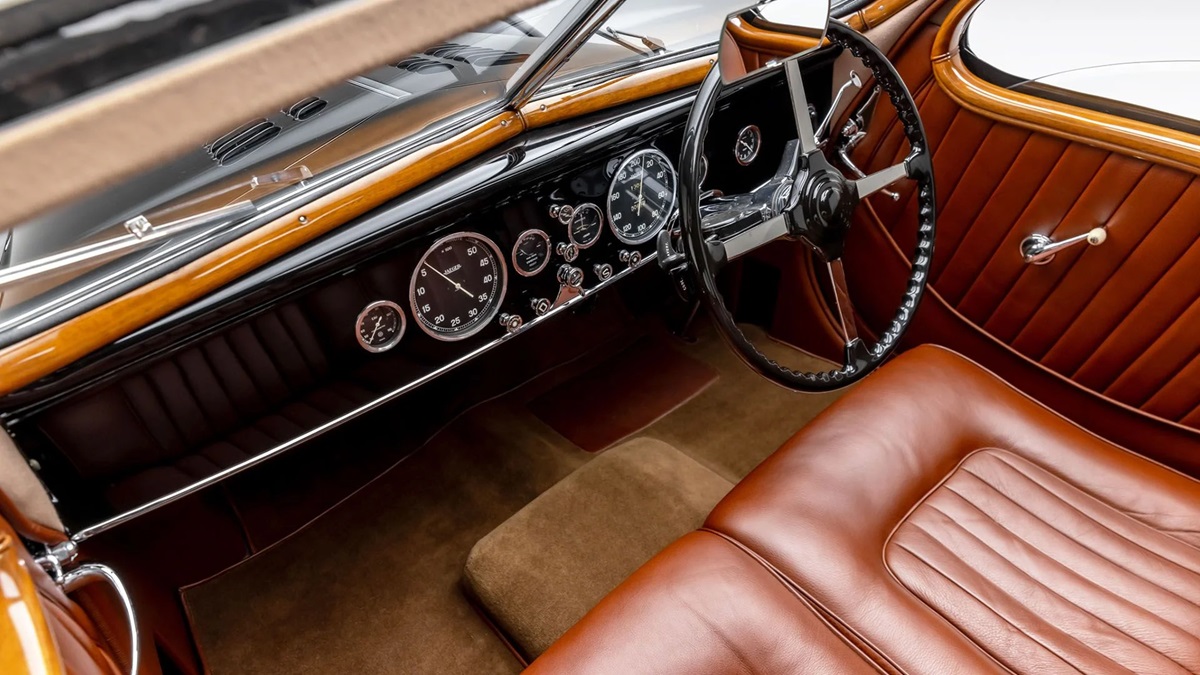
As a true appreciator of fine cars, Schumann had Figoni incorporate a number of bespoke details that were special orders. The livery was specified as bleu “Tango” irisée noire, which was a metallic dark blue with a black tinge, a very expensive selection as metallic paints were rare and costly to make at the time. Traces of this original dark blue may still be found behind the dashboard and inside the glovebox. The three-abreast seat was upholstered in Havana (tobacco) leather with matching wood on the door cappings. The dash was fitted with a full set of Jaeger instruments with black dials and painted in body color, while the carpets and headliner were in a delicate shade of gray. Special curtains in Havana leather were made for the rear window.

Bespoke details to the body included free-standing headlights. The enclosed headlights seen on most Teardrops provided poor light for night driving, and a number were in fact modified by their early owners, simply because they couldn’t see properly in the dark. In addition, the body received a full sliding sunroof, detachable rear fenders, a Lago Spéciale script on the rear deck and opening rear windows to improve airflow in the cabin. Most importantly, however, Schumann specified a graceful, chromed sweep spear on the body side, a unique styling enhancement that was used on a number of Figoni designs in this period but was absent on design 9222. This started as a beltline at the trailing edge of the radiator shell, ran along the edge of the hood and then swept down in a supple curve along the side of the door, only to double back on itself at the sill. Pure aesthetic genius.

Antoine Schumann was able to enjoy his jewel of a car until the Nazi invasion of France which began in May 1940. The Schumann family was Jewish, and Antoine was forced to either leave France or face deportation to German concentration camps. As so many other cars during the Nazi Occupation, the striking Talbot-Lago was squirreled away as it would have been one of the first cars the Occupiers would have expropriated for their own use without compensation. Antoine fled to Egypt, took a pilot’s license and joined the French Resistance.

There, he flew for the Compagnie de l’Air au Moyen-Orient, a squadron operating out of Cairo that fought Nazi Field Marshal Erwin Rommel’s Deutsches Afrika Korps and participated in the Battle of Tobruk. From 1943, Antoine Schuman served under François Dumont in the air force of the Forces Françaises Libres, the Free French Forces. For his bravery during the war, Schumann was made an Officer of the Legion of Honor and awarded the Croix de Guerre. On April 18, 1947, he married Jeanine Constantinovitch, and on June 25, 1948, for reasons unknown, he changed his last name to Saville. At seven in the morning on August 15, 1956, Antoine Schuman died as Antoine Saville in his apartment at no. 16 rue Paul Valéry in the 16th arrondissement of Paris. He was 50 years old.

Frédéric Damman and the 24 Hours of Spa

Paris was liberated on August 19, 1944, but fighting continued in Europe until Germany surrendered unconditionally on May 7, 1945. It is not known when Antoine Schumann returned to France, but it seems that he kept 90034 until sometime in late 1946 or early 1947. Paul Frère, the late racing champion and noted automotive journalist, remembered seeing 90034 in Brussels in 1946 or 1947 where it was for sale with the Garage Masuy, located in the rue de Stassart, close to the Porte de Namur in downtown Brussels. The car was apparently in nigh on perfect condition, which is consistent with the fact that it had been laid up during the War and had not seen much use since its delivery in January of 1939.

Sometime in 1947, chassis 90034 was purchased by Frédéric (a.k.a. Freddy) Damman, owner of the Magasins Butch clothing stores which provided him with the wherewithal to finance his hobbies as amateur pilot and race driver. 90034 received registration 2536, and Damman had the car repainted in gray, after which he prepared it for participation in the 1948 Belgian Grand Prix, Les 24 Heures de Spa, which took place on July 10 and 11. Chassis 90034 was entered in the 4-liter category and given race no. 92. With Damman and co-driver and mechanic Constant Debelder at the wheel, the car placed first and won its class—an impressive result for a nine-year-old car.

Freddy Damman’s daughter has recounted that it was love at first sight when he first spotted 90034 in the Garage Masuy showroom. There is no reason to doubt this, as it turned out to be a very long love affair on Damman’s part: he kept 90034 for 32 years until July 17, 1979, a few months after its 40th “birthday”, when he finally parted with his cherished Talbot-Lago in a private sale. His daughter said that Damman owned many cars over the years, only retaining one or two important cars at a time. This included a number of exotic Ferraris, but it was always 90034 that was the keeper, the car that stayed behind when the time came to buy something new. The Talbot was simply the car he loved the most.

Moving On

The lucky buyer in July 1979 was Gaston Garino who had worked at the Hispano-Suiza factory in Bois-Colombes. In the early 1950s, Garino purchased an old garage in Puteaux where he specialized in keeping Hispanos on the road. By 1979, Garino had partnered with M. Lerouvillois, and the enterprise had become a dealer in high-end classics. 90034 was registered 1551-HN-92 by Garino, using the chassis identity of T150 C-SS chassis no. 90121, a Pourtout-boded car, on the registration document. This subterfuge may have been performed for customs reasons. Chassis number 90121 was an obscure car at the time as it was not finished until October 1944 after the French Liberation and had been exported to the USA in 1953.

On May 14, 1980, and still using the identity of 90121, chassis 90034 was re-registered 543-DAL-75 and sold to film producer and businessman Michel Seydoux, a famous early French collector in Clausonne in the Alpes-Côte d’Azur region. The car was auctioned by Poulain-Le Fur on December 16, 1981, and passed from Seydoux to Yves Rossignol, an avid motoring enthusiast of little means. Once again, 90034 received a new registration, namely 1938-KB-13. Rossignol kept 90034 for 23 years. During that time, the car received a two-tone black and burgundy livery but was subsequently repainted in a single shade of black. Importantly, it remained unmolested and complete, and had never received an actual restoration. In 1998, thanks to the help of the Talbot Club and its President Dominique Dupont, the original identity of 90034 was re-established.

In 2004, Antoine Rafaëlli, the legendary author of Memoirs of a Bugatti Hunter, contacted Toby Ross, another car sleuth, telling him that he had seen a Teardrop in Marseille some years back, and that it belonged to someone called Yves Rossignol. They located Rossignol in a garage in Nice where he was making security bars for windows. A friendship was established, and eventually, Rossignol agreed to sell.

Yves Rossignol described himself as an “Adventurer”. In the past he had been the young boyfriend of Madame Coty of Coty Perfumes. At some point, she bought the Talbot for him at a Paris auction which can only have been the Poulain-Le Fur auction. He later married a lady from Columbia and spent time in South America. At some point, “La Noire” as he called 90034, was shipped to South America, where Rossignol used it. It starred in a long-forgotten film and Rossignol had a photo of the car being rowed across a lake on a wooden raft.

At some point, Rossignol and the car returned to France—he sans wife. She had gotten fed up with him being penniless. By the time Toby Ross was negotiating with Rossignol, La Noire was hiding in plain sight in a car museum close to Geneva airport. Toby Ross went to see it, took some poor-quality photos in the gloomy museum and set about selling it. In July 2004, chassis 90034 sold to Marc Caveng of 135 Route de Chêne, Chêne Bougeries, a collector-dealer based in Geneva, Switzerland, who repaired the engine head, renewing the valves. Yves Rossignol took his payout and went back to live with his wife in Columbia. In 2005, Caveng sent 90034 to auction in Monterey, where it sold to the late John O’Quinn.

90034 was then sent to RM Auto Restorations in Blenheim, Ontario, Canada for a comprehensive restoration. The body was refinished in a deep luminous black, while the original tobacco leather was renewed in the same shade and the original wood trim was kept and refinished. The car was extraordinarily complete, so virtually all body panels remain original. The engine and mechanicals were fastidiously reconditioned. After the passing of John O’Quinn in October 2009, chassis 90034 was sold to its current owner in August 2010 at the Monterey auctions.

For the past fourteen years, this deeply historic automobile with its ground-breaking coachwork of timeless beauty has been part of and curated by an important collection on the West Coast of the United States. This is the singular motorcar that is being offered. Highly original and authentic, in beautifully restored condition, it has a continuous and unbroken history of ownership since its inception in September 1938 when ordered by Antoine Schumann. Many years after the fact, Paul Frère remembered the unique engine and exhaust note he heard when this Talbot-Lago blasted by at the 1948 24 Hours of Spa. This is a car that makes memories, a car that stays with you. One word from Cole Porter’s famous song for the Grace Kelley, Frank Sinatra and Big Crosby film High Society sums up Talbot-Lago Teardrop chassis 90034: Unforgettable. For the Silo, Caroline Cassini.

  • Ordered new by gentleman race driver and banker Antoine Schumann as a replacement for his Bugatti Type 50
  • Sold to Schumann by Luigi Chinetti for the sum of 165,000 francs
  • The only Figoni Teardrop Coupé built on the T150 C Lago Spéciale chassis
  • Special-order body with unique features specified by Schumann
  • Class winner at the 1948 Belgian Grand Prix, the 24 Hours of Spa
  • Known provenance with ownership by prominent French collectors
  • An outstanding design icon of remarkable and enduring beauty

Chassis No. 90034

Chassis No. 90034
Figoni et Falaschi Design No. 9222

1938 Talbot-Lago T150 C Lago Spéciale Teardrop Coupé by Figoni et Falaschi

Auction Sale Estimate: $6,500,000 usd – $8,500,000usd/ $8,900,000cad – $11,600,000cad

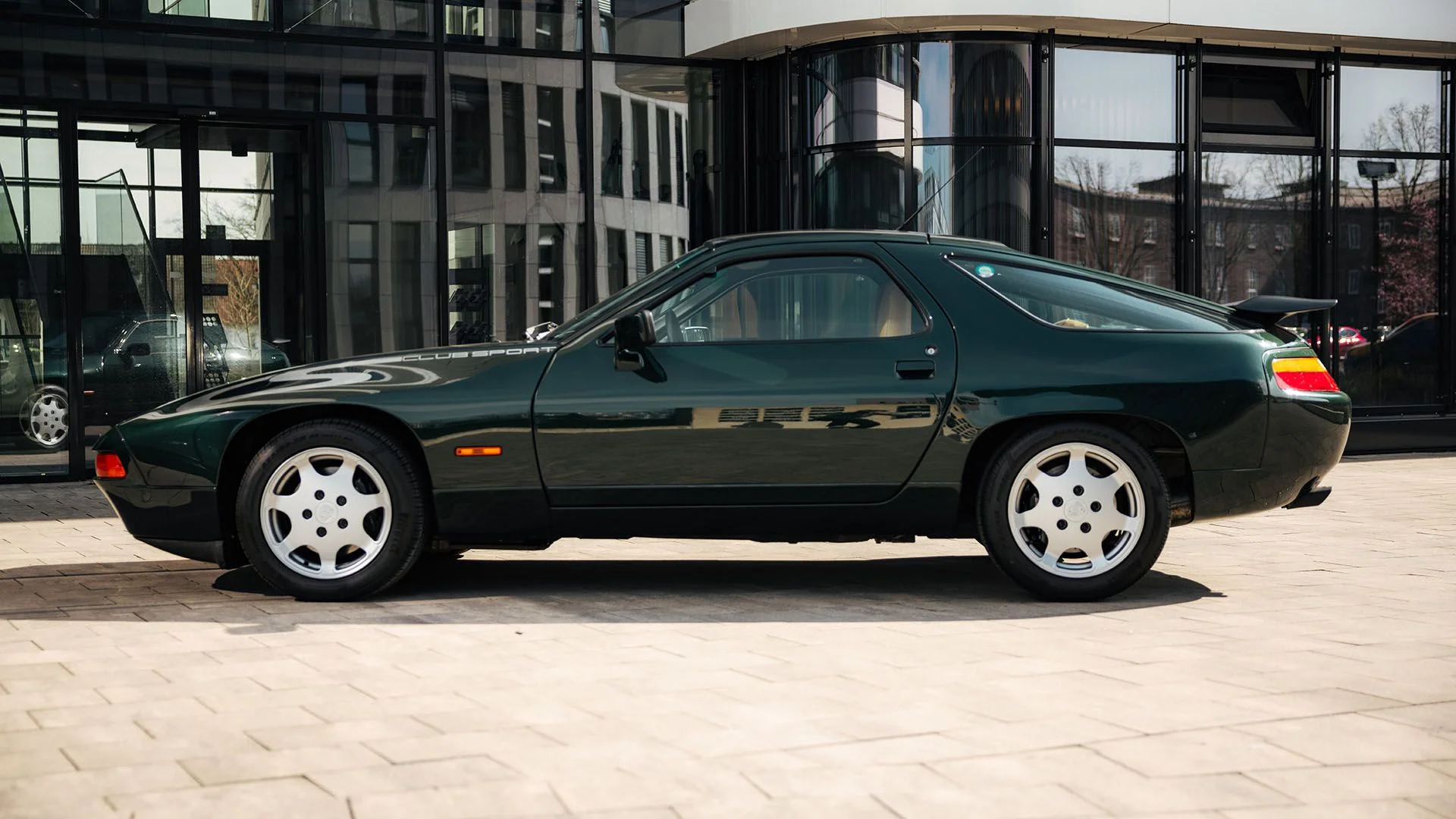
An Ultimate 1980s Porsche: Clubsport 928

Lot 106 | The Porsche Auction in partnership with Air|Water | Auction Estimate: $275,000 usd – $375,000 usd/ $378,000 cad- $516,000 cad

INQUIRE

Ahh the 1980s. What a time to have lived through….when the panache of the laid back 1970s transformed into an MTV generation that fueled itself with (briefly) New Coke, parachute pants, Mr. T and Miami Vice. You may already know about “the car”- the one that taught Tom Cruise how to drive a stick and made famous the line “Porsche, there is no substitute”, but as the decade closed and styles began to change so too did the vastly misunderstood yet gorgeous 928.

Enter the 1989 Clubsport

For Sale 1989 Porsche 928 Club Sport

For Sale 1989 Porsche 928 Club Sport

For Sale 1989 Porsche 928 Club Sport

For Sale 1989 Porsche 928 Club Sport

For Sale 1989 Porsche 928 Club Sport

For Sale 1989 Porsche 928 Club Sport

Highlights

  • A matching numbers German-market example initially retained by the Porsche factory per its Porsche Germany build sheet
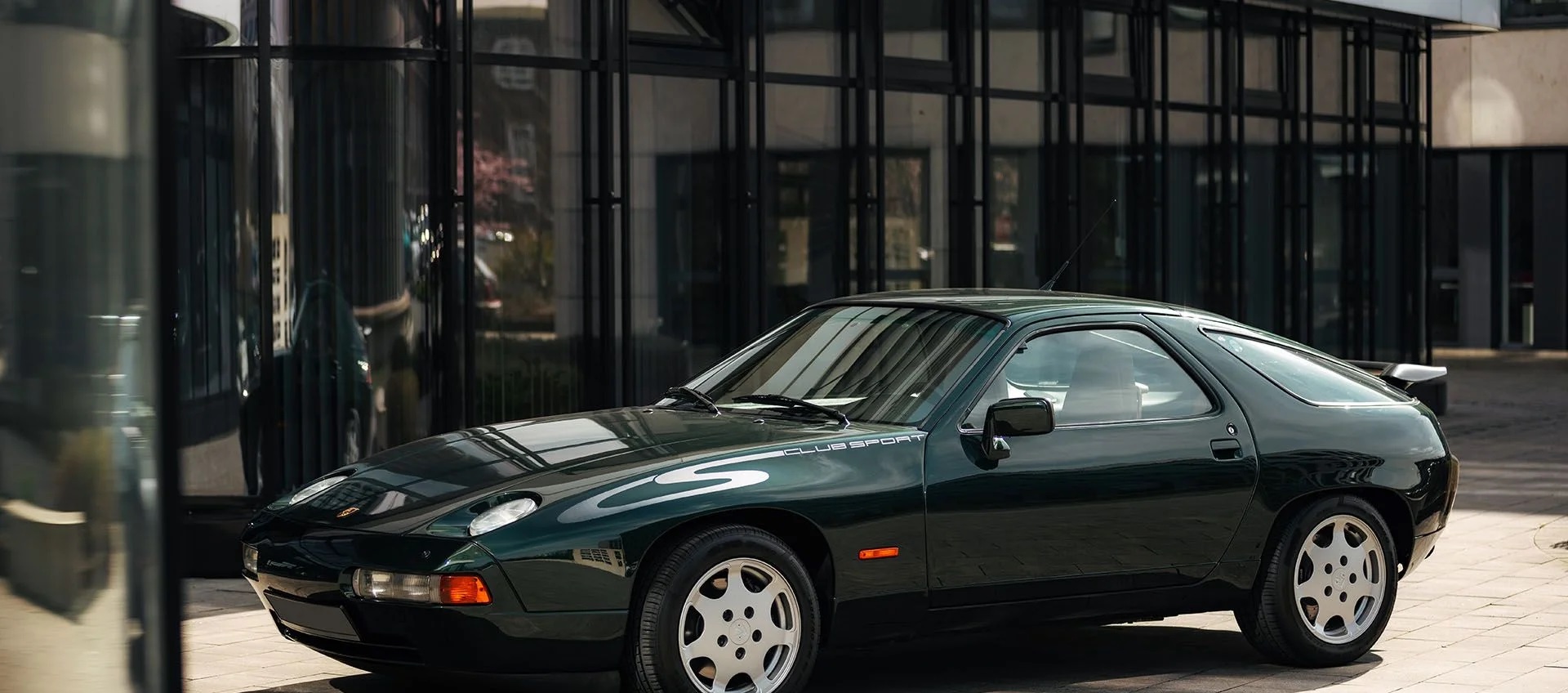
  • One of just seven lightweight 928s optioned with the “M637” Club Sport package built for 1989, one of Porsche’s rarest creations
  • Special lightweight Club Sport package features include the absence of a sunroof, a lighter exhaust, a lack of undercoating, and lighter magnesium-alloy wheels
  • Special sporting Club Sport package features include manual sport seats, short throw shifter, limited-slip differential, lowering by 20 mm, 150 mm wider track, and special badging
  • Fitted from the factory with special “SP” stamped “M28/41” 5.0-liter V8 engine producing a conservatively factory rated 320 PS
  • The only 928 Club Sport finished in Forest Green Metallic (Tannengrün Metallic) over a Cashmere Beige and Black leather interior
  • Over € 65,000 invested between 2019 and 2021

Description

Chassis No. WP0ZZZ92ZKS840540
Engine No. 81K 00246 SP

There are rare Porsches that many know about — the 997-generation 911 Speedster (356 total) and 2010 911 Sport Classic (250 total) come to mind — yet there are those special cars built in low double-digit quantities that are exceedingly uncommon and far less known. Take this lightweight series of 911s, for example. Just 20 1967 911 Rs were produced, only 21 1984 911 SCRS, and just seven years later Porsche produced 22 Carrera 4 Lightweights. The 911 wasn’t the only model in Porsche’s lineup that received the lightweight treatment in small quantities, and it was the 928 on which Porsche engineers interestingly focused their weight saving efforts.

Their initial efforts focused on four prototypes gifted as company cars to each of the four factory 962 sports racing prototype drivers that season: Jochen Mass, Derek Bell, Hans Stuck, and Bob Wollek. All four loved the changes made to their prototypes intended to comfortably transport them across the continent at high rates of speed to the European races. In fact, Derek Bell enjoyed his so much he kept it as his daily driver for 18 years! With such a positive reception, Porsche made these changes available to the public the next year as “M637” Club Sport option. Those 928s optioned with M637 were approximately 120 kilograms lighter than their S4 stablemates due to the removal of comfort features like the rear wiper, a portion of the wiring harness, and PVC undercoating.

Heavier parts were lightened. The exhaust system, a smaller AC compressor, and magnesium wheels special to the Club Sport were added. In addition, the 928 Club Sport featured stronger acceleration due to a modified final drive ratio, short shifter, a limited-slip diff, a transmission without vibration dampening, and sports seats. The Club Sport also featured lowering by 20 millimeters and a 150 millimeter wider track along with special badging. Finally, the Club Sport was fitted from the factory with a special “SP” stamped 5.0-liter V8 engine likely producing more than the conservatively estimated 320 PS, due to special camshafts, a 1 mm increase in valve lift, a modified engine control unit, and a higher rev limit. Following their tried-and-true path, Porsche, along with their racing drivers, developed a 928 with more power, lighter weight, and better handling — a true Porsche Club Sport!

This matching numbers 928 Club Sport on offer is one of just seven production lightweights built for 1989 and is the only example finished in Forest Green Metallic over a Cashmere Beige and Black leather interior. It was originally retained by Porsche AG as a special “Werkswagen” company car for longtime Porsche employee Bernd Kahnau. Kahnau was no mere employee. After his father’s passing – a longtime Porsche employee himself — in 1979, Kahnau was personally recruited to work for Porsche at the request of Ferry Porsche. The former BMW employee quickly became immersed in all manner of important development projects, most notably as a production planner for the 928, 911 Club Sport, 911 Speedster, and 911 models from the 993 to 991.

Beyond being equipped with the highly desirable Club Sport package, this rare 928 was optioned by Kahnau with air conditioning, a tinted windshield, and a Blaupunkt Bremen radio in addition to the sporting items inherent in ordering a Club Sport. It is said that Kahnau was very attached to his Club Sport, as the green on tan livery matched the colors of his English country house! He owned it for approximately two years before it eventually landed with an individual based in Switzerland, where it was located until at least 2019.

Most recently, under current ownership, this matching numbers Club Sport has been the focus of a lavish amount of attention totaling over €65,000 worth of repairs and servicing between 2019 and 2021. Most importantly, following a 33-point Porsche inspection at 120,800 kilometers in 2019, the car visited Landsharks in 2020 for a new water pump, fresh coolant and engine oil, filters, and an oil pan gasket. At the same time the thermostat was replaced, along with the clutch disk and pressure plate, and engine electrical items including the ignition cable, distributor cap and rotor, spark plugs, and two knock sensors.

Underneath, the Club Sport received new brake discs and pads front and rear, a new brake master cylinder, the replacement of the center catalytic converter with lambda probe, and a fresh battery. This work along with other sundry items and parts totaled €22,736.91. Following an accident to the rear of the car, additional invoices from Landsharks that year show the Club Sport was the recipient of cosmetic attention as well with interior saddlery work, a new windshield, new seals, unibody work to repair the rear accident damage, and fresh paint in its original shade of Forest Green Metallic. In 2021, the air conditioning system was refurbished with a new compressor, dryer and a system clean with new liquids and fluids. Today, this rare, well-preserved 928 Club Sport with its matching number engine and transmission is offered with 122,748 kilometers at cataloging with a copy of its Porsche Germany build sheet, recent service paperwork, and manuals.

For the Silo, Bastian Voigt/Hagerty.

Why Not Laserdiscs In The 2020’s?

In this, our new high tech world, a lot of people may think I’ve gone decidedly crazy.

I’ve always wanted the man cave ‘aka’ cinema room to have a nostalgic feel to it. I started collecting videos at the tender aged of 11. All my friends growing up called me videoboy lol because I was the go-to-guy to get films from on vhs videotape but one format that always intrigued me was laserdisc.

A Little History

LaserDisc (often abbreviated as LD) is a home video format and the first commercial optical disc storage medium, initially licensed, sold and marketed as MCA DiscoVision in North America in 1978.  No one can say for sure if the disco craze at that time was responsible for its early name or if it was simply a play on the word ‘disc’. Whatever the reason, the early DiscoVisions have distinct cover designs which make them quite collectible and they have a certain unique retro-funk all of their own.

Although the format was capable of offering higher-quality video and audio than its consumer rivals- VHS and Betamax videotape, LaserDisc never managed to gain widespread use in North America, largely due to high costs for the players and video titles themselves and the inability to record TV programs. It was not a popular format in Europe and Australia when first released but was popular in the 1990s. By contrast, the format was strongly embraced in Japan and in the more affluent regions of Southeast Asia, such as Hong Kong, Singapore and Malaysia, and was the prevalent rental video medium in Hong Kong during the 1990s. Its superior video and audio quality made it a popular choice among videophiles and film enthusiasts during its lifespan. The technologies and concepts behind LaserDisc were the foundation for later optical disc formats including Compact Disc (CD), DVD and Blu-ray (BD).

A Little Boasting

LaserDisc had a number of advantages over VHS (and Beta) videotape. It featured a sharper picture with a horizontal resolution of 425 TVL lines for NTSC and 440 TVL lines for PAL discs, while VHS featured only 240 TVL lines in NTSC (VHS HQ offered 260). It could handle analog and digital audio where VHS was mostly analog only (VHS did have PCM audio in professional applications but was uncommon), and the NTSC discs could store multiple audio tracks. This allowed for extras such as director’s commentary tracks and other features to be added onto a film, creating “Special Edition” releases that would not have been possible with VHS. Disc access was random and chapter based, like the DVD format, meaning that one could jump to any point on a given disc very quickly. By comparison, VHS would require tedious rewinding and fast-forwarding to get to specific points.

Please be kind! Rewind!

LaserDiscs were initially cheaper than videocassettes to manufacture, because they lacked the moving parts and plastic outer shell that are necessary for VHS tapes to work, and the duplication process was much simpler. A VHS cassette has at least 14 parts including the actual tape while LaserDisc has one part with five or six layers. A disc can be stamped out in a matter of seconds whereas duplicating videotape required a complex bulk tape duplication mechanism and was a time-consuming process. However, by the end of the 1980s, average disc-pressing prices were over $5 USD per two-sided disc, due to the large amount of plastic material and the costly glass-mastering process needed to make the metal stamper mechanisms. Due to the larger volume of demand, videocassettes quickly became much cheaper to duplicate, costing as little as $1 USD by the beginning of the 1990s.

LaserDiscs potentially had a much longer lifespan than videocassettes. Because the discs were read optically instead of magnetically, no physical contact needs to be made between the player and the disc, except for the player’s clamp that holds the disc at its center as it is spun and read. As a result, playback would not wear the information-bearing part of the discs, and properly manufactured LDs would theoretically last beyond one’s lifetime. By contrast, a VHS tape held all of its picture and sound information on the tape in a magnetic coating which is in contact with the spinning heads on the head drum, causing progressive wear with each use (though later in VHS’s lifespan, engineering improvements allowed tapes to be made and played back without contact). Also, the tape was thin and delicate, and it was easy for a player mechanism, especially on a low quality or malfunctioning model, to mishandle the tape and damage it by creasing it, frilling (stretching) its edges, or even breaking it.

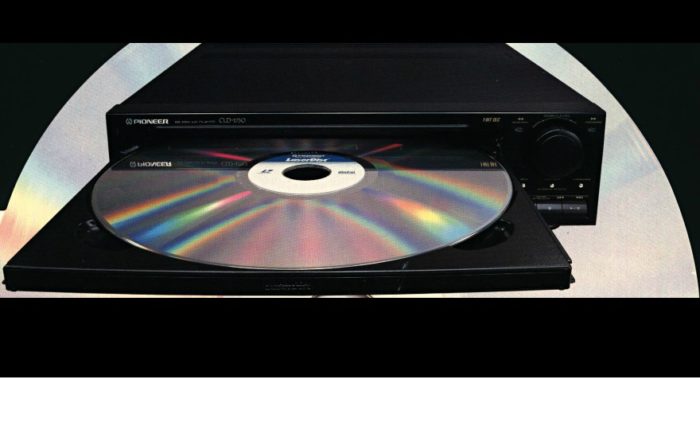
My NTSC/PAL hybrid player.

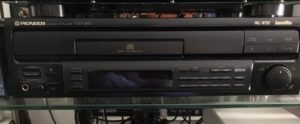
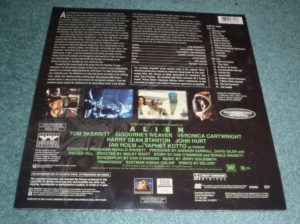
LaserDisc players also had several advantages of VHS and other format playback machines. Some models, such as my Pioneer CLD-1850 are able to playback both NTSC movies and PAL movies. Since I live in the UK- this means that I can buy Laserdiscs from America or Japan (or anywhere in the world that uses NTSC video) and they will play in my machine. Try doing that with VHS or DVD. Another important innovation for Laserdisc was the fact that it was the very first home video format to offer Dolby Digital Surround Sound- often referred to as AC-3 on Laserdisc jackets and hardware. Many fans of Laserdisc are still enjoying this feature because some movies such as the Alien AC-3 LD were released with their original cinema surround mix on the AC-3 Laserdisc and those mixes are unavailable on today’s modern formats such as Blu-ray or UHD Blu-ray. Many early LD players can even be modified to turn them into AC-3 LD players.
The Death And Re-birth Of Laserdisc

By the time of the advent of the DVD, LaserDisc had declined considerably in popularity, so the two formats never directly competed with each other. In fact, combination LD/DVD players were introduced into the marketplace and continue to be quite popular with collectors as these players tend to be flagship models with advanced features such as digital 3D comb filters and digital frame memory and effects. It’s too bad that I couldn’t afford the format at the time , and I really don’t know why I’ve decided to pull the trigger now as Jez would put it lol.

Prices on the used market are still quite high on these combi players but other machines are affordable and the LD’s themselves can usually be found at affordable prices with exceptions for the ultra rare and more obscure releases.  I can’t say exactly

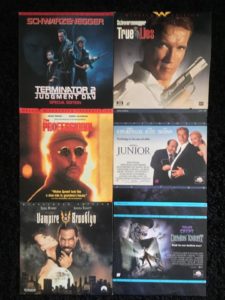
Some of my LD collection.

what has me so excited again about Laserdisc and why I’m back in the hunt but I really like the way the discs are packaged in big vinyl like slips, they look so cool. The artwork has totally sucked me in. I’ve started my journey, but I don’t know where it will end. And of course that journey has to begin with Schwarzenegger LD’S. “Get to da choppa! Hurry!”  

For the Silo, Anneal Butt- member of Laserdiscs & Hardware Enthusiasts on Facebook.

Featured image via highdefdigest.com

Freddie Mercury’s London Home Offered For Sale

One of the greatest rock frontmen of all time, Queen’s Freddie Mercury was famous for his theatrical style and four octave vocal range.

Born Farrokh Bulsara in Zanzibar, he fled to England with his family in the wake of the Zanzibar Revolution, in which many Arabs and South Asians were massacred. Settling near London, he studied graphic art and design (which he would later use to design Queen’s logo) and sold second-hand clothes with future Queen drummer Roger Taylor at the Kensington Market.

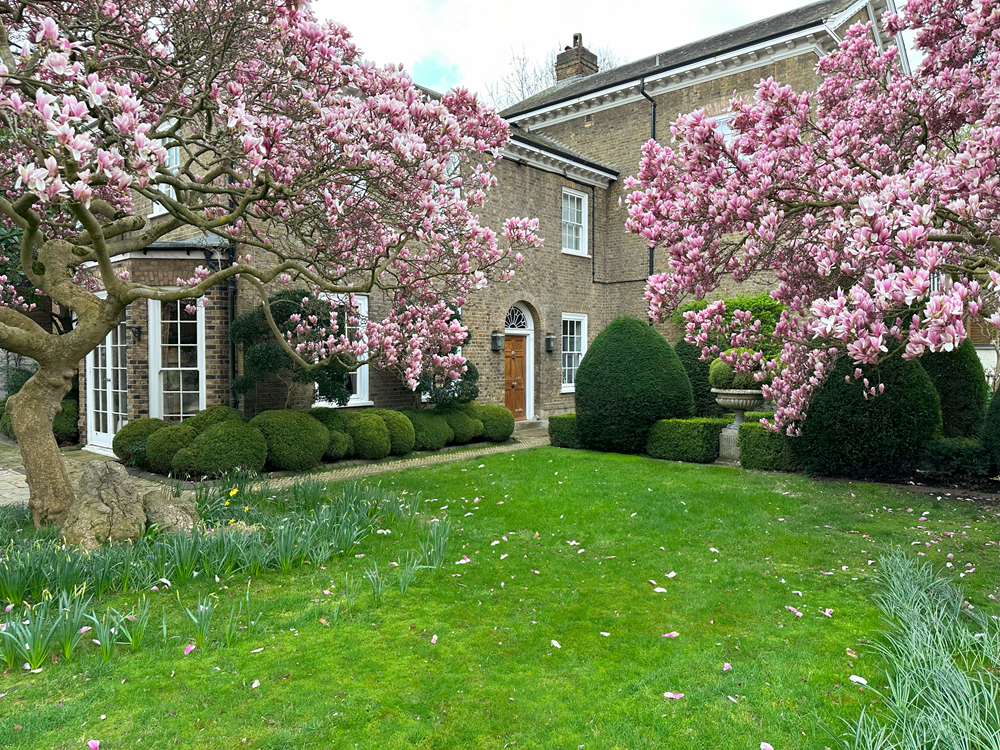
Garden Lodge- Trees in bloom

He fronted a series of bands, but his career really took off in 1973, when he joined with Taylor, guitarist Brian May, and bassist John Deacon to produce Queen’s first self-titled album. He would perform over 700 shows with the band, thrilling sold-out stadiums with his unique style and strong connection to his audience. He died of AIDS in 1991, but his music lives on, with Queen’s Greatest Hits the best-selling album of all time in the UK, and two of his songs “We Are The Champions” and “Bohemian Rhapsody” voted best songs of all time in major polls, and his induction into the Grammy Hall of Fame. 

Mercury left his Kensington home to his former partner and longtime friend Mary Austin.

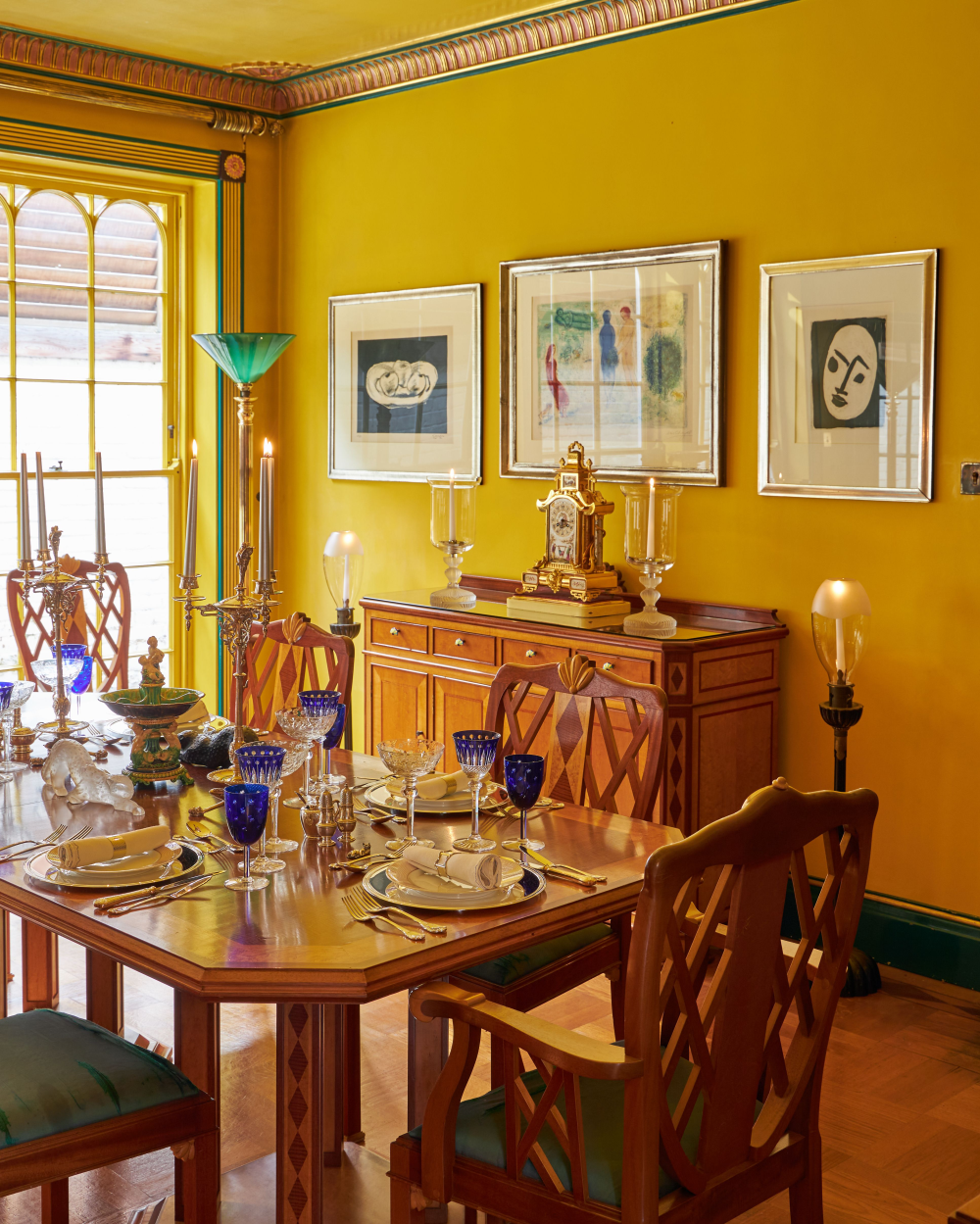
Garden Lodge- Dining Room.

Though he would pursue romantic relationships with men, he considered Mary the love of his life and common-law wife. Garden Lodge is a stunning Neo-Georgian mansion which served as Mercury’s “country house in London”, a sanctuary from his high-intensity life on tour. Meticulously preserved for thirty years by Austin, this time capsule of music history is offered for sale for the first time since Mercury’s purchase in 1980, accepting offers in excess of £30m ($38m usd/ $51.7m cad). 

Freddie’s grand piano which once lived at Garden Lodge sold via Sotheby’s Auction for $2.2m USD/ $2.96m CAD.

Garden Lodge’s centerpiece is a two-story drawing room, which once housed the grand piano on which Mercury composed his signature hit, “Bohemian Rhapsody.” French doors lead from the Japanese sitting room to the beautiful gardens. Every room of the house is infused with Mercury’s vibrant personality, with design choices made personally by the artist, including citrus-toned yellow walls in the intimate dining room, and floor-to-ceiling mirrors in the lavish dressing room that once housed his extensive collection of stage costumes. Surrounded by stone walls, the chance to own this unique cultural landmark is a once-in-a-lifetime opportunity. 

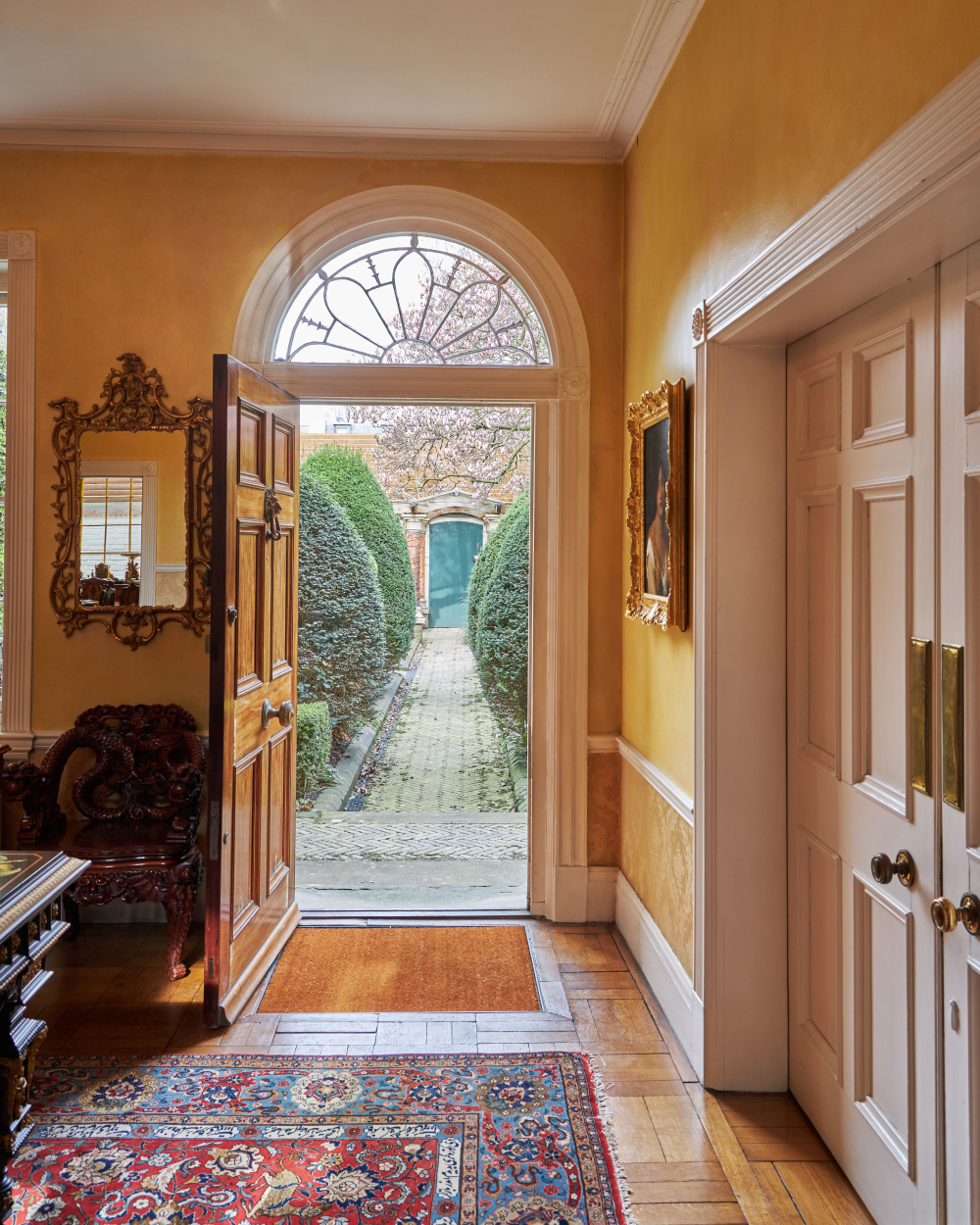
Garden Lodge- A view from the hall looking towards the famous ‘Green Door’.

According to Austin, “This house has been the most glorious memory box, because it has such love and warmth in every room. Ever since Freddie and I stepped through the fabled green door, it has been a place of peace, a true artist’s house, and now is the time to entrust that sense of peace to the next person.”

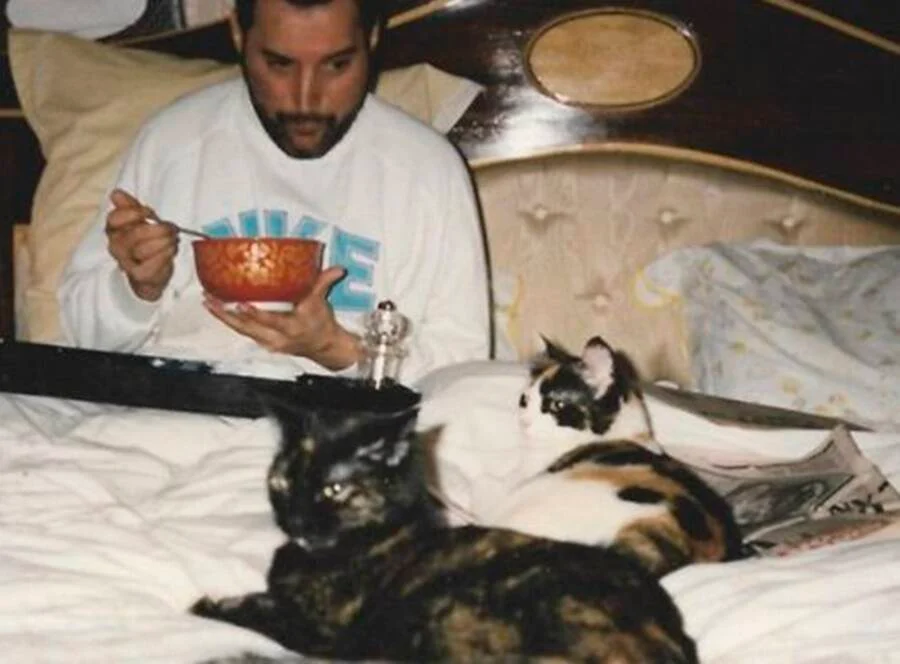
Freddie- at home in Garden Lodge and in bed eating a meal that needed a peppermill close by.

Kensington is an upscale London neighborhood known for its stately Victorian homes. Nearby options for entertainment include the Natural History Museum, the Design Museum, Kensington Palace, and Kensington Gardens. The chic boutiques on Kensington High Street and star-studded concerts at Royal Albert Hall are both within walking distance. Popular with celebrities, the neighborhood’s notable residents include Eric Clapton, Stella McCartney, Rowan Atkinson, and Dido. For the Silo, Bob Walsh/toptenrealestatedeals

The listing is held by Knight Frank. Photos of Garden Lodge courtesy Knight Frank.

Iconic Mid-Century Modern Home For Sale

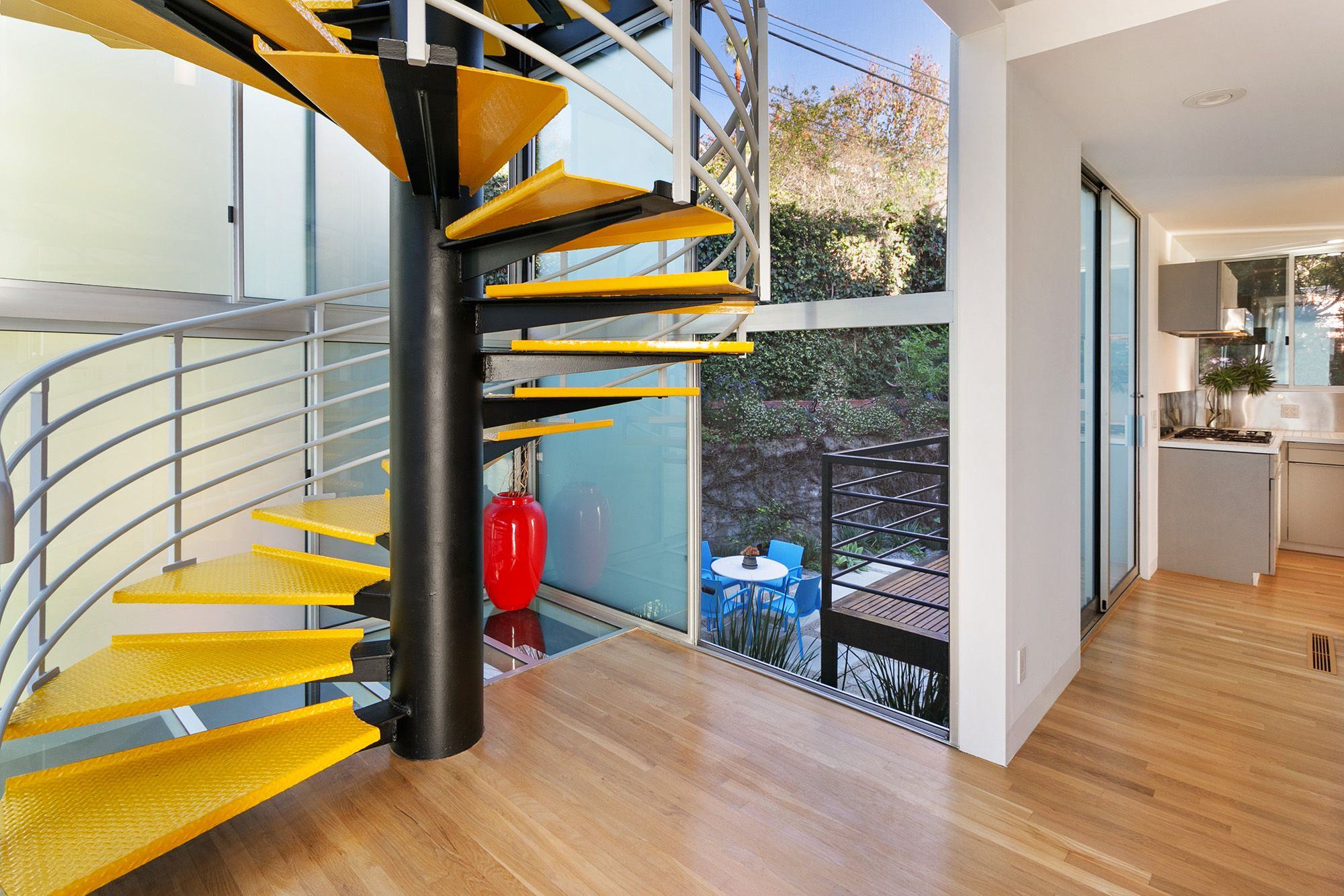
Pierre Koenig was one of the most iconic architects of the mid-century modern movement, which focused on functional designs, harmony with nature, geometric lines, and the use of steel and glass. Koenig’s final project, a gorgeous geometric home in Santa Monica known as the Schwartz House, has been listed for sale at $4.55 million usd / $6.13 million cad. 

More like a work of art than a typical house, the rare historic home sits atop four structural steel columns, designed to minimize the home’s ecological impact and promote a harmonious relationship with nature. The residence’s rotated design is focused on southern exposure and capturing the sea breezes to conserve energy but also offers an attention-getting look. Stark lines, black-steel framing, galvanized wall panels, and floor-to-ceiling glass provide the classic mid-century modern aesthetic for which Koenig is so famous.

More from our friends at toptenrealestatedeals.com. Photos by Cameron Carothers.
Mission Possible: Find Classic Unrestored Cars In Tennessee Fields

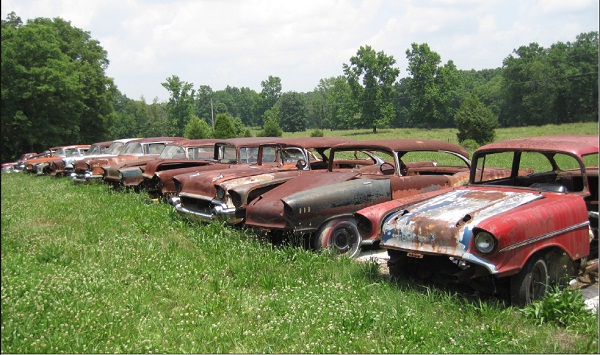
19 (!) 1957 Chevy cars in a Tennesee field

Once again I find myself Down in the Southern U.S checking out beautiful un-restored classic cars in their usual (usual here) worn out aged condition. With very little rust. It never ceases to amaze me the sheer quantity of classics down here. I look at such a wide array of any make or model. (people actually think that they have all been picked already!). One short cruise down one back-road down here and I guarantee that you will spot at least an old Chevy truck parked out back behind a house, in a barn, or just barely sticking out of an old garage that is coming down around it.

As an extreme car enthusiast, all I can say is that it is unreal.

This, not planned, but longer than expected trip to Georgia, brought me to see a sweet 1968 el Camino SS, with a 383 stroker engine and nice black interior. I almost got to look at an original, untouched 1963 split window Corvette, parked in a carport for like 20 years. Apparently under a couple inch thick layer of dust. Go figure it was gone before I even got there.

A teaser sneak-peek at the back end and side of the 1968 ElCamino. Complete with black interior and a 383 Stroker engine. 

A couple of the more odd-ball cars I looked at were a 1985 Corvette on 20inch 140spoke knock-off rims ( I don’t understand this one!), and a metallic orange 85 Monte Carlo SS jacked up about 14 inches sitting on 24’s, and featuring real bullet holes that it received in a police shootout (the guy who had it, bought it from a police auction). Neat looking car.

I also met a man down here who had to have had about 6 or 7, 58-60 Corvettes in different stages of repair. With one I believe, 1959 Corvette completely restored, in a high-gloss black, with a mint convertible top, and factory 4speed standard (manual to our UK and European friends) transmission. He also had one 1958, close to finished. They were both sweet cars. I must also add that the other 4 or 5 were scattered around his property among scrap, building supplies, and bushes. It was quite a sight.

These very rare cars in abundance on this property.

I walked out behind his shop and he had a 1957 Chevy 210 Station Wagon with no engine, but complete interior down to the factory radio! This car just parked, with bushes and weeds growing around it. (I think I am going to buy this one to build with my son and daughter and keep as the Sunday cruiser). I’m thinking a nice, loud, built small block, flat-black paint, and white wall tires on gloss-red rallys. I love these cars!

You probably noticed the first photo in this post right? Well, on a previous trip down here about two years ago I caught wind of a guy in Tennessee who apparently had 19, (that’s right!!! 19!) 1957 Chevy cars.

I couldn’t believe it when I got there and I don’t think too many people can say that they’ve seen nineteen 1957 Chevys all in one spot. It was incredible.

This guy had acres and acres of farm with cars tucked away everywhere you looked. 1951 Fords, A 59 Chrysler, 38 Chevy coupe, 59 International pickup, a 1929 Chevy Hot-rod, an I think 1930 Nash, all kinds of cars and trucks that you never see. In nearly original condition. My actual favorite here though, was his personal “parts getter” 1929 Chevy Truck Rat-rod, it was clever right down to the piston rad cap that stuck out of the hood. I really liked this one. The cool thing about finding all these cars is meeting their owners and hearing all of their stories. Car people are usually fun to hang out with, especially in the south.

1929 Chevy Truck “Rat Rod”.

I’m coming back with a friend who bought a 1966 Big back window, Chevy custom-10 short-box. Its not a half bad truck. He’s gonna fix it up. Maybe add a small block V-8. We’ll see. I’m heading back to Canada tomorrow. Goodbye t-shirt days in January, goodbye five dollar all-you- can eat buffets, goodbye three dollar smokes and goodbye constant, rare car sightings. Oh well, I always know that there will be future adventures in the deep south. Checking out sweet old cars for people, and telling them where they’re at. It’s always cool to have someone ask if I know of an old car they have been looking for and can’t find, and I can tell them “I can give you the phone number of a guy who’s got one of those”. It’s always very cool to have someone bring you a new project. So many possibilities with every car that rolls in…

For the Silo, Robb Price. Photos via the author. Check out Robb’s auto biz on Facebook.

Six Landmark Films from the Columbia Pictures Library Debut on 4K

Debut on 4K Ultra HD For the First Time October 25th 

IT HAPPENED ONE NIGHT FROM HERE TO ETERNITY

TO SIR, WITH LOVE ~ THE LAST PICTURE SHOW ANNIE

AS GOOD AS IT GETS

Exclusively Available on 4K Disc in this Limited Edition Set,

Includes an 80-Page Hardbound Book on the History & Impact of the Films

and Over 35 Hours of New and Archival Special Features


TORONTO, ONT. (October, 2022) – 
Continuing the fan-favourite and award-winning series, Sony Pictures Home Entertainment is proud to debut six more acclaimed and iconic films from its library on 4K Ultra HD disc for the first time ever, exclusively within the COLUMBIA CLASSICS 4K ULTRA HD COLLECTION VOLUME 3, available October 25. This must-own set includes films that have resonated and endured, with stars and stories that have reverberated through cinema history: IT HAPPENED ONE NIGHT, FROM HERE TO ETERNITY, TO SIR, WITH LOVE, THE LAST PICTURE SHOW, ANNIE and AS GOOD AS IT GETSEach film is presented in 4K resolution with Dolby Vision High Dynamic Range, and four of the films have all-new Dolby Atmos mixes.

The six films in the COLUMBIA CLASSICS 4K ULTRA HD COLLECTION VOLUME 3 are only available on 4K Ultra HD disc within this special limited edition collector’s set. Included with the collection is a gorgeous hardbound 80-page book, featuring in-depth sections about the making of each film within the set via six all-new incisive essays from renowned writers—including a special exclusive essay from award-winning writer/director James L. Brooks on his 1997 classic, AS GOOD AS IT GETS!

The set also includes a variety of rare related features and TV episodes, expanding the worlds of several of the included films—some of which haven’t been available in decades! From a 1932 cinematic incarnation of Annie to a nearly five-hour 1979 TV miniseries adaptation of FROM HERE TO ETERNITY—and much more!—these supplemental additions round out this must-own gift set, perfectly timed for holiday gift-giving.

IT HAPPENED ONE NIGHT

Synopsis:

Clark Gable and Claudette Colbert team up for laughs as mismatched lovers in this 1934 screwball comedy classic. Spoiled Ellie Andrews (Colbert) escapes from her millionaire father (Walter Connolly), who wants to stop her from marrying a worthless playboy. En route to New York, Ellie gets involved with an out-of-work newsman, Peter Warne (Gable). When their bus breaks down, the bickering couple set off on a madcap hitchhiking expedition. Complications fly when the runaway heiress and brash reporter fall in love. Directed by Frank Capra, IT HAPPENED ONE NIGHT was the first movie to be honoured with all five major Oscars®: Best Picture, Best Actor, Best Actress, Best Director, and Best Screenplay.

IT HAPPENED ONE NIGHT Disc Breakdown

·       4K Ultra HD Includes:

·       Feature presented in 4K resolution with Dolby Vision

·       Original Mono DTS-HD Master Audio

·       Special Feature:

o  NEW: YOU CAN’T RUN AWAY FROM IT – 1956 remake of IT HAPPENED ONE NIGHT, starring June Allyson and Jack Lemmon. Newly remastered in HD!

§  Blu-ray Includes:

·       Feature presented in high definition, sourced from the 4K master

·       Original Mono DTS-HD Master Audio

·       Special Features:

o  Audio Commentary featuring Frank Capra, Jr.

o  Frank Capra, Jr. Remembers It Happened One Night Featurette

o  Screwball Comedy? Featurette

o  Original Live Radio Broadcast

o  Advertising Materials

o  Theatrical Trailer


IT HAPPENED ONE NIGHT 
has a run time of approximately 105 minutes and is rated PG.

FROM HERE TO ETERNITY

Synopsis:

In this landmark film, passion and tragedy collide on a military base as a fateful day in December 1941 draws near. Private Prewitt (Montgomery Clift) is a soldier and former boxer being manipulated by his superior and peers. His friend Maggio (Frank Sinatra) tries to help him but has his own troubles. Sergeant Warden (Burt Lancaster) and Karen Holmes (Deborah Kerr) tread on dangerous ground as lovers in an illicit affair. Each of their lives will be changed when their stories culminate in the Japanese attack on Pearl Harbor. Winner of eight Oscars®, including Best Picture, Best Director and Best Supporting awards for Sinatra in a career-defining role and for Donna Reed as a not-so-wholesome club hostess.

FROM HERE TO ETERNITY Disc Breakdown

·       4K Ultra HD Includes:

·       Feature presented in 4K resolution with Dolby Vision

·       Dolby Atmos English audio

·       5.1 DTS-HD Master Audio

·       Original Mono DTS-HD Master Audio

·       Special Features:

o   NEW: Strength and Sacrifice: The Making of From Here to Eternity

o   NEW: Eternal History Revisited Featurettes

o   NEW: FROM HERE TO ETERNITY 1980 TV Pilot – the TV pilot starring William Devane and Barbara Hershey, presented in SD!*

o   Theatrical Trailers

·       Feature Blu-ray Includes:

·       Feature presented in high definition

·       5.1 DTS-HD Master Audio

·       Dolby Digital Mono

·       Special Features:

o   Eternal History: Graphics-in-Picture Track

o   Audio Commentary featuring Tim Zinnemann and Alvin Sargent

o   Making of From Here to Eternity

o   Excerpt from “Fred Zinnemann – As I See It” 

FROM HERE TO ETERNITY has a run time of approximately 118 minutes and is rated PG.

TO SIR, WITH LOVE

Synopsis:

A novice teacher faces a class of rowdy, undisciplined working-class punks in this classic film that reflected some of the problems and fears of teens in the 60s. Sidney Poitier gives one of his finest performances as Mark Thackeray, an out-of-work engineer who turns to teaching in London’s tough East End. The graduating class, led by Denham (Christian Roberts), Pamela (Judy Geeson) and Barbara (Lulu, who also sings the hit title song), sets out to destroy Thackeray as they did his predecessor by breaking his spirit. But Thackeray, no stranger to hostility, meets the challenge by treating the students as young adults who will soon enter a work force where they must stand or fall on their own. Celebrating its 55th anniversary.

TO SIR, WITH LOVE Disc Breakdown

·       4K Ultra HD Includes:

·       Feature presented in 4K resolution with Dolby Vision, restored from the original camera negative

·       Dolby Atmos English audio

·       5.1 DTS-HD Master Audio

·       Original Mono DTS-HD Master Audio

·       Special Features:

o   NEW: A Tribute to Sidney Poitier

o   NEW: TO SIR, WITH LOVE 1974 TV Pilot – Hari Rhodes stars in this rare TV adaptation of the 1967 classic film, presented in HD!

·       Blu-ray Includes:

·       Feature presented in high definition, sourced from the 4K master

·       5.1 DTS-HD Master Audio

·       Original Mono DTS-HD Master Audio

·       Special Features:

o   Audio Commentary featuring Actor Judy Geeson and Film Historians Julie Kirgo and Nick Redman

o   Audio Commentary featuring Novelist E.R. Braithwaite and Author / Teacher Salome Thomas-El

o   NEW: TO SIR, WITH LOVE II – the 1992 TV-movie sequel to the 1967 classic, starring Sidney Poitier and directed by Peter Bogdanovich, presented in HD!

o   NEW: To Potter, With Love Featurette

o   NEW: Beginnings of an Acting Career Featurette

o   Those Schoolboy Days Featurette

o   Look and Learn Featurette

o   E.R. Braithwaite: In His Own Words Featurette

o   Lulu and the B-Side Featurette

o   Miniskirts, Blue Jeans and Pop Music! Featurette

o   To Sidney, With Love Featurette

o   Principal El: He Chose to Stay Featurette

o   Theatrical Trailer

TO SIR, WITH LOVE has a run time of approximately 105 minutes and is rated PG.

THE LAST PICTURE SHOW

Synopsis:

Released in 1971 to critical acclaim and public controversy, THE LAST PICTURE SHOW garnered eight Academy Award® nominations, including Best Picture, and was hailed as the most important work by a young American director since Citizen Kane. A surprisingly frank, bittersweet drama of social and sexual mores in small-town Texas, the film features a talent-laden cast led by Jeff Bridges, Cybill Shepherd and Timothy Bottoms. Cloris Leachman and Ben Johnson each won Oscars® for their work in supporting roles. Featuring both director Peter Bogdanovich’s preferred 1999 Definitive Director’s Cut and the 1971 Theatrical version on 4K Ultra HD.

THE LAST PICTURE SHOW Disc Breakdown

·       Director’s Cut 4K Ultra HD Includes:

·       Director’s Cut presented in 4K resolution with Dolby Vision, restored from the original camera negative

·       Original Mono DTS-HD Master Audio

·       Theatrical Version 4K Ultra HD Includes:

·       1971 Theatrical version presented in 4K resolution with Dolby Vision, restored from the original camera negative

·       Original Mono DTS-HD Master Audio

·       Feature Blu-ray Includes:

·       Director’s Cut presented in high definition, sourced from the 4K master

·       Mono DTS-HD Master Audio

  • Special Features:

o   Audio Commentary featuring Director Peter Bogdanovich

o   NEW: A Tribute to Peter Bogdanovich

o   The Last Picture Show: A Look Back Documentary 

o   A Discussion with Filmmaker Peter Bogdanovich

o   Location Footage

o   Promotional Featurette 

o   Theatrical Trailers

THE LAST PICTURE SHOW has a run time of approximately 118 minutes and is rated 18A. THE LAST PICTURE SHOW: DIRECTOR’S CUT has a run time of approximately 126 minutes and is rated 18A for sexuality, nudity and language.

ANNIE

Synopsis:

Celebrating its 40th anniversary, ANNIE is the story of everyone’s favourite plucky, red-haired orphan! One day Annie (Aileen Quinn) is chosen to stay for a week with the famous billionaire “Daddy” Warbucks (Albert Finney). One week turns into many, and the only person standing in the way of Annie’s fun is Miss Hannigan, the tyrannical ruler of the orphanage (played to hilarious perfection by Carol Burnett). Will Miss Hannigan’s zany attempts to kidnap the irrepressible Annie succeed? Sing along with the unforgettable songs and experience this beloved musical!

ANNIE Disc Breakdown

·       4K Ultra HD Includes:

·       Feature presented in 4K resolution with Dolby Vision, restored from the original camera negative

·       Dolby Atmos English audio

·       5.1 DTS-HD Master Audio

·       Original 2-Channel Surround DTS-HD Master Audio

·       Special Feature:

  • NEW: LITTLE ORPHAN ANNIE – 1932 feature starring Mitzi Green as Annie, newly restored and presented in HD!

·       Feature Blu-ray Includes:

·       Feature presented in high definition, sourced from the 4K master

·       5.1 DTS-HD Master Audio

·       Original 2-Channel Surround DTS-HD Master Audio

·       Special Features:

  • NEW: Cast Audio Commentary – featuring all-new reflections from stars Carol Burnett, Ann Reinking, Tim Curry and Roseanne Sorrentino
  • NEW: Aileen Quinn: A Conversation
  • NEW: Behind the Music with Charles Strouse
  • NEW: Looking Back: Behind the Scenes
  • Annie’s Journey to the Screen
  • “Easy Street”
  • “I Don’t Need Anything But You”
  • Making a Finale (no audio)
  • Sing-Along with Annie!
  • My Hollywood Adventure with Aileen Quinn
  • Musical Performance by Play: “It’s the Hard-Knock Life”
  • Theatrical Trailers and TV Spots

ANNIE has a run time of approximately 127 minutes and is rated G.

AS GOOD AS IT GETS

Synopsis:

Jack Nicholson, Helen Hunt, Greg Kinnear and Cuba Gooding, Jr., star in James L. Brooks’ hit comedy, AS GOOD AS IT GETS, now celebrating its 25th anniversary. Nicholson gives a show-stopping Academy Award®-winning performance as Melvin Udall, an obsessive-compulsive novelist with Manhattan’s meanest mouth. But when his neighbor Simon is hospitalized, Melvin is forced to babysit Simon’s dog. And that unexpected act of kindness, along with waitress Carol Connelly (Helen Hunt, in an Academy Award®-winning performance), helps put Melvin back in the human race. Nominated for seven Academy Awards®, including Best Picture (1997).

AS GOOD AS IT GETS Disc Breakdown

·       4K Ultra HD Includes:

·       Feature presented in 4K resolution with Dolby Vision, restored from the original camera negative

·       Dolby Atmos English audio

·       Original 5.0 DTS-HD Master Audio

·       Feature Blu-ray Includes:

·       Feature presented in high definition, sourced from the 4K master

·       Original 5.0 DTS-HD Master Audio

·       Special Features:

o   Audio Commentary featuring Director James L. Brooks, Stars Jack Nicholson, Helen Hunt and Greg Kinnear, Editor Richard Marks, Producer Laurence Mark and Composer Hans Zimmer

o   NEW: Deleted Scenes

  • Melvin Stalls Victor with Intro from James L. Brooks
  • “Kiss Her, Man!” Original Ending

o   NEW: Behind the Scenes Footage

o   NEW: The Making of As Good As It Gets Featurette

o   NEW: Archival Theatrical EPK Soundbites

o   Theatrical Trailer

AS GOOD AS IT GETS has a run time of approximately 139 minutes and is rated PG for strong language, thematic elements, nudity and a beating. 

EXCLUSIVE BONUS DISC INCLUDES:

·       FROM HERE TO ETERNITY – the nearly 5-hour 1979 TV miniseries starring Natalie Wood, William Devane and Peter Boyle, presented in high definition*

* Select instances of music have been removed for this presentation.

Academy Award® and Oscar® are the registered trademarks and service marks of the Academy of Motion Picture Arts and Sciences.

Collecting Videogames Is All About The Hunt

A sample of Syd’s arcade and home platform collection. Note the original Sega Genesis retail display ‘arcade machine’

Most of us have hobbies.

When I was growing up stamp collecting seemed like it was on the verge of dying out but I started a collection anyway. I had a lot of fun with it and although I no longer have that collection (I really wish I did) it provided many hours of entertainment and gave my brain a chance to think.

Today, I collect video games.

It’s a hobby that is becoming more and more popular as more and more generations are born with gaming as a normal part of everyday life. One of the best things about game collecting as a hobby is that you can diversify your collecting in various ways.

For example, you can be an “everything” collector like I am. You collect all video game systems and games from the mid-1970’s to today. This is the most challenging (and dare I say it, expensive) of the choices but it doesn’t have to be. You could concentrate on the oldies, starting out with a system like the Atari 2600 or you could try to focus on the “16-bit era” and focus on systems like the Super Nintendo which came out in 1991 and produced a great library of titles.


Another great aspect of game collecting is that it can fit any budget. Frugal gamers can find the best of deals at garage sales and far, out of the way retailers or you can loosen your wallet a bit and find easier pickings at the bigger retailers.

With collecting, it’s all about the hunt.

It doesn’t matter where you live. You can take the family for a drive on the weekend while you look for buried treasures. For Canadians, there is even a website dedicated to classic game collectors where you can connect with like-minded individuals. Just head over to Canada’s Classic Game Collectors Website.

I think it’s important to define the parameters of what you are collecting (for example, are you collecting boxed items or “loose”) and so on. It gives you guidance when going shopping. I know some collectors who only buy sealed games (very expensive) and others who only collect certain game series (for example all of the Zelda games or all of the Pokemon titles). The possibilities are quite endless. Regardless of what approach you take, collecting can be almost as much fun as playing. For the Silo, Syd Bolton.  Featured image- Commodore Vic-20 computer and modem used by the author to conduct the world’s first tweet from a Vic-20. 

An Evolution Of Canadian Shopping Consumers Distributing Style

As a technology writer for the Silo, I am always focusing and thinking about the evolution of technology. I write about how computers and video games have changed over the years, but of course, many other things change around us and the one I have been thinking about a lot lately is shopping. ( Consumers Distributing may be back,  the relaunch namesake follows us on Twitter  )

CD had some serious PPMP’s (Portable Personal Music Players)- notice how the colour and graphic schemes are totally late 80’s/early 90’s?

When I was a kid, I remember getting the Consumers Distributing catalog and taking it into my room to read thoroughly. Of course, I tended to go directly to the toys section and more specifically I looked at the video games and computers. I dreamed about the day I would own some of these items, and I patiently saved my pennies from my job as a paper route carrier. Life can be tough when you are 12.

Started in 1957, Consumers Distributing tried to save costs for consumers by creating a warehouse like environment that allowed them to operate in smaller locations.

Customers would typically shop through a catalog (which they could take home or use in-store) and fill out a request form. This form was taken to the counter where a customer service representative would go fetch your item(s) and ring up the sale.

At its peak the chain would grow to 243 outlets in Canada and 217 in the United States. By 1996, however, the customers were fading as frustration grew with items being out of stock (or, more accurately, the customer perception was that items were always out of stock). In 2006, the company appeared to emerge from bankruptcy protection but little has been done to revive the stores to the way they once were.

Nothing says vintage or captures the ‘aura’ of shopping in a Consumers Distributing store quite like a polaroid.

Even though the end of the chain could be considered a failure, the evolution of the concept continues to this day. Stores like Home Depot and Costco operate in a warehouse-like environment, there are just no catalogs.

Canadian retail giant Hudson’s Bay Company also thought it was a pretty good idea since they purchased and ran a competitive chain of stores called “Shop-Rite” that were open from 1972 to 1982.

.At its peak, Shop-Rite had 65 stores in Ontario before conceding defeat to Consumers. It wasn’t the competition that was really the problem, it was the concept.

With the recent closing of the retail operations of Blockbuster and Rogers Video, we are seeing another step in the evolutionary process. Decades from now, people will probably think it was quite strange to obtain our movies from a retail store because everything will be digitally beamed into our homes and the physical disks and tapes we use now will be completely gone.

My friend Dave Thielking is a lot like me and he remembers the days when we were kids flipping through those catalogs.

So when he obtained some old catalogs I knew we could work together to put them online and share with our other friends who remember the old days of shopping and the great toys and items we wanted to save our pennies for. The result is a new website called the Consumers Distributing Archive and you can find it at http://www.cdarchive.ca.

We are never going to be able to stop evolution – of any kind – but it doesn’t mean we have to like it, or that we can’t go back to the way things were even just for an afternoon or two. For the Silo, Syd Bolton.

New MORGAN PLUS FOUR LM62 CELEBRATES SIX DECADES SINCE MORGAN’S LE MANS WIN

The Morgan Motor Company announces the launch of the Plus Four LM62, a model which celebrates the company’s legendary class win in the 1962 24 Hours of Le Mans. Based on the standard Morgan Plus Four and limited to just 62 examples, it pays tribute to the Morgan Plus 4 SuperSports – known by its registration TOK 258 – which took victory in the 2.0-litre class of the gruelling endurance race six decades ago.

The renowned TOK 258 was finished in dark green, while a particular shade of red was popular on motorsport Morgan vehicles of the time, and these two colours have inspired the hues available on the Plus Four LM62. A Heritage White hardtop – just like the one fitted to the famous race car – comes as standard, marking the first time this item has been available for the model. Further paying homage to the victorious Morgan is an LM62 graphics pack, which includes roundels with the number ’29’ – as per TOK 258 – as well as an LM62 rear badge, silver-painted wire wheels, a Le Mans-style fuel filler cap and a domed rear panel. These touches are complemented by driving spot lights, body-coloured A-pillars, a black splitter and cowl mesh, polished stoneguard, black mohair sidescreens, a sidescreen bag embroidered with the LM62 logo, and an active sports exhaust with black tailpipes.

Inside, the model is adorned with an LM62 metal plaque, displaying the car’s unique build number from its run of 62 examples, along with LM62 laser-engraved black saddle-leather door pulls and headrests embroidered with the specially designed LM62 graphic. Bespoke satin lacquer rubber mats with black vinyl edges, painted steering-wheel centre, and a Tawny wood centre-tunnel top and dashboard come fitted to the LM62 as standard, while heated black leather Comfort Plus seats with horizontal pleating, perforated seat centres and matching stitch colour, complete with leather wrapped seat backs complete the interior aesthetic.

To further personalise your Plus Four LM62, options include a soft-top hood, LM62-specific photographic build record, and an LM62 accessory pack which includes two-eared wheel spinners, a Moto-Lita steering wheel, headlight tape, and a chrome interior rear-view mirror.

Steve Morris, Chairman and CEO of Morgan Motor Company, said: “The 1962 Le Mans class-winning Morgan Plus 4 holds a special place in the hearts of Morgan enthusiasts, employees and owners around the world. It marked one of Morgan’s greatest motorsport achievements, the car covering more than 2,200 miles at an average running speed of almost 94mph, and triumphing – like David vs Goliath – over our bigger, and better funded, rivals of the time.

“With the Morgan Plus Four LM62, we pay homage to this famous vehicle and incredible moment in time, 60 years on. Limited to just 62 individually numbered examples, the bespoke touches and enhanced level of standard specification make these cars an enticing proposition for customers wanting a piece of Morgan history.” 

The Plus Four LM62 is available from Morgan Dealers globally, in left- or right-hand drive, and with the choice of manual or automatic transmission, the Plus Four LM62 is on sale now. In the UK, it’s priced from £78,995 ($134,224.81 cad). For pricing in other regions please consult your local Dealer.

About Morgan Motor Company:

Morgan Motor Company is a British manufacturer of handcrafted sports cars. Located in Malvern Link, UK. The world-famous Morgan vehicles offer a unique blend of charisma, quality materials, craftsmanship and performance. Morgan has been handcrafting coach built traditional British sports cars that are thrilling to drive and unique within the marketplace since 1909. In March 2019, Investindustrial purchased a majority share of the company, and by doing so invested in the long-term future of the Morgan Motor Company building cars in Britain. The Morgan family, along with the senior management team and the wider workforce, retain a shareholding of the company and work alongside Investindustrial. Morgan produces around 850 models, of which over 70% is exported. Its model range – comprising of the 3 Wheeler, Plus Four and Plus Six – is sold through 50 official dealerships in 32 countries.

Protecting the body in Combat- European Bronze Style

This monograph provides for the first time a combined overview of all classes of metal body armour from the European Bronze Age in a holistic perspective, combining discussion of both traditional typo-chronologies and aspects of manufacture and use.

The earliest metal body armour recovered comes from Dendra, Greece, and dates to the first half of the 15th century BC.

However, the majority of metal body armour, including helmets, cuirasses and greaves, derives from the European Late Bronze Age, c. 1200–950 BC. This armour has been found from Iberia in the west to Cyprus in the east, and from Sicily in the south to Denmark in the north, as well as in the Near East. It thus derives from a wide geographical study area. Nevertheless, only around 30 cuirasses, 75 greaves and 120 helmets have so far been recovered.

The development, manufacture and use of this metal body armour across Europe remains unclear, even after more than a century of research. Earlier studies were largely concerned with typo-chronological aspects of this armour, whilst topics such as manufacturing techniques, efficacy and technological observations were rarely addressed.

Page 29 from the full volume available below. Click on the hypertext at the end of this post for the PDF.

This volume therefore brings together both traditional artefact and metallurgical studies, as well as reconstructions of manufacturing techniques, technological developments and innovations and use-wear analysis. The monograph also provides much-needed detail concerning material characterisation, in the form of alloy composition and microstructure analysis of a significant sample of the original finds.

Combining the results of this with the study of the manufacturing techniques and use-wear traces, a better understanding of how this armour was both produced and used is achieved. I have documented, studied and analysed all accessible helmets, greaves and cuirasses in eastern Europe as well as a number of examples from western Europe, significantly increasing the quantity of body armour studied and analysed in detail. The publication contains the whole spectrum of known body armour currently recovered, as well as including ‘new’ finds from auctions or private collections, which have previously been overlooked.

The present volume offers a holistic artefact study of European Bronze Age body armour, its manufacture and usage. It serves as a basis for further experimental studies into the production and utility of bronze helmets, cuirasses and greaves, which will deliver further important insights in … View full abstract For the Silo, Marianne Modlinger.

Dead Media- 3D

A can of virtual reality

I’ve always been fascinated with stereo viewers. Once upon a time, when I was a wee lad, I visited my great-grandmother at her wee home in Jolly Olde England.  It turned out that she had the same regard for immersive technology as I did- she had a Victorian era stereograph viewer and a sick collection of  antique 3D stereo cards. Steampunk or what?

Victorian Stereograph ViewerYes, stereoscopy has been around for a long time. That contraption belonging to my great-grandmother was made of wood and had two glass lenses. It weighed so much I had to brace it on the floor, on top of a pillow, and lie in front, resting my head on my elbows. It was worth the effort. I could see ‘into’ the photograph and felt like I was transported into space and time. On a side note- I had this experience again decades later when I bought a heavily discounted (read: cheap) Nintendo Virtual Boy.

View-Master

This feeling of traveling outside of the body and experiencing a sense of virtual surroundings was shared by millions of kids and adults when the View-Master was first released in the late 1930’s. Here’s what Wikipedia has to say: “View-Master, since 1939, has been a device for viewing seven 3-D images (also called stereo images) on a paper disk. Although the View-Master is now considered a childrens’ toy, it was originally marketed as a way for viewers to enjoy stereograms of colourful and picturesque tourist attractions.”

Whatever the original intent was, View-Master has become synonymous with several generations of Pop Culture geeks and depending on your age, the sight of a black or red (or red and blue) View-Master conjures up images of Donald Duck, The Lone Ranger, or E.T., The Extra-Terrestrial.

Keep a bottle of eye drops nearby.

Like most immersive technologies, educational and practical uses were developed. The U.S. Military used the View-Master as an aid in the identification of airplanes. The Gruber Company used the View-Master to develop human anatomy study guides. But for all of this, the best View-Master reels are 1960’s Batman and 3D stills from the original Tron film. Of course this is highly personal and your tastes may be different.

3D is back sort of…..although the last few years have seen North American releases of 3D blurays finally end (and no 3D televisions being manufactured), Europe continues to see new releases and these can be purchased online. This is a good thing.  Sure I can dust off the bluray 3D version of Tron (Tron: Legacy). and still enjoy it’s jaw dropping immersion but it’s nice to know that the newer releases such as Wonder Woman 1984 can still be added to the collection.

Oculus Quest 2

If 3D is dying a slow death the same can’t be said for it’s direct descendant. Virtual Reality gaming and simulation takes immersion to an entirely other level:  it provides a full 360 degrees of movement and viewing, complete with real world effects such as light and shadow movement and visual scaling.  If you haven’t already tried VR gaming then you are missing out. But that’s a story for a future article.

For the Silo, Jarrod Barker.

One of my personal fav's.
Tron 1982 ViewMaster Image

Warhol, Lichtenstein Art Auction look back

Is it us or is there something 'photoshop' and 'meme'-like to Warhol's work? CP

Almost one decade ago: Andy Warhol’s “Endangered Species and Ads” prints bring a combined $677,000 USD alone at this notable Modern and Contemporary Art event.

Two complete portfolios by Andy Warhol, Endangered Species, 1983 and Ads, 1985, sold for $338,500 USD each to far exceed their estimates among a field of fresh-to-market iconic works during Heritage Auctions’ $2.9 million USD Modern and Contemporary Art Signature® Auction, May 22 in Dallas.

The auction sold 90% by value and 78% by lot.

Close up of one of the ten screenprints up for auction by ANDY WARHOL (American, 1928-1987) Ads, 1985 Portfolio of ten screenprints on Lenox Museum Board 38 x 38 inches (96.5 x 96.5 cm) Ed. 50/190 Each signed and numbered in pencil Printed by Rupert Jasen Smith, New York Published by Ronald Feldman Fine Arts, Inc., New York PROVENANCE: Private collection, Texas LITERATURE: Feldman & Schellmann, II.350-359 Warhol, Andy:. American painter, photographer, filmaker and publisher, 1928-1987
Close up of one of the ten screenprints up for auction by ANDY WARHOL (American, 1928-1987)
Ads, 1985
Portfolio of ten screenprints on Lenox Museum Board
38 x 38 inches (96.5 x 96.5 cm)
Ed. 50/190
Each signed and numbered in pencil
Printed by Rupert Jasen Smith, New York
Published by Ronald Feldman Fine Arts, Inc., New York
PROVENANCE:
Private collection, Texas
LITERATURE:
Feldman & Schellmann, II.350-359
Warhol, Andy:. American painter, photographer, filmaker and publisher, 1928-1987

Here's a look at some of the other Warhol auctions. Endangered Species earned over 1/3 of a million dollars. CP

ANDY WARHOL (American, 1928-1987)

Ads, 1985

Portfolio of ten screenprints on Lenox Museum Board

38 x 38 inches (96.5 x 96.5 cm)

Ed. 50/190

Each signed and numbered in pencil

Printed by Rupert Jasen Smith, New York

Published by Ronald Feldman Fine Arts, Inc., New York

PROVENANCE:

Private collection, Texas

LITERATURE:

Feldman & Schellmann, II.350-359

Warhol, Andy: American painter, photographer, filmaker and publisher, 1928-1987

Condition Report*:

With original Ronald Feldman Fine Arts, Inc. cardboard portfolio box and index print. All screenprints unframed and in good condition with specifics listed below. Mobil: Minor rubbing 3/8″ in due to former frame. A few incidental surface scratches and rubs. One 5/8″ abrasion, resulting in very minor loss. Paramount: Minor rubbing 3/8′ to 1/2″ due to former frame. Very minor bumping to bottom right corner. Chanel: 1/2″ to 1″ light rubbing due to former frame. Slate purple backgrund has hazy toning, beginning about 1/4″ in. Apple: Very minor incidental rubbing to edge. Rebel Without A Cause (James Dean); Van Heusen (Ronald Reagan); Blackglama (Judy Garland): All have only very minor edgewear. Volkswagen; Life Savers: Very minor surface rubbing and edgewear. Donald Duck: Very minor edgewear. Top corners have minor wear. Light handling creases. Some wrinkling and an indentation at end of signature. Left side center shows some moderate wrinkling and creases with some minor loss, beginning at 11″ from the bottom up to 24″, and affecting 3″ into the work. The face and body of Donald Duck is affected somewhat, as well as the background near edge. Light wear in top left corner and a small abrasion on middle right side. Unframed

Two works by Ed Ruscha responded well among buyers as his gunpowder on paper titled Rustic Pines, 1967, realized $290,500 USD and a color screenprint, Double Standard, 1969, sold for $182,500 USD , setting a record for the work. Mel Ramos’ Georgia Peach, 1964, fresh from a Texas collection, sold for $158,500 USD.

“The market for good contemporary art doesn’t seem to have hit any ceiling,” said Frank Hettig, Director of Modern and Contemporary Art at Heritage. “Our focus is presenting fantastic, fresh-to-market discoveries and bidders certainly responded in kind. It gives us high expectations for our November 2 Modern and Contemporary auction in Dallas.”

Among the modern masterpieces in the auction, the magnificent, 7-foot Cobalt Chandelier, 2003, by Dale Chihuly reached $158,500 USD. It is the largest Chihuly chandelier to appear on the secondary market and was offered through a federal court-appointed receivership overseeing the sale of assets previously owned by R. Allen Stanford of Stanford Financial Group.

Forms in Space by Lichtenstein earned $53,125.

Roy Lichtenstein’s Forms in Space, 1985, a screenprint published by the artist for the Institute of Contemporary Art’s Rally round the Flag benefit, achieved $53,125 USD and Georges Rouault’s Chemineau, 1937, realized $40,625 USD.

Here's a look at what some Lichtenstein's other pieces sold for.
Here’s a look at what some Lichtenstein’s other pieces sold for.

Sculptural art performed well as Étienne Hajdu’s La Mer, 1964, sold for $35,000 USD and Pablo Picasso’s Vase deux anses hautes, 1953, sold for $30,000 USD while Robert Graham’s Frieze Figure I-G, 1989/1990, brought $21,250 USD.

So what is that Volkswagen Warhol worth today in 2021? It’s hard to pen the value but in Spring 2019 one single print ad brought 30,000 UK Pounds ( 52,000 $ CAD) in a Christie’s auction.


ROY LICHTENSTEIN (American, 1923-1997)

 Forms in Space, 1985

 Screenprint in colors on Rives BFK paper

 31 x 47-1/2 inches (78.7 x 120.7 cm)

 Ed. 35/125

 Signed, dated and numbered in pencil


LITERATURE:

 Corlett, 217

NOTE:

 Published by the artist for the Institute of Contemporary Art, University of Pennsylvania, Philadelphia.

 Forms in Space has been created especially in honor of ICA’s benefit, Rally round the Flag (label on frame verso) .

Lichtenstein, Roy:. American painter, printmaker; born 1923 in New York City, died 1997 in New York City


Condition Report*:

 Sheet: 35.75 x 51.5 A crease in upper center at extreme sheet edge; small pressure mark at lower right corner; lower right corner lightly bumped; paper lightly undulates; framed. Framed Dimensions 36.25 X 52.5 Inches


Supplemental- Apple logo designer dishes on history http://www.macworld.com/article/1142322/logo_design.html

Top 10 Most Expensive Records Sold On Discogs In May 2020

PORTLAND, OR. July, 2020:  Discogs, the world’s record store, recently released its latest Top 30 Most Expensive records list for items sold in the Discogs Marketplace during May.  The complete list for May 2020 can be viewed on the Discogs Blog, while the following are the highest priced records sold with all prices in US dollars (multiply by 1.36 for current CAD dollar exchange rate) :

1

Jay Richford & Gary Stevan - Feelings

Jay Richford & Gary Stevan – Feelings

Sold for $5,660.00
Label: Carosello
Format: LP, Album
Country: Italy
Released: 1974
Genres: Jazz, Funk / Soul |Styles: Jazz-Funk, Easy Listening, Soul-Jazz, Psychedelic

2

Charlie Parker - Bird Blows The Blues

Charlie Parker – Bird Blows The Blues

Sold for $4,999.00
Label: Dial Records
Format: LP, Album, Comp
Country: US
Released: 1949
Genres: Jazz | Styles: Bop

3

The Queers - Love Me

The Queers – Love Me

Sold for $4,000.00
Label: Doheny Records
Format: 7″
Country: US
Released: 1982
Genres: Rock | Styles: Punk

4

Willie Tee - Teasing You Again / Your Love, My Love Together

Willie Tee – Teasing You Again / Your Love, My Love Together

Sold for $3,813.00
Label: Gatur Records
Format: 7″
Country: US
Released: 1972
Genres: Funk / Soul | Styles: Soul

5

Michael Rabin With Leon Pommers - Mosaics

Michael Rabin With Leon Pommers – Mosaics

Sold for $3,527.00
Label: Capitol Records, Capitol Records
Format: LP, Album
Country: UK
Released: 1959
Genres: Classical | Styles: N/A

6

Nick Drake - Five Leaves Left

Nick Drake – Five Leaves Left

Sold for $3,409.00
Label: Island Records
Format: LP, Album, Gat
Country: UK
Released: 1969
Genres: Rock, Folk, World, & Country | Styles: Folk Rock

7

The

The “Group”* Featuring Cecil Washington – I Don’t Like To Lose

Sold for $3,236.00
Label: Prophonics Studios
Format: 7″
Country: US
Released: 1966
Genres: Funk / Soul | Styles: Soul

8

AC/DC - Can I Sit Next To You, Girl

AC/DC – Can I Sit Next To You, Girl

Sold for $3,139.00
Label: Albert Productions
Format: 7″, Single, Promo, A-l
Country: Australia
Released: 1974
Genres: Rock | Styles: Hard Rock

9

Marvin Gaye - What's Going On

Marvin Gaye – What’s Going On

Sold for $3,000.00
Label: Tamla, Tamla
Format: LP, Album, Gat
Country: US
Released: 1971
Genres: Funk / Soul | Styles: Soul

10

Delaney & Bonnie - The Original Delaney And Bonnie

Delaney & Bonnie – The Original Delaney And Bonnie

Sold for $2,752.00
Label: Apple Records
Format: Acetate, LP
Country: UK
Released: 1969
Genres: Rock | Styles: Southern Rock

Prix d’Ami -Discovering Antique Pickers Barns

Kojak’s young helper. image: courtesy of P. Ross

Discovering the Picker’s barns…after visiting Marcel Gosselin [last issue- http://tinyurl.com/7g4oxnk CP ] we went on to a large picker’s barn we had noticed on the way into Victoriaville which is where we met Jean (Kojak) Deshaies. As we arrived, the place was buzzing with activity as several pickers clamored for the attention of a completely bald man; pointing at, and demanding prices of items still being unloaded from his pickup truck. Not being used to this type of “pressure” buying we went inside and started to peruse the rows of furniture and items there.

Nothing was priced. We made note of several things of interest, and waited.

After several minutes the bald man came in and approached us introducing himself in a distinctive, low raspy voice as Kojak, and started simply “how can I help you?”. I was slightly taken aback by the intensity of his voice, abrupt manner, powerful short build, and the fact that he had absolutely no facial hair including eyebrows. He seemed….slightly hostile. We explained that we were dealers from Ontario, and that this was our first trip to Quebec. He immediately broke into a big smile and grabbed my hand and gave it a firm shake, and after introductions asked us what we found interesting. As we pointed out several pieces of early furniture, rugs, carvings, etc., he would offer a short description and then bark out the prices. As we said yes to an item, a young helper would grab the piece and haul it off to a place by the entrance where he started to make a pile. Kojak wrote the prices on a piece of scrap paper. He warmed with every item chosen and before long would sometimes follow the price quoted with a second lower price he called “prix d’ami” or “friend’s price”.

After awhile I noticed the large pile we had accumulated. I expressed my concern that I might not have enough cash for everything, but he said not to worry because a cheque would be fine. I was surprised at this sign of trust but he joked that he knew I would be back, and besides if the cheque was not good he would soon be at my door to collect, and I wouldn’t want that to happen.

He told us that he and a few of the other local dealers were just back from New York City where they had marched unannounced into the office of a downtown lawyer who had bought several items in the area with bad cheques, and had not answered their calls. “We just walked into his office, grabbed him by the scruff of the neck and told him we wanted our stuff back.  We didn’t have to do more. He took us right to the warehouse. We were back home ten hours later.”If you had trouble covering a cheque it was fine as longs as you were up front about it, and made it right. No problem.”

Getting all of the stuff we bought into the truck was another thing but we managed. For the Silo, Phil Ross. Visit Phil’s blog at www.shadflyguy.com

Worthy Road Trips Part 2 New York State

In my last Silo travel column, I featured five of my favorite travel destinations in Ontario within 250 kilometres of Niagara. Here’s another five, but this time “on the other side of the ditch”.  First, I’d suggest if you travel into the United States frequently like I do apply for a NEXUS pass (www.cbsa-asfc.gc.ca/prog/nexus). This pass is available to Canadian and U.S. citizens and costs around $50.00. It allows you and every other occupant in your car that has the pass to quickly cross over the border and return. It’s saved me hours of waiting at the border. Also be sure to carry health insurance for travel outside of Ontario.

[The nexus card will save you time at US Canada border crossing but part of the application process involves finger-printing and the completed card uses the same controversial RFID technology used across parts of the US Mexico border CP]

Now let’s get down to business…….and in no particular order ;>
Ellicottville, N.Y.
(120 kilometres from the Canada/U.S. border)
This is a place I go to two or three times a year because there’s always something happening. They have 11 festivals spread throughout the year. Ellicottville has a compact pretty-as-a picture postcard downtown. It’s void of big-box retailing. There are plenty of historic brick and wooden buildings that have been re-born as unique, quirky, crayon-coloured stores and restaurants www.ellicottvilleny.com or 1-800-349-9099

Ellicottville NY- top- late Summer bottom- mid Winter

Randolph, N.Y.
(140 kilometres)
Not far from Ellicottville you’ll find the tiny village of Randolph. This village and the outlying countryside are deliciously peaceful. You’ll find a large thriving population of Amish families. As you drive the back roads, you’ll pass numerous styles of Amish horse and buggies. Loose your camera for this part of the trip. The Amish don’t like to be photographed. We spent all day visiting and speaking with these fine people who operate numerous businesses along, “The Amish Trail” that are open to the,” English”. Some of the places we visited specialized in toy making, farming, jams, pies, cheese making, quilting, pillows, and rugging. Forget your credit card. The Amish only accept cash and they’re closed on Sundays.
www.NYAmishTrail.com or 1-800-331-0543

Stay cabins along the Amish Trail in Randolph

Hammondsport N.Y.
(250 kilometres)
I was originally trying to find Watkins Glen when I got lost and stumbled upon Hammondsport N.Y. What a hidden gem it turned out to be. This small community is nestled at the southern end of Lake Kueka and set in a protected valley in New York State’s Finger Lakes region. You can’t be in a hurry here. An old-fashioned town square anchors the village. Historic buildings snuggle side-by-side around its perimeter. The star attraction here is pristine Lake Kueka. There are also well maintained homes on the tree-lined streets date back to the 1800’s.Just on the outskirts of town is the Glenn H. Curtis Museum. It pays tribute to Glenn Curtis a pilot who took the first preannounced flight in America on July 4, 1908.In January of this year Budget travel voted Hammondsport the, “Coolest Small Town in America”. Well, so much for my hidden gem.
www.hammondsport.org

Heritage architecture and vintage ooze at Maloney’s Pub in Hammondsport

Medina, N.Y.
(69 kilometres)
I have known some great breakfast joints in the past but Rudy’s Diner (closed Sundays) found in this friendly village along the old Erie Canal is one of the best. Just about everything here is made from scratch and reasonably priced in this converted 1940’s Sinclair Gas Station.
This town founded in the 1820’s echoes of the nineteenth century. Check out these things. Their beautifully restored downtown is very walkable. Don’t pass up seeing the Oak Orchard River Gorge and Medina Falls. It’s hard to find so ask a local. On the outskirts of town is the Culvert Road Tunnel. It’s the only arched roadway running under the Erie Canal. This narrow tunnel is like going through the eye of a needle! One must, is a visit to the Medina Railroad Museum (closed Mondays and major holidays).If you have kids they’ll love it and so will you. Tell owner Marty that George and The Silo sent you.
www.medina-ny.com

So there you have it. Enjoy the remaining bit of Summer holidays and remember September and October are beautiful months. For the SiloGeorge Bailey.

Largest And Most Trusted Digital Marketplace For Shipping Estate Sales

We’re  EBTH-  Everything But The House- the largest and most trusted digital marketplace for shipping estate sales, but we started small, in front yards and tag sales. Our founders,-Brian Graves and Jacquie Denny, met while working in the Cincinnati auction and antiques world. While they loved uncovering the potential of pieces waiting inside their clients’ homes, they couldn’t help feeling like the traditional estate sale formats made it difficult for families to earn fair market value for their belongings. Not to mention the fact that design lovers and deal-hunters were limited to shopping for home furnishings and decor in their areas alone.


EBTH founders, Brian and Jacquie.

They also realized they liked helping people and they liked working together and so naturally, EBTH was born, and its online auctions let fans from Ohio to Anchorage in on a well-kept secret: that there were thousands of one-of-a-kind treasures waiting in the America’s best homes and now, at their fingertips.

Eight years later, EVERYTHING BUT THE HOUSE  ( CEO Andy Nielsen , CBO Mandana Dayani  ) sells furniture, jewelry, art coins, cars, collectibles, and more in over 27 US cities and counting. We’re bigger, but no less committed to giving buyers access to incredible homes around the country, fueled by the sellers who inspire us every day. We feel lucky to be at the center of a community that celebrates the rare, historical, weird, and wonderful.

Supplemental- EBTH backgrounder via Fortune.com


Amazing Fan Series Star Trek Continues Wraps Up With Florida Supercon Screening

The cast and crew of STAR TREK CONTINUES finished principal photography on our series a few months ago, and we are working at warp speed to put all of the finishing touches on Episodes 9, 10, and 11 – which will complete our salute to The Original Series.

And while we are all sad to see STAR TREK CONTINUES come to a close, we have committed to our supporters that these last three chapters in our story will be finished and released this year. That means three more upcoming premieres of the continuing voyages of the Starship Enterprise.

Episode Nine is in sound design and will have a debut screening at the end of July at Florida Supercon in Ft Lauderdale. We’re so honored to announce some very familiar names in guest starring roles for Episode 9, including John de Lancie and Anne Lockhart.

Of course, John needs no introduction. His character will be among the first to appear on our Planet Set (constructed with support from our crowdfunding campaign).

Anne Lockhart may be best known to science fiction fans for her role as “Sheba” on the original Battlestar Galactica, but she has also been in hundreds of other productions and commercials – including a recurring role in Chicago Fire on NBC. (And, of course, her Mom was June Lockhart, the matriarch of Lost in Space!)

John de Lancie, Chuck Huber (McCoy) and I will each be guests at Florida Supercon. So we hope you might plan a trip to Fort Lauderdale to enjoy the world premiere screening of “What Ships Are For,” at the end of July. Details about the screening will be on the Supercon website.

Finally, our remaining episodes constitute an exciting two-part story that will not only finish out our series, but bring an exciting and satisfying conclusion to the original five year mission of the Enterprise. Episode Ten is set to premiere at Salt Lake Comic Con (the weekend of September 21) and Episode Eleven will have its debut screening at New York Comic Con October 6.

Keep this comm channel open for more info about our final installments. And again, thank you to all of you for your enthusiasm and support for this “love letter to Star Trek”.
John De Lancie Beaming In To STAR TREK CONTINUES
With Episode 9, STAR TREK CONTINUES adds another feather to its cap — versatile actor, comedian, singer, director, and producer John de Lancie. Well-known to fans for his strong Trek background, de Lancie met STAR TREK CONTINUES founder Vic Mignogna on the convention circuit, and Mignogna offered him a role in the production.

“Vic asked me if I’d be interested in appearing in STAR TREK CONTINUES, and he told me a little bit about the show. I asked him to let me read the script, and I was immediately impressed with it. It’s definitely classic STAR TREK, because it’s a secular moral story and one that I think is particularly poignant in our current times. I believe the material is the most important thing, and this is really good material.” Episode 9 is penned by Kipleigh Brown, who appears as Lt. Smith in the series.

De Lancie says he’s “also very sympathetic to people who put together their own projects. I know how much work it is. And in this case, Vic has his hands in every element of the production. It was an easy choice to say yes because I knew I could be somewhat helpful in a modest sort of way. And I knew I would be acting in an interesting story.”

Strange New Worlds

De Lancie said he didn’t really have any preconceptions about STAR TREK CONTINUES, since he had not seen any of the series’ episodes.

“I have to say legitimately that I was really impressed,” once he joined the production crew on set in southern Georgia. “There is a lot of attention to detail, and a lot of love went in to all of this.”

He said that he was surprised and “got chills” as he walked the halls of the Enterprise.

“I had the feeling that I was on a historic set, even if it is a facsimile of the original. These were the identical colors to what was used in the 1960’s, when they were trying to sell color TVs. And the other thing that struck me is that these sets have a certain 1960’s look, from the gadgets to the crew quarters. This had the same look of all the shows that I used to watch as a kid.”

Growing up in the 1950’s, de Lancie said that he didn’t watch that much television, and in fact his parents had taken the TV away. “I had a real problem with reading, so my parents just took the TV out of the house.” De Lancie’s escape was Saturday afternoon science fiction movies at the theater.

For Episode 9, de Lancie is careful not to reveal any plot details when describing his character, except to say that there are elements of the character that are revealed as the story unfolds.

“He is a character not unlike many of us. He has recognizable human traits and deep-seated prejudices.”

De Lancie came prepared for his role, just as he is for any acting assignment, and spoke his first lines on the Planet Set that had just been dressed into a lush forest environment.

Convention Capers

A frequent guest at conventions throughout the world, de Lancie had just returned from FedCon in Germany when he spoke to STAR TREK CONTINUES.

“I really do enjoy meeting the fans at the conventions. I enjoy being up on stage and answering the questions. And I enjoy having drinks later with the actors. But what is becoming wearisome is the travel – especially if you go overseas. It takes your body about three days to adjust to a new time zone, and then the event is over and you’re heading back the other way.”

Travel has certainly been on his agenda of late for another reason, since the entire de Lancie family recently returned from a big journey.

“My wife was in Burma, teaching. So I went with her. Then we went to Vietnam, and then our kids joined us in Japan and the whole family took a boat trip. I was back for a couple of days, did a convention in Phoenix, and then it was off to Bonn, Germany,” for FedCon.

Ponies, Dragons, and Video Games

The busy actor has another fan base, far different from those who appreciate his Trek credentials. For the past six years, de Lancie has been the voice of a dragon named Discord on the cartoon series My Little Pony: Friendship is Magic.

“Yes, there are conventions for My Little Pony. But it’s a very different fan base. I like particularly talking with the little kids. They have a hard time imagining that they’re looking at someone their grandfather’s age who plays a mischievous dragon. It’s also an unusual fan base, in the adult world. I did a documentary about that. I like the show very much, because it also has a sort of secular morality attached to it. You don’t need to have a religious text to be the source of a moral lesson. There are a lot of unusual people involved with My Little Pony. I talk to a lot of people in the military who just like looking at something bright, happy, and upbeat,” de Lancie says.

In addition to the My Little Pony TV series, de Lancie has also voiced his character for a Pony video game. And he’s worked as a voice actor for games like World of Warcraft, StarCraft 2, and others.

“While I don’t play video games, I was asked a few years ago to do voices for one. I’ve watched my kids over the years play a lot of games. I’m a big history buff, so one thing I really liked about the game Assassin’s Creed was the fun way they went back in time with very detailed representations of Florence and Constantinople.

“I like the fact that doing video games keeps me current in the minds of people who are 20 years old,” he adds.
Guest Star Anne Lockhart Comes Full Circle with STAR TREK CONTINUES
An actress and voiceover artist with literally hundreds of credits to her name, veteran performer Anne Lockhart will be a guest star in Episode 9, which will have a debut screening in late July.

Lockhart is best known to science fiction fans for her groundbreaking role as Sheba in the original Battlestar Galactica in 1978. Now her travels take her to another science fiction universe. An invitation to join the cast came from STAR TREK CONTINUES creator Vic Mignogna.

“I’ve known Vic for a couple of years. He called me one day and said that he had an idea to talk about regarding STAR TREK CONTINUES, which was a guest starring role in an upcoming episode. And I asked him what took him so long! It’s such an honor to be in an episode, because I’m a fan. I love the whole look and the concept of it. And the fact that I got asked to be part of that universe is amazing,” Lockhart says. “I was there before I’d even read the script!”

Lockhart loved working with fellow guest star John de Lancie on the episode, and it was actually the second time that both had worked together.

“We did the first two-hour episode of EMERGENCY, a long time ago. I don’t think he remembered being in that one with me. He played a doctor, and I was his patient – rescued from a burning building. I remembered him because he was so dear. Working with John is joyful. There are so many actors who just show up and do it in their sleep. But not him.”

Lockhart has built an impressive resume over several decades of TV, film, and commercial work. Her first series was Lassie in the late 1950’s, as a child actress. Years later, Glen Larson, the creator of Battlestar Galactica approached Lockhart about a role in proposed series.

“The role of Sheba was written for me. I knew Glen Larson because I had done episodes of the The Hardy Boys for him. He sent me the barebones pilot script for Battlestar Galactica. And basically it was about a bunch of guys and a girl who came in every few pages and said ‘don’t forget your laser gun.’ I turned it down,” Lockhart explains. She was recovering from a fire that had burned down her house and was living with her mom (TV actress June Lockhart) at the time.

“Glen said he could always rewrite the character, and the script went through several re-writes.” Lockhart loved the revised script and came aboard the Battlestar.

“Jane Seymour didn’t want to do a series. So they killed her character. The character of Sheba was so strong and so wonderful to play – and it was nothing like the original script. I ended up with a better character.”

Being in space was nothing new to the Lockhart family. Lockhart’s real mom played Maureen Robinson on Lost in Space, the mother to a family traveling the stars. Some days, Anne and her sister were dropped off at the 20th Century Fox lot to wait for their mom to finish her work and do homework in her dressing room.

“I remember one day there was a chunk of time when Billy Mumy (who played Will Robinson) had nothing to do. We just took off and wandered the Fox lot for two hours, exploring the sets of shows like Peyton Place. And then we finally wandered back. My mom was panicked. And so was Billy’s mom,” Lockhart laughs as she recalls the memory.

Currently, Lockhart stays busy with the recurring role of a dispatcher on Chicago Fire, a role that she has to reprise at the drop of a hat. “There are some times when they’ll call me over the weekend and say that I have to be in Los Angeles on Tuesday.”

She worked out the schedule to come to southern Georgia and the new planet set of STAR TREK CONTINUES for her role in Episode 9.

“We worked our tails off. Vic shot over twenty pages in three days. That’s just insane. But that shows how good he is. It shows how good the crew is. I was just so overwhelmed with the commitment and the people who were there volunteering their time, just out of love. It was really a wonderful experience.”

Like William Shatner, Anne Lockhart has a fancy for horses and has raised thousands of dollars of the years with rodeos benefitting autistic children. And she serves on the board of directors for the Thousand Oaks, California Kingsmen Shakespeare Company.

“It’s been several years since I’ve appeared on stage with Kingsmen. It was started by my friend Lane Davies, and literally it started with a dirt stage and two lights. Now it’s one of the premiere Shakespeare companies in the country. My children have grown up performing with me. It was so cool to go there, thrown down your blanket, and see Shakespeare presented in a very contemporary way. We did Julius Caesar, but set in a city like New York. It was like The Godfather. We did The Merry Wives of Windsor as if it was the swinging London scene of the 1960’s. It’s not just a bunch of people in togas,” says Lockhart.

While she has seen some rough cuts of the episode, Lockhart says she’s looking forward to the public release of Episode 9.

“This was kind of like a dream come true for me. Being part of the STAR TREK universe is something I’ve looked forward to doing. I adored STAR TREK. And Lost in Space, to be honest, kind of became a comic book. STAR TREK was always just my favorite.”

For the Silo, Vic Mignogna -Captain of STAR TREK CONTINUES

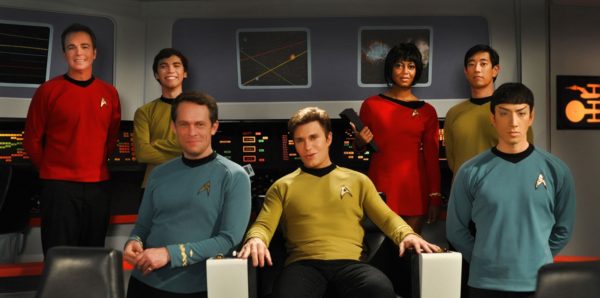
Fans Of 1960s TV Star Trek Should Be Aware of Star Trek Continues

When the next episode of STAR TREK CONTINUES is revealed, science fiction fans will see a familiar face in a guest star role.  The new episode, titled Still Treads the Shadow, features guest star Rekha Sharma, perhaps best known to science fiction fans for her role in more than 30 episodes of Battlestar Galactica.   While details of Sharma’s character in STAR TREK CONTINUES are being kept under wraps until April, she says the offer for a role came after meeting Vic “Kirk” Mignogna at FedCon Germany last year during the 50th Anniversary of STAR TREK event.


“Vic and I kept in touch after FedCon, and then he asked if I’d be interested in coming aboard STAR TREK CONTINUES.  He told me about a script that was in development and the character he had in mind.  I’m so delighted that it worked with my schedule,” Sharma says.   Sharma’s first introduction to the original STAR TREK series came from her big brother.   “All my friends were watching Full House or something.  I’m not sure! And there I was, coming home after school and watching the original STAR TREK and old Perry Mason reruns!  I remember my brother told me that there were people opening and closing the doors, which I thought it was so cool and cheesy. And it very much appealed to my dreams of utopia — especially as a young colored girl growing up in very white neighborhoods,” says Sharma.   Rekha’s character of Tory Foster in the rebooted Battlestar Galactica, which began in 2004, developed after several auditions.   “From the very first audition, I was immediately struck by the intelligence, artistry and kind-heartedness of the directors and producers. I thought, I’d really like to work with these people! First I went in for the role of a Viper pilot, then a captain, and then the role of Tory came along.  Oh yeah, I thought, this is a perfect part for me.” Galactica’s producers apparently agreed.   “Working on Battlestar Galactica was a dream come true.  From my previous experience, I honestly didn’t think I could be creatively satisfied working in TV. But Battlestar Galactica changed that. Not only was it creatively satisfying, but we also had such a great team of people.  We are all like family to this day,” Sharma explains

 star trek continues bridge

What does it mean to be a STAR TREK CONTINUES guest star?   “It means I have fulfilled a dream, in a way, and that I’ve come full circle. I loved those stories. They had a wonderful morality and vision for humanity that made my heart sing. And then I got to step onto those sets and step into my childhood and be a part of telling that kind of story.   Not only that, but that world was so fun! I loved those neat-o futuristic gadgets when I was a kid. And now, as an adult, I got to play with them. I got to sit on the bridge.  There weren’t any trailers, so when I needed to rest between scenes, I took naps in sickbay on board the Enterprise.   And I got beamed in the transporter!  I can’t wait to see that,” she says enthusiastically.   The experience of working on the STAR TREK CONTINUES set “was so refreshing,” Sharma says.  “Everyone is there for love, not money. It felt like Battlestar Galactica that way. Although it’s a fan run project, the STAR TREK CONTINUES sets were surprisingly professional and very impressive. It was a mix of TV veterans and total newbies, and that made for an awesome atmosphere to work in. It was the best of both worlds, really.”   Sharma likes to compare the character she’s playing in Episode 8 to be much like aviation pioneer Amelia Earhart.  “She is smart as a whip, very technically inclined, and brave. I thought of her as a bright light of goodness and intelligence with a big heart.”   She admits to being very surprised at what the cast and crew have created with STAR TREK CONTINUES.   “You know, Vic told me that I’d become part of the family, but I had no idea what he meant. They have chosen a team who are all friendly, diligent, thoughtful and good-hearted people. I felt so welcomed and incredibly lucky. It makes sense that they’re shooting in the south – they’re so hospitable!  And those sets! Again, Vic told me what they built, but until you’re there you just can’t conceive of it. It’s really impressive. I know I’m not the only one who was moved to tears,” Sharma says.   Fans will be able to see Rekha Sharma at future conventions and events.   “It’s funny. At first it felt so strange to do conventions, but as time has gone on I’ve really come to appreciate them.  It’s special to have the opportunity to meet the fans and discuss the themes of these shows. You get to connect with people that you’d never get to meet otherwise. And sci-fi fans are awesome because, generally speaking, they still have dreams. They’re not jaded. They believe in possibility. And without that, nothing would ever change for the better. We’ve got to hold on to our dreams and keep being warriors in this world – to truly go where no man has gone before.”   “Still Treads the Shadow” will premiere at Fan Expo Dallas on April 1 at the Dallas Convention Center.

Frequently Asked Questions and Answers about remaining episodes of STAR TREK CONTINUES 


How are you getting around the guidelines for fan films?   As CBS/Paramount has made clear, the guidelines are not laws; they are general parameters applied on a case-by-case basis. Since the implementation of the guidelines, we have stopped all crowdfunding activities and have focused strictly on completing the four episodes which had already been funded as of that time by fans’ donations to our 501(c)(3) non-profit. STAR TREK CONTINUES has always followed any and all instructions given to us by CBS regarding our production, and will continue to do so.   Does STAR TREK CONTINUES have any type of special and/or official arrangement with CBS/Paramount?   No.


How long are the episodes?   They will be exactly the same format as our previous episodes   Why are you ending the series?   Recent developments necessitated our finishing up sooner than we intended, but it was always our goal to bring The Original Series to a conclusion. With our final four episodes, we will have done that. It’s been an amazing five years creating this series, and we will miss making it.  But all good things… Weren’t you going to make 13 episodes? Did CBS make you stop?   CBS is not responsible for the decision to end the series. We are doing 11 episodes instead of 13 because another fan group took advantage of the good graces of the copyright holders forcing them to protect their property and the interests of their license holders. In deference and gratitude to CBS, we are wrapping up earlier than planned. We always have stood, and continue to stand, with CBS.   Can we get DVDs/Blu-ray discs of the final episodes?   As we do not own STAR TREK, we cannot sell DVDs or Blu-ray discs. In the past, we’ve made a limited number of discs available as crowdfunding perks. However, since we are no longer crowdfunding, providing episodes to the public on DVD and/or Blu-ray discs is not currently feasible for us.   What will happen to the studio/sets? Will set visits/tours be available?   We don’t have a definitive answer on this right now, but we’re considering all our options.

Chinese Newspaper Baskets

Surprisingly sturdy and functional wastebaskets

Okay I admit it, newspapers are dead. But maybe in China they aren’t. Or are.  Because in a local bargain shop I discovered a cache of wastebaskets in three different sizes made entirely out of newspapers: Chinese newspapers to be exact.  And that started me thinking.

It seems probable that in China, or somewhere near there, an active recycling program is taking place. Instead of shredding or burning them for landfill, some sort of manufacturing facility is turning clean, bright and seemingly unread newspapers into functional everyday objects. Does this mean that the newspaper industry is suffering in China? Is there a surplus of printed newspapers? Are more Chinese people getting their news from digital media than print? Who can say. My phone calls to the Chinese embassy consulate in Toronto about these pressing issues were not returned.

The irony of wastebaskets made out of, well, waste, is not (ahem) wasted on me.

These products are powerful “green” metaphors produced in one of the most polluting nations on the planet. The industrialization of China is full steam ahead and damn the torpedoes. Consumer goods? They want everything we have, so it’s hard to claim any moral high ground. Anyway, there is an environmental statement here, intended or not. I’m just not sure what it is.

On the other hand, they are just really fun and handy wastebaskets that feel great when you pick them up by their long, soft handles. I kind of want one.

Supplemental:

In Jennifer Baichwal’s film Manufacturing Landscapes, about Canadian photographer Edward Burtynsky, we learn there are whole towns in China dedicated to breaking down and “smelting” the useable metals out of discarded electronics. When you choose to buy a new DVD player because it’s cheaper than repairing your old one, this is likely where your old one goes. Apparently you can smell these towns a mile off. The Chinese government sure knows a thing or two about recycling. But what would it cost to do this kind of metal recovery safely? What would it cost to make baskets out of the millions of unread, discarded and obsolete print newspapers in Canada?

First “Party Star”, Socialite Dorothy Taylor’s Beverly Hills Mansion For Sale

“The Countess of Beverly Hills Mansions” Before Paris Hilton and Kim Kardashian, socialite Dorothy Taylor may have been the first Hollywood celebrity who wasn’t in the entertainment business. She was the ultimate party host and frequent 1930’s scandal rag fodder. Her lovers included Gary Cooper, Bugsy Siegel, George Raft and an Italian count.

Dorothy Taylor Countess Of Beverly Hills And Interior 3Dorothy’s trip to celebrity fame began after she inherited $12 million in 1916, the equivalent of about $275 million today. The first thing she did with her money was divorce her British aviator husband, Claude Grahame-White, and embark on a long party in Europe’s best circles. In 1923, she married Italian Count Carlo Dentice di Frasso, many years her senior. On the outskirts of Rome, the new countess acquired and restored one of Europe’s most famous homes, Villa Madama, that had been designed in the sixteenth century by Raphael. It was later used by Benito Mussolini during World War II for National Fascist Party functions.
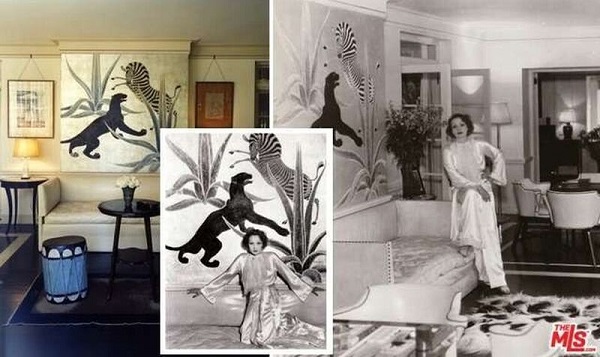
While residing in the villa, actor Gary Cooper was doing a movie in Rome and became quite ill. Dorothy took him in and during his recuperation began an intense affair with him under her husband’s nose. Since she and the count were at that point leading separate lives, Dorothy went on with the affair and moved to Hollywood where she purchased a mansion in Beverly Hills. Making friends of some of Hollywood’s most important stars through her Cooper connections, Dorothy called in the best decorators and landscapers and created a luxurious estate that was classic Art Deco filmdom glamour. Dorothy and Cooper eventually went their own ways but remained distant friends. She was always known as the woman who taught Gary Cooper how to dress, making him the most elegant man in Hollywood.

Dorothy Taylor Countess Of Beverly Hills And Interiors

Through her new Hollywood friends, Dorothy eventually rented her mansion to Marlene Dietrich and headed off to search for sunken treasure on the studio-owned schooner, Metha Nelson; Captain Bligh’s ship in the 1935 movie “Mutiny on the Bounty.” Also on the ship was American gangster Bugsy Siegel. Although the trip turned into a disaster when the schooner was tossed violently by 70 mile-per-hour gale winds that split the main mast and destroyed the sails, it was the start of a new affair with Bugsy.  She always rejected gossip of her association with Bugsy, instead referring to him as Benjamin to her friends.

In 1947, Dorothy sold the Beverly Hills house to MGM pianist Jose Iturbi, who lived there until he died in 1980. In 1954, Dorothy died of heart failure in a train compartment while she was traveling with George Raft from Las Vegas to Los Angeles after attending one of Dietrich’s performances.

Hand painted murals & mirrored verre églomisé panels.

Once again for sale, the beautifully preserved Spanish Revival estate hasn’t changed much since its heyday in the 1930s when it was featured in “House and Garden.” At approximately 8,000 square feet, it has four bedrooms and five baths on 1.12 acres. The home was built for entertaining with large public rooms and although it looks like wallpaper, the walls are covered in hand-painted murals. In the dining room, the walls are mirrored verre églomisé panels that depict towering palms. There is also a two-bedroom guest house and pool nestled within the mature landscaped grounds. The asking price is USD $26.9 million. Dimitri Velis of Hilton and Hyland in Beverly Hills is the listing agent. For the Silo, Terry Walsh.

Visit our friends at TopTenRealEstateDeals.com for more famous homes and real estate news.


UK Firm Offers Modern Tech To Heat Old Homes

NOTE~ As of today’s date, 1 Pound Sterling = $1.88 CDN or $1.39 US dollars Modern Technology to Warm an Old Home by Cast Iron Radiators 4u
Modern Technology to Warm an Old Home by Cast Iron Radiators 4u.

Invest in iconic Space flown items with Heritage Live! Auctions

First Lunar Bible Apollo14Don’t miss out on incredible historic space items such as the first complete Lunar Bible flown aboard Apollo 14. Heritage Live! allows you to place late proxy bids and compete live against the auction floor from your PC or mobile device*. We recommend placing proxy bids before the live session in the unlikely event either side experiences technical problems during the auction.

The software is available for Android, Safari for iPhone, and Opera Mobile version 10+. More will be supported in the coming months.

For more details contact [email protected]

Click here for Free download on HA’s gorgeous 140 page colour Auction catalogue.


Mickey Mouse Animation Cel Brings Ninety Eight Thousand Dollars At Auction

An incredibly rare piece of animation history, an all-original, unrestored production cel and master background from Walt Disney’s 1935 classic “Mickey’s Service Station,” featuring Mickey Mouse and Goofy, realized more than $98,000 USD http://click.ems.ha.com/?qs=a0b6f777c8e9164555c159500ceacad54ad319a092d48c8921bd30eb14370065a07914702d97f374  at Heritage Auctions in New York on July 1, as part of the company’s $1.28+ million Animation Art Signature® Auction, at the Fletcher-Sinclair Mansion (2 E. 79th Street, at 5th Ave.).

We may never know who the artist is that made the auctioned off cel. Walt employed young, pretty women to work in the inking and cell departments. image: still from an early 1940's Walt Disney film explaining how cartoons were being made (watch this below)- "hundreds of pretty girls working in a brightly lit, air-conditioned room" says the narrator. CP
We may never know who the artist was that made the auctioned cel. Walt Disney employed many young, pretty women to work in the inking and cell departments. Image: Still from an early 1940’s Walt Disney film explaining how cartoons were being made. CP

100sOfprettyGirlsInkingDepartmentSaysDisneyVintageFilm

“It’s an extraordinary price for an extra ordinary piece,” said Jim Lentz, Director of Animation Art at Heritage. “This is really a Holy Grail piece of animation and one of the best I’ve ever seen, from one of the best early Mickey cartoons and one of the very last black and white Mickey cartoons before Disney changed everything by going to color.” Besides the rarity of the cel and the background, it is also believed that this is the only known black and white production cel featuring Goofy in private hands. In the classic cartoon Mickey (voiced by Disney himself), along with Goofy and Donald, do their best to find a squeaking sound in Pete’s roadster. Naturally, they take the car apart looking for the source of the annoying sound, which turns out to be a cricket.

The Bullwinkle Show Storyboard

One of the great surprises of the auction came in the form of a set of 1961 storyboards from The Bullwinkle Show (Jay Ward Studios), three extremely rare trimmed storyboards by Roy Morita for the episode “Buried Treasure,” on Ward Inc. storyboard paper, which crushed its $750+ USD pre-auction estimate to finish, amidst very spirited bidding, at $44,460 USD. One panel features Rocky and Bullwinkle, one has a close up of Bullwinkle, and one is an amazing drawing of Frostbite Falls, Minnesota, with the handwritten notation “B+R House” and an arrow pointing out the specific abode.

Top Heritage Buildings In Kitchener Waterloo Include ‘Lady Gaga’ Hotel

TORONTO- Five years ago, a Group of provincial Masonry experts selected its top masonry heritage buildings in the Kitchener-Waterloo, Cambridge region in conjunction with the North Waterloo Region Branch of the Architectural Conservancy of Ontario. These buildings that define Kitchener-Waterloo (K-W) and Cambridge are known for their distinctive beauty, history and longevity.

The Walper Hotel- stopping point for Lady Gaga and in the past Eleanor Roosevelt, Louis Armstrong. photo: Nick Stanley


With an enduring presence that shapes the landscapes on which they were built, these heritage buildings were selected by industry experts as the finest examples of masonry design in the tri-cities of southern Ontario. “Heritage buildings made of brick, block or stone are the longest lasting and most architecturally significant designs in any community,“ says Jack Prazeres, President of MasonryWorx. “Landmarks like these move people with their iconic beauty.”

Prazeres went on to say, “Often built with locally quarried stone and clay for brick, many of these buildings not only define their communities through their design but also their material – they are true reflections of the geography on which they stand.”

The yellow-hued brick for example is a hallmark of this region that creates a sense of place like no other part of Ontario. The yellow-coloured brick comes from calcium rich clay mixed with limestone from the Niagara escarpment.

“Although none of our top masonry heritage buildings used the yellow brick, because in the past it was not considered as high quality as red brick, the yellow brick deserves honourable mention for the regional distinctiveness it has created,” Prazeres says.  “There is no doubt however that this regional brick has stood the test of time and has helped define Waterloo Region.”

Jack Prazeres, President of MasonryWorx- photo courtesy Ministry of Citizenship

The criteria used to choose the top buildings included: durability, aesthetic appeal, craftsmanship, and the best use of masonry products in their architectural design.

After a panel discussion by masonry professionals working with brick, block and stone, MasonryWorx selected the following five 
Kitchener-Waterloo and Cambridge buildings to honour for their masonry heritage 
value:

Galt Collegiate Institute – This Cambridge landmark was founded in 1852, when it was known as the Galt Grammar School, a highly reputable private school for boys. Today, the symmetrical building designed in the Scottish Baronial style houses a public secondary school. The building, which is constructed from fossilized limestone quarried from on-site riverbanks, underwent several additions between 1859 and 1923.

http://gci.wrdsb.ca/

Gore Mutual Insurance Company head office — The 1935 Neoclassical Revival head office of the historic Gore Mutual Insurance Company in Cambridge features impressive exterior fieldstone walls and a beautiful interior finished in at least four types of marble and locally supplied granite. Stunning features of marble and fieldstone also grace the 1955 addition to the building.

http://www.goremutual.ca

Wilfrid Laurier University, Lyle S. Hallman Faculty of Social Work– First known as St. Jerome’s College, the two buildings on this property in Kitchener were built in 1907 and 1909. The buildings are handsome and well-preserved examples of Neo-Classical architecture. The features of the 1907 Duke St. building include the monumental central pavilion with pediment, coupled columns, front entrance, window openings and brickwork. Features of the 1909 College St. building include the brickwork and window openings.

http://www.downtownkitchener.ca/news/wilfrid_laurier_faculty_social/

Walper Hotel – A parade of notable guests from Eleanor Roosevelt and Louis Armstrong to Pierre Trudeau and Lady Gaga have dined and slept at this hotel at King and Queen Streets in Kitchener. Established in 1893, the building cost just $75,000 to build. Guests could have a room, three meals a day, a pitcher of water, gas lamp lighting, a spot to hitch their horse and use of one of the hotel’s common area bathrooms for just $4.50 per week. With its delicate brickwork over the arched windows and elegant cornices, it is the city’s best example of hotel architecture.

http://www.walper.com/the_hotel.html

Wissler-Cascaden House The simple Mennonite Georgian style popular with Pennsylvanian settlers inspired the design of his two-storey house in Waterloo.  It was built in 1842 by John Wissler, a pioneer from Lancaster County, Pennsylvania. He helped establish the hamlet of Lexington thanks to his tannery and the many businesses and trades that sprouted up to support it. The current owners have given a great deal of time, effort and care to the extensive restoration of the house which portrays a faithful representation of early Waterloo. For the Silo, Vickie Fagan. 

http://www.historicplaces.ca/en/rep-reg/place-lieu.aspx?id=10658

The Georgian Style: Constructed in 1842, Waterloo's Wissler-Cascaden House. Compare (search our site) with the Lynnwood Heritage Property housing the Norfolk Arts Centre. CP
The Georgian Style: Constructed in 1842, Waterloo’s Wissler-Cascaden House.


Supplemental- MasonryWorx is the trade association of brick, block and stone masonry industry professionals. Its membership includes product manufacturers, suppliers and skilled professionals from across Ontario, and the organization is committed to providing home buyers, homeowners, architects, engineers, builders and government leaders with accurate, timely information about the use and benefits of brick, block and stone products.