
Tag Archives: survey

Canada’s Financial Rules May Be Holding Growth Back

  • In the second year of our regulatory scorecard paper, results continue to show the need for a more balanced approach to financial oversight, one that explicitly incorporates innovation and competition alongside traditional stability and consumer protection goals.
  • Newly issued and updated regulatory documents did not change previous results.
  • The imbalance reflects the mandates of Canadian regulators, which stand in contrast to those of their UK, Australian, and US peers, where innovation and competition are more explicitly recognized.
  • The study highlights deficiencies in the implementation and communication of cost-benefit analyses. Compliance costs are increasingly embedded across most of the financial sector workforce, with the share of labour costs and revenues devoted to compliance rising steadily, significantly exceeding international counterparts, and falling disproportionately on smaller firms.
  • If left unaddressed, these asymmetric and rising compliance costs risk diverting skilled labour and capital away from core business functions, undermining productivity, innovation, and the overall competitiveness of Canada’s financial sector.
  • Modernizing the mandates of Canadian regulators to explicitly recognize the tradeoffs between stability, investor protection, and economic dynamism is an economic imperative.

1. Introduction

Canada continues to face a well-documented struggle with weak productivity growth, poor business investment, and sluggish economic expansion.1 There is also a quantifiable link in Canada between growing regulatory burdens, including financial sector regulation and weaker growth.2 The challenge, therefore, is not whether to regulate, but how: regulators must find a balance between safeguarding financial stability and enabling economic dynamism. Achieving such a balance could be especially consequential in Canada, where both growth and competitiveness remain fragile.

Against this backdrop, a crucial question is whether Canadian financial regulators operate within a sound and structured framework that ensures the implementation of truly necessary rules and regulations. To provide an answer, this paper builds on the work of Bourque and Caracciolo (2024)3 which employed two complementary types of analysis – one theoretical, one empirical – to shed light on the strengths and the weaknesses of Canada’s regulatory landscape.

The theoretical analysis established the foundation for evaluating regulatory effectiveness by defining the core principles that should guide financial regulators in building a sound and efficient regulatory framework.4 It identified three essential steps that should underpin any regulation-making process: (1) thoroughly identifying the problem; (2) conducting a comprehensive cost-benefit analysis to weigh the implications of potential regulations; and (3) clearly articulating objectives to ensure predictability and consistency.

The empirical analysis involved a two-stage quantitative and qualitative textual analysis. The first stage consisted of an international comparison, where the performance of Canada’s primary federal financial regulator – the Office of the Superintendent of Financial Institutions (OSFI) – was benchmarked against two international counterparts: the United Kingdom’s Prudential Regulation Authority (PRA) and the Australian Prudential Regulation Authority (APRA). This comparative analysis helped contextualize OSFI’s regulatory approach in relation to best practices observed in other financially comparable jurisdictions.

The second stage dug deeper into the Canadian financial regulatory landscape, evaluating the regulations of the main federal and provincial bodies against the principles identified in the theoretical framework. To do this, Bourque and Caracciolo (2024) developed a comprehensive scorecard that assessed core regulatory documents to determine the extent to which Canadian regulators adhered to these principles.

The findings showed that although Canadian regulators have generally succeeded in crafting well-structured regulations, their approach often falls short of adhering – on aggregate – to the core principles outlined in the framework. This leads to a lack of predictability and a more reactive, rather than proactive, set of rules and regulations. In this environment, rules are introduced in response to emerging challenges rather than through proactive, forward-looking planning. Further, there is a notable lack of systematic and substantive use of cost-benefit analysis, both in the development of regulations and in communicating their expected impact.

The scorecard allowed for an investigation into the priorities of Canadian regulators. Most of the current regulations in Canada place financial stability and consumer protection as their primary goals. These are, of course, both crucial objectives; however, they are too often pursued without adequate consideration of their interplay with innovation and competition. As a result, regulatory frameworks may end up stifling growth, particularly among smaller firms that lack the resources to absorb compliance costs as easily as larger institutions.

Building on last year’s study, this paper has three principal objectives. First, it updates the regulatory scorecard. An annual update makes it possible to track how Canadian regulatory priorities evolve over time and assess whether any progress is being made in addressing the shortcomings identified earlier. Notably, this updated scorecard reveals that the fundamental orientation of Canadian financial regulation remains largely unchanged: stability and consumer protection continue to dominate (if anything, with a slight uptick), while considerations of dynamism, innovation, and competition remain on the back burner. To be sure, some rebalancing is emerging. Ad hoc initiatives – such as blanket orders, sandbox activities, and similar discretionary measures – have introduced some pockets of innovation and efforts to reduce administrative burden. Nevertheless, our main point persists: without a deeper shift in regulatory philosophy, such measures risk remaining isolated exceptions, rather than indicative of a broader shift.

To probe the core of Canadian regulators’ philosophy – and to test whether the observed regulatory imbalance is structural – the analysis is extended to include foundational documents that set out regulators’ objectives, mandates, and missions.5 Examining these texts allows for an assessment as to whether the current priorities are rooted in the very design and self-perception of regulatory institutions, rather than from recent or temporary policy choices. The results show a clear hierarchy of objectives in regulator mandates across the country, with stability and consumer protection firmly dominant. This stands in contrast to the mandates of regulators in the UK, Australia, and the US, where innovation and competition feature more prominently. Without a shift toward a more balanced regulatory philosophy, Canada risks falling further behind in competitiveness, innovation-driven growth, and overall economic resilience.

One consequence of this regulatory imbalance is the potential for disproportionate compliance costs – relative to benefits – being imposed on the financial sector. Hence, the third goal of the paper is to evaluate the cost side of cost-benefit analysis in regulatory decision-making. We do this by quantifying and identifying compliance costs imposed by financial regulations across different financial subsectors, with particular attention to varying firm sizes. By empirically assessing these costs, this study fills a critical gap in the literature, offering concrete evidence of how current regulatory frameworks affect businesses, especially smaller firms that may face a heavier burden. Our aim is to start a new, thorough, and reliable database that will create valuable insights for policymakers and regulators.

The first wave of results is concerning.

Although the benefits of regulation are difficult to measure, compliance duties are becoming increasingly embedded across most of the financial sector workforce. The share of labour and revenues devoted to compliance continues to rise – well above international counterparts – and the burden falls disproportionately on smaller firms. If left unaddressed, these asymmetric and rising compliance costs risk diverting skilled labour and capital away from core business functions, further undermining productivity, innovation, and the overall competitiveness of Canada’s financial sector.

2. The Updated Scorecard

2.1 Methodology

To update the regulatory scorecard, we employ the same textual and topic analysis framework as in the previous study (Bourque and Caracciolo 2024), applying it to newly issued and updated regulatory documents from the past year (June 2024 to June 2025) alongside previous documents. Our focus remains on key regulatory materials across the banking, insurance, pensions, and securities sectors, including Financial Services Regulatory Authority of Ontario (FSRA) Guidelines, Autorité des marchés financiers (AMF) Guidelines, Office of the Superintendent of Financial Institutions’ (OSFI) Guideline Impact Analysis (and related documents), and Canadian Securities Administrators’ (CSA) Companion Policies.6

Using natural language processing (NLP) techniques (see Bourque and Caracciolo [2024] for a more complete description), we extract and classify key terms, sentences, and logical arguments to assess how these documents address market failures (e.g., market abuse, asymmetric information, systemic and liquidity risk), policy objectives (e.g., stability, transparency, efficiency), and cost-benefit considerations.7 This allows us to evaluate the extent to which Canadian regulators align with the core principles of sound regulatory decision-making: problem identification, cost-benefit assessment, and clear articulation of objectives.

While the core methodology remains unchanged, this iteration refines our classification process.8 We will perform this update on an annual basis, allowing us to systematically track shifts in regulatory priorities over time. The full updated scorecard, which reflects these refinements and new findings, is presented in online Appendix C (Table 1).

2.2 Results

This updated regulatory scorecard reveals similar results as last year in Canadian financial regulation: the fundamental priorities of regulatory authorities have remained largely unchanged, with consumer protection, transparency, and stability dominating the regulatory agenda. Despite ongoing discussions about the need to stimulate economic growth in Canada, our analysis indicates that a more balanced approach to financial oversight, one that explicitly incorporates innovation and competition alongside these traditional goals, remains largely absent from newly issued and updated regulatory documents (evaluated alongside existing documents).

Most regulatory initiatives (approximately 92 percent versus 89 percent of last year) primarily target market abuse, stability, transparency, and, ultimately, improved consumer protection. On the other hand, a smaller fraction (around 14 percent, compared to 16 percent last year) explicitly aim to enhance efficiency, promote growth and innovation, and take into account the stability versus dynamism trade-off that is a critical part of any regulatory structure.

One notable exception among the newly analyzed documents is delivered by FSRA’s Guideline GR0014APP, which demonstrates a departure from the prevailing regulatory narrative. This document explicitly acknowledges the importance of fostering a more dynamic financial marketplace, introducing measures aimed at reducing barriers to entry and enhancing the competitive landscape.9 We also acknowledge that CSA’s National Instrument 81-101 Mutual Fund Prospectus Disclosure, which focuses on enhancing transparency and investor protection through standardized disclosure requirements, aims to simplify the disclosure procedure and, therefore, represents an important step forward in regulatory efficiency.

Beyond these individual measures, we note that FSRA and CSA have also set out broader ambitions. FSRA’s 2024–2027 Strategic Plan highlights burden reduction and regulatory efficiency, while CSA’s 2025–2028 Business Plan emphasizes internationally competitive markets and regulatory approaches that adapt to innovation and technological change. These commitments are commendable and encouraging, but they remain largely aspirational: they signal intent, but the challenge is whether they will translate into consistent features of day-to-day regulatory instruments. Our annual updated scorecard will be able to monitor this.

Breaking down our analysis to the single regulator level, FSRA stands out as the one that has gone furthest in bridging the gap between intentions and actions: around 17 percent of its analyzed documents now contain growth or innovation considerations (up from 13 percent last year). By contrast, CSA – which admittedly had the highest percentage last year – OSFI, and AMF remain closer to their prior levels, with innovation-oriented content in only 18 percent, 10 percent, and 10 percent of their documents, respectively. For now, the broader regulatory environment continues to disproportionately prioritize risk mitigation and consumer safeguards over fostering a more adaptive and competitive financial sector.

Moreover, and again consistent with last year, there is a dearth of explicit cost-benefit analysis or meaningful discussion of the broader economic costs imposed by the regulatory interventions across nearly all examined documents.10

3. Where Does This Imbalance Come From?

Our scorecard raises a fundamental question: is this imbalance an unintentional result, or does it reflect the regulators’ mandate and therefore a structural feature of Canada’s regulatory landscape? To answer this, we examined the mandates and missions of Canadian financial regulators (prudential and securities regulators alike). For the vast majority, dynamism, competition, and capital formation are typically only included following the mission statements – OSC being a notable exception. The primary focus of the mission statements remains on stability, investor protection, and market integrity, which are vital but fall short of capturing the full potential of a dynamic, innovative financial sector.

For example, OSFI’s mandate is to:

  • “ensure federally regulated financial institutions (FRFIs) and federally regulated pension plans (FRPPs) remain in sound financial condition;
  • ensure FRFIs protect themselves against threats to their integrity and security, including foreign interference;
  • act early when issues arise and require FRFIs and FRPPs to take necessary corrective measures without delay;
  • monitor and evaluate risks and promote sound risk management by FRFIs and FRPPs.”11

It is only after that that they say, “In exercising our mandate:

  • for FRFIs, we strive to protect the rights and interests of depositors, policyholders and financial institution creditors while having due regard for the need to allow FRFIs to compete effectively and take reasonable risks.”

To further substantiate this point, we look to see whether the secondary status of competition, cost, and innovation in Canadian regulators’ mandates is a uniquely Canadian phenomenon or part of a broader international pattern. Benchmarking against international best practices is particularly relevant in financial regulation, where peer jurisdictions face similar market dynamics and policy tradeoffs. By comparing Canada’s regulatory mandates to those of similar international counterparts, we can better assess whether the Canadian approach reflects a deliberate policy choice or a missed opportunity to align with evolving global standards.

As in the scorecard, we conducted a systematic textual analysis of the mandates and missions of major financial regulators in Canada, the UK,12 Australia,13 and the United States.14 Using natural language processing techniques, we extracted and quantified the most prominent themes and keywords in these foundational documents.15 The results are visually summarized in the accompanying wordclouds. The size of each word reflects its frequency and “keyness” – a measure of statistical importance and relevance within the analyzed texts. Unlike simple term frequency, this approach highlights the concepts and priorities regulators emphasize disproportionately relative to the overall corpus, providing a more nuanced quantitative assessment. The wordclouds thus offer an intuitive visual snapshot of the dominant regulatory themes.

What emerges from this analysis is a clear divergence in regulatory philosophy. The wordclouds for the UK and Australia show that terms such as “competition,” “growth,” and “cost” are extremely relevant in the language of their regulators’ mandates. This reflects an explicit and deliberate embedding of economic dynamism and efficiency into their regulatory objectives.

Indeed, the UK’s PRA and Australia’s APRA, while maintaining stability and consumer protection as core priorities, have made efforts to explicitly incorporate competition, innovation, and market adaptability into their mandates over the past decade (Figure 1). The PRA, for example, makes the case that long-term resilience requires a financial sector that is not only stable but also competitive, forward-looking, dynamic, and innovative. By integrating efficiency and market innovation, the PRA looks to ensure that the financial ecosystem can grow and evolve with emerging market demands.
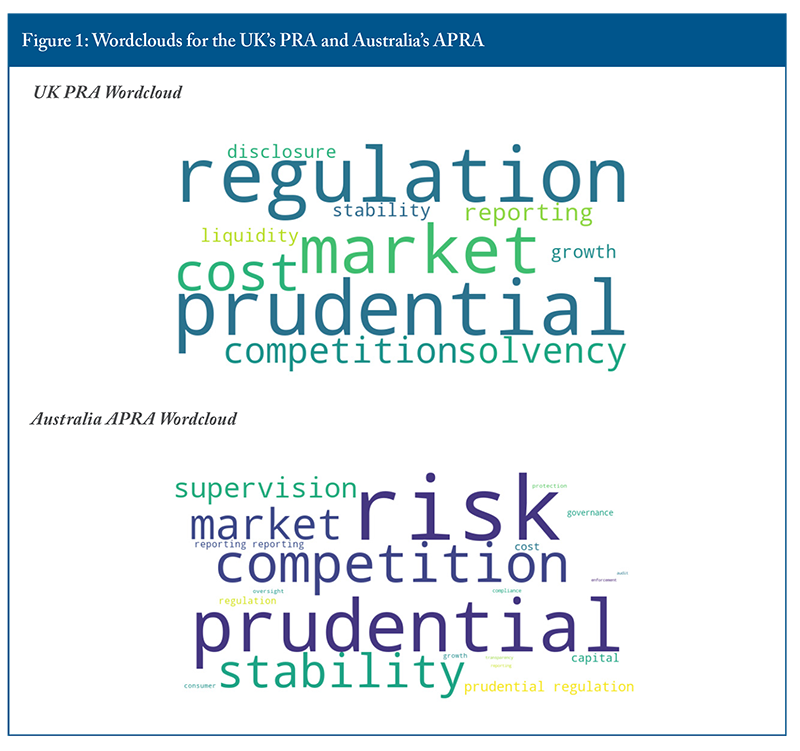
Similarly, APRA’s mandate balances the primary objective of safety “with considerations of competition, efficiency, contestability (making barriers to entry high enough to protect consumers but not so high that they unnecessarily hinder competition) and competitive neutrality (ensuring that private and public sector businesses compete on a level playing field).”16

In contrast, the wordclouds for Canadian deposit-taking and insurance regulators reveal a notable absence of such language (see Figure 2 for OSFI, FSRA17, and AMF18). Their mandates and mission, while perhaps containing references to competition and growth, are dominated by terms like “stability,” “solvency,” “obligation,” and “consumer protection.”
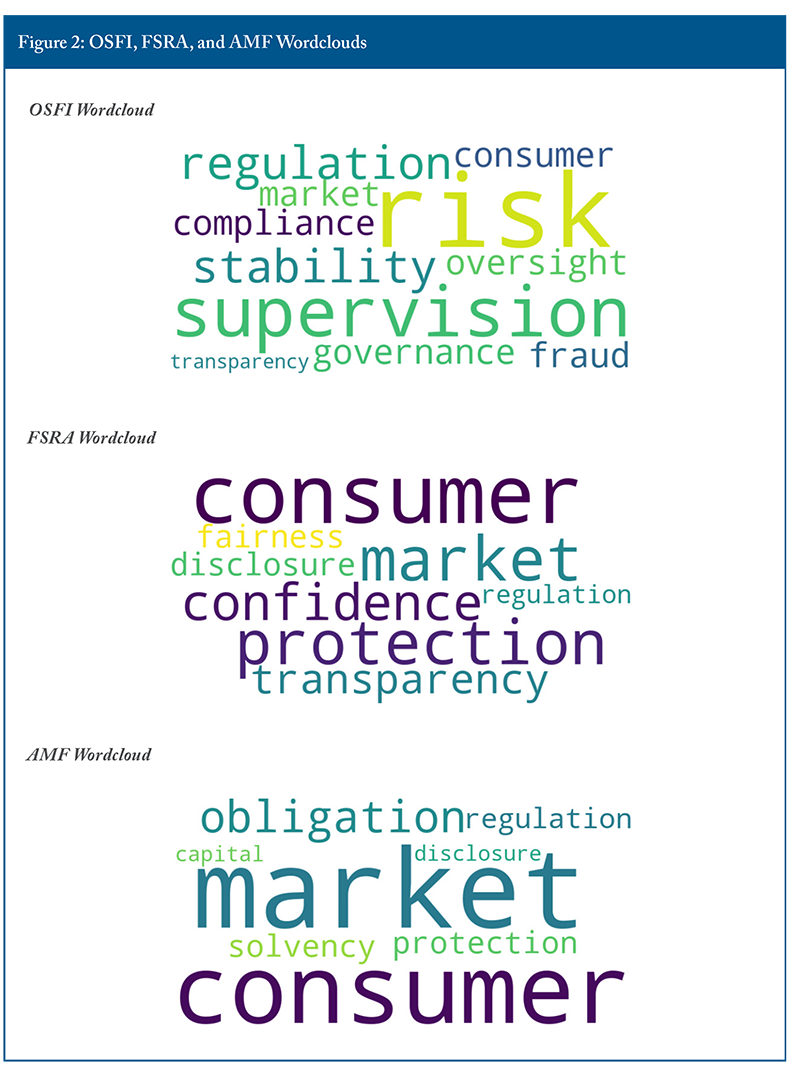
This linguistic gap is not just cosmetic; it reflects a structural difference in regulatory philosophy. Without a formal mandate to consider competition or cost, many Canadian regulators have less incentive to systematically integrate these factors into their rulemaking.

A similar divergence is evident in securities regulation. The UK’s Financial Conduct Authority (FCA) and the US Securities and Exchange Commission (SEC) place competition, growth, dynamism, and capital formation at the centre of their regulatory mandates (Figure 3).19
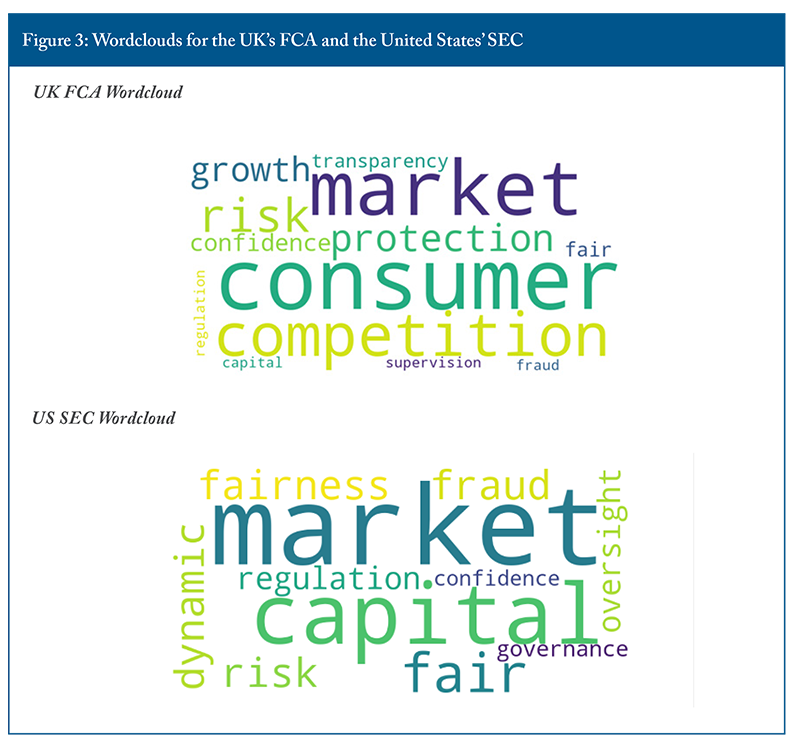
These are not just theoretical differences. SEC’s statutory responsibility to facilitate capital formation led to a practical framework that drives policies to increase market access for a broader range of firms. The SEC has introduced initiatives such as Regulation A+ and crowdfunding exemptions, which aim to make it easier for small and emerging firms to raise capital while balancing investor protection. The FCA’s mandate similarly incorporates competition as a core principle, emphasizing measures to ensure that financial markets remain vibrant and responsive to technological progress, highlighting also how this, in turn, will increase investors’ welfare.

In contrast, although some of the largest securities commissions – such as the OSC, BCSC, and ASC – are notable exceptions, explicit competition or capital formation mandates are not necessarily the norm across our 13 provincial securities commissions, nor at the umbrella organization, the CSA (see Figure 4 for CSA’s wordcloud).20 The Ontario government did take a step in this direction in 2021, when it expanded the OSC’s mandate to include fostering capital formation and competition.
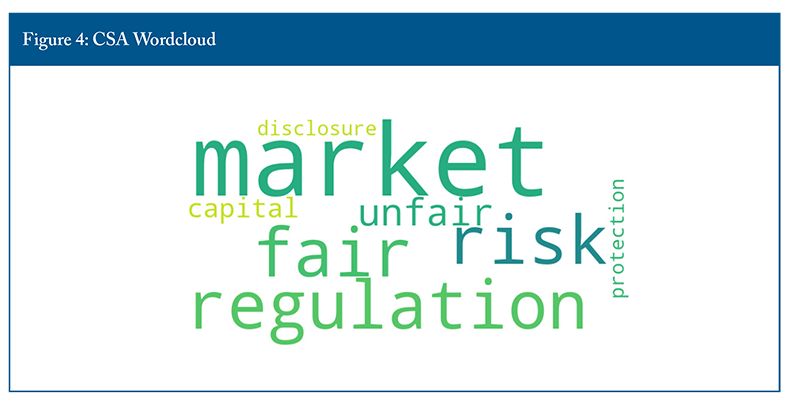
While investor protection and market integrity remain fundamental and essential objectives, the absence of a consistently clear directive to foster market dynamism means that regulatory actions are more likely to be slanted towards a more cautious, conservative approach. There have certainly been some targeted efforts to support innovation and broaden access to capital, such as the CSA’s Financial Innovation Hub21 and their harmonized crowdfunding rules, but these remain isolated and ad hoc. Unlike the systematic, mandate-driven commitment seen in the UK and the United States, Canadian initiatives are not consistently rooted in a formal regulatory priority to promote capital formation.

This regulatory gap is particularly concerning given Canada’s persistent struggles with weak productivity growth, poor investment, sluggish economic expansion, and relatively low levels of innovation adoption.22 A financial regulatory environment that does not explicitly encourage competition, innovation, and capital formation may reinforce these trends by raising barriers to entry, increasing compliance costs for smaller firms, and discouraging capital market participation, particularly from high-potential startups and emerging sectors. The absence of a statutory capital formation mandate within securities regulation means that new firms seeking to grow or disrupt established industries may face challenges in accessing the funding they need, further contributing to a stagnant market environment.

Modernizing the mandates of Canadian regulators to explicitly recognize the tradeoffs between stability, investor protection, and economic dynamism is an economic imperative. Without a shift toward a more balanced regulatory philosophy, Canada risks falling further behind in capital market competitiveness, innovation-driven growth, and overall economic resilience. Financial stability does not have to come at the expense of progress, and as other international regulators are trying to do, we should aim to achieve the best-designed regulatory framework in order to foster both stability and market growth. A more forward-looking mandate, in which competition, capital formation, and innovation are treated as integral to the health of the financial system, would not only strengthen Canada’s economic position but also ensure that its regulatory framework remains adaptable to future challenges and opportunities.

4. Neglected by Design: Quantifying the Costs of Regulation

A practical consequence of the imbalance in regulatory priorities are gaps in how cost-benefit analyses are designed and implemented in Canadian financial regulation. A further goal of this paper is to help push this issue ahead by developing a method for more accurately quantifying regulatory costs. The aim is to create a new, annually updated and survey-based cost database that provides a new lens on the regulatory burden and equips regulators with a tool to better understand the real impact of their activity across firms of different sizes and sectors. We acknowledge upfront that we focus specifically on the cost side of the analysis, leaving the benefits assessment to future work.

4.1 The Importance of Quantifying Regulatory Costs and the Difficulties Implied by the Task

The costs of regulations – across all industries, including financial services – are often cited as one of the biggest factors contributing to reduced market entry, increasing industry concentration, and weak investment. This pattern is evident worldwide, including in the United States and Canada (Gutiérrez and Philippon 2019, 2017), as well as in many other developed countries (Aghion et al. 2021). The mechanism postulated by the literature above is that compliance costs as a result of government regulations disproportionately impact small firms, creating barriers to new entrants, inhibiting business growth, and therefore ultimately slowing down productivity. Additionally, when large incumbents face increased regulatory costs, they either incur them, which may affect other parts of their business, or pass some of these costs on to consumers, especially if, given higher barriers, they end up possessing significant market power. As a result, consumers will also be adversely affected, which has broader implications for the overall economy.

The central issue remains the unresolved question of how to define and quantify the total compliance cost properly, as well as how to assess whether these costs affect small and large firms differently. Measuring compliance costs at the firm level is, in fact, a highly complex challenge from both qualitative and quantitative perspectives.

First, from a qualitative perspective, there is no unanimous agreement on which costs to include and how to model their impact on different firms. While some argue that the biggest part of compliance costs can be significantly decreased through economies of scale and lobbying, and therefore are much smaller for larger firms (Davis 2017; Alesina et al. 2018; Gutiérrez and Philippon 2019; Akcigit and Ates 2020; Aghion et al. 2021), others suggest that small businesses are, in fact, the ones in a better position, as they receive plenty of exemptions (Brock and Evans 1985; Aghion et al. 2021).23

Second, from a quantitative perspective, measuring firm-specific regulatory burdens presents numerous obstacles. Quantifying firm-level compliance costs is complex due to limited granular data. Existing studies often focus on broad relationships or industry-level shocks (Gutiérrez and Philippon 2019), lacking detailed evaluations of individual business burdens. These obstacles include variations in regulatory requirements across financial subsectors, overlapping regulations from different government levels, tiered compliance rules, varying inspection stringency, and differing technological and efficiency constraints across firm sizes (Agarwal et al. 2014; Stiglitz 2009; Kang and Silveira 2021; Goff et al. 1996). As Goff et al. (1996) noted, “the measurement problems are so extensive that directly observing the total regulatory burden is practically impossible.”

4.2 Modelling and Measuring Compliance Cost and Its Impact on Labour Productivity: Traditional Methods and Our Approach

Traditional approaches to quantifying the regulatory burden typically fall into two broad categories: counting the number of regulations in force or measuring the size of compliance departments within firms.24 The first approach, despite its widespread use, is simplistic and can be misleading. It assumes that each new regulation automatically adds the same weight to firms’ compliance burdens, failing, therefore, to account for differences in complexity, enforcement, and actual economic impact. Most importantly, it also disregards the fact that not all regulatory documents impose additional costs. Some provide clarifications, interpretation, simplify compliance procedures, or consolidate existing rules, thereby reducing uncertainty and making it easier for businesses to adhere to legal requirements. A regulatory framework with an extensive set of well-organized, clearly written guidelines can be far easier to navigate than a system with fewer but ambiguous or conflicting regulations. Yet, a raw count of regulations makes no such distinctions, treating all rules as equally burdensome and limiting insights into the real costs faced by businesses.

The second common approach – measuring the size of compliance departments – is somewhat more informative but still incomplete. This method operates on the assumption that regulatory costs can be estimated by looking at the number of employees explicitly assigned to compliance roles.25 While this metric does offer a tangible measure of firms’ direct expenditures on compliance, it fails to capture the reality that regulatory obligations extend far beyond dedicated compliance teams. In practice, firms cannot limit compliance tasks to a single department; employees across multiple functions – including finance, operations, and even customer service – must allocate significant portions of their work to meeting particular regulatory requirements. These responsibilities often divert employees from their core business functions, increasing operational complexity and reducing efficiency in ways that are difficult to measure using traditional methods.

The failure to account for these indirect costs leads to a fundamental misrepresentation of how regulatory compliance affects firms, particularly with respect to labour productivity. Standard measures of productivity typically calculate output per worker, assuming that all employee time is dedicated to value-generating activities. However, when employees across departments must dedicate significant portions of their time to compliance, their effective contribution to production decreases even if they are not officially counted as part of the compliance workforce. This distortion is particularly relevant in highly regulated industries, such as the financial sector, where firms must continuously adapt to evolving rules, engage in periodic audits, and maintain detailed reporting practices. These obligations consume work hours that could otherwise be devoted to innovation, strategic growth, or client service. By failing to account for these hidden labour costs, traditional approaches systematically underestimate the true economic impact of regulatory compliance.

Evidence in support of this argument comes from occupational data sources such as the US O*NET database, which provides firm-level insights into job responsibilities at the single-employee level across industries. These data reveal that compliance-related tasks affect, to different extents, most of the workers, and are not confined to designated regulatory personnel.26

A more accurate framework for assessing regulatory costs must therefore go beyond these limited proxies and capture the full extent of compliance-related labour reallocation. This is precisely what we try to accomplish with our project. Through detailed firm-level surveys, we collect data not only on compliance department size but also on how regulatory responsibilities are distributed across the entire workforce. By distinguishing between employees who are fully dedicated to compliance and those who must allocate a portion of their time to regulatory tasks, we can develop a more precise estimate of how compliance demands affect firms’ overall labour productivity and financial performance. Our approach, which we call the Compliance Labour Cost Index, allows us to measure variation in regulatory costs across firms of different sizes and financial subsectors, helping to assess whether burdens are proportionate or not.27

Furthermore, our survey methodology captures the evolution of compliance intensity over time. This paper presents the first wave of our survey, with our long-term goal being to conduct it every year, thereby creating a dynamic, up-to-date resource for understanding regulatory costs. By maintaining a consistent, structured approach to data collection, we will be able to track changes in compliance burdens over time, offering insights into whether new regulations are increasing costs, whether firms are finding more efficient ways to comply, and how regulatory expenses vary across different business models. This database will provide a clearer picture of regulatory costs at the firm level and also equip policymakers with the empirical evidence necessary to design smarter, more effective regulations – ones that balance economic growth with necessary oversight.

4.3 Survey Results

28

The results presented here are based on an unbalanced panel29 of survey responses covering three fiscal years: 2019, 2023, and 2024.30 This structure allows us to capture both pre- and post-pandemic conditions while filtering out the most acute COVID-19-related distortions in 2020, 2021, and 2022. The panel includes firms of varying sizes across the different subsectors of the Canadian financial sector, enabling both an aggregate view and size-based comparisons. The key findings from this survey can be grouped into four main observations, each highlighting a distinct aspect of the compliance burden.

Fact 1: Compliance is Everyone’s Job!

Compliance work is now deeply embedded across the financial sector workforce. In 2024, on average, 73 percent of employees had at least some compliance-related duties, and close to 8 percent spent the majority of their time (75–100 percent) on such tasks. As postulated in the previous sections, regulatory obligations are not confined to specialist compliance teams but are interwoven into the daily operations of most departments, diverting time and focus away from activities that directly generate value for clients or shareholders. The pervasiveness of compliance roles means that regulation is no longer something handled at the margins of the business, but rather a constant presence shaping workflows across the organization.

Fact 2: Compliance Is Eating Payroll – A Growing Regulatory Burden Is Reshaping Workforce Allocation

The share of total labour costs devoted to compliance-related activities (time and salaries spent meeting regulatory requirements rather than delivering core products or services) has been rising steadily. Our Compliance Labour Cost Index stood at approximately 16 percent in 2019, rose to around 19 percent in 2023, and reached 22 percent in 2024. To put it differently, around one dollar in every five spent on payroll is now directed to tasks that exist solely to ensure regulatory adherence. To put these figures in context, Trebbi et al. (2023), using US establishment-level O*NET data, estimate that regulatory compliance accounts for 2.3 percent to 2.7 percent of total labour costs across the US financial sector. This divergence highlights the crucial need for a more systematic cost-benefit approach in Canadian regulatory design. We simply cannot afford such a big gap.31

Fact 3: External Compliance Costs Are Also Surging, and Are Eating into Revenues

While internal labour costs capture the human effort behind compliance, they tell only part of the story. A significant (and growing) portion of the regulatory burden is channelled through external spending: advisory fees, legal fees, compliance technologies, governance structures, and membership dues. These costs are less visible but no less impactful, directly affecting firms’ bottom lines and reducing their strategic flexibility. To gauge both their scale and their evolution over time, we measure external compliance costs as a share of total revenues. We can observe how this ratio has risen steadily over the three years analyzed, climbing from about 1.2 percent in 2019 to 1.6 percent in 2024. The increase reinforces how compliance imposes a mounting financial strain beyond internal labour, diverting resources that could otherwise be invested in innovation, growth, and other productive initiatives.

Fact 4: Size Matters (a Lot!) – The Compliance Burden Hits Small Firms Hardest

A striking asymmetry emerges between small firms (under 100 employees) and large firms (over 100 employees).32 While the growth rate of compliance involvement and costs appears independent of firm size, their magnitude is not. In both 2023 and 2024, an average of 35 percent of workers in small firms had high or medium compliance involvement, compared with just 13 percent in larger ones.

As a natural consequence, smaller institutions shoulder significantly higher compliance costs: in 2024, the labour cost index reached 20 percent for small firms, compared with 12 percent for larger ones.

This imbalance is particularly worrying when we consider that small firms and startups are often the main engines of innovation, and as they grow, of productivity growth as well. Yet, these seem to be precisely the firms disproportionately drained by regulatory demands, risking a throttling effect on the dynamism and competitiveness of the entire financial sector.

In short, these facts require attention. Reassessing compliance costs must be an urgent priority on the regulators’ agenda, as it is essential to ensure the health and resilience of our financial sector.

5. Policy Discussion and Conclusion

The updated regulatory scorecard confirms that the core patterns identified in prior analysis persist. Canadian financial regulation continues to focus overwhelmingly on stability and consumer protection, while innovation, competition, and cost-efficiency remain secondary. This regulatory orientation is not just a product of recent policy inertia; it is deeply rooted in the structural design of mandates and institutional priorities. Current mandates apply a lexicographic hierarchy that prioritizes financial stability and consumer safeguards above all else – often at the expense of reducing unnecessary regulatory burdens and fostering economic dynamism and growth.

This imbalance is set to become an even greater challenge amid profound global shifts. Political instability in the United States, ongoing conflicts, and broader geopolitical tensions have created a more volatile and unpredictable environment. Stability will remain crucial, but Canada also has an opportunity to adopt regulatory frameworks that actively promote efficiency, innovation, and growth. With such elements in place, Canadian financial institutions can better thrive in a changing world while reinforcing the very stability regulators aim to safeguard.

The costs of the current imbalance are already evident. Evidence shows that compliance burdens are rising sharply, with significant implications for firms’ competitiveness. Our Compliance Labour Cost Index, which tracks regulatory labour across the sector, reveals that compliance demands grew from 16 percent of total internal labour in 2019 to 21 percent in 2024. The strain is particularly acute for smaller firms, where compliance costs reached 28 percent of payroll – double the share borne by larger institutions. External compliance expenses, including advisory, technology, and governance costs, have also grown, further restricting firms’ ability to invest in growth and innovation.

These findings show that stability-focused regulation, absent economic balance, can erode productivity, innovation, and long-term market vitality. Smaller firms are particularly vulnerable, even though they are central drivers of competition and innovation. Policy responses should therefore focus on two priorities.

First, regulatory mandates must be modernized to recognize the full set of policy objectives: stability, investor protection, efficiency, growth, and competition. Explicitly embedding economic goals alongside traditional safeguards would bring Canadian practice closer to international standards and create a more adaptive framework. Encouragingly, securities regulators in Ontario, BC, and Alberta, as well as Ontario’s provincial prudential regulator, FSRA, have already begun acknowledging this need in business plans that emphasize competitiveness and in guidelines aimed at reducing regulatory burden. Our scorecard will continue to track whether such commitments translate into practice.

Second, regulatory design should always require rigorous cost-benefit analyses that are made publicly available at the outset of rulemaking. Transparent, upfront cost-benefit analyses would establish clear benchmarks against which post-implementation reviews can be meaningfully conducted. Tools such as our Compliance Labour Cost Index can enrich this process of comparison. Institutionalizing public cost-benefit analyses would ensure that regulations are evaluated not only against their intended goals but also against their real-world economic costs, enabling more proportionate and adaptive policymaking.

In sum, safeguarding stability and protecting consumers remain essential. But stability itself increasingly depends on Canada’s ability to sustain competitive, innovative, and efficient financial markets.

The author extends gratitude to Pragya Anand, Angélique Bernabé, Ian Bragg, Jeff Guthrie, Sarah Hobbs, Jeremy Kronick, Peter MacKenzie, Grant Vingoe, Mark Zelmer, Tingting Zhang, and several anonymous referees for valuable comments and suggestions. The author retains responsibility for any errors and the views expressed.

For the Silo, Gherardo Caracciolo – C.D. Howe Institute.

REFERENCES

Agarwal, Sumit, David Lucca, Amit Seru, and Francesco Trebbi. 2014. “Inconsistent Regulators: Evidence from Banking.” The Quarterly Journal of Economics 129(2): 889–938.

Aghion, Philippe, Antonin Bergeaud, Timo Boppart, Peter J. Klenow, and Huiyu Li. 2019. “Missing Growth from Creative Destruction.” American Economic Review 109(8): 2795–2822.

Akcigit, Ufuk, and Sina T. Ates. 2020. “Ten Facts on Declining Business Dynamism and Lessons from Endogenous Growth Theory.” American Economic Journal: Macroeconomics 13(1): 257–298.

Alesina, Alberto, Carlo A. Favero, and Francesco Giavazzi. 2018. “What Do We Know about the Effects of Austerity?” American Economic Association Papers and Proceedings 108: 524–530.

Bourque, Paul C., and Gherardo Gennaro Caracciolo. 2024. The Good, the Bad and the Unnecessary: A Scorecard for Financial Regulations in Canada. Commentary 664. Toronto: C.D. Howe Institute. July. https://cdhowe.org/publication/good-bad-and-unnecessary-scorecard-financial-regulations-canada/.

Brock, William A., and David S. Evans. 1985. The Economics of Small Businesses: Their Role and Regulation in the U.S. Economy. New York: Holmes & Meier.

Davis, Steven J. 2017. “Regulatory Complexity and Policy Uncertainty: Headwinds of Our Own Making.” Brookings Papers on Economic Activity (Fall): 301–375.

Eichenbaum, Martin, Michelle Alexopoulos, and Jeremy Kronick. 2024. “Economists Must Convince the Public That Productivity Isn’t Just a Number.” The Globe and Mail. August 5. https://cdhowe.org/publication/eichenbaum-alexopoulos-kronick-economists-must-convince-public-productivity-isnt-just/.

Goff, Brian L., et al. 1996. Regulation and Macroeconomic Performance. Vol. 21. New York: Springer Science & Business Media.

Gu, Wulong. 2025. “Regulatory Accumulation, Business Dynamism and Economic Growth in Canada.” Analytical Studies Branch Research Paper Series, no. 481. Statistics Canada. February 10. https://doi.org/10.25318/11f0019m2025002-eng.

Gutiérrez, Germán, and Thomas Philippon. 2017. “Declining Competition and Investment in the U.S.” NBER Working Paper No. 23583. https://doi.org/10.3386/w23583.

_______________. 2019. “The Failure of Free Entry.” NBER Working Paper No. 26001.

Kang, Karam, and Bernardo S. Silveira. 2021. “Understanding Disparities in Punishment: Regulator Preferences and Expertise.” Journal of Political Economy 129(10): 2947–2992.

Restuccia, Diego, and Richard Rogerson. 2008. “Policy Distortions and Aggregate Productivity with Heterogeneous Establishments.” Review of Economic Dynamics 11(4): 707–720.

Robson, William B.P., and Mawakina Bafale. 2024. Underequipped: How Weak Capital Investment Hurts Canadian Prosperity and What to Do about It. Commentary 666. Toronto: C.D. Howe Institute. September. https://cdhowe.org/publication/underequipped-how-weak-capital-investment-hurts-canadian-prosperity-and-what/.

Stiglitz, Joseph. 2009. “Regulation and Failure.” In New Perspectives on Regulation, edited by David Moss and John Cisternino, 11–23. Cambridge, MA: The Tobin Project.

Trebbi, Francesco, Miao Ben Zhang, and Michael Simkovic. 2023. “The Cost of Regulatory Compliance in the United States.” USC Marshall School of Business Research Paper. January 15. https://doi.org/10.2139/ssrn.4331146.

Arab Public Opinion Poll About Israeli War On Gaza

Doha, January 2024 // The Arab Center for Research and Policy Studies announced the results of their public opinion poll regarding the Israeli war on Gaza on Wednesday 10 January 2024. The poll was carried out on a sample of 8000 respondents (men and women) from 16 Arab countries. The survey questions were selected to determine the opinions of citizens in the Arab region on important topics related to the Israeli war on Gaza.

The results of the survey demonstrate the locality of the war as felt by Arab public opinion, with 97% of respondents expressing psychological stress (to varying degrees) as a result of the war on Gaza. 84% expressed a sense of great psychological stress.

Extent of psychological stress felt during the war on Gaza

About 80% of respondents reported that they regularly follow news of the war, compared to 7% who said that they do not follow it, a further indication that the Arab public sees this war as a local event. To access the news 54% of respondents relied on television, compared to 43% who relied on the internet.

Extent of news followship about Israel’s war on Gaza

It is noteworthy that the results highlighted that Arab public opinion does not believe that the military operation carried out by Hamas on 7 October 2023 was in pursuit of a foreign agenda. 35% of respondents considered that the most important reason for the operation was the continued Israeli occupation of the Palestinian territories, while 24% attributed it mostly to defence against Israel’s targeting of Al-Aqsa Mosque, and 8% saw it as a result of the ongoing siege of the Gaza Strip.

The most important motivations for Hamas to carry out the military operation on 7 October 2023

 Most importantSecond most important
The ongoing Israeli occupation of Palestinian land3513
Defending al-Aqsa Mosque against attacks2421
The ongoing blockade of Gaza812
Ongoing and expanding settlement on Palestinian land68
Liberating Palestinian detainees and prisoners in Israeli prisons613
Israel’s rejection of the establishment of a Palestinian state45
The United States’ failure to achieve a just peace23
The international community’s disregard for Palestinian rights and the ongoing occupation45
Halting the normalization process between Arab governments and Israel23
Carrying out the plan or agenda of a foreign power such as Iran22
Other21
Don’t know / Declined to answer50
No second option014
Total100100

While 67% of respondents reported that the military operation carried out by Hamas was a legitimate resistance operation, 19% reported that it was a somewhat flawed but legitimate resistance operation, and 3% said that it was a legitimate resistance operation that involved heinous or criminal acts, while 5% said it was an illegitimate operation.

Assessments of Hamas’ military operation on 7 October 2023

The results showed that there is an Arab consensus of 92% expressing solidarity with the citizens of the Arab region with the Palestinian people in Gaza. While 69% of respondents expressed their solidarity with Palestinians and support for Hamas, 23% expressed solidarity with Palestinians despite opposing Hamas, and 1% expressed a lack of solidarity with the Palestinians.

Solidarity with Palestinians and support for Hamas

The majority of respondents rejected comparisons between Hamas and ISIS made by predominately Israeli and Western politicians and media personalities.

Comparisons between Hamas and ISIS

When asked about the responses of regional and international powers to Israel’s war on Gaza, 94% considered the US position negatively, with 82% considering it very bad. In the same context, 79%, 78%, and 75% of respondents viewed positions of France, the UK, and Germany negatively. Opinion was split over the positions of Iran, Turkey, Russia, and China. While (48%, 47%, 41%, 40%, respectively) considered them positively (37%, 40%, 42%, 38%, respectively).

Evaluation of international and regional positions

In the same context, 76% of respondents reported that their position toward the United States following the Israeli war on Gaza had become more negative, indicating that the Arab public has lost confidence in the US. Furthermore, respondents demonstrated a near consensus (81%) in their belief that the US government is not serious about working to establish a Palestinian state in the 1967 occupied territories (The West Bank, Jerusalem, and Gaza).

About 77% of respondents named the United States and Israel as the biggest threat to the security and stability of the region. While 51% saw the United States as the most threatening, 26% considered the biggest threat to be Israel. While 82% of respondents reported that US media coverage of the war was biased towards Israel, only 7% saw it as neutral.

How opinion on US policy in the Arab region has changed since the war on Gaza

Evaluation of US seriousness in establishing a Palestinian state in the 1967 Occupied Palestinian lands

Biggest threats to the peace and stability of the region

 Greatest ThreatSecond Greatest Threat
Gaza war202220202018Gaza War202220202018
United States5139444325252328
Israel2641373733283840
Iran77101310131915
Russia46238847
France222110531
Turkey22213252
China12102220
Other12
Don’t know / Declined to answer61220
No second option071767
Aggregate100100100100100100100100

Evaluation of US media coverage of the war on Gaza

Arab public opinion sees the Palestinian Cause as an Arab issue, and not exclusively a Palestinian issue. A consensus of 92% believe that the Palestinian question concerns all Arabs and not just the Palestinians. On the other hand, 6% said that it concerns the Palestinians alone and they alone must work to solve it. It is worth noting that this percentage is the highest recorded since polling began in 2011, rising from 76% at the end of 2022, to 92% this year. Some countries recorded significant increases. In Morocco, it rose from 59% in 2022 to 95%, in Egypt from 75% to 94%, in Sudan from 68% to 91%, and in Saudi Arabia from 69% to 95%, a statistically significant increase that represents a fundamental shift in the opinions of the citizens of these countries.

Consideration of the Palestinian Cause as an Arab issue over time

Arab public opinion is almost unanimous in rejecting recognition of Israel, at a rate of 89%, up from 84% in 2022, compared to only 4% who support its recognition. Of particular note is the increase in the percentage of those who rejected recognition of Israel in Saudi Arabia from 38% in the 2022 poll to 68% in this survey. Such a statistically significant increase also applies to other countries such as Morocco, where the percentage rose from 67% to 78%, and Sudan, where it increased from 72% to 81%.

Support/opposition for recognizing Israel over time

When asked about their opinions on what measures Arab governments should take in order to stop the war in Gaza, 36% of respondents stated that Arab governments should suspend all relations or normalization processes with Israel, while 14% of them stated that aid and support should be brought into Gaza without Israeli approval, and 11% said that the Arab governments should use oil as a weapon to assert pressure on Israel and its supporters.

Measures that should be taken by Arab governments to stop the war on Gaza

 Most important measureSecond most important measure
Suspend relations or normalization with Israel3615
Deliver aid to Gaza without Israeli approval1416
Use the oil weapon to pressure Israel and its supporters1113
Establish a global alliance to boycott Israel911
Provide military aid to Gaza810
Announce military mobilization56
Reconsider relations with the United States46
Reconsider relations with states that support Israel’s war on Gaza35
Build alliances with states that have taken practical steps against Israel34
Other32
Don’t know / Declined to answer40
No second option012
Total100100

There is a near consensus among Palestinian respondents from the West Bank (including Jerusalem), around 95%, that safety and freedom of movement between the governorates and cities of the West Bank and their sense of security and personal safety have been affected negatively since 7 October 2023.

Negative effects experienced in the West Bank since 7 October 2023

A further 60% of Palestinian respondents in the West Bank said that they had been subjected to or were witnesses to raids by the occupation army forces, while 44% said that they were subjected to arrest or interrogation by the Israeli army, and 22% reported that they were subjected to harassment by settlers.

Frequency of witnessing or happening upon incidences of raids, arrests, or settler harassment in the West Bank since 7 October 2023

This survey is the first of its kind to gauge public opinion on the topic across the Arab region. The field work was conducted from 12 December 2023 to 5 January 2024 in Mauritania, Morocco, Algeria, Tunisia, Libya, Egypt, Sudan, Yemen, Oman, Qatar, Kuwait, Saudi Arabia, Iraq, Jordan, Lebanon, and the West Bank, Palestine (including Jerusalem). The surveyed communities represent 95% of the population of the Arab region and its far-flung regions. The sample in each of the aforementioned communities was 500 men and women, drawn according to cluster and self-weighted sampling methods to ensure that every individual in each country had an equal probability of appearing in the sample.

For the Silo, Dr Ahmed Hussein, researcher at the Arab Center for Research and Policy Studies.

Seven Steps For Countries To Regulate Generative AI In Education

Generative artificial intelligence (GenAI) tools have far-reaching implications for education and research. 

Yet the education sector today is largely unprepared for the ethical and pedagogical integration of these powerful and rapidly evolving technologies.

A recent UNESCO global survey of over 450 schools and universities showed that less than 10% of them had policies or formal guidance on the use of GenAI applications, largely due to the absence of national regulations. And only seven countries have reported that they had developed or were developing training programmes on AI for teachers.

That is why UNESCO has developed and released the first-ever global Guidance for Generative AI in Education and Research to support countries amidst the rapid emergence of GenAI technologies.

The new guidance, recently launched during UNESCO’s flagship event Digital Learning Week in Paris, calls on countries to implement appropriate regulations, policies, and human capacity development, for ensuring a human-centred vision of GenAI for education and research. 

What the guidance is proposing

The guidance presents an assessment of potential risks GenAI could pose to core humanistic values. It offers concrete recommendations for policy-makers and institutions on how the uses of these tools can be designed to protect human agency and genuinely benefit students, teachers and researchers.

The guidance proposes seven key steps for governmental agencies to regulate the use of GenAI in education:

Step 1: Endorse international or regional General Data Protection Regulations or develop national ones. The training of GenAI models has involved collecting and processing online data from citizens across many countries. The use of data and content without consent is further challenging the issue of data protection.

Step 2: Adopt/revise and fund national strategies on AI. Regulating generative AI must be part and parcel of broader national AI strategies that can ensure safe and equitable use of AI across development sectors, including in education.

Step 3: Solidify and implement specific regulations on the ethics of AI. In order to address the ethical dimensions posed by the use of AI, specific regulations are required.

Step 4: Adjust or enforce existing copyright laws to regulate AI-generated content: The increasingly pervasive use of GenAI has introduced new challenges for copyright, both concerning the copyrighted content or work that models are trained on, as well as the status of the ‘non-human’ knowledge outputs they produce.

Step 5: Elaborate regulatory frameworks on generative AI: The rapid pace of development of AI technologies is forcing national and local governance agencies to speed up their renewal of regulations.

Step 6: Build capacity for proper use of GenAI in education and research: Schools and other educational institutions need to develop capacities to understand the potential benefits and risks of GenAI tools.

Step 7: Reflect on the long-term implications of GenAI for education and research: The impact and the implications of GenAI for knowledge creation, transmission and validation – for teaching and learning, for curriculum design and assessment, and for research and copyright.

A human-centered vision for digital learning and AI

The guidance is anchored in a humanistic approach to education that promotes human agency, inclusion, equity, gender equality, cultural and linguistic diversity, as well as plural opinions and expressions. In line with UNESCO’s Recommendation on the Ethics of Artificial Intelligence and the Beijing Consensus on Artificial Intelligence in Education, it also responds to the flagship report, Reimagining our futures together: A new social contract for education which calls to redefine the relationship between humans and technology.

UNESCO is committed to steering technology in education, guided by the principles of inclusion, equity, quality and accessibility. The latest Global Education Monitoring Report on technology in education highlighted the lack of appropriate governance and regulation. UNESCO is urging countries to set their own terms for the way technology is designed and used in education so that it never replaces in-person, teacher-led instruction, and supports the shared objective of quality education for all.

Father’s Day Gifts for Deserving Dads Include Manitoba Cheeseboards


https://luxelistreviews.com/wp-content/uploads/2023/04/fathers-day-LO.jpg

Last year, consumer spending on Father’s Day was expected to total $20 billion USD / $27 billion CAD, nearly on par with the previous year’s record-setting figure of $20.1 billion, according to the National Retail Federation’s annual consumer survey. With approximately 76 percent of North American adults expected to celebrate Father’s Day in 2022, this year’s dad-driven holiday will surely be another boon for retailers.

With so many options, what is worth gifting to the guys in your life? Here are some tried and true gift ideas that’ll duly deliver.

TECH

Atomi Alpha Electric Scooter (https://www.amazon.com/)


Dad can get where he needs to go in style this summer and beyond with the Atomi Alpha electric scooter.

This motorized ride offers impressive performance and is packed with smart technology—enabling users to effectively commute, while avoiding traffic jams and high gas prices. Invented to provide an eco-friendly and flexible mode of transportation, the Atomi Alpha can easily be carried around or securely locked. The minimalistic, yet stylish, e-scooter comes equipped with a powerful 650-watt rear motor that lets riders experience quick acceleration and torque.

With its lightweight, 10Ah 18650-power lithium battery, owners can enjoy the daily commute or a long journey with a range of up to 25 miles on a single charge. In addition, the Atomi Alpha features a nicely hidden rear suspension that maintains the electric scooter’s elegant look, but maintains enough durability to handle potholes and uneven terrain. The Atomi Alpha comes with industry-standard, nine-inch wheels made of puncture-proof tubeless tires, making sure that you will never get a flat. Atomi leads with safety first—featuring an LED front light, blinking brake tail light and indicator lights on both sides. The scooter also has four reflectors that make night riders even more visible. And when you’re ready to park your ride, the Atomi Alpha’s built-in combination lock pairs effortlessly with its app-locking function so you can feel secure that your adult scooter is safe and will be waiting to transport you to wherever life may take you next.

SPOT X’s Two-Way Satellite Messenger (https://www.findmespot.com/)

Not sure what to gift that adventurous dad this year?

How about a guaranteed method of communication—no matter where life takes him. SPOT X is a two-way satellite messenger that connects to users’ smartphones via Bluetooth wireless technology when off the grid or beyond reliable cellular coverage.. Through the SPOT X app, users can then access contacts and communicate easily with family, friends or directly with Search and Rescue services in life-threatening situations. It even can be used as a standalone communication device, and has its own dedicated U.S. mobile number so others can message them directly at any time.

From backpacking, camping, fishing and hunting to snowmobiling, off-roading and cycling, SPOT devices support all off-the-grid adventuring, making them the ideal tracking and communications gear for recreational users. The company is a leader in satellite messaging and emergency notification technologies—having helped initiate more than 9,000 rescues worldwide. Its devices provide communication capabilities, even when users are out of cell range, and can initiate search and rescue with a single button. Plus, SPOT is committed to making its products and services affordable to ensure that its life- and money-saving technology is available to all who dare to venture into the unknown.

iRobot’s Roomba Combo j7+ Robot Vacuum and Mop (https://www.irobot.com/)


Keeping your busy household’s floors clean just got easier. 

iRobot’s Roomba Combo j7+ Robot Vacuum and Mop is the reportedly world’s most advanced, and the first truly hands-free, two-in-one robot vacuum and mop with a fully retractable pad. While other two-in-one cleaning robots barely lift their mop pads and require users to run two separate mop and vacuum missions, the Roomba Combo j7+ performs both functions simultaneously—vacuuming hard floors and carpets while the automatic mop prevents wet carpet messes.

 And, thanks to iRobot OS and the robot’s PrecisionVision Navigation system, customers don’t have to pick up before the cleaning begins. The Roomba Combo j7+ recognizes more than 80 common objects, which enables the robot to clean more specific places on command, such as around kitty litter boxes, toilet bowls, dishwashers and more. Pair the robot with your voice assistant and instruct it to clean specific rooms or by selected objects in your home, as the Roomba Combo j7+ understands approximately 600 voice commands—more than any other two-in-one robot on the market. Users can also customize their device’s cleaning jobs in the iRobot Home app by choosing what rooms should be vacuumed and mopped, vacuumed only or even adjust the amount of cleaning solution the mop should dispense.

Cubii Revive from Cubii (https://www.cubii.com/cubii-revive)


Relief, relaxation and recovery have never been so conveniently accessible. 

Cubii Revive’s whisper-quiet, portable and battery-operated footplate utilizes therapeutic vibrations to help relieve minor aches and pains while supporting muscle recovery—all from your favorite place to sit. The 14.6-inch by 16.9-inch device features a compact design, built-in handle and is compatible with all foot sizes to accommodate your natural sitting position wherever is most convenient for you. Its 10 levels of passive vibration intensity support lower body muscle recovery and pain relief for fully personalized recovery sessions with every use.

In addition, the ergonomic Cubii Revive also includes a backlit LCD monitor to display battery and intensity levels in any lighting and cordless functionality with a four-hour battery life. Cubii focuses on holistic solutions in its approach—offering customers new and innovative products to serve a diverse community. Whether taking that first step on your path to wellness or beating a personal record, the brand is here to cheer on your every move. And, with wellness at the forefront of Cubii’s vision, the company believes everyone should have an equal opportunity to be healthy. In fact, it reportedly regularly donates Cubii ellipticals to those who would benefit from using one, but might not be able to obtain one by their own means.

Customized Gaming Controllers from Dream Controller (https://dreamcontroller.com/)


Is the Dad in your life a gamer?

Gift them a Dream Controller constructed directly from their wildest imagination. These unique, quality devices are custom-tailored to customers’ preferences—featuring cosmetic and technological upgrades that are also intended to improve their overall performance. Dream Controller’s inventory includes hundreds of trendy, handcrafted designs developed using the hydro-dipping paint process. Even more, each item is professionally designed by graphic artists that carefully create each controller to perfection. Customers can choose from controllers that are compatible with Xbox One, Elite, Nintendo Switch and Oculus Quest 2 as well as themed AirPods and others.

Created by gamers, Dream Controller saw a need for state-of-the-art, modified controllers in the marketplace and wanted to back the company with stellar customer service and technical support. The range of customizable options seems to supersede that of its competitors, with Dream Controller customers having the option to create personalized gadgets designed to their specifications if they’d like to go beyond the many pre-made designs and templates already available. And, whether your old man is an expert or new to the community, a beautiful, distinctive and high-quality device from Dream Controller is sure to level-up their game in all areas. 

https://luxelistreviews.com/wp-content/uploads/2023/04/Credit-ROKFORM-for-GROKWirelessGolfSpeaker.jpeg
ROKFORM G-ROK’s Wireless Golf Speaker (https://www.rokform.com/)


Want to make that round of golf get even better? Provide an awesome soundtrack to play alongside dad and his pals. The G-ROK Wireless Golf Speaker from ROKFORM instantly mounts to a golf cart or any other metal surface with its super strong, MAGMAX magnetic technology. Its aluminum hook easily attaches to a golf bag and it’s compact enough to slip into one. This rugged iPX7 waterproof and dust-proof wireless speaker is perfect for taking on and off the course, rain or shine. The G-ROK Wireless Golf Speaker features dual eight-watt drivers to deliver a clear, crisp sound and just the right amount of bass for the course. 

And, for those who’d like to listen to music without announcements or interruptions, the device’s optional SD card stores up to 5,000 songs, so music can be played with or without a phone. Its 24-hour battery life lasts up to six rounds before needing a charge; because who wants to charge their speaker after only two rounds? For the ultimate on-course experience, users can pair their portable golf speakers to create double the sound, which already amplifies across a resounding 30-foot range. ROKFORM’s user-friendly design allows customers to operate the device from their phone or speaker with easy buttons, so they can play, pause, control the volume, skip, answer calls and power the device on and off with ease.


STYLE 

The xSuit 4.0 (https://xsuit.com/)


Who says keeping it classy has to mean discomfort?

The xSuit 4.0 is the newest version of the brand’s highly popular xSuit—the suit known for extreme comfort, stretch and convenience. This recently released iteration is the most comfortable and stylish version yet, taking into account years of research and customer feedback. Among expanded stretch and other upgrades, the updates feature additional sizes and colors, including brand-new light blue and light gray versions. Utilizing advanced R&D and technology, the xSuit 4.0 is wrinkle, stain and odor-resistant—optimizing the convenience for wearers. It’s also fully machine washable, which eliminates the need for frequent dry cleaning and ironing. This makes it the ideal travel suit, whether sporting your xSuit 4.0 for business, weddings or other events. Due to its top quality construction, the garment is highly durable and lasts five times longer than average.

Even more, the men’s clothing brand’s versatile designs enable easy mixing and matching to give you a wide range of choices in outfits and styles. xSuit works with some of the world’s top manufacturing experts in fashion technology in order to make the most comfortable clothing that keeps customers looking their best all day long. The company’s products are engineered with innovative materials—bringing the highest quality and sustainable alternative to fast fashion to men around the globe.

Men’s Clothing from Jachs New York (https://www.jachsny.com)


Add some key staple items to Dad’s closet this year with Jachs New York’s blend of classic and modern take on clothing essentials.

Its Blue Reverse Slub Jogger, for instance, delivers effortless style with an upgrade on the brand’s knit piece. Jachs NY’s new reverse jogger features the coziest, softest fabric that feels as great as it looks. It’s designed with 63 percent polyester, 33 percent viscose and four percent spandex and includes a soft-brushed fleece backing—providing just the right amount of added stretch.

Another customer-favorite, Jachs NY’s Navy Striped Tri-blend Short Sleeve Henley, offers the classic, three-button sleeve Henley fit in a super soft and light-weight linen tri-blend fabric that is ideal for summer weather. For a more polished look, the Grey Rayon Blend Stretch Herringbone Blazer features the classic two-button frame, but is half-lined with rayon for extra softness, stretch, comfort and mobility. Jachs NY was founded in 2008 with a mission to make the perfect clothing for those who want to live their own American dream. From classic outerwear to everyday shirting, chinos and sweaters, the menswear company creates essentials needed for your daily life—and your daily adventures. Using time-tested techniques and vintage inspiration, its brand philosophy is simple: great style should be effortless.

PUMA X IGNITE Spikeless Golf Shoes by Volition America

http://volitionamerica.com/)

Level up the dad in your life’s game with better golf gear.

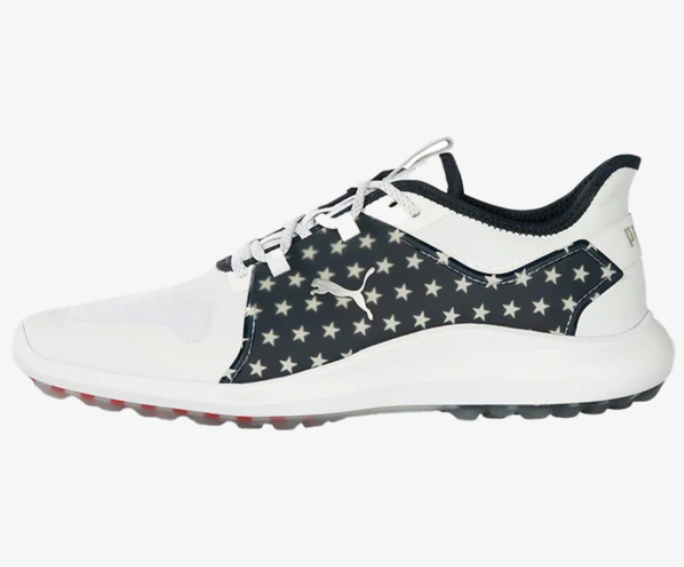
A collaboration with PUMA and Volition America, the IGNITE Fasten8 Spikeless Golf Shoes are a cool, America-inspired shoe featuring the stars and stripes on the footwear’s upper and outsole. They’ll provide the performance needed on the course … and the style while off of it. The innovative materials and progressive design include both PWRFrame and TPU overlays to create a breathable and waterproof outer, while the TPU PWRCAGE offers unparalleled support around the midfoot. The laces’ integrated webbing straps wrap the area for a secure fit. Plus, you can’t overlook the shoe’s ignite foam midsole that’s wrapped in SoleShield for added durability, unparalleled comfort and an energy return that can help you feel and play your best all day long. Volition America has made it its mission to disrupt the industry as America’s apparel brand—uniting Americans under a common goal to use the power of choice to affect positive change. With options ranging from shoes to apparel, the company has partnered with high-profile brands like Puma to give back to worthy causes.

https://luxelistreviews.com/wp-content/uploads/2023/04/Credit-CraftdLondon-for-SilverRoseNecklace-scaled.jpeg
Men’s Jewelry by Craftd London (https://craftdlondon.com/)


As the demand for men’s jewelry booms, Craftd London has become a go-to brand across the globe.

Each piece holds its own story and comes with a lifetime guarantee, no questions asked—making it literally a gift for life. Its best-selling Blue Tennis Chain was recently given the Blue Iced treatment and has leveled up wearers’ styling options with just the right amount of edge. The three-millimeter piece features AAA-grade Blue Cubic Zirconia, 316L stainless steel and rhodium, while also being water, heat and sweat-resistant. The Blue Tennis Chain is available in two sizes: 19.5-inches or 21.5-inches. But why stop at just one of these beauties, when you can gift dad a matching bracelet? Craftd London’s Blue Tennis Bracelet offers the same exceptional quality and specs as its necklace counterpart, including two size options to help customers find the right fit. For those who are looking for a touch of symbolism with their jewelry, Craftd London’s Silver Rose necklace illustrates the beauty and fragility of life in its simple, yet stunning, craftsmanship.

The 316L stainless steel and rhodium pendant comes with a chain that is water, heat and sweat resistant. The brand’s Compass Pendant also holds a message to the wearer, reminding people that a true leader crafts his own path. Give your loved one the gift of discovering new places and living a life of freedom with this 18-karat gold and 316L stainless steel chain and pendant. Like all of Craftd London’s products, the Compass Pendant is sweat proof, waterproof, hypoallergenic and tarnish resistant. Most importantly, it’s designed with its own meaning to make it personal for the wearer. “We all like to feel championed,” cofounder Alex Cannon says. “And with something that tells its own story, you can really give that personal touch.”

Versace VE2212 Aviator Sunglasses from SmartBuyGlasses (https://www.smartbuyglasses.com/)


Who doesn’t love a new pair of sunglasses, especially from a world renowned designer brand?

The Versace VE2212 Sunglasses from SmartBuyGlasses make a stylish Father’s Day gift that’s perfect for the summer season. He can look great and feel protected from the sun the next time he’s out and about. Versace’s seasonal collection offers a wide variety of colors to choose from, but these aviator shades are a perennial favorite—made super swaggy with its mix of gunmetal frames and grey-silver mirror lenses. The shades ate available in a variety of lenses to suit your lifestyle and vision needs, including prescriptive for distance, reading, progressive and more as well as blue light blockers and polarized. No matter the lens type, the Versace VE2212 Sunglasses can effortlessly complete any look. Plus, SmartBuyGlasses offers amazing prices and 100-day returns. The online store’s mission is to deliver great-quality, low-cost eyewear to its customers worldwide as fast as possible. Even more, when you shop online with SmartBuyGlasses, you’re shopping an exhaustive catalog of brands, types and designs boasting chic new trends and excellent-quality glasses.

AT HOME

https://luxelistreviews.com/wp-content/uploads/2023/04/Credit-Nolah-for-BambooSheetSet2.jpeg
Nolah’s Bamboo Sheet Set (https://www.nolahmattress.com/)


Are you ready for a better night’s sleep?

Nolah’s Bamboo Sheet Set is made of a lightweight, satin-smooth and breathable bamboo material that is just as good for the environment as it is for your shut-eye. Bamboo sheets are a great option for hot sleepers and allergy sufferers, as bamboo wicks away excess moisture to help keep you dry and comfortably cool during the night. This material is also naturally antimicrobial and hypoallergenic, so your sheets will remain fresh and clean for much longer.

Independent testing showed a 99 percent E. coli and staph reduction and 90 percent Candida albicans (yeast) reduction on the bamboo fibers after 18 hours of incubation. In addition, the Bamboo Sheet Set is Forest Stewardship Council-certified and Oeko-Tex 100-certified—guaranteeing Nolah’s product contains no harmful chemicals, toxins or dyes. And, when it is time to give them a wash, Nolah’s bamboo sheets are highly durable and washing machine-friendly for a convenient clean every time. The sheets are available in twin, twin XL, full, queen, king, California king and split king sizes to accommodate more sleepers. Nolah prides itself on being a sleep technology company that is on a mission to improve your sleep and mattress shopping experience, with products ranging from top-notch mattresses to bed frames and bedding.

Essentia Mattress’ Kingston Organic Pet Bed (https://myessentia.com/)


Help dad lavish his best friend in luxurious comfort with the Kingston Organic Pet Bed.

Taking luxe dog beds to a whole new level, this pet bed is made entirely of a plush mix of three unique shredded foams. This includes Essentia Mattress’ patented Beyond Latex organic foam combined with natural latex foams for maximum pressure relief, breathability and durability. The family pooch will nestle in and enjoy the soft, organic cotton cover that allows them to customize the adhesive-free Kingston to their liking by burrowing in the cozy blend of organic foams—the same natural, healthy and high-quality materials used to construct all Essentia products.

The company’s attention to detail ensures your pet keeps a fresh, comfortable sleep surface. The organic, SoftGrip cotton bottom helps stop the bed from sliding and makes it safe to use on all floors. Even more, the removable and washable Kingston’s organic cotton cover features food-grade waterproofing integrated into the inside backing, which helps protect the bed and facilitate  easy cleaning. This product is available in three sizes—accommodating furry pals up to 110 pounds! Essentia Mattress’ options are packed with non-toxic, certified organic vegan technology.

Brightly’s Terra Stone Coasters (https://brightly.eco/)


Say goodbye to sweaty, messy coasters and hello to the Terra Stone Coasters by Brightly.

These natural and eco-friendly coasters are made with high-quality, diatomaceous earth—providing maximum moisture absorption and quick-drying action. The unique properties of diatomaceous earth make the Terra Stone Coasters perfect for use with cold drinks, which helps to prevent condensation and keep your home’s surfaces clean and dry. Plus, the natural composition of diatomaceous earth makes them an excellent choice for those looking for a more sustainable option for their decor, and wish to enjoy their purchases with a clear conscience.

Their unique properties and elegant design make them the perfect choice for those who value function and style in their home accessories. The package comes in a set of four. Brightly’s goal is to empower conscious consumers around the world—recognizing that small, daily actions add up to a huge impact on the world around us. Along with its products, the company educates more than three million individuals every day through inspiring short-form videos on social media, an award-winning podcast and thoroughly-researched, myth-busting articles. Brightly holds itself accountable, as well, and is Climate Neutral Certified. To do this, the brand must show that it is working to reduce greenhouse emissions throughout its operation and compensates for all of them every year.

TRAVEL

The ULTI Messenger Bag by CONMIGO (https://conmigobags.com/product/shop/)


No matter if you’re traveling around the block or around the world for business or pleasure, travel should always be a fabulous experience—never a hassle.

The main culprit for travel angst? Having the wrong gear. One great resolution is the The ULTI Messenger Bag by CONMIGO, which provides the luxury of being comfortable, joy of being organized and peace of mind of being safe—all in one bag. This re-designed carry-on is perfect when a backpack doesn’t meet your needs or style. It has enough panache for the boardroom and is rugged enough to handle whatever the road throws at it. Lightweight so you can stay nimble, the ULTI messenger bag’s crossbody design keeps your hands free, so you can hold on to what matters. 

Plus, this functional travel and laptop bag features an abundance of secured pockets and compartments to help keep you organized and on point wherever you may be journeying to. Other ULTI bag highlights include a TSA-compliant, detachable portfolio for electronics, seat cushion and enhanced safety features. CONMIGO designers also crafted the gear with water-resistant, ballistic nylon and ensured its ability to comfortably fit under the seat when traveling in an aircraft. A donation from each sale of the ULTI travel bag is also made to the American Veterinary Medical Foundation.

PURGGO’s Car Air Eco-Purifier & Freshener (https://www.amazon.com/)


Is dad embarrassed by the persistent odor in his car or is he tired of that suffocating artificial scent from common fresheners that require constant refills? Or, does it bother everyone else?

Well, if any of the above criteria resonates, the PURGGO’s Car Air Eco-Purifier and Freshener will make the perfect Father’s Day gift this year. It’s made with pure and sustainable natural bamboo charcoal, which absorbs and eliminates odor instead of masking it. Fragrance- and allergen-free, the PURGGO is all-natural, non-toxic and 100 percent asthma, pet- and allergy-friendly. All this product contains is pure, all-natural moso bamboo charcoal: one of the most renewable natural resources in the world. Bamboo charcoal has been used for thousands of years in Asia to purify the air, and PURGGO harvested this power—making it the longest lasting available product of its kind on the market worldwide. Plus, it lasts for more than 365 days and works continuously in the background. PURGGO’s mission is simple: to create an effective, safe and responsible product that the company would want to use itself, and is reflected in the design philosophy of the air freshener—from the materials used to the rounded corners and smooth textures that have its roots in Asian culture.

OUTDOORS 

Putt-A-Bout’s Portable Putting Greens (https://putt-a-bout.com)


If dad likes to golf, give him the gift of an indoor putting green this Father’s Day.

 Putt-A-Bout provides just that with their USA-made products that are top-sellers on Amazon—offering the perfect solution for short-game practice anywhere and anytime. Ideal for golfers of all skill levels, these portable mats can turn almost any floor space into a fun putting area that lets you hone your game, have some fun and enjoy some low-key competition. The company’s XL215 Putting Mat is large at 15 feet long and two feet wide.

It’s great for practicing both short and long putts with a realistic stimp speed. Its premium back that will eliminate folds and creases in the putting surface. Also portable, it’s  easy to roll and store away or transport. Putt-A-Bout’s Par Three Golf Putting Green is another great gift option, as this kidney shaped practice putting green with three practice cup cutouts has a surface that always stays smooth. Built in sand trap cutouts catch missed shots. Putt-A-Bout designed its product to be easy to use, but also handily stored away when not being utilized. With its top-notch and lay-flat backing material, users can conveniently lay out the mat when ready to play and roll it back up for compact storage or transport on-the-go. Customers can also personalize their putting mat, which is available in five different sizes and perfect for both home and office use.

The Beach Bundle Chair from SUNFLOW (https://getsunflow.com/)


Do you want dad to have the best seat on the beach this summer season?

SUNFLOW’s Beach Bundle Chair offers four different positions and a host of innovative accessories for optimal seaside lounging. This chair is built with the highest quality, rust-resistant frame—necessary for wet environments—and is crafted with water-resistant fabric that can be hosed off without harming the material.

SUNFLOW’s Beach Bundle Chair includes removable straps in its design to help make the versatile recliner easy to carry, while also offering several fashion-forward color options to best meet its owners’ style. But, while the construction is impressive, this product really shines with its attachments. Its sun shade helps protect users from 98 percent of the sun’s rays, while the dry bag keeps valuables just that: dry, safe and sand-free during every beach excursion. Plus, the Beach Bundle’s drink holder provides the perfect spot for everything from a canned beverage, to a wine bottle. The chair’s added towel attachment keeps your towel safely stowed beside you without the fear of it falling down or flying away on a windy day. SUNFLOW’s Beach Bundle is the brainchild of fashion and product designer Leslie Hsu, with the mission of reinventing the beach chair by giving it the functional makeover it deserves. This is all part of the premium beach brand’s goal of filling every day at the water’s edge with smiles—helping to make your happy place even happier.

FOOD & BEVERAGE  


Herd & Grace Signature Steak Boxes (https://herdandgrace.com/)


Give the father figure in your life the gift of high-quality, Australian cuts of meat with Herd & Grace’s Signature Steak Boxes, which will be delivered right to his doorstep.

Herd & Grace is a premium delivery service for steaks sourced from pastures located in Australia and Tasmania. The company’s environmentally-conscious, halal-certified steaks are featured in Michelin and AAA-rated fine dining steakhouses and eateries, and are now available to homes across the globe. Australian beef sets itself apart from the usual type found in the U.S. due to its high marbling scores, delicious taste, unmatched tenderness and unique flavor. For these reasons, Australian beef is a superior pick, thanks in part to the wide open spaces for livestock to roam and the cleanest air in the world—giving the cows a better quality of life and generating singular dining experiences. In an age where factory farming in America confines cattle to over-crowded feedlots, these Australian and Tasmanian farms and ranches offer at least an acre of land per cow. In addition to the elite flavor and silky tenderness, Australian steaks feature ethical, sustainably grazed pastures, which reduce topsoil erosion and decrease emissions of methane and greenhouse gasses—all while removing carbon dioxide from the atmosphere.

These Old World, sustainable processes help in the effort to combat climate change. Choose from a selection of Herd & Grace’s finely curated boxes, or customize your cuts utilizing the brand’s various subscription level options. I sampled the Herd & Grace BBQ Box boasting cuts you won’t find at the market. With highly coveted delicacies are normally reserved for the most upscale restaurants, one bite and you’ll understand why they are in such demand. It features 24-28 ounce Pure Black Tri-Tip Cut; two massive 28-32 ounce Cape Grim Tomahawk Steaks; and one 3-4 Pound Cut of Pure Black Picanha MB5+. This premium collection can be delivered directly to dad’s doorstep lickety split.

Customizable Cheese Boards and Platters from Lynn & Liana Designs (https://lynnliana.com/)


Lynn & Liana Designs offers Customizable Cheese Boards and Platters that will serve as art in your home, while also helping serve up delicious treats to guests.

Not only do the boards come in nine colors, but no two boards are alike. Lynn & Liana Designs uses eco-friendly resin to create stunning pieces that are unique to each board. These one-of-a-kind items are hand-poured and meticulously crafted—making for a beautiful charcuterie spread and great conversation items at dinner parties. Singer Meghan Trainor even shared her love for the cheese boards in her viral TikTok video, which garnered seven million views. The small Manitoba family business has grown tremendously since starting in 2018 from a garage set-up. Lynn & Liana Designs went from producing 100 boards in its first year to well over 100,000 boards in 2022 alone. Now available in 2,000-plus stores, 28-year-old founder Melissa Funk has done more than jump on the charcuterie board craze. She’s reinvented it by crafting elegant boards and platters that stand out and bring a piece of nature into people’s homes. Even more, a portion of the brand’s sales go toward the replanting of trees across North America.

The Entertainer’s Tray from Groovy Girl Gifts (https://www.groovygirlgifts.com/)


Add to dad’s entertaining collection with The Entertainer’s Tray from Groovy Girl Gifts.

This stunning, charcuterie serving board, which can be personalized, brings a touch of class to the functionality of creating a stellar presentation for guests. Crafted from premium acacia wood, it features a sleek marble insert and is built to withstand regular use. Even more, the Entertainer’s Tray provides ample space for arranging a variety of cheeses, dips, cured meats, fruits, nuts or whatever tasty snacks strike your fancy. This item includes three dipping spoons, three bowls and four charcuterie utensils packaged nicely in a white box to round out the entire piece. Whether hosting a small gathering with friends, or putting together an elaborate spread for a special occasion, the durable board is sure to impress with its smooth, polished surface. Plus, it’s the perfect backdrop for showcasing dad’s personal style. The Entertainer’s Tray is also easy to clean and only requires a wipe down with a damp cloth after each use to maintain its appearance—making it the ultimate versatile, go-to set for all your hosting duties this summer.

“World’s Cheesiest Dad” Gift Basket from Cheese Brothers (https://www.cheesebros.com/)


A tasty and delightful gift worthy of those food-loving fathers, Cheese Brothers’ “World’s Cheesiest Dad” Gift Basket brings all the cheese, but in the best way possible.

This hand-picked gift collection combines the e-commerce company’s finest Wisconsin cheeses with classic mustard and award-winning artisan salami. Dad will love the smoked Gouda, which is cold-smoked with applewood and hickory at Cheese Brothers’ Wisconsin-based pack house. And, for lovers of the sharp variety, this basket has him covered with its eight-year-aged cheddar that’s sure to hit the spot. Other basket highlights include four, six-ounce blocks of Wisconsin-made cheese; two five-ounce blocks of aged cheddar; a jar of classic mustard or cherry lavender jam; artisan salami; white organic crackers and a “World’s Cheesiest Dad” sticker to tie it all together.

Cheese Brothers proudly honors its roots by following in the cheese-making traditions established by one of the founders’ great grandfathers when he immigrated to the U.S. from Switzerland in 1919. None of the business’s products are ever processed or artificial—sourcing milk from local family farms and utilizing only natural and simple seasonings to enhance its gourmet products. The eight-year-old company ships cheese and gift packages nationwide, so show your pops how much you care through their taste buds with Cheese Brothers’ uniquely cheesy basket. After all, the world’s best dad deserves the best.

Bisquit & Dubouché’s X.O. Cognac (https://www.reservebar.com/)


The perfect after-dinner sip for dads on Father’s Day.

 Bisquit & Dubouché’s X.O. is a silky, sumptuous cognac that’s incredibly rich, full-bodied and stunningly smooth. The X.O. expression is matured in French oak barrels for a minimum of 10 years—offering drinkers a symphony of woody flavors and smoky notes. The initial notes explored on the nose are enriched with aromatic hints of plum, mocha, cedar wood and licorice. Crafted using only the most prestigious Eaux-de-vie from the Grande and Petite Champagne crus, the premium beverage’s lingering finish and incredibly smooth taste are the satisfying results of the brand’s uniquely long distillation time. For the best tasting experience, Bisquit & Dubouché’s X.O. cognac is best enjoyed neat. The company was founded more than 200 years ago by Alexandre Bisquit and Adrien Dubouché, making its formal debut in the U.S. in February 2022 as an official sponsor of Frieze Los Angeles. The avant-garde cognac maison is known for its innovative cognac-making and the rebellious spirits of its founders. The unique distillation method relies on intuition over conventional techniques to create Bisquit & Dubouché’s distinctive taste of nuanced floral and fruity aromas.

Customizable Ice Cube Tray Molds from Siligrams (https://siligrams.com/)


Looking to add some flair to dad’s drinks this year? 

Look no further than Siligrams’ Customizable Ice Cube Tray Molds. These durable, high-quality silicone molds provide a personal touch to any gift, party or occasion and can be customized with the text, monogram, a graphic or logo of your choice. Whether you’re looking to create ice cubes in the shape of dad’s favorite sports team logos, adding a unique touch to the home bar or giving a gift of monogrammed ice cubes, Siligrams’ molds are the perfect solution. American-made, the ice cube trays are easy to use and maintain, all while being safe for use in the dishwasher, freezer and oven. The Customizable Cylinder Ice Cube Tray can be customized with your unique text, monogram, or graphical design.

The ice cylinders measure 2.3 inches in diameter, making it a great fit in a standard rocks glass for spirit forward cocktails or in tumblers and thermoses for your soda and iced coffee. The Customizable Whiskey Ball Mold makes an iconic cocktail ice ball as a classy companion to your favorite spirits. The spherical shape maximizes the surface area to volume ratio, meaning you’ll get maximum chilling of your drink with minimum watering down. The ice balls are 2.3in diameter spheres, and can also  be customized with your text, monogram, or logo! I also like Siligrams non-slip Customizable Silicone Bar Mat that keeps your glasses and bottles steady and collects spills to keep your bar area clean. It’s also easy to clean – just dump it into the sink and run it through the dishwasher. Use it as a drying mat or a coffee bar mat too! Plus, personalize it with your name, logo, or any design to make it truly your own.

Original Wine Purifier and Decanter from Üllo (https://ullowine.com/)


Gift the father figure in your life with the ultimate wine-drinking experience: all the delicious flavor of their favorite bottle of vino without the hangover. Üllo’s Original Wine Purifier + Decanter combines the purification power of Selective Sulfite filtration with the time-honored tradition of decanting to create a premier expression of red wine. The hand-blown Decanter, made from ultra-transparent and lead-free crystal, is the perfect fit for the Üllo Wine Purifier and lets your favorite red or white wine’s aromas and flavors come alive.

Üllo is the first and only wine purification brand to target just sulfites in the removal process—and none of the natural compounds that make every wine unique. Along with eliminating hangovers and irritation, sulfite-free wine also allows drinkers to enjoy any bottle without the stuffy nose, headaches or other common side effects of histamines. Plus, the easy-to-use Üllo Wine Purifier works with all Üllo wine filter replacements, rests on any wine glass and fits perfectly with Üllo’s decanters and carafe. Other features of this set include a purifier travel bag, soft-touch display base and six Selective Sulfite full-bottle filters. The kitchen gadget simplifies the clean-up process and disassembles easily, is dishwasher-safe and makes enjoying pure wine a delightful experience.

2018 Sketches Red Wine from PEJU Winery (https://shop.peju.com/)


A bright and savory red wine that dad will love, PEJU Winery’s 2018 Sketches charms the senses with aromas of fig jam, vanilla and a hint of nutmeg. This Cabernet Sauvignon and Merlot blend begins with notes of savory black truffle, honeyed oak and pomegranate and finishes with notes of cocoa powder. PEJU Winery’s 2018 Sketches can be uncorked and enjoyed now, or put away in your wine fridge for another 8-10 years. The blend is harvested from PEJU Winery’s acclaimed Persephone Estate Vineyard in Napa Valley, California at nearly 1,000-feet elevation, producing fruit with rich, focused flavor and a precise sense of place as a strong foundation for its wines.

The story behind the 2018 Sketches bottle stems from owner Herta Peju’s lifelong love for artistic expression. From her early school years through college, she would draw all over her notebook as a tool to remember her lessons. Working closely with winemaker Sara Fowler, the two created a magnificent wine encompassing the beauty that Peju sees in everyday life. Each bottle of Sketches features a label with artwork by Peju, making it an excellent trophy for your cellar.

The Non-Alcoholic Quartet Wine Pack by Jøyus (https://drinkjoyus.com/)

Cutting back on wine may be good for dad’s health, but that doesn’t mean his beverage selection needs to be limited, too.

 The Non-Alcoholic Quartet Pack from Jøyus brings variety, the pleasure of a glass of wine and the non-alcoholic peace of mind together in four delicious bottles. One-hundred percent woman- and sober-owned, the brand’s product doesn’t have that overly sweet or grape-juice taste commonly associated with non-alcoholic wines. These delightfully dry and complex, alcohol-removed selections can have even the snootiest of vino snobs pouring a second and third glass.

Take its Cabernet Sauvignon, for instance. The blend delights the palate with its warmth and complexity, while the well-balanced tannins, notes of ripe dark berries, aged oak and undertones of vanilla will keep you coming back sip after sip. Jøyus’ pack also includes a Rose and Sparkling Rose that feature delicate notes of watermelon and peaches, or hints of blackberries, strawberries and California citrus, respectively. Drinkers can also expect the notes of crisp green apple, fragrant fall pear and ripe melon of the Sparkling White wine to help round out the set. Still unsure? Not only did Jøyus win two awards at The San Francisco International Wine Competition and another at the International Wine and Spirits in London, but there are only 15-30 calories per serving—a perfect, guilt-free treat for everyone, no matter where they are on their sober journey.

La Tourangelle’s Gourmet Truffle Infused Oils (https://latourangelle.com/)


Is dad a chef in the kitchen?

Add to his arsenal with La Tourangelle’s Truffle Infused Oils. The company’s White Truffle Infused Oil features complex notes of woods, earth and fruit that are characteristic of the Italian White Alba Truffle, while the Black Truffle Infused Oil highlights complex, earthy notes of damp forests and dried mushrooms that can be found in the French Périgord Truffle. Earthy, robust and distinctive, these truffle-infused oils are a perfect finishing drizzle atop a range of unique culinary creations. La Tourangelle is passionate about making high-quality ingredients that are good for the table, community and planet. Through regenerative farming, artisan production methods and nature-friendly packaging, the company aims to empower people to cook like they care.

Each natural product is crafted locally in California and France using traditional practices. From sourcing the best quality ingredients, to small batch production, La Tourangelle’s products are rooted in artisan know-how. La Tourangelle believes in making staples that are authentic, delicious and sustainable—all while spreading joy and well-being through food. As a family business, La Tourangelle brings expertise and craftsmanship techniques learned from previous generations to modern day oil-making, using traditional French practices to produce delicious artisan oils in California.

Calicle’s Insulated Ice Cream Bowl Set (https://caliclecups.com/)


Upgrade your ice cream experience and say goodbye to meltdowns. Calicle’s smart and stylish Insulated Ice Cream Bowl Set keeps your favorite frozen treats at the perfect consistency from the first bite to the last, so you can savor every single spoonful. These vacuum, triple-insulated bowls keep your scoops from melting up to 200 percent longer than traditional bowls—even in warm weather. Perfect for barbecues, pool parties, beach days, picnics or at home on the couch, Calicle’s Insulated Ice Cream Bowl Set makes it easy to enjoy ice cream indoors or out, and includes lids for mess-free treats on-the-go while. And, the durable construction and grippy base make them safe for kids and glass-free zones. Not just for cold foods, they’ll keep hot foods hot longer as well.

This set comes with two 12-fluid ounce bowls in white frost or midnight black colors. In addition to providing reusable products to help reduce the waste produced by single-use items, Calicle also uses recyclable packaging materials. Plus, the brand believes it’s important to support organizations whose work is meaningful and donates two percent of its sales to support the Coral Reef Alliance. Whether you’re spoiling yourself or seeking a sweet gift, these bowls are guaranteed to bring a smile to anyone’s face. Make every spoonful count with the gift that keeps giving—scoop after scoop.

SELF-CARE  

The HEROBOARD Exercise Platform (https://www.heroboardfitness.com/)

No trainer? No problem.

Help dad get a total body workout with a single, convenient fitness tool this summer: the HEROBOARD. This highly-functional, moving exercise platform offers users an incredibly smooth and stable experience, while being able to move evenly on all types of surfaces—forward, back and side to side. Designed for both beginners and advanced athletes, the HEROBOARD allows for a variety of exercises that target every part of the body and is the perfect piece of equipment to use at home, outside or at the gym. The easy-to-use HEROBOARD jumpstarts those that need that extra bit of encouragement and is even utilized by trainers and physical therapists to assist in their work with clients.

The platform ensures stability and doesn’t flip over when operated. It’s also angled by three degrees for a raised heel, which eases your form to protect your knees and helps in bringing the board back for eccentric exercises. Each HEROBOARD comes with a drawstring bag for portability, a poster with QR codes linking to instructional videos, a custom-shaped foam exercise pad and a resistance band that can be easily attached to the board’s hook to take your exercises to the next level. Plus, dad can access new and creative instructional workout videos each week from the company’s website or its various social media platforms.

Derm Dude’s Grooming Products (https://dermdude.com/)

Give dad the at-home pampering he deserves with Derm Dude’s quality selection of men’s grooming products. 

The company’s EVERYTHING Trimmer is the absolute perfect tool for both the beard and body. The three-in-one trimmer includes 17 unique “easy spin” dial settings for beard, mustache and facial hair; stainless steel blades and guide combs with precision trimming for a nick-free beard, body and groin area; and an IPX7 high, waterproof-rating for convenient use in the shower. Derm Dude’s device also includes a 60-minute runtime; rechargeable, built-in battery with compact USB charger; and is small, lightweight and cordless for ease of use and convenience. The EVERYTHING Trimmer does it all—including every length option and style in-between. And, to keep dad’s beard nourished and itch-free, the brand’s Accelerator Beard Oil is formulated to moisturize, soften and condition facial hair in a single application.

The fast-absorbing and non-greasy Nutribeard Complex is formulated with natural Jojoba oil, Argon oil, vitamin E and other natural oils, which promote healthy beard growth when used over time. Derm Dude’s Accelerator Oil 3-Pack offers three scents that are sure to keep the user smelling and feeling good. The Sandalwoody scent has a slight, new leather hint while being warm, spicy, exotic, musky and, most importantly, woody. The Island Rum oil has notes of rum and coconut to create a warm and summery scent, while Morning Woodsy exudes a masculine, outdoorsy scent with notes of evergreen woods, cedarwood and mountain air.

LED Teeth Whitening Kit from MOON Oral Beauty (https://moonoralcare.com/)


Elevate dad’s oral care routine with MOON Oral Beauty’s LED Teeth Whitening Kit.

Equipped with the brand’s best-sellers, this set includes its LED Teeth Whitening Device, Kendall Jenner Teeth Whitening Pen and Dissolving Whitening Strips to help keep customers’ smiles healthy and bright. In fact, the LED device is reported to rapidly whiten teeth up to 12 shades in just two weeks or less, with just five minutes per use. Its lightweight, wireless design pairs with the Dissolving Whitening Strips to remove tough stains on the teeth’s surface for a no-mess application, with no rinsing required.

The device already comes with a two-week supply of Whitening Strips, a travel-friendly case and a charging base. Plus, this bundle includes an extra pack of strips. MOON’s Dissolving Strips are unique, as they whiten teeth up to seven shades lighter and dissolve completely in your mouth within 15 minutes. They are made with gentle, better-for-you ingredients that are perfect for sensitive teeth. Made with Elixir III, the pen features MOON’s proprietary antioxidant blend of lavender oil, strawberry fruit extract and honeysuckle flower extract, which is proven to instantly brighten and whiten teeth over time. It’s great for touch-ups to keep those pearly whites polished while on-the-go.  Now, dad can easily throw it in a bag and have it on hand and ready to use when needed.

Sacral Still Point Pressure Pillow from Kanuda (https://kanudausa.com/)


Does the dad need a posture reset?

The “Kanuda Lumbar Nap” Sacral Still Point Pressure Pillow is a one-of-a-kind product that integrates physical therapy benefits into a pillow—ensuring proper neck alignment while sleeping on one side or the other. Its design mimics a physical therapy session at home by stimulating pressure points of the sacrum, stretching your lower back with its natural bending lumbar spine curvature. A few of the benefits of the Kanuda Lumbar Nap pillow include improvement of the craniosacral system function, tension relief in the lower back muscles, restoration of the spine’s natural lumbar curve to the correct posture and improvement in the range of motion in the hips. All the user needs to do is place the polyurethane foam pillow on the floor and lie down on their back so that the sacrum groove on the Kanuda Lumbar Nap is positioned directly underneath the user’s sacrum. For best results, it’s recommended to stay in this position for anywhere between 10-40 minutes daily. The South Korean company has been perfecting its product through ongoing research and development since 2005—helping to lead the way in customer satisfaction. Reportedly the first-ever pillow to incorporate physical therapy techniques to relieve neck pain and induce proper sleep positions, Kanuda helps keep your neck, spine and shoulders truly aligned in proper resting position.


For the Silo, by Merilee Kern.

Merilee Kern, MBA is an internationally-regarded brand strategist and analyst who reports on cultural shifts and trends as well as noteworthy industry change makers, movers, shakers and innovators across all categories, both B2C and B2B. This includes field experts and thought leaders, brands, products, services, destinations and events. Merilee is Founder, Executive Editor and Producer of “The Luxe List” as well as Host of the  “Savvy Living” lifestyle TV show that airs in New York, Los Angeles, San Francisco, Miami, Atlanta and other major markets on CBS, FOX and other top networks; as well as the “Savvy Ventures” business TV show that airs nationally on FOX Business TV and Bloomberg TV. As a prolific lifestyle, travel, dining and leisure industry voice of authority and tastemaker, Merilee keeps her finger on the pulse of the marketplace in search of new and innovative must-haves and exemplary experiences at all price points, from the affordable to the extreme. Her work reaches multi-millions worldwide via broadcast TV (her own shows and copious others on which she appears) as well as a myriad of print and online publications. Connect with her at www.TheLuxeList.com and www.SavvyLiving.tv / Instagram www.Instagram.com/MerileeKern / Twitter www.Twitter.com/MerileeKern / Facebook www.Facebook.com/MerileeKernOfficial / LinkedIN www.LinkedIn.com/in/MerileeKern.

***Some or all of the accommodations(s), experience(s), item(s) and/or service(s) detailed above may have been provided at no cost or sponsored to accommodate if this is review editorial, but all opinions expressed are entirely those of Merilee Kern and have not been influenced in any way.***

Source: https://nrf.com/research-insights/holiday-data-and-trends/fathers-dayy-data-and-trends/fathers-day

Agree? Aussie Study Reveals Canada Most Desired Country To Relocate To Worldwide

A study by Compare the Market Australia has analyzed each country around the world on their annual search volume for terms such as ‘relocating to [country]’ and ‘moving to [country]’ to reveal the world’s most desirable countries to relocate to. 

The most desired countries to relocate to? Here comes a boring chart!

RankTop destinationFavourite in X countries
1Canada50
2Japan31
3Spain19
4China15
5France11
6Turkey9
6South Africa9
8India7
9Australia6
10Greece4
10Fiji4

Taking the top spot is Canada, with our North American nation being the most desired destination in 50 other countries around the world. Canada is a very welcoming country for expats, which has led to it becoming a very diverse and multicultural destination. 

Second place goes to Japan, with 31 countries having it as their number one relocation destination, including Australia. Japan has one of the highest life expectancies in the world, which could explain why so many people are researching to move there.

Spain is another very popular choice, especially amongst those in other European countries, with 19 countries having it as their favourite in total. Known for its warm Mediterranean climate, Spain is also another destination that has excellent healthcare and quality of life.

  • The least desired countries to relocate to in the world include: Sweden, The Philippines, Bulgaria, Germany, Thailand, Egypt, Singapore, Myanmar, Italy, and Nigeria with only one other country wanting to move to each of these destinations. 

Further Study Insights:

Each country’s most desired relocation destination

Check the map below to see where each country in the world wants to relocate to the most.

While the majority seem to prefer somewhere within the same continent, there are some notable exceptions to this.

As the most searched country overall, we can see that people from as far away as India and South Africa have Canada as their most searched destination.

However, there were also some definite regional trends though. For example, many African nations have South Africa as their most searched destination.

Methodology

Using Google Ads Keyword Planner, the annual search volume for each of the following terms was found for each country in the world:

  • Houses in [country]
  • [Country] property
  • Moving to [country]
  • Relocating to [country]

This process was then repeated for each country in the world, taking a total of the searches across all four search terms, to reveal where each country wants to relocate to the most.

Note that searches within the same country were removed from the results.

In addition, all searches were carried out in English, as results in native languages proved to give inconsistent results.

For the Silo, Ruby Robinson.

Automation Key To Future Of Work Under Great Reset

LOS ANGELES—Automation is no longer an option, automation is the key to surviving the Great Reset.

In 2021, more than 47 million American workers resigned, an annual record. In Canada numbers are harder to determine since accurate resignation numbers are not readily available. However, Statistics Canada has published the results of a survey pitched towards Canadian workers.

With no sense of the number of people surveyed and the accuracy of the data gathering the results should perhaps be best taken at face value: “In January, respondents were asked whether they were planning to leave their current job, and whether quality of employment considerations were among the reasons for doing so. Fewer than 1 in 10 Canadian workers aged 15 to 69 (7.3%) were planning to leave their current job within the next 12 months, compared with 16.1% in 2016, when respondents to the General Social Survey were asked the same question (not seasonally adjusted). When January 2022 LFS respondents were asked to report their main reason for planning to leave their job, preliminary results show that at least 1 in 5 of those planning to leave (22.2%) reported reasons related to quality of employment, including low pay (15.7%), heavy workload (4.3%) and inability to do their current job from home (2.2%). The trend is continuing. Surveys and data show that 6 in 10 young professionals have changed jobs or plan to and that 4.5 million workers quit their jobs in March.”

Businesses face continuously evolving markets and societal pressures that are transforming the way employees and employers put in exchange with each other to provide value to consumers and clients.

Staffing agencies especially have been under pressure during the pandemic and navigating the Great Reset.

Bilflo automates back-office tasks and helps staffing manage hundreds of contractors and direct hires on a single, simple platform. This allows organizations to conserve time and labor while expanding business operations and profits. The ability to pull in live performance metrics makes it easy for businesses and teams to track their progress on goals. 

“The pandemic was a catalyst for development and expansion, springing from a strong foundation. We spent the past decade developing Bilflo to provide value to clients, especially during a turbulent time,” said Bilflo CEO Barrett Kuethen. “Bilflo was built by staffing industry experts to specifically serve the industry and address the unique operational pains to bridge process gaps.”

As of 2022, Bilflo has an extensive integration roadmap that has started with ATS platforms: Bullhorn and Jobadder along with accounting systems like Quickbooks. The company is expanding with key offerings such as Importing External Time, which will support staffing companies by eliminating redundancy and manual errors from VMS tools and other client time portals. Bilfo’s developers and leadership update the platform responsively to customers to provide optimized results. 

Bilflo is outcome-driven and their case studies with leading companies bring to life their platform and services. Amtec, a 60-year-old staffing company which employs over 1,000 contractors every year, provides talent to industries like health care, IT, aerospace and more. After adopting Bilflo the company reduced back-office labor by 75 percent, doubled capacity and achieved 49 percent annual cost savings. Extension, a 20-year-old full recruitment and staffing company handles up to hundreds of employees per week, and similarly achieved success through Bilflo, saving more than $20,000 usd a year and eliminating 16 hours a week in manual workload.

Bilflo founders held a webinar, in association with Staffing Industry Analysts (SIA), to discuss why and how to automate staffing companies’ back-office processes. Bilflo has already seen success after emerging in the market early this year and has received 3rd party validation from industry leaders like G2.com. Bilflo received recognition as a high performer for 2022 including generally, and for small business, mid-market, “easiest to use,” “easiest to do business with” and for “best support.” G2 features Bilflo reviews and case studies here on back office management, and tech stacks.

Bilflo’s APIs (application program interface) communicate with organizations’ ATS to retrieve information. This eliminates the need for someone to spend hours manually entering data.

Bilflo makes it so that companies can store contract job information such as rates, burdens, timecard types, overtime rules, job site addresses, workers’ comp codes and rates, and more.

In the era of remote work and asynchronous collaboration, companies need systems in place to handle timecard and expense management.

Compliance is more difficult to manage than ever. Bilflo solves these problems by calculating overtime in all states and provinces. Payroll integration and automated invoicing rapidly handle complex payment terms, billing addresses, line item information, and real-time reports.

Sixty Six Percent Of Canadians Take Smartphones Into Bathroom

Study: Lots of Canadians use smartphones while on the toilet

A digital privacy expert provides tips on protecting your phone on and off the john:

recent survey by the cybersecurity company NordVPN revealed that as much as 65.6% of Canadians bring their smartphones with them into the toilet. That’s a bit less than the average of all surveyed countries. While most Canadians (60%) scroll through social media during that time, barely anyone thinks of growing threats online and hackers’ attempts to compromise people’s phones.

“Canadians seem to need smartphones a lot.”

“Our previous survey already showed that Canadians spend a lot of time online- more than 22 years per lifetime which is a third of their lives,” says Daniel Markuson, a digital privacy expert at NordVPN. “Even though the majority (83%) name smartphones as the device that tracks their online behavior the most, Canadians still haven’t developed good cyber habits to protect their online lives,” he says.

Using social media and gaming — top activities for Canadians while on the toilet

The majority of Canadians admit that their time on the toilet is mostly spent scrolling through social media (60%), gaming (40%), and reading or listening to the news (35%). This shows that Canadians like entertaining themselves while in the bathroom.

Among other activities, Canadians also watch videos, movies, or television programs (33%) check work email and other tools, for example, Slack, Microsoft Teams (33%), and call or message other people (31.5%).

“While most of Canadians’ time on the loo is spent on social media, people also feel concerned about Facebook (80%) and Instagram (40%) collecting the biggest amount of their users’ data. Social media networks, ISPs, third-party organizations, websites, and governmental institutions regularly collect users’ personal data and track browsing habits for marketing or other purposes,” says Daniel Markuson.

Cybersecurity refresher for Canadians

Smartphones are evolving at a rate that is beyond belief, making us stay connected even while on the loo. However, Canadians are encouraged to not forget about their online safety, even while immersed in social media, conversations, games, or the news.

Daniel Markuson, a digital privacy expert at NordVPN, shares key tips on protecting your phone on and off the john:

  • Keep apps and the phone’s operating system (OS) up to date. Don’t skip software updates.
  • Do your research. Never download unknown apps — read up on them first.
  • Avoid unofficial app stores. They’re more likely to contain malware-ridden apps.
  • Avoid using unknown Wi-Fi. And always use a VPN when you do.
  • Be vigilant. Don’t click on suspicious links, don’t give out your number to strangers, and be wary of unknown numbers.

Methodology: The survey was commissioned by NordVPN and conducted by the external company Cint on January  19-26, 2022. The survey’s target group was residents of France, USA, the UK, Canada, Australia, Germany, Spain, the Netherlands, Poland, Lithuania aged 18+ (nationally representative), except for Lithuania (18-74) and the sample was taken from national internet users. Quotas were placed on age, gender, and place of residence. 9800 people were surveyed in total, made up of 800 people from Spain and 1000 people from each of the remaining countries. 

Image

Fundraising Survey Shows More Canadians Are Giving But Giving Less

(Toronto, Ontario) Seven in ten Canadians have given to charity in 2018, and almost half of donors are open to different sorts of giving approaches than just the traditional solicitation letter, according to the 2018 What Canadian Donors Want Survey, conducted by the Association of Fundraising Professionals (AFP) Foundation for Philanthropy – Canada in partnership with Ipsos.

The survey, which featured 1,500 Canadians age 18 or older, found that the percentage of people giving to charity in 2017 jumped by four points from the 2015 survey, returning to previous giving levels. Even as more Canadians are giving, they are giving less—an average of $772 cdn in 2017 compared to average giving levels of $924 cdn in 2015 and $726 cdn in 2013.

Eighty percent of donors give to more than one cause, with 23 percent giving to 4-5 charities and 13 percent supporting 6 or more causes. The top recipients of donations are social services and health charities—more Canadians (59% and 57%) gave to those causes than any other.

Overall, Canadians are more confident in the charitable sector than ever before, with nearly eight in ten respondents (78%) saying they’re confident in the organizations that comprise the charitable sector. That figure represents a five-point increase from 2015 and is significantly higher than confidence in the private sector (67%) or the public sector (60%).

Roger Ali Foundation for Philanthropy Canada

“Overall, the survey shows a Canadian population that is very supportive of the work of the country’s charities and a good understanding of how charities work to support communities,” said Roger Ali, CFRE, chair of the AFP Foundation for Philanthropy – Canada. “However, there are signs that donors are changing how they want to give and interact with charities, and the sector needs to understand and adapt to these changes so that we remain relevant to the people who support us and the people we serve.”

Changes in Volunteering, Giving Behavior

One troubling sign is a drop in volunteerism rates. According to the survey, one-third of Canadians volunteered their time to a charity or non-profit in the past 12 months and spent an average of 88 hours—down precipitously from 110 hours in 2015. “We’ll be watching this closely in our next survey to see if this is a one-time drop or a trend,” Ali added.

Canadians continue to change in how they want to be approached for donations. While 44% express a preference for traditional requests, such as mail, one quarter prefer a more personal approach like peer-to-peer contact or crowdfunding. Three in ten (31%) say they’re open to anything, having no specific preference.

Poor Are Most Charitable In USA

Fundraising preferences vary significantly by age. Baby Boomers (54%) are the most likely to prefer being solicited through traditional requests, compared to Gen X’ers (43%) or Millennials (33%). By contrast, Millennials (17%) lead the way on crowdfunding, preferring this option to a greater extent than their Gen X (11%) or Boomer (5%) counterparts.

Perceptions of Charity Roles, Performance

Many underlying views on charities have remained relatively stable over time. Three-quarters of Canadians continue to agree that charities play an important role in society to address the needs not being met by the government, the public sector or the private sector. Majorities also believe that charities are trustworthy (61%) and act responsibly with the donations they receive (63%).

Canadians are more divided on how much charities spend on their programs and services vs. how much they spend on supplies, administration, salaries and fundraising. A growing majority (58%, up six percentage points from 2015) trust charities on how much they say they spend money on programs and overhead.

However, about a third of Canadians (34%, down 4 points) are less trusting, indicating that charities overstate how much they spend on the cause or programs (24%), or that charities are being intentionally misleading (10%). Yet, when presented with factors and asked how important each one is in evaluating a charity’s effectiveness, Canadians placed more emphasis on a charity’s ability to achieve its mission and create impact than managing its operation or its fundraising.

“Donors are looking for charities that create impact to change the world for the better,” said Lorelei Wilkinson, CFRE, chair of the AFP Foundation for Philanthropy – Canada Research Committee. “But it’s always clear that they keep a careful eye on administrative costs and a charity’s operations. The charitable sector needs to do a better job of explaining that overhead costs are essential for growth and sustainability —for things like equitable salaries, updated computer equipment, etc.— as part of being efficient with their use of donor dollars.”

Looking Ahead

Almost half of Canadians (46%) indicate that they are very likely to give in the next 12 months, while another one-third (34%) are somewhat likely to donate. However, 59% say they are also concerned about the economy, which may force them to reassess their giving plans.

A considerable number of Canadians (42%) proactively seek out information on the cause/charity and contact them to donate, while six in ten (58%) say the charity approaches them and they donate based on the information they receive. When looking for information on charities they support, Canadians continue to rely on online information (75%) as opposed to family, friends or colleagues (39%).

Social Media

The 2018 What Canadian Donors Want Survey also asked general questions about Canadians’ use of social media.

Similar to 2015, eight in 10 Canadians (81%) have a social media account. This applies across every age group, from 91% of Millennials through to 85% of Gen X’ers and 70% of Baby Boomers. Women (84%) are more likely than men (78%) to maintain at least one social media account.

Facebook dominates the Canadian social media landscape: three in four Canadians (75%) say they have a Facebook account, placing it well ahead of Twitter (29%), Instagram (28%), Reddit (5%) or other social media (13%).

Nearly two in ten Canadians on social media (18%) have donated to a charity in response to a request that came through their social media account. Millennials (23%) and Gen X Canadians (19%) are more likely than Baby Boomers (13%) to have made a charitable donation in response to a social media invitation or post.

“As generations age, we expect that email and social media will continue to become more prevalent in fundraising,” said Mary Bowyer, CFRE, member of the AFP Foundation for Philanthropy – Canada Research Committee. “For now, we’re seeing a blend of different approaches, and the most successful charities will be those who personalize their appeals based on what individual donors want, meaning a mix of mail, email, videos, Tweets and other communications.”

About the Survey

The 2018 What Canadian Donors Want Survey was based on a poll conducted between October 10 and October 17, 2017, on behalf of the AFP Foundation for Philanthropy – Canada. For this survey, a sample of 1,500 Canadians aged 18+ was interviewed. Weighting was then employed to balance demographics to ensure that the sample’s composition reflects that of the adult population according to Census data and to provide results intended to approximate the sample universe.

The precision of Ipsos online polls is measured using a credibility interval. In this case, the poll is accurate to within ±2.5 percentage points, 19 times out of 20, had all Canadian adults been polled. The credibility interval will be wider among subsets of the population. All sample surveys and polls may be subject to other sources of error, including, but not limited to coverage error, and measurement error.

The Association of Fundraising Professionals (AFP) is the largest international association of fundraising professionals in the world.  AFP has over 33,000 members world-wide, with 3,800 in Canada.  AFP promotes the importance and value of philanthropy, and enables people and organizations to practice ethical and effective fundraising.   AFP Canada was formally created in 2017.

As the philanthropic arm of AFP, the AFP Foundation for Philanthropy – Canada supports many programs and services through its fundraising efforts.  Fulfilling the promise of philanthropy by funding programs and services in the areas of research, diversity & inclusion, supporting the profession and leadership.  To find out more, please visit www.afpnet.org.


Body Check North America Study Shows Natural Look Is The New Sexy

A new study of the dating app Jaumo concludes that superficiality in online dating is just a preconceived prejudice. A survey among North American users shows that the majority of participants do find athleticism attractive but a couple of extra pounds on the hips will not necessarily decrease your chances of finding a date.



What attracts Jaumo users? 
What is it, that attracts one person to another? Which body features are most important to most people? To answer these questions, Jaumo carried out a survey among more than 4,400 Jaumo users from the US. Jaumo interviewed them over a period of 4 weeks about their preferences in regards to their own body and personal ideals required of a partner. Users could agree or disagree with the statements outlined in the survey.

Image: whoabooty.com

Jaumo users are not only active flirters.
63 percent of the users find an athletic partner attractive and more than half of the respondents don’t mind a couple of extra pounds on their significant other’s hips. It is noticeable that significantly fewer users, namely 42 percent, consider an athletic body sexy. And the sexes even completely agree on this question!

Raw data from Jaumo Survey.


Hairy is not scary.
On the subject of body hair, the female users are pretty much in total agreement: 76% think chest hair belongs on the male body. The male users see this somewhat differently, but nonetheless, 64 percent of respondents agree. A natural look is also preferred in the downstairs department. 63 percent find a hairy pubic area perfectly acceptable and a total of 70% of the women prefer to see hair when they look down.

The way to someone’s heart is through their stomach.
Vegan, vegetarian, low-carb or meat-eater – with so many varied eating preferences, it may be difficult to find a partner with the same nutritional routine. For 77 percent of the Jaumo users, however, a compatible diet with their partner is seen as a must. For the Silo, Racheal A. Mack.

Jaumo founders Jens Kammerer and Benjamin Roth.

About Jaumo
Jaumo is a dating app founded by Jens Kammerer and Benjamin Roth in 2011. Jaumo has 20 million users in 180 countries around the world, more than 2 million of them in the USA and Canada. The dating app is available for free for iOS at the Apple Store and Android at the Google Play Store. The driving force of the two friends from Germany is to offer an uncomplicated and user-oriented product that binds satisfied customers.


Law Firms Should Nurture A Culture For Growth Factor

Hillel pic Web

There’s a strong correlation between the growth of a law firm and the strength of its culture, according to a new survey published in February’s ABA Journal.

The most successful mid-sized firms are those that put a high value on their culture – how they do business and the written and unwritten rules for behavior, according to the survey conducted by TAGLaw and the Center for the Study of the Legal Profession.

“Firms in which everyone plays by the rules and values dictated by the leadership are more successful in part because, whether they realize it or not, they’re branding themselves,” says Hillel L. Presser, Esq., MBA, author of a new book, “The Lawyers Law of Attraction: Marketing Outside the Box But Inside the Law,” (www.lawyermarketingllc.com).

Branding – developing a unique, distinctive and consistent image — is vital for any lawyer hoping to stand out from the competition, Presser says.

It’s even more important to distinguish oneself in today’s post-Recession economy. Demand for legal services, revenues and rates have all dropped significantly since the Recession began in December 2007, according to a 2013 advisory by Hildebrandt Consulting and Citi Bank.

“The compound annual growth rate for revenues in the legal market was 9.8 percent leading into the Recession. From 2008 to 2012, it was 0.8 percent,” Presser says.  So how does a law firm – or an individual lawyer – develop a brand?

“In a firm, if you have a strong culture, start by giving it a closer look. What values define your culture? What rules govern interactions with clients? Do you have a collaborative team approach or independent individualistic lawyers?” he asks. “All of these answers will help you define your brand.”


Presser Book Cover Web


If you’re an individual lawyer, you are your brand. Your personality, your look, how you present your practice all contribute to your brand identity. To build a successful, strong brand, you need to be sure these things convey what you want them to – and more important, appeal to your market.

Presser offers these tips for building your brand:

• Identify your personality, your specialty and your target market: These form the basis of your brand and it’s important for all three to work well together. Presser defines his personality as “an innovator and educator who’s very social and very serious about financial protection.” His specialty is asset protection, and his target audience is all individuals with money, property or other assets that are not secured in the best way.

• Decide what will appeal to that target audience: If you already have clients, look for what they have in common – it will say a lot about what they value and, hence, what appeals to them. Everything from the clothes they wear to the cars they drive to the information they share about themselves offer clues to what they value. Maybe it’s reliability. Non-conformity. Social status.  Solid quality. Is that who you are? If so, make sure it’s reflected in your brand.

• Think about what makes you different from your competition. From soda companies to athletic apparel manufacturers, every industry includes rivals selling the same products. Through branding, they distinguish themselves to appeal to their target audience – to set themselves apart. What makes you different from other divorce, criminal defense or corporate attorneys? How does that fit in with your personality, specialty and target market?

• Look for ways to incorporate your personality into your practice.Everything from the furnishings in your office to the clothes you wear to your business card and website should incorporate the personality and values you want to convey. If the tone of the copy on your website is casual and light-hearted and you want your brand to say old-fashioned hard work and reliability, you need to have the copy rewritten.

Your brand will be the foundation for your marketing, so take the time necessary to ensure all of the elements work in harmony, Presser says.

“You don’t have to be everything to everyone – you can’t be,” he says. “So focus on your niche audience and what’s important to them as well as what’s important to you. It will make you more successful both in setting yourself apart and attracting the types of clients you want to attract.”

About Hillel L. Presser, Esq., MBA

Hillel L. Presser is the owner of Lawyer Marketing LLC, a company dedicated to helping lawyers effectively market their practices. He’s also the founder of The Presser Law Firm, P.A., representing individuals and businesses in establishing comprehensive asset protection plans. He is a graduate of Syracuse University’s School of Management and Nova Southeastern University’s law school, and serves on Nova’s President’s Advisory Council. He also serves on the boards of several non-profit organizations for his professional athlete clients. He is a former adjunct faculty member of law at Lynn University. For the Silo, Ginny Grimsley.