Tag Archives: debt

World Economic Forum 56th Annual Meeting Has Spirit Of Dialogue Theme

Chief Economists Perceive Relative Resilience but Remain Concerned about Asset Prices, Debt and Geoeconomic Tensions

Acknowledging the relative resilience of the global economy amid turbulence, 53% of chief economists surveyed expect global economic conditions to weaken in the year ahead, down from 72% in September 2025.Uncertainty around technology remains high, with 52% expecting AI-related stocks to decline and 40% expecting gains. On growth, expectations diverge by region, with economists expecting strong momentum in South Asia and East Asia and weak to moderate growth in Europe.

On macroeconomics, nearly a third of respondents are concerned about sovereign debt crises in advanced economies and nearly half in emerging economies; over 60% expect governments to rely on higher inflation and tax revenues to manage elevated debt.Learn more about the Chief Economists’ Outlook here.

Follow the Annual Meeting 2026 here and on social media using #WEF26.

Geneva, Switzerland, January 2026 – The global economic outlook has improved modestly but remains uncertain, with asset valuations, mounting debt, geoeconomic realignment and rapid artificial intelligence deployment creating both opportunities and risks, according to the World Economic Forum’s latest Chief Economists’ Outlook, published today. Although 53% of chief economists expect global economic conditions to weaken in the year ahead, this marks a significant improvement from the 72% who held this view in September 2025.
 
“The Chief Economists survey reveals three defining trends for 2026: surging AI investment and its implications for the global economy; debt approaching critical thresholds with unprecedented shifts in fiscal and monetary policies; and trade realignments,” said Saadia Zahidi, Managing Director, World Economic Forum. “Governments and companies will have to navigate an uncertain near-term environment with agility while continuing to build resilience and invest in the long-term fundamentals of growth.”
 
AI and other asset valuations are under scrutiny
Concentrated AI stock gains are splitting the views of the chief economists. A narrow majority (52%) are expecting AI-related US stocks to decline over the next year, but 40% foresee further increases. Should values fall sharply, 74% believe impacts would spread across the global economy. Cryptocurrencies face bleaker prospects, with 62% anticipating further declines following market turbulence, while 54% believe gold has peaked after recent rallies.
 
When it comes to the potential expected returns from AI, there is wide variation across regions and sectors. Roughly four in five chief economists expect productivity gains within two years in the US and China. Chief economists expect the information technology sector to adopt AI fastest, with nearly three-quarters anticipating imminent productivity gains. Financial services, supply chain, healthcare, engineering and retail follow as “fast-movers”, with one to two-year timelines. By firm size, the chief economists expect companies with 1,000+ employees to see gains earlier than others: 77% of chief economists expect meaningful productivity gains within two years.
 
The employment picture in relation to AI is expected to evolve over time: two thirds expect modest job losses over the next two years, but views diverge sharply over the longer term: 57% anticipate net losses over 10 years, while 32% foresee gains as new occupations emerge.
 
Debt may drive difficult trade-offs
Managing elevated debt levels has become a central challenge for policy-makers, particularly as spending pressures rise. Defence spending is almost unanimously expected to increase, with 97% of chief economists anticipating rises in advanced economies and 74% in emerging markets. Digital infrastructure and energy spending are also expected to rise. Most other sectors are expected to see stable levels of spending, while a majority of surveyed economists anticipate spending on environmental protection to decline in both advanced (59%) and emerging economies (61%).
 
Views are split equally on the likelihood of sovereign debt crises in advanced economies, while nearly half (47%) see them as likely in the year ahead in emerging economies. A large majority of chief economists expect governments to rely on higher inflation to reduce burdens (67% in advanced economies, 61% in emerging markets). Tax increases are also viewed as likely by 62% for advanced economies and 53% for emerging markets. Some 53% of chief economists anticipate seeing debt restructuring or default as a debt management strategy in emerging markets over five years, compared to just 6% for advanced economies.
 
Trade flows and regional growth outlooks are realigning
Global trade and investment are adjusting to a new, competitive reality. Chief economists expect import tariffs between the US and China to remain mostly stable, though competition could intensify in other domains. Some 91% expect US tech export restrictions to China to remain or increase; 84% anticipate the same for Chinese critical mineral restrictions.
 
In this new context, 94% of chief economists expect more bilateral trade deals and 69% anticipate growth in regional trade agreements. Some 89% expect Chinese exports into non-US markets to further increase, while surveyed economists are split on the future of global trade volumes. Meanwhile, almost half of them foresee the continued rise of international investment flows, and 57% expect FDI into the US to increase compared to 9% who expect increased inflows to China.
 
When it comes to growth expectation among the chief economists surveyed, South Asia leads with 66% anticipating strong or very strong performance, driven by robust growth in India. Some 45% expect strong growth and 55% moderate growth in East Asia and the Pacific. Some 36% expect strong growth and 64% moderate growth in the MENA region. The US outlook improved notably, with 69% expecting moderate growth versus 49% in September 2025, but only 11% expecting strong growth. China faces mixed prospects, with 47% expecting moderate growth and 24% strong growth and nearly an equal number – 29% – expecting weak growth. Europe confronts the weakest outlook, with 53% expecting weak growth, 44% moderate growth, and only 3% anticipating strong growth.
 
About the Chief Economists’ Outlook
The report builds on extensive consultations and surveys with chief economists from the public and private sectors, organized by the World Economic Forum’s Centre for the New Economy and Society. The report supports the Forum’s Future of Growth Initiative, aiming to foster dialogue and actionable pathways to sustainable and inclusive economic growth. The Chief Economists’ Outlook is complemented by other recent publications with economic foresight. Four Futures for the New Economy and Four Futures for Jobs in the New Economy explore strategic implications for businesses navigating geopolitical shifts, technology disruption and workforce transformation through 2030, offering indicators to track and strategies to prepare for multiple scenarios.
 
About the Annual Meeting 2026
The World Economic Forum’s 56th Annual Meeting, taking place today the 19th and running until 23 January 2026 in Davos-Klosters, Switzerland, will convene leaders from business, government, international organizations, civil society and academia under the theme, A Spirit of Dialogue. Click here to learn more.
 
A Spirit of Dialogue Brings Record Numbers of World Leaders to Davos for World Economic Forum Annual Meeting 2026

A record 400 top political leaders, including close to 65 heads of state and government – with six G7 leaders expected – nearly 850 of the world’s top CEOs and chairs, and almost 100 leading unicorns and technology pioneers will convene in Davos-Klosters for one of the highest-level gatherings in the Annual Meeting’s history.  Held under the theme of A Spirit of Dialogue, the 56th Annual Meeting will provide an impartial platform for close to 3,000 participants from over 130 countries to navigate the major economic, geopolitical and technological forces reshaping the global landscape.

A major focus will be on the unprecedented speed of innovation and technological advancement with key voices from industry and academia present.– At a pivotal moment for global cooperation, the World Economic Forum will convene its 56th Annual Meeting today in Davos-Klosters, Switzerland, bringing together close to 3,000 cross-sector leaders from over 130 countries under the theme A Spirit of Dialogue. Marking record levels of governmental participation, 400 top political leaders – including close to 65 heads of state and government and six of the G7’s leaders – are expected to take part, alongside nearly 850 of the world’s top CEOs and chairpersons, and almost 100 leading unicorns and technology pioneers.  
 
Amid the most complex geopolitical backdrop in decades – marked by rising fragmentation and rapid technological change – the need for an impartial platform that brings together diverse and sometimes diverging voices across industries, regions, and generations is urgent. Building on the Forum’s long-standing tradition of providing a trusted space for dialogue and public-private collaboration, the Annual Meeting 2026 will enable an open exchange of ideas and perspectives on the issues that matter most to people, economies and the planet, turning shared understanding into action.
 
“Dialogue is not a luxury in times of uncertainty; it is an urgent necessity,” said Børge Brende, President and CEO, World Economic Forum. “At a critical juncture for international cooperation – marked by profound geoeconomic and technological transformation – this year’s Annual Meeting will be one of our most consequential. With historic levels of participation, it will provide a space for an unparalleled mix of global leaders and innovators to work through and look beyond divisions, gain insight into a fast-shifting global landscape, and advance solutions to today’s and tomorrow’s biggest and most pressing challenges.”
 
“As the World Economic Forum enters its next chapter, this year’s Annual Meeting is bringing together a record number of global leaders from government, business, and non-governmental organizations at a moment when dialogue matters more than ever,” said Larry Fink, Interim Co-Chair, World Economic Forum. “Understanding different perspectives is essential to driving economic progress and ensuring prosperity is more broadly shared.”
 
“At a moment when cooperation matters more than ever, the Annual Meeting provides a unique space to turn dialogue into meaningful progress,” said André Hoffmann, Interim Co-Chair, World Economic Forum. “By bringing together leaders across regions and sectors, it creates the conditions to rebuild trust, align priorities and advance solutions that support long-term, sustainable growth for all, within planetary boundaries.”
 
Switzerland is the host country for the meeting. 400 government leaders are expected to attend this year, representing the highest level of government participation in the Annual Meeting’s history, including close to 65 heads of state and government, 55 ministers for economy and finance, 33 ministers for foreign affairs, 34 ministers for trade, commerce and industry, and 11 Governors of Central Banks. High-level government representation is expected from all key regions, including six G7 leaders and heads of state from countries central to dialogue on critical global situations – from Ukraine to Gaza and the broader Middle East, and beyond.   
  
Top political leaders taking part include:
 
Top political leaders taking part include: Donald Trump, President of the United States of America; Mark Carney, Prime Minister of Canada; Friedrich Merz, Federal Chancellor of Germany; Ursula von der Leyen, President of the European Commission;  He Lifeng, Vice-Premier of the People’s Republic of China; Javier Milei, President of Argentina; Prabowo Subianto, President of Indonesia; Pedro Sánchez, Prime Minister of Spain; Guy Parmelin, President of the Swiss Confederation 2026; Vahagn Khachaturyan, President of the Republic of Armenia; Ilham Aliyev, President of the Republic of Azerbaijan; Bart De Wever, Prime Minister of Belgium; Gustavo Petro, President of Colombia; Félix-Antoine Tshisekedi Tshilombo, President of the Democratic Republic of the Congo; Daniel Noboa Azín, President of Ecuador; Alexander Stubb, President of Finland; Kyriakos Mitsotakis, Prime Minister of Greece; Micheál Martin, Taoiseach, Ireland; Aziz Akhannouch, Head of Government, Kingdom of Morocco; Daniel Francisco Chapo, President of Mozambique; Dick Schoof, Prime Minister of the Netherlands; Mian Muhammad Shehbaz Sharif, Prime Minister of Pakistan; Mohammed Mustafa, Prime Minister of the Palestinian National Authority; Karol Nawrocki, President of Poland; Mohammed Bin Abdulrahman Al Thani, Prime Minister and Minister of Foreign Affairs of the State of Qatar; Aleksandar Vučić, President of Serbia; Tharman Shanmugaratnam, President of Singapore; Isaac Herzog, President of the State of Israel; Ahmad Al Sharaa, President of Syria; Volodymyr Zelenskyy, President of Ukraine.     
 
Heads of international organizations taking part include:
 
António Guterres, Secretary-General of the United Nations; Ngozi Okonjo-Iweala, Director-General of the World Trade Organization; Ajay S. Banga, President of the World Bank Group; Kristalina Georgieva, Managing Director of the International Monetary Fund; Mark Rutte, Secretary-General of the North Atlantic Treaty Organization; Tedros Adhanom Ghebreyesus, Director-General of the World Health Organization; Alexander De Croo, Administrator of the United Nations Development Programme; Mathias Cormann, Secretary-General of the Organisation for Economic Co-operation and Development; Doreen Bogdan-Martin, Secretary-General of the International Telecommunication Union; Barham Salih, UN High Commissioner for Refugees; Jasem Al Budaiwi, Secretary-General of the Gulf Cooperation Council. 
 
Around 1,700 business leaders, including close 850 of the world’s top CEOs and chairpersons from the World Economic Forum’s Members and Partners, will also participate, alongside almost 100 CEOs and chairpersons of Unicorn companies and Tech Pioneers who are transforming industries and shaping the future or technology worldwide.
 
Some of the top voices in technology and innovation taking part include:
 
Jensen Huang, NVIDIA; Satya Nadella, Microsoft; Dario Amodei, Anthropic; Dina Powell McCormick, Meta; Demis Hassabis, Google DeepMind; Yoshua Bengio, Université de Montréal; Alex Karp, Palantir Technologies; Sarah Friar, OpenAI; Yuval Harari, Centre for the Study of Existential Risk; Khaldoon Khalifa Al Mubarak, Mubadala; Peggy Johnson, Agility Robotics; Arthur Mensch, Mistral AI; Bret Taylor, Sierra; Peng Xiao, G42; Eric Xing, Mohamed bin Zayed University of Artificial Intelligence.
 
“In an era where exponential technological innovation and geopolitical disruption are deeply intertwined, the need for constructive dialogue between policy-makers and industry is clear,” said Mirek Dušek, Managing Director, World Economic Forum. “Leaders will share views from across sectors to help build the understanding needed to balance short-term priorities and immediate challenges with long-term value creation.”
 
Close to 200 leaders from civil society and the social sector – including labour unions, non-governmental and faith-based organizations, as well as experts and heads of the world’s leading universities, research institutions and think tanks – will also participate in the meeting.
 
Heads of civil society organizations participating include: 

 
David Miliband, President and CEO, International Rescue Committee; Sania Nishtar, CEO, Gavi, The Vaccine Alliance; Luc Triangle, General Secretary, International Trade Union Confederation; Kirsten Schuijt, Secretary General, WWF International; Mohammad Al-Issa, Secretary General, Muslim World League; Comfort Ero, President and CEO, International Crisis Group; Pinchas Goldschmidt, Chief Rabbi and President, Conference of European Rabbis; Oleksandra Matviichuk, Nobel Peace Laureate and Chair, Ukraine Center for Civil Liberties; Peter Sands, Executive Director, The Global Fund; Amitabh Behar, Executive Director, Oxfam International; Aulani Wilhelm, President and Executive Director, Nia Tero.
 
 
The 2026 programme is centred around five pressing global challenges where public-private dialogue and cooperation, involving all stakeholders, are critical for collective progress:How can we cooperate in a more contested world?How can we unlock new sources of growth?How can we better invest in people?How can we deploy innovation at scale and responsibly?How can we build prosperity within planetary boundaries?  “In a global economy shaped by technology, geoeconomics, and demographics, the defining challenge will be whether opportunity is broadly shared or if growth remains sluggish and uneven,” said Saadia Zahidi, Managing Director, World Economic Forum. “The meeting will connect leaders to discuss how to unlock growth, jobs and economic transformation that translate into progress for communities everywhere.
“The meeting’s Arts and Culture Programme will further amplify the diversity of voices and perspectives needed to advance impact, while showcasing the power of art, influence, and culture to drive change and create unique space for dialogue.
 
Renowned artistic and cultural leaders in attendance include:

 
Marina Abramović, Jon Batiste, Thijs Biersteker, Sabrina Elba, Renaud Capuçon, Hiro Iwamoto, Suleika Jaouad, Sir David Beckham, Ahmad Joudeh, Yo-Yo Ma, Emi Kusano, Harvey Mason Jr, Hans Ulrich Obrist, Katie Piper, Ronen Tanchum, JR and will.i.am.
 
The Open Forum, now in its 23rd year, will host public panel discussions for the local community and participants from around the world, encouraging wider participation and open dialogue on key global issues.

UK Tuition Highest Among Most Influential Countries Canada Ranks Fifth

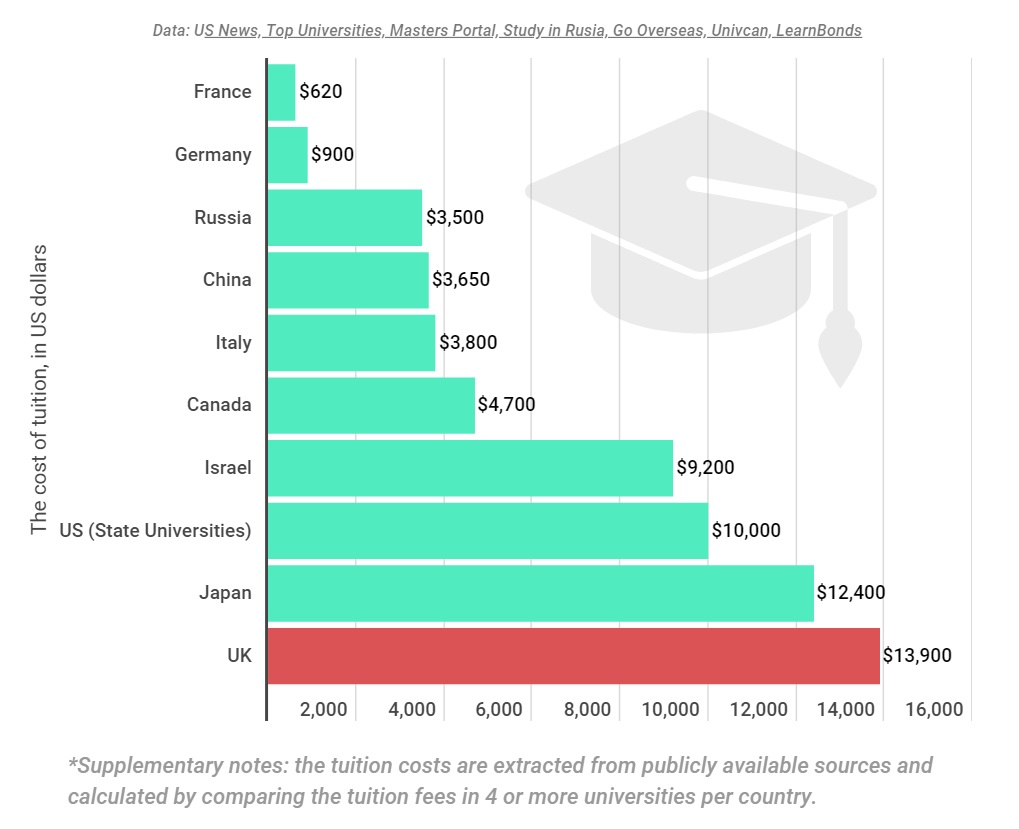
Data calculated by Learnbonds.com shows that the United Kingdom has the highest tuition fees among the top ten world’s most influential countries at $13,900 per year.

Tuition fees compared

Among the top countries, Japan ranks second with an average of $12,400 to represent a percentage difference of 10.7% with the UK.

According to the data:

“The United States ranks third with average public college tuition of $10,000 representing a percentage difference of 28% when compared to the UK.”

Israel ranks fourth with $9,200 followed by Canada at $4,700. In the sixth position, is Italy with average tuition fees of $3,800. China and Russia are among countries that rank lower in average tuition at $3,650 and $3,500 respectively.

Among the top ten most influential countries, Germany and France are the only nations with average tuition below the $1000 mark. In Germany, the public college tuition fee is at least $900 while France is $620.

Germany’s cheap tuition fees can be attributed to the free tuition policy. In France, the fees are affordable for students with the EU/EEA and Switzerland.

In most countries, the cost of education is higher when you factor in the cost of living. Students have to incur extra costs in food and housing.


Top 10 Countries by International Influence
Details: according to 2019 dataData: US News

Chart
#CountryGDPPopulationGDP per Capita
1.United States$20.5 trillion327.2 million$62,869
2.China$13.6 trillion1.4 billion$18,116
3.United Kingdom$2.8 trillion66.5 million$45,741
4.Russia$1.7 trillion144.5 million$28,797
5.Germany$4.0 trillion82.9 million$52,386
6.France$2.8 trillion67.0 million$45,893
7.Japan$5.0 trillion126.5 million$44,246
8.Italy$2.1 trillion60.4 million$39,676
9.Israel$369.7 billion8.9 million$37,994
10.Canada$1.7 trillion37.1 million$49,690

Apart from tuition fees, students also have to pay for other expenses, such as housing, food, and books, which can run into thousands of dollars a year. However, in the United States, the cost of education depends on the choice of institution. The student loan burden is at crisis levels in the US, say many observers.

Israel comes fourth with an average fee of $9,200 while Canada occupies the fifth position. Between 2019-2020, the average college fees in the North American country were $4,700 representing a figure almost three times less than the UK.

In the sixth position, is Italy with average college fees of $3,800. During the period under review, compared to the UK, a percentage difference of 72.6%.

China and Russia also rank among countries with low tuition fees at $3,650 and $3,500 respectively.

China has invested heavily for years in its education system to make it affordable for citizens and foreigners. Chinese universities have a reputation for offering quality education with high-standard facilities.

France, Germany among countries with the cheapest college fees

Among the top ten most influential countries, Germany is among countries with average public college tuition below $1000. During the period under review, the average cost was $900. Compared to the UK, this is a percentage difference of 93.5%.

In Germany, the low cost of education can be attributed to factors such as the existing free tuition system. However, students can incur extra costs in student union and semester fees. Despite the extra charges, compared to other countries, the fee is still affordable.

However, France has the most affordable college education among the rated countries. The average public college is $620 to represent a percentage difference of over 95% compared to the UK. Generally, in France, tuition fees are lower for students from the EU/EEA and Switzerland. Students outside this region pay more.

Although most students can afford tuition fees in most countries, extra charges such as housing and food make college education more expensive. The situation is worsened especially in regions with a high cost of living. Globally, private tuition fees are usually higher compared to public institutions, ranging between $15,000 – $40,000.

For the Silo, Justinas Baltrusaitis -learnbonds.com

International Monetary Fund- World Economy Still Recovering

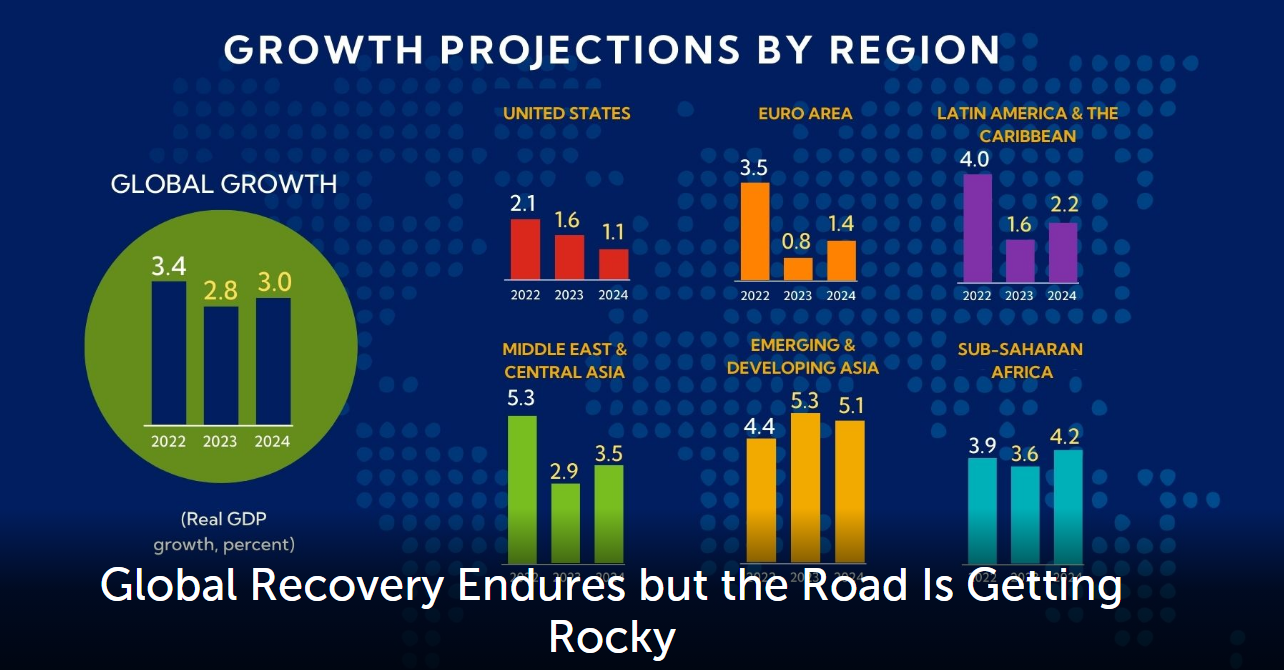
The IMF announced today (Tuesday, April 11, 2023) in the World Economic Outlook’s press briefing that the baseline forecast for global output growth is 0.1 percentage point lower than predicted in the January 2023 WEO Update, before rising to 3.0 percent in 2024.

“The world economy is still recovering from the unprecedented upheavals of the last three years, and the recent banking turmoil has increased uncertainties.”

“We expect global output growth to fall from 3.4% last year to 2.8% in 2023, before rising to 3% in 2024, mostly unchanged from our January projections. Advanced economies are expected to see an especially pronounced growth slowdown from 2.7% in 2022 to 1.3% in 2023. Global headline inflation is set to fall from 8.7% in 2022 to 7% in 2023 on the back of lower commodity prices but underlying core inflation is proving to be stickier. Importantly, this outlook assumes that recent financial stresses remain contained,” said Pierre-Olivier Gourinchas, the IMF’s Chief Economist.

Much uncertainty clouds the short- and medium-term outlook as the global economy adjusts to the shocks of 2020–22 and the recent financial sector turmoil. Recession concerns have gained prominence, while worries about stubbornly high inflation persist.

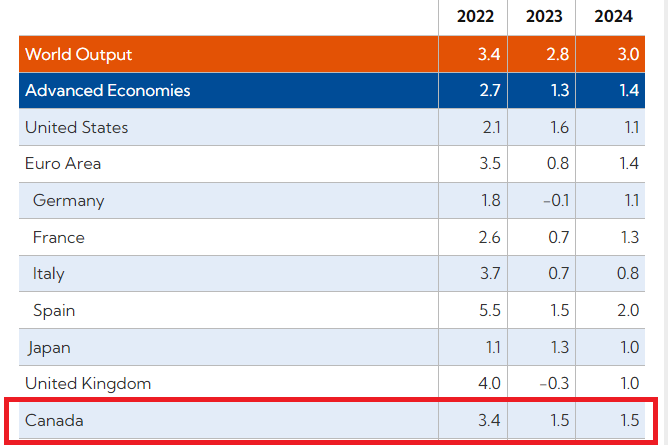
Chart- world economic outlook projections including Canada.

“Once again, risks are heavily tilted to the downside, they have risen with the recent financial turmoil. Most prominently, recent banking system turbulence could result in a sharper and more persistent tightening of global financial conditions. The simultaneous rate hikes across countries could have more contractionary effects than expected, especially as debt levels are at historical highs. There might be a need for more monetary tightening if inflation remains stickier than expected. These risks and more could all materialize at a time when policymakers face much more limited policy space to offset negative shocks, especially in low-income countries,” added Gourinchas.

With the fog around current and prospective economic conditions thickening, policymakers have a narrow path to walk towards restoring price stability while avoiding a recession and maintaining financial stability. Achieving strong, sustainable, and inclusive growth will require policymakers to stay agile and be ready to adjust as information becomes available.

“First, as long as financial stress is not systemic as it is now, the fight against inflation should remain the priority for central banks. Second, to safeguard financial stability, central banks should use separate tools and communicate their objectives clearly to avoid unwarranted volatility. Financial policies should remain laser focused on preserving financial stability and watch for any buildup of risks in banks, non-banks, and the real estate sectors. Third, in many countries fiscal policy should tighten to ease inflation pressures, restore debt sustainability, and rebuild fiscal buffers. Finally, in the event of capital outflows that raise financial stability risks, emerging market and developing economies should use the integrated Policy framework, combining temporary targeted foreign exchange interventions and capital flow measures where appropriate,” said Gourinchas.

Why Everyone Should Strive To Pay Off Their Mortgage Quicker

Lots of people struggle to get a mortgage in the first place. It’s especially hard now because homes are so expensive. You start to think you’ll be paying off your mortgage for the rest of your life. 

Luckily, your finances will probably improve considerably over time. When they go up you should look into paying your mortgage early. Let’s look at some of the top reasons why it’s something you should aim for in the future. 

Extra Money To Enjoy Yourself 

Get It on Credit - Wikipedia

If people need to take out bad credit loans in Toronto, ON, they won’t have lots of disposable income. When you don’t have great credit you can’t enjoy yourself, but that’s not the case when you’re older. 

When you have more disposable income after paying off a mortgage, you’ll have much more money to spend on luxuries. If you need to keep paying a huge chunk of your income towards a mortgage your life won’t be as fun. 

Saving Lots Of Money In Interest 

Once you walk into Clover Mortgage Brokers in Toronto & GTA, they’ll let you know how much you can spend on a home. But it’s going to be a lot more over the lifetime of the mortgage due to interest payments. 

When you pay interest on a loan, it makes up a big chunk of your monthly payments in the beginning. The amount of interest you pay drops over time, but if you pay off the mortgage early you’ll no longer have to pay it.


Why Choose a Mortgage Broker in Canada? | Hatch Mortgages

It Eats Into Any Debts You Have 

Over the course of a lifetime, couples can generate a huge amount of debt. College tuition, car payments, and credit cards can sometimes be quite high. These debts won’t disappear once you pay your mortgage. 

Fortunately, once your mortgage is gone you’ll be able to focus 100% of your efforts on your other debts. It will take you one step closer to becoming debt-free, so you’ll have one less thing to worry about. 

A Mortgage Is A Secured Loan 

When you take out a mortgage it’s classified as a secure loan, which means when you don’t pay the loan they’ll be able to take your home away. In a perfect world, you’ll have as few secured loans as possible. 

You could pay a credit card instead of a mortgage, but it would mean they could take your home. Even though you won’t miss your credit card payments, they couldn’t take your home even if you did completely ignore them because a credit card isn’t classified as a secure loan. 

It’s Easier To Enjoy Retirement 

Nobody should have to pay debts when they’re retired. Sadly, so many people are struggling now, so it’s much more common than you think. It will eventually start to hurt your mental and physical health. 

How can you enjoy retirement if you’re always worrying? Maybe you’ll even have to stay on at work because you can’t afford to retire. Pay off your mortgage to ensure you don’t have any stress when you retire. 

Debt Isn't About Right Or Wrong - It's About Freedom

Don’t Leave It Too Late 

Nobody is saying you should try to pay off your mortgage as soon as possible, but it’s something you’ve got to start considering as the years go by. 

Violence Against Women Costs Lesotho South Africa $113 Million USD Annually

Lesotho–South Africa relations - Wikipedia
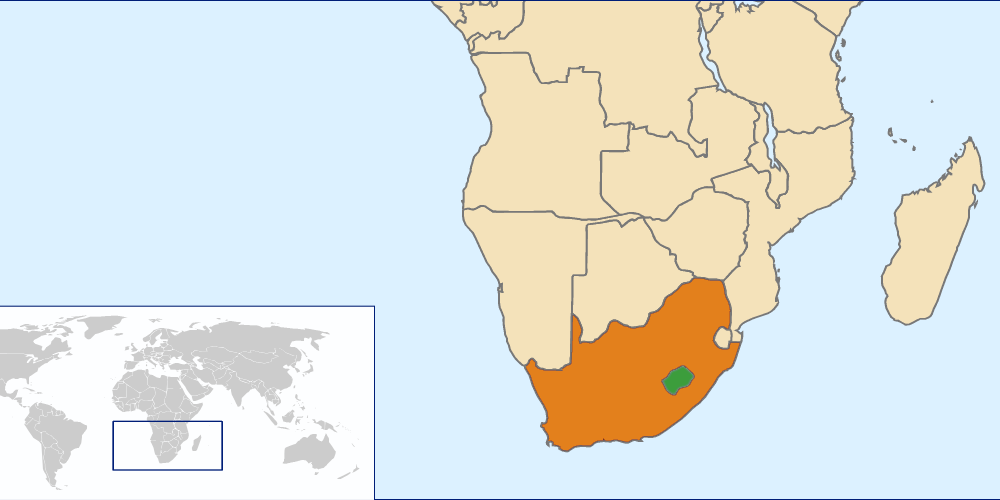
Lesotho, South Africa- Commonwealth member.
A recent Commonwealth report has revealed violence against women and girls costs Lesotho more than $113 million (about 1.9 billion Lesotho loti) a year. The report estimates the total cost, including loss of income and expenses associated with medical, legal and police support, equates to around 5.5 per cent of Lesotho’s gross domestic product (GDP).

The cost of $113 million means each Lesotho citizen loses at least $50 every year to violence against women and girls.The cost of $113 million means each Lesotho citizen loses at least $50 every year to violence against women and girls.

The bulk – $45usd million – is attributed to legal protection, healthcare, social services and learning loss.

This is more than twice the amount – $21 million – Lesotho spent on health, education and energy in the last fiscal year. The report sets out policy recommendations for the health, education, legal and private sectors to better meet the needs of victims, which include: Updating the forms used for collecting data on violence against women and girls; Using digital services to collect and share the data with stakeholders; Training staff responsible for recording, analyzing and sharing data; Developing a broad approach involving all sectors to prevent the abuse; and making strategic shifts to allocate resources to carry out these recommendations.

Commonwealth Secretary-General Patricia Scotland said: “This report proves once again that ending violence against woman and girls is not only the right thing to do but it is also the smart thing to do and beneficial to us all. “Tackling this issue will prevent immense pain and suffering for individuals and communities and will also end the damage this violence does to our economies and prosperity. “As the first report of its kind to focus on Lesotho in this way, our intention is that it should provide the basis for designing more clearly focused national policies and programs, and help ensure that adequate resources are allocated for priorities such as training service providers.

“The findings put a price tag on the endemic scourge of gender-based violence, and demonstrate that the consequences of ignoring the problem are far higher than the cost of taking preventative and remedial action. “By providing the baseline for a series of periodic costing studies and practical intervention, we hope the report will help pave the way towards significant progress on eliminating violence against women and girls, thereby saving many lives.”

The loss of income for women who experience violence due to missed days of work and lost productivity comes to $22usd million annually. Income losses result in less spending which triggers a negative impact on commodity demand and supply of goods and services. Lesotho’s Minister of Gender and Youth, Sport and Recreation Mahali Phamotse said: “Violence against women and girls is a problem in Lesotho which affects national development.“

The report will help Lesotho come up with appropriate strategies that will help eradicate violence against women and girls as we are now aware of its causes and economic implications. “The report calls for immediate action through which my ministry will embark on a project to ensure the protection of women and girls.”

In Lesotho, about one in three women experience sexual or physical violence in their lifetime, similar to the global prevalence rate. The Commonwealth worked with Lesotho’s Ministry of Gender and Youth, Sport and Recreation to conduct the study and produce this report.

This is the second country report completed by the Commonwealth. The first was produced for Seychelles in 2018. Read: The Economic Cost of Violence Against Women and Girls: A Study of Lesotho 

The Commonwealth is a voluntary association of 54 independent and equal sovereign states and includes Canada. Our combined population is 2.4 billion, of which more than 60 per cent is aged 29 or under. The Commonwealth spans the globe and includes both advanced economies and developing countries. Thirty-two of our members are small states, many of which are island nations.

The Commonwealth Secretariat supports member countries to build democratic and inclusive institutions, strengthen governance and promote justice and human rights. Our work helps to grow economies and boost trade, deliver national resilience, empower young people, and address threats such as climate change, debt and inequality. Member countries are supported by a network of more than 80 intergovernmental, civil society, cultural and professional organisations.
 
For the Silo, Snober Abbasi.

Start Saving for an Emergency Fund

Debt is much more common than you think. Almost everyone has encountered it at least once in his or her life, and it’s nothing to be ashamed of. What is most important is being able to recognize it and address that you need help.

One way to get help is by consulting a not-for-profit credit counselling agency that offers holistic support in all aspects of debt maintenance. The right agency will offer advice on everything from how to spot and avoid credit repair scams to delivering judgment-free credit rebuilding advice through wise credit and money management.

To avoid future situations of financial uncertainty start saving for an emergency fund once you’ve been able to knock off some of your debt. Having a safety net will make you feel more stable in years to come, and as the title suggests, it’s always an excellent idea to have funds available if any sort of emergency takes place.

It takes time and dedication, but you’ll thank yourself later on when you can pay debts off in half the amount of time as it would normally take.

How Much Should You Save?

Of course, everyone’s situation is different. Depending on if you have a family or you live on your own, if there is a beloved pet that may require medical care — there are many factors that can affect how you should consider initiating your emergency fund.

It’s a common belief that a typical person should be able to access six-months of salary at any time. This is incredibly unrealistic for most people, but it can be a long-term goal.

Look at what you earn per month, and think of an amount that makes sense to set aside in a savings account each paycheque.

How to Build the Emergency Fund

Speak with your Credit Counsellor first to gain some insight on what your emergency fund could look like, and consider these ideas.

  • The first step is to save one month of living expenses. Sit down and plan out how much your food, entertainment, bills, rent, and so on cost. Work out how long it would take to save that amount, and set aside a chunk of money each month. Even if takes a few months, the point is that you’re working toward a goal.
  • If time and health allow, get supplemental income. Are you free on weekends to work a few shifts at your friend’s store? Perhaps you could take on an additional freelance writing or design gig to chip away at in the evenings. It’s hard work, but if you’re able to take on something a little extra, it will pay off.
  • Save your tax refund. It might not be possible to save the entire amount, but if you’re able to, do it! After you’ve filed your taxes and if you qualify for a refund, saving it can be a simple way to boost your savings.

Think about the benefits of opening an emergency fund. You’ll feel so much more secure and calm knowing that there are funds available in case something unpredictable happens.

You will get back on track and you can plan for the future.

Canadian Money And How Select Banks Create It

Poof!My book, Money: Whence It Came, Where It Went, tells us that “The study of money, above all other fields in economics, is one in which complexity is used to disguise truth or to evade truth, not to reveal it.

 The process by which banks create money is so simple the mind is repelled.”

Graham Towers, the first Governor of the Bank of Canada, explained the process by which banks create money: “The manufacturing process consists of making a pen-and-ink or typewriter entry on a card in a book. That is all. Each and every time a bank makes a loan, new bank credit is created – new deposits – brand new money.

John Kenneth Galbraith- mystic or curmudgeon? image: poorwilliam.net

Broadly speaking, all new money comes out of a bank in the form of loans. As loans are debts, then under the present system all money is debt.”

Money created by banks and other financial institutions is interest-bearing debt. They create the principal and expect their money to be returned with interest. We can’t create interest the way they create the principal, so we must obtain it from some other money that was also created as interest-bearing debt. There is never enough of this money in existence at any time to pay off all of our collective debt. More interest-bearing money must continually be borrowed into existence.

In 2013, not so long ago, the ratio of household debt in Canada, including mortgages and consumer debt, was more than 160% of disposable income after mandatory deductions and income taxes and this statistic will keep growing with each year. The federal debt in Canada then was more than $600 billion, and interest payments on the debt in 2011-2012 cost $31 billion dollars or 11 cents of every tax dollar. Now in 2019, the federal debt has grown to $768 billion.

The five largest banks in Canada reported more than $27 billion in combined net income for the 2012 fiscal year.

Canada’s central bank, the Bank of Canada, claims to “regulate credit and currency in the best interests of the economic life of the nation”, and to mitigate “fluctuations in the general level of production, trade, prices and employment”, yet the purchasing power of the Canadian dollar has dropped steadily since the Bank of Canada was founded in 1934. As a store of value the dollar has not performed very well. It should also be noted that Canadian banknotes ceased to be redeemable for gold in 1929.

Bank of Canada notes are fiat money that the federal government declares to be legal tender, and the Bank has a monopoly on the issuance of bank notes. These notes are supplied to financial institutions to satisfy public demand. Chartered banks in Canada are no longer required to maintain statutory cash reserves for the loans they make. According to some estimates, Bank of Canada notes add up to less than 2% of the total amount of loans made by the banks and other financial institutions.

Once upon a time, Canada used real paper bills for one and two dollars. The move away from paper currency is interesting. Is there a concerted effort to 'do away' with physical money? (The recent withdrawal of the penny being an example.) The penny was costing more to manufacture and distribute than its actual physical value...that's partly because it wasn't made out of pure copper- hence it became "expensive". Will the nickel be the next coin to die? Is it even made out of nickel anymore? Check back in ten years. CP

Money created as interest-bearing debt is scarce from the moment it is created, which curtails its effectiveness as a medium of exchange. Every dollar comes into existence as interest-bearing debt, and the overall cost of interest is reflected in the price of everything we buy. This is not to suggest that interest should be banned or that interest rates need to be controlled by a central bank. Anyone should be free to lend his or her savings at a mutually agreeable rate. Equity financing, with shared risks and rewards, is another option.

What is being suggested here is that we ask some fundamental questions about the monetary system and the function of money.

 Are you able to use your goods, services, labour, knowledge, skills and abilities to obtain enough money to purchase other goods and services?

Are you able to obtain credit when you need it and are also willing and able to pay it back? Are you able to negotiate an agreeable price for credit and loans? Are you on a treadmill of debt, no matter how hard you work, how many expenses you cut, or how hard you try to save?

Are your savings secure and retaining their value?

Money is basically credit, like an IOU. Our ability to exchange our goods and services should not be hampered by the price of credit or an inadequate supply of money. Anything physically possible is financially possible. We can extend credit to anyone who wants to purchase anything from us and who is willing and able to provide us with a mutually agreeable amount of his or her goods and services. In essence, goods and services pay for other goods and services.

A mutual credit clearing system is an alternative method that can be used to facilitate reciprocal exchange.

Members of a credit clearing association have a trading account where an ongoing record is kept of their sales and purchases, their credits and debits. Every transaction includes a credit entry for one member and a debit entry for another, but interest does not have to be paid when an account temporarily has more debits than credits. Credit is extended to members from the rest of the traders in the group, and the major benefit of this system is that members can obtain interest-free credit. In the long term every member is expected to provide as much as they obtain. It all balances out within the community of traders. It’s all a simple matter of bookkeeping.

Direct credit clearing systems can be operated on a fee-for-service basis to cover expenses and to compensate those who provide this service. Nobody is ever forced to join any trading group and members are also free to leave when their debts are clear. Anyone can start their own credit clearing service, which allows competition between associations based on quality and price of service. Associations can also cooperate with each other to increase the number of potential trading partners and broaden the range of goods and services that are available.

Credit does not have to be scarce or expensive. We can control our own credit and allocate it as we choose. Are your best interests being served by the money you use?   For The Silo, John Kenneth Galbraith.

Top Ways Folks Go Broke

Being broke sucks and you don’t have to come from a wealthy family, have the next  billion-dollar idea or work 18-hour days to become rich, says self-made millionaire Mike Finley. In fact, you don’t have to be extraordinary in any of the headline-grabbing ways. What you need is the self-awareness to avoid wasting Financial Happiness.

“Money used wisely can give you financial security ”

Finley lists 10 of the most common money traps that lead to consumers going broke:

1- Making the appearance of wealth one of your top priorities by acquiring more stuff. The material trappings of a faux lifestyle, as seen in magazines and advertisements, are not good term happiness.

2- Working a job you hate, and spending your free time buying happiness. Instead, find fulfilling work Monday through Friday so you are not compensating for your misery with expensive habits during the weekend.

Even worse than living paycheck to paycheck- advance loan on your paycheck.

3-  Living paycheck to paycheck and not worrying about saving money. Don’t live for today, as if that’s all that matters. Have you already achieved all of your dreams by this moment? If not, embrace hope and plan for tomorrow. (Appreciating your life today doesn’t require unnecessary expenditures.)

4-  Stopping your education when someone hands you a diploma; never reading a book on personal finance. Just about any expert will tell you that the most reliable way out of poverty is education. Diplomas shouldn’t be the end of learning; they should be a milestone in a lifetime of acquiring wisdom.

5-  Playing the lottery as often as possible. While you’re at it, hitting the casino! Magical thinking, especially when it comes to money, is a dangerous way to seek  financial security.

6-  Running up your credit cards and making the minimum payments whenever possible. Paying interest on stuff you really don’t need is a tragic waste of money.

7-  When you come into some free money, spending it. Feeling like you deserve it. By that logic, you’re saying that a future version of you doesn’t deserve the money, which can be multiplied with wise investments.

8-  Buying the biggest wedding and the biggest ring so everyone can see just how fabulous you really are. Nothing says “Let’s start our future together” like blowing your entire savings on one evening.

9-  Treating those “amazing” celebrities and “successful” athletes as role models. Trying to be just like them whenever possible. As far as we know, there’s only one you the universe has ever known. Don’t dilute your unique individuality by chasing an image.

10-  Blaming others for your problems in life. Repeat after me: I am not a victim. The victim mentality is an attempt to rationalize poor habits and bad decision-making.

“If you’re feeling uncomfortable with your financial situation, don’t just sit there in a malaise of ‘If only I had more money,’ ” Finley says. “Instead, use it as motivation for a better life; that’s why the discomfort is there.”

Like most North Americans, Mike Finley was raised with no education in personal finances. Joining the Army out of high school, he realized he didn’t understand money management and began the task of educating himself. After 26 years in the service, during which he practiced the principles he learned, he retired a millionaire. Finley is the author of “Financial Happine$$,” and teaches a popular financial literacy class at the University of Northern Iowa.  For the Silo, Jarrod Barker.

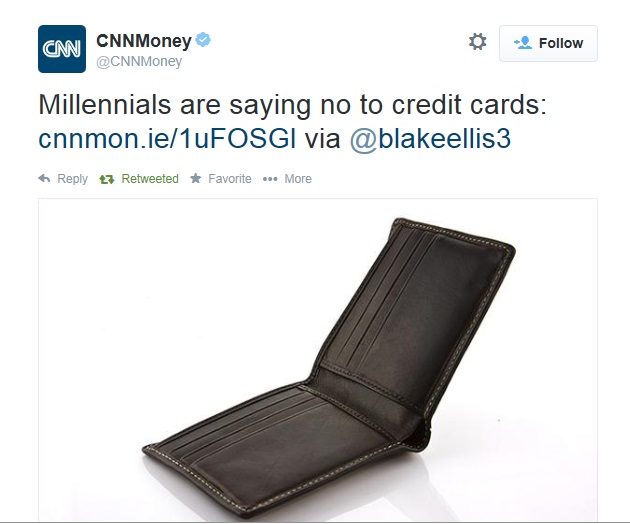
CNNMoney- Millennials Saying No To Credit Cards

CNN Money No Credit Cards For Millenials


CNNMoney ‏@CNNMoney 13h

Millennials are saying no to credit cards: http://cnnmon.ie/1uFOSGl  via @blakeellis3 pic.twitter.com/T1U8i7OU2I

What some tweeters are saying:

CalBeach ‏@CalBeach 13h

@CNNMoney @blakeellis3 They’re smart to avoid debt.

YmeYnot ‏@YmeYnot2011 13h

@CNNMoney @blakeellis3 Only use charge card when you can pay entire debt completely before you are charged interest.

NETGAINS ‏@Netgains_ 13h

@CNNMoney @blakeellis3 Great info… Thanks for sharing..

Equality=Peace ‏@angrigarisangri 13h

@CNNMoney @CNN @blakeellis3 Yes to #bitcoin!

Glenn ‏@GlennMPR 13h

@CNNMoney @CNN @blakeellis3 Smarter than my generation then.

Pm3marston ‏@Pm3marston 13h

@CNNMoney @CNN @blakeellis3 We know not to be caught in the credit card trap. Only use it as a cash replacement card, not for debt.

Roger Bustos ‏@rogerbgom 13h

@CNNMoney @blakeellis3 like a smart wallet just pass the wallet and charge from your credit or debit just pick with your phone….

BrokenHearted ‏@patientfailure 12h

@CNNMoney @CNN @blakeellis3 Stupid. You’re spending decisions should never change based on your form of payment.

Patrick B ‏@sportbikeguy00 12h

@CNNMoney @CNN @blakeellis3 Credit & debts of any kind should be avoided,my motto is if you can’t pay cash for it,save up or forget it.

mizo ‏@bemelmesre 12h

@CNNMoney @CNN @blakeellis3 Never used a credit card in my life. Only used credit for commercial purposes.

victor ‏@victor_de64 11h

@CNNMoney @CNN @blakeellis3 I’m a baby boomer and cut all mine 19 years ago and never missed them

CynicalPolitico ‏@IndyinTX31 11h

@CNNMoney: Millennials are saying no to credit cards: http://cnnmon.ie/1uFOSGl  via @blakeellis3 pic.twitter.com/sAw87n1GDt”()

FatNoMore™ Fitness ‏@FNM_Fitness 10h

@CNNMoney @blakeellis3 Either buy cast or use paypal. Credit cards are just a disaster waiting to happen #ParentWillAgree

Andrew Smith ‏@iSmitty12 10h

@DaveRamsey thoughts? “@CNNMoney: Millennials are saying no to credit cards: http://cnnmon.ie/1uFOSGl  via @blakeellis3 pic.twitter.com/kcL0lgMyzP

Yvonne Moedt ‏@YvonneMoedt 9h

@CNNMoney That’s great!! You never know what’s left or how big your debt is and will never get out once you start. Real paper money #future

Declan Martens ‏@DeclanMartens 9h

@CNNMoney @blakeellis3 hey that’s us! @Malicious_Tea

Zbolts ‏@zbolts 9h

They use mom/dad?! “@CNNMoney: Millennials are saying no to credit cards: http://cnnmon.ie/1uFOSGl  via @blakeellis3 pic.twitter.com/f1jlE2zlAq

HogsAteMySister ‏@hogsatemysister 9h

@CNNMoney @blakeellis3 Which is easy to do when you still live at home…

Websterwall ‏@Websterwall 8h

@CNNMoney @blakeellis3 It’s true. No card for me. Living within my means

The Epitomy Of An ‏@ErnieBlanco63 8h

@CNNMoney With the job market being so rocky it’s a smart move.

Stephen Cefalu ‏@Scef2308 7h

@CNNMoney @CNN @blakeellis3 they don’t know how to use a CC to maximize the rewards and cash back. Learn how to use credit.

Jay Brausch ‏@BigDogStar 7h

@CNNMoney @CNN @blakeellis3 One of the smartest things of the new millennium that they can do.

KC Simbeck ‏@kc_simbeck 6h

@CNNMoney I’d like to not have a credit card. But it’s pretty much required for building credit.

Liesel Rickert ‏@le_rickert3 6h

Ive been wanting 1, but can’t decided bc of 2 factors here RT “@CNNMoney: Millennials are saying no to credit cards: http://cnnmon.ie/1uFOSGl 


Ontario government wants to strengthen rules for Debt Settlement Services

OntarioGovRegulationIcon


Ontario is taking steps to provide vulnerable consumers with protection against unfair business practices of some companies that offer debt settlement services.

As part of the province’s continuing commitment to strengthen consumer protection, the Ontario government intends to introduce legislation that, if passed, would impose new rules for debt settlement services, including:

 Banning companies from charging upfront fees for debt settlement services.

 Limiting the total amount of fees consumers are charged.

 Requiring clear, easy to understand contracts.

 Establishing a 10-day cooling-off period, providing consumers more time to consider their agreements.

 Allowing the licenses of non-compliant companies to be revoked.

These proposed reforms would help protect the rights of consumers and are part of the new Ontario government’s commitment to building a strong economy and a fair, safe and informed marketplace.

QUOTES

“Ontario consumers need to have confidence that they’re getting what they pay for when purchasing debt settlement services. We’re going to introduce legislation that would protect some of our most vulnerable consumers from being taken advantage of, at a time when they need the most help.”

— Tracy MacCharles, Minister of Consumer Services MPP Pickering-Scarborough-East


“Ontarians work hard for their money. Why just give it away to a company that is going to take your up-front fee but not actually settle with your creditors? I’m pleased the Ontario government is strengthening protections for consumers looking for help from debt settlement companies”

— Gail Vaz-Oxlade, financial writer and host of “Til Debt Do Us Part”

QUICK FACTS

 Ontario is joining other provinces like Alberta and Manitoba that regulated companies offering debt settlement services.

 There are currently 22 companies and 38 credit counselling providers offering debt settlement services in Ontario.

 The average consumer debt in Ontario is more than $25,000 per person.

LEARN MORE

Read more about how the Ontario government protects consumers who use companies that offer debt settlement services. www.sse.on.gov.ca

Protect yourself against scams and fraud.


ontario.ca/consumer services

Disponible en français