Tag Archives: household debt

Vehicle Millennials Once Mocked Makes Major Comeback

Millennials are abandoning SUVs for the one vehicle they swore they’d never drive: the minivan.

For years, North Americans were told bigger was better. Three-row SUVs became the default family vehicle, and automakers poured billions into the category. Consumers followed in droves. But now a surprising reversal is underway. The same generation that spent decades mocking minivans is increasingly choosing them over SUVs, and experts say the shift reveals something much larger about the state of the North American consumer in 2026.

Faced with persistent affordability pressures, elevated borrowing costs, expensive insurance premiums, and rising household debt, many families are abandoning image-driven vehicle purchases in favor of practicality, value, and long-term cost savings. The result? The minivan is making an unexpected comeback!

Why Minivans Are Growing Again
ce van 2.png

The growth comes after decades of decline and signals a notable shift in consumer priorities. Industry analysts cite several major factors:

  • Better cargo space than most three-row SUVs.
  • Easier third-row access.
  • Sliding doors favored by parents.
  • Better fuel economy versus large SUVs.
  • Lower purchase prices compared to similarly equipped SUVs.
  • Strong hybrid offerings from Toyota and Kia.
  • Rising affordability concerns among younger families.

What makes this trend especially compelling is who is driving it. Millennials, many of whom grew up riding in minivans and spent years rejecting them as uncool, are now among the key buyers fueling the segment’s resurgence. As the oldest members of Generation Alpha enter their school-age years and family transportation needs evolve, functionality is increasingly outweighing perception.

Costly SUVs Are Pricing Out Families
SUV prices have steadily climbed since 2021, with three-row options outpacing overall car price inflation. As once-mainstream options like the Suburban and Expedition become more associated with luxury pricing, families looking to pack into a single vehicle have turned to minivans like the Chrysler Pacifica, Toyota Sienna, and Kia Carnival.

Kia Carnival with impressive seating capacity.

The rise of hybrid minivans has also changed the minivan’s reputation from gas guzzler to economical, Earth-friendly choice. Toyota’s hybrid Sienna is also available with all-wheel drive, a combination northern families would have once only dreamed of. For 2026, the hybrid Toyota Sienna gets up to 36 miles per gallon. Ten years ago, the Sienna was good for just 21 miles per gallon. Times are changing! Anyone want to talk about advanced style and design- look back over 30 years ago to the Previa.

The economics are difficult to ignore. Many popular minivans offer significantly more usable passenger and cargo space than comparably priced SUVs, often while delivering better fuel economy and a lower purchase price. For families already grappling with inflation and high monthly expenses, the savings can add up to thousands of dollars annually.

Automotive retail analysts and consumer advocates Zach and Ray Shefska at http://www.caredge.com/ emphasize the following factors:

  • Millennials Are Suddenly Embracing Minivans
  • This Trend Reveals About America’s Financial Reality in 2026
  • SUVs Are Becoming the New Status Symbol Consumers Can No Longer Afford
  • Minivans Deliver the Best Value for Families Today
  • Cargo Space, Insurance Costs, and Fuel Economy Matter More Than Ever
  • Is This a Temporary Shift or the Beginning of a Long-Term Consumer Reset?
  • Rising Household Costs Are Changing Vehicle Buying Decisions
  • The Minivan IS the Family Vehicle North Americans Are Reconsidering in Record Numbers


The minivan story is not really about minivans. It is about a generation confronting economic reality and making purchasing decisions based on value instead of image. The comeback of the vehicle many Millennials once swore they would never own may be one of the clearest indicators yet of how dramatically the North American consumer is changing.

For the Silo, Karen Hayhurst.

Canadian Money And How Select Banks Create It

Poof!My book, Money: Whence It Came, Where It Went, tells us that “The study of money, above all other fields in economics, is one in which complexity is used to disguise truth or to evade truth, not to reveal it.

 The process by which banks create money is so simple the mind is repelled.”

Graham Towers, the first Governor of the Bank of Canada, explained the process by which banks create money: “The manufacturing process consists of making a pen-and-ink or typewriter entry on a card in a book. That is all. Each and every time a bank makes a loan, new bank credit is created – new deposits – brand new money.

John Kenneth Galbraith- mystic or curmudgeon? image: poorwilliam.net

Broadly speaking, all new money comes out of a bank in the form of loans. As loans are debts, then under the present system all money is debt.”

Money created by banks and other financial institutions is interest-bearing debt. They create the principal and expect their money to be returned with interest. We can’t create interest the way they create the principal, so we must obtain it from some other money that was also created as interest-bearing debt. There is never enough of this money in existence at any time to pay off all of our collective debt. More interest-bearing money must continually be borrowed into existence.

In 2013, not so long ago, the ratio of household debt in Canada, including mortgages and consumer debt, was more than 160% of disposable income after mandatory deductions and income taxes and this statistic will keep growing with each year. The federal debt in Canada then was more than $600 billion, and interest payments on the debt in 2011-2012 cost $31 billion dollars or 11 cents of every tax dollar. Now in 2019, the federal debt has grown to $768 billion.

The five largest banks in Canada reported more than $27 billion in combined net income for the 2012 fiscal year.

Canada’s central bank, the Bank of Canada, claims to “regulate credit and currency in the best interests of the economic life of the nation”, and to mitigate “fluctuations in the general level of production, trade, prices and employment”, yet the purchasing power of the Canadian dollar has dropped steadily since the Bank of Canada was founded in 1934. As a store of value the dollar has not performed very well. It should also be noted that Canadian banknotes ceased to be redeemable for gold in 1929.

Bank of Canada notes are fiat money that the federal government declares to be legal tender, and the Bank has a monopoly on the issuance of bank notes. These notes are supplied to financial institutions to satisfy public demand. Chartered banks in Canada are no longer required to maintain statutory cash reserves for the loans they make. According to some estimates, Bank of Canada notes add up to less than 2% of the total amount of loans made by the banks and other financial institutions.

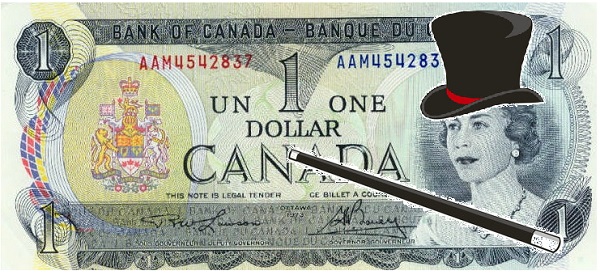
Once upon a time, Canada used real paper bills for one and two dollars. The move away from paper currency is interesting. Is there a concerted effort to 'do away' with physical money? (The recent withdrawal of the penny being an example.) The penny was costing more to manufacture and distribute than its actual physical value...that's partly because it wasn't made out of pure copper- hence it became "expensive". Will the nickel be the next coin to die? Is it even made out of nickel anymore? Check back in ten years. CP

Money created as interest-bearing debt is scarce from the moment it is created, which curtails its effectiveness as a medium of exchange. Every dollar comes into existence as interest-bearing debt, and the overall cost of interest is reflected in the price of everything we buy. This is not to suggest that interest should be banned or that interest rates need to be controlled by a central bank. Anyone should be free to lend his or her savings at a mutually agreeable rate. Equity financing, with shared risks and rewards, is another option.

What is being suggested here is that we ask some fundamental questions about the monetary system and the function of money.

 Are you able to use your goods, services, labour, knowledge, skills and abilities to obtain enough money to purchase other goods and services?

Are you able to obtain credit when you need it and are also willing and able to pay it back? Are you able to negotiate an agreeable price for credit and loans? Are you on a treadmill of debt, no matter how hard you work, how many expenses you cut, or how hard you try to save?

Are your savings secure and retaining their value?

Money is basically credit, like an IOU. Our ability to exchange our goods and services should not be hampered by the price of credit or an inadequate supply of money. Anything physically possible is financially possible. We can extend credit to anyone who wants to purchase anything from us and who is willing and able to provide us with a mutually agreeable amount of his or her goods and services. In essence, goods and services pay for other goods and services.

A mutual credit clearing system is an alternative method that can be used to facilitate reciprocal exchange.

Members of a credit clearing association have a trading account where an ongoing record is kept of their sales and purchases, their credits and debits. Every transaction includes a credit entry for one member and a debit entry for another, but interest does not have to be paid when an account temporarily has more debits than credits. Credit is extended to members from the rest of the traders in the group, and the major benefit of this system is that members can obtain interest-free credit. In the long term every member is expected to provide as much as they obtain. It all balances out within the community of traders. It’s all a simple matter of bookkeeping.

Direct credit clearing systems can be operated on a fee-for-service basis to cover expenses and to compensate those who provide this service. Nobody is ever forced to join any trading group and members are also free to leave when their debts are clear. Anyone can start their own credit clearing service, which allows competition between associations based on quality and price of service. Associations can also cooperate with each other to increase the number of potential trading partners and broaden the range of goods and services that are available.

Credit does not have to be scarce or expensive. We can control our own credit and allocate it as we choose. Are your best interests being served by the money you use?   For The Silo, John Kenneth Galbraith.