Tag Archives: peace

Global Cooperation Shows Resilience In Face of Geopolitical Headwinds

  • The Global Cooperation Barometer 2026 reveals strong pressures on multilateral institutions are causing global cooperation to evolve rather than retreat.
  • While multilateral forms of cooperation declined, smaller and more agile coalitions of countries –and, at times, companies – were instrumental in maintaining overall cooperation levels.
  • Climate and technology saw strong increases in cooperation even in the face of headwinds, health and trade stayed broadly flat and there was a sharp drop of cooperation in peace and security.
  • Learn more about the Barometer and read the accompanying report here. Follow the Annual Meeting 2026 here and on social media using #WEF26.

Geneva, Switzerland, January 2026 – Global cooperation is proving resilient even as multilateralism continues to face strong headwinds, according to the World Economic Forum’s Global Cooperation Barometer 2026. However, cooperation is below where it needs to be to address critical economic, security and environmental challenges. Within a more complex and uncertain geopolitical context, open and constructive dialogue is a critical factor in identifying potential collaborative pathways that advance shared interests.
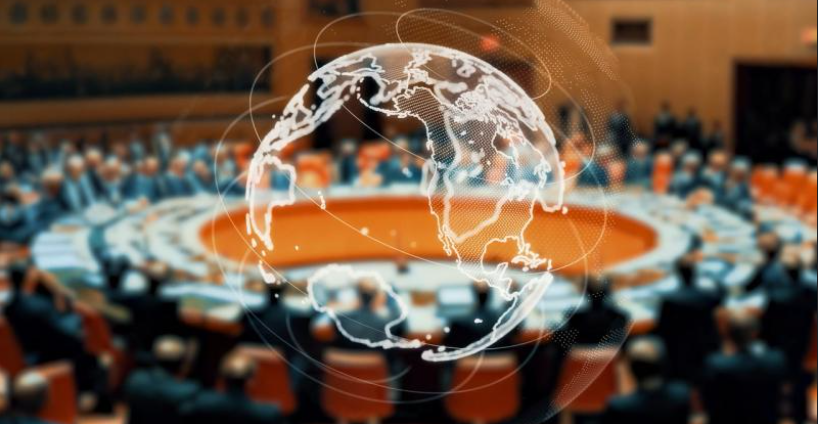


In its third year, the Global Cooperation Barometer 2026, developed in collaboration with McKinsey & Company, uses 41 metrics to assess the level of cooperation worldwide across five pillars: trade and capital; innovation and technology; climate and natural capital; health and wellness; and peace and security.

The 2026 Barometer indicates that the overall level of cooperation has largely been unchanged in recent years but the composition of cooperation appears to be evolving. Innovative, smaller collaborative arrangements are emerging, often within and between regions, as cooperation through multilateral avenues has weakened. Progress on global priorities has shown the greatest momentum when it aligns with national interests – with climate and nature and innovation and technology seeing relatively strong increases in cooperation. Other pillars, including health and wellness and trade and capital, have stayed flat. The peace and security pillar experienced the largest drop.

“Amid one of the most volatile and uncertain periods in decades, cooperation has shown resilience,” said Børge Brende, President and CEO, World Economic Forum. “While cooperation today may look different than it did yesterday, collaborative approaches are essential to grow economies wisely, accelerate innovation responsibly and prepare for the challenges of a more uncertain era. Flexible, nimble and purpose-driven approaches are most likely to withstand the current turbulence and deliver results.”

“Leaders are reimagining collaboration across borders,” said Bob Sternfels, Global Managing Partner, McKinsey & Company. “Cooperation may look different today, and involve different partners, but importantly, it continues to deliver on some critical shared priorities. Collaborative progress can, and does, continue to happen even amid global divisions.”

Global cooperation is reinventing itself

The changing dynamics of cooperation are visible in each of the five pillars of the Barometer.

  • Trade and capital cooperation flattened. Cooperation remained above 2019 values, but its makeup is shifting. Goods volumes grew, albeit slower than the global economy, and flows are shifting to more aligned partners. Services and select capital flows show momentum, particularly among aligned economies, especially where they can contribute to bolstering domestic capabilities. While the global multilateral trade system faces rising barriers, smaller coalitions of countries are cooperating through initiatives such as the Future of Investment and Trade (FIT) Partnership.
  • Innovation and technology cooperation rose to unlock new capabilities even amid tighter controls. IT services and talent flows are up, and international bandwidth is now four times larger than before the COVID-19 pandemic. Restrictions on flows of critical resources, technologies and knowledge expanded – especially, but not only, between the United States and China. However, new cooperation formats are rising, with instances of cooperation on AI, 5G infrastructure and other cutting-edge technologies among aligned countries.
  • Climate and natural capital cooperation grew, but is still short of global goals. Increased financing and global supply chains stimulated deployment of clean technologies, which reached record levels in mid-2025. While China accounted for two-thirds of additions of solar, wind and electric vehicles, other developing economies stepped up. As multilateral negotiations become more challenging, groups of nations – for example, the European Union and ASEAN (Association of South-East Asian Nations) – are combining decarbonization with energy security goals.
  • Health and wellness cooperation held steady, with outcomes resilient for now, but aid is under severe pressure. Topline cooperation in this pillar did not fall, in part because health outcomes continued to improve after the end of the COVID-19 pandemic. Although health outcomes have stayed resilient, the stability masks growing fragility. Pressures on multilateral organizations have eroded support flows and development assistance for health contracted sharply – with further tightening in 2025 – affecting low- and middle-income countries most acutely.
  • Peace and security cooperation continued to decrease, as every tracked metric fell below pre-COVID-19 pandemic levels. Conflicts escalated, military spending rose and global multilateral resolution mechanisms struggled to de-escalate crises. By the end of 2024, the number of forcibly displaced people reached a record 123 million globally. However, growing pressures are creating an impetus for increased cooperation, including through regional peacekeeping mechanisms.

The Global Cooperation Barometer shows countries are rewriting the way they engage in cooperation. Creating new cooperative formats will require new structures, from trade agreements to standards alliances, and new types of partnerships, including public-private and private-private, to manage them effectively. The report concludes by highlighting the need for leaders to focus on rebuilding an effective dialogue with partners as the foundation for identifying and advancing shared interests.
 
About the Global Cooperation Barometer
The Global Cooperation Barometer – first launched in 2024 – evaluates global collaboration across five interconnected dimensions: trade and capital; innovation and technology; climate and natural capital; health and wellness; and peace and security. The Barometer is built on 41 indicators, categorized as cooperative action metrics (evidence of tangible cooperation, such as trade volumes, capital flows, or intellectual property exchanges) and outcome metrics (broader measures of progress such as reductions in greenhouse gas emissions or improvements in life expectancy). Spanning 2012-2025 and indexed to 2020 to reflect pandemic-era shifts, the Barometer normalizes data for comparability (e.g., financial metrics relative to global GDP and migration metrics to population levels). Given rapid developments across all the areas the barometer covers, this year’s report complements the 2024 findings with more recent 2025 data where available, through partial-year data or projections. In addition, two surveys were conducted: one with around 800 executives and another with about 170 experts who are current or former members of the World Economic Forum’s Network of Global Future Councils.

About the Annual Meeting 2026
The World Economic Forum’s 56th Annual Meeting, taking place on 19-23 January 2026 in Davos-Klosters, Switzerland, will convene leaders from business, government, international organizations, civil society and academia under the theme A Spirit of Dialogue. Click here to learn more.

For the Silo, Jarrod Barker.

en Francais

Forum Économique Mondial, [email protected]
La coopération mondiale fait preuve de résilience face aux vents contraires
géopolitiques

  • Le Baromètre de la coopération mondiale 2026 indique qu’en dépit de fortes pressions sur les
    institutions multilatérales, la coopération mondiale ne recule pas, mais progresse.
  • Alors que les formes multilatérales de coopération ont reculé, des coalitions plus petites et plus
    agiles de pays, et même parfois d’entreprises, ont contribué à maintenir les niveaux de
    coopération globaux.
  • On a pu observer une forte augmentation de la coopération en matière de climat et de
    technologie, malgré les vents contraires, une relative stabilité en matière de santé et du
    commerce, et une forte baisse en matière de paix et de sécurité.
  • Pour en savoir plus sur le Baromètre et consulter le rapport associé, cliquez ici. Suivez
    l’Assemblée annuelle 2026 ici et sur les réseaux sociaux grâce au hashtag #WEF26.
  • Genève, Suisse, janvier 2026 – Selon le Baromètre de la coopération mondiale 2026 du Forum
    Économique Mondial, la coopération mondiale fait preuve de résistance alors même que le
    multilatéralisme continue d’être confronté à de forts vents contraires. Toutefois, la coopération n’est
    pas à la hauteur de ce qu’elle devrait être pour relever les défis économiques, sécuritaires et
    environnementaux décisifs. Dans un contexte géopolitique plus complexe et incertain, un dialogue
    ouvert et constructif est essentiel pour identifier les voies de collaboration potentielles faisant
    progresser les intérêts communs.
    Pour la troisième année, le Baromètre de la coopération mondiale 2026, élaboré en collaboration
    avec McKinsey & Company, se base sur 41 paramètres pour évaluer le niveau de coopération à
    l’échelle mondiale, selon cinq dimensions : le commerce et les capitaux, l’innovation et la technologie,
    le climat et le capital naturel, la santé et le bien-être, ainsi que la paix et la sécurité.
    Le Baromètre 2026 indique un niveau global de coopération globalement inchangé sur les dernières
    années, avec toutefois une évolution dans la composition de cette coopération. Des accords de
    collaboration innovants, souvent de moindre ampleur, émergent au sein d’une même région ou entre
    régions, dans un contexte de recul de la coopération multilatérale. Les avancées concernant les
    priorités mondiales ont été les plus marquées lorsqu’elles s’alignaient sur les intérêts nationaux, avec
    notamment une progression notable de la coopération dans les domaines du climat et de la nature,
    ainsi que de l’innovation et de la technologie. Les autres dimensions, y compris la santé et le bien
    être ainsi que le commerce et les capitaux, sont restées stables. La dimension paix et sécurité a
    connu la plus forte baisse.
    « Au sein de l’une des périodes les plus instables et incertaines de ces dernières décennies, la
    coopération a fait preuve de résilience, » déclare Børge Brende, Président-Directeur général du
    Forum Économique Mondial. « Bien que la coopération actuelle soit différente de ce qu’elle était hier,
    les approches collaboratives sont essentielles pour faire croître les économies à bon escient,
    accélérer l’innovation de manière responsable et se préparer aux défis d’une ère plus incertaine. Les
    approches flexibles, souples et axées sur les objectifs sont les plus susceptibles de résister aux
    turbulences actuelles et de produire des résultats. »
    « Les dirigeants redéfinissent la collaboration transfrontalière », déclare Bob Sternfels, Global
    Managing Partner chez McKinsey & Company. « Si la coopération se présente aujourd’hui sous un
    nouveau jour, impliquant des partenaires différents, il est important de noter qu’elle continue de
    1
    répondre à certaines priorités communes essentielles. Le progrès collaboratif peut se poursuivre, et
    se poursuit, même au milieu des divisions mondiales. »
    La coopération mondiale se réinvente
    La dynamique changeante de la coopération est visible dans chacune des cinq dimensions du
    Baromètre.
  • La coopération en matière de commerce et de capitaux s’est stabilisée. La coopération est
    restée supérieure aux valeurs de 2019, mais on observe une évolution de sa composition. Les
    volumes de marchandises ont augmenté, quoique plus lentement que l’économie mondiale, et
    les flux commerciaux se redéploient vers des partenaires plus étroitement alignés. On observe
    un dynamisme des services et de certains flux de capitaux, en particulier au sein des économies
    alignées, surtout lorsqu’ils peuvent contribuer à renforcer les capacités nationales. Alors que le
    système de commerce multilatéral mondial est confronté à des obstacles croissants, des
    coalitions de pays à moindre échelle coopèrent dans le cadre d’initiatives telles que le
    Partenariat pour l’avenir de l’investissement et du commerce (Future of Investment and Trade –
    FIT).
  • La coopération en matière d’innovation et de technologie a augmenté, libérant de nouvelles
    capacités malgré des contrôles plus stricts. Les services informatiques et les flux de talents sont
    en hausse, et la bande passante internationale est aujourd’hui quatre fois plus importante
    qu’avant la pandémie de COVID 19. Les restrictions pesant sur les flux de ressources, de
    technologies et de connaissances essentielles se sont multipliées, notamment entre les États
    Unis et la Chine. Toutefois, de nouveaux formats de coopération voient le jour, avec des
    exemples de coopération en matière d’IA, d’infrastructure 5G et d’autres technologies de pointe
    entre les pays alignés.
  • La coopération en matière de climat et de capital naturel s’est développée, mais reste en
    deçà des objectifs mondiaux. L’augmentation des financements et des chaînes
    d’approvisionnement mondiales a stimulé le déploiement des technologies propres, avec des
    niveaux record mi-2025. Si la Chine a été à l’origine de deux tiers des nouveaux véhicules
    2
    solaires, éoliens et électriques, d’autres économies en développement ont accéléré leurs efforts.
    Les négociations multilatérales devenant plus difficiles, des groupes de nations, dont, par
    exemple, l’Union européenne et l’ANASE (Association des nations de l’Asie du Sud-Est),
    combinent la décarbonisation avec des objectifs de sécurité énergétique.
  • La coopération en matière de santé et de bien-être est restée stable, avec des résultats qui
    demeurent pour l’instant résilients, mais l’aide est soumise à de fortes pressions. La coopération
    en première ligne au sein de cette dimension n’a pas diminué, en partie grâce à l’amélioration
    des résultats en matière de santé après la fin de la pandémie de COVID 19. La stabilité des
    résultats en matière de santé masque une fragilité croissante. Les pressions exercées sur les
    organisations multilatérales ont érodé les flux de soutien, et l’aide au développement de la santé
    s’est fortement contractée, avec un nouveau resserrement en 2025, affectant plus
    particulièrement les pays à faible revenu et à revenu intermédiaire.
  • La coopération en matière de paix et de sécurité a continué à diminuer, tous les indicateurs
    suivis étant en-deçà des niveaux atteints avant la pandémie de COVID 19. Les conflits se sont
    intensifiés, les dépenses militaires ont augmenté et les mécanismes multilatéraux de résolution
    des conflits ont eu du mal à désamorcer les crises. Fin 2024, le nombre de personnes déplacées
    de force a atteint le chiffre record de 123 millions. Toutefois, des pressions croissantes incitent à
    une coopération accrue, y compris par le biais de mécanismes régionaux de maintien de la paix.
    Le Baromètre de la coopération mondiale montre une nouvelle manière pour les pays de s’engager
    dans la coopération. De nouveaux formats de coopération appelleront des structures renouvelées,
    des accords commerciaux aux alliances de normalisation, et des partenariats innovants (notamment
    public-privé et privé-privé) pour en assurer une gestion efficace. Le rapport conclut en soulignant la
    nécessité pour les dirigeants de se concentrer sur le rétablissement d’un dialogue efficace avec les
    partenaires, fondement de l’identification et de la promotion d’intérêts communs.
    À propos du Baromètre de la coopération mondiale
    Lancé pour la première fois en 2024, le Baromètre de la coopération mondiale évalue la collaboration
    mondiale à travers cinq dimensions interconnectées : le commerce et les capitaux, l’innovation et la
    technologie, le climat et le capital naturel, la santé et le bien-être, ainsi que la paix et la sécurité. Le
    Baromètre s’appuie sur 41 indicateurs, classés en mesures d’action coopérative (preuves d’une
    coopération tangible, telles que les volumes d’échanges commerciaux, les flux de capitaux ou les
    échanges de propriété intellectuelle) et en mesures de résultats (mesures plus larges des progrès
    réalisés, telles que la réduction des émissions de gaz à effet de serre ou l’amélioration de l’espérance
    de vie). Couvrant la période 2012-2024 et indexé à 2020 pour refléter les changements de l’ère
    pandémique, le Baromètre normalise les données pour les rendre comparables (par exemple, les
    mesures financières par rapport au PIB mondial et les mesures migratoires par rapport aux niveaux
    de population). En outre, deux enquêtes ont été menées : l’une auprès d’environ 800 cadres et l’autre
    auprès d’environ 170 experts, membres actuels ou passés du réseau des conseils pour l’avenir du
    monde du Forum Économique Mondial.
    À propos de la réunion annuelle 2026
    La 56e réunion annuelle du Forum Économique Mondial, qui se tiendra du 19 au 23 janvier 2026 à
    Davos-Klosters, en Suisse, réunira des dirigeants d’entreprises, de gouvernements, d’organisations
    internationales, de la société civile et du monde universitaire autour du thème Un esprit de dialogue.
    Cliquez ici pour en savoir plus.
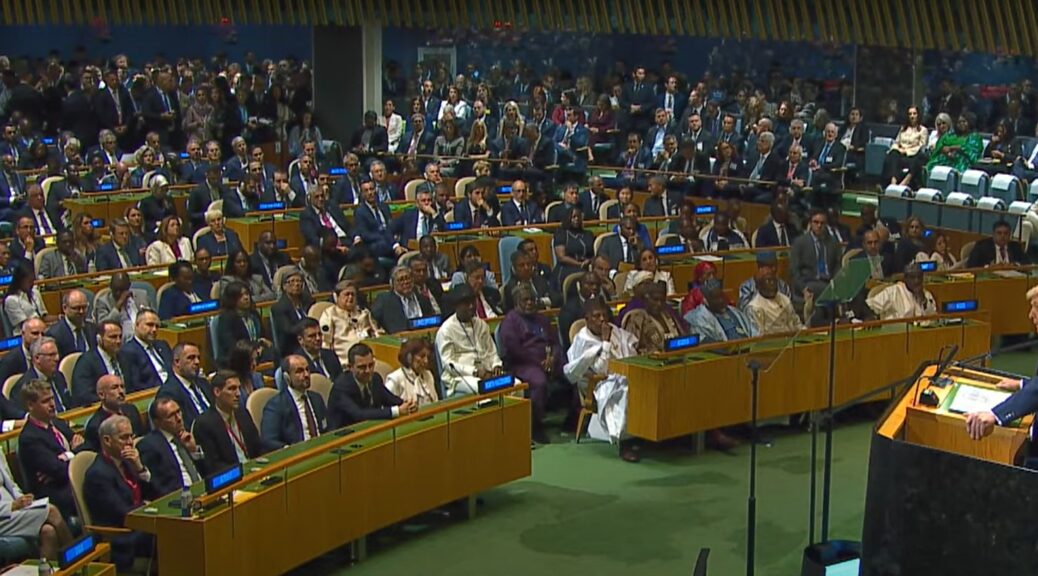
POTUS Delivers Poignant Remarks To UN General Assembly Without Teleprompter

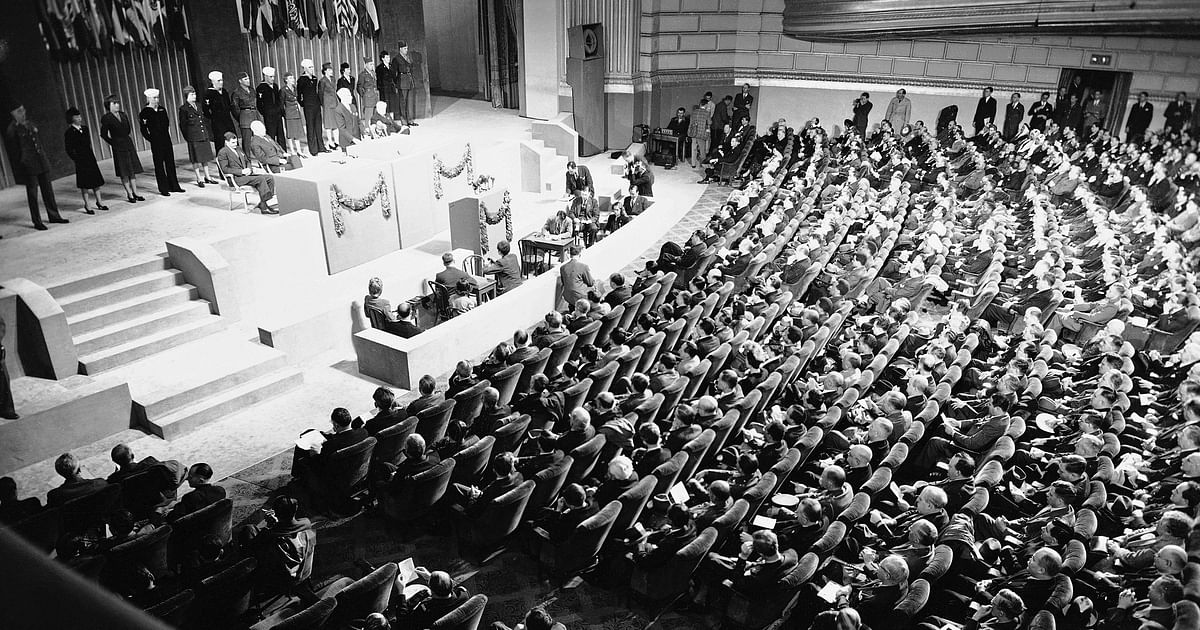
Earlier this month marked the 80th session of the United Nations General Assembly (UNGA80), which opened  on September 9, 2025.  UNGA High-Level Week also took place this week and ends today, when leaders from around the world will gather in New York City.  

The 80th Anniversary of the founding of the UN is an opportunity to return the organization back to its founding mission of promoting peace and security around the world. This year the United States is prioritizing three themes through their engagement at the United Nations:  Peace, Sovereignty, and Liberty. 

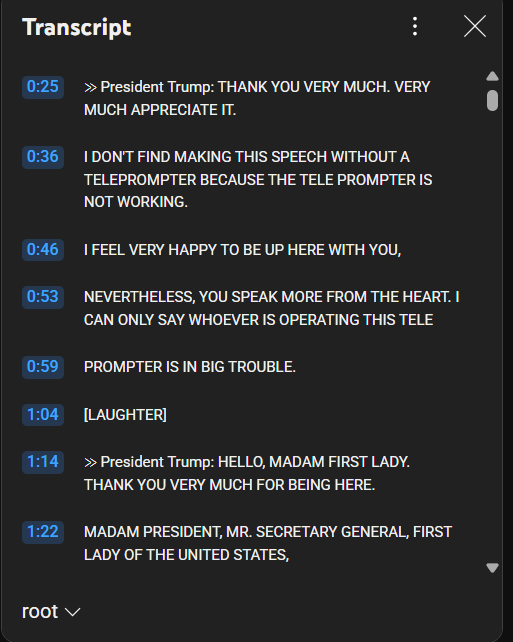
“POURING IN OVER FOUR YEARS OF THE INCOMPETENT BIDEN ADMINISTRATION AND NOW WE HAVE IT STOPPED, TOTALLY STOPPED. IN FACT, THEY’RE NOT EVEN COMING BECAUSE THEY KNOW THEY CAN’T GET THROUGH. BUT WHAT TOOK PLACE IS TOTALLY UNACCEPTABLE. THE U.N. SUPPOSED TO STOP INVASIONS NOT CREATE THEM AND NOT FINANCE THEM.

IN THE UNITED STATES, WE REJECT THE UNITED STATES MASS NUMBERS OF PEOPLE FROM FOREIGN LANDS CAN BE PERMITTED TO TRAVEL HALFWAY AROUND THE WORLD, TRAMPLE OUR BORDERS, CAUSE CRIME AND DEPLETE OUR SOCIAL SAFETY NET. WE HAVE REASSERTED THAT AMERICA BELONGS TO THE AMERICAN PEOPLE AND I ENCOURAGE ALL COUNTRIES TO TAKE THEIR OWN STANCE IN DEFENSE OF THEIR CITIZENS, AS WELL. YOU HAVE TO DO THAT BECAUSE I SEE IT. I’M NOT MENTIONING NAMES, I SEE IT AND I COULD CALL EVERY SINGLE ONE OF THEM OUT, YOU ARE ENJOYING YOUR COUNTRIES, THEY ARE ENJOYING — BEING DESTROYED.

THEY ARE BEING BY ILLEGAL ALIENS LIKE NOBODY EVER SEEN BEFORE. ILLEGAL ALIENS ARE POURING IN AND NOBODY IS DOING ANYTHING TO CHANGE IT, TO GET THEM OUT. IT IS NOT SUSTAINABLE AND BECAUSE THEY CHOOSE TO BE POLITICALLY CORRECT, THEY ARE DOING ABSOLUTELY NOTHING ABOUT IT.” President Donald Trump

This article courtesy of the U.S. Department of State.

World Economic Forum- Global Cooperation At Crossroads

The Global Cooperation Barometer indicates that international cooperation has “flatlined”, driven by heightened geopolitical tensions and instability, but positive momentum in climate finance, health and innovation offers hope.
In an era of heightened volatility, leaders will need to embrace “disordered” cooperation and dynamic, solutions-driven decision-making to deliver tangible results and build trust. AI and other emerging technologies are reshaping the global landscape and driving upheaval. Concerted cooperation will be critical to harness benefits and minimize risks.

Geneva, Switzerland, January 2025 – The World Economic Forum’s Global Cooperation Barometer offers a critical assessment of the state of global cooperation, showing a world grappling with heightened competition and conflict, while also identifying various areas where leaders can drive progress through innovative collaboration. Released amid geopolitical, technological and sociopolitical upheaval, the Forum’s flagship annual report underscores the urgency of addressing shared challenges and offers leaders guidance on what cooperation can look like in a shifting world.
 
The Global Cooperation Barometer 2025, developed in collaboration with McKinsey & Company, uses 41 indicators to measure the current state of global cooperation. The aim is to offer leaders a tool to better understand the contours of cooperation broadly and along five pillars: trade and capital flows, innovation and technology, climate and natural capital, health and wellness, and peace and security. Now in its second edition, the Barometer draws on new data to provide an updated picture of the global cooperation landscape, with a particular focus on the impact of the new technological age.
 
“The Barometer is being released at a moment of great global instability and at a time when many new governments are developing agendas for the year, and their terms, ahead,” said Børge Brende, President and CEO of the World Economic Forum. “What the Barometer shows is that cooperation is not only essential to address crucial economic, environmental and technological challenges, it is possible within today’s more turbulent context.”
 
“This second edition of the Global Cooperation Barometer focuses on where cooperation stands today and what it can look like in the new technological age,” said Bob Sternfels, Global Managing Partner, McKinsey & Company. “Advancing global innovation, health, prosperity and resilience cannot be done alone. Leaders will need new mechanisms for working together on key priorities, even as they disagree on others, and the past several years have shown this balance is possible.”

The latest edition of the Barometer highlights that global cooperation is at a critical juncture. The report’s analysis reveals that after trending positively for a decade and surpassing pre-pandemic levels, overall cooperation has stagnated.

This has been driven by a sharp decline of the peace and security pillar of the Barometer over the past seven years, caused by mounting geopolitical tensions and competition which have significantly eroded global collective security. Levels of conflict and attendant humanitarian crises have increased in the past year to record levels, driven by crises including, but not limited to, the Middle East, Ukraine and Sudan.

As the largely stable cooperative order that defined the post-Cold War period is giving way to a more fragmented landscape, solutions to pressing challenges – from climate action to technological governance – require collaboration. And despite the global security crises, the new findings indicate that collaboration has continued in various areas including vaccine distribution, scientific research, renewable energy development, and more – offering models for future cooperation.
Notably, peace and security have declined sharply in recent years, but other pillars of the Barometer have remained resilient and reveal emerging opportunities for international cooperation,

Innovation and technology. While geopolitical competition is rising in regard to certain frontier technologies such as semiconductors, overall global cooperation on technology and innovation advanced in 2023, in part due to digitization of the global economy. This helped drive the adoption of new technologies, a strong ramp-up in the supply of critical minerals – and a related drop in price of lithium batteries – and a rebound in student mobility. However, rapid disruption from emerging technologies such as AI is reshaping the global landscape, raising the possibility of a new frontline of geostrategic competition or even an “AI arms race”. Cooperative leadership and inclusive strategies will be key to harness its vast potential while tackling risks.

Climate and natural capital: Cooperation on climate goals improved over the past year, with increased finance flows and higher trade in low-carbon technologies such as solar, wind and electric vehicles. Yet, urgent action is required to meet net-zero targets as global emissions continue to rise. Greater global cooperation will be essential to scale up technologies and secure the financing needed to meet climate goals by 2030.

Health and wellness: Some health outcomes, including life expectancy, continued to improve post-pandemic, but overall progress is slowing compared to pre-2020. While cross-border assistance and pharmaceutical R&D have declined, and cooperation on trade in health goods and international regulations stalled, various health metrics including child and maternal mortality remain strong. Given rising health risks and ageing populations, leaders should invest in global cooperation to bolster public health and sustainable health systems.

Trade and capital flows: Metrics related to the flow of goods and services, trade, capital and people had mixed outcomes in 2023. Goods trade declined by 5%, driven largely by slower growth in China and other developing economies, while global fragmentation continued to reduce trade between Western and Eastern-aligned blocs. Despite this, global flows of services, capital and people showed resilience. Foreign direct investment surged, particularly in strategic sectors like semiconductors and green energy, while labour migration and remittances rebounded strongly, surpassing pre-pandemic levels.Looking ahead, leaders will need to find ways to work together, even as competition increases, as tangible results will be crucial to maintain public trust and support. The report concludes by underscoring the urgent need for adaptive, solutions-driven leadership to navigate a turbulent global landscape. By pivoting towards cooperative solutions, leaders can rebuild trust, drive meaningful change and unlock new opportunities for shared progress and resilience in the complex years ahead.
 
About the Global Cooperation Barometer Methodology
 
The Global Cooperation Barometer – first launched in 2024 – evaluates global collaboration across five interconnected dimensions: trade and capital, innovation and technology, climate and natural capital, health and wellness, and peace and security. The Barometer is built on 41 indicators, categorized as cooperative action metrics (evidence of tangible cooperation, such as trade volumes, capital flows, or intellectual property exchanges) and outcome metrics (broader measures of progress like reductions in greenhouse gas emissions or improvements in life expectancy). Spanning 2012–2023 and indexed to 2020 to reflect pandemic-era shifts, the Barometer normalizes data for comparability (e.g., financial metrics relative to global GDP and migration metrics to population levels) and weights it equally within and across pillars.
 
About the Annual Meeting 2025
 
The World Economic Forum Annual Meeting 2025, taking place in Davos-Klosters from 20 to 24 January, convenes global leaders under the theme, Collaboration for the Intelligent Age. The meeting will foster new partnerships and insights to shape a more sustainable, inclusive future in an era of rapidly advancing technology, focusing on five key areas: Reimagining Growth, Industries in the Intelligent Age, Investing in People, Safeguarding the Planet, and Rebuilding TrustClick here to learn more.

Children Worldwide Call For Promises Of Universal Education

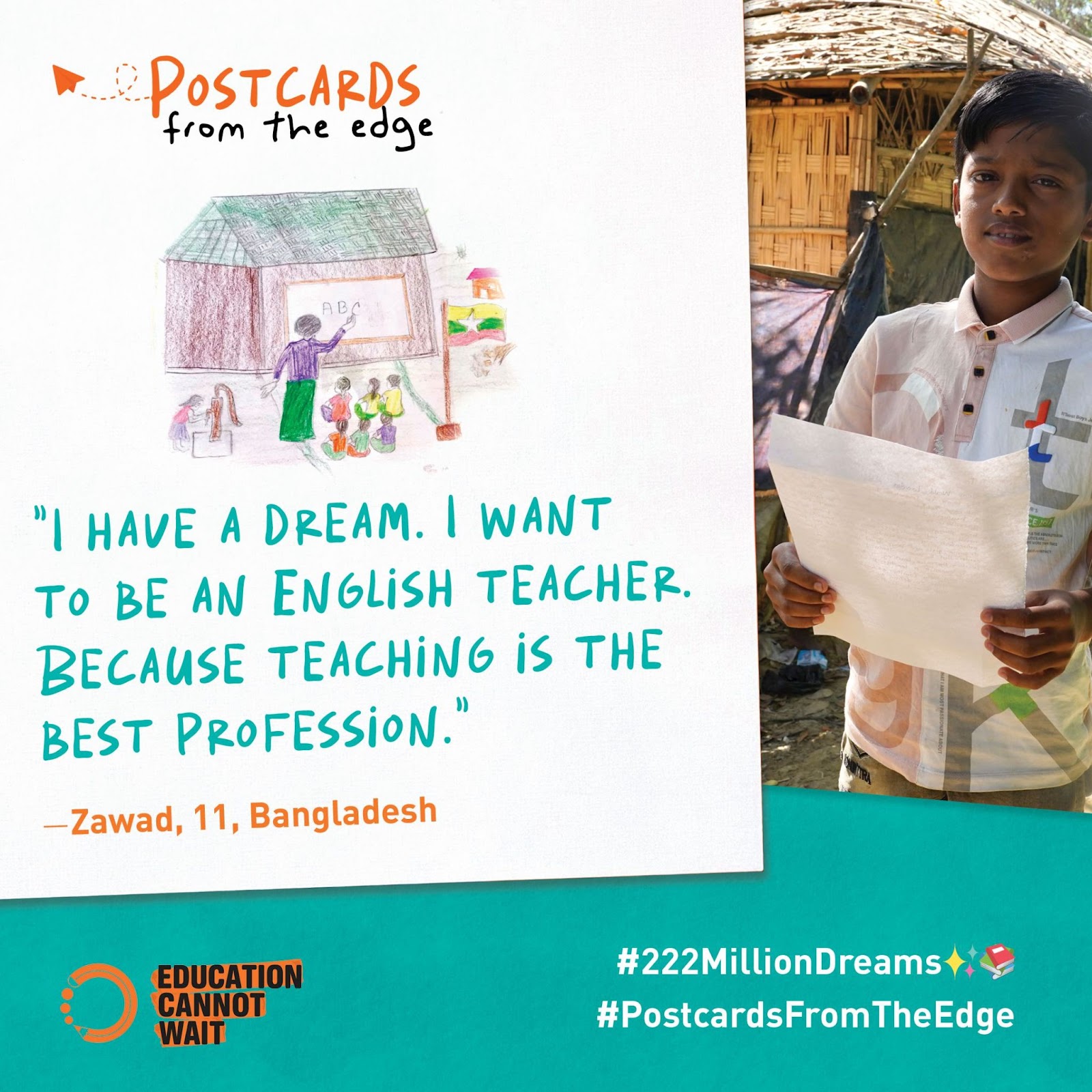
New York – Through an innovative, children-led campaign delivered by the UN’s global fund for education in emergencies, Education Cannot Wait (ECW), crisis-impacted girls and boys worldwide are sharing “Postcards from the Edge” to call on world leaders and public and private sector donors to make good on promises to ensure education for all by 2030 as outlined in the Sustainable Development Goals.

These first-person accounts and drawings offer inspiring and thought-provoking portraits of the challenges facing girls and boys caught in conflict and protracted crises around the world.

“They are inspiring and compelling stories of hope and an incredible resilience in the face of adversity and testaments to the amazing power of education to transform lives. We must listen to the world’s children. They deserve their human right to an education. Their voice must speak to our decency, they deserve to be heard,” said Yasmine Sherif, Director of Education Cannot Wait.

To date, more than 50 letters, drawings and videos have been received from crisis-affected girls and boys supported through ECW-funded programmes across more than 20 of the world’s toughest country-contexts.

ECW’s strategic partners – including Educo, Plan International, Save the Children, Street Child, UNESCO, UNHCR, UNICEF, World Vision and many others – continue to collect these first-person accounts to highlight the singular power of education to end violence, hunger and poverty, and build a more peaceful world for generations to come.

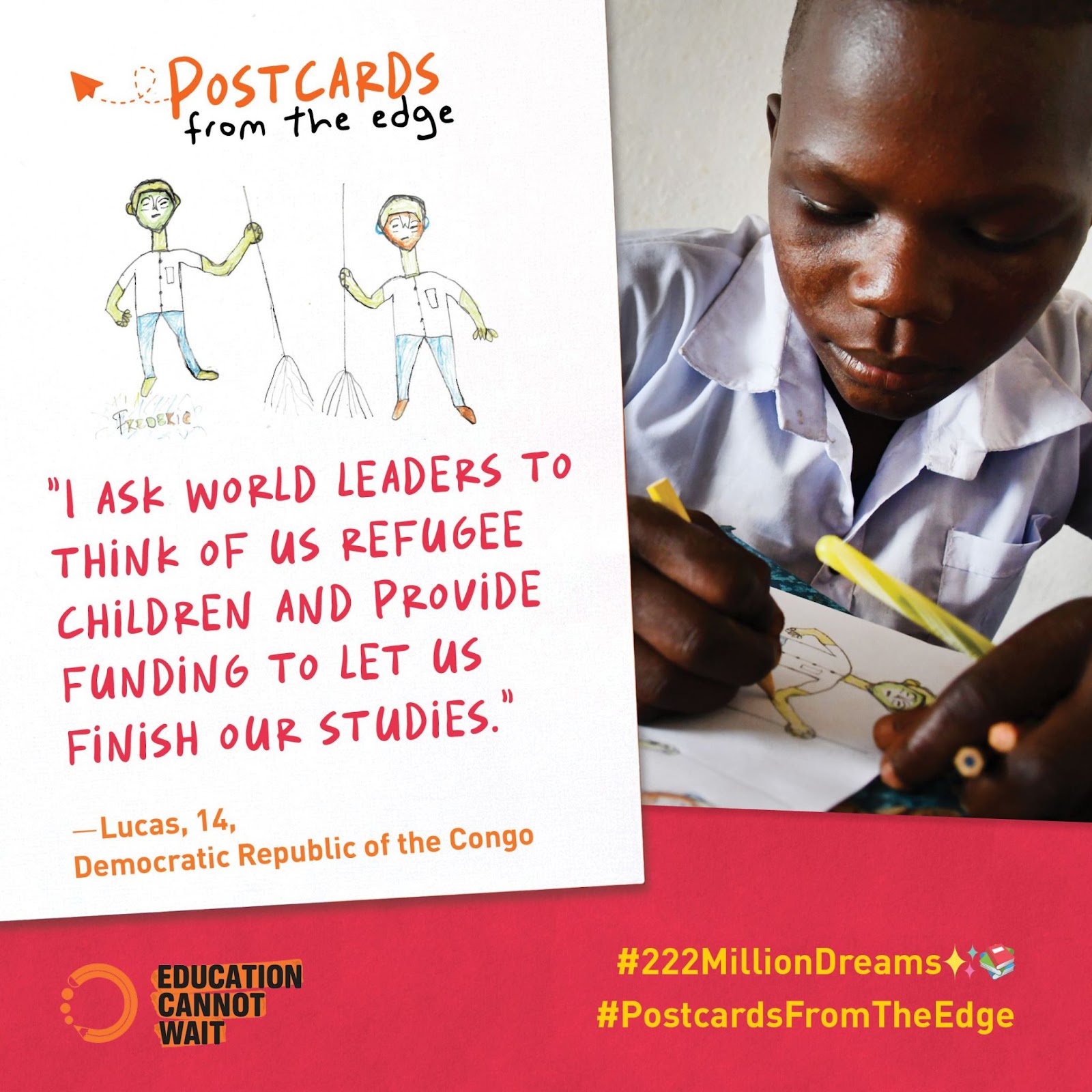
In the Democratic Republic of the Congo, Lucas*, a 14-year-old refugee from the Central African Republic recounts the story of seeing his mother murdered and his village burnt to the ground.

Through a multi-year resilience programme delivered by UNHCR with funding from ECW, the boy is now back in school and dreams one day of becoming a doctor.

In his postcard, Lucas makes an impassioned plea for world leaders “to think of us refugee children and provide funding to let us finish our studies.”

Worldwide 222 million girls and boys like Lucas are having their futures ripped from them by the converging impacts of conflict, climate change, forced displacement and other protracted crises. Girls and children with disabilities are especially at risk.

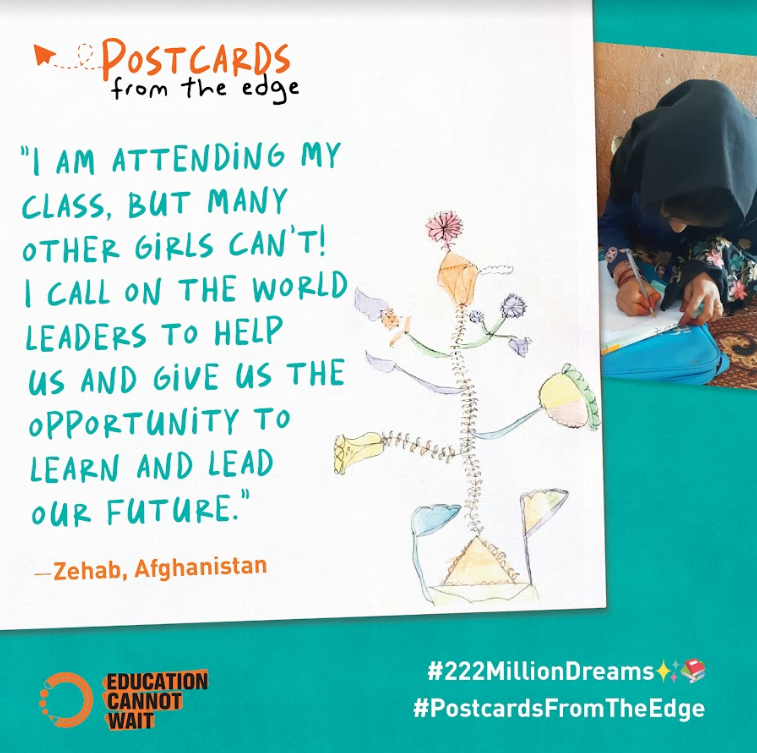
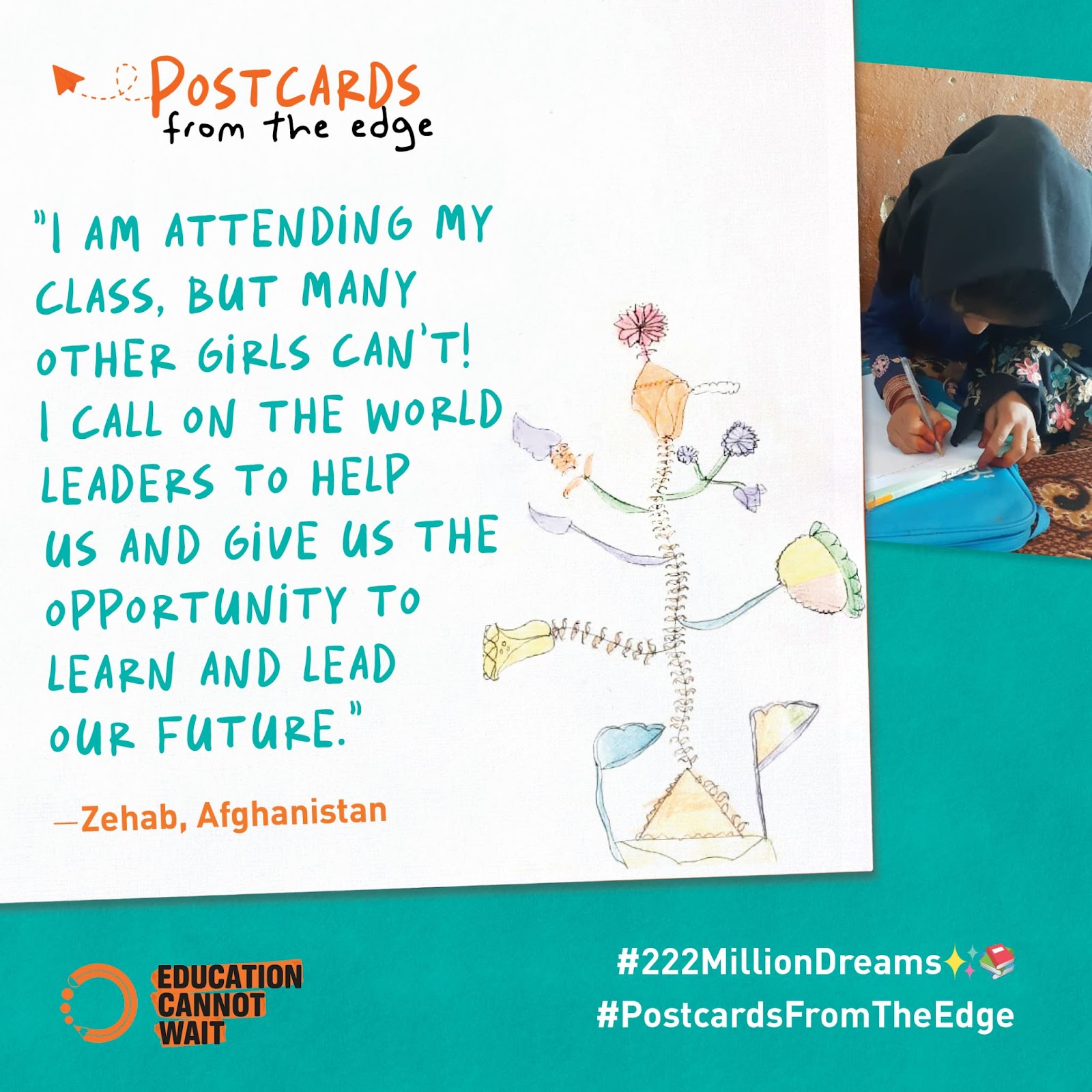
Several letters were submitted from girls and boys in Afghanistan. With new rules banning girls from education and denying women their human rights, it is not clear if Zehab* from the Uruzgan Province will be able to continue her education. But for now, with the support of ECW and Street Child, she is still able to attend a non-formal community-based learning programme.

“I want to get education and become a well-known doctor. But I am wondering that I might not achieve my dreams, as girls are not allowed to attend schools in Afghanistan,” she says in her postcard. “I call on the world leaders to help us and give us the opportunity to learn and lead our future.”

Leaders across the globe will come together at the Education Cannot Wait High-Level Financing Conference on February 16 and 17 in Geneva, Switzerland, to make good on commitments to ensure every child, everywhere, is offered a quality education.

Throughout the event, youth advocates and global champions will read the Postcards from the Edge to ensure the voice of the world’s most vulnerable children are heard.

Education Cannot Wait is calling on donors, foundations and high-net-worth individuals to mobilize US$1.5 billion over the next four years. With this funding, ECW and its strategic partners will reach 20 million children and adolescents with the safety, hope and opportunity that only quality education can provide.

*Names have been changed for privacy purposes.

#PostcardsFromTheEdge  – Letters from Children

POSTCARDS
“For me, #education is the only hope I have left to achieve my dream of becoming a doctor.”~Lucas, 14, 🇨🇫 refugee in #DRCongo.
Read how @EduCannotWait+@UNHCR_DRC help children like Lucas achieve their dreams!👉bit.ly/3XTpzEf#PostcardsFromTheEdge
Darline, 14, from #Haiti🇭🇹 demands change & an #education!
@EduCannotWait’s #PostcardsFromTheEdge Campaign amplifies the voices of girls & boys like Darline ahead of #HLFC2023.Read Darline’s powerful letter📨http://bit.ly/3ixhKoX @UNICEFHaiti#222MillionDreams✨📚
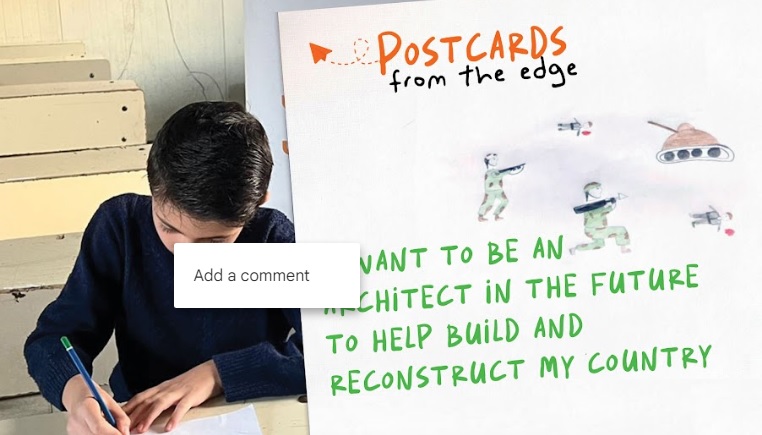
“I want to be an architect in the future to help build & reconstruct my country #Syria🇸🇾 & all the countries that are affected by war & destruction.” ~Kamil, 12, refugee in #Iraq.
Read @EduCannotWait’s #PostcardsFromTheEdge delivered w/@SavetheChildren.📨 http://bit.ly/3kui6Nt 
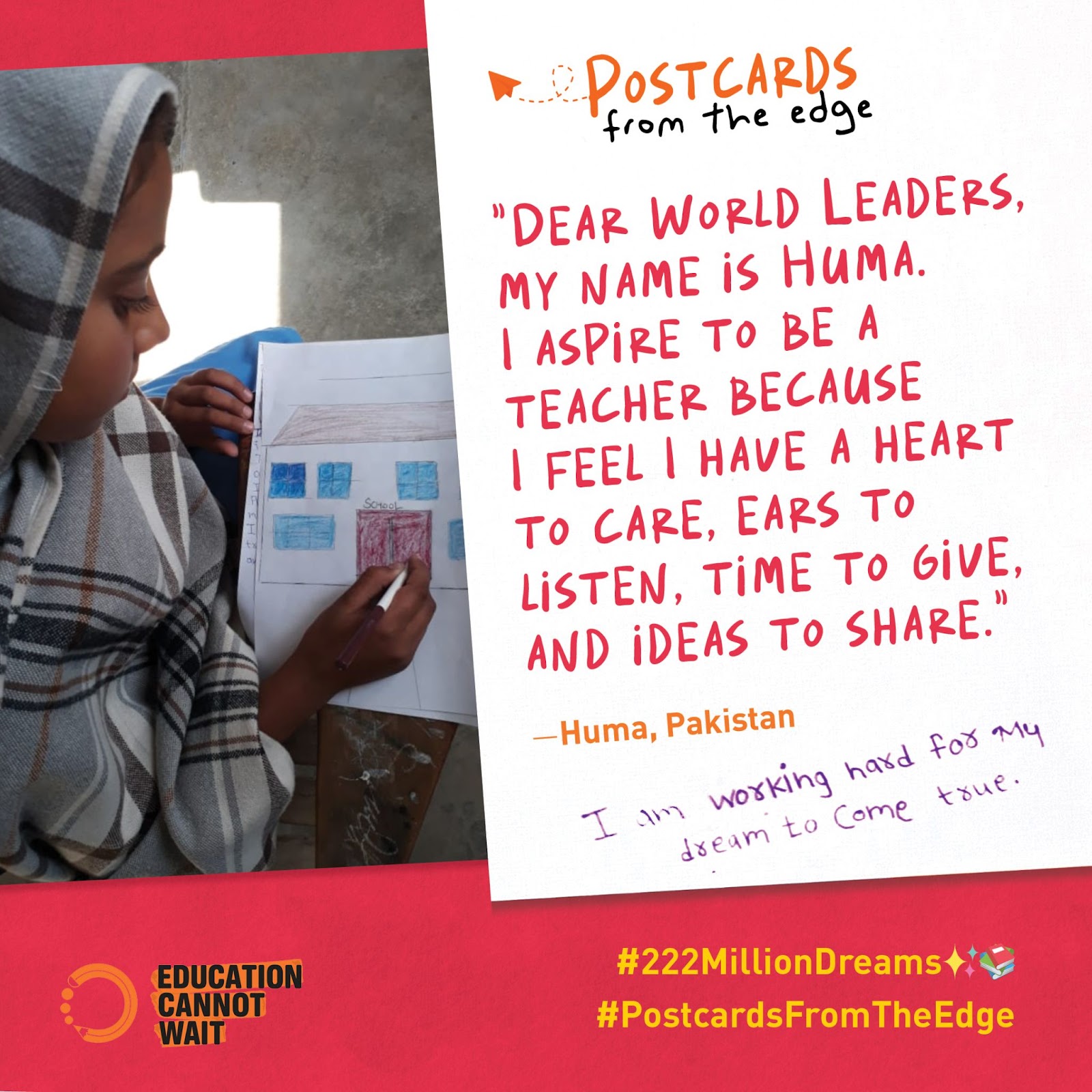
“I aspire to be a #teacher because I feel I have a heart to care, ears to listen, time to give & ideas to share” ~Huma, #Pakistan🇵🇰.
Read her #PostcardsFromTheEdge to hear how @EduCannotWait+@UNICEF_Pakistan is making #222MillionDreams✨📚 come true.📨bit.ly/3R7l4UE
11-year-old Zawad, a refugee in #Bangladesh🇧🇩, wants his community and family to prioritize education. With support from @UNICEFBD+@EduCannotWait his dreams are coming true. 
Learn more in his inspiring #PostcardsFromTheEdge 👉bit.ly/3DcFl5s
“I call on the world leaders to help us and give us the opportunity to learn and lead our future.” ~Zehab, #Afghanistan🇦🇫. Read Zehab’s @EduCannotWait’s #PostcardsFromTheEdge 📨https://bit.ly/3CTEpmh
Like & retweet if you agree #EducationCannotWait for #Afghan girls!


Report: Regulations on U.S. arms exports often skirted, rarely enforced

SOMERVILLE, Mass.—While the United States likes to claim it has the gold standard of arms export control measures, in practice the measures offer few restrictions on U.S. presidents’ ability to ship arms wherever they like, according to a new report from the World Peace Foundation (WPF) at Tufts University’s The Fletcher School of Law and Diplomacy.

The Arms Export Control Act (AECE) of 1976, as well as the United States’ international obligations, are meant to ensure decisions to export arms take into account the potential to escalate conflict or fall into the hands of U.S. enemies. The AECA sets up Congress as a check on presidential decisions.

“The potential for arms sales to exacerbate a conflict rarely stops a sale,” said report author Jennifer Erickson, associate professor of political science and international studies at Boston College. “When we do restrain exports, more often than not, political calculations are at work, rather than the legal checks and balances Congress put in place.”

Among the key findings of On the Front Lines: Conflict Zones and U.S. Arms Exports:

  • Conflict is not a consistent deterrent for U.S. arms exports. The United States usually prioritizes diplomatic and economic ties in export decision making—regardless of the conflict status of the recipient.
  • Presidents face few restrictions on using arms sales to meet policy goals. U.S. law sets an almost unreachable vote threshold for Congress to block or modify arms sales.
  • Even when the U.S. chooses not to supply weapons to conflict zones, it can and does use alternative means, such as common allies, to get arms to combatants.
  • There is no realistic way for the U.S. government to guarantee the weapons it sells are used only by the buyer, in ways that conform with U.S. interests. We cannot ensure weapons are only used defensively, for instance. And arms have staying power. Years after initial sales, they may be used instead for priorities the U.S. opposes.
  • Interpretation of regulations may become looser still as the U.S. enters a “New Cold War” with China or Russia.

In coming to these conclusions, the report examines U.S. arms sales, and restraint, connected to recent conflicts in Libya, Nigeria, South Sudan, Syria and Yemen. The World Peace Foundation commissioned similar studies on arms sales by the governments of the United Kingdom and France.

These studies follow earlier research by the WPF on which nations send arms into conflict zones, available on the website, Who Arms War? 

“The United States has all the regulations and policy tools it needs to ensure we do not make already dangerous places even more deadly,” said Alex de Waal, World Peace Foundation executive director and research professor at The Fletcher School. “We have mechanisms that can minimize the risk of America arming deadly actors. What we don’t seem to have is the political will to actually use those mechanisms. On numerous occasions American arms have made the world a more dangerous place, including for Americans.”

ABOUT THE WORLD PEACE FOUNDATION

Established by the publisher Edwin Ginn in 1910, the World Peace Foundation aims to “educate the people of all nations to a full knowledge of the waste and destructiveness of war and of preparation for war, its evil effects on present social conditions and on the wellbeing of future generations, and to promote international justice and the brotherhood of man, and generally by every practical means to promote peace and goodwill among all mankind.”

Yoga Legend Offers 7 Ways To Make Morning Time Your Favorite

Most people dread the moment the alarm clock goes off having to fight their way out of bed to start the day.  But what if you could turn morning time into your favorite time of the day, where waking up is actually easy and more enjoyable?

Aadil Palkhivala
Aadil Palkhivala

Yoga legend Aadil Palkhivala, known across the world as the “Godfather of yoga in the west,” and author of Fire of Love: For Students of Life and Teachers of Yoga, offers these tips that will make it easier to get going in the morning:

1. Wake up to something pleasant: The very first thing most people think about when they wake up are all the things they have to get done that day.  It quickly makes them feel overwhelmed, frustrated and stressed out. Instead, start your day thinking about the things you are grateful for, and focus on the fun activities you have planned for the day. Do some Heartfull TM Meditation that focuses on deep breathing that will wake you up peacefully and put you in the mood to create throughout the day.

  1. Lose the traditional alarm clock: Jarring the body from a deep sleep is unhealthy for the nervous system. Waking up to a softer noise that gradually increases in volume is a much better choice. Sounds from nature are soothing and naturally awake the body.

  1. Drink a glass of warm water right away: Before you head for the coffee, drink a glass of warm water. Warm water will open up the circulation in the throat and stomach. It helps the body naturally hydrate and feel awake and alive.  It also helps enhance circulation and removes toxins from the night and day before.  People who drink water right before bed and when waking up are also less prone to heart attacks.
  1. Have an organic smoothie: They say garbage in equals garbage out, so start your day with a powerful organic smoothie.  Anything that contains green fruits/veggies is a good choice, along with plant-based proteins. Avoid animal-based proteins which are more difficult to digest.
  1. Stretches: Just like you would warmup your car on a cold winter day, you need to break up the tension from the night before and get the body ready for action.  Do some simple stretches that focus on the neck, shoulders, hips and spine.

Warm Shower6. Take a warm shower: It’s as common as the chicken and egg debate: should you shower in the morning or at night?  The answer is actually both, but especially in the morning because a warm to hot shower will increase circulation in the skin, and help awake the nervous system.
  1. Clean air: When you sleep in a room that has clean air, you’re going to wake up feeling refreshed and ready to take on the day.  Use an air ionizer and purifier with HEPA filter that removes odors and fumes from cleaners, aerosols, carpet and paint. HEPA filters remove more than 99 percent of airborne irritants.

For nearly thirty years, Aadil has been regarded as a “teacher of teachers,” and many of the world’s top yoga instructors have studied with him. He has a unique teaching style, mixing melodious instructions with recitations of poetry, philosophical insights, and in-the-moment humor.

Alive and Shine Center LogoAadil and his wife, Savitri, are the founders of Purna Yoga, a holistic synthesis of yogic traditions based on the work of Sri Aurobindo and The Mother. Discover more about Aadil  and the Alive and Shine Center.  For the Silo, Alex Smith.
Supplemental- A short history of Yoga http://swamij.com/history-yoga.htm

Sony’s Nature Sounds Alarm Clock- now discontinued but still available via Amazon and Ebay.

ISIS Goal Splits Family And Divides Muslims

History is made in moments, often of crisis and uncertainty, and the wisdom with which we meet them. This is one of those moments.

ISIS goal is to split the human family. To divide the world’s 1.5 billion Muslims from everyone else. Those in our societies who sow fear, suspicion and hatred of Muslims  are the best allies the extremists who attacked Paris and Beirut could ask for.

Muslims are almost one quarter of humanity, and 99% are as horrified by the ISIS attacks as everyone else. They have been the greatest victims of ISIS, and have the greatest power to help defeat it. So let’s answer hate with humanity, and seize this chance for transformative change. For all of us – Muslims and Non-Muslims everywhere – to fiercely welcome each other into our one human family like never before.

We Are All One

Sign the global “Undivided” message, add your own, and share the page with everyone – If enough us join now, we can start a global wave of solidarity, and make the pain of these attacks the birth pangs of a more beautiful world. When we get to 500,000 signatures Avaaz will run ads in Muslim community papers and online, as well as key right wing papers that spread fear and division: 

https://secure.avaaz.org/en/loving_transformation_loc/?bsOTIab&v=69561&cl=8992696952

The real front line of this war is not just in the dusty towns of Syria and Iraq, but in the media and social media forums where the stories we tell ourselves compete. There is a fraternity of ignorance and hatred and it stretches across borders, in which extremists on all sides work together to drag the rest of us down into their backward world of spiraling brutality.

Our governments will need to increase their vigilance in preventing attacks, and support military efforts to defeat ISIS. But our job as people, and our leaders’ jobs as moral leaders, is to ensure that love, the transformational antidote to ISIS’ hate, blooms between Muslims and everyone else everywhere. THAT would be ISIS’ worst nightmare – it might even give some of the angry young men they recruit cause to hesitate – a chance to see an alternative as inspiring to them as the backward brand of faith that ISIS markets.

At the darkest times, our light as humanity can shine brightest. Human rights were not recognized until after the second world war. The world got it wrong after 9/11, when leaders play into Al Qaeda’s hands by stoking Islamaphobia. This time, let’s be wiser, come together as Muslims and non-Muslims more closely than ever before, and brightly shine the light of the world we’re building:

https://secure.avaaz.org/en/loving_transformation_loc/?bsOTIab&v=69561&cl=8992696952

From a place of love, we might begin to listen to our brothers and sisters among Muslims that have lent ISIS some support. First and foremost those Sunnis from Syria and Iraq, who have been treated unjustly by Iraq’s government, and incredibly brutally oppressed by Syria’s dictator Al Assad. We might begin to understand that when we failed to offer their families protection and relief from the horrors they faced, ISIS offered that protection, and some accepted it. We might focus on learning from this, and offering them a better deal.

With that lesson, we might see the stories of the peoples around the world that ISIS fighters come from. From Chechnya, where generations of Muslim families were horrifically murdered while the world looked away. Or from Egypt, or Algeria, or dozens of other countries, where sickeningly brutal state security police have tortured and murdered countless Muslims who dared to stand up to their venal corruption – something that is a religious responsibility for Muslims.

And maybe then we will understand that while ISIS is a monster that we must defeat, the monster is more than just the group itself. It’s the desperation of millions of people suffering under horrific conditions, and looking for a way out. And the rest of us in the human family, Muslims and non-Muslims, have either looked away, failed to effectively address, or often, backed and supported these horrors.

So let’s seize this moment with wisdom, to bring down the monster we face, the one we all have lines of responsibility for. Let’s see the human family united like never before to defeat ISIS – not just on the battlefield, but in our own societies, in the media and social media, and most of all in the thousands of Muslim communities that live today around the world in fear.  Let’s encourage Muslim and Non-Muslim communities everywhere to embrace each other, welcome refugees with compassion, escalate our pressure on Egypt and other brutal governments to stop brutalizing opponents and creating the ISIS’ of the future, redouble our efforts to achieve a peace deal in Syria, protect at-risk communities like the Rohingya, stop constant terrifying drone attacks on communities, and ensure that the military actions we support are scrupulously careful to avoid traumatizing the civilians who are suffering enough already under ISIS’ boot. If we do these things, we’ll do far more than defeat ISIS, we’ll defeat the misery that has given rise to them, and in a way that takes the human family one wiser step further on our journey together.

With love and gratitude for this amazing community,

Ricken, Luis, Ben, Alice, Rewan, Elana, Mohammed, Steve, Emma and the whole Avaaz team.

Bravo TV Star Asa Soltan Rahmati Launches Sacred Rituals For Women Book

Asa Soltan Rahmati has had many lives. From fleeing Iran as a child and living as a refugee in Germany and then the U.S. to becoming a celebrated reality television star on Bravo TV’s Shahs of Sunset; from launching a successful designer line of women’s kaftans to becoming a brand new parent with beau Jermaine Jackson Jr. – she is a master of reinvention and personal-betterment. In her newest life – as a published author – she sets out to empower other women to truly love themselves and take control of their own destinies.

Her book GOLDEN: Empowering Rituals to Conjure Your Inner Priestess is hitting bookstore shelves now. In it she shares seven sacred rituals that she developed throughout her life as she went from refugee (twice) to “artsy” to the Persian Pop Priestess that fans of Shahs of Sunset have grown to admire. I’d love to send you a copy of the new book for consideration of coverage in an upcoming story.

Asa’s life has been a filled with great challenges and deep loss, but through it – and through her outsider status – she learned to face life fearlessly and with her own style. From her self-love ritual to her chapter on confidence (“Radiate Beauty from the Inside Out”), Asa provides readers with the ultimate “green juice, master cleanse and z pack” for life. It all starts with her Priestess Detox, the total mind, body, soul cleanse to get the reader in touch with her own Inner Priestess. Asa’s ability to translate her rituals have helped hundreds of thousands of her fans become more empowered. GOLDEN is her gift to them and to anybody who is ready to take control, learn to love themselves, and face the future with confidence and strength.

When I was in college at UCLA, I worked part-time at an African art store in Santa Monica. One day Maya Angelou came into the store. I have always been a huge fan of hers and I was completely starstruck. She walked straight toward me, took my hand in hers, looked me directly in the eyes, and said, “stay golden, my child.”

– Asa Soltan, from GOLDEN

GOLDEN by Asa Soltan

Empowering Rituals to Conjure
Your Inner Priestess

Available Now

Asa Soltan Rahmati – Persian Pop Priestess, Spiritual Gangsta, and beloved star of Bravo TV’s hit reality show, Shahs of Sunset – shares seven sacred rituals that she has developed throughout her life in GOLDEN: Empowering Rituals to Conjure Your Inner Priestess (North Star Way; May 9, 2017; $25.99 USD).

Asa was eight years old when her family fled their war-torn country of Iran to seek refuge in Germany. To say she experienced culture shock after arriving is an understatement. She had never seen anyone that looked and acted so different from her, and she didn’t speak a word of German or English. She felt completely cast off from her land, her culture, and her people.

Feeling a need to connect to her culture and herself, she created rituals that she practiced every day. At first they were a simple way to create a sacred space for herself so she could go within and remember who she really was. But when she became a refugee for the second time moving from Germany to Los Angeles, those rituals — on beauty, love, career, family, and friendships–kept her deeply connected to her Inner Priestess, the authentic version of herself that existed without ego, baggage, or attachments to material things.

Asa’s own personal journey to find peace and self-acceptance helped her marry her artistic side with her business acumen and led her to launch a highly successful kaftan business, create a line of jewelry for Home Shopping Network and, of course, the television show. GOLDEN will help readers find their own power with inspirational quotes, stories and photos from her childhood to illustrate the impact her rituals can have. Whether you choose to focus on one ritual separately or all of them at once, GOLDEN can guide you to a state of glamorous, gorgeous mindfulness and a chance to live the life of your dreams.

Since the first season of Shahs aired, Asa has gained a loyal legion of fans who refer to her as the Spiritual Gangsta. Many of them write her to seek answers to their most personal questions. They often ask how to feel confident and feel good about their bodies in a world that’s hyper critical of women’s looks, how to gain the courage to follow their dreams, and how to stay true to their culture and traditions yet remain a modern woman. Asa’s ability to translate her rituals have helped hundreds of thousands of her fans become more empowered. GOLDEN is her gift to them.

Golden by Asa Soltan

About Asa Soltan Rahmati
Asa Soltan Rahmati, also known as the Persian Pop Priestess and Spiritual Gangsta, is the star of Bravo’s hit realty show, Shahs of Sunset. Asa lived on three continents and spoke four languages by the time she moved to the United States at fifteen. The Islamic revolution and decade-long war were the backdrop of her early childhood, and paved the way for her own personal revolution to build confidence, spirituality, and remain at peace among life’s daily trials and tribulations. Known for her glamour and down-to-earth spirituality, Asa is also an internationally recognized multimedia artist, philanthropist, and entrepreneur. In 2014 Asa launched her highly anticipated luxury kaftan line, Asa Kaftans, which celebrities and her international fan-base adore. Asa is committed to using her unique blend of high-art, pop-culture, glamour, and spirituality to make the world a more beautiful and positive place. For the Silo, Jason Southerland.

About North Star Way
North Star Way is an imprint dedicated to publishing “information to make your life better.”  With a non-fiction editorial focus in the areas of motivation, inspiration and books that advise and inform, North Star Way aims to connect readers with thought leaders through a variety of new media formats including books and e-books, on-line courses and subscriptions, speaking engagements, mobile applications, original video and audio books, sponsorships and business partnerships, podcasts. North Star Way authors include John O’Leary, Maya Penn, Amanda Steinberg, JJ Virgin, and Keke Palmer.


Words A Spoken Word Poem

“Words”. Thoughtful contemporary poetry from Allen Minor.


Allen Minor is From Utica, New York and lives in Daytona Beach, Florida

@allen_minor (Twitter)

allen minor (YouTube)

allen-minor (Tumblr)

allen_minor (Instagram)

Website  http://Amazon.com/author/asminor