
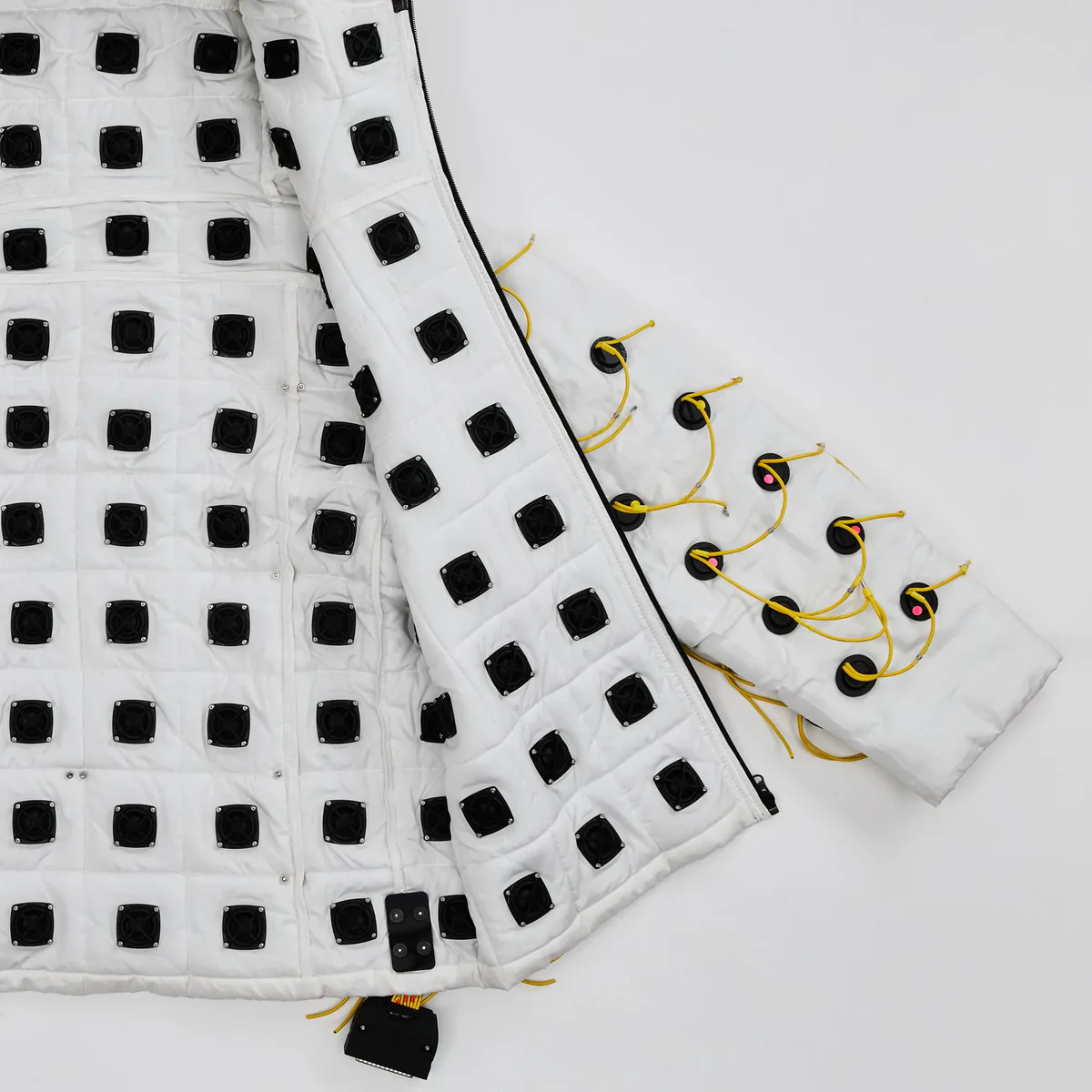
Our friends at Vollebak have taken these ancient ideas and used them in a new kind of transcendental technology. The Sonic Jacket, engineered with 180 speakers that fire frequency directly into your body. Evenly distributed across the jacket’s body, arms and hood, each speaker is just 32mm in diameter and 10mm deep, mounted in laser cut holes and able to generate frequencies from 4 Hz to 20,000 Hz. All fire inward towards the body rather than out into the room. So you don’t listen to this jacket. You feel it.
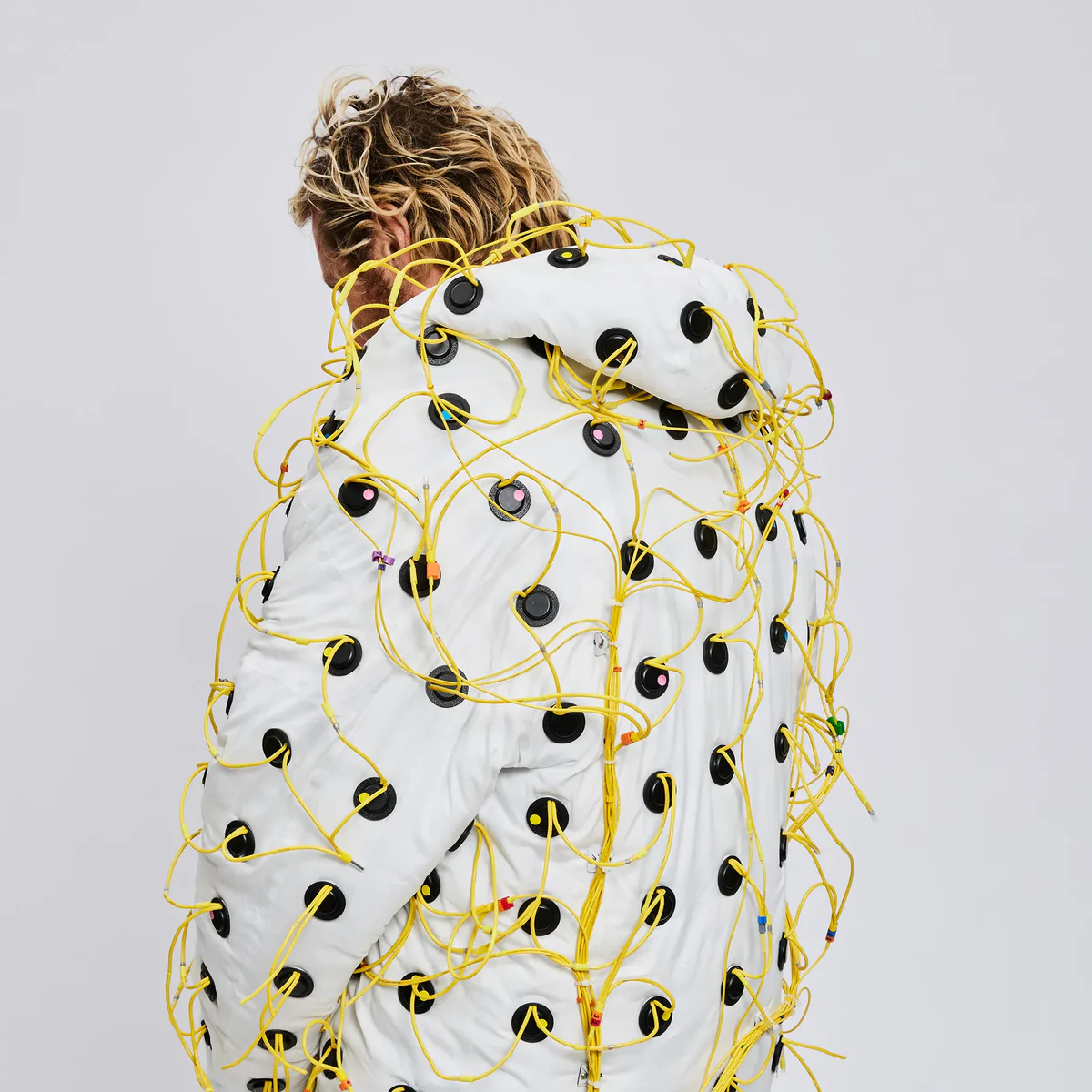
The Sonic Jacket is not the first time sound and frequency have been used to alter the human body and mind. But it’s definitely the first time in history that you can walk around while having 4 Hz to 20,000 Hz fired directly into your body… so we decided to be our own guinea pigs
The jacket’s design is deliberately raw and functional. We’ve left the yellow wiring visible, the engineering exposed. “It’s made to look like a science experiment because that’s what it is,” says FBFX co-founder Grant Pearmain. “We’re not hiding the wires. Far from it.”
Patterned Vibration Pathways
Or read on for a short history of frequency in the human story…The earliest uses of sound for wellbeing were embedded in ritual, not medicine. Australian Aboriginal healers use the didgeridoo in ceremonies aimed at restoring spiritual and social balance, its low drones and pulsed rhythms strongly coupled to breath, chest vibration and trance. In ancient Mesopotamian and Egyptian temples, sung prayers and musical incantations were used alongside herbs and amulets. Illness was spiritual imbalance and sound was one route back to alignment. Patterned vibration was the path to group bonding, meaning making and altered states.
Classical Greek philosophy turned experience into theory.
For Pythagoras and his followers, simple musical ratios, octaves, thirds and fifths, were evidence that the cosmos and the body were structured mathematically. This was the “music of the spheres,” the idea that music could tune the soul as you tune a lyre string. Plato and Aristotle developed ideas of ethical acoustics, arguing that particular modes and rhythms encouraged courage, restraint or contemplation. In India and China Nada Yoga treated sustained tones and mantras as a route to meditative absorption while Chinese qigong pairs specific syllables with organs and emotions, using sound to regulate qi.
Musical Pillars?
Temples, cathedrals and megalithic chambers don’t just contain sound, they shape, sustain and amplify it. The room becomes part of the instrument. Recent acoustic studies of Hindu temples show that pillared halls and carved stone surfaces create highly diffuse sound fields, with strong resonance and long reverberation that envelop chanting and bells. At Meenakshi Amman temple, some columns are carved as “musical pillars” that ring with clear notes when struck. Work on Hagia Sophia mosque in Istanbul, built a millennium and half ago, has shown that its enormous dome produces a reverberation time of around 11 seconds, so that chant blends into an almost continuous halo of sound.

Archaeoacousticians study the sophisticated sonic mechanics of sacred spaces. They have found that chambers in many prehistoric sites in Europe and the Mediterranean strongly amplify frequencies around 108 Hz to 110 Hz, the “megalith frequency,” overlapping with male chants and drum tones. The American psychiatrist and neuroscientist Ian Cook found that at 110Hz, the brain shifts from analytical and verbal focus and towards emotion and non-verbal processing. These chambers were machines for generating calm introspection. Whether ancient builders understood this or simply worked until they got a building to sound the way they wanted, the result is the same… spaces that hack our brainwaves.

The Great Pyramid of Giza has become a focal point for studies into architecture and sonics. Its internal chambers behave as acoustic resonators, supporting standing waves at particular frequencies. Measurements in the King’s Chamber indicate strong modes in the low-frequency range, with some analyses highlighting a resonance near 117 Hz. The granite coffer inside the chamber has its own resonant frequencies, excited by striking or humming into it. Christopher Dunn’s “Giza Power Plant” theory argues that the whole structure is a coupled oscillator that converts seismic vibration into energy via piezoelectric granite.

Neuroscience has given us a more precise map of how different frequencies affect our mental state. Alpha waves, around 8 Hz to 12 Hz, are associated with relaxed wakefulness, internal focus and reduced sensory distraction. Theta, around 4 Hz to 8 Hz, shows up in drowsiness, early sleep, deep meditation and certain creative tasks. Gamma activity, roughly 30 Hz to 100 Hz, correlates with higher-order cognition and focused attention, working memory. Flow states – the feeling of total absorption in a task – have been linked to increased frontal theta alongside moderate alpha and bursts of gamma.
The brain, it turns out, has frequency signatures for different modes of being.
| The idea that external sound can nudge the brain toward specific states is called entrainment. Present a rhythmic stimulus and the brain’s oscillations may start to synchronise with it. Pump slightly different tones into each ear, say 210 Hz and 200 Hz, and the auditory system generates a perceived third beat at the difference frequency, 10 Hz, which the brain allegedly follows. This is called the frequency-following response and it’s the theoretical underpinning of binaural beats and a growing number of apps, wearables and YouTube channels promising alpha for relaxation, theta for meditation, gamma for focus. The man who came up with binaural beats was Robert Monroe. A radio executive who owned a production company in 1950s Virginia, Monroe began experimenting with sound patterns for learning during sleep. In 1958, he unexpectedly started experiencing powerful vibrational states and episodes of apparent separation from his body, experiences he later documented in the book Journeys Out of the Body and two sequels. Rather than dismiss them, he spent the rest of his life trying to understand and reproduce them. In 1974, he founded the Monroe Institute as a non-profit research centre devoted to the systematic exploration of altering consciousness through sound. The jacket has a number of different ways to control your frequency feed. A control unit includes an MP3 player delivering 10 pre-set frequencies while a large physical dial lets you explore and fine-tune the frequencies that really make you feel good. The unit is also fitted with a reader for Micro SD cards which can hold up to 1,000 pre-set frequencies so you can create your personalised library. We are also working on a Sonic Jacket app that will connect to the control unit via Bluetooth. At the lowest frequencies, speakers can overheat. To get over this, the jacket will exploit one of the strange ways we experience frequency. If we are ‘played’ two slightly different frequencies, say 100 Hz and 104 Hz, we hear or feel the difference between the two – which is 4 Hz in this case. That’s how the jacket produces ultra-low frequencies without doing something less fun… like catching fire. The jacket is not a one-off experiment. The science of frequency and consciousness is still being written. And this jacket will play a part in writing it. Portable, personalised, immersive sound therapy will become an essential tool when we want to feel more, or less, human. And as a wearable resonance chamber, engineered to shift the wearer’s cognitive and physiological state through sound, it marks the start of a new era in wearable technology. NICK AND STEVE TIDBALL – FOUNDERS |
For the Silo, Jarrod Barker.