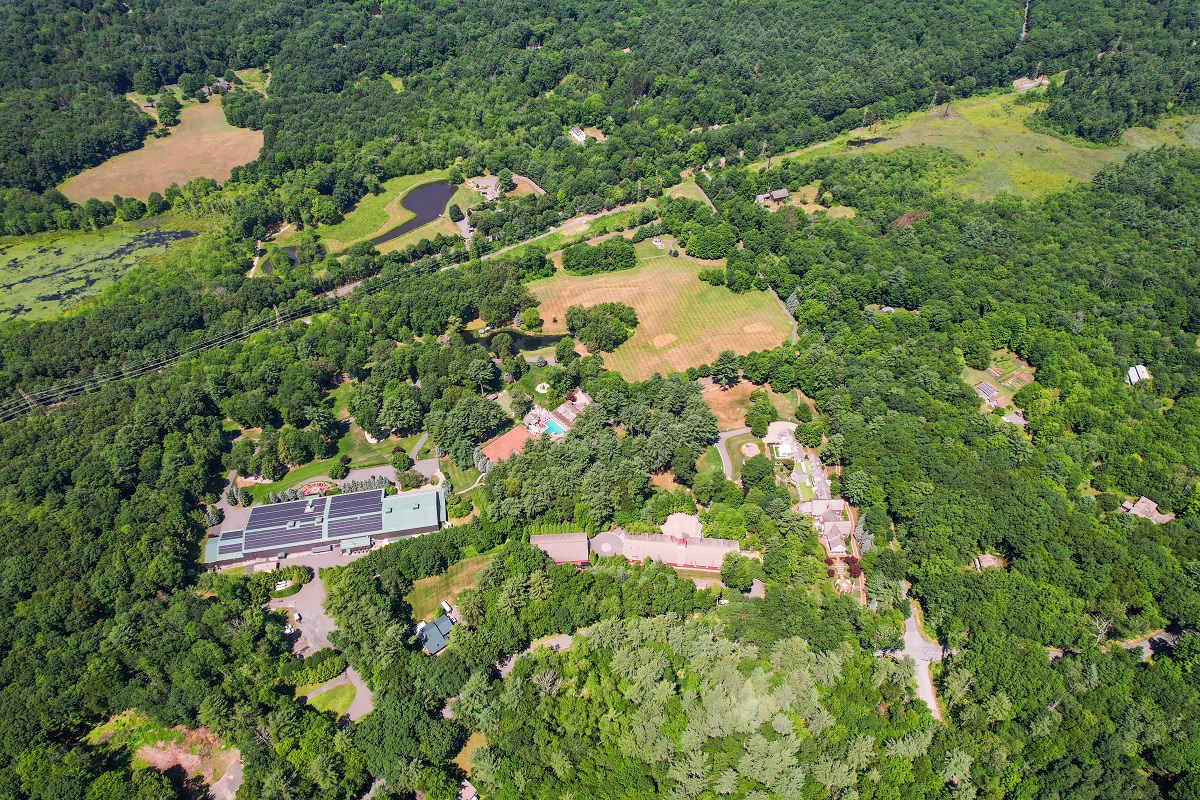
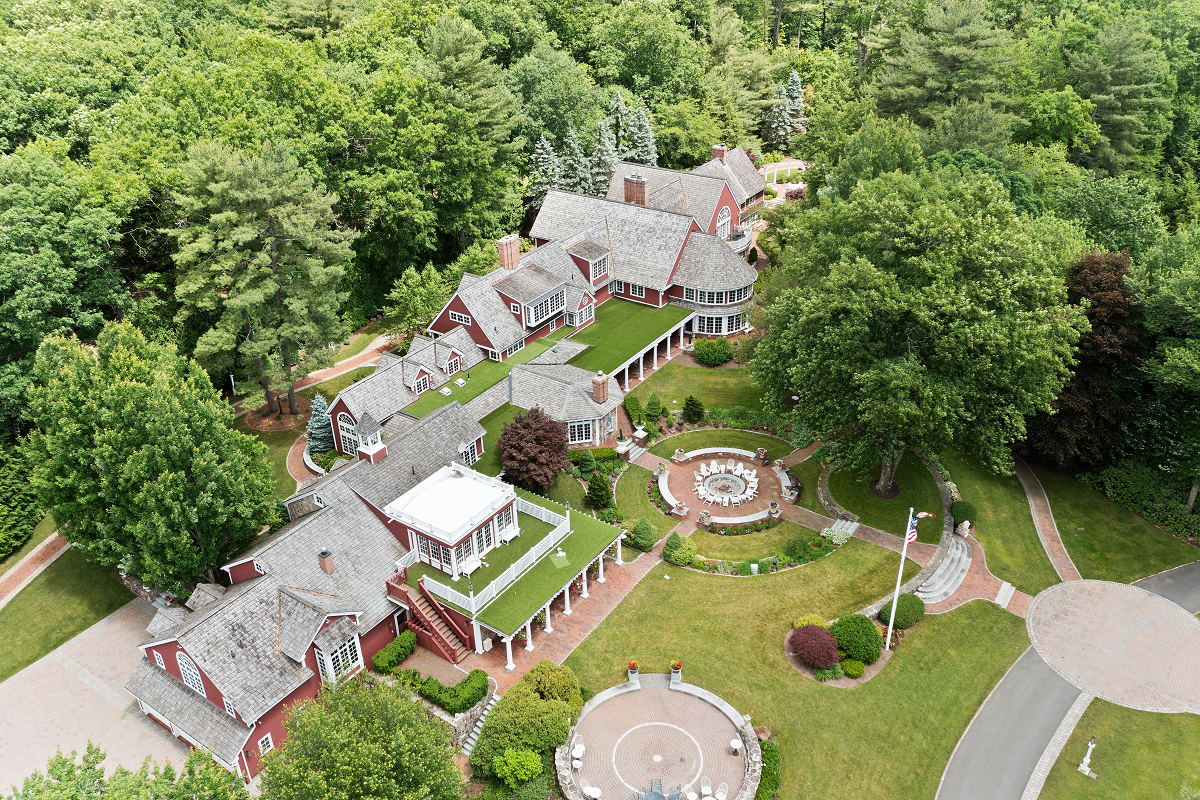
The tiny home sector is big on innovation as exemplified by a new crop of amazing Accessory Dwelling Unit (ADU) designs across the U.S. and Canada showcasing state-of-the-art architectural and interior features, thoughtful layouts and stunning aesthetics that redefine what’s possible in small-space living. Maxable—North America’s leading provider of resources for building guest houses, casitas, in-law suites, granny flats, pool houses and other ADUs—has officially named the the #1 best ADU of 2025 and other of the ’10 Best’ for the year based on a mix of criteria: visual appeal, use of space, creativity and functionality. Multiple photos for each are showcased online demonstrating the extreme ingenuity of each build.
Every year, Maxable’s ‘Best ADU of the Year’ competition celebrates the most innovative and impressive tiny home projects from across North America. Accessory dwelling units (ADUs) that don’t just look great, but solve real challenges of space, budget, and lifestyle. And the Top 10 have just been named! “If there’s one thing we’ve learned this year, it’s that accessory dwelling units ADUs aren’t going anywhere,” says Maxable CEO Paul Dashevsky. “In fact, they’re chugging along at full force as new regulations make their mark, homeowners are letting their creativity bloom, and designers are pushing the limits of what’s possible in small-space living.”
Here is the #1 winner and other of the top 10 best ADUs that have earned their keys in 2025. ______________________________________________________
#1 Best ADU of 2025:
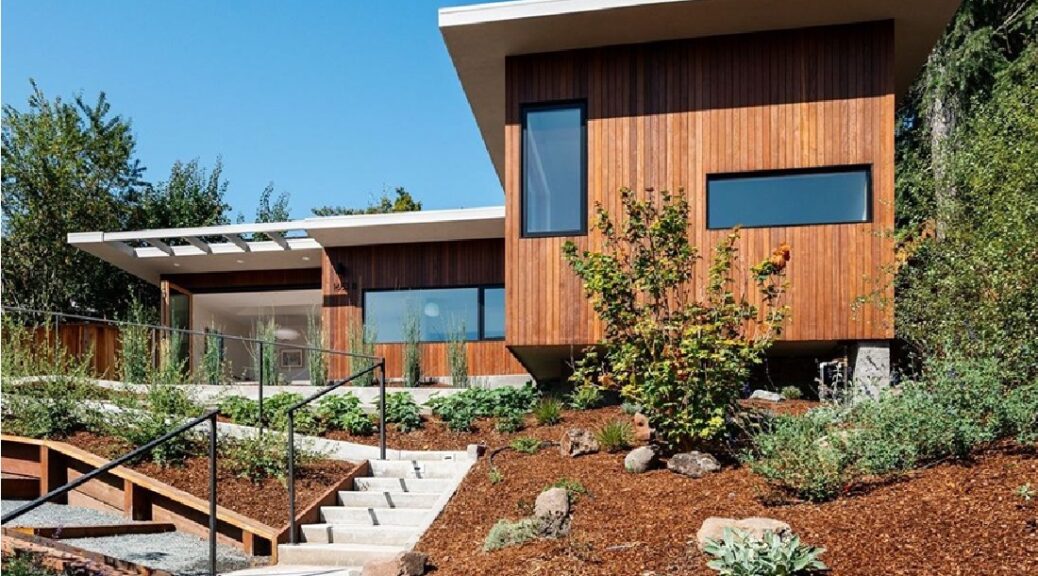
Ashby ADU, Piedmont, CA
Designer: Tuan Le Design
Builder: Atelier19AD6
Size: 800 sq ft, 2 bed, 1 bath
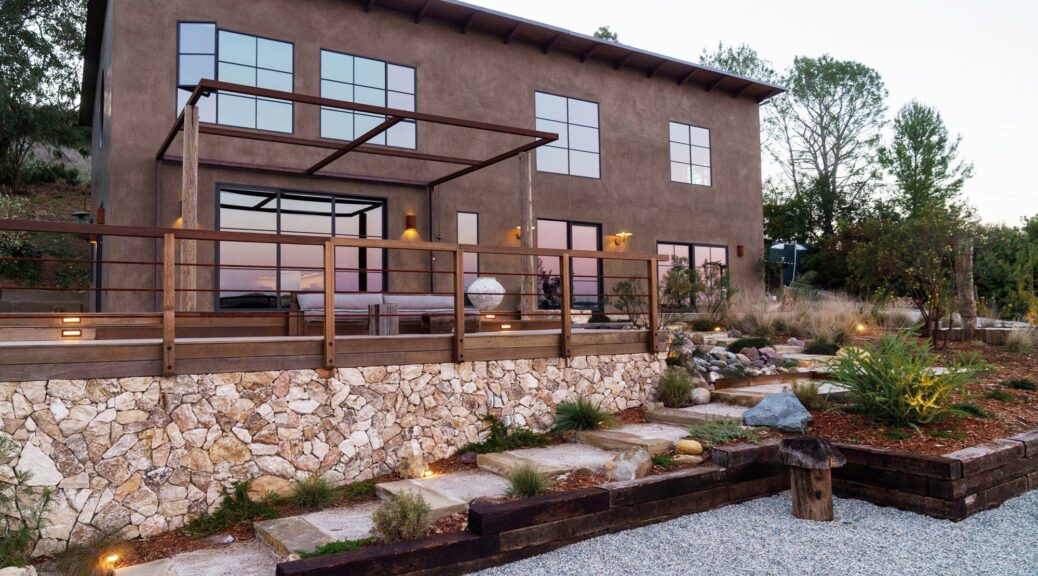
Built on a steep slope, the project faced challenges with utility coordination, subcontractors, supply chain delays, and neighbor considerations, yet the team navigated every obstacle to deliver a standout result. The unit is fully electric, with a heat pump, water heater, and solar panels, making it efficient and environmentally conscious. Skylights and floor-to-ceiling four-panel sliding glass doors fill the interior with natural light, creating a bright, airy atmosphere. The modern design continues on the exterior with sleek wood paneling that complements the contemporary interior. The result is a stylish, functional ADU that maximizes both the views and the livable space
Other Top 10 Best ADUs of 2025
Chamomile Cottage, Arlington, MA
Modular Design and Build: Backyard ADUs
Size: 567 sq ft, 1 bed, 1 bath
If a cozy cup of tea was an ADU, we think it’d look like this! Designed to bring an aging father closer to his family and young grandchildren, this modular build balances warmth, accessibility, and beautiful design. As one of the first detached ADUs completed under Massachusetts’ new ADU law, it also marks a milestone for backyard living in the state. Built with collaboration between Backyard ADUs and a homeowner with impeccable design taste, the result is both functional and heartfelt. Chevron wood flooring, warm olive walls, and a charming fireplace make the space feel like home from the moment you step inside. Skylights fill the rooms with natural light, while the ADA-compliant bathroom ensures comfort and safety for years to come.
Alora ADU, San Diego, CA
Designer: Ruland Design Group
Builder: Glann Fick, Coastline Construction
Size: 1,000 sq ft, 2 bed, 2 bath duplex
This project is a beautiful example of how ADUs can bring generations together while adding long-term value to a property. The homeowners created not one, but two attached backyard homes. One was designed for an aging mother, and the other for rental income to support the family. Together, the units make space for four generations to stay close while still maintaining privacy and independence. Both ADUs were designed with light, openness, and connection to the outdoors in mind. High ceilings and clerestory windows fill the interiors with natural light, while large sliding glass doors open to private patios for easy indoor-outdoor living. Each space feels modern and welcoming, complete with well-appointed kitchens and roomy islands perfect for family meals or morning coffee. It’s a true example of multigenerational living done right.
Copperline ADU, San Diego, CA
Designer and Builder: SnapADU
Size: 980 sq ft, 2 bed, 2 bath
This Spanish-style ADU in Rancho Santa Fe was designed to blend seamlessly with the community’s strict architectural standards. The homeowner, a roofing contractor, personally installed the boosted tile roof to match the main home, turning HOA requirements into an opportunity to create a timeless retreat. Today, the ADU serves as a private space for family and guests. Every element, from hand-textured stucco to arched porch openings and copper gutters, was carefully chosen to mirror the primary residence. Inside, faux wood ceiling beams add warmth to the great room, while custom shelving and professional-grade appliances enhance the kitchen. Each bedroom features an ensuite bath and walk-in closet, with a back entrance leading to a mudroom and laundry area.
Brick House ADU, Denver, CO
Designer and Builder: ADU4U
Size: 938 sq ft, 1 bed, 1.5 bath
This ADU project breathes new life into an old, historic building, while preserving its authentic character and respecting its roots. Building a modern structure within an 138 year old structure was an innovative solution to achieve this. In historic Curtis Park, Denver’s oldest neighborhood, an 1886 brick carriage house stands as a testament to the passage of time. The building sits inside the boundaries of Denver’s historic Curtis Park, so all exterior design and material selections had to be approved through the city’s Landmark Commission.
ADU4U turned this once-unlivable structure into a cozy, modern home while preserving its historic charm. To bring it up to today’s safety standards, the team strengthened the old brick with a new steel frame and carefully reused original materials throughout the interior. The hayloft door became the powder room door, and the old floor joists were turned into a beautiful kitchen peninsula. Now, this light-filled ADU perfectly balances historic character with modern comfort. It’s truly a shining example of how old buildings can be reimagined for today’s living.
Longview ADU, Washington D.C.
Designer: Ileana Schinder
Builder: J Cabido Designs
This project is a creative transformation of an abandoned garage and storage space into a bright and efficient one-bedroom ADU. By keeping the original structure’s footprint, the design team minimized both construction costs and the visual impact on the surrounding property. Every detail was planned with sustainability in mind. From upgraded insulation to energy-efficient mini splits and an energy recovery ventilator, the ADU meets Washington DC’s strict environmental standards while maintaining year-round comfort. Restoring the building’s existing openings allowed natural light to flood the interior, creating a warm and inviting space that feels much larger than its footprint. The result is a thoughtful blend of preservation, sustainability, and smart design, breathing new life into what was once an overlooked structure.
Sagebrush ADU, Menlo Park, CA
Designer: Inspired ADUs
Builder: Integrum Construction
This ADU is a masterclass in craftsmanship and timeless design. Every detail, from the cedar shake siding to the copper flashings, was carefully chosen to mirror the main home and create a seamless, cohesive look. Instead of competing with the original architecture, it enhances it, feeling like it has always been part of the property. Natural materials play a starring role here. The cedar and copper will continue to age beautifully, adding warmth and character over time. Inside, handmade tile, custom cabinetry, and a cozy loft make the space feel elevated yet inviting. Every inch was designed with intention, balancing function, beauty, and authenticity. This ADU proves that small-scale construction can be both refined and enduring.
Brushstroke ADU, Newcastle, CA
Designer and Builder: A+ Construction ADU Builders
Size: 1,198 sq ft + 800 sq ft deck, 3 bed, 2 baths
The client didn’t want to separate three generations of their family, so they built a second home in their backyard. This ADU allows their parents to live independently with their own routines and art studio, while staying just steps from family dinners, grandkid hugs, and everyday life together. At 1,200 sq. ft., the ADU includes three bedrooms, two bathrooms, and a large open living area. The layout prioritizes comfort, easy movement, and aging-in-place, with wide circulation paths, direct deck access from the primary bedroom, and plenty of natural light. A dedicated art studio with custom cabinetry and large windows supports the grandmother’s creative routine. The best feature? An 800 sq. ft. covered deck and carefully chosen exterior finishes. All of these details make the ADU feel integrated with the main home, creating a thoughtful, functional, and long-term living space for the whole family.
Alcove ADU, Los Angeles, CA
Designer: Homeowner
Builder: Doobek Brothers
Size: 593 sq ft, 1 bed, 1 bath
What started as a retrofit for a carport turned into a fully functional ADU, making smart use of limited space while navigating strict city codes. Because the property sits on a hillside, any addition beyond the existing roofline would have required expensive drainage to the street, so the design works entirely within the original footprint. The interior feels calm and spacious thanks to thoughtful layout, finishes, and furniture. A double wall between the kitchen and bathroom cleverly hides appliances while providing storage for cleaning supplies, making the space feel open and uncluttered. Temperature and sound insulation reduce energy costs for both units, making it highly efficient. Windows were sized to align with the upstairs unit, creating visual harmony. With parking right outside and a potential deck planned for the upper unit, this ADU demonstrates how careful design can turn code restrictions into a livable home.
Elevare ADU, San Diego, CA
Designer: Sergio Perlata
Builder: HM Construction
Size: 479 sq ft, 1 bed, 1 bath
This daring ADU was built on top of the homeowner’s existing house to preserve the garage while creating a luxurious, functional space. What started as a bold idea and labor of love resulted in a retreat that balances comfort, style, and modern California living. The design maximizes natural light, features high-end finishes, and offers seamless indoor-outdoor flow. Privacy for the main house was carefully considered, and practical choices like spa-like micro-cement in the bathroom create a durable, low-maintenance, and rental-friendly space. More than just a guest house, this ADU is a thoughtfully crafted space that inspires relaxation and connection.
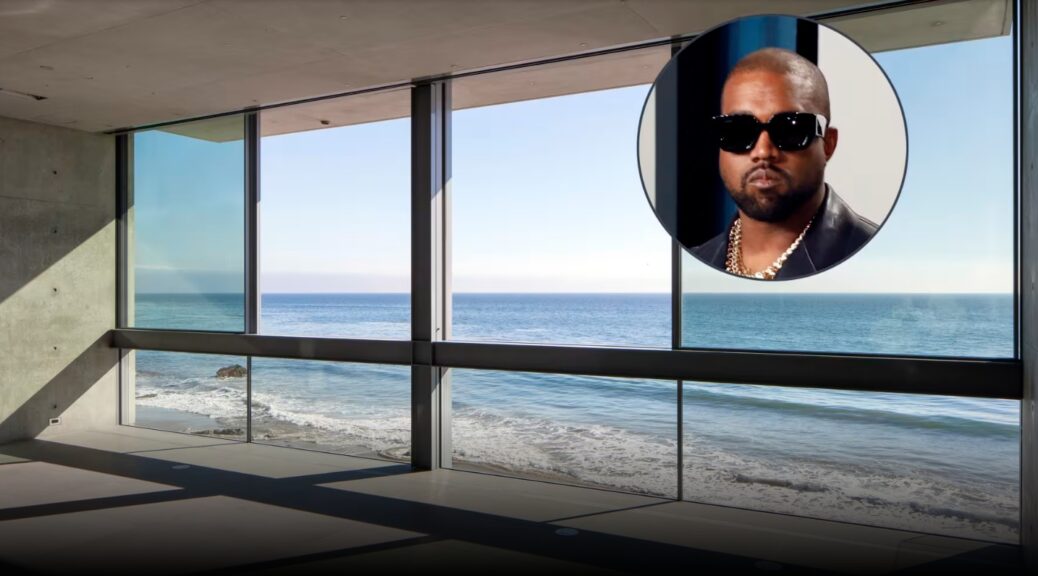
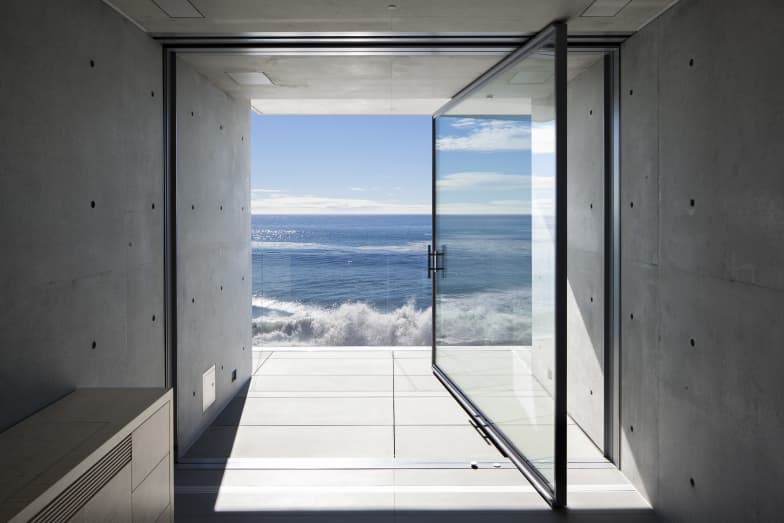
The concrete Malibu mansion abandoned mid-renovation by Kanye West is back on the market with a previous deal now on the rocks.
The Malibu Beach home that Kanye West bought in 2021 for $57.3 million usd/ $79.03 million cad but then gutted, abandoned and sold for $21 million usd/ $28.97 million cad has hit a new snag. The 4,000-square-foot home, designed by renowned architect Tadao Ando, has bounced between several developers and is now back on the market for $34.9 million usd/ $48.14 million cad.
It’s the latest twist in the saga of the oceanfront house, designed by award-winning Japanese architect Tadao Ando, which the rapper purchased in 2021.
West bought the three-story home for $57.3 million—and then immediately gutted it, leaving only a concrete shell with no windows, plumbing or electricity when he dumped the project about two years later.
Note- prices below are in USD, please read intro paragraph above for CAD conversion at time of publication.
The skeletal beach house then sold for $21 million last year to Steven “Bo” Belmont, a developer who returned it to the market within months. He quickly went into contract to sell it to another developer, the Montana-based Andrew Mazzella, for $30 million, both parties confirmed.
Listing images show the home before a gut renovation was begun.The Oppenheim Group/Roger Davies
The deal with Mazzella, a luxury home developer, was scheduled to close in May but has now stalled, as the shell of a house was back on the market as of Wednesday asking $34.9 million, down from an initial ask in March of $39 million.
According to Belmont, CEO of crowdfunding platform Belwood Investments, the deal is enirely dead, he told Mansion Global on Monday. Belmont cancelled the contract after Mazzella requested a third extension to find financing when the second extension expired on July 31.
Mazzella confirmed that they mutually cancelled the contract earlier this month, but was quoted as saying he’s “not out of the game just yet”, and is “still interested in negotiating a deal for the house”.
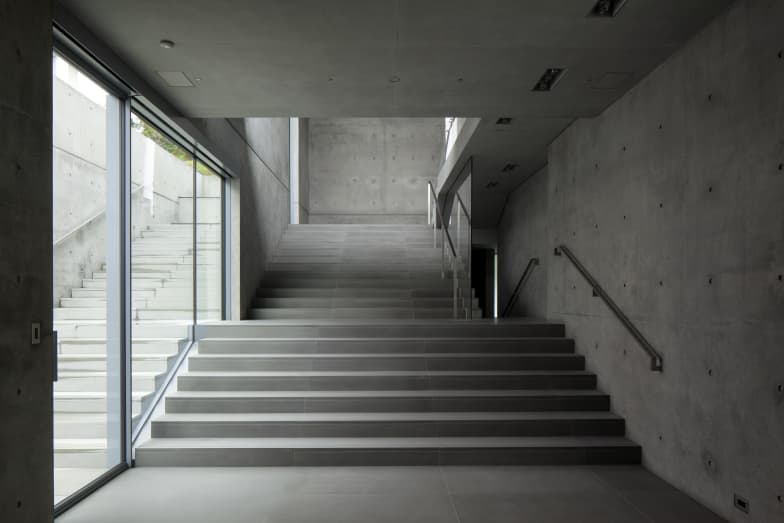
Roughly 1,200 tons of concrete were used to build the original home.The Oppenheim Group/Roger Davies
Prior to the March deal, Belmont had already begun the $8.5 million process of returning the 4,000-square-foot home to its original design by the Pritzker Prize-winning architect, built in 2013 for financier Richard Sachs, he said. He consulted with Sachs and hired the same design-build firm, Marmol Radziner, who had constructed the house originally.
Belmont plans to sell the building as-is at the new price to recoup the money already invested, or return to the original plan of restoring it and selling the completed house—which he expects to be in even more demand in the wake of the January wildfires.
“Malibu is going to get a full face lift, with fire-retardant concrete homes, and we have the ultimate high-end concrete home. A tsunami can’t take it out. A fire can’t take it out,” Belmont said. “And it’s the only Ando for sale.”
The listing is with Jason Oppenheim of the Oppenheim Group and Mauricio Umansky of the Agency, who have been representing the seller from the start. Oppenheim previously repped Kanye in the sale to Belmont, as well. Neither immediately responded to a request for comment.
Realtor.com first reported the home’s return to the market.
Mazzella had also planned to complete the reno of the house and list it closer to Kanye’s original purchase price. “It’s a very complicated construction project,” he said.
Mazzella is working on restoring another Los Angeles mansion and plans to keep looking for opportunities if the deal for this one does fall through. “I consider my business style to be that of Trump, Musk and Carl Icahn combined so it’s not an easy process,” he said.
For the Silo, Liz Lucking/ Mansion Global, Jarrod Barker.
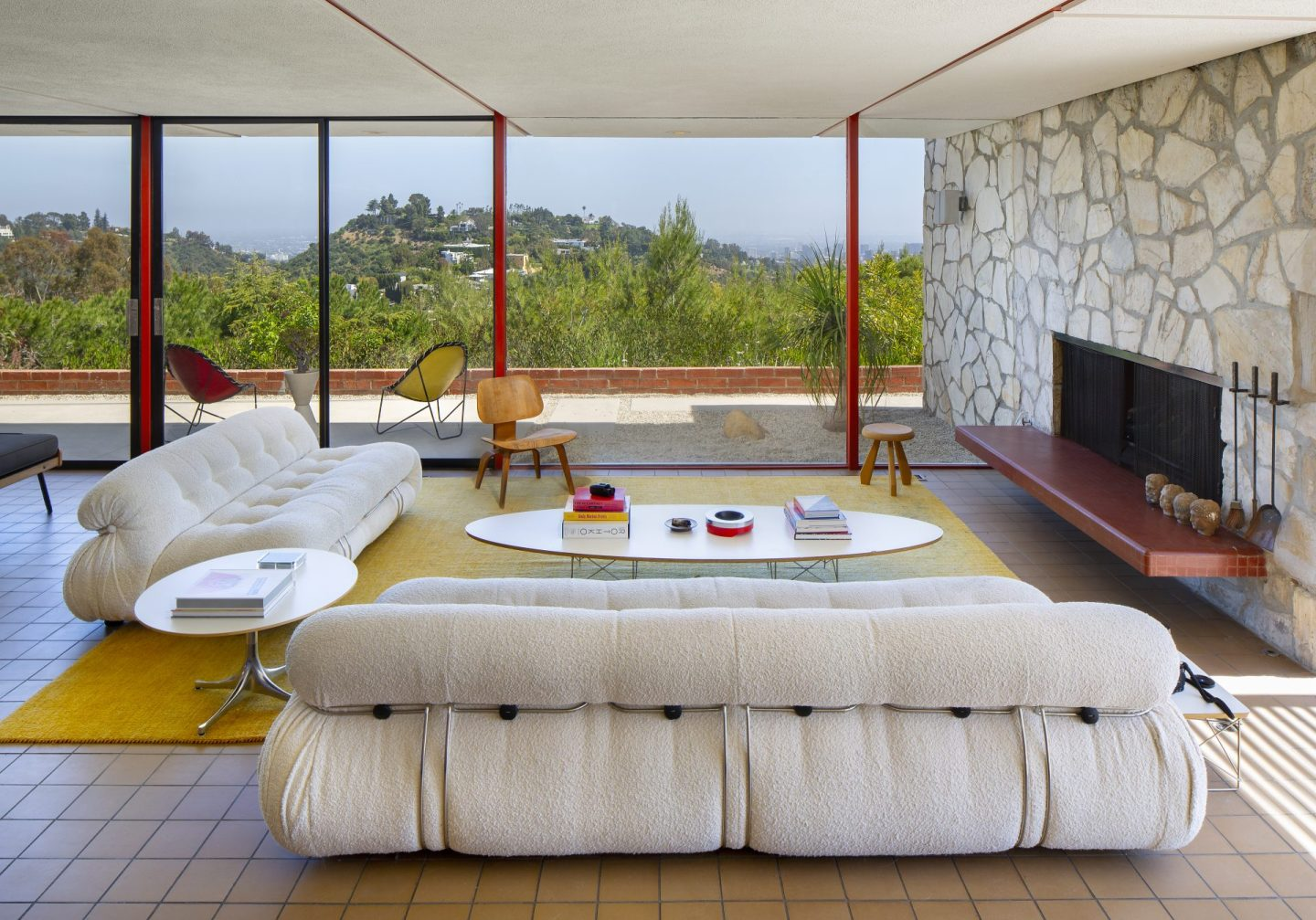
Vintage mid-century modern homes are as popular today as they were when built in the 1950s and ’60s. Arts & Architecture magazine’s post-war Case Study Houses, for example, rarely come up for sale, and when they do, are usually snapped up by aficionados almost as quickly as the listing goes into print. Case Study House #16 is now for sale and priced at $5.4 million usd/ $7.4 million cad.
When World War II ended and the American troops were returning home, it was the start of the baby boom and a monumental housing shortage. Well-known architects in the country were asked to design simple, affordable homes that could be built en masse.
The magazine Arts & Architecture put out a challenge to architects that included Richard Neutra, Raphael Soriano, Craig Ellwood and Ray Eames. The Case Study Houses were numbered 1 through 28, and two apartments were included. They were built from 1945 sporadically through 1966. Thirteen were never built, and from the ones that were, at least three were later demolished. A couple of them have been renovated rather than restored, and the rest are lived in and cared for today.
NUMBER 16
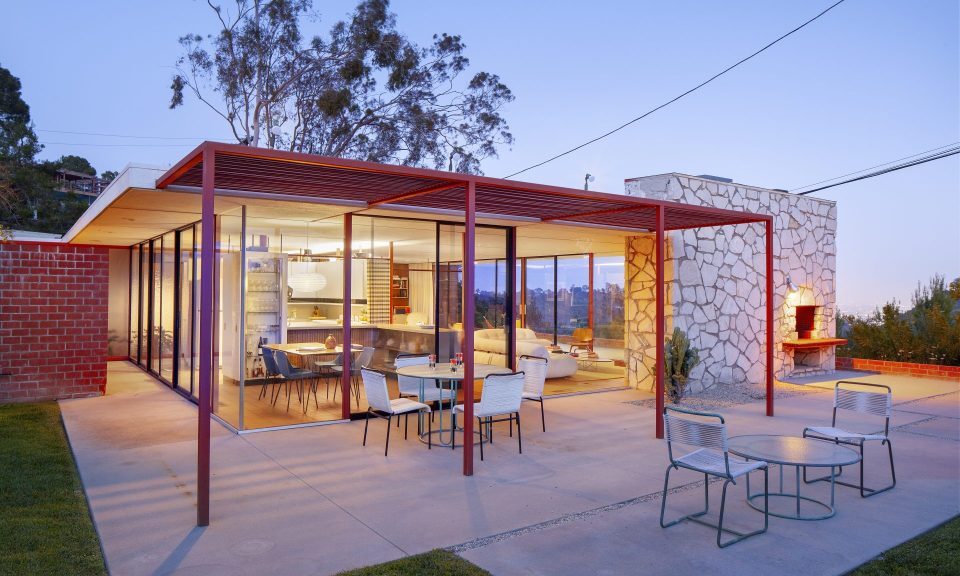
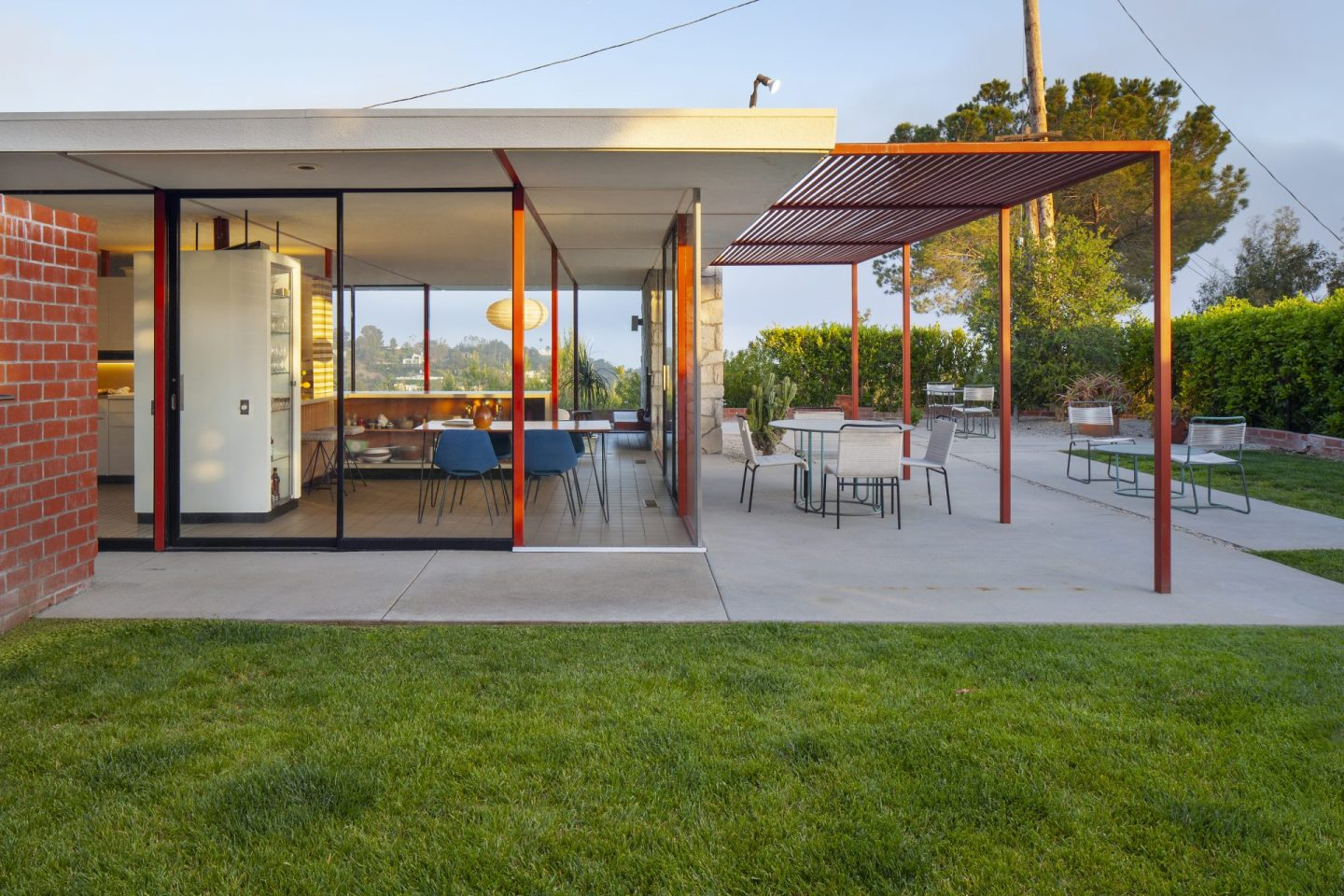
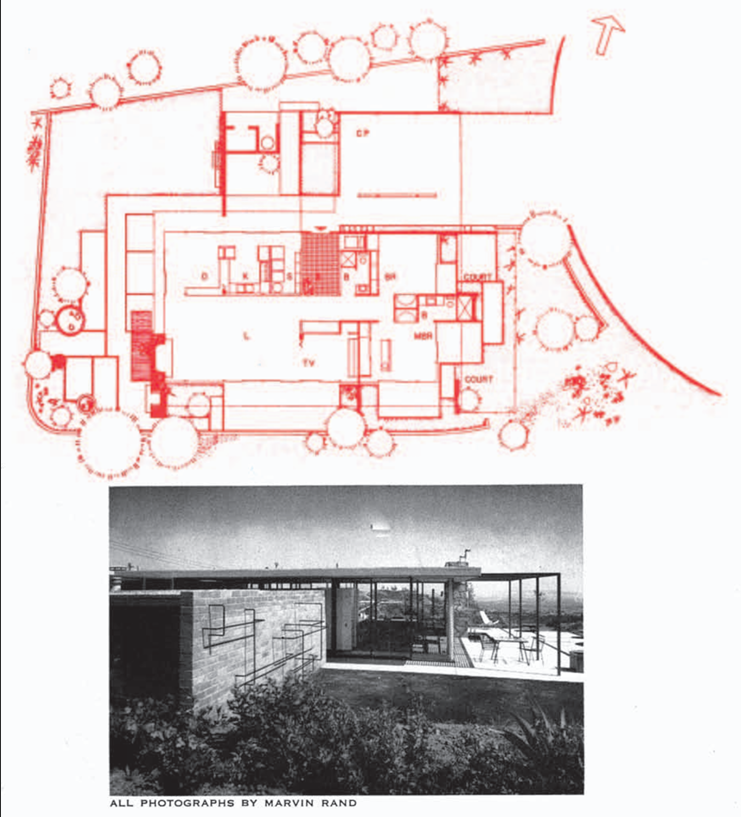
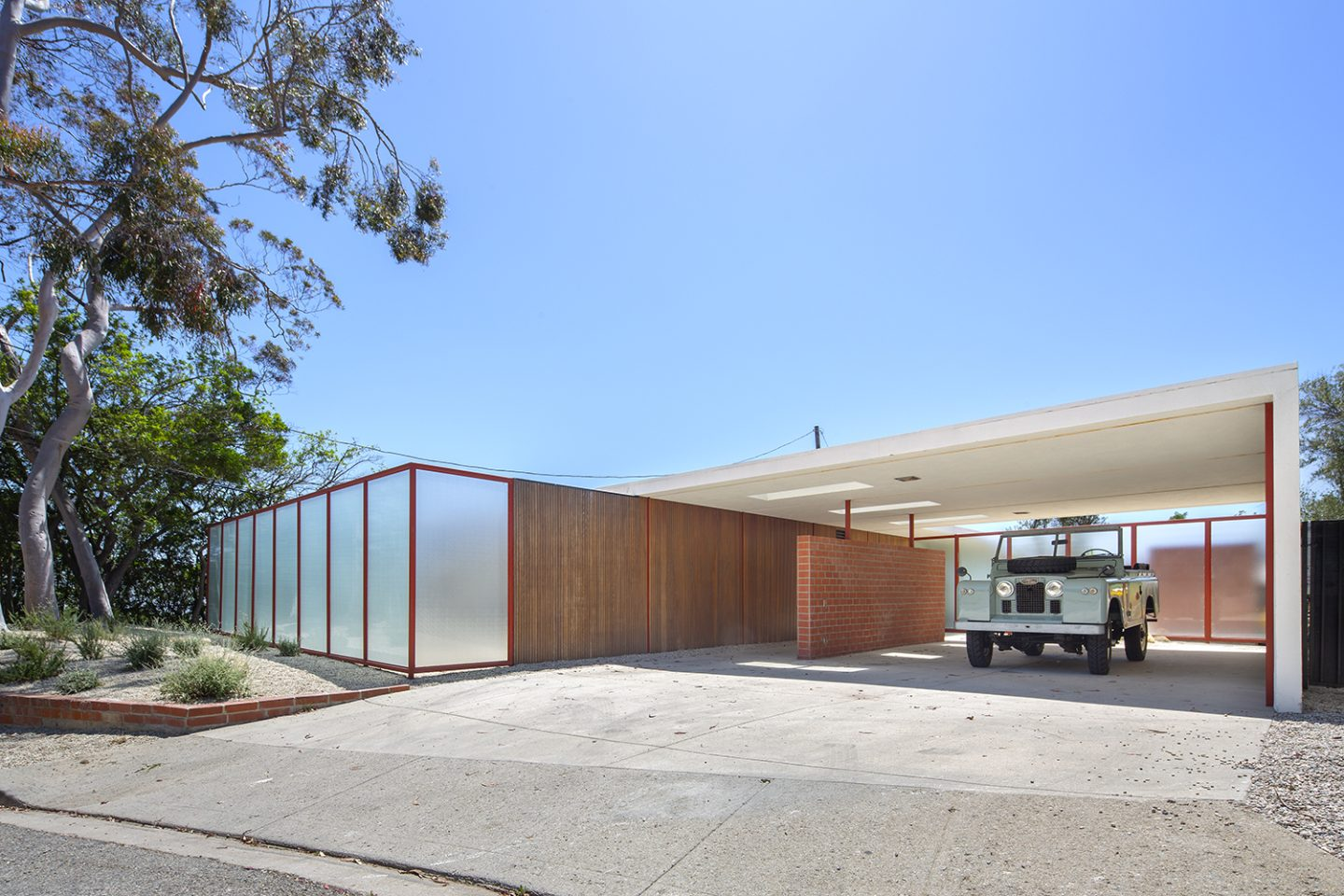
Number 16 was the first of three Case Study Houses designed by Craig Ellwood. Completed in 1953 in Bel Air, the house was innovative in its use of exposed steel-structural framing and floor-to-ceiling glass walls to optimize the views and open to the grounds, making it feel twice the size.
Ellwood was actually an engineer rather than an architect, and placed a lot of emphasis on the stability of the structure using steel, glass, and concrete built on a slab. The 1,664-square-foot home with two bedrooms and two baths is just as contemporary today as when it was built. The living room has a dramatic stone fireplace set into the glass wall that extends beyond it into a terraced area. Set into mature landscaping, the house appears to rest on a cushion of greenery.
The historic Case Study House #16 is for sale in Bel Air, Los Angeles, California. Priced at $5.4 million usd/ $7.4 million cad, the listing agent is Veronika Sznajder with Crosby Doe Associates. For the Silo, Bob Walsh/ toptenrealestatedeals.com
Topanga Canyon is one of LA’s most unique neighborhoods. Nestled in the Santa Monica mountains, the tight-knit community is known for its spectacular nature and Bohemian vibes. During the 1960s and 70s, the neighborhood was a haven for rock stars, including Canada’s own Neil Young and Joni Mitchell along with Jim Morrison, several members of The Eagles, and even country legend Linda Ronstadt among its talented residents. R&B superstar Marvin Gaye described Topanga as “a place where I can create my masterpiece,” and numerous artists agreed. Local venue The Topanga Corral hosted some of the all-time greats and inspired The Doors’ hit “Roadhouse Blues.” Simultaneously accessible and remote, the region remains a sanctuary for artists of all kinds.
The opportunity to own a piece of this special neighborhood presents itself with the listing of Topanga Canyon’s “Egg House” for $4.995 million usd/ $6.790 million cad. This sculptural masterpiece of brutalism and organic design proudly sits at 225 Powderhorn Ranch Road.
Designed and built by artist couple Chad Hagerman and Allison Ochmanek of Rascal Makers, the home is inspired by the concept of the embryo – the origin of life, potential, and transformation. Combining brutalist architecture with organic materials, the bespoke home offers a serene aesthetic with touches of Japanese minimalism. The home is a true statement piece, with handcrafted plaster walls, stone floors, artisan fixtures, and thoughtful details throughout. With four beds and five baths, the stunning home offers 3,350 square feet of living space.
May, 2025 – Canada cannot rely on immigration alone to address the challenges posed by its ageing population and relentless decline in fertility rates [ see Canada’s Soaring Housing and Living Costs Stop Baby Making CP], according to a new report from our friends at the C.D. Howe Institute. Without a broader population strategy, rising immigration could fuel rapid growth while straining housing, healthcare, and infrastructure – without fully resolving rising old-age dependency ratios or labour force pressures.
In this post, Daniel Hiebert confronts an important policy dilemma: although immigration increases overall population and helps address short-term labour gaps, the long-term trade-offs are significant. Without corresponding investment and planning, rising immigration risks compounding the very pressures it aims to alleviate.
“This is a particularly opportune moment to reflect on how immigration fits into Canada’s long-term demographic strategy, especially as both permanent and temporary immigration surged between 2015 and 2024, and are now being scaled back,” says Hiebert. “We need to think ahead about what kind of future we are building — and how we get there.”
Based on current patterns, it takes five new immigrants to add just one net new worker, once dependents and added consumer demand are factored in — a reality that undermines assumptions about immigration as a direct fix for labour shortages.
Hiebert argues that Canada must move beyond short-term immigration planning and adopt a long-range population strategy — one that combines immigration with other tools like delayed retirement, increased workforce participation, and stronger productivity growth. The alternative, he warns, is a “population trap”: a scenario where growth outpaces the country’s capacity to support it, undercutting prosperity in the process.
The report also calls on governments to coordinate immigration levels with long-term planning in housing, healthcare, education, and infrastructure.
“There’s no question that immigration is integral to Canada’s future,” says Hiebert. “But assuming it can carry the load alone ignores the structural pressures we’re facing — and the investments we need to make today to ensure future stability.”
Balancing Canada’s Population Growth and Ageing Through Immigration Policy
Canada faces twin demographic pressures: an ageing population and rapid population growth driven by immigration. The report argues that immigration levels must strike a careful balance – sufficient to offset some effects of low fertility and an ageing workforce, but not so high as to outpace infrastructure and economic capacity.
A sustainable population strategy requires coordinated planning across immigration, infrastructure, workforce participation, and capital investment. The report calls for long-term planning that aligns immigration policy with economic and social goals and emphasizes the need to manage absorptive capacity to avoid overburdening housing, healthcare, and public services.
Introduction
Declining fertility is a global trend and is especially pronounced in countries with high levels of economic development. These countries share the common challenge of ageing populations, with rising old-age dependency ratios (OADRs)1 and a shrinking portion of the population in prime working age. Several policy responses have been established to deal with this emerging reality, including pronatalist and other family-based social programs, efforts to enhance automation and productivity, incentivization of a larger proportion of the population to enter the formal labour force, delaying retirement benefits, and increasing the rate of immigration. The success of these approaches has varied, raising critical questions for policymakers: which strategies are the most efficient? What are their costs? And which policies offer the best balance between risk and reward?
This Commentary explores the potential role and limitations of immigration in alleviating Canada’s challenges of low fertility and ageing. This is a particularly opportune moment to consider such an issue given that both permanent and temporary immigration strongly increased between 2015 and 2024 and will be reduced for the 2025 to 2027 period.
Using custom demographic projections, this paper examines how various immigration scenarios – ranging from historical rates to the peak of 2024 – will affect Canada’s demographic outlook over the next 50 years. The analysis investigates the role immigration could play in mitigating the effects of an ageing population, while also acknowledging the associated trade-offs, including pressures on infrastructure and rapid population growth. The findings highlight that Canada’s immigration policy, while important, should be framed within a long-term population strategy that aligns immigration policy with broader economic and social goals – including capital investment, productivity, delayed retirement, and expanded social infrastructure – to ensure sustainable growth and enhanced prosperity for all Canadians.
Canada’s Demographic Challenge and Recent Immigration Policy Responses
Canada’s current demographic challenge is the product of two primary factors: low fertility and the ageing and retirement of the Baby Boom generation. Canada’s fertility rate first rapidly declined from the peak of the Baby Boom (1950s) to the early 1970s, when it first fell below the replacement level. Since then, it has continued with a slower, though persistent decline, interrupted by occasional slight recoveries. Most recent calculations reveal that Canada’s fertility rate is now at 1.26 – a level unprecedented in Canadian history and among the lowest globally. The consequences of low fertility are particularly pronounced today due to the ageing of the Baby Boom generation. In 2025, this cohort ranges in age from 59 to 79 years old, while the average age of retirement in Canada was 65.1 in 2023. Around two-thirds of boomers have already reached the age of 65, with the remaining third expected to follow in the coming years. The impact of this demographic shift is therefore ongoing and continues to affect the labour market and economy at large.
Throughout its history, Canada has turned to immigration to resolve demographic challenges (Hiebert 2016). From the late 1940s to the mid-1980s, Canada admitted an average of 150,000 permanent residents annually, though numbers fluctuated. By the end of that period, concerns over low fertility began to be articulated. This prompted the government to increase annual immigration levels to 250,000, a figure that was quite consistent over the following 30 years, with annual rates ranging from the low to high 200,000s. By the end of the 20th century, immigration accounted for over half of Canada’s population growth and labour force expansion.
The most recent shift in immigration policy began in late 2015 under the Liberal government, which pursued an expansionary strategy. Annual immigration targets and admission levels increased – save for the 2020 pandemic year – leading to a target of 500,000 for 2025. However, this target will no longer be realized following the revised plan announced at the end of 2024. Along with increased permanent immigration, the government had adopted a more facilitative approach to temporary migration, leading to rapid growth in the number of international students, temporary foreign workers, and other non-permanent residents. In 2023, the Canadian population expanded by 1.27 million, representing an annual growth rate of 3.2 percent, which is highly unusual among advanced economies. For example, the average population growth rate of the other G7 countries in 2023 was less than 0.5 percent (Scotiabank 2023).2
Given Canada’s low fertility, 98 percent of this growth stemmed from net immigration, both temporary and permanent (Statistics Canada 2024a). Today, Canada is approaching a point where all population growth and most of the impetus for population renewal (Dion et al. 2015) will come from immigration. However, the “big migration” trajectory of 2015 to 2024 has shifted. While public opinion historically supported ambitious immigration targets, this sentiment changed sharply in 2024. Concerns about housing shortages, infrastructure strain, and what has been termed a “population trap” – where population growth outpaces capital investment capacity – have fueled resistance to current immigration levels. These pressures clearly influenced the 2025 to 2027 plan, which curtails permanent immigration targets by approximately 20 percent and tightens restrictions on temporary migration programs.
Short- and Long-Term Immigration Policy
Before focusing on the relationship between immigration and demography, it is instructive to explore a fundamental tension in immigration policy: should the Government of Canada prioritize the “maximum social, cultural and economic benefits of immigration”3 for today or for the future? These goals may not always align: satisfying the needs of today may have long-term consequences – a trade-off familiar to anyone who has managed a budget.
It has been long underappreciated that Canada’s immigration policy is built around a combination of short- and long-term goals. Economic selection practices provide a helpful example. Since the introduction of the points system nearly 60 years ago, selection priorities have oscillated between addressing short-term labour market needs (e.g., incorporating and/or prioritizing job offers in selection criteria) and building the human capital of the future workforce, under the assumption that highly skilled individuals can adapt and drive productivity, and therefore prosperity. Striking the right balance between these priorities is challenging and requires careful planning.
The balance between short- and long-term immigration perspectives is reflected in the combination of the economic selection system and levels planning. The former – which includes permanent skilled immigration – involves trade-offs between filling immediate labour shortages and building future human capital.4 The latter determines the scale and composition of Canada’s permanent immigration system. In contrast, temporary migration programs are almost entirely shaped by short-term planning horizons – with the partial exception of the International Student Program, which operates in accordance with a medium-term planning horizon in five-year increments.5
These issues are pivotal to considerations of the relationship between immigration and demography. The impact of immigration extends beyond the number of admissions. If immigrants are selected to enhance the human capital of Canada’s workforce and integrate productively, they can potentially raise per capita GDP and mitigate the challenges of an ageing population (Erkisi 2023; Montcho et al. 2021). Conversely, if the system prioritizes lower-skilled individuals, fails to utilize the skills of highly educated immigrants, or admits newcomers at a scale that exceeds the economy’s capacity to absorb them, it risks lowering per capita GDP and compounding demographic challenges (Smith 2024).
Immigration, therefore, has both scale and compositional effects. Scale impacts include changes to population size, age structure, and regional distribution, which directly affect housing demand and social services. Compositional impacts include broader socioeconomic outcomes such as income inequality, productivity, and trade relationships. While this paper focuses on scale impacts, readers should bear these compositional effects in mind.
Another critical consideration is the relationship between admission levels and the expected economic outcome of admitted immigrants. In Canada’s Express Entry system, admission thresholds are adjusted based on the number of entries. Larger admission cohorts tend to lower the points threshold, potentially reducing the overall human capital of entrants (Mahboubi 2024).
Immigration and Canada’s Demographic Challenge
This paper argues that long-term considerations should play a larger role in immigration levels planning. Immigration decisions made today shape Canada’s demographic structure for decades, as immigrants become part of the population, contribute to fertility, enter the workforce, and eventually retire. These stages must be incorporated into demographic projections and policy planning, yet they are often overlooked due to the focus on immediate needs and political cycles.
To illustrate the long-term demographic impact of immigration, consider two extreme scenarios. In the first, Canada’s fertility rate declines to 1.0 (the 2023 rate in British Columbia) and net migration falls to zero, implying no population growth from migration. Under these conditions, Canada’s population would shrink from 40 million in 2023 to 12.3 million by 2100. In the second scenario, the extraordinary 2023 growth rate of 3.2 percent continues indefinitely, with rising migration levels. By 2100, Canada’s population would reach 452 million.
While neither of these scenarios is realistic, they illustrate the decisive influence that fertility and migration have in shaping the future scale of Canada’s population. Despite their seemingly preposterous nature, the key point remains: with fertility rates remaining low,6 the state is entirely responsible for determining the scale of the Canadian population. Decisions about temporary visas and permanent residence serve as the primary levers of control. Policymakers must recognize that the choices made today will have profound and lasting effects on Canada’s demographic and economic future.
Population Projections and Their Implications
Statistics Canada produced a recent population projection for various scenarios in January 2025, covering the period of 2024 to 2074.7 Across the scenarios, total fertility rates range from 1.13 to 1.66, permanent immigration rates vary from 0.70 to 1.2 percent per year, and net temporary migration figures are assumed to decline in the short term before stabilizing. The selected scenarios suggest that the projected population of Canada would range from 45.2 to 80.8 million in 2074 – a difference of over 35 million people, roughly equivalent to Canada’s current population. The scale of infrastructure and social investments needed to accommodate such growth would be enormous.
Beyond sheer numbers, government policy also affects the age structure of Canada’s future population. The OADR is expected to rise, and increased immigration is often proposed as a solution. However, the retirement age is, to an important extent, a social construct and this paper explores the efficiency of changing Canada’s retirement age compared with adjusting immigration levels to address the issue.
While migration can temporarily mitigate low fertility effects by maintaining a larger workforce, it cannot fully offset population ageing (Robson and Mahboubi 2018). Even doubling Canada’s population through immigration would only reduce the average age by five years, as immigrants’ average age is close to that of the receiving population (around 30 versus 40).8 Doyle et al. (2023) argue that increasing immigration could delay ageing impacts but would require continuously higher volumes, becoming unsustainable.9 Immigrants are typically concentrated in the labour force ages (25-40) but, in 30-35 years, this group will be approaching retirement, creating an economic challenge similar to the Baby Boom generation’s retirement. Unless increasing rates of immigration are in place continuously (an unrealistic scenario), at some point society must adjust to a smaller, older population.
Moreover, there appear to be additional costs to rapid population growth that are driven by high immigration. Doyle et al. (2023 and 2024) contend that when the labour force expands faster than investment in capital and infrastructure, the result is a dilution of capital per worker, reducing Canada’s productivity and living standards. This concern highlights not only the pace of immigration-driven growth but also Canada’s historically low levels of business and infrastructure investment, suggesting a need to boost investment alongside population growth.10
Research shows that while larger immigration targets increase real GDP through a larger labour supply, they could also reduce GDP per capita (El-Assal and Fields 2018).11 Indeed, in recent years of very high population growth through net international migration (2022-2023), Canada’s level of real GDP per capita has been stagnant.12
Furthermore, house price escalation associated with a surge in demand may negatively affect fertility decisions, particularly for families renting homes (Dettling and Kearney 2014; Fazio et al. 2024). In other words, compensating for low fertility through high rates of immigration may indirectly contribute to additional fertility decline.
Studies show that immigration alone has a limited impact on altering age composition (Robson and Mahboubi 2018). Even doubling immigration rates would only slightly improve the OADR (Beaujot 2001). All of the immigrants admitted by Canada between 1951 and 2001, for example, are believed to have reduced the median age of Canadians in 2001 by only 0.8 years.
The effect of younger immigrants, as seen in Australia’s approach, would improve outcomes,13 but Guillemette and Robson (2006) found that this impact would still be modest. An unintended consequence of focusing on younger immigrants is that it contrasts with Canada’s economic selection system, which rewards human capital development. Half of the 2022 Express Entry applicants were 30 or older (IRCC 2022), challenging the idea that immigration could rapidly reduce the average age of the population.14
A Custom Glimpse of the Future
To update our understanding of the role immigration could play in Canada’s demography, this section explores the results of a special population projection, using Statistics Canada’s microsimulation model called Demosim, to assess the impact of varying immigration rates on the Canadian population in the future. Two demographic outcomes are highlighted in this analysis: population size and the OADR.
While population size is a straightforward measure, the exclusive focus on the OADR – without also considering the youth dependency ratio (YDR) – may raise questions about the completeness of the analysis. After all, both young and older people place disproportionate demands on social services. One could also argue that increasing the rate of immigration (depending on the age profile of newcomers, other things being equal) could reduce the OADR while increasing the YDR. There are two major reasons for focusing on the OADR in this analysis. First, it is the most widely used indicator of the ageing population and has particularly profound impacts on the cost of healthcare, Canada’s most expensive social program.15 Second, while the YDR and OADR reflect dependency burdens, they have very different long-term implications: a high YDR represents a short-term fiscal cost but also an investment in the future workforce. In contrast, a rising OADR signals a more permanent shift in the age structure of the population, with fewer economic offsets. For these reasons, and to maintain analytical clarity and focus, the YDR has been omitted from this analysis.
Demographic variables used in the projection, except for the immigration rate, were either held constant (e.g., fertility rate at the 2023 level of 1.33 and the temporary resident population assumed to remain constant at around two million after 2021) or based on assumptions from recent Statistics Canada projections (e.g., emigration rate, life expectancy).16 Using the 2021 base population,17 projections were provided for 50 years. Six scenarios were created based on annual permanent immigration rates ranging from 0.3 percent to 1.8 percent. These correspond to immigration levels in 2025 between around 125,000 and 750,000, based on the 2024 Q4 population estimate of 41.5 million. From 2000 to 2015, the immigration rate averaged 0.6 percent per year (Scenario 2), rising to nearly 1.2 percent per year by 2024 (Scenario 4). The 2025-2027 immigration plan aligns with Scenario 3, at a rate of around 0.9 percent. In essence, the scenarios reflect both current and recent immigration rates, allowing for expansion or contraction, as shown in Table 1.
Population projections vary significantly across the scenarios (Figure 1). As Canada’s natural population growth is rapidly approaching zero and is expected to turn negative in the coming years – and with emigration remaining steady – an immigration rate of 0.3 percent of the population would result in virtually no net international migration. Under this scenario, the population would begin to decline slightly. At the same time, Canada’s OADR would more than double, rising from 29.5 retirees (65 and older) per 100 working-age individuals (18-64) to 48.2 in 2046 and 61.6 in 2071 (Figure 2).18 Such a demographic structure would be unprecedented and pose a significant challenge to economic prosperity. For context, Japan currently has the highest OADR globally, at approximately 48 per 100.19
The second scenario, reflecting Canada’s immigration levels from 2000 to 2015, would add 4.6 million to the population by 2046 and another two million by 2071. The OADR would rise to 44.5 by 2046 and 55.8 in 2071. The third scenario most closely aligns with the 2025 to 2027 immigration plan (though it excludes the projected reduction in temporary residents). If immigration remains at 0.9 percent of the population for the next 50 years, the national population would reach 55.6 million in 2071, and the OADR would be 50.8. The fourth scenario extends the higher 1.2 percent immigration rate from 2024, projecting a population of 67.2 million by 2071. Despite this growth, the OADR would still rise to 46.5 by 2071 – similar to Japan’s current level. Reducing the immigration target from 1.2 percent to 0.9 percent in the 2025-27 plan would result in 11.6 million fewer people by 2071, assuming a stable rate. The sixth scenario, though ambitious, is instructive. If IRCC raised the permanent immigration target to 1.8 percent annually and maintained it for 50 years, Canada’s population would increase to nearly 62 million by 2046 and exceed 91 million by 2071. Even with this growth, the OADR would still rise to 39.5 by 2071. A visual scan of the relevant figure suggests that it would take an immigration rate of around 2.7 percent per year to hold the dependency ratio constant. Moreover, it would be challenging to sustain Canada’s high-human-capital selection threshold in the Express Entry system under this scenario.
Note another important trend. Figure 1 shows that the population diverges across the six scenarios over time, demonstrating the growing efficiency of immigration rates in changing Canada’s population growth over time. In contrast, the OADRs across the scenarios in Figure 2 remain roughly parallel after 2046 and begin to converge a little in the later years, illustrating that immigration ultimately becomes less efficient at altering the age structure of the population over time. Why? A population with low fertility receiving a steady flow of younger immigrants will, in the short term, have a younger average age due to the immigrants’ youth. However, as the immigrant population ages, its average age eventually surpasses that of the receiving population, making the overall population older in the long term.20 Therefore, the effect of steady immigration on the age structure diminishes over time, and only a continuous increase in immigration would prevent this.
Further, it is also important to acknowledge that once there is a sustained period of high immigration (i.e., the case of Canada between 2015 and 2024), a dramatic reduction in the rate of immigration will result in a demographic “bulge” with a large cohort followed immediately by a smaller one – akin to the relationship between the Baby Boom and Generation X. This would ultimately set in motion the same demographic dynamic that Canada faces today, with the larger generation eventually retiring and the OADR increasing. The demographic lesson is clear: shocks in the age structure of a population – whether through dramatic increases or declines in fertility or through major changes in the rate of net migration – place stress on infrastructure and, if they are large, may challenge the long-term stability of the welfare state.
Before reflecting further on these findings, consider the impact of varied immigration rates on the cultural composition of the Canadian population (Vézina et al. 2024). In 2021, approximately 44 percent of the Canadian population had an immigrant background – either as non-permanent residents, immigrants, or individuals with at least one immigrant parent (see Table 2). Under the third scenario, which aligns with the 2025 to 2027 immigration plan, this proportion would nearly reverse by 2046 and change even more dramatically by 2071, with nearly two-thirds of all Canadians being persons with an immigrant background.21
Such a shift would redefine immigrant integration and public perceptions of multiculturalism. Whether this level of cultural change would be widely accepted remains uncertain. If the high 2024 immigration rate was sustained, nearly three-quarters of Canadians in 2071 would be either immigrants or children of immigrants.
Immigration and Other Policy Levers in Addressing Population Ageing
This section assesses how immigration compares to other policy tools in addressing the demographic challenges of an ageing population. Governments have several policy tools to either shape demography directly or mitigate societal consequences. The key concern in an ageing society is the impact of a shrinking labour force on the ability to sustain social services such as healthcare, education, and pensions. The principal direct policies are encouraging fertility and increasing immigration (Lee 2014). Governments can also address the fiscal impact of ageing by: boosting workforce participation among working-age adults; delaying retirement and enlarging the working-age population; raising tax rates; reducing expenditures – especially those related to the elderly population; and increasing the productivity of labour (Lee et al. 2014; Beaujot 2017). Some of these choices are more efficient than others. Pronatalist policies have been established in some 60 countries, yet none have been successful in restoring fertility to a replacement level (UNFPA 2019). Moreover, their effects tend to be short-lived.22
How efficient is immigration in mitigating population ageing and its effects? The data explored so far indicate that while increasing the rate of immigration is highly effective at generating population growth, it is less effective at significantly changing the age composition of the population. A recent analysis by British Columbia Ministry of Advanced Education and Skills Training provides additional depth on this issue.23 Their study presents a simple but informative labour force participation ratio: for every 10 permanent immigrants admitted to the province, six will find work relatively quickly, while the remaining four will be too young or old, pursuing education, or not immediately ready to join the labour market. This reflects the broader reality that approximately half of all economic-class immigrants are spouses and dependents and that only around 60 percent of immigrants are admitted through the economic class to begin with.
It would be tempting, but also simplistic, to see this as the direct impact of immigration on the labour force (i.e., 10 newcomers equate to six net new workers), but there is an important additional dimension that must be considered. Adding 10 people to the population generates consumer demand for goods and services including shelter, food, transportation, and many other things. Meeting this demand requires four additional workers. These four additional workers expand the scale of the economy but do not create net new workers (Fortin 2025).
When 10 newcomers are admitted, given that four will not immediately enter the labour force and another four workers will be required to satisfy extra consumer demand, only two net new workers are added. That is, to add one net new worker to the labour force requires five new permanent immigrants (and therefore approximately two additional dwellings). This is nicely summarized in a ratio: 10-6-4-2. There is no reason to expect that this ratio would be appreciably different in other provinces or Canada as a whole. Just as immigration is more efficient at increasing the size of the population than it is at changing the age structure, the same holds true for the relationship between immigration and net workers added to the labour force.
An example can help illustrate this point. Imagine an ageing society with a population of one million and 1,000 doctors. As more doctors retire than can be replaced through domestic training, the government looks to immigration to fill the gap. It estimates that 100,000 newcomers must be admitted, since only a small fraction of new immigrants will be doctors. This produces the desired effect, and the number of doctors remains stable. However, the population has grown to 1.1 million, and to preserve the same level of access to care, 1,100 doctors are now required. Simply stabilizing the labour force while adding population is an insufficient way to resolve emerging labour shortages because it ignores the additional demand created by population growth (Fortin 2025). This mirrors the earlier point: immigration adds workers, but it also adds consumers. As a result, the net gain to the labour force is much smaller than the headline number of newcomers might suggest.
It is beyond the scope of this paper to investigate the efficiency of all the other measures in mitigating the effects of ageing or increasing the size of the labour force. However, Figure 3 illustrates the demographic impact of one such lever – delaying the average retirement age to 70, compared to maintaining it at 65 – as an example to demonstrate how different policies vary in their ability to influence the OADR.
Figure 3 shows that, under this policy shift, maintaining immigration at the rate of the 2025 to 2027 plan (Scenario 3) would be sufficient to stabilize the OADR to 2046 – keeping it just below 30, similar to its level in 2021. None of the immigration scenarios alone achieve this outcome if the retirement age stays at 65. While the OADR increases over time in all scenarios, delaying retirement significantly slows both the pace and magnitude of this rise.24 However, the purpose of this example is not to propose a specific change. Instead, it highlights the relative effectiveness of this particular lever and emphasizes the need for a multifaceted strategy to address demographic challenges.
In summary, Canada’s demographic challenges stem from low fertility and the retirement of the Baby Boom generation. Immigration can delay and mitigate the effects of ageing but cannot fully counteract them without immediate and dramatic increases. As long as immigration remains within historical levels, ensuring a sufficient workforce will require a combination of immigration and complementary policies.25
Demography and Levels Planning
The policy dilemma implied by demographic realities is both straightforward and immensely complex: it is now impossible to maintain the age composition of the Canadian population while also maintaining its size without turning back the clock more than 50 years in terms of fertility. At the extremes, there are two stark policy choices: maintain the current size of the Canadian population but adjust expectations to accommodate a vastly higher OADR (approximately that of Scenario 1); or maintain the age structure of the Canadian population and plan for a vastly larger population (larger than any projected in the scenarios used in this study). The real policy choice will lie somewhere between these extremes and will require a combination of accommodations.
Table 3 summarizes more realistic options by showing the level of population increase and the different OADRs projected for 25 and 50 years forward. It compares the scenarios that most closely approximate Canada’s permanent immigration targets for the recent past – Scenario 2 (pre-2015 consensus), Scenario 4 (2024 rate), and Scenario 3 (2025 to 2027 plan). Had the Liberal government maintained the earlier rate of immigration after 2015 (that is, maintaining the 0.6 percent rate of immigration), Canada’s population would have grown by around 7.5 million by 2071, but with an OADR higher than any country today (55.8 senior citizens per 100 working-age people). By shifting to, and maintaining, a 1.2 percent annual immigration rate between 2015 and 2024, the population would grow much faster – by 29 million more people over half a century – while the OADR would be lower, at 46.5 per 100. Notice that the change in policy would lead to nearly four times the population growth compared to the reduction in the OADR, which improves by only 17 percent. Scaling back the rate of permanent immigration in 2025 to 2027 moderates both the population increase and the OADR improvement. Nevertheless, it would still yield a population growth of over 17 million in the next 50 years, with Canada’s OADR surpassing that of contemporary Japan.
Regardless of the choice being made, Canada will be both larger and older in the coming decades. This shift has significant implications and calls for strategic long-term planning. For example, the country will need to invest simultaneously in child benefits and new schools, as well as in elder care facilities. Housing demand will continue to mount unless significant changes occur in housing investment policies and outcomes. It also means investing in infrastructure to sustain key public services – such as increasing hospital capacity and expanding public transit. Without these adjustments, the quality of life for Canadians would decline. Crucially, this must occur while public finances are adjusted in light of a rising OADR (or the retirement age is raised).26 It also necessitates a continuing cultural diversification of the population through immigration and temporary migration. Ongoing and growing investments in social inclusion will be required.
The greatest challenge for government is to decide on the optimum balance between ageing and growth while securing public buy-in for immigration policies.27 All of this must occur against the backdrop of other pressing issues such as global climate change, geopolitical instability, technological change, and political polarization – not to mention the need to be mindful of the relationship between immigration, ethnocultural diversity, linguistic and religious groups, Indigenous Peoples, and other equity-seeking groups. Assiduous attention must be paid to Canada’s demographic challenge, despite these powerful intersecting concerns.
Consider financial investment, where growth is based on compounded rates of interest. One of the most common recommendations made by financial advisors is to harness the power of compounded growth by starting to invest early in one’s life. Even small amounts invested in one’s twenties can pay remarkable dividends forty years later. The same logic applies to population management; demographic choices today will have far-reaching consequences in subsequent decades. Adding four to five million to Canada’s population over the next decade cannot simply be undone at the end of that period. The same ageing pressures will remain, but with a larger population that may require even higher immigration levels. As long as fertility remains well below replacement, this issue will persist – regardless of Canada’s population size. There will always be the looming threat of population decline and its consequences.
Short and Long Policy Horizons
Population change is cumulative and difficult to reverse, making it imperative to consider the long-term implications of both temporary and permanent immigration together. This requires viewing them as components of the same system – particularly given the many pathways that allow temporary residents to transition to permanent status, and the increasing reliance on temporary residents within Canada’s permanent immigration system (Crossman et al. 2020). In recent years, temporary migration has increasingly become a kind of “down payment” to Canada’s permanent immigration system, a shift that has transformed Canada’s immigration system into a more fluid, two-step process, although this flow-through process may be interrupted given the latest levels plan (i.e., there is a large gap between the number of temporary residents in Canada and the “room” accorded to that population in the new plan). A comprehensive approach also demands that levels plans, which currently establish expectations for a three-year period, be developed with longer time horizons in mind.28 In other words, immigration levels should reflect Canada’s immediate priorities as well as its long-term goals, including the potential for future population renewal. The focus on present needs should not overshadow a forward-looking vision for the country, as current policies play a decisive role in shaping Canada’s future.29
A common point made in public discussion of Canadian immigration policy is that levels planning should pay more attention to absorptive capacity. This means aligning the number of both temporary and permanent residents with the growth of social services – notably education and healthcare – as well as housing and other infrastructure. The concept of absorptive capacity can be interpreted in passive or active terms. Under a passive approach, levels planning would be guided by the current state of social services and infrastructure including housing, which would determine the appropriate level of immigration (e.g., based on an acceptable range of physicians, housing completions, etc., per 1,000 persons). Conversely, an active approach would flip the direction of causality and establish the parameters of social spending and infrastructural investment based on population growth which, in an era of low fertility, is essentially a function of the scale of temporary and permanent immigration. In this latter situation, IRCC would play a more central role in national planning, as immigration targets would shape the long-term scale of government spending across a wide range of responsibilities. This process would be greatly facilitated by a conscious, long-term population strategy at the heart of levels planning. In such a framework, all sectors of society – government, private business, and non-profit social services – could make informed decisions to guide their investments with far more assurance of long-term patterns of demand. This would be a potent indirect benefit of a population-based approach to migration and immigration management.
There are important tradeoffs between these approaches. A passive approach may be more cautious and politically feasible in the short term, but risks underestimating long-term needs and perpetuating reactive policymaking. An active approach, by contrast, allows for proactive investment and planning – but only if there is full follow-through. If governments commit to population growth targets without ensuring that social and physical infrastructure keep pace, the result could be increased strain on housing, healthcare, and public trust.
While this paper supports an active approach, its core aim is to push for long-term thinking and to encourage an informed public conversation about the choices ahead.
Regardless of which approach is chosen, the issue of social license is key. As noted earlier, a majority of Canadians have recently come to believe that population growth generated by immigration has outstripped the development of social and physical infrastructure. In 2023, this growing perception led to a substantial shift in public support for the number of newcomers that were being admitted. The government must ensure that population growth, infrastructure capacity, and capital investment are aligned – and clearly communicated to the public. This means developing a population strategy alongside an economic strategy. These are not competing priorities, but complementary and mutually reinforcing goals.
Conclusion
Given its low fertility, Canada’s demographic and economic future would be bleak in the absence of immigration. Even under low immigration scenarios (0.3 and 0.6 percent of the population per year), Canada would enter uncharted territory with respect to its OADR. At the same time, immigration is more efficient at increasing the population size than it is at either adding net new workers to the economy or fundamentally altering the age structure of the population. Higher rates of immigration may address short-term labour shortages, provide important skills, and stimulate economic activity (a higher GDP), but their effect on prosperity (GDP per capita) depends on whether they are accompanied by robust productivity growth, capital investment, and innovation. Moreover, they present challenges to Canada’s infrastructure, particularly in housing supply and healthcare availability. Without such complementary investments, rapid population growth could lead to a population trap – where population growth outpaces investment capacity – ultimately lowering prosperity, and potentially worsening fertility rates.
Canada’s demographic future depends on policy decisions made today, which carry long-term consequences that require careful planning and adaptation. While immigration level planning includes multi-year targets and considers a range of factors, in practice it often focuses on managing short-term pressures rather than shaping a long-term population vision. With fertility rates at historic lows, Canada’s reliance on immigration for population growth is intensifying. While immigration is a relevant tool for mitigating population ageing, it cannot prevent Canada from ageing on its own. This impasse highlights the need for a comprehensive population strategy that aligns with a long-term economic strategy – recognizing that growth and economic planning are complementary, not competing, goals. The strategy must also balance population growth with the challenges of an ageing society and address social priorities, including ethnocultural diversity and inclusion, Canada’s linguistic landscape, and Indigenous reconciliation.
A sustainable path forward must integrate immigration with policies to boost workforce participation, promote productivity, incentivize capital investment, and consider measures such as delayed retirement, all while recognizing the potential social and economic trade-offs involved. Without a clear and proactive strategy, Canada risks mounting economic and social pressures. A well-managed, long-term population plan, grounded in both economic realities and social capacity, will be essential to maintaining prosperity and ensuring that growth benefits all Canadians. For The Silo, Daniel Hiebert -Emeritus Professor of Geography at the University of British Columbia.
References
Adcerà, Alicia, and Ana Ferrer. 2013. “The Fertility of Recent Immigrants to Canada.” IZA Discussion Paper Series 7289: 1-21. https://docs.iza.org/dp7289.pdf.
___________. 2017. “Canada: The case for stable population with moderately low fertility and modest immigration.” Canadian Studies in Population 44(3-4): 185-190.
Dettling, Lisa J., and Melissa Schettini Kearney. 2014. “House prices and birth rates: The impact of the real estate market on the decision to have a baby.” Journal of Public Economics 110(c): 82-100. https://ideas.repec.org/a/eee/pubeco/v110y2014icp82-100.html.
Dion, Patrice, Éric Caron-Malenfant, Chantal Grondin, and Dominic Grenier. 2015. “Long-Term Contribution of Immigration to Population Renewal in Canada: A Simulation.” Population and Development Review 41(1): 109-126. https://doi.org/10.1111/j.1728-4457.2015.00028.x.
Dungan, Peter, Tony Fang, Morley Gunderson, and Steve Murphy. 2023. “Macroeconomic Impacts of Immigration in the Canadian Atlantic Region: An Empirical Analysis Using the Focus Model.” IZA Institute of Labor Economics 16527: 1-25. https://docs.iza.org/dp16527.pdf
Fazio, Dimas, Tarun Ramadorai, Janis Skrastins, and Bernardus Ferdinandus Nazar Van Doornik. 2024. “Housing and Fertility.” SSRN Electronic Journal. https://dx.doi.org/10.2139/ssrn.5046571.
Fortin, Pierre. 2025. The Immigration Paradox: How an Influx of Newcomers Has Led to Labour Shortages. Commentary 677. Toronto: C.D. Howe Institute. February.
Laplante, Benoît. 2018. “The Wellbeing of Families in Canada’s Future.” Canadian Studies in Population 45(1-2): 24-32. https://doi.org/10.25336/csp29376.
Lee, Ronald D. 2014. “Macroeconomic Consequences of Population Aging in the United States: Overview of a National Academy Report.” American Economic Review 104(5): 234-239. https://www.aeaweb.org/articles?id=10.1257/aer.104.5.234.
Lee, Ronald, et al. 2014. “Is low fertility really a problem? Population aging, dependency, and consumption.” Science 346(6206): 229-234. https://doi.org/10.1126/science.1250542.
Montcho, Gilbert, Julien Navaux, Marcel Mérette, and Yves Carrière. 2021. “Comparing Public Transfers between Immigrants and Natives: A National Transfer Accounts Approach.” SSRN Electronic Journal. https://ssrn.com/abstract=3968396.
Romaniuk, Antole. 2017. “Stationary population, immigration, social cohesion, and national identity: What are the links and the policy implications? With special attention to Canada, a demographer’s point of view.” Canadian Studies in Population 44(3-4): 165-178. https://journals.library.ualberta.ca/csp/index.php/csp/article/view/29290.
Smith, Philip. 2024. “Accounting for the decline in Canada’s Real GDP Per Capita since Mid-2022.” International Productivity Monitor 46: 83-100. https://www.csls.ca/ipm/46/IPM_46_Smith.pdf.
Zhang, Haozhen, Jianwei Zhong, and Cédric de Chardon. 2020. “Immigrants’ net direct fiscal contribution: How does it change over their lifetime?” Canadian Journal of Economics/Revue canadienne d’économique 53(4): 1642-1662. https://doi.org/10.1111/caje.12477.
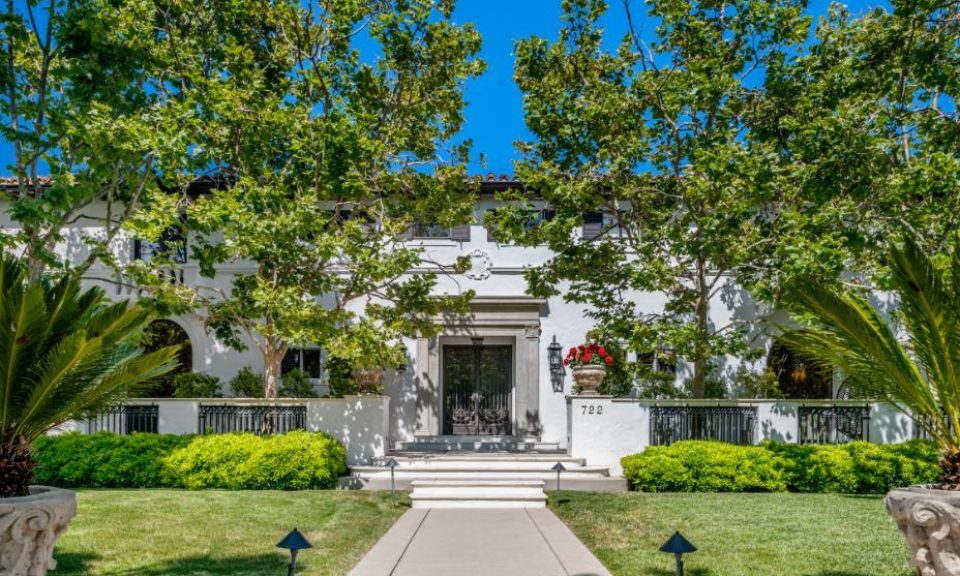
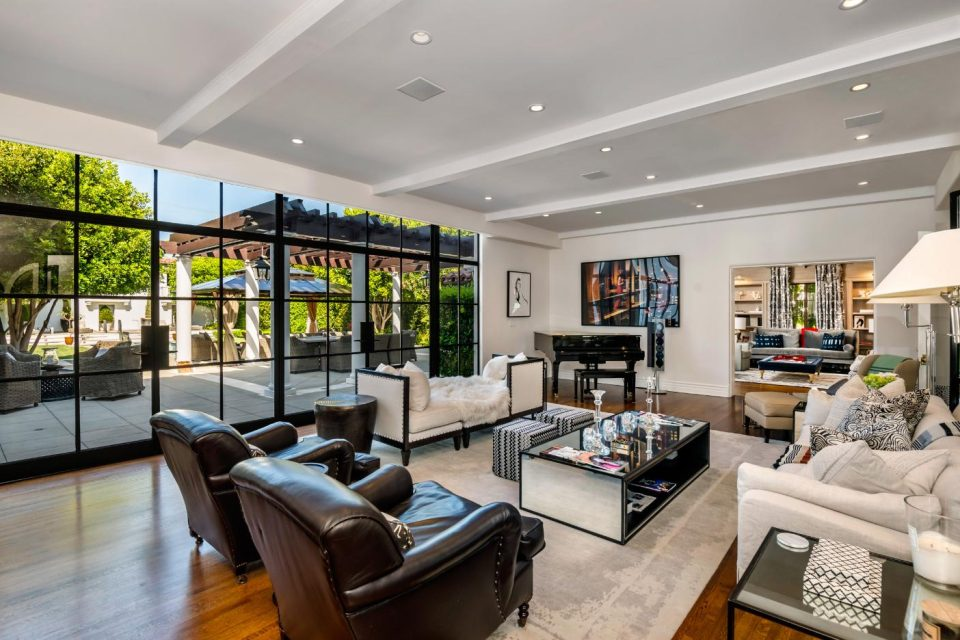
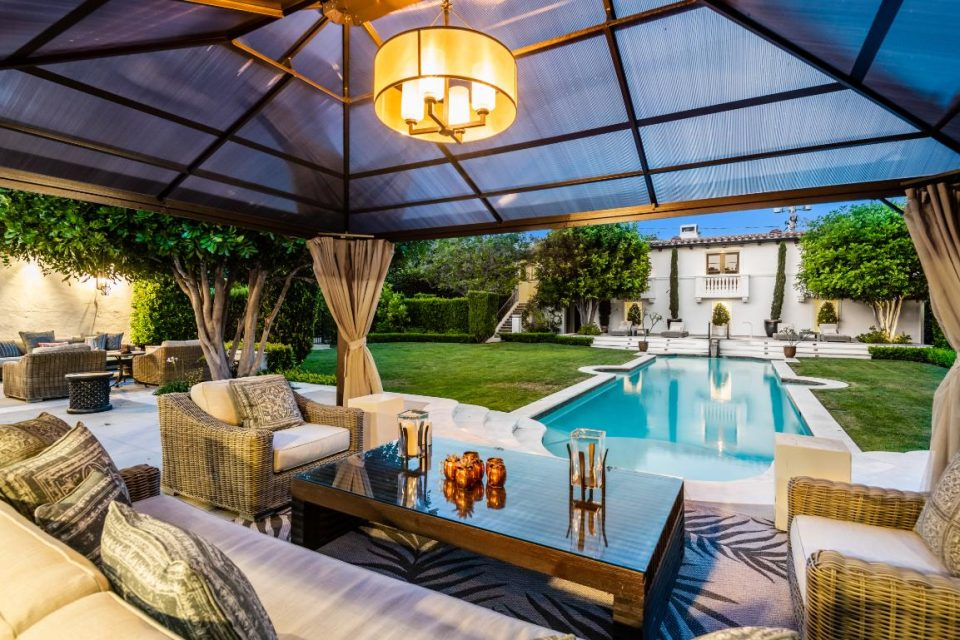
Brunette knockout Christina Estrada modeled for some of the world’s top brands and appeared in the famous Pirelli calendar. Born in the USA, the glamorous Estrada has been based in London since 1998. She was previously married to Saudi billionaire Sheikh Walid Juffali, but the couple divorced in 2016, leaving Estrada the sole owner of a fabulous Beverly Hills villa. The supermodel has listed the stunning estate for sale at $26 million usd/ $37.7 million cad. According to the listing agent, Gary Gold, “This is the quintessential Beverly Hills estate located on the best block of the best street in the Flats. This is the type of home you see in a movie portraying the good life.”
Built in the 1930s, the mansion has been painstakingly restored, blending the irreplaceable craftsmanship of a bygone era with all the latest in modern luxury.
Spanning 9,000 square feet with five bedrooms, eight bathrooms, and luxe modern amenities, the residence will be sold fully furnished.
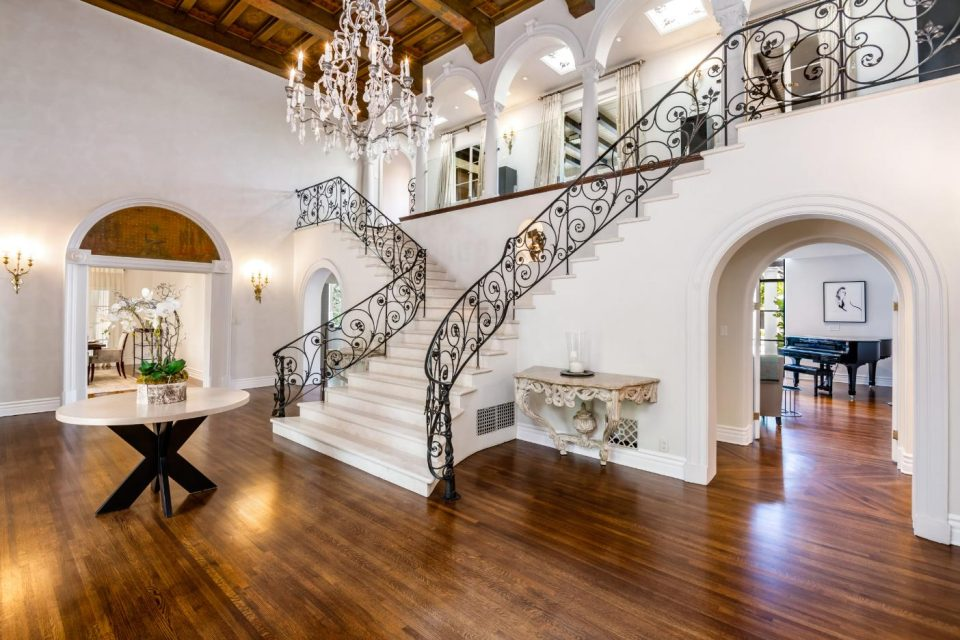
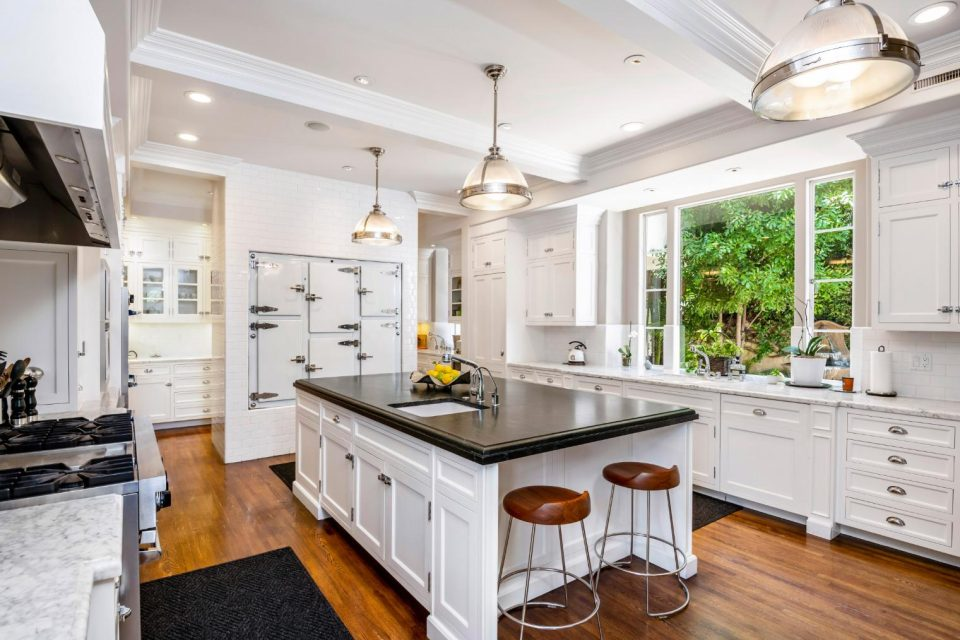
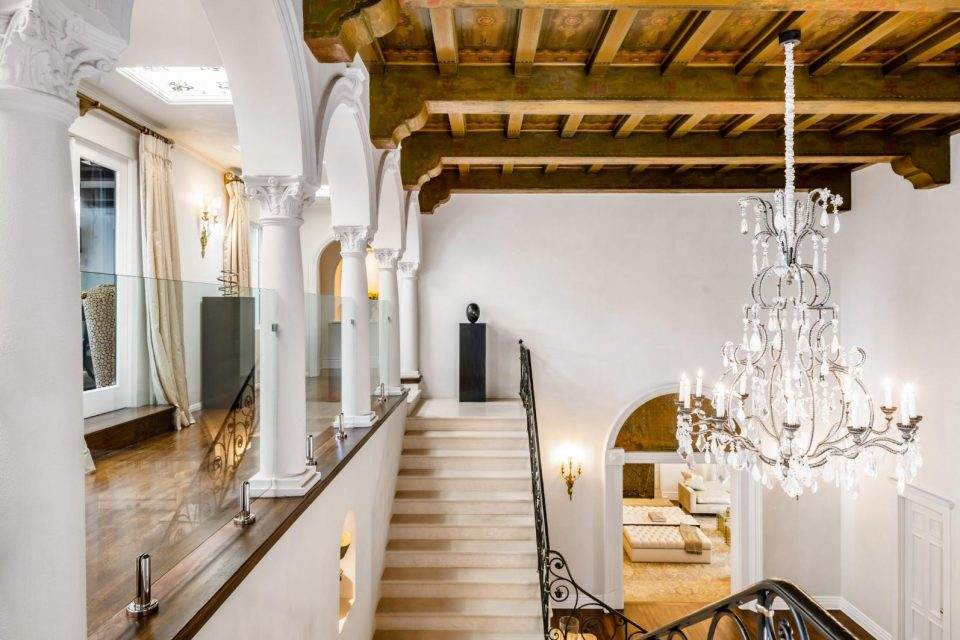
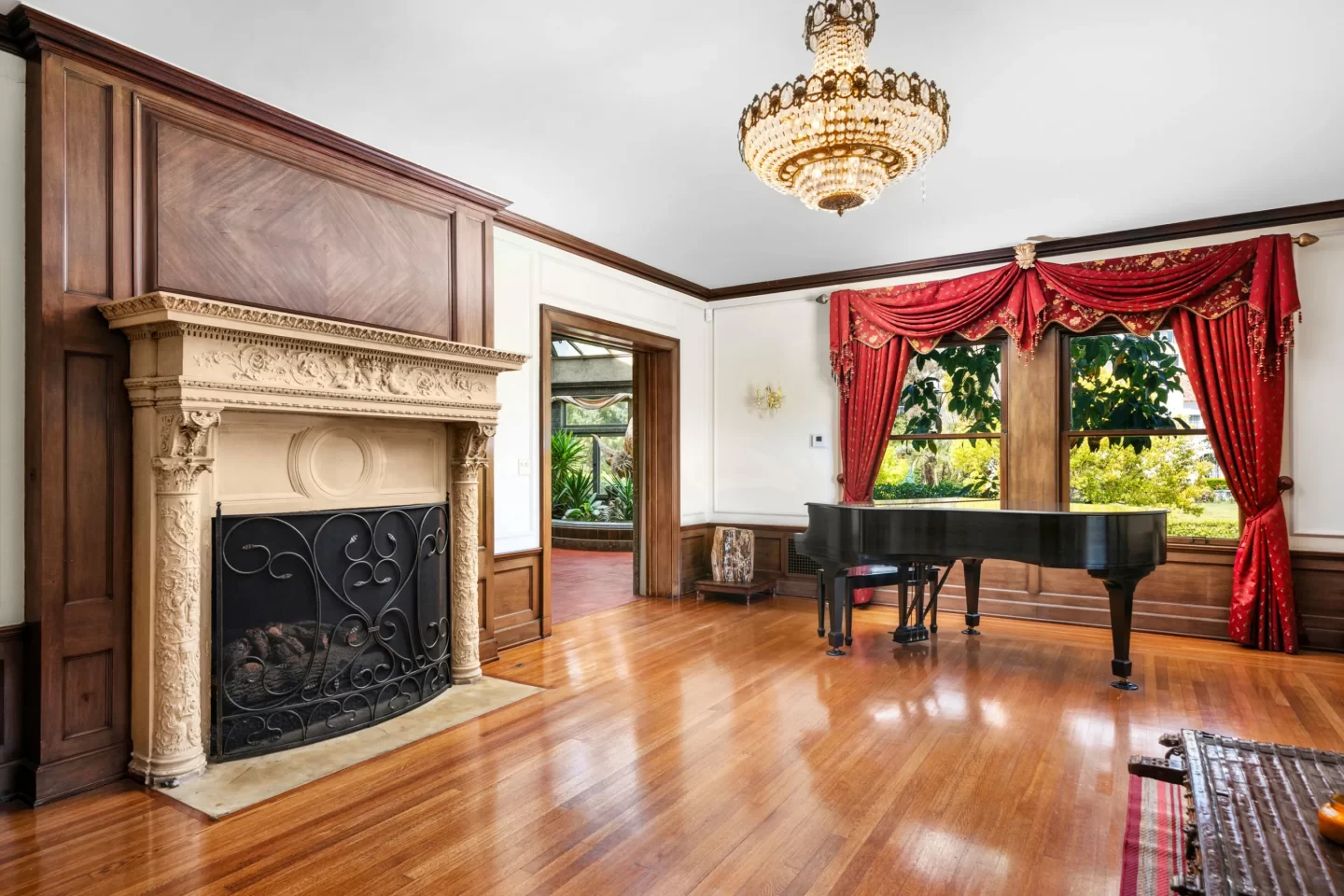
The two-story home boasts an imposing Italian-style facade. Old World styling is evident throughout the mansion, with columns, archways, wrought-iron details, and exquisite beamed ceilings. Enter through the impressive two-story foyer, featuring double staircases, coved archways, a wonderful chandelier, and a hand-painted ceiling. The chef’s kitchen boasts top-of-the-line appliances and a spacious butler’s pantry, while the formal dining room includes seating for 12. A cozy breakfast offers a more relaxed atmosphere, with yard access for al fresco dining.
The spacious primary suite includes big windows for lots of natural light, a generously appointed bathroom with marble accents and a glamorous mirrored powder room, plus a walk-in closet fit for a supermodel’s wardrobe. Upstairs, find three more bedrooms with their own en-suites, furnished in a classic style. A step-down living room with steel-case windows and an attractive great room with an inviting fireplace offer lots of space for lounging. Meticulous attention to detail is evident in every room, while the chic but understated furnishings allow the home’s timeless beauty to shine.
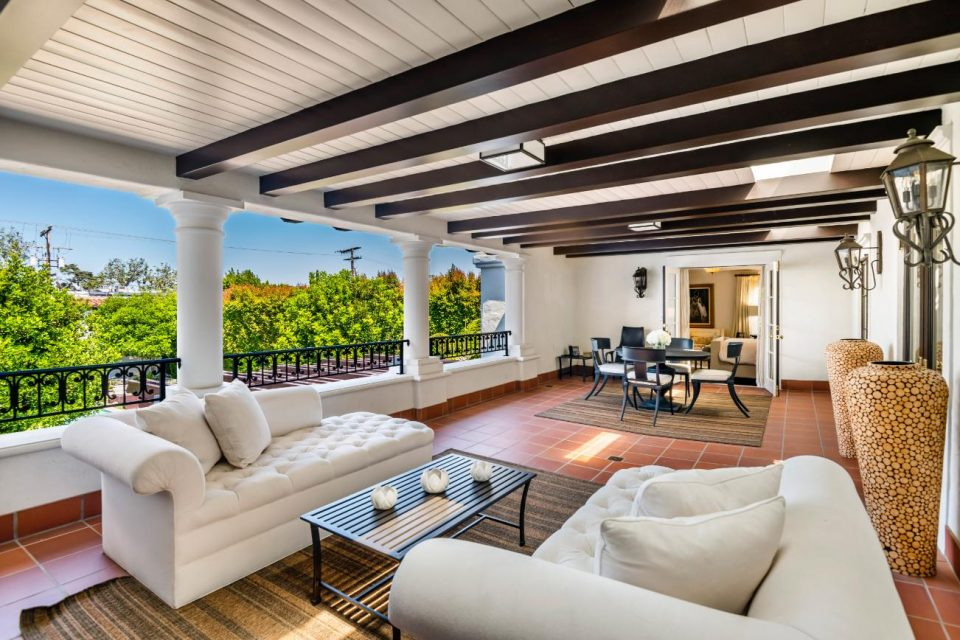
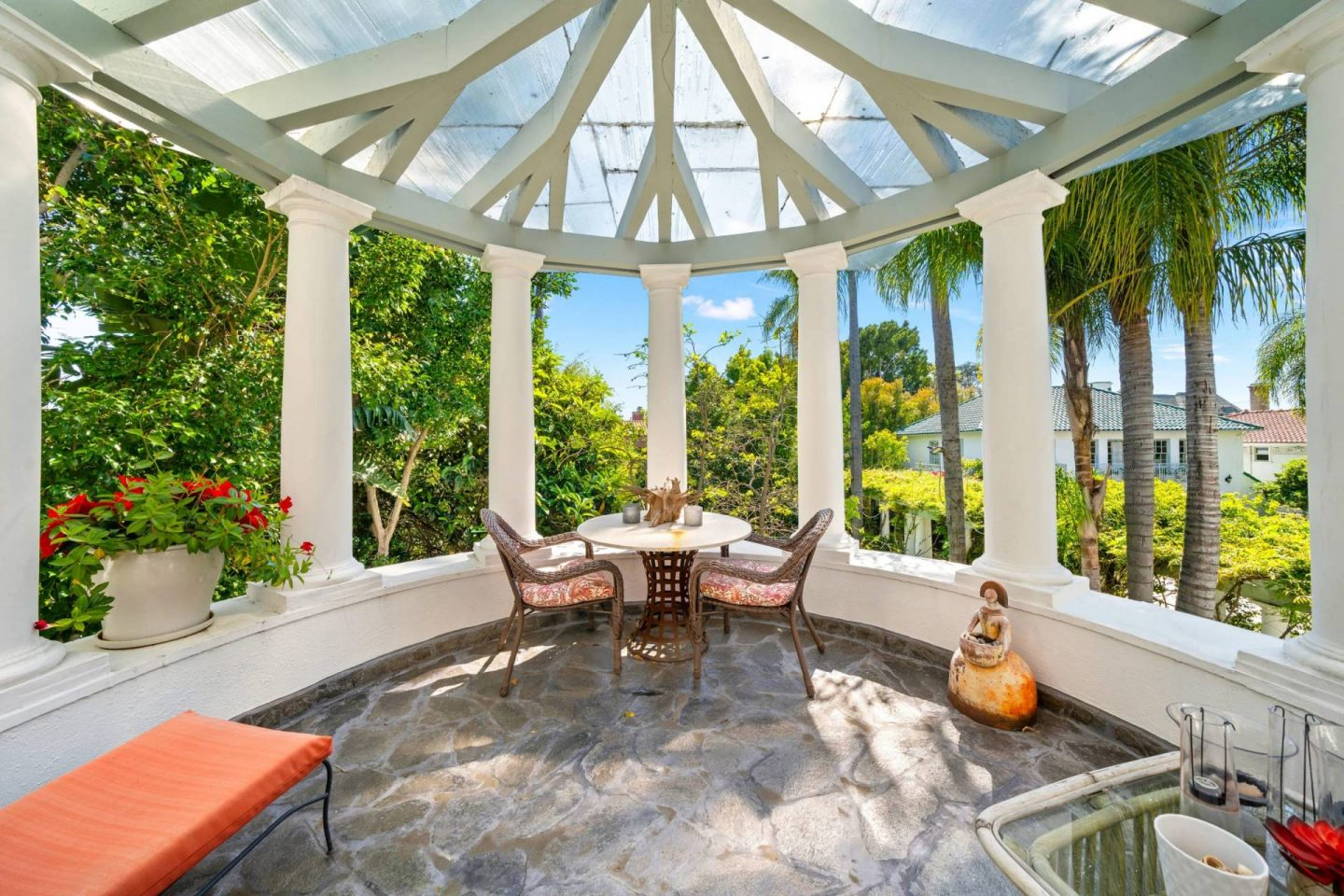
The spectacular yard offers a resort-like atmosphere with a stylish pool, manicured lawns, and tall hedges for lots of privacy. Multiple balconies offer pool views, while the den and family room connect with the outdoor spaces for seamless indoor-outdoor living, taking advantage of LA’s year-round pleasant weather. The covered loggia is especially lovely, with intricate columns and a curtained gazebo. Other amenities include a library with built-in bookshelves, a five-car garage, and a separate guest house with two bedrooms and two baths.
Located just off world-famous Sunset Blvd, the mansion is convenient to the music and entertainment venues of the Sunset Strip, the high-end shops on Rodeo Drive, the Getty Museum, and the Los Angeles Country Club. Known for its beautiful homes on large lots, the Flats is one of 90210’s most exclusive neighborhoods. Just a few of the zipcode’s illustrious residents include Adele, Taylor Swift, Jennifer Aniston, Jack Nicholson, Ashton Kutcher and Katy Perry. For the Silo, Bob Walsh/ toptenrealestatedeals.com.
The listing is held by Gary Gold at Forward One. Photo Credit: Jennifer Mann, The Luxury Level
Beverly Hills Artist, Energy Guru & Landscape Designer Also Does Dreamy Homes!
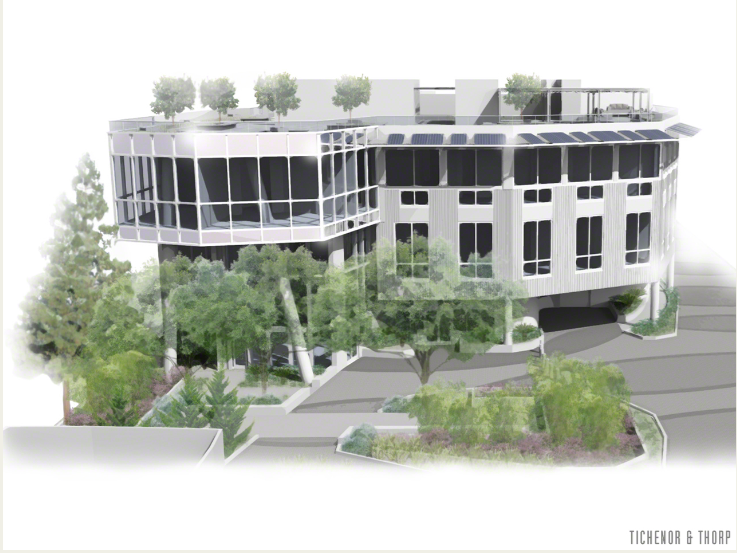
Beverly Hills-based architect Brian Tichenor is a man of many talents, widely recognized for original, artful building designs that integrate large-scale residences and their surrounding landscapes. A graduate of UCLA, Tichenor is a member of the architecture faculty at rival school University of Southern California. Some of his most notable projects include the new LA Times Headquarters and Nantworks, a campus of DNA sequencing and R&D labs on reclaimed oil fields in the north Baldwin Hills that use methane capture, solar infrastructure, and co-generation to achieve energy self-sufficiency.
The Artist
In the art world, Tichenor’s colorful watercolors are found in the homes of many art collectors. And Brian has completed more than 100 gardens throughout the world. With his wife, fellow architect Raun Thorp, he is the author of Outside In: The Houses and Gardens of Tichenor & Thorp, published by Vendome Press in 2017.
A ten-acre estate in Alamo, thoughtfully designed by Tichenor, has been listed for sale at $17.75 million usd/ $24.4 million cad.
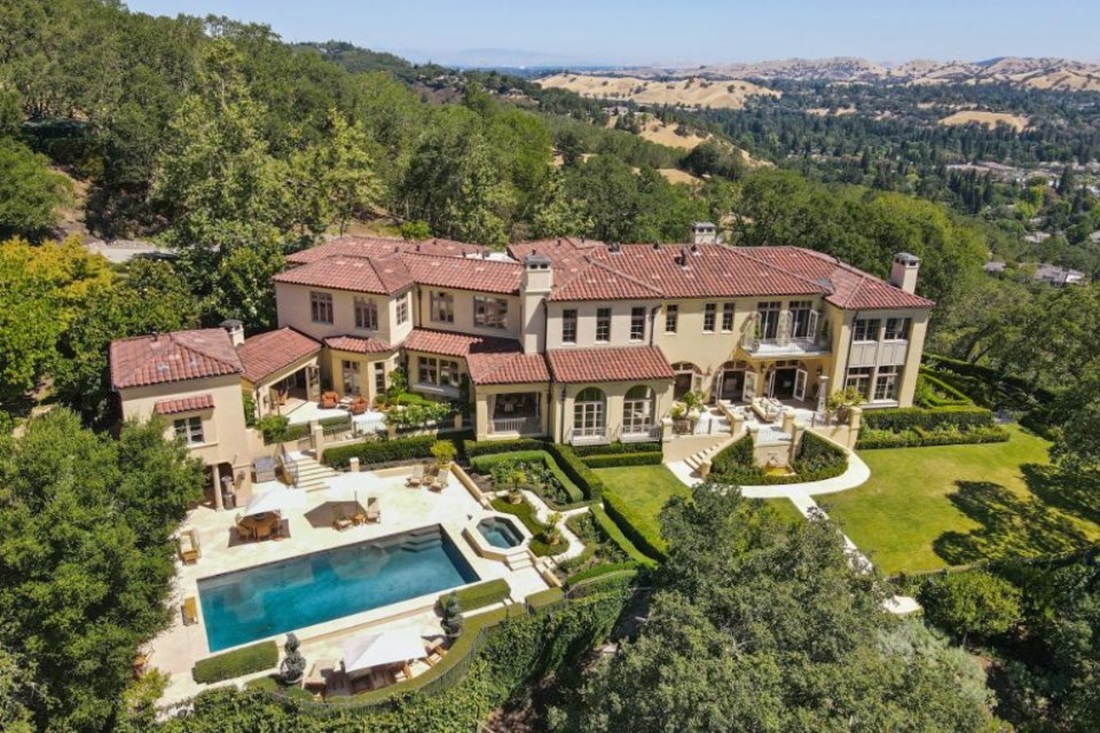
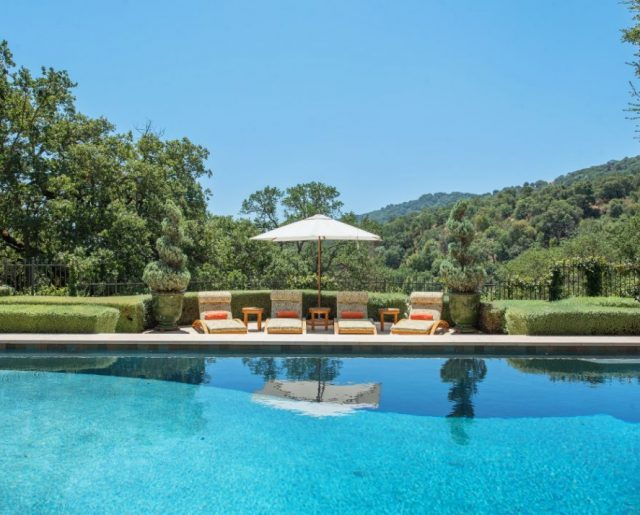
Known as Lark Ridge Estate, the property includes Tichenor’s trademark landscaping featuring Mediterranean-style gardens, a lion’s-head fountain with Emperador dark marble surround, a dark plaster pool, and an octagon-shaped spa, complemented by the property’s stunning views of Mt. Diablo and the surrounding valley.
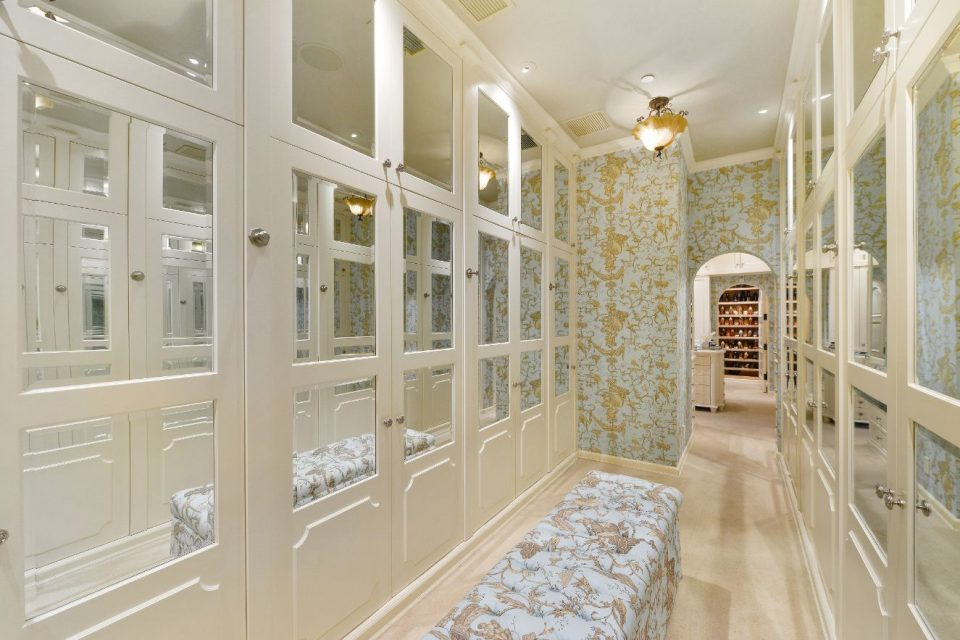
Three houses sit on the grounds, protected by private gates. The 9,812-square-foot main house includes six bedrooms and nine bathrooms. The two-story mansion is the classic Mediterranean with a red-tile roof. Exquisitely designed for indoor-outdoor living, the floor plan offers grand-scale entertaining spaces, casual living areas, sitting rooms, private bedroom retreats, enormous walk-in closets, spa-like bathrooms, dual-executive-office spaces, a gym, and a media room.
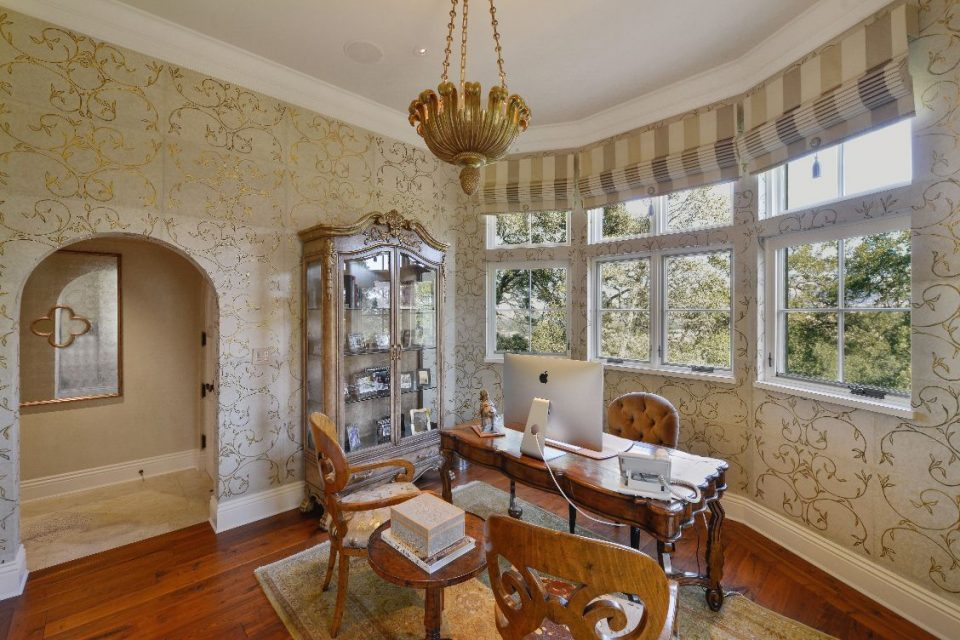
French doors, extensive use of Venetian gold from Italian artisans, antique fireplaces, rock crystal chandeliers, and custom onyx-and-marble countertops impart an air of decadent luxury. Each room is unique, with truly stunning wall coverings, including parchment and gold-leafed wallpaper in the executive office, pearlized Venetian plaster walls in the master suite, custom hand-painted grass-cloth walls in the family room, and a fireplace from New York’s Plaza Hotel. Miele appliances, state-of-the-art AV & security systems, motorized shades, and a computerized lighting system offer the ultimate in high-tech living.
The 917-square-foot carriage house provides a one-bedroom/one-bathroom guest home with a full kitchen and laundry room over an impressive nine-car secondary garage. The 718-square-foot tennis house offers a similar one-bedroom/one-bathroom layout with a kitchenette. Perfect for entertaining, the tennis house opens onto the full-sized lighted tennis court with a basketball hoop and the entertainment deck with a two-way fireplace. An outdoor kitchen and bar, ample poolside lounging areas, and resort-inspired amenities are sure to charm even the most discerning guests.
Located 28 miles south of San Francisco, Alamo is a suburban community known for its bucolic feel and relaxed atmosphere, close enough to San Francisco and Silicon Valley for a comfortable commute but secluded from the hustle and bustle of the city. Lark Ridge Estate sits just above the Iron Horse Regional trail, beloved by walkers, runners and cyclists. Numerous parks and wilderness areas surround the community, which has not yet been heavily developed. Celebrities who call Alamo home include Olympic gold medalist Kristi Yamaguchi, MLB record-setter Mark McGwire, and Oakland Raiders owner Marc Davis.
The listing is held by Dana Green of Dana Green Team of Compass, Lafayette, California.
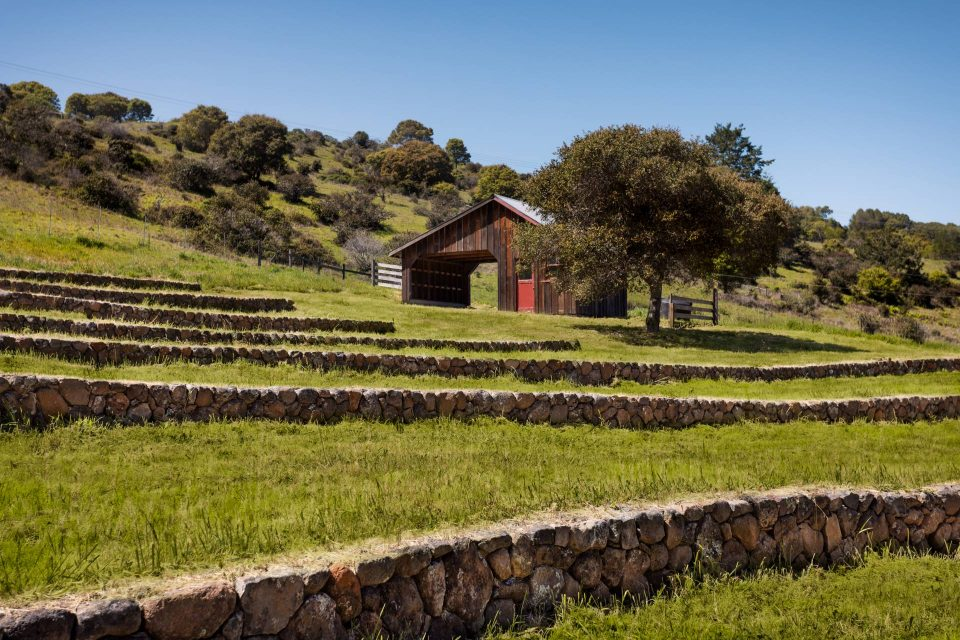
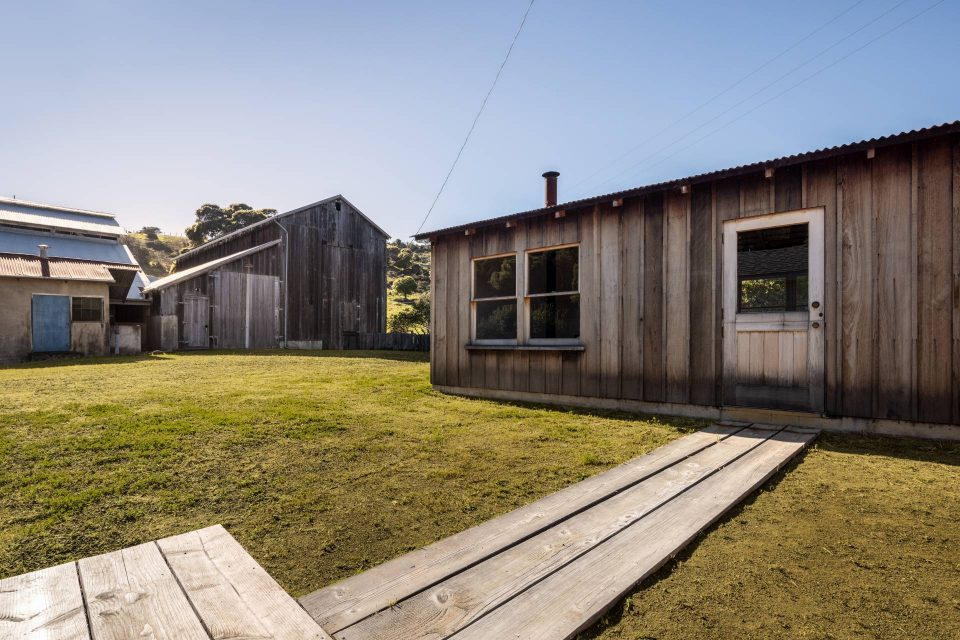
North America’s most famous living photographer, Annie Leibovitz, had quite the surprise when she bought her 65-acre home and farm in 2019 and learned that North America’s most famous photographer of the 20th century, Ansel Adams, had photographed one of the farm’s barns a century ago. It was the perfect metaphor for her purchase of The Hideaway in Bolinas, California.
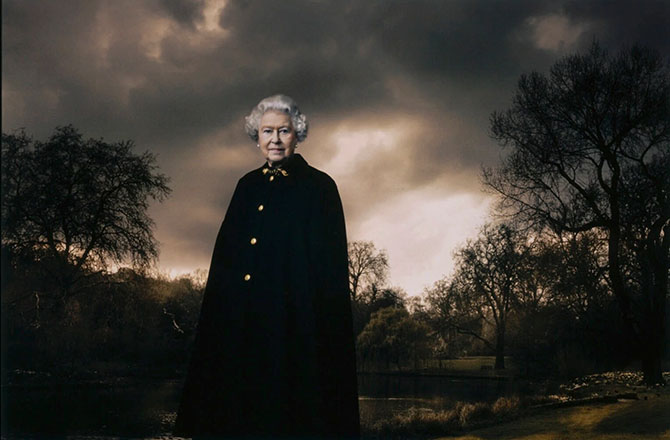
Annie Leibovitz – Queen Elizabeth II. Sold for $27,500 usd/ $37,600 cad via Phillips (April 2012).
Leibovitz is renowned for her intimate portraits of celebrities for Rolling Stone, Vanity Fair, and Vogue. She did Mick Jagger, Adele, Linda Ronstadt, Queen Elizabeth II, Bruce Springsteen, The Blues Brothers, and the Barack Obama family.
Her snapshot of John Lennon wrapped around Yoko Ono, taken just a few hours before his death, is one of Rolling Stone’s most famous cover images. And her photos of then 15 year old Miley Cyrus sparked controversy and marked a turning point in the young singer’s career.
Leo DiCaprio with Swan 1997 by Annie Leibovitz
Declared a Living Legend by the Library of Congress, Annie is the first woman to have a feature exhibition at Washington’s National Portrait Gallery. Born in Connecticut and based in New York, the self-described “California Person” purchased a 65-acre home and farm, known as The Hideaway, in Bolinas, California in 2019, hoping to spend more time on the West Coast, where she had majored in photography at the San Francisco Art Institute. But with her three young adult children on the East Coast, Annie has decided to list the property for sale at $8.9 million usd/ $12.8 million cad.
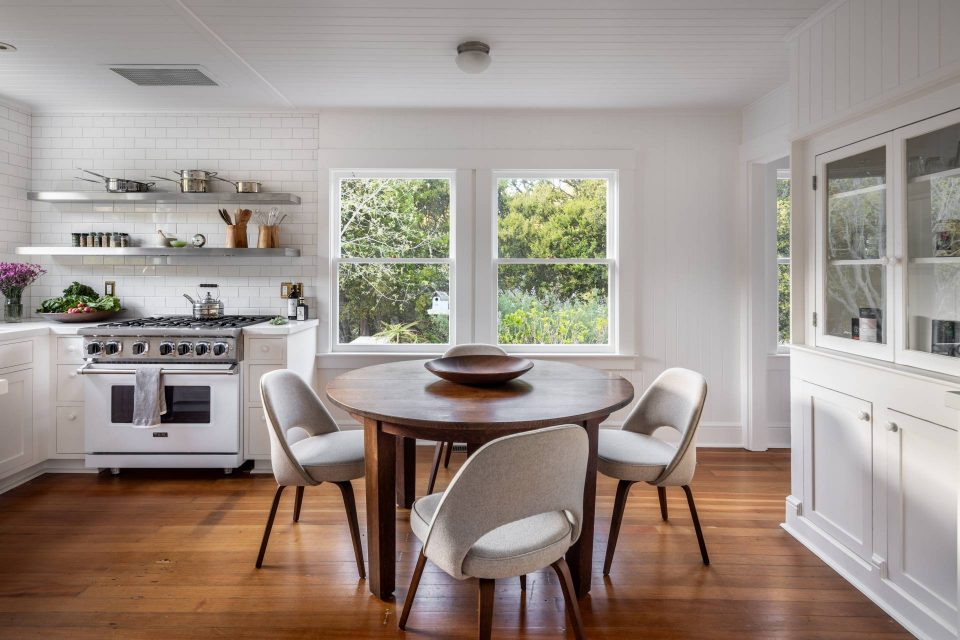
With her new property dating back to the 1800s, Leibovitz spent over $2 million usd/ $ 2,736,000 cad on improvements, which included several structures: a home with four bedrooms, a guest house, a caretaker’s residence, and a converted garage.
The original, vintage rotary dial phone was retained in the renovation.
A previous owner, Hardly Strictly Blue Grass founder Warren Hellman, added a recording studio and a performance venue with a banquet hall to the property.
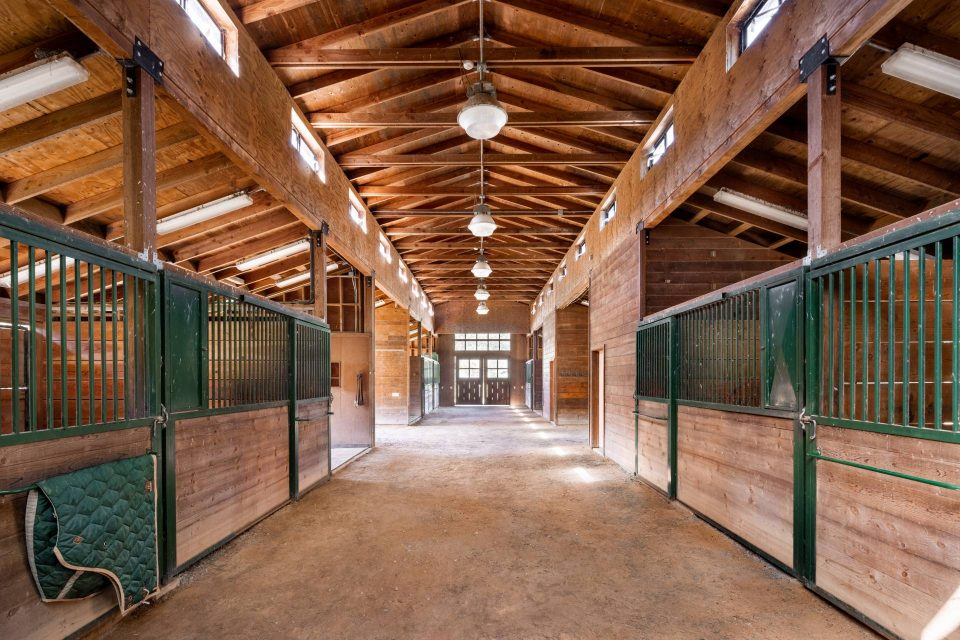
An equestrian’s dream, the complex has impressive horse facilities, including a 100′ x 200’ all-weather riding arena and a top-of-the-line, seven-stall barn with exposed beams and an attached office. Spectacular rolling hills and verdant pastures provide fodder for horses, cattle, or other livestock.
Last but definitely not least: gorgeous views of Bolinas Lagoon, Stinson Beach, Mount Tamalpais, the Pacific Ocean, San Francisco, and the surrounding countryside add even more allure to the picture.
What might be described as the perfect California location on Bolinas Bay, Bolinas has a small-town atmosphere but is only an hour’s drive north to San Francisco. Known for its reclusive residents, Bolinas is only accessible via unmarked roads. The Hideaway is close to bird and seal sanctuaries, botanical gardens, great spots for kayaking and surfing, and the charming Bolinas and Stinson Beach towns. Almare Falls, one of only two beach waterfalls in the continental United States, is accessible via the California Coastal Trail. Other celebrities hiding away in this uniquely beautiful, secluded area include director Joel Coen, actress Frances McDormand, chef and restaurateur Alice Waters, and Third-Eye Blind frontman Stephan Jenkins.
The listing is held by Alexander Fromm Lurie at Compass. Photo credit: Jacob Elliott, courtesy of Compass.
Widely regarded as the greatest heavyweight boxer of all time, Muhammad Ali was named “Sportsman of the Century” by Sports Illustrated in 1999.
Born Cassius Clay in Louisville, Kentucky, he started boxing at the age of twelve. At eighteen, he took home gold in the 1960 Olympics before going pro. In 1964, he upset Sonny Liston to become the heavyweight champion of the world, converted to Islam, and changed his name. Citing his religious beliefs, he refused to be drafted during the Vietnam War, fighting a draft-dodging conviction all the way to the Supreme Court. His stance against the war and his prominence as a black sportsman during the civil rights era made him a hero to African Americans and the counterculture. His fancy footwork and unorthodox movement made him the world heavyweight champion three separate times between 1964 and 1978, while his brash style and poetic trash-talking influenced hip-hop music.
Outside the ring, he was nominated for two Grammys for his spoken word albums. The superstar retired from boxing in 1979 and died in 2016.
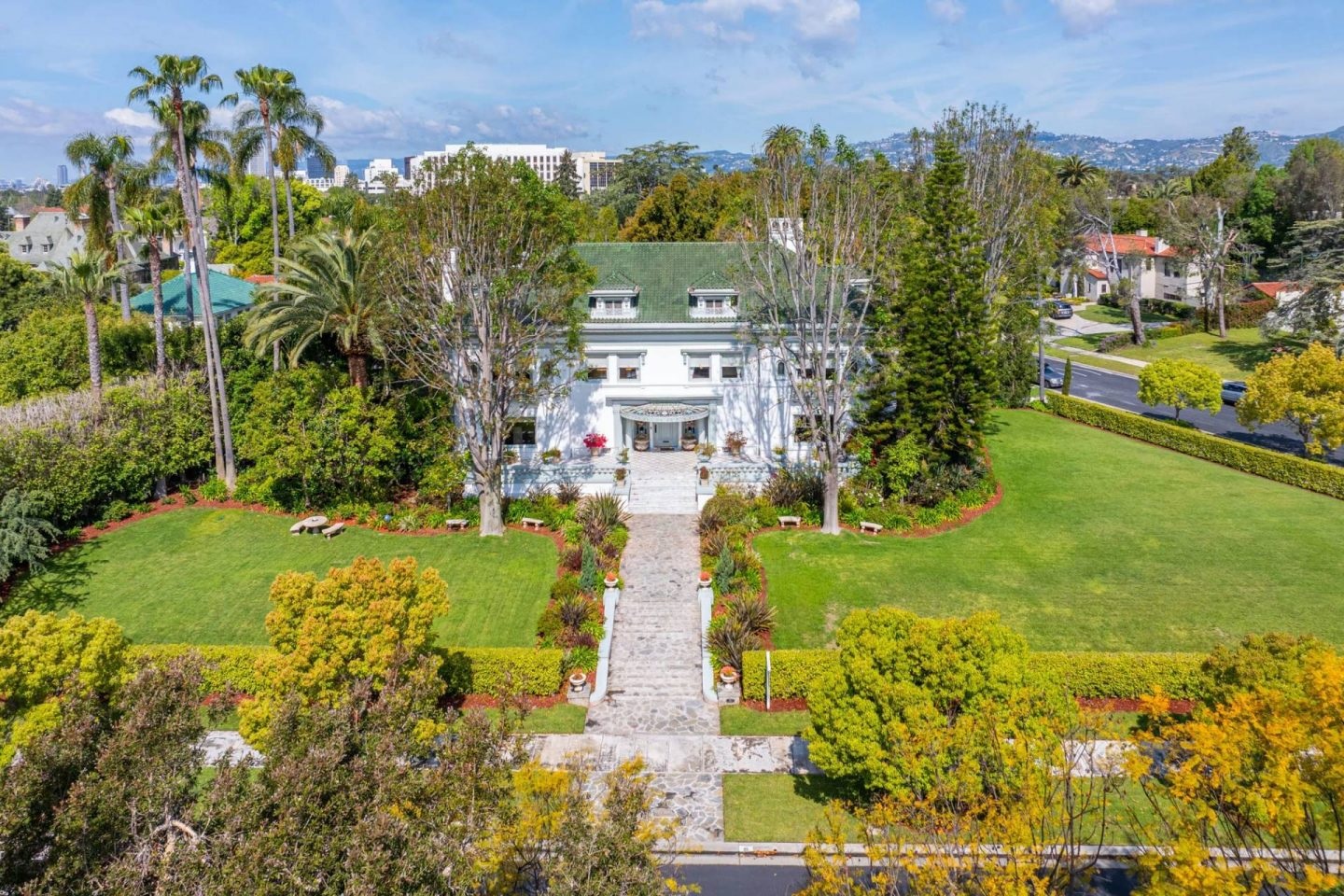
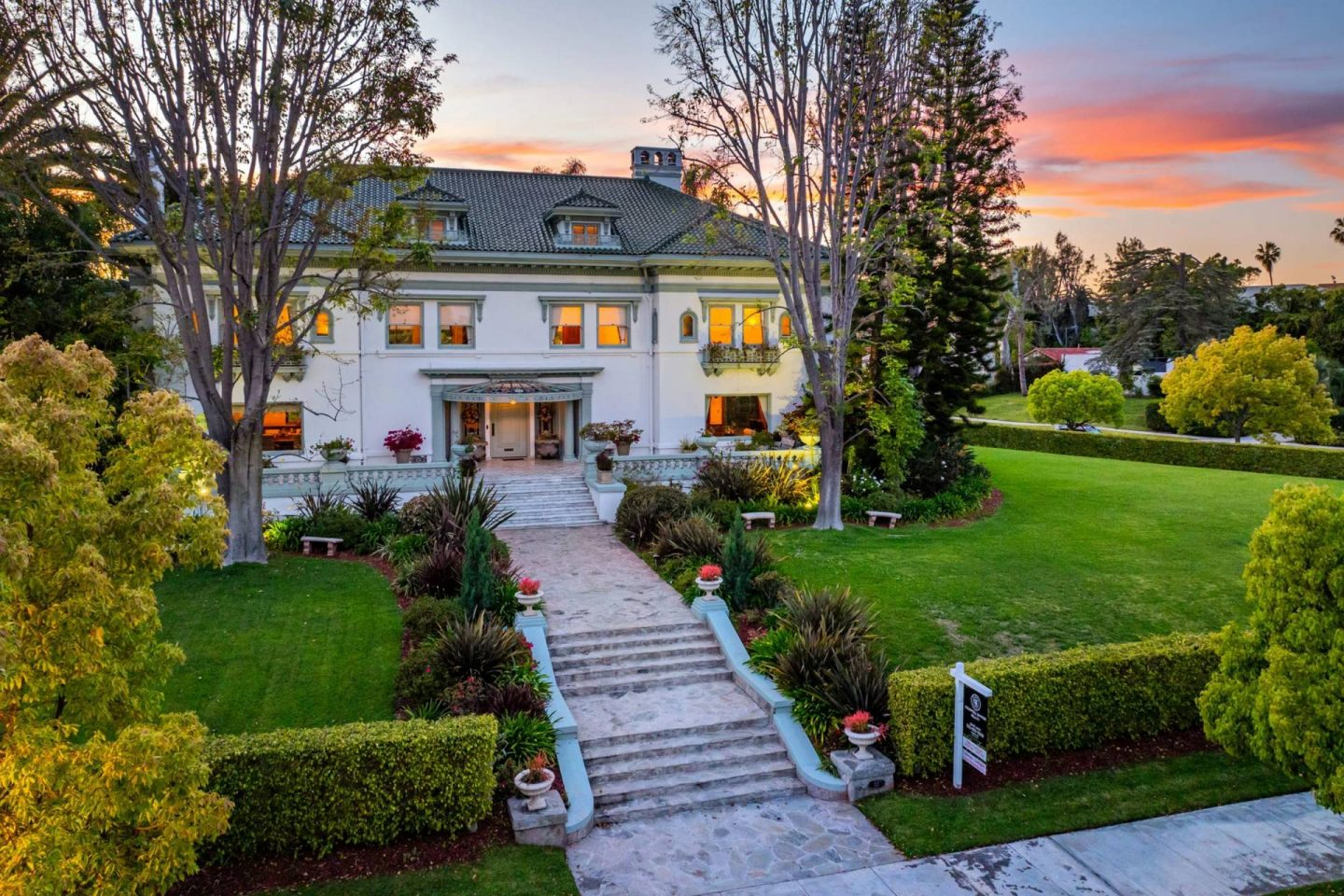
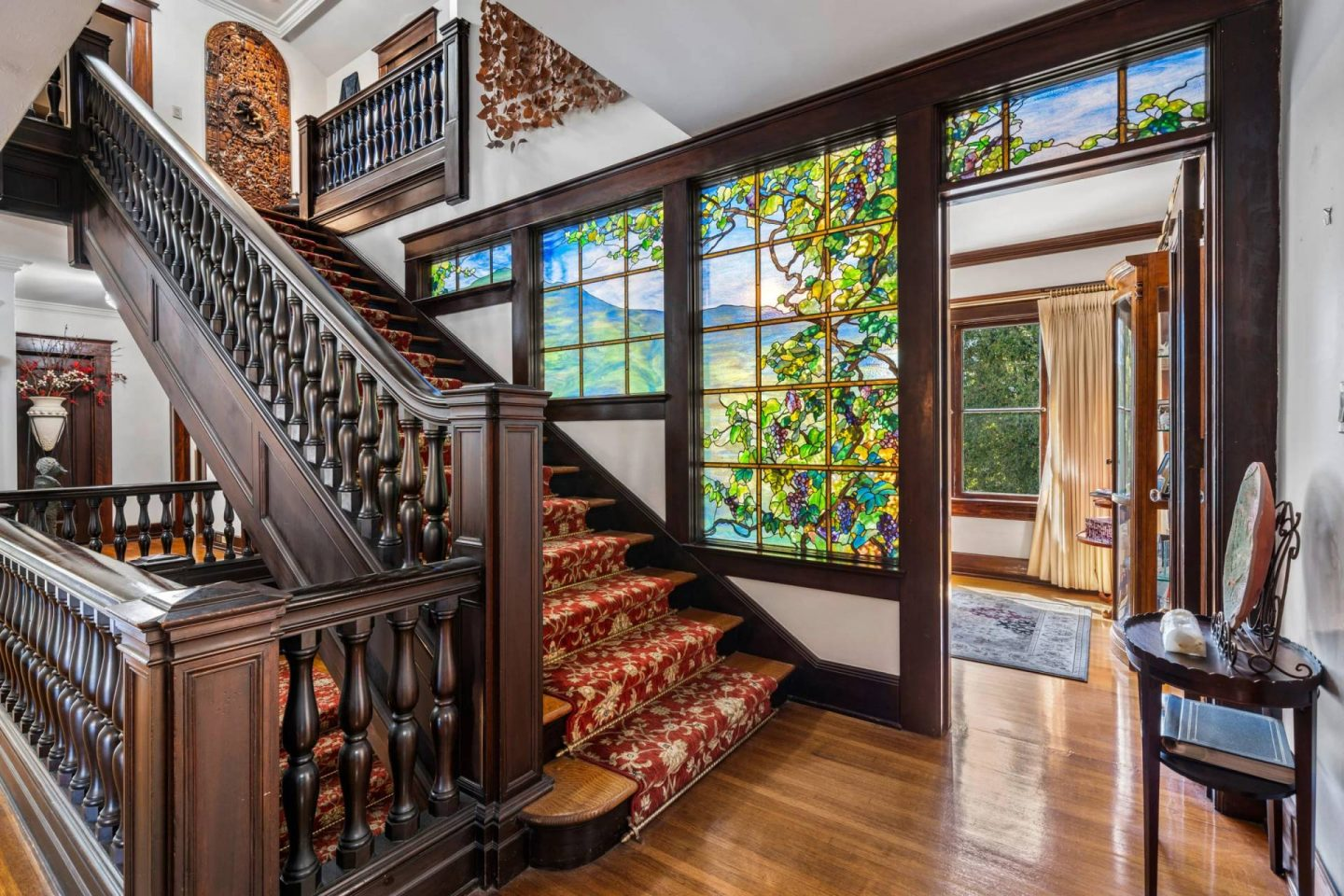
Muhammad Ali’s former mansion, a beautiful Italian Renaissance home in a prime Los Angeles neighborhood, is set to be auctioned by Concierge Auctions. Built in 1916 by John C. Austin, architect of the Griffith Observatory and LA’s City Hall, the estate much like the Champ exudes charm and grandeur. A stained glass personally designed by Louis Comfort Tiffany tops a collection of priceless architectural features, including antique fireplaces, French Empire chandeliers, and imported Italian marble.
Ali owned the home from 1979 to 1984.
Stone steps lead up to a European-style facade. Set up for entertaining in style, the mansion’s lower floor features a grand entry hall, a sun room with a glass roof, a spacious salon, an ornate formal dining room, a living room with oversized bay windows, and a den with a wet bar. The estate has hosted a parade of luminaries, including Sylvester Stallone, Clint Eastwood and President Obama.
Upstairs, find bedrooms and offices, including a massive primary suite with its own fireplace. The suite opens onto a columned deck that overlooks two beautifully landscaped gardens. The park-like grounds include a swimming pool, lush lawns, a pergola terrace, stone fountains, and patios. Sitting on a 1.5-acre corner lot, the 10,500-square-foot mansion and 1,000-square-foot guesthouse are surrounded by privacy hedges and nestled behind the guarded gates of Fremont Place, an exclusive gated community in Hancock Park.
Hancock Park is an upscale Los Angeles neighborhood known for its architecturally important homes.
A haven for Golden Age celebrities, some of Ali’s neighbors included Mae West, Clark Gable, and Nat King Cole, plus titans of industry A.P. Giannini (founded Bank of America) and King Gillete of Gillete Inc. Contemporary stars who call the region home include Margot Robbie and Fred Savage. Nearby options for entertainment include the Los Angeles County Museum of Art and the Wilshire Country Club.
Previously listed for $13.5 million usd/ $18.5 million cad, the estate will be auctioned with a reserve. Bidding will close on May 15th.
Black Sam Bellamy was one of the most notorious and wealthiest pirates of the Golden Age of Piracy in the early nineteenth century. In his short pirate career, he captured fifty-three ships, including the English slave ship Whydah Gally, which he used as his flagship.
The famous pirate’s island hideaway, now a stunning resort property, has been listed for sale at $50 million usd. Black’s Island is a seven-acre gem off the coast of the Florida Panhandle, sporting a four-star resort with twenty-six waterfront bungalows. Accessible only by boat, seaplane or helicopter, the white-sand island is about ten minutes from the mainland, offering a spectacular Caribbean adventure without leaving the United States.
The property can be operated commercially or retained as a family compound.
Born in Devon, England, he sailed with the Royal Navy before joining a crew of treasure hunters who turned to piracy when their mission to find a Spanish shipwreck failed. Bellamy served initially under Captain Benjamin Hornigold and his first mate, Edward Teach, later known as Blackbeard. When the crew became frustrated with Hornigold’s refusal to attack English ships, they mutinied and elected Bellamy as their captain instead. He was generous with those he raided and loved by his crew, who called themselves “Robin Hood’s Men.” This “Robin Hood of the Sea” or “Prince of Pirates” developed a distinctive style, favoring long black coats and forgoing the then-fashionable powdered wig for a dark ponytail tied with a black satin bow.
His favorite weapons were four dueling pistols carried in his sash.
The pirate prince’s reign ended when a nor’easter storm capsized his ships, drowning the captain and most of his crew. The wreckage of the Whydah Gally was discovered in 1982, yielding over 200,000 artifacts, including a cannon loaded with gold and precious stones.
1982 discovery of Black Sam’s booty made headlines worldwide. image: Irish Sun
The fully furnished bungalows come in one- and two-story models, 1,225 and 1,425 square feet respectively. Each unit includes two bedrooms, a loft bedroom area, two full bathrooms, a spacious kitchen with an island and top-notch appliances, a living room, a dining area, a laundry room and a balcony, while the two-story bungalows have an additional half bathroom. Boasting a classic look with blonde wood walls and grey stone floors, the bungalows were recently remodeled. A round floorplan offers 360-degree views of the gorgeous island from sunrise to sunset.
In addition to the bungalows, the resort includes a four-story luxury clubhouse, a cabana with bar, beach volleyball courts, and a forty-by-sixteen-foot swimming pool. The island is in the middle of a marine estuary, offering sparkling clear water and numerous opportunities for bird-watching and duck hunting, plus kayaking, paddle boarding, jet skiing and relaxing on the beach.
Private islands are all the rage among celebrities and the world’s elite. Beyonce and Jay Z are said to own two private islands in Florida, with Leonardo DiCaprio, Eddie Murphy, David Copperfield, and Mel Gibson just a few of the A-listers with private islands outside the USA.
The listing is held by Jon Kohler of Jon Kohler & Associates. Photo credit: Jon Kohler & Associates.
I bet you did not know these facts from our friends at toptenrealestatedeals.com : British singer-pianist-composer Elton John is the most successful solo artist in the history of the Billboard charts, with more than 50 number-one hits, seven number-one albums, and over 300 million in record sales.
He has received two Oscars, a Tony, a star on the Hollywood Walk of Fame, induction into the Rock and Roll Hall of Fame, and a knighthood from Queen Elizabeth II. The revered artist has recently completed his final tour, Farewell Yellow Brick Road, which became the highest-grossing concert series of all time.
Now moving permanently to his Windsor, England estate, he is offering the Atlanta condo that has been his US base for thirty years for sale at $4,995,000 usd / $6,744,249 cad.
John originally purchased a duplex on the 36th floor of the luxurious Park Place high-rise tower in Atlanta’s Buckhead neighborhood for $925,000 usd/ $1,248,935 cad, then added five neighboring units over the years to construct his 13,300 square-foot, four-bed, seven-bath residence spanning two floors.
The meticulously designed home features stunning wood walls, floor-to-ceiling windows, and 360 degrees of city skyline and western canopy views.
Jim Carrey’s prolific career includes marquee comedy roles such as The Riddler, The Mask and Ace Ventura and critically acclaimed dramas Eternal Sunshine of the Spotless Mind, for which he won two golden globes and eleven MTV awards.
In 2022, he announced that he was taking a break from acting and was considering retirement. The prolific star has relocated to his vacation property in Maui and put the Brentwood estate where he has lived for the last 30 years up for sale.
Now listed for $26.5 million USD/ $35.2 CAD, reduced from $28.9 million USD/ $38.4 million CAD, the sprawling ranch-style mansion is nestled behind huge hedges and private red-brick gates.
The 12,700-square-foot home features five bedrooms, six full bathrooms, and three half baths. The stylish residence’s pitched high-beam ceilings offer tons of airflow, while skylights let in plenty of natural light to bathe the bright white walls and Jim’s extensive art collection, including his own impressive creations. The living, dining, and family rooms flow together with hardwood and polished stone floors, fireplaces and ample windows with views of the lushly landscaped grounds. The well-appointed chef’s kitchen offers an indoor BBQ. A circular breakfast nook looks out onto flowering pear trees. Multiple sliding glass doors open onto a central courtyard that provides space for entertaining or lounging in the classic California indoor/outdoor living style.
Jim’s primary bedroom suite includes its own private patio, plus a stunning wood-paneled bathroom with a copper-hooded fireplace, leaded glass windows, and a soaking tub. An Art Deco-style home theater pays homage to the movie palaces of old, with mohair-covered sofas, burl wood columns, and a lavish marble bathroom. The spacious gym and home office are perfect for the modern remote-work lifestyle. The massive two-acre grounds are a rarity in LA and include a full-size tennis court, a waterfall swimming pool, a pool house with bar, a sauna/steam room, vegetable gardens, and numerous mature trees. Walking paths wind through the serene environment, leading to the yoga and meditation platform. Carrey called the home “a place of enchantment and inspiration” and hopes it will continue to be “a magical sanctuary” for its next occupant.
One of LA’s most sought-after neighborhoods, Brentwood is right next to the hustle and bustle of Santa Monica but retains a community feel. Known for its tree-lined streets, unique mansions, and one of the best farmer’s markets in Los Angeles, Brentwood is home to numerous celebrities, including Arnold Schwarzenegger, LeBron James, and Tobey Maguire. Options for entertainment include the world-class Getty Museum, the Brentwood Golf Club, and the upscale shops and restaurants on San Vicente Blvd.
The listing is held by Janelle Friedman of Sotheby’s International.
The 12,700-square-foot home features five bedrooms, six full bathrooms, and three half baths, plus tennis courts, a waterfall pool, and an enormous two-acre lot.
For the Silo, Bob Walsh.Photos: Daniel Dahler for Sotheby’s International Realty
The IMF announced today (Tuesday, April 11, 2023) in the World Economic Outlook’s press briefing that the baseline forecast for global output growth is 0.1 percentage point lower than predicted in the January 2023 WEO Update, before rising to 3.0 percent in 2024.
“The world economy is still recovering from the unprecedented upheavals of the last three years, and the recent banking turmoil has increased uncertainties.”
“We expect global output growth to fall from 3.4% last year to 2.8% in 2023, before rising to 3% in 2024, mostly unchanged from our January projections. Advanced economies are expected to see an especially pronounced growth slowdown from 2.7% in 2022 to 1.3% in 2023. Global headline inflation is set to fall from 8.7% in 2022 to 7% in 2023 on the back of lower commodity prices but underlying core inflation is proving to be stickier. Importantly, this outlook assumes that recent financial stresses remain contained,” said Pierre-Olivier Gourinchas, the IMF’s Chief Economist.
Much uncertainty clouds the short- and medium-term outlook as the global economy adjusts to the shocks of 2020–22 and the recent financial sector turmoil. Recession concerns have gained prominence, while worries about stubbornly high inflation persist.
“Once again, risks are heavily tilted to the downside, they have risen with the recent financial turmoil. Most prominently, recent banking system turbulence could result in a sharper and more persistent tightening of global financial conditions. The simultaneous rate hikes across countries could have more contractionary effects than expected, especially as debt levels are at historical highs. There might be a need for more monetary tightening if inflation remains stickier than expected. These risks and more could all materialize at a time when policymakers face much more limited policy space to offset negative shocks, especially in low-income countries,” added Gourinchas.
With the fog around current and prospective economic conditions thickening, policymakers have a narrow path to walk towards restoring price stability while avoiding a recession and maintaining financial stability. Achieving strong, sustainable, and inclusive growth will require policymakers to stay agile and be ready to adjust as information becomes available.
“First, as long as financial stress is not systemic as it is now, the fight against inflation should remain the priority for central banks. Second, to safeguard financial stability, central banks should use separate tools and communicate their objectives clearly to avoid unwarranted volatility. Financial policies should remain laser focused on preserving financial stability and watch for any buildup of risks in banks, non-banks, and the real estate sectors. Third, in many countries fiscal policy should tighten to ease inflation pressures, restore debt sustainability, and rebuild fiscal buffers. Finally, in the event of capital outflows that raise financial stability risks, emerging market and developing economies should use the integrated Policy framework, combining temporary targeted foreign exchange interventions and capital flow measures where appropriate,” said Gourinchas.
Michael Kittredge started making candles as a teenager and selling them to friends and family. One of his first products was a Christmas candle he made for his mother on the family stove out of his melted crayons and a wick from a shoelace. Within a few years, he had opened his first Yankee Candle Shop in his hometown of South Hadley, Massachusetts. The business expanded to become the wildly successful Yankee Candle Company whos candles are sold all over America.
In a 1986 interview with New England Business, Mr. Kittredge recalled that a visiting machinery salesman from Germany had declared him crazy for not investing in automation at his plant in Deerfield. “Then,” Mr. Kittredge said, “I went out to my Porsche and got my tennis racket to go out and play on my tennis courts, and I said, ’Yeah, I’m crazy. What are you driving?’” The Wall Street Journal A long time guitarist, Michael Kittredge switched to the drums after having a stroke. He died in 2019 at the age of 67.
Kittredge cashed out in 1998, selling 90% of his company for $500 million USD/ $683 million CAD. He used the money to jet around the world, collect luxury sports cars, drink $20,000 USD/ $27,000 CAD bottles of wine, and construct a fantastic compound on over 60 acres of parkland in idyllic Western Massachusetts. With the entrepreneur’s passing in 2019, the estate his son described as “like having Disneyland in the backyard” has been listed for $23 million USD/ $31.4 million CAD .
Generous with friends, family, and employees, Kittredge designed his compound to entertain his guests in the utmost luxury. Sparing no expense, the eight Colonial-style structures on the property were constructed with the finest materials from all over the world. The main house includes five bedrooms, six full bathrooms and five half baths, and over 25,0000 square feet of living space.
The home features 11 fireplaces spread across multiple levels, a solarium, an oval office with glass walls, a pine-paneled living room with built-ins, and a stunning two-story great room with a balcony and an atrium-like ceiling. Two commercial-grade kitchens, one with five islands, and a wine grotto allow for large-scale entertaining.
The 9 hole golf course is just beyond….
Meandering paths on the property wander past ponds, fountains, waterfalls, and gardens to connect the main home with the estate’s many amenities. Several guest homes and staff quarters bring the bedroom total up to sixteen.
Three tennis courts, a T-shaped pool with expansive deck and fully equipped cabana, and a nine-hole golf course offer hours of athletic fun. For relaxation, the compound includes an epic 55,000-square-foot spa complex complete with multiple gyms and massage areas, saunas, a steam room, and an indoor tennis court with stadium seating.
The state-of-the-art, 4,000-square-foot outdoor stage has hosted such bands as Hall & Oates, The Doobie Brothers, KC and The Sunshine Band, and Eric Burdon & The Animals. A two-story arcade features pinball, slots, arcade games, and a three-lane bowling alley.
Two huge garages offer plenty of space for high-end toys while a full-sized auditorium offers another venue for concerts and shows. A truly spectacular indoor water park, modeled after the Bellagio in Las Vegas, with palm trees, water slides, and pools, completes the one-of-a-kind entertainment pavilion.
A sleepy town with less than 2,000 residents founded in 1750, Leverett, Massachusetts is best known for the Buddhist monument New England Peace Pagoda, historic churches, and a scenic chasm called Rattlesnake Gutter. It is close to the five-college area of Amherst, Hampshire, Smith, Mt. Holyoke, and the University of Massachusetts.
The listing is held by Johnny Hatem Jr. of The Sarkis Team at Douglas Elliman. For the Silo by Terry Walsh /TopTenRealEstateDeals.com
Within the global sector of cyber security, the two major areas that are constantly under attack are financial and governmental. Financial organizations that hold consumer data, in particular those that provide financial services to retail and commercial customers, including banks, investment companies, real estate firms, retail banking and insurance companies, are an obvious target for the simple fact that this is where the money is. At the end of the day, unless an attack is of a personal nature, in which the reputation of an individual or business is targeted, monetary assets are the endgame.
Now imagine a cyber threat the same as you would a burglar walking down the street. When a thief leaves their home, they do not necessarily know what they are going to target, unless they have done some reconnaissance and are after something specific. In most cases, however, the target itself is not premeditated. And a house which is more vulnerable and has less defences, will always be the first point of call. Given the choice between a house with an open window and lights out, and a house with attack dogs, security cameras and search lights, nine times out of ten a burglar will take the opportunity to infiltrate the house with the open window. Why? Because it is easier and quicker to break into this house successfully.
The same applies within the finance industry. If there is a vulnerability, it will be the first target. In response, banks and financial institutions require tailored and sophisticated security to support their systems and people, and to defend against an onslaught of complex and aggressive cyber-attacks. Not only must security compliance within the financial sector be tenfold, but it is essential that security precautions evolve, to mirror the growing threat landscape.
But as new cyber threats develop daily, this is easier said than done.
Anti-Fraud Systems
To uphold compliance, and elements such as GDPR, antifraud systems within the finance industry have developed significantly over the last few years to safeguard credentials. To do this a combination of key codes, two factor authentication, voice ID, behavioral analysis, one-time passcodes, protective messaging, and digital fingerprinting have been widely integrated.
In fact, if you look at the document, ‘Comparison of banking providers’ fraud controls’, from the Financial Conduct Authority (FCA), the majority of banks use a combination of these systems. With organisations including the Bank of Scotland, First Direct, Halifax and HSBC, using touch identification. An element that would seem almost impossible to recreate virtually.
But cyber criminals have a concerningly accurate knowledge of the internal workings of banking and banking systems. And, in 2019, an arena known on the dark web as Genesis Market was uncovered. Within Genesis Market, digital fingerprints, stolen from PC’s, were/are sold. And, with each fingerprint, a user’s digital identity provides the means to bypass security measures and gain access to accounts.
According to darknetstats, Genesis Market is accessible by invitation alone. Once in, not only are fingerprints available, but so are passwords, credit card information, cookies and more.
Admiral Kirk retina scan in progress. Star Trek 2: The Wrath of Khan
It is no wonder that retina scanners are developing in the biometrics/banking sphere.
Internal Threats
It can be argued that the reason why many cyber criminals know so much about the inner workings of financial organisations is because, at one point or another, many worked legitimately within the industry. Internal teams pose as much of a threat as external attacks. In every Bond film there is always an insider guy.
The Insider guy in 1995’s James Bond film GoldenEye. Alec Trevelyan (006), aka Janus.
But whether an attack is malicious or accidental, internal security breaches are regular occurrences. Which us why User Behavior Analytics is crucial to understand the actions within a team, and to highlight and stop unusual activity before the damage is done.
Another element that is important to recognize with regards to internal threats, is that many employees/insiders are completely unaware that they are a threat in the first place. Take, for instance, an employee working remotely. This employee may be sat at a local café where they decide to work on a company device. If this device was unknowingly hacked while using a different Wi-Fi, the user may be completely unaware that they are spreading malicious malware via their device throughout the company.
Ransomware
Say a crime group has gained access to personal accounts. The next logical step is to blackmail the victim/organization via ransomware. Unfortunately, as a public security breach would cause mass panic and many potential lawsuits, banks will often pay off cyber criminals into an anonymous cryptocurrency account, rather than lose client data. Crime groups know this.
Sometimes victims speak out, but this does not always end well.
Take Travelex, the currency exchange company, for instance. Following an attack by a Sodinokibi ransomware in January, $6 million usd was demanded in exchange for 5GB of personal data. Since the attack, Travelex has fallen into administration, with PwC saying that the ‘foreign exchange firm was acutely impacted by COVID and the recent cyber-attack.’
For financial organisations, ransomware can and will destroy a whole business. And, if they lock you out of an account, you are finished.
App Developments
Apps surrounding investment and finance have grown substantially in 2020. This, in part, is a good thing, as the ability to invest online is quick and easy, and accessible to all. But due to the demand, many of these apps were developed quickly and are underprepared for cyber-attacks.
For instance, many do not provide two-factor authentication, are not supported by the appropriate regulations, are not patched or maintained properly, and do not have contingency plans in place to mitigate the effects of a cyber-attack. As a result, personal information of app users is relatively easy to steal and sell. This can be done by creating duplicate fraudulent apps to trick the user. On these duplicate apps, the imagery and language of the genuine app is mirrored. And, once the personal information is supplied, both real and virtual money is then accessible. Thus, the circle of ransomware ensues.
COVID-19
Another element to take into consideration over the past two years and counting is, of course, COVID-19. According to an article by ComputerWeekly, ‘what has been referred to as an “unprecedented anomaly”, cyber criminals were and to some degree still are increasingly targeting the financial services sector during the Covid-19 coronavirus pandemic, with attacks on banks and other financial institutions spiking by 38% between February and March of 2020 to account for 52% of all attacks observed by VMware’s Carbon Black Cloud.’
COVID-19 has altered cyber security on a global scale and in every vertical.
Third-Party Risk
These days, few organisations work on their own. The majority use third parties, including vendors, partners, e-mail providers, service providers, web hosting, law firms, data management companies, subcontractors and so on. With regards to many of these, from IT systems to sensitive information shared with legal teams, these third parties could easily be a backdoor into your financial systems for attackers to infiltrate.
According to Ponemon Institute, ‘53% of organisations have experience one or more data breaches caused by a third party, costing an average of $7.5 million to remediate.’ For a large organisation, this can be crippling. And can wipe out a small organisation in a matter of minutes.
To manage third parties, financial organisations must have the ability to detect threats, and the capability to respond to them. Which requires the right combination of people, processes, and technologies.
But half the battle is locating vulnerabilities in the first place. Which is why cyber resiliency needs to be sharp, and why investing in the best managed security services is essential. From Firewall Management, to Decoy Deception and Honeypots, it is important to know what services will support an organisation best. This will depend on factors including location, company size, current security measures and more.
Considerations
Cyber threats will continue to grow into 2023. That much is clear.
Financial organizations have either already tackled a cyber-attack, will tackle one in the very near future, or may be a target of one currently, but are simply unaware of the fact.
Effective security comes down to three key elements. Processes, people and technology. Processes must run seamlessly alongside the organisation. Security experts must have the capability to detect, react and understand the context of a risk. And the technology must be superior, to keep up with cyber threats. All elements are equally as important, and you must have all three to ensure security.
In times like these security measures are more crucial than ever. Especially for those within finance. So that our life savings are secure, the security of our loved ones is maintained, and the livelihoods of those employed within the financial world continues. Contact SecurityHQ for a free consultation to learn more. For the Silo, Eleanor Barlow.
One of Hawaii’s most photographed and celebrity-popular homes with postcard views of a 240-foot natural waterfall, a sports stadium with seating for 450 people, a nine-tee golf course, an aquatic center, a two-story water slide, and some of Hawaii’s best ocean views is going to auction. Read more about this stunning slice of Hawaii. Shout out to our friends at TopTenRealestateDeals.com for this feature.
With a secluded location on the Big Island’s northeastern shore, Waterfalling Estate made gossip-mag headlines in 2016 when Canada’s own- Justin Bieber rented the home for two weeks at $10,000 USD / $12,875 CAD per night for his entourage, which included six skimpy-bikini-wearing models.
Located a few miles north of Hilo on eight acres overlooking where the jungle meets the ocean and the Hamakua coastline, the home has five bedrooms, ten bathrooms and two third-floor master suites with lanai. The main living area, including chef’s kitchen and dining has spectacular waterfall and ocean views. On the aquatic level are two guest suites, a game room, media area, two whirlpools, sauna, shower, outdoor kitchen and dining area. There is a one-bedroom guest house, four-car garage, helipad, plus an outdoor bar.
The Big Island offers a big number of activities and entertainment from stunning beaches such as Laupāhoehoe, Waikiki, and Waipi’o, hiking in the Hilo Forest Preserves or Akaka Falls State Park, zip lining over KoleKole Falls, Volcano National Park, whale watching, jungle jaunts, farmer’s markets, world-class fishing, and unforgettable sunsets.
Laupāhoehoe Beach
Even more adventure is just a 50-minute plane trip away to Honolulu for less than $100 USD/ $129 CAD.
Taking the plane from Honolulu to Waterfalling Estate.
Currently listed for $9.95 million USD / $12.82 million CAD, the property will be going to auction August 15th with a $5.99 million USD/ $7.6 million CAD reserve.
What once was a successful pairing between Johnny Depp and Amber Heard has changed course and their dirty laundry is playing out in real time all over the world. Whether real or as a way to get each back into the limelight and boost their careers, the court case has proven to be entertainment on a level that has at times even had the judge laughing. One thing unfolding is that Amber appears to have her heart set on acquiring one, if not all, of Johnny’s fabulous L.A. penthouses.
What’s so desirable about them? Find out more via this article sent along to us from our friends at toptenrealestatedeals.
Known for being a somewhat dark, idiosyncratic actor, Depp has followed his own instincts in his choice of parts since his first role in Nightmare on Elm Street in 1984.
A Florida high school dropout at age 15, he played in several garage bands and married early. When he and his new wife took a trip to Los Angeles, in a stroke of good luck he happened to meet Nicolas Cage who suggested he go into acting. This led to his first film role in 1984’s Nightmare on Elm Street and quick successes in Edward Scissorhands, Sleepy Hollow and the Pirates of the Caribbean series. He then moved on to more serious parts portraying drug and gangster criminals in Blow, Public Enemies and Black Mass.
Widely considered one of Hollywood’s best actors and box office stars with Golden Globe and Screen Actors’ Guild Awards, Depp has made headlines from his movies, love life and his interesting real estate holdings, which include an island in the Bahamas. At various times engaged to Sherilyn Fenn, Jennifer Grey, Winona Ryder and Kate Moss, Depp had a long relationship with French singer-actress Vanessa Paradis. During his Paradis years, he purchased an entire French village which was recently on the market at $55.5 million usd. After he split with Vanessa, he married Amber Heard in 2015, but divorced just one year later. Listed after the $7 million usd divorce settlement with Heard is Depp’s unique collection of penthouses in downtown Los Angeles.
Depp acquired the five multi-storied, side-by-side penthouse units over a period of years after the building had been refurbished in 2007.
Decorated in his unique style, he never joined the units, but instead lived in them as though going from room to room, or lent to relatives to use.
Whether or not it was a conscious real estate business decision or a happy fluke, it means that the collection of units can be resold as a whole or individually. The group includes five condo units: four two-bedrooms and a one-bedroom, totaling approximately 11,500 square feet.
The 13-story Eastern Columbia Building was designed by Claud Beelman in 1930, considered to be one of the city’s best examples of Art Deco architecture still standing.
Johnny Depp’s collection of five penthouses in the famous Los Angeles Eastern Columbia building were available in 2016 as a group for $12.78 million USD; they are not currently on the market. For the Silo, Genelle Brown.
Photos: James Lang, Berlyn Photography for Partners Trust (now Compass) Video Credit: Sean Evans, @evvo1991
California’s San Francisco Bay area is the United States’ most expensive real estate market, with a median home-sale price of USD$1.3 million (CAD$1.7 million). Toronto and the GTA (Greater Toronto Area) is Canada’s most expensive real estate market, with a median home-sale price of CAD$1.3 million (USD just under $1 million).
Unlike its southern neighbor Los Angeles, the pricey San Francisco mansions belong not to movie and TV stars but to the movers and shakers of the technology industry. The Bay Area boasts the country’s highest concentration of tech companies and tech jobs, earning the region the nickname “Silicon Valley” after the material used to make computer chips.
A home in San Francisco’s Pacific Heights neighborhood sold for USD$43.5 million (CAD$55.8 million) in 2021, which is the current record for the area’s biggest sticker price, but a new listing in the ultra-exclusive town of Woodside aims to shatter that record. Styled like an Italian villa, the spectacular compound has been listed for USD$110 million (CAD$141 million).
65 foot pool.
Sitting on over three acres of some of the most sought-after real estate in the world, the grounds feature a 65-foot pool with spa, an entertainment zone with an outdoor kitchen and fire pit, landscaped gardens that include fountains, a vineyard with more than forty olive trees and a rose garden with over one hundred roses as well as a private hiking trail. Nestled behind high-tech gates, the compound offers a 14,000-square-foot main home as well as a separate executive office and conference center, a fitness center/massage/hair salon building, and a two-bedroom guesthouse.
Golf simulator? Check.
Retractable glass walls, French oak floors, and hand plastering on every surface complement rare Italian marbles inside the luxurious mansion. Crystal chandeliers and marble fireplaces feature throughout. The enormous main kitchen features two waterfall-wrapped islands, marble counters, top-of-the-line Wolf and Sub-Zero appliances, and custom-built-steel-and-glass cabinetry, while a separate chef’s kitchen offers extensive storage space plus a BlueStar range with two ovens.
Master suite.
The primary suite is a work of art featuring a barrel-vaulted foyer with leather-front and glass-display cabinets that conceal a refrigerator and Miele laundry and a cathedral-beamed ceiling with chandelier. The sectionalized wardrobe room is couture-worthy. A two-sided Davinci fireplace is shared with the bathroom, which also has heated limestone floors and a marble bath for two. Each additional bedroom includes a customized walk-in closet, outside entrance, and en-suite marble bath.
Designed for the high-tech lifestyle, the home is controlled by state-of-the-art automated systems that take care of every need for comfort, convenience, and security from behind the scenes. The home’s fantastic amenities include an Atmos Dolby screening room, a golf simulator, indoor-and-outdoor lounges, and an epic wine salon for 6,000 bottles.
Woodside is a small town with only 5,000 residents and a median home price above USD$5 million (CAD$6.4 million). Most residents are tech investors and innovators. Larry Ellison, founder of Oracle Corporation and the world’s tenth-richest man, lives down the street from the villa in a 23-acre, Japanese-themed estate.
Known as an equestrian community, Woodside retains a rural residential character despite being only a short commute to Silicon Valley and Stanford University.
The town is ringed with nature preserves, including the Purisima Open Space and Skaggs Point. Options for entertainment include the Michelin-starred Village Pub and Bucks of Woodside, a famed hotspot for Silicon Valley’s most powerful, where many important venture capital deals have been signed. The real estate listing is held by Scott Danser of Compass. For the Silo, Genelle Brown/Top Ten Real Estate Deals dot com.
Once projected to list for $500 million USD, this LA home is for sale at a still staggering $295 million USD.
“America’s Most Expensive Home – Twice As Big as the White House”
One of the world’s most expensive homes, appropriately named “The One,” has just hit the market. Construction ran several years late causing financial issues for the developer. If The One sells anywhere near the $295 million USD ask, it would be the most expensive home ever sold in California, well over the $177 million USD that venture-capitalist Marc Andreessen paid for his Malibu mansion in 2021 and the $165 million USD that Amazon CEO Jeff Bezos paid in 2020 for his Beverly Hills estate.
Perched on a promontory with 360-degree panoramic views of the Pacific Ocean, downtown Los Angeles and the San Gabriel Mountains, the Bel Air mansion is surrounded on three sides by a moat and measures in at a mind-boggling 105,000 square feet – almost twice as big as the White House. Located on 3.8 acres, the house, which was actually raised during construction to further optimize the views, includes 21 bedrooms and 49 baths.
Highlights of The One include five outdoor and indoor swimming pools with the moat encircling three quarters of the exterior, a massive nightclub, full-service beauty salon, wellness spa, 10,000-square-foot sky deck, 400-foot private outdoor running track with a glass-walled view of the city, and a private theater with seating for over 40.
In addition to ownership of one of the world’s most spectacular homes, the property also includes butterfly artwork by Stephen Wilson, an Oto Murano chandelier by Vistosi, a rotating statue by Mike Fields, and a glass sculpture by Italian artist Simone Cenedese. There is also a two-story library/office with a balcony and water features touching three windowed walls, and parquet flooring. Add in a custom bar with a smoked-mirror backsplash and marble countertops, a cigar lounge, four-lane bowling alley, putting green, wellness center, gym, a 64-foot (19.5 Meter) indoor pool with juice bar, tennis court, 10,000-bottle wine cellar, and a 30-plus car garage with two car-display turntables.
Entertaining in such unique luxury might draw some interesting Bel Air neighbors such as Jennifer Lawrence, who moved there last year, Justin Bieber, Taylor Swift, Liam Hemsworth, Miley Cyrus and Kylie Jenner to name just a few.
The property is listed by Aaron Kirman of Compass, Beverly Hills and Branden and Rayni Williams of The Beverly Hills Estates, Beverly Hills, and will go to Concierge Auctions, which if not sold prior, will be held online on February 28th. For The Silo, Terry Walsh/Top Ten Real Estate Deals.com.
If you don’t have any available savings, your home equity can provide an immediate source of funds.
Even the most responsible homeowners can find themselves faced with an unexpected home emergency repair or maintenance issue without the cash on hand to deal with it. If this is you, you are not alone. There are solutions available that can help you tap into your home equity to fund those projects without having to take out an expensive loan with the bank.
Consider a Home Equity Line of Credit (HELOC)
A Home Equity Line of Credit enables homeowners to access up to 85% of the value of their home for what they need. If you have owned your home for a number of years, then you have built up equity that can be used as collateral.
A Home Equity Line of Credit is designed specifically to help homeowners cover these unexpected costs without worrying about their level of savings or credit score. Taking out a HELOC is a fast and convenient borrowing option because you can access the funds you need, pay it off and borrow again if needed.
To calculate your home equity, simply follow this equation:
The value of your property – the balance remaining on your mortgage = your home equity
In many cases, you will pay less to borrow against your home equity than if you were to get an unsecured loan or line of credit. When you choose to work with a mortgage broker instead of the bank, you can get access to more lending options and at a lower interest rate.
Take Out a Second Mortgage
Many homeowners are aware of HELOCs but haven’t considered that second mortgages are also an available option. Essentially, a second mortgage functions as an additional mortgage loan. Both mortgages will need to eventually be paid off but because they normally come with much lower interest rates than unsecured loans, they can be an appealing option to borrow much needed funds.
With the value of Ontario homes increasing due to the booming real estate market, many homeowners are using this opportunity to access the value of their home.
You can use your second mortgage for anything as long as you continue to make your repayments. So, if you have a home maintenance or renovation project in mind, then it’s a good idea to consider a second mortgage now instead of waiting until it becomes an emergency situation.
Work with a Trusted Mortgage Broker
A mortgage broker acts as the intermediary between the financial institution offering the loan and the individual seeking the loan to buy real estate. The mortgage broker works with both parties to ensure the loan gets approved. The main benefit of working with an experienced mortgage broker is that he or she can work with a wide variety of lenders to find the best terms and rates.
For those who are self-employed or don’t have stellar credit, working with a mortgage broker is advantageous because they are experienced at working with complex situations. This is especially critical for anyone who requires fast funding and has been turned down for a loan by the bank.
A mortgage broker like Burke Financial specializes in handing challenging applications and works with people who have varying needs and circumstances.
Regardless of whatever life problem you are facing, a mortgage broker can help you explore your options and find a solution to your problem so you can get back to other life tasks. For the Silo by our friends at Burke Financial.
Moving into a retirement home marks a special occasion because it signifies the beginning of your golden years. While this means that you can finally relax and start enjoying all of life’s greatest pleasures to their fullest extent, it shouldn’t mean that you can disregard financial planning either.
Out of the Old and Into the New
When you decide to capitalize on your lifelong investment property and use that money towards enjoying your retirement, you’ll likely follow through with a long-awaited plan to downsize. The reason for this isn’t merely financial; it is because, as an empty-nester, you no longer require all of the space that you once did when raising a family. You are also likely no longer interested in performing all of the continual maintenance that your old home requires.
Moving into a Custom-Built Townhome
However, just because you have decided to downsize doesn’t mean that you should enjoy your new home any to less extent. If you’re looking for a new location in southern Ontario, you can work with a Fort Erie home builder to create the custom townhome of your dreams.
When you opt to partner with a company that builds custom homes, you’ll get access to more choices about how you’ll live during your retirement. Not only can you add extra rooms, but you’ll be able to decide on the look of aesthetic features like what type of flooring that your new home will contain in each room.
Building Your Next Investment
When you build a custom home, the choices you make about the final product where you’ll live can influence the value of your home. Extra rooms and fine-quality flooring options will increase the resale value of any property, as will opting for energy-efficient appliances.
The Potential for Appreciation
Given the growing popularity of the Niagara region, the most likely outcome regarding real estate will be a continued increase in value. If you’re interested in purchasing a home that will make a good investment property, then it will help to buy a custom option that allow you to gain more control over particulars and will be worth more than a previously owned property.
Embrace the Active Adult Lifestyle
While a newly-built custom home is sure to become a wise investment, that’s not all that retirement living is about. Buying a home in an active adult community will provide you with the opportunity to make social and active lifestyle choices that can contribute to better health and an increased lifespan. You’ll also be living near great beaches and easy access to nature.
Given that the road ahead in life is always unpredictable, there’s never a bad time in your life to think about financial planning. After all, you want to ensure that you’ll be covered in the case of emergencies and that you have something leftover to leave to your children and grandchildren. To get started on your nest investment home, get in touch with a company that builds custom homes in the Niagara region. For the Silo, Mila Urosevic.