Tag Archives: Radiation

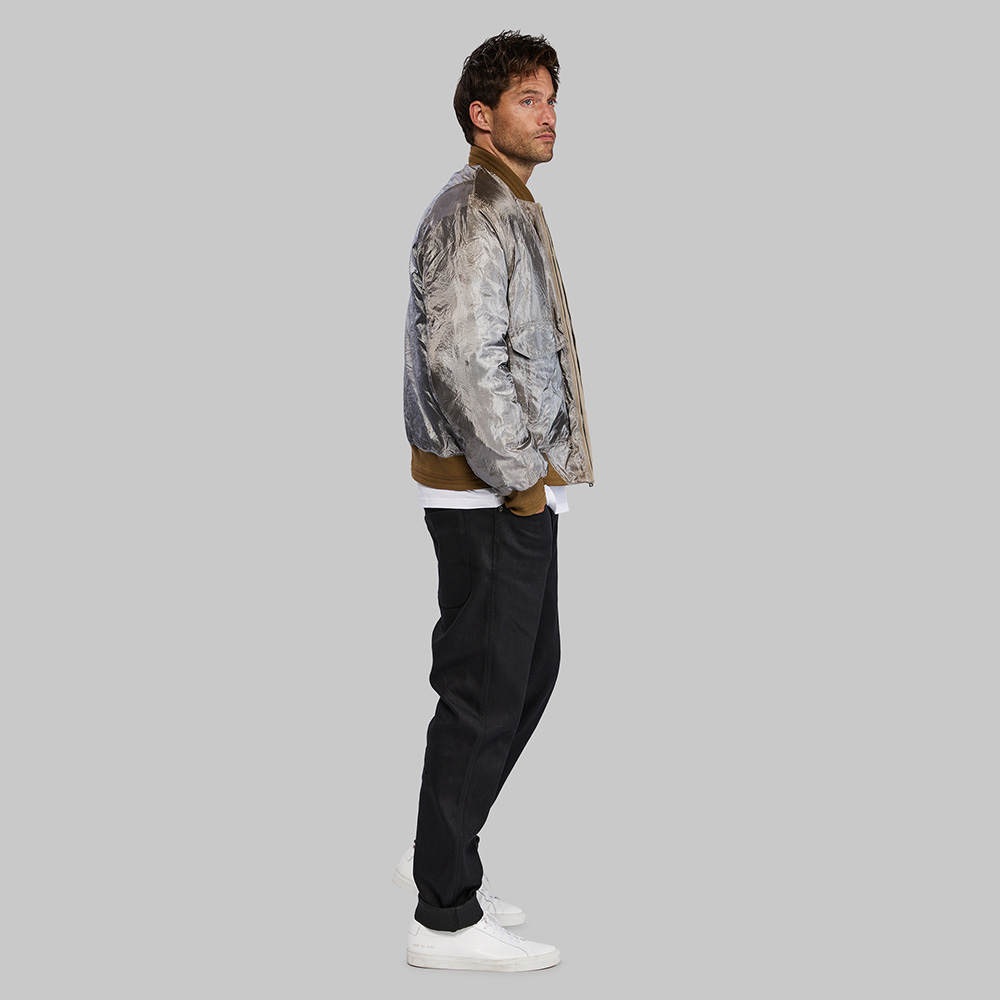
Fight Matrix Life With This Cyberpunk Bomber Jacket

Back in the 1980s the cyberpunk genre envisioned a world of societal breakdown where technologically modified humans are controlled by mega-corporations watching their every move… or 2026 as it’s otherwise known.
So as science fiction becomes modern day reality, our friends at Vollebak are giving you a chance to stick it to the mega-corporations, and dress a bit like Ryan Gosling in Drive at the same time.


Ever since brothers Nick and Steve Tidball started Vollebak they’ve been working on advanced material science to solve for things like disease resistance, climate change, space travel and resource scarcity. And next up is the electromagnetic spectrum.
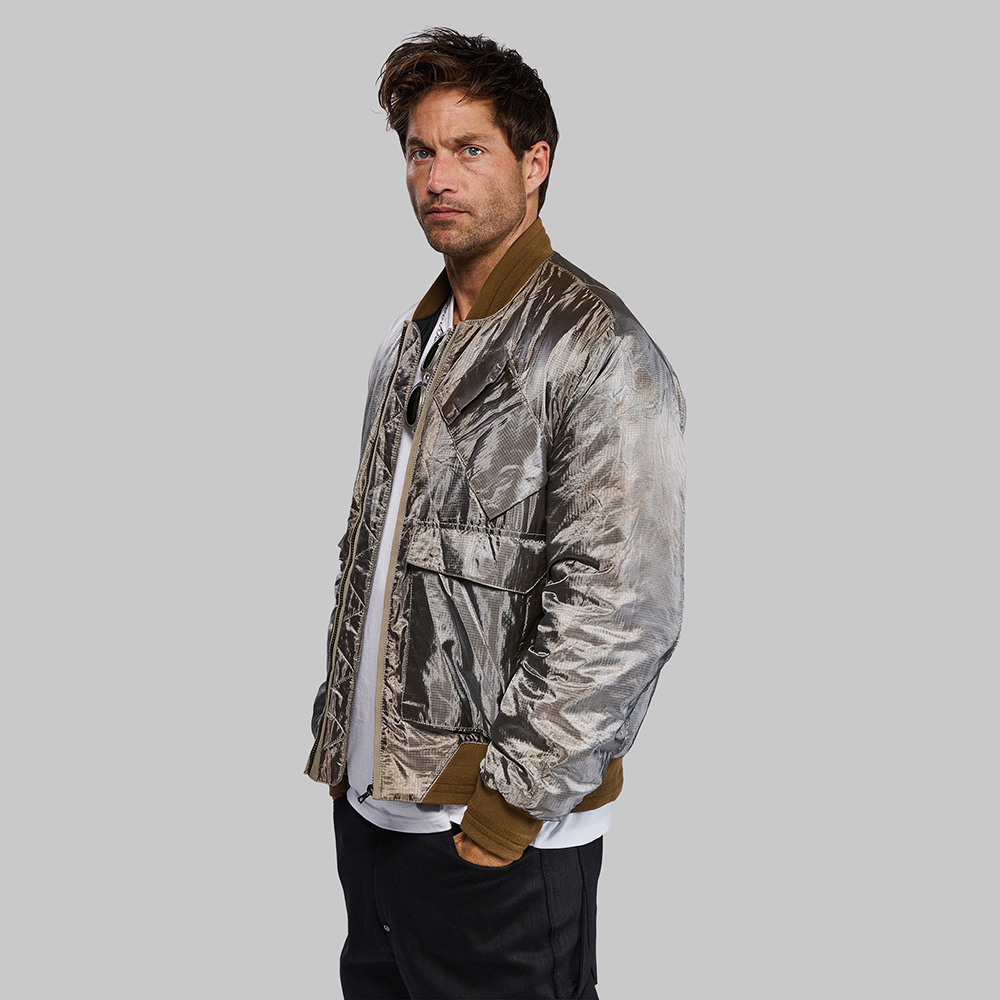
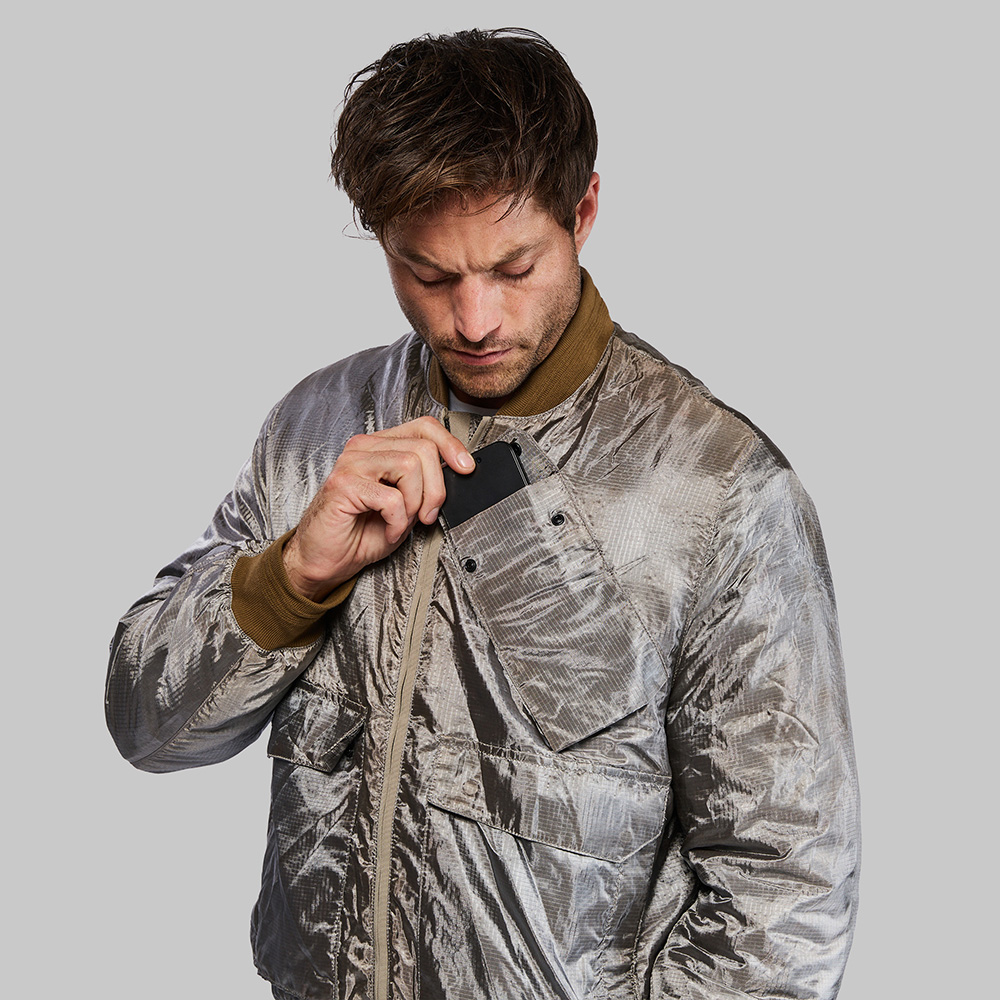
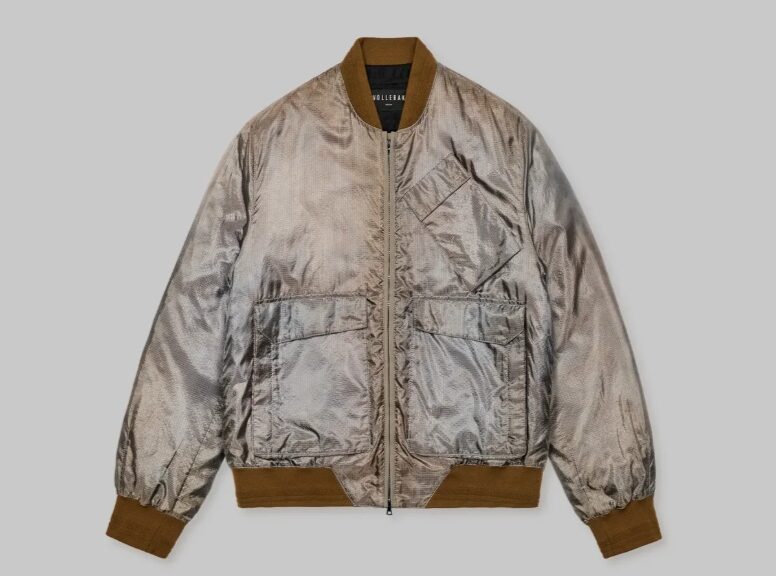
Shielding Bomber | vollebak.com

Mars And The Hulk Have Something To Do With This Design

While Gamma rays might have turned Bruce Banner into The Hulk, in reality radiation and human beings don’t go well together. And as we enter an era of cybersecurity breaches, geopolitical instability, the first manned missions to Mars (after Elon settles down on the Moon first) , and cosmic radiation exposure, it’s going to present an increased threat.

So this is cool- this Electromagnetic Shielding Bomber is built with the same electromagnetic shielding technology used for the Mars Rover.
Long before the Curiosity Rover was sent to Mars to search for signs of life, it had to be tested here on Earth. So NASA created an electromagnetic shielding tent that was designed to completely block out external electromagnetic radiation during testing… like someone sending a text, turning the microwave on, or chatting with the James Webb telescope.  

Shields The Waves

We’ve now taken that technology and converted it into our first Electromagnetic Shielding Bomber. It’s embedded with pure silver that blocks radio waves and microwaves in the 0.2GHz to 14GHz frequency range – which includes WiFi, Bluetooth, Ku-band satellites and radar systems.
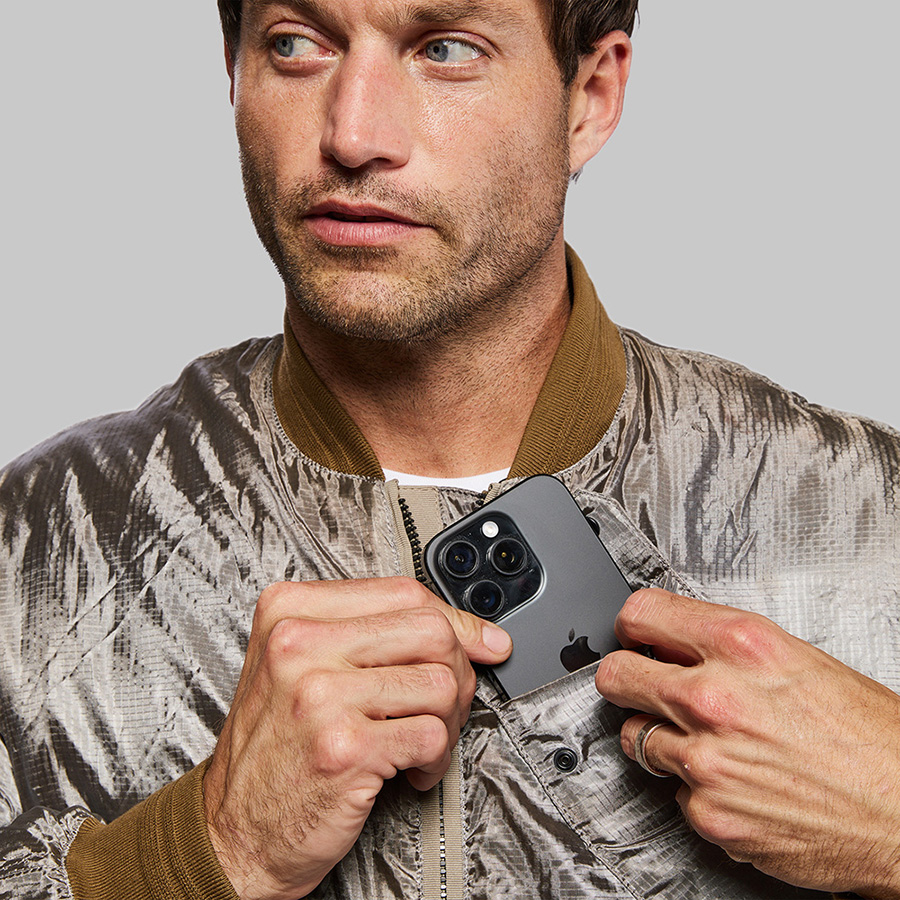
It also comes with a phone shielding pocket that works like a Faraday cage – blocking access to your devices, regardless of whether they’re switched on or off. Conceptually it’s like making a pocket that’s entirely watertight… just for electromagnetic energy instead. So you shouldn’t be tracked, hacked, or even called.
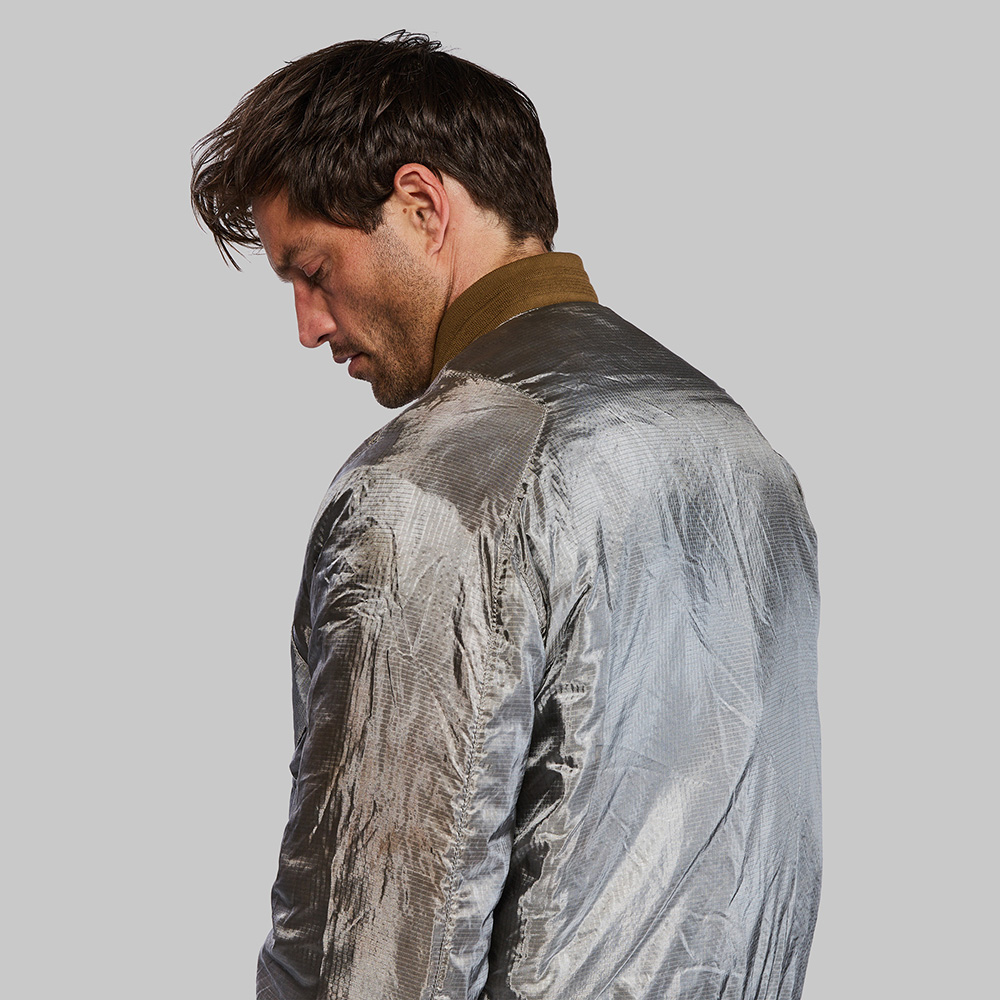
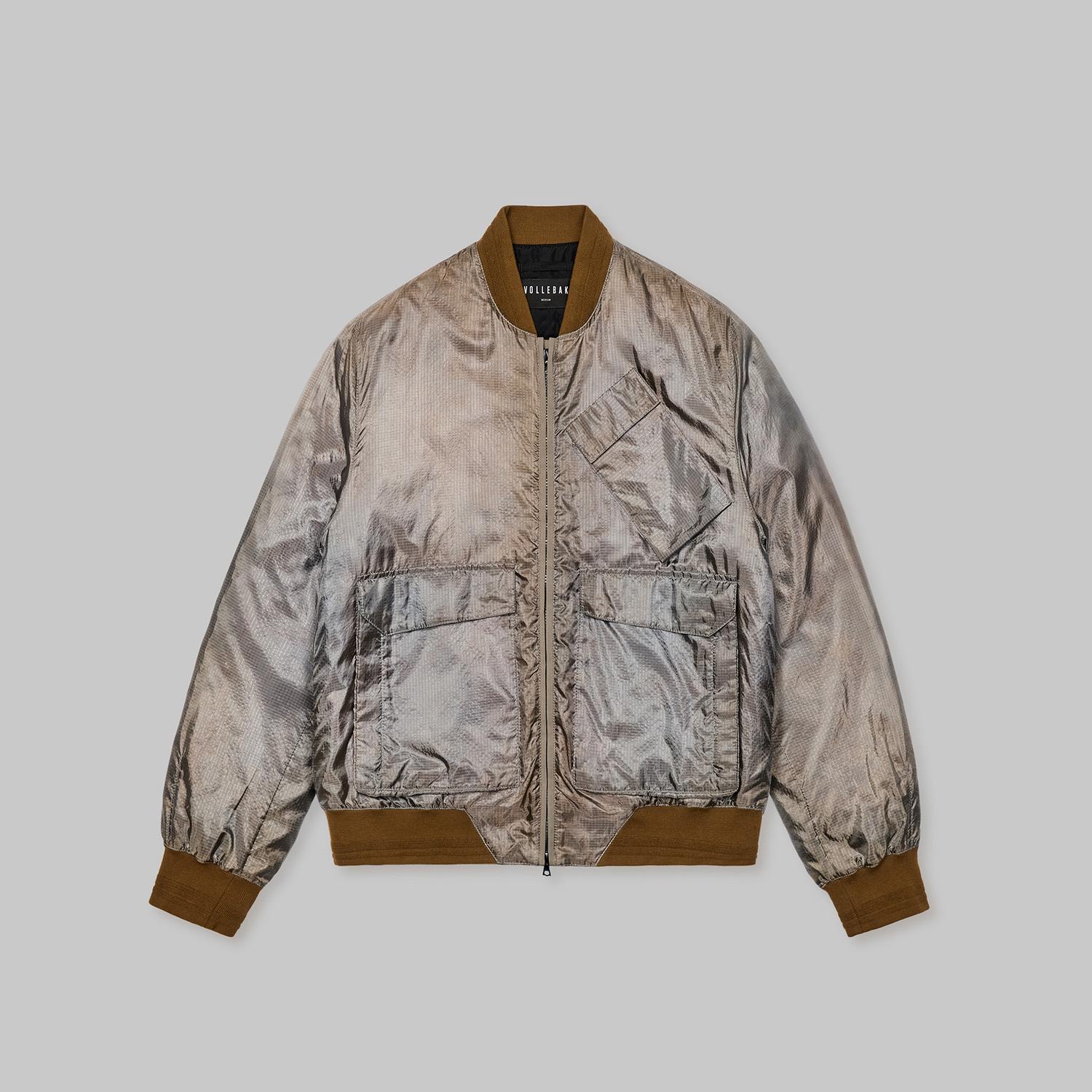
While the outside of the jacket offers space-age protection, its shape, cut and aesthetics come from the jet-age, and are based on the original MA-1 flight jacket.


Shielding Bomber | vollebak.com
BUY THE BOMBER
Shielding Bomber | vollebak.com

For the Silo, Jarrod Barker.

Clothes From Future Now Available Including Faraday EMI Blocking Jacket

Vollebak Logo

Don’t worry, we will get to the jacket- but first the story starts in 1836 in Victorian England. And it you weren’t there you didn’t miss anything. It included a grumpy-looking queen, bad weather, a lot of sexual repression, and rich people throwing buckets of human waste out of their windows. 

On the plus side it also had a bunch of scientists running around like kids on acid. One of them was Michael Faraday – Victorian England’s answer to David Blaine.

Over the last 190 years the Faraday cage has gone from a crazy Victorian scientist sitting inside an electrical storm, to critical black-ops architecture, to a wildly experimental jacket that looks like it’s emerged from a craft in Dune.

A Faraday cage at the US Bureau of Standards (now NIST) used to protect delicate measuring instruments from electromagnetic fields.

Now Michael was a showman. But instead of freezing himself in ice, or suspending himself in a glass box, his trick was making super abstract physics feel tangible. And his greatest stunt of all was standing inside an electrical storm. In front of a packed out theatre at the Royal Institution in Mayfair, Faraday lined a large wooden box with metal foil, hit it with discharges from high voltage electrical machines… then calmly stepped inside. Sparks crackled across the outside of the enclosure. Blue light crawled over the metal skin. Faraday meanwhile stood there in silence. Like the final boss. While the energy simply flowed around him.

It might have looked like he’d built his own supersized coffin – complete with all the necessary equipment to kill him – but it turned out Faraday understood equations as well as he understood spectacle. 

  • Made from approx. 50% copper
  • Blocks electromagnetic waves from 0.2GHz to 14GHz
  • Eight-pocket defensive storage system with shielding flaps

By the time he stepped into his foil-lined cube, he’d already spent years dismantling older ideas of electricity.  

A Faraday cage isn’t a wall. It’s a detour. When an electromagnetic field hits a conductive enclosure, the free electrons inside it immediately start to flow, redistributing themselves across the surface until the field inside is cancelled out. Build the right shape from the right material, and electricity behaves like water flowing around a rock.

It’s one of the simplest demonstrations of how matter tells fields what they are allowed to do. The impact of Faraday’s experiment quickly escaped the lecture hall – because the Faraday cage didn’t just deflect static charge, but whole regions of the radio frequency and microwave spectrum.

The principle was applied in bunkers, test chambers and secure rooms. Then in spacecraft, data centres, radar installations and intelligence facilities, where even a stray spike of interference can crash systems or corrupt data. Today our Faraday Cage Jacket is a descendant not only of that wooden box, but everything that followed in its footsteps. It’s the same physics. Just shrunk. Softened. And wearable. And you can join the waiting list here.

We designed it from scratch, using the principles of clothing and electromagnetic infrastructure at the same time.

And this is what transforms it from a pure physics experiment, to an object that looks like it’s just emerged from a craft in Dune. Most of us spend our lives today inside a semi-permanent yet completely invisible electromagnetic fog: radio waves from antennas. Microwaves from routers. Radar from aircraft. Signals bouncing between satellites, phones, vehicles and buildings.

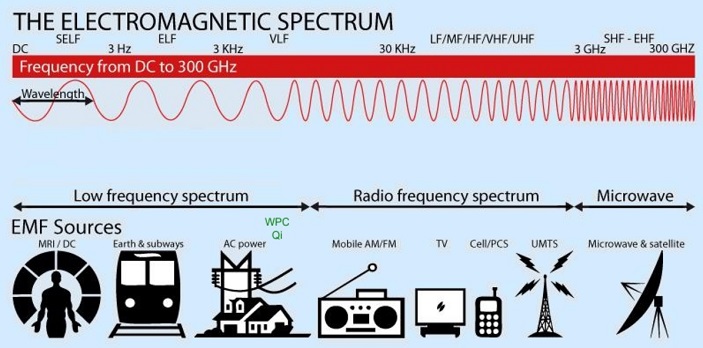
So the first Faraday Cage Jacket treats that electromagnetic energy the same way someone climbing Everest would treat cold weather – as something you can defend against, and insulate yourself from.  It blocks electromagnetic waves across the 0.2–14GHz range. This includes all the unseen wiring of the digital age: WiFi at 2.4GHz and 5GHz. Bluetooth at around 2.4GHz. Mobile networks. As well as higher-frequency Ku-band satellite and radar systems. In lab testing the material reaches shielding effectiveness figures of up to 92 dB – for reference this is the kind of level normally associated with secure infrastructure and electromagnetic test laboratories.

Every seam and every opening affects how energy moves across the jacket.

So the job of the design is to manage those electromagnetic fields. 

And that’s why the jacket is built from large, faceted spaceship-style panels and snap-down flaps. Overlapping sections create layered shielding zones and add 10 – 20 dB more attenuation. Each overlap is another place for energy to be redirected – another chance to keep it moving around the body instead of through it.

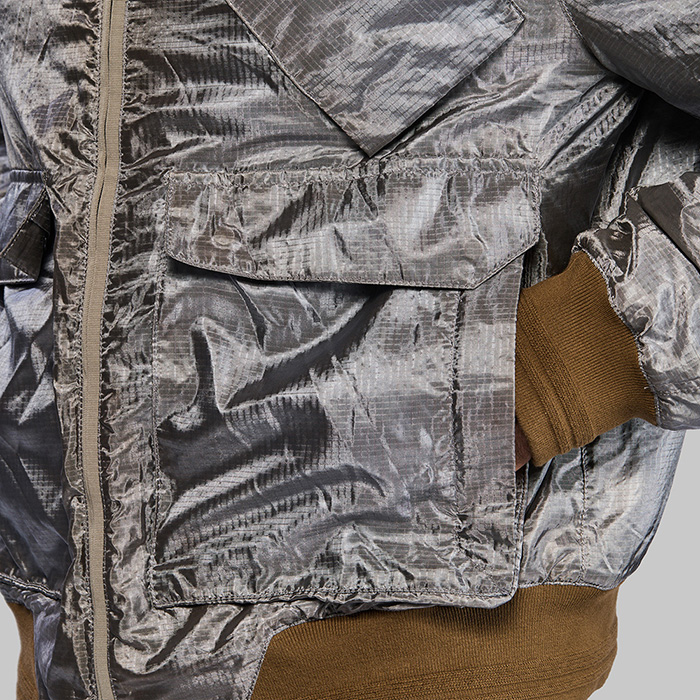
The jacket’s eight pockets are designed the same way. Instead of flat bags stitched onto a shell, they’re three-dimensional, origami-like bellows pockets that form enclosed volumes that behave less like pockets and more like small rooms – put a device inside one of these pockets and it’s almost impossible to track, hack or even call. So if you’re looking to shield yourself from the dystopian conditions our future digital overlords set – whether that’s surveillance, space radiation, or select parts of the electromagnetic spectrum – the Faraday Cage Jacket belongs in your future.

Technical Details

Outer material: Shieldex® Kiel + 30 non-woven shielding textile

Material composition: 48% copper, 46.5% polyamide, protective acrylic coating

Textile normally used to shield rooms and electronic environments

Shielding effectiveness: up to 92 dB in lab testing

Blocks electromagnetic waves from 0.2GHz to 14GHz

Thermally and electrically conductive

Naturally antimicrobial

Eight pockets including double-entry origami bellows pockets

Snap-down pocket flaps to add additional shielding

Two-way Riri zip

Nautical-cut hood sits flat when not in use

Engineered sleeves for unrestricted movement

For the Silo, Nick and Steve Tidball/ Vollebak.

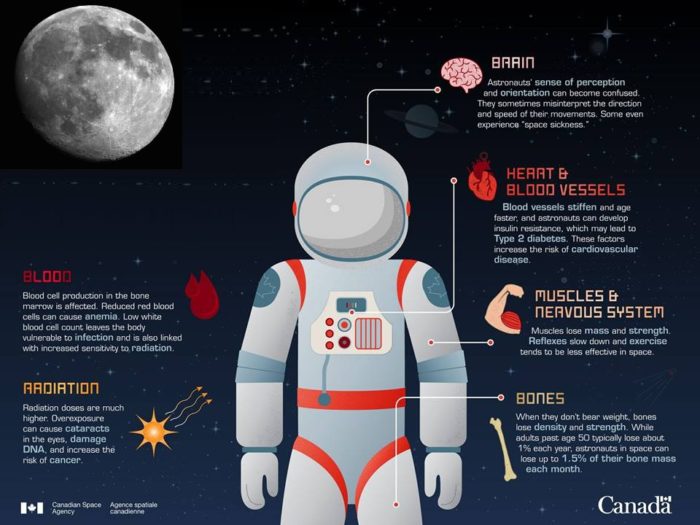
Canada Space Agency -How Space Affects Our Body

Living in space has significant effects on the human body. As we prepare for journeys to more distant destinations like Mars, humankind must tackle these risks to ensure safe travel for our astronauts.


Canada Space Agency PSA space info

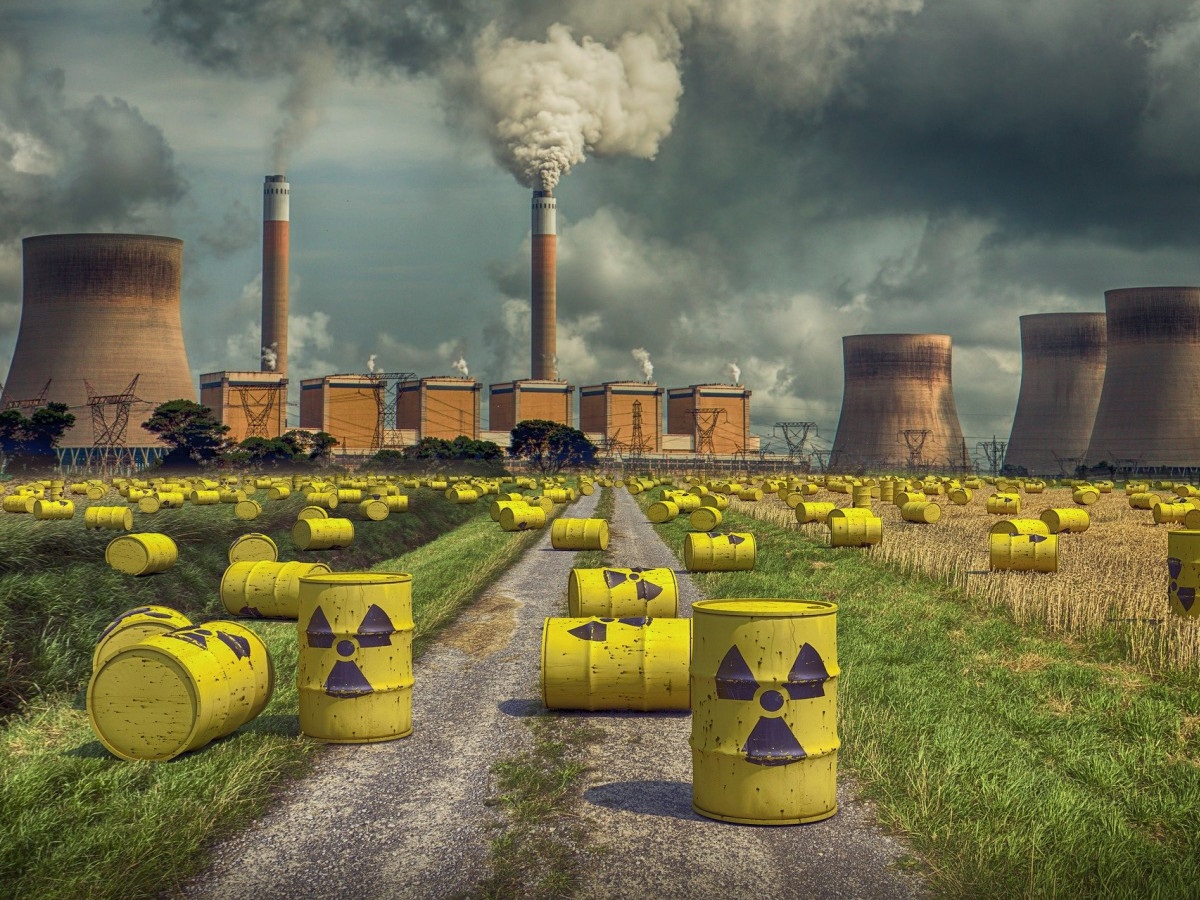
Ontario Town Votes Yes To Nuclear Waste Storage

Ontario Town Votes to Become a Willing Host for a Nuclear Waste Repository
Uranium pellets are shown during a tour of a Nuclear Waste Management Organization facility in Oakville, Ont., on Dec. 12, 2023. The Canadian Press/Frank Gunn
The Canadian Press

By The Canadian Press

Ontario Town Votes to Become a Willing Host for a Nuclear Waste Repository

A northwestern Ontario town has formally decided it is willing to become the site of a deep geological repository for Canada’s nuclear waste.

The Nuclear Waste Management Organization plans to select a site this year where millions of bundles of used nuclear fuel will be placed in a network of underground rooms connected by cavernous tunnels.

The process for the $26-billion project had already been narrowed down to two sites, Ignace in northern Ontario and another in southern Ontario, and the NWMO says that both the local municipality and the First Nation in those areas will have to agree to be willing hosts.

Ignace, between Thunder Bay and Kenora, is now the first of those four communities to make its decision known, and town council voted in favour of it at a special meeting on July 10.

One of the many natural waterfalls found in Ignace, Ontario.

A committee of community members tasked with taking the pulse of the town’s willingness presented the results of a community vote and said that out of the 640 residents who voted, 495 or 77 percent voted in favor.

Neither of the First Nations has yet made their willingness decisions, and the municipality of South Bruce is set to hold a referendum in October.

Site for Canada’s Underground Nuclear Waste Repository to Be Selected Next Year

Ontario Partners With Bruce Power to Expand Nuclear Energy Generation Station

The current fleet of nuclear reactors in Canada will produce about 5.5 million used fuel bundles, with around 3.2 million already in either wet or dry storage on site at nuclear plants.

But the NWMO says the current containers of thick concrete walls lined on the outside with a steel plate are designed to last 50 years, so they are not a long-term solution.

The organization, funded by the corporations that generate nuclear power and waste, such as Ontario Power Generation and Hydro-Quebec, is instead planning to build a deep geological repository, as far underground as the CN Tower is tall.

The used nuclear fuel pellets, baked into ceramic, are contained in fuel rods made of corrosion-resistant Zircaloy. Those rods will be in containers made of carbon steel and coated with copper, and those containers will be packed into bentonite clay.

Opponents in the affected communities worry about safety, while proponents see value in the jobs and economic development the project will bring.

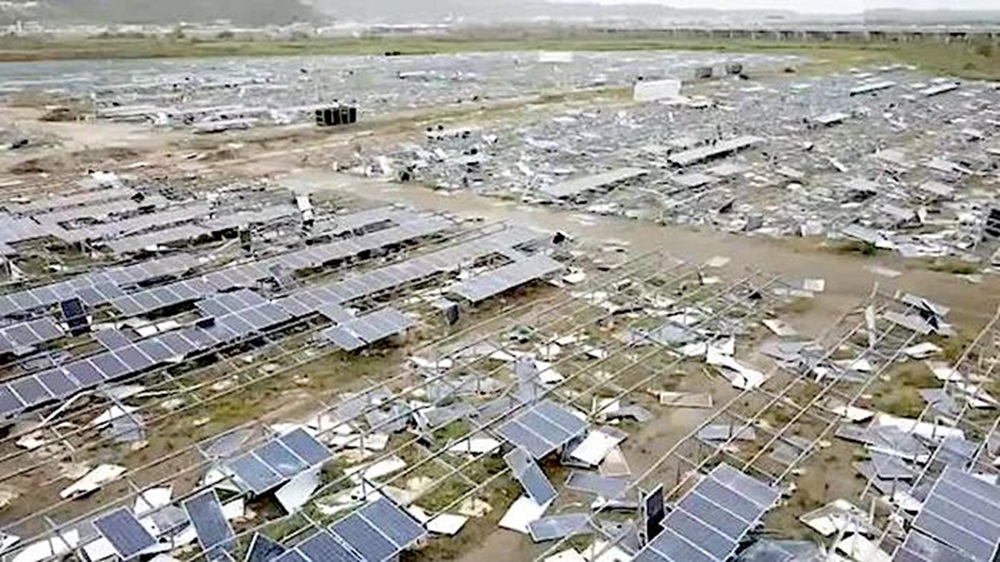
Canada- Discarding Used Solar Panels in Landfills Poses Significant Pollution Risk

Global Affairs Canada is seeking a contractor who can present an environmentally friendly way to recycle solar panels.

Discarding Used Solar Panels in Landfills Poses ‘Significant’ Pollution Risk, Gov’t Says
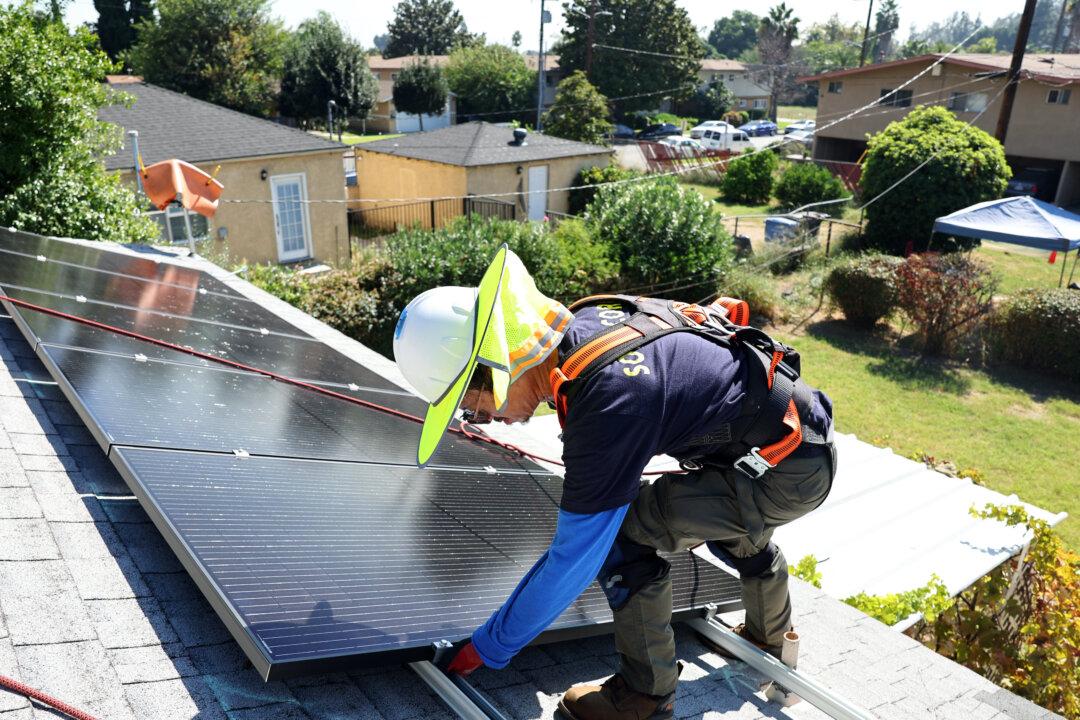
A worker installs solar panels on the rooftop of a house in Pomona, Calif., on Oct. 19, 2023. (Mario Tama/Getty Images)

Via friends at the epoch times. Landfilling of used solar panels poses a “significant” pollution risk due to toxic chemicals potentially leaching into groundwater, a government document says.To solve this issue, Global Affairs Canada is seeking a contractor who can present a cost-effective and environmentally friendly way to recycle solar panels, according to a July 23 notice on the government website.

“Solar panels have valuable materials, including critical materials such as aluminum, tellurium, and antimony as well as gallium and indium in some thin-film modules, which are currently not being recycled once the panels reach their end of life,” said the notice posted by Global Affairs Canada.

Solar panels and renewables are part of the federal plan to get to net-zero greenhouse gas emissions by 2050, the government says. As more and more panels are used, however, Ottawa needs a plan to recycle them in order to reduce the pollution risk.

The government has earmarked $1.15 million CAD for the contract.

“As the photovoltaic market grows, both for public and private use, the volume of end-of-life solar panels will also grow, which will result in significant pollution risks,” the website notice says.

“The overall environmental impact of solar panels is much higher if they are dumped in landfills, where hazardous chemicals and heavy metals can leach into groundwater.” For the Silo, Chandra Philip.

Chandra Philip

RELATED STORIES

‘Dirty Secret’: Made-in-China Solar Panels Produce 3 Times More Carbon Emissions Than UN Claims: Study

‘Dirty Secret’: Made-in-China Solar Panels Produce 3 Times More Carbon Emissions Than UN Claims: Study

Solar Panel Waste Predicted to Hit 1 Million Tonnes by 2030: Australian Research

Solar Panel Waste Predicted to Hit 1 Million Tonnes by 2030: Australian Research

As part of the contract, proposals must ensure that all materials removed from the solar panels are free from contaminants like metals and radiation. Contractors are also required to manage the toxic chemicals from the panels, like lead and cadmium, ensuring they will not be released into the environment or cause health risks to humans.

Solar panels also contain some key elements that are worth recycling and reusing, the website says.

“These individual materials are often a part of the devices that Canadians use every day such as smartphones and computers,” Global Affairs says. “As such, recycling these materials should provide significant economic, environmental, and social benefits.”

Solar panel recycling can also reduce the need for critical mineral mining, an activity that has extensive negative environmental and social impacts, the government notice says.

The way solar panels are constructed, however, can make it difficult to separate and recycle these valuable materials, Global Affairs says.

“Separating those materials and uniquely recycling them is a complex and expensive process as opposed to the cheap method of discarding the entire panel into a landfill,” says the website.

Global Affairs says it wants a “scalable and cost-effective” recycling solution that can be used for solar panels at any time during their lifecycle: production, use period, and end-of-life stage. The agency says it may give out multiple contracts to help solve the problem.

Why Radiation Protection Makes Sense- even at ‘Low’ Exposure levels

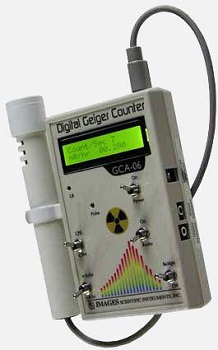
Geiger CounterRadiation is all around us.

  It occurs naturally in our environment, coming to us from the sun, from the soil and foods that we eat, and in the air that we breathe. It is omnipresent across a diverse cross section of industries. We tend to associate radiation with the nuclear industry, but the reality is that we come across radiation sources in numerous other areas:  construction, health care, oil and gas, research, manufacturing, food processing – to name just a few.

With radiation being everywhere in our lives, it is not surprising that it garners a lot of attention, curiosity and, often, worry.

With more than 15 years as a career radiation protection professional, I’ve had to respond to many occupational radiation safety questions — some have related to regulations and compliance, others to potential health effects of exposure and ways to minimize such exposure. In all cases, it is best to rely on well established radiation physics concepts and scientific data, where available.

While there is not much that we can do to escape natural background radiation exposure, we do want to avoid any unnecessary exposure to high levels of radiation, such as the potential hazard due to elevated radon (a radioactive gas) in our homes and workplaces.

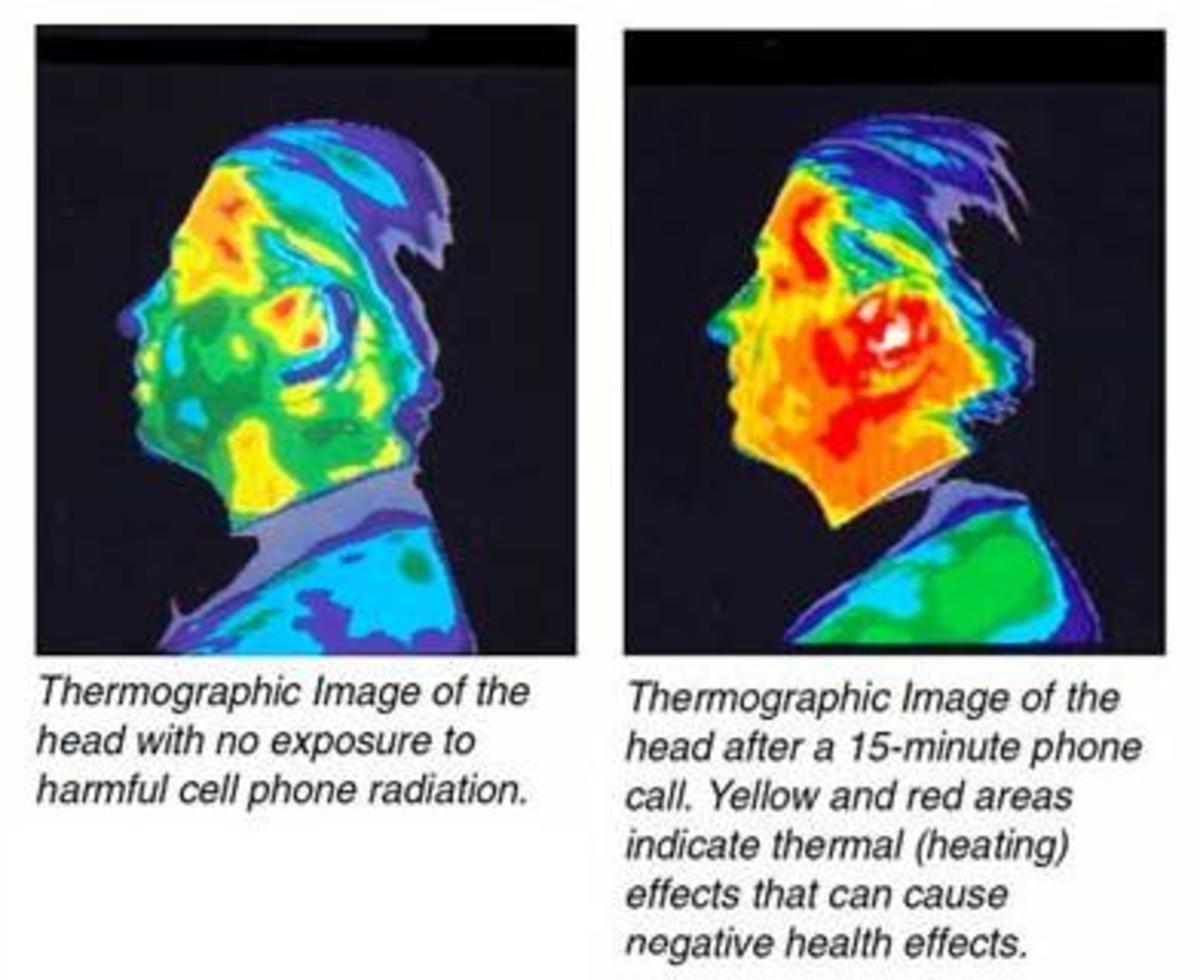
How to Protect Yourself From Harmful Mobile Cell Phone RF-EMF Radiation -  TurboFuture

Radon testing of homes is the simplest first step you can take to protect yourself and your family from radon gas, but all too often we do not make the time to educate ourselves and make this a priority. Workplaces are required to have a radiation protection program in place that is appropriate for the type of radiation and potential risk in their industry. But it takes time and investment to develop these programs, and it requires the commitment of both employers and workers to put these programs into practice.

Our challenge is that radiation and its associated risks are not always well understood.

On the one hand, we do not wish to alarm anyone unnecessarily, yet we want to make sure that the public, workers and employers are aware of the steps they need to take to stay safe.  Remember, we are talking about an “invisible” hazard that very rarely causes ill health effects in the short-term. Additionally, the existing radiation protection models are built on what we call the linear no-threshold concept, which, in simple terms, is based on studies of the atomic bomb survivors from the Second World War in Japan and other high-exposure situations, and extrapolates the information to the potential health effects of low exposures.

Low Levels Radiation

An agency of the World Health Organization (WHO) recently published a study on the health effects of low-level exposure to radiation that provides data to support the validity of the linear no-threshold model. We encourage all who read the study (available at The Lancet Haematology) to not get alarmed and to keep the study conclusions in perspective.

It suggests that extended exposure to low level of radiation increases the risk of developing leukemia.

A frightening statement, but we have to keep in mind that the increased risk is small, in line with what we have estimated based on the modeling concepts. This boils down to two things: first, it is important that we continue to apply the ALARA principle — “As Low as Reasonably Achievable” — to all our of interactions with radiation; and second, that we continue to view the numbers associated with radiation and risk in the proper context. The study points to a “small increase” of risk of dying from cancer from low levels of radiation exposure.

Let’s put this into perspective. 

If we extrapolate this study’s conclusions for nuclear workers to persons living near Canadian nuclear plants, people are 6,000 times more likely to die in a car accident, than to die from leukemia due to doses received from reactor plant emissions. Yet most of us think nothing of driving to work, driving our kids to school, or driving to visit friends and family.  The radiation risk is there, but it is significantly smaller than the risks we accept every day, often without even thinking or worrying about them.

More research is required on the health risks from low-level radiation exposure, and there are efforts underway around the world to make it happen. At the Radiation Safety Institute, we will be looking forward to hearing about more study results.  In the meantime we invite all people who are interested in the subject of radiation safety, who have a question or a concern, to reach out to our Free Information Service at 1-800-263-5803 or by e-mail at [email protected]. Let’s keep the conversation going.  For the Silo, Laura Boksman Chief Scientist at the Radiation Institute of Canada.

Click to view on I-tunes

Greens: Ontario Has Forgotten Many Residents In Radiation Pill Mail-Out

Arbitrary boundaries put WhitbyOshawa residents at higher risk from nuclear radiation accident

(Whitby-Oshawa): “Does the Liberal government care about the safety of my neighbours in Whitby-Oshawa?” asks GPO candidate Stacey Leadbetter.
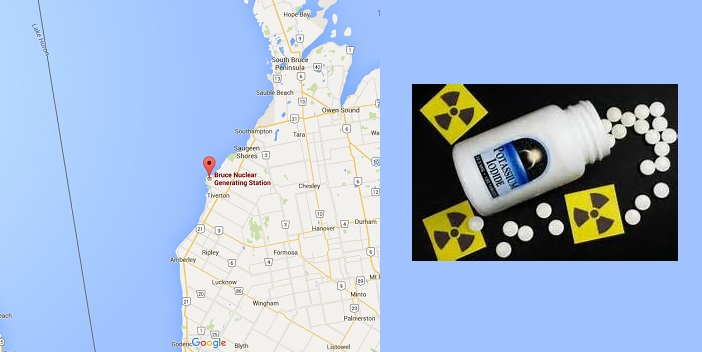
“So many residents of our community have been left out of the government’s mailing of potassium iodine (KI) pills. These pills protect us from thyroid cancer if there is a radiation leak – we need to make sure that everyone at risk will have them.”
The GPO is calling on the government to extend the pre-distribution zone to residents living within 30-50 km of the Pickering, Darlington and Bruce nuclear generating stations.
Governments in Europe like Switzerland pre-distribute KI pills to residents living within a 50 km radius of a nuclear facility. New Brunswick pre-distributes KI pills in a 20 km radius. In Ontario, only those residents living within a 10 km radius of nuclear stations receive them. 
On November 4 2015, the Regional Council of Durham passed a motion asking the province to consider the feasibility of extending the 10 km primary zone for nuclear emergency planning.
“Will Kathleen Wynne step up, listen to science and protect the residents of Whitby-Oshawa at risk from a nuclear radiation leak?” asks Mike Schreiner, GPO leader.
“People’s safety is too important to make this stuff up on the fly,” adds Schreiner. “We desperately need an evidence based, public review of nuclear emergency plans. This is especially important when determining the radius of the primary zone and the pre-distribution of KI pills.”   For the Silo, Becky Smit.