This is an entertaining article 😉 The United States spends millions of dollars every year covering up something they say doesn’t exist – Extraterrestrials. In fact, the U.S. military not only recognizes three alien species but for nearly 70 years has been working with the Greys, the Reptilians and the Tall Whites under signed treaties. America also has diplomatic relations with the Anunnaki.
But the cover-up goes even deeper.
The U.S. military has the capability of time travel using interstellar spacecraft capable of flying faster than the speed of light.
Time Traveler John Titor II
Based at Area 51, John Titor II began travelling through time on missions for a highly-secretive arm of the U.S. Air Force in 1979 and served as commander of the 177th Time Travel Division from the years 2030 to 2036.
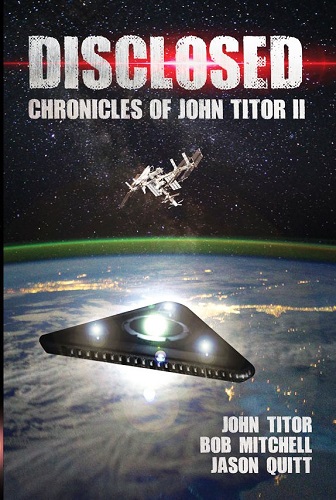
His life story is told for the first time in “Disclosed:Chronicles of John Titor II” – a new book co-written by Canadian authors Bob Mitchell and Jason Quitt.
“In return for allowing the Greys, the Reptilians and the Tall Whites to have hidden bases on Earth with unlimited access to resources – and the U.S. never revealing to the public they exist – the ETs have provided black technology to the military beyond anybody’s wildest imagination,” Titor II said.
Titor II reveals the hidden truths behind humanity’s biggest cover-ups.
These include;
The existence of at least two different off-world colonies.
The U.S. military has a fighting force of thousands of genetically-engineered cloned super soldiers.
Who really killed President John F Kennedy?
Our timeline has been changed without us knowing it.
Humanity’s extinction and Earth’s inevitable environmental Armageddon.
Mitchell, Quitt and John Titor II will discuss their mind blowing book for the first time on Coast to Coast with George Noory on Sept. 1, the same day it goes on sale on Amazon. .
Bob Mitchell
“Once you read this book you will never look at the world the same way again,” author Bob Mitchell said. “Parts of it scared the hell out of me, especially when John revealed what our future will be like.”
“Disclosed has the potential to shake up the entire conspiracy/UFO world,” author Jason Quitt said. “People all over the world are demanding disclosure. This bookwill push the boundaries.
Disclosed:Chronicles of John Titor II is a perfect follow the international sensation “Forbidden Knowledge–Revelations of a multi-dimensional time traveler,” which was co-written by Mitchell and Quitt and released in March 2016.
“It’s important to understand that John Titor II isn’t the John Titor, who suddenly popped up on the Internet in 2000 claiming to be a time traveler with so many outlandish predictions,” Mitchell said. “In our new book, John Titor II doesn’t make predictions. He has experienced what has and is about to happen.”.
Jason Quitt
“John Titor II is the real deal,” Quitt said..
Although no longer time traveling, John Titor II continues to consult with the Department of Defense. He lives in a heavily-secured compound with 24-hour security in southern California. For the Silo, Sigmund George Smith.
How many of us have had to deal with messy, twisted and often times dangerous wires and power cords in our homes? It’s amazing how quickly an outlet can fill up and then what to do? Bryan Nooner is the owner of an Illinois home construction company and the CEO/founder of Twist and Seal. He developed the idea when he and his family could not keep their outdoor light cords dry during the holidays. It was time to develop a solution and find a way to organize all of the cords.
After trying everything he could think of to makeshift some waterproof protection, Twist and Seal was born.
Twist and Seal’s patented designs enclose connectors in a water-tight cocoon, safeguarding homes and protecting against outages and electrical shocks.
Smart cable management- The Cord Protect Green
Since its inception in 2012, the company’s family of patented products has grown to include several options in a range of sizes, including the Mini, Cord Dome, and the brand new Cord Protect, as well as the company currently taking pre-orders on the contractor-grade Maxx. Twist and Seal was awarded the “Most Innovative Product of the Year” Award three years in a row at the National Hardware Show in the U.S.
Twist and Seal is certified by the National Electrical Manufacturers Association (NEMA) and the Consumer Product Safety Commission and is made in the USA. For the Silo, Lauren Knight.
Pricing: Mini: usd $9.98 for a 2-pack Cord Protect: usd $8.95 each Cord Dome: usd $29.95 each To learn more contact:marketingdirector@thesilo.ca
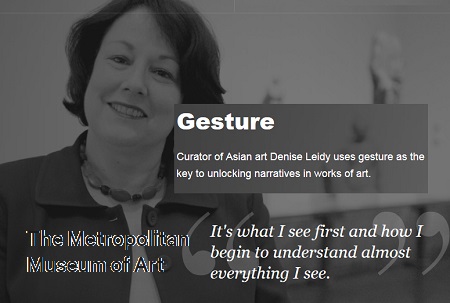
Dear Reader, it is difficult to deny that a side of art making is fatally concerned with the poetic grace of the gesture – it is expected that a work should exude a cosmic and ineffable air.
Regardless of your medium, I hope this glance into the minds of two established poets from very different walks of life can help dissipate the intimidating mist between process and product, as well as remind you that the transcendent and the familiar are often one in the same.
Global spectator Meena Alexander recognizes that even in the grand art of poetry is a desire to express what cannot be said through its own means. After eight books of poems and a lifetime of travel, Alexander continues to defend her craft as the most ordinary of entities, no more inexplicable than a child’s obvious and impossible sense of language or rhythm.
New York-based Eileen Myles approaches poetry from a reserved and humble perspective, with the intent of striking a tasteful balance between metaphysical grandeur and the habitual rhythm of the everyday.
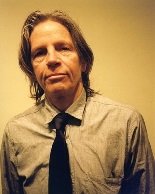
Myles, a breathing artistic currency, treats poetry as an extension of the self with the potency of a movement and the collective memory of a civilization. Myles proves that common experience and abstract phenomena are synonymous when we step back to look.
If the weight of the world seems so immense that the few strands of creativity cannot unravel, the Mayer Foundation offers emergency funding for New York artists facing economic, residential or medical turbulence. Proposals may be submitted at any time, with over two thousand dollars granted to those with concrete objectives and a levelheaded art plan.
It is easy to forget that behind the polished mirror of history is a messy and cumulative reality. There is little difference between the intelligentsia of years past and the friends sitting at your dining room table. For the Silo, Brainard Carey.
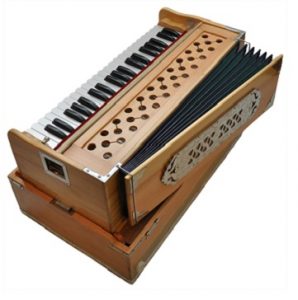
There is general disagreement on whether Indian music can be performed on the harmonium and public interest in the debate is accordingly intense, as the controversially written articles and discussions prove to this day.
The matter has evaded scientific scrutiny until now…….click the following link to learn more about the harmonium in North Indian music: Full Text PDF- The Harmonium in North Indian Musicby Birgit Abels.
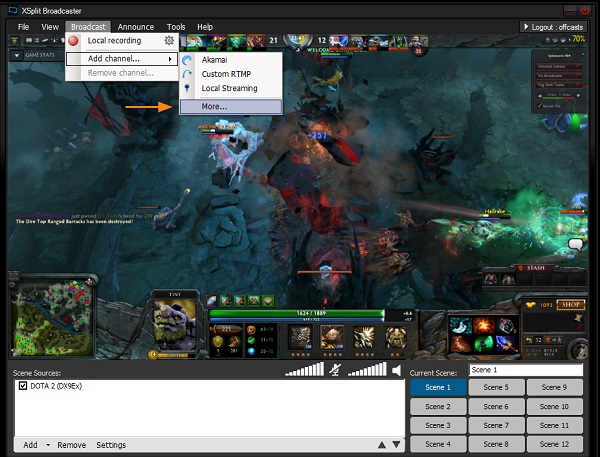
When we launched XSplit almost six years ago, we set out on a mission to make live streaming and recording simple. In that time, both broadcasting and gaming changed dramatically, with the advent of new live streaming services, the birth of the Twitch Streamer, and the explosion of eSports capturing the imagination of players across the globe.
Fast forward to 2016 and the world’s top gaming personalities, eSports teams, game developers, publishers and millions of people worldwide are using XSplit to create innovative, hilarious, entertaining and meaningful content that has impacted audiences of all ages. Live streaming has helped bring people together from all walks of life, and with hundreds of thousands of new users joining us every month, that number is set to grow higher still.
Yet this is still only the beginning. Our aspirations for the future are much bigger, as we envision a world where players can seamlessly connect to one another in a dedicated space, share and create content, compete with one another and grow their own communities. To turn this dream into a reality though, we knew we needed the right expertise, technology and people to make this happen.
This is where social discovery platform, Player.me, and tournament management service, Challonge come in. Between these two services we see the potential to create a platform that connects the entire gaming community and serves the needs of all players in their daily lives.
Henrik Levring
We’re going to shake things up a bit over the coming months by combining the Player.me community and discovery engine with Challonge’s tournament bracket technology to create a future where players, content creators, eSports entrepreneurs and event organizers, can connect with one another seamlessly and beautifully.
Both Sean Fee (CEO of Player.me) and David Cornelius (CEO of Challonge), two top entrepreneurs and leaders in their field share this vision to build a connected experience, and we cannot wait to show you what’s coming in the near future. On a final note, we would like to thank our community, our partners and of course you – our users for being with us on this adventure. For the Silo, Henrik Levring, CEO of SplitmediaLabs.
Starting last month Habits Studio and QUANTUM formalized a new partnership that signaled an exciting collaboration between the Italian design studio and the Japanese innovation studio/accelerator.
With shared aspirations and values, the two companies plan to work closely to develop Internet of Things (IoT) products that breathe new life into everyday experiences. The first product created by the partnership was unveiled at the Digital Habits booth at the Salone del Mobile Milano 2016, held in Milan, Italy in April. Inspired by moon-watching, the teams introduced a unique interior lighting display, ‘Another Moon’, that showcases the delicate beauty of waxing and waning of the moon in real time.
Being enhanced through their collaboration, both companies are committed to developing future products and services that have appeal for the wider global marketplace. The partnership opens up new opportunities for both companies to incorporate global design perspectives into the earliest stages of product development.
In addition to this, QUANTUM and Habits Studio plan to leverage their partnership across a wide range of projects undertaken in conjunction with QUANTUM’s numerous partner companies.
HABITS Studio provides seamless experiences for users looking to adopt innovations and new technologies. The team includes product designers, mechanical and electronic engineers, visual and interaction designers, who together, bring their visions to life by making interactive prototypes as proof of concepts. Habits Studio has also an internal innovation platform, called ‘Digital Habits’.
QUANTUM was launched in 2014 as a division within TBWA\HAKUHODO to help foster innovative growth and exploration. It went on to establish its own brand called QM in 2015. The collaboration with Habits Studio started between QM and Digital Habits.
“We have a special link with Japan. We started working in the country in 2000 when we were still students. Now we feel somehow integrated with the habits and creativity of the Japanese people. Our design approach appears to be especially effective for Japanese advanced industries. The partnership with QUANTUM ideally fits this opportunity and the capabilities of both companies express together a whole creative heritage.” Innocenzo Rifino, Founder, Habits Studio
“Our work style at Ku-Mu (QM) is always to collaborate with partners flexibly depending on the products and services we produce. Through the project with Habits Studio, we realized that partnering with global design firms would make us enrich the products we develop with a broader perspective, especially at a time when both businesses and markets are becoming more global. Habits has lots of experiences working with global companies, including some in Japan, and we are very excited to continue our collaboration on more projects based on this partnership.” Futaba Maehara, General Manager, QUANTUM Makers, QUANTUM
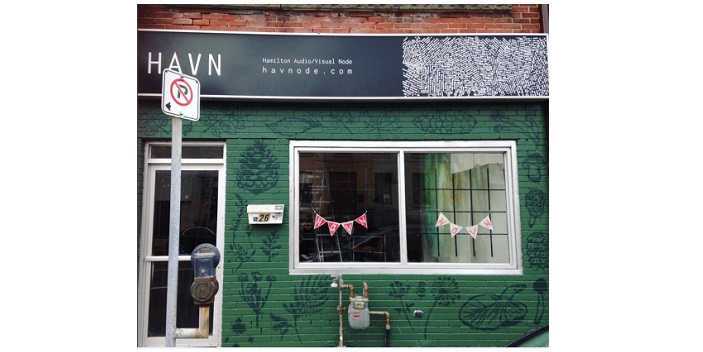
I learned about the Hamilton Audio Visual Node (HAVN) a few years ago by doing the rounds during Art Crawl. Since then it’s become obvious they’re hosting some of the most innovative music and visual art in Hamilton. I sat down with Connor Bennett and Chris Ferguson at the beginning of July to learn more about the collective and discover yet another reason to move to Hamilton. Connor and Chris made it pretty clear you don’t need an invitation to join the party. Featured Title Image, The HAVN Storefront on Barton Street Credit: Ariel Bader-Shamai
Timothy: How did HAVN get started?
Connor: Um, a few of us started a band, and we were practising in the basement of a student house and when it came time to leave that house, we wanted a space where we could continue to play, and show art, and we just lucked out, our collaborator and co-founder Amy McIntosh was living above a storefront and…
Chris: …had a good relationship with the landlord and managed to get the downstairs space at a price we could afford.
Connor: That was May, 2012, we opened up just as most of us were graduating from McMaster University.
Timothy: What does it mean to be a node for the arts? Is the storefront a critical component?
Connor: It’s probably not critical, although it’s nice, it’s really nice. I wouldn’t say it’s critical because we don’t do regular gallery hours, where people can just pop in. It is nice to have the storefront space for things like art crawl. We’re off of James Street but it’s still easier to get people out as compared to a studio space.
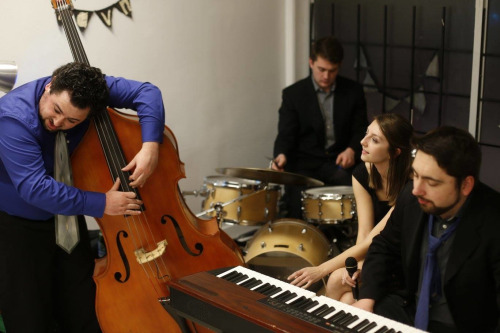
Aubrey Wilson Quartet in February 2015, Photo Credit: Amy McIntosh
Chris: Back to your question, as to what it means to be a node. Nodes are intersection points, which denotes the collaborative nature, the interdisciplinary nature of what we’re trying to do. And it was chosen for the sake of the acronym [Laughter].
Timothy: So what are your activities?
Chris: You could put it into four categories. We do art shows every art crawl, and occasionally outside of art crawl. We do music shows two to five times a month. And then there’s HAVN Records, our cassette tape little label. There’s also some miscellaneous things that are harder to categorize. We’ve done craft nights where people come out. Or if people in the collective supply an idea and make it happen. For a little while we had a darkroom in the backroom where people could develop photos.
Timothy: What are some of the highlights from the past couple of years?
Chris: It wasn’t something that I was involved with personally but I thought the darkroom was a really cool idea. It’s not something that’s widely available and it was a DIY thing where they obtained all the equipment and brought it all together. Some of it was donated by a like-minded friend from Guelph.
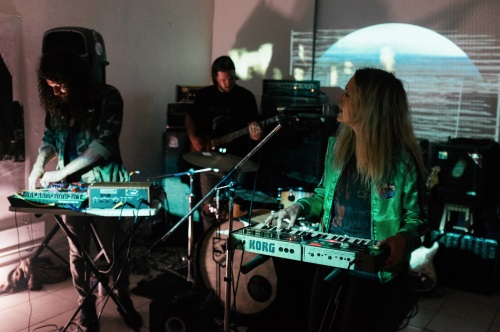
Connor: One of the best concerts I’ve seen recently was hosted by Cem Zafir and his partner Donna Akrey at HAVN, and they had a percussionist by the name of Tatsuya Nakatani come in and everyone in the room was transported to a different world, it was a magical moment. Those happen a lot. We’ve been really lucky with a lot of good music.
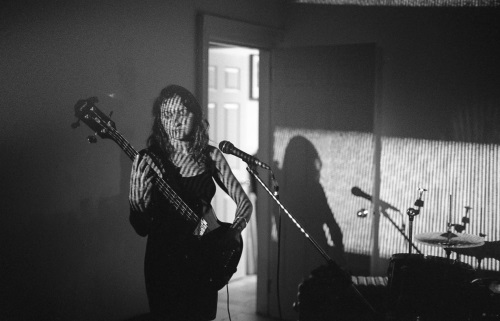
Hagface and Zena in August 2015, Photo Credit: Tony Hoang
Chris: What was the name of the show, I think Ariel and Petra did it, with the yarn, it was kind of, performance stuff; would you consider it a successor to the Quanta_1 show, where you and Kearon…
Connor: Yeah, yeah, it’s kind of like that…
Chris: An extension of that idea. Petra and Ariel did it, how would you describe it?
Connor: It was kind of a poetic yarn installation, with figures…
Chris: …and quotations.
Connor: It was great.
Chris: Really well executed. Not something you see a lot of.
Connor: Yeah, there’s lots of highlights.
Chris: We could keep going.
Connor: Once you start thinking about it.
Chris: I really liked our show for Supercrawl last year, which ended up being themed around Cootes Paradise, the Cootes to Escarpment EcoPark System, which is a conservation effort beginning with Cootes Paradise all the way into Burlington to connect some critical natural lands. The show really nailed the peaceful nature of it. Supercrawl is very busy, there’s tonnes of people and then you come to HAVN and it’s peaceful, relaxed.
Connor: Serene.
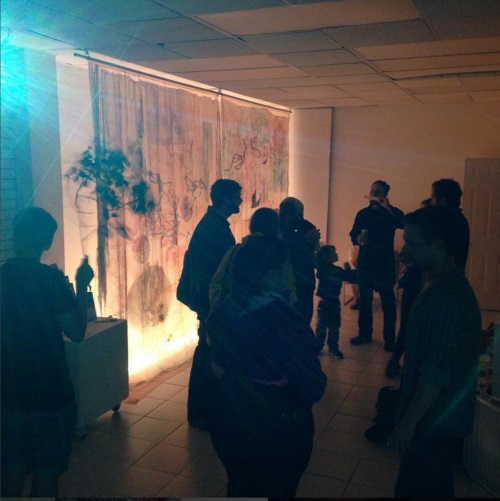
Chris: Yeah, Judy Major-Girardin, a professor at McMaster that taught a lot of the HAVN crew, was very generous with her time and she’s a big supporter of that initiative, so she put up a gorgeous installation with sound recordings from Georgian Bay. Frogs. Printed cheesecloth. It was stunning.
Corridors, in Support of the Cootes to Escarpment EcoPark System, September 2015, Photo Credit: Ariel Bader-Shamai
Timothy: What are your objectives? What is the need or desire that you are addressing?
Connor: I’d say from the music side of things, it’s a space for outsider music, for music that doesn’t really fit in a club or a bar. It’s a small space, really intimate, so even if ten people come out it feels like a nice crowd.
Chris: Yeah, It could just be a touring band who might have trouble booking a show at a bigger venue, because they wouldn’t attract a bigger crowd.
Connor: We know a lot of people who are booking shows in Hamilton and we’re filling a bit of a void since they’re not booking these types of shows. Like free jazz, for example, there’s no venues that are booking free jazz but we will gladly and enthusiastically book a free-jazz show.
Boyhood and Holzkopf in July 2015, Photo Credit: Tony Hoang
Timothy: How did you determine the scope of your practice?
Connor: Time determined that. When I started out with HAVN I was working a lot more with Kearon on the visual arts and installation projects and with time my interests and time investments moved more towards the music. It’s a natural evolution within the group, that we’ve settled into our roles based on our interests.
Timothy: Were those interests present from the beginning, or have they been nurtured over time?
Connor: One of the reasons why this has worked out for so long is that everyone has been really passionate about creativity, and art in general, and open to all art forms. That’s been the crux of why we’ve been around for so long, and putting on shows that are successful.
Timothy: What is your current relationship with institutional structures like the university and the gallery?
Connor: Well, quite a few professors from McMaster have shown art in our space. Judy and Dr. McQueen had a show recently. Other galleries? We have good relationships with other galleries, in particular, the Factory Media Centre, because we’ve done a lot of media art, not only that, we’ve shown a lot of art there, and both Amy McIntosh and Aaron Hutchinson have been on the board there. Amy’s been involved since the beginning.
Timothy: You position yourself as an alternative, though.
Chris: It’s not an adversarial relationship, like ‘that stuff is no good.’
Connor: We just don’t want to replicate things that are being done elsewhere. I’m sure we do it all the time. But the intention is to fill a void, take a risk.
Timothy: What are the benefits and limitations associated with your present configuration?
Connor: We’ve had trouble finding grants that apply to us. That’s one challenge because we operate with no inflow of money, so it’s just tough to make it work sometimes. That’s one of the limitations.
Chris: Sometimes I wonder if we put more time into the grants whether we would begin to take a different path. Like, having gallery hours wouldn’t be a bad thing, but it would be different than what we do now, and it would mean that we would be travelling down a more traditional path.
Timothy: Can you speak of the benefits and effects of HAVN, for yourselves and the broader community?
Connor: It’s such a useful space for us as artists and musicians, that’s kind of priceless.
Chris: It’s great to have a spot that you’re part of.
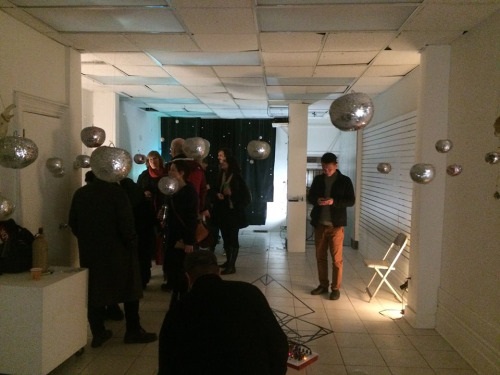
The Celestial Offerings Show in December 2015, Photo Credit: Petra Matar
Connor: Ideally we’re providing a space that’s inclusive, and open, where people feel comfortable. But if I was new to Hamilton and I went to HAVN I could understand feeling intimidated because there’s all these people who know each other already.
Chris: I think it’s always hard, because you establish your audience, and your friends, and you want people to have a stake in the space, that they’re part of it, that they’re not just attending shows, but that they’re part of the community too. But you have to balance that with being open and having new people feel that they can be part of it.
Timothy: So do you have any words of advice to people who might want to start a collective?
Chris: If I had any advice it would be pretty cheesy.
Connor: I don’t know. [Laughter]
Chris: The real trick is having the right group of people.
Connor: Get lucky.
Chris: Yeah, we couldn’t have made this happen in a bigger city where the rents are more expensive.
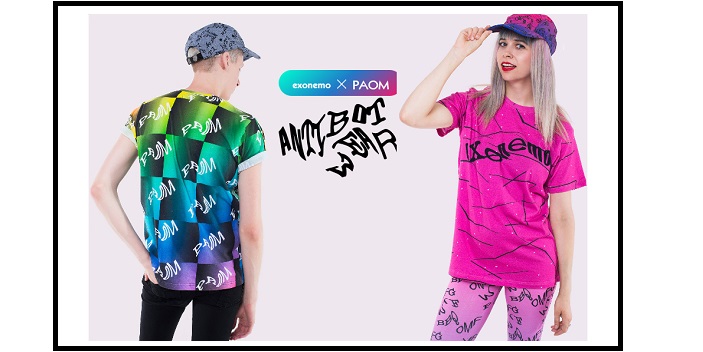
Print All Over Me is a creative community of people turning virtual ideas into real world objects. Every three months, we release a series of silhouettes like t-shirts, backpacks, jockstraps, etc. As a designer, you can upload your own artwork to each silhouette and then offer your design for sale. Even “captcha” designs like in our collab below with EXONEMO.
Every piece on PAOM is custom made. We print the fabric first and then cut and sew. We believe that by taking fashion slowly we can: a. offer high quality items; b. produce in an environmentally sustainable way; c. (and most importantly) offer our studio employees a living wage and health benefits.
Our office and collab studio is based in New York at New Inc. – the New Museum’s incubator. Our main production studio is outside Shanghai and we have a satellite studio in Georgia, outside Savannah.
Click me to design your own captcha – antibot wear.
Supplemental-
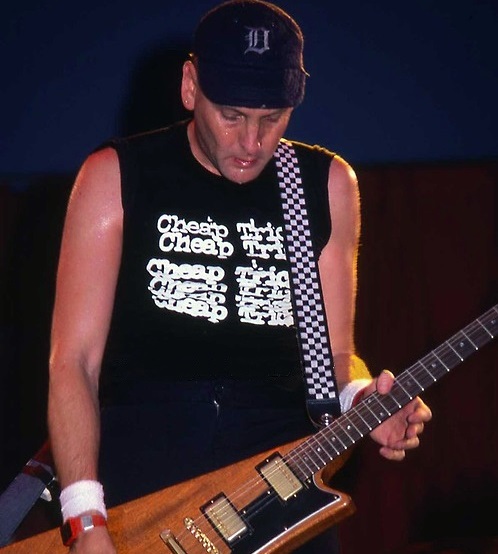
Neilsen’s signature look- a la 1970’s 1980’s
Was Cheap Trick guitarist Rick Nielsen an early captcha-clothing pioneer?


 Titor II reveals the hidden truths behind humanity’s biggest cover-ups.



 Regardless of your medium, I hope this glance into the minds of two established poets from very different walks of life can help dissipate the intimidating mist between process and product, as well as remind you that the transcendent and the familiar are often one in the same.
 Global spectator
 Myles, a breathing artistic currency, treats poetry as an extension of the self with the potency of a movement and the collective memory of a civilization. Myles proves that common experience and abstract phenomena are synonymous when we step back to look.

 The matter has evaded scientific scrutiny until now…….click the following link to learn more about the harmonium in North Indian music: