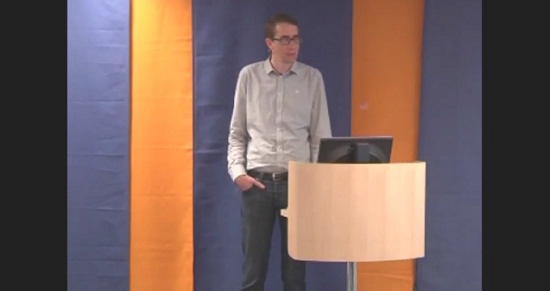
“Ultimately, governments will be the saviour of the Internet,” said keynote speaker, Dragon’s Den star Robert Herjavec at the 2012 Canadian Internet Forum photo: Scott Parker , The Ottawa Citizen
OTTAWA – June 11, 2012 – The Canadian Internet Registration Authority (CIRA) and the Swedish company OpenDNSSEC AB (svb) are pleased to announce they are partnering on an initiative to make the Internet more safe and secure. CIRA will provide support for the continued development and enhancement of OpenDNSSEC, a free administration tool that uses open source code to simplify the implementation of Domain Name System Security Extensions (DNSSEC). DNSSEC is a set of extensions that will significantly improve online security.
“The support from CIRA is valuable to OpenDNSSEC AB in its effort to develop the software. It gives us the opportunity to strengthen the project with Sara Dickinson from the research and development company Sinodun as a project manager,” said Patrik Wallström, Acting President of OpenDNSSEC.
“We are pleased to offer our support to the OpenDNSSEC project,” said Byron Holland, President and Chief Executive Officer of CIRA. “It is through initiatives like this that CIRA can help foster a safe and secure Internet experience for all Canadians.”
OpenDNSSECis being developed in an international co-operation project with several participats: .SE (The Internet Infrastructure Foundation), Kirei, NLnet Labs, Nominet, SIDN, Sinodun Internet Technologies, and SURFnet. The OpenDNSSEC software was released in beta in 2009, and it has undergone significant improvements since that time.
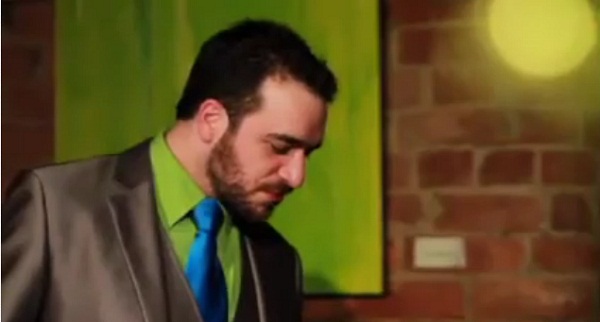
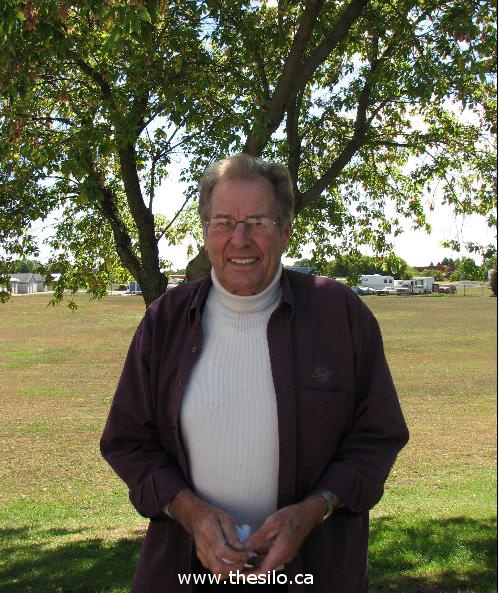
Patrik Wallström, Acting President of OpenDNSSEC photo: Mith Media/The Silo
OpenDNSSEC AB was formed in 2011 to support other top-level domain administrators in their use of the tool to manage Domain Name System Security Extensions (DNSSEC). The company develops the software and offers training and support agreements.
More about the software and DNSSEC
OpenDNSSEC simplifies the management of DNSSEC, an extension of the Internet’s open directory service DNS, which prevents Internet and e-mail addresses from being manipulated and ensures that they lead to the right online destination. In OpenDNSSEC, which .SE was involved in the development of, the necessary processes are automated to eliminate the need for manual management.
Under DNSSEC, Internet zones are cryptographically signed. When looking up a domain name, the signature is controlled using a key published by the party responsible for this zone.
.SE (The Internet Infrastructure Foundation) is a not-for-profit public-service organization that acts to promote the positive development of the Internet in Sweden. .SE is responsible for the Internet’s Swedish top-level domain, .se, encompassing domain-name registration and administration, as well as the technical operation of the national domain name registry. Proceeds from domain-name registrations are used to support projects that contribute to the Internet development in Sweden, through proprietary operations and the financing of independent projects. Read more at http://www.iis.se.
About CIRA
The Canadian Internet Registration Authority is the member-driven organization that manages Canada’s .CA domain name registry, develops and implements policies that support Canada’s Internet community, and represents the .CA registry internationally.
Toronto – GPO leader Mike Schreiner is calling on the McGuinty
governmentto dedicate1% of the transportation infrastructure budget
to cycling and another 1% for pedestrians. Sustainable infrastructure
is a sound investment that will help people choose healthy
transportation options.
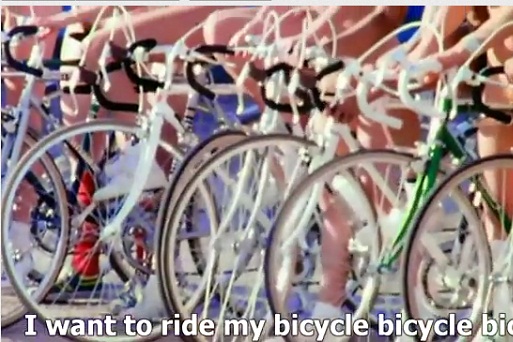
[The song featured is by Mercury and was supposedly inspired by his observing a leg of Tour de France. It starts with a chorus unaccompanied by instruments. The chorus is followed by two verses connected with a bridge, both followed by a chorus. Around the middle of the song there is a solo played with numerous bicycle bells. During the live performances, it was often played by the audience who specially brought the bells for this purpose. The song has a very unusual chord progression with numerous modulations, a change of meter (from 4/4 to 3/4) in the bridge, and the multitracked vocal and guitar harmonies.
The video for the song became scandalously famous for featuring 65 naked women, all professional models, racing at Wimbledon Greyhound Stadium. It was filmed by Dennis de Vallance. The group rented the stadium and several dozen bikes for one day for filming the scene; however, when the renting company became aware of the way their bikes were used, they requested the group to purchase all the bicycle seats. The original video uses special effects to hide the nudity.
“Bicycle Race “é um single da banda de rock inglesa QUEEN. Foi lançado em 1978, no álbum JAZZ e escrito pelo vocalista da Queen FREDDIE MERCURY. Ela foi lançada como um duplo lado-A única juntamente com a canção” Fat Bottomed Girls “. A canção é notável por seu vídeo com uma corrida de bicicleta com mulheres nuas em Wimbledon Stadium, que foi editado ou mesmo proibido em vários países. A canção tem uma progressão de acordes muito incomum com modulações diversas, uma mudança de metro (de 4 / 4-6 / 8) na ponte, e os vocais multipista e harmonias de guitarra.
A canção foi escrita por MERCURY e foi supostamente inspirado por sua observação de uma perna do Tour de France. Ela começa com um coro acompanhados por instrumentos. O coro é seguido por dois versos conectado com uma ponte, ambos seguido por um coro. Ao meio da música há um solo com sinos de bicicleta numerosos. Durante as apresentações ao vivo, muitas vezes era tocado pelo público, que levavam os sinos especialmente para esta finalidade.
O vídeo para a canção tornou-se famoso por escandalosamente com 65 mulheres nuas, todas as modelos profissionais, competindo em Wimbledon Greyhound Stadium. Foi filmado por Dennis de Vallance. O grupo alugou o estádio e várias dezenas de bicicletas durante um dia para filmar a cena,. Porém, quando a empresa que alugou tomou conhecimento da forma como as suas bicicletas foram usados, eles pediram ao grupo para adquirir todos os assentos das bicicletas, o vídeo original usa efeitos especiais para esconder a nudez. Courtesy of http://www.youtube.com/user/lcsRamone CP ]
“If Premier McGuinty can find $1 billion dollars to build his
‘people’s highway,’ why can’t he find a few million dollars to make
streets safe for people?” asks Schreiner.
Today marks the launch of Bike Month in the City of Toronto. Cycling
plays an important role in the health of our citizens, strengthening
our local economies and our general quality of life.
Quebec spends $200 million on cycling infrastructure and earns $135
million each year from bicycle tourism alone. The US dedicates 1.6% of
its transportation budget for states to invest in cycling
infrastructure. Ontario has no dedicated funding to support cycling or
pedestrian infrastructure.
“Ontario needs infrastructure if we are serious about making our
streets and roads safe,” says Schreiner. “A small investment to
support cycling will reap big rewards — combating gridlock, reducing
health care costs and supporting local businesses.”
Two Danish studies showed that when 1% of car drivers switched to
riding bicycles, health care costs were reduced by 1%. Copenhagen
saves $300 per person per year on health costs because almost 80
percent of its population bikes regularly. Cycling and walking
projects create 11-14 jobs per $1 million spent, compared to just
seven jobs created per $1 million spent on highway projects. These and
other studies show that Ontario cannot afford not to invest in cycling
infrastructure.
The GPO’s 1% percent solution would create two funds for
municipalities to access the dollars they need for cycling and
pedestrian infrastructure. By doing so, Ontario would finally
recognize that cycling and walking are important forms of
transportation for growing numbers of Ontarians.
“We need a Complete Streets Act in Ontario to ensure that our streets
are safe for all users: cars, trucks, bikes, pedestrians, wheeled
mobility devices, and transit users” says Trinity-Spadina candidate
and GPO critic for transportation Tim Grant.
Our future- values and esteem guide young girls development at Camp Stella Puella
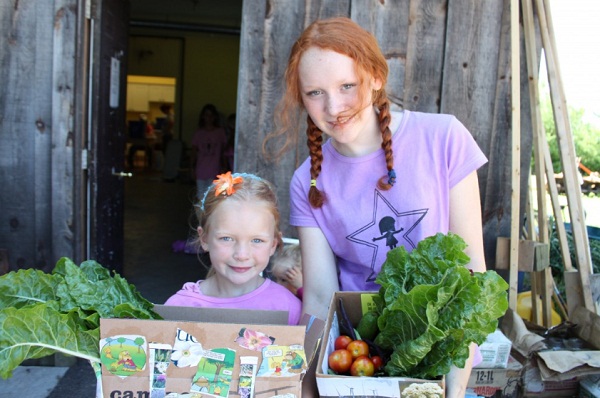
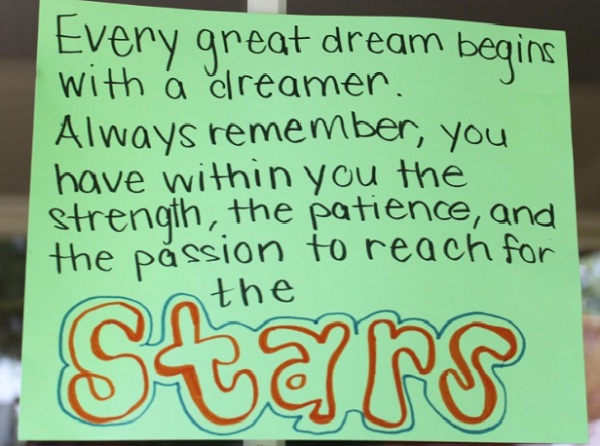
Camp Stella Puella (“star girl” in Latin) is a summer camp “with a higher purpose,” says co-founder Mina Kazemi. Since she began in Dunnville,Ontario in 2008, along with cousin and co-director Julia Salco, the goal has been to provide young girls with a fun environment in which to explore issues of self-esteem, as well as introduce them to social action on a global scale, in hopes of instilling a passion to make positive change in the world.
It wasn’t long before Mina’s older sister Yasmin joined the team, two young women uniquely qualified to bring the world to Dunnville’s children. Mina is studying global health at the University of Toronto, has taken a world literacy trip to Ek Balam Mexico, and travelled to Kenya in 2009 with the Me to We program who, along with their charitable partner Free the Children, seeks to empower youth through activism at home and across the planet.
Yasmin also studies science and global health, has spent time in Ecuador volunteering at a childcare centre, and has been active since 2009 with Community Living. Last year she was president of the Best Buddies program, which matches a university student with a developmentally disabled adult to provide mentoring and friendship. All three young women are lifeguards with National Life Saving and first aid certification.
An emphasis on self-esteem and social action is what “sets us apart from other summer camps,” Yasmin says. Here’s how it works: at the beginning of the week, counselors introduce their campers to three issues of global significance—could be child labour, global warming, and how to find slave and sweatshop-free merchandise for more conscientious consumption. Or, perhaps, why girls can’t go to school inIndia. Through the process of building consensus with the children, a theme for the week is chosen, and the kids begin learning through age appropriate activities. Always they are taught that thinking globally begins with how we act locally, right here at home. Every week, as well, the children help plan a fundraiser based on their chosen theme. As an example, last year, after a week of learning about environmental issues, they organized an eco-spa with proceeds going to the World Wildlife Fund to help save endangered species.
After 5 summers, things are going well. This year a sister camp is active in Hamilton, and the Dunnville contingent is adding some overnight trips to their agenda. When I asked Mina what her motivation for all this work was, she told me that when she was a little girl, she loved going to camp. “It’s a place where long lasting friendships can be forged. And it can be character building too.” It sounds like these three ambitious young women have come up with a formula for a summer camp experience that can be both fun and formative. Every day there is some self-esteem building activity. Building on that foundation of self-love, a bunch of young girls are discovering there is a whole world out there waiting for people of conscience, just like them. For the Silo, Chris Dowber.
UPDATE March1, 2017– Camp Stella Puella does not currently have an active camping program but they continue to engage and offer services. There are plans in place to renew the camp program to learn more, visit www.stellapuella.ca or call 905-774-8601. Please mention The Silo when contacting.
13% of all adult Ontarians are public sector workers- accounting for over half of Ontario government spending
Let’s find alternatives to layoffs and program cuts. On May 16th, I introduced my Private Members Bill titled: An Act to address Ontario’s debt through alternatives to public sector layoffs and government program cuts while reducing the fiscal pressure on the people of Ontario who are having trouble paying their bills. This legislation offers options for tackling runaway spending that has us staring down the barrel of a $411.4 billion debt.
Servicing this debt impairs the ability of Ontario to function and has led to levels of taxation that restrict the ability of businesses to compete, and of individuals to survive financially.
There are over one million public sector employees in Ontario [ according to statistics in one recent study by the CMAJ http://www.cmaj.ca/content/178/11/1441.abstract , in 2007 the estimated adult population of Ontario was 7,996,653 which means 1/8 adult Ontarians or 13% of all adult Ontarians are a public sector employee, a staggering statistic CP ]- 70 per cent unionized compared to 15 per cent in the private sector. Labour costs account for over half of Ontario government spending. This spending sees public sector workers receiving higher compensation – wages, benefits, pensions… – than their private sector counterparts. The total amount paid to the public sector has jumped by 46 per cent since 2003.
My bill aims to take legislative steps address this trend, recognizing the Drummond report https://www.thesilo.ca/the-next-day-ontario-receives-drummond-commission-suggestions-on-public-service-reforms/ advice, “one recommendation that crosses all sectors is the need for prolonged moderation of growth in public-sector total compensation”. While the McGuinty team continues to dodge and weave through credit downgrades, flagging job numbers, and mounting debt, the truth is that unless the province gets its house in order, there will be no alternative but continued cuts to government programs and continued layoffs resulting in a lower level of service for all of us.
To limit the need for such extreme and harsh solutions, I feel the Government of Ontario needs to act immediately to limit compensation paid to employees in the public sector. At the same time, as spelled out in my bill, government must continue to recognize its legal duty to consult fully with those employees and their bargaining agents, and to negotiate with them constructively and in good faith.
My bill [if passed CP ] would amend the Crown Employees Collective Bargaining Act, 1993 to:
1. indicate government’s responsibility and objectives to fully engage, consult and conduct genuine and constructive negotiations with public sector workers on legislative changes to collective bargaining and compensation
2. link the total compensation package to the rate of Ontario’s real GDP economic growth per capita
3. allow for public sector furlough i.e. days off without pay. It’s important to note that between 2007 and 2009, over half the states have imposed mandatory furlough for their public sector employees
4. allow change in public sector pensions to defined contribution from defined benefit. Here as well, at least forty states have enacted significant changes to their public sector pension plans
5. limit length of public sector collective agreements to one year, after which wages are frozen until a new contract is settled, until budget is balanced
6. introduce a comprehensive and transparent benchmarking system for compensation, which would include a costing of the full compensation package, including benefits, pensions and moving through seniority grids
7. mandate stricter criteria for compensation awards in researching private vs. public comparables – achieved through a provincial wage board.
I look forward to providing more details as we approach debate of my bill June 7th For The Silo by Toby Barrett, Haldimand-Norfolk MPP
Rachel DeAlto- flirting expert and brain behind the concept of FlipMe
May15, 2012– Introducing FlipMe, LLC—a revolutionary new way for women to flirt without providing their personal information, but before we get to that, Rachel DeAlto (flirting expert and the mastermind of FlipMe) offers her Top 5 Flirting Tips for Men: 1) Make the Approach – Flirting from afar should last about 1 minute. Take the initiative and start a conversation – even “Hi” works! 2) Play it Cool – Women definitely want to know you are interested, but we don’t want to feel like the last woman on Earth. Let us know you like us, but play a little cat and mouse along the way. 3) Pay Attention – It’s easy to get distracted, but try to give your full attention when you are just starting to get to know her. Listen to what she is saying and ask follow-up questions. 4) Stay Humble – You may be super successful and drive a fancy car, but don’t boast – it is a complete turn off. Let her figure it out on her own, and be impressed by your down to earth style. 5) Go Solo – We know you love your friends, and one day we might too! Until then, keep your boisterous buddies at bay while we get our flirt on.
Rachel DeAlto is a seasoned expert who has been featured on several television shows and programs and regularly teaches courses on flirting at The Learning Annex, America’s leading adult education center.
FlipMe Revolutionizes “How to Date” Rules & the Online Dating Scene and this popular flirting tool empowers Women to channel their inner coquette & make the first move.
How does it work?
– Give a prospective love interest a card with a sweet, sassy or sexy statement
– Log into your profile to see if he has responded
– Upon a response, connect and become intrigued with the new form of flirting
About FlipMe:
What FlipMe really is, is a philosophy. It’s here to say – let’s have fun again, and be confident. Get out there, meet people and make a connection. It’s breaking the ice made easy. You take charge of your dating life by giving your sassy, flirtatious side the perfect sidekick. FlipMe brings a casual confidence to meeting newpeople by offering a clever way to say “hi.” This stylish accessory is a simple and intriguing way to break the ice and let someone know you’re interested without divulging your personal details. When you purchase a pack, you get 30 cards, each with a unique code that lets the lucky recipient view your profile and send you messages. No one gets access unless you give them a card, and no one gets to see your personal information. It’s a safe, secure way to put the fun back in flirting. http://flipme.com/index.php
Canadian crooner Ori Dagan (well at least half of him)
Ori Dagan (twitter @oridaganjazz) seems to me like a man on a mission. With a rich baritone voice, he has tried to craft a jazz album that is both hip and playful, and, at the same time, a genuine jazz album, complete with standards and heavyweight musicians, and some original tracks as well. Dagan’s album, Less than Three, is a tasty stew of standards and originals with a classic Hebrew song thrown into the mix, and one from his own pen: Nu Az Ma, a call for peace of truly universal dimensions.
Ori Dagan (still from performance) image: www.thesilo.ca
After an opener of Madonna’s Lucky Star (yep, THAT Madonna CP ), which reminded my friend Sophie of a 60’s beat poetry track, with minimalistic base and percussion and funky vocals, Dagan moves to his mother tongue with Eretz Zavat Halav, a Hebrew song featuring the magnificent Jane Bunnett on soprano sax. Bunnett is a true jazz superstar, a multiple Juno award winner and multiple Grammy nominated musician and bandleader who has worked combining Cuban music with new and avant-garde jazz. There was a house down the street from me in west-end Toronto where people told me Jane Bunnett had moved. I used to hear her sax emanating out into the street from a third-story window. It was truly wonderful.
[If there’s any doubt about Ori’s capabilities as a live-on-the-spot performer this youtube video should alleviate. CP]
The material on Dagan’s CD is eclectic. I’ve already mentioned the Madonna cover. There’s also a totally scat version of Lady Gaga’s Bad Romance that is exceedingly fun and features some great scatting too. Not everybody can do that you know. And he throws in some very sensitive renditions of Elton John/Bernie Taupin (This is your Song) and Lloyd Webber/Rice (I’d Be Surprisingly Good for You), to demonstrate a surprising range that can cover modern hits to a cutting, up-tempo Sweet Georgia Brown to round off the album.
This is a very dexterous record featuring a range of styles, and Dagan’s voice is rich, and according to my friend Sophie, sexy. She’d go see him “in a minute.” –CD
A few examples of the fantastic Cooling Tower art found at: http://weburbanist.com Did you know Cooling Towers (the nuclear style) predate nuclear power?
Ontario Energy Board report reveals nuclear causing rising electricity rates. “We need an honest discussion about rising electricity prices in Ontario. The misleading rhetoric blaming green energy for rising electrical rates is a disservice to the people of Ontario. According to the Ontario Energy Board, since 2006, 45% of the increase in our electricity costs are from subsidies for the nuclear industry, while only 6% are due to subsidies for green energy.
This will only get worse if the McGuinty Liberals proceed with their $33 billion nuclear spending spree. We still have not paid off the $19.8 billion debt from our last nuclear fiasco. The bottom line is that the cheapest and greenest kilowatt is the one we save. We have to stop burning money and deliver a long-term energy plan that prioritizes energy efficiency programs.
The stakes are too high to have politically partisan rhetoric derail an adult conversation about our energy future. We need to protect our pocketbooks with an honest look at the causes of rising electrical rates.”
The full OEB report is available here- OEB MSP green report [ It’s not a ‘light’ read at 106 pages but it’s quite detailed CP ]
Jaymini Bhikha Cell: 416-275-8573 Office: 416-977-7476 jbhikha@gpo.ca Green Party of Ontario PO Box 1132 Toronto, ON M4Y 2T8 Canada
Don't they want to listen anymore? The Green Party of Ontario believe that the recently passed budget bill " muzzles public input onchanges to important environmental protections."
[Ontario]Liberals have voted to pass a budget that muzzles public input on changes to important environmental protections. With these changes buried in the budget bill (Bill 55), the government has in effect exempted them from the public participation process normally required by law.
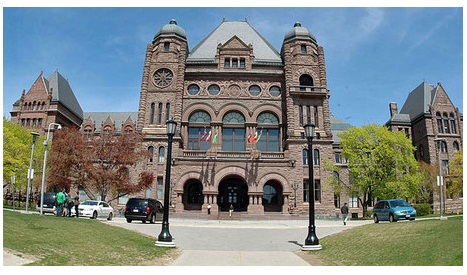
The Ontario Legislature at Queen's Park, Toronto, Ontario Canada
“The GPO is all in favour of working together, and we applaud the cooperation that has averted another election. But it’s wrong for the Liberal government to use the budget bill to silence public input on changes to environmental protections,” says GPO leader Mike Schreiner. “The public has a right to comment on legislation that protects Ontario’s natural legacy.”
The GPO is calling on the Liberals to remove changes to laws prescribed under the Environmental Bill of Rights from Bill 55 before final passage. Greens oppose using omnibus legislation to avoid the mandatory 30-day public comment period.
“Changes to environmental protections have no place in a budget bill,” says Schreiner. “Solving a financial deficit by creating an ecological one isn’t sound management or good leadership. It’s time for the Liberals to do the right thing and address changes to environmental laws separately from the budget.”
Green Party of Ontario PO Box 1132 Toronto, ON M4Y 2T8 Canada
Supplemental-
TORONTO, ONTARIO–(Marketwire – April 19, 2012) – The Quetico Foundation is deeply concerned that the Ontario Government’s omnibus budget bill will impact Ontario endangered species and parks. Significant amendments to dozens of important pieces of legislation are contained within Bill 55, Strong Action for Ontario Act. These changes being proposed, without consultation, include serious modifications to the Endangered Species Act, 2006 (ESA) that allow for exemptions, and to the Provincial Parks and Conservation Reserves Act, 2006 (PPCRA) that threaten and weaken the process for preparation and review of park management plans. These modifications have no relevance to budget matters!
The Foundation is concerned that Bill 55 both weakens crucial global initiatives to preserve biodiversity and relieves government of its duties with respect to proper management of our Ontario Parks.
Further, inclusion of multiple legislative amendments in a budget bill disregards the process that normally opens such changes to public consultation. The standard process of the posting of changes on the Environmental Registry has been ignored.
The Foundation urges Ontarians to demand that the proposed endangered species and parks legislation amendments to the PPCRA and the ESA, along with a number of other Acts that fall under the Environmental Bill of Rights, be removed from Bill 55. Citizens need to insist that due process be followed and that any proposed amendments be posted on the Environmental Registry and be open to public discussion in accordance with the normal government process.
About The Quetico Foundation:
The Quetico Foundation was formed as a not-for-profit organization in 1954 with a mandate to protect the wilderness values and ecological integrity of Quetico Provincial Park and other wilderness areas in Ontario for the benefit of future generations.
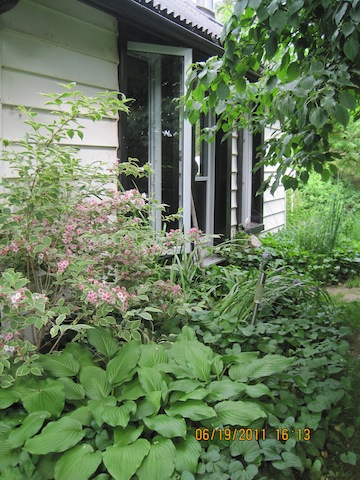
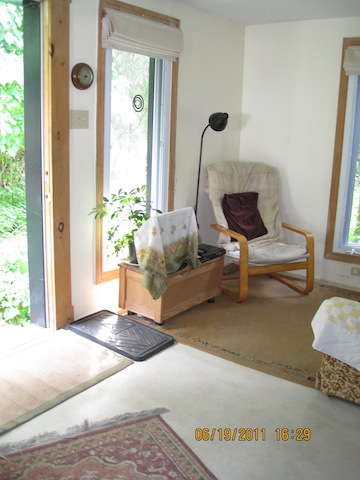
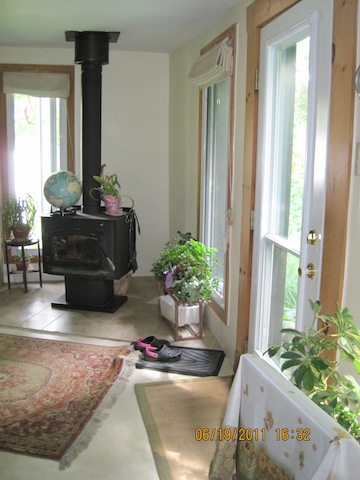
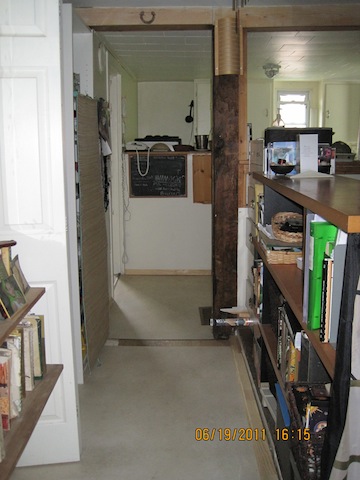
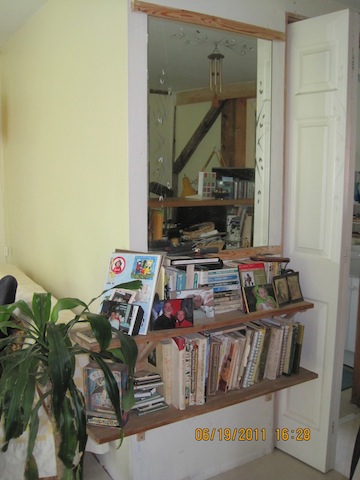
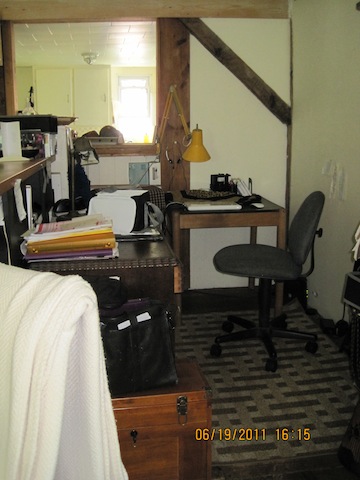
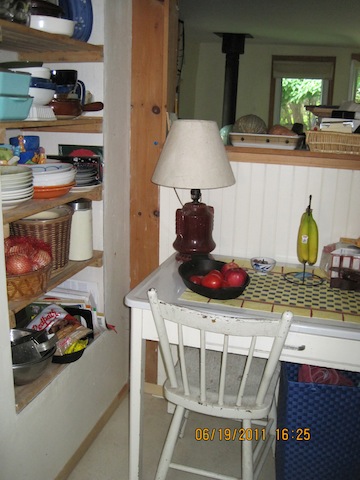
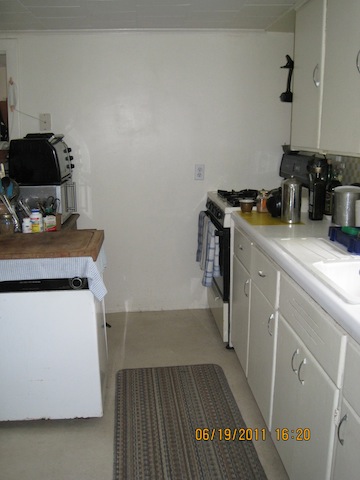
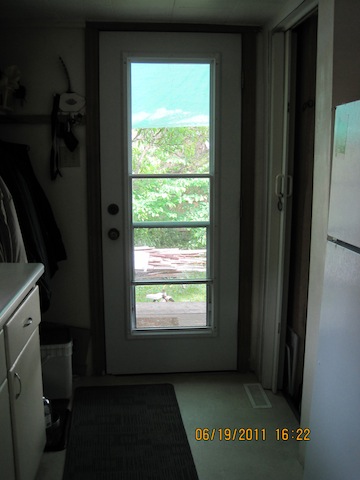
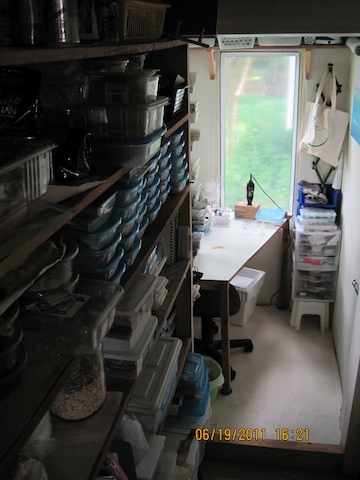
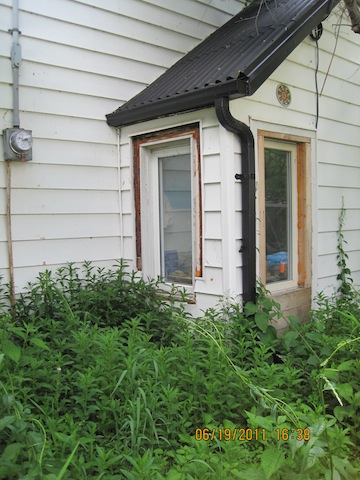
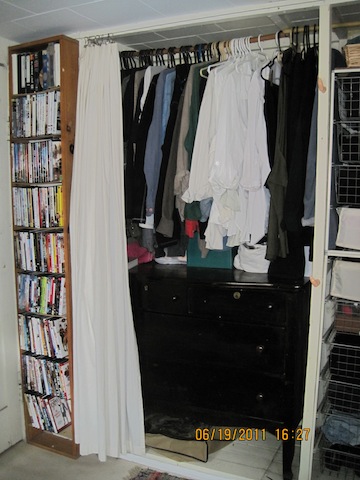
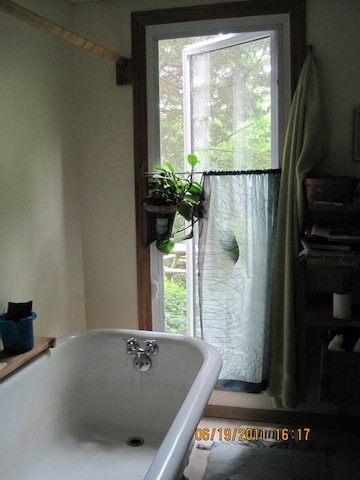
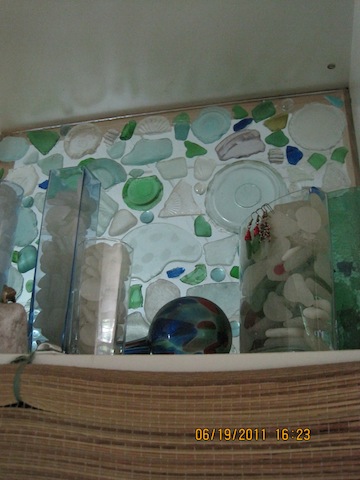
Here are some quick shots I did of our place. For us, the challenge is to use every possible space and yet achieve a feeling of spaciousness. I just did a count of all the space saving/creating measures we have made over the years – about 25 – not counting replacing, enlarging and adding windows and doors – from simple shelves to complex projects involving cutting into walls and making a new room.
It has taken us more than 20 years to do this. We purchased the place and a barren 3/4 acres in 1986 for $20,000. And, it has turned out even better than we dreamed possible.
Even in this tiny space, we can lose each other. David Wells, my partner in all this, has a blog in which he talks about our life here. You may be interested: http://DavesBackPorch.blogspot.com/p/about-me.html
OUR SMALL HOUSE
EXTERIOR FRONT
INTERIOR – FRONT
INTERIOR FRONT
‘HALL’ FROM FRONT DOOR TO KITCHEN
MIRROR IN ‘HALL’ TO REFLECT MORE LIGHT
OFFICE/COMPUTER (to the immediate right of above ‘hall’)
KITCHEN STORAGE AND TABLE (other side of office above)
KITCHEN – small but functional. As a former professional
cook, I have found ways to scale equipment way down,
and use my creativity to produce nutritious, interesting meals.
NEW KITCHEN DOOR ENTRY – STAIRS TO JEWELLERY STUDIO AT RIGHT
JEWELLERY STUDIO – PREVIOUS ENTRY
NEW BACK ENTRY
BEDROOM (7′ X 11′)
CLOSET – DVD STORAGE – behind door
BATHROOM w CLAWFOOT TUB – AND WINDOW LOOKING
OUT TO ‘WOODLET’ (A Spa at Home)
BATHROOM VANITY WITH BEACH GLASS MOSAIC INTERIOR WINDOW
TO LET LIGHT INTO CENTRE OF HOUSE
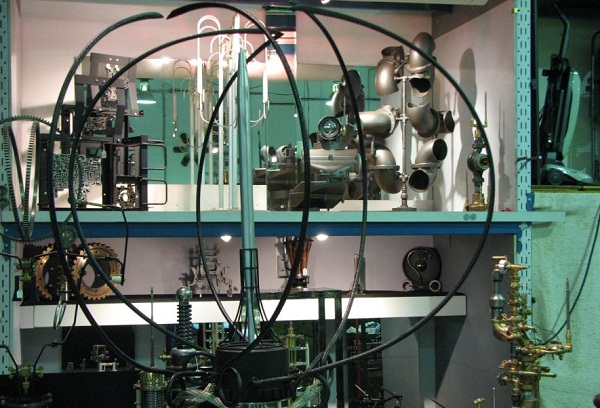
In 1968 Simon Kotsch got into the army surplus business. It was good to him, but in ways you might not expect. Something began to happen to Simon as he sorted through his bounty of obsolete engine parts and electrical fittings: he noticed that he found the pieces beautiful. An excitement took hold of him. And then he went to work, drilling and cutting and fitting metal components together to make new things. Beautiful things. He felt “caught up,” he says simply. So began a love affair with military-industrial cast-offs that continues to this day. This was the birth of a sculptor and of a mecha artist.Let us throw aside, officially and forever, the artifice of journalistic objectivity.
I like this guy’s passion and I like his work. When we visited Kotsch’s Victoria St. Studio in Simcoe, Ontario we were greeted with warm smiles that never went away. Taking joy from your work is one thing, but when you combine joy with the sensibility of a true artist who respects, even loves his materials, the results can be magical.Some of Kotsch’s sculptures look like they could have come from the mind of Jules Verne—grand, monumental machines whose functions border on the mysterious, infused with Kotsch’s concern for symmetry and his acute sense of balance, proportion, and pattern. Others have a strong vertical momentum, like castles or rockets with many levels. But not everything has a sci-fi feel.
Kotsch uses the heft and gravity of larger pieces to create powerful and interesting earthbound sculpture. His ability to recognize, or create, striking patterns makes some of his metal works quite decorative to my eye—and that in no way infringes on their status as works of art.
Kotsch says he “savours the natural colour” of each item, whether it’s aluminum, copper, brass or porcelain (used as insulation in old electrical systems). You will not find much (any) painting here. You will also not find much welding. This, by his own admission, is because he’s not very good at it, and mediocre welding would make a sculpture look awful. He cuts and drills to make pieces fit. One technique he has developed is to take slices out of solid machine parts with a band saw, revealing patterns of copper wire within, like opening a geode.
An example of influence: years of working with Army surplus ephemera have inspired Simon’s forms
Simon Kotsch takes obsolete machinery—all of his extensive catalogue of parts predate metric—and turns it into stimulating works of art. We spent about an hour with him, and I left both excited and energized. I, too, had been “caught up.” This is one of the miracles of art for me: through active engagement with an artist’s work a kind of interface occurs between creator and appreciator, mediated through the work itself. I certainly appreciated the skill and imagination of Simon Kotsch, but I think I caught a bit of his love as well. For the Silo, Chris Dowber.
"The NDP's proposal to subsidize home heating fuel rather than supporting our most vulnerable children through full funding of the Ontario Child Benefit reflects misguided priorities," says Green Party of Ontario (GPO) leader Mike Schreiner
On April 3rd, NDP leader Andrea Horwath introduced the first of their budget proposals, taking HST off of home heating costs. “The NDP’s proposal to subsidize home heating fuel rather than supporting our most vulnerable children through full funding of the Ontario Child Benefit reflects misguided priorities,” says Green Party of Ontario (GPO) leader Mike Schreiner. “Subsidizing energy consumption increases pollution and benefits big home owners the most –generally the wealthy consume the most energy.”
“This is bad economic, social and environmental policy, driven by political expediency,” adds Schreiner. “The NDP’s proposal is a job creation strategy for Alberta oil and natural gas companies, not Ontario businesses.”
The GPO prefers to support lower-income families, social assistance recipients, and energy conservation ahead of subsidizing energy waste.
With this in mind, the GPO advocates eliminating the misleadingly-named Clean Energy Benefit, which supports the wasteful consumption of electricity, clean or dirty. Canceling it would save $975 million.
Here’s how we’d advise investing those savings, while still balancing the budget:
* $220 million for an energy rebate program targeted to lower-income families and seniors. * $600 million for an energy-efficiency building retrofit program to help homeowners, tenants and small business save money by saving energy. * $90 million to fund a full increase in the Ontario Child Benefit.
* $65 million to avoid freezing social assistance rates.
It’s not too late to put our financial, social and environmental future ahead of cynical politics. Environmentally and socially-concerned, fiscally-responsible voters should demand that Horwath’s NDP rethink such short-sighted budget demands. Read the GPO open letter to Premier McGuinty with our proposals for budget amendments www.gpo.ca
Jaymini Bhikha (Office) 416-977-7476 (Cell) 416-275-8573 jbhikha@gpo.ca
Sent from Green Party of Ontario PO Box 1132 Toronto, ON M4Y 2T8 Canada
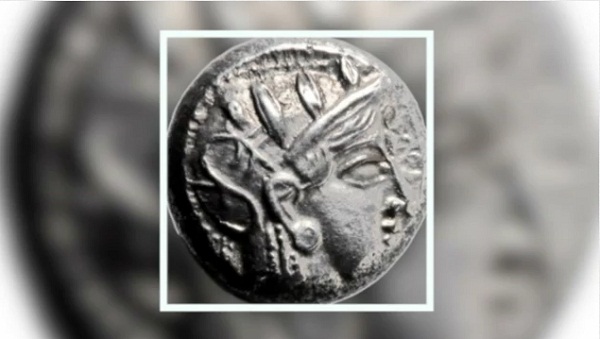
Incredibly rare “Owl type” Silver Drachm (opposite face with Jerusalem lily) image:courtesy Heritage Auctions
The first silver shekel struck in Jerusalem by Jewish forces rebelling against Roman oppression in the first century CE, one of only two specimens known, brought a world record price of $1,105,375 at Heritage Auctions on March 8 as part of the auction of The Shoshana Collection of Ancient Coins of Judea. The coin sold to an anonymous overseas collector. Overall, this auction realized over $7.6 million, with the whole of the collection, consisting of more than 2200 coins in total, expected to realize more than $10 million in multiple auctions this year.
“This Year 1 silver shekel, struck shortly after the Jewish War began in May of 66 CE, is an incredible piece of history,” said Cris Bierrenbach, Executive Vice President of Heritage Auctions. “This is literally one of the very first coins the Jewish rebels struck after the ousted the Romans from Jerusalem, sending shockwaves through the empire. That history, as evidenced by the spirited bidding and the superb price realized, obviously continues to resonate today, more than 2,000 years later.”
The Shoshana Collection, assembled over the course of four decades by an American collector, is the greatest assembly of ancient coins related to the foundation of ancient Israel ever offered, spanning more than 11 centuries.
Other highlights from the collection include an incredibly rare gold aureus as Caesar (69-79 CE), struck at an Eastern mint in 69 CE, likely Tyre, anticipating the subjugation of Judaea, which the Romans achieved with the fall of Jerusalem in 70 CE, which brought $956,000, while one of only two known surviving silver quarter-shekels of Year 1 (May 66-March 67 CE) in existence brought $896,250.
A few of the additional highlights included:
Jewish War (66 – 70 AD). AR half shekel. Year 4. Hendin 1365. TJC 209. AJC 262,25. Samuels 980 (this coin). Extremely Fine. One of six recorded specimens. Realized: $358,500.
Vespasian (69 – 79 AD). AE sestertius. AD 71 Rome. Hendin 1500b. RIC 71,161. BMC 543. Impressive Good Extremely Fine. Realized: $262,900.
Jewish War (66 – 70 AD). AR shekel. Year 5. Hendin 1370. TJC 215. AJC 263,31. Samuels 94 (this coin). Very Fine. Ex: Nelson Bunker Hunt. Realized: $262,900.
Jewish War (66 – 70 AD). Year 5. Hendin 1370. TJC 215. AJC II 263,31. Brand 3. Bromberg II, 309 Good Very Fine. Realized: $179,250.
Divus Vespasian (69 – 79 AD). AV aureus. Struck by Titus, AD 80-81, Rome. Hendin 1581. RIC 230,363. Cohen 143. BN 89. Superb. Realized: $131,450.
Aelia Capitolina (Jerusalem, renamed by Hadrian) Collection, 164 coins. Realized: $107,550.
Titus as Caesar (79 – 81 AD). AV aureus. AD 72-73 Rome. Hendin 1469. RIC 84, 370. BMC 520. BN 73. About Extremely Fine. Realized: $101,575.
Vespasian (69 – 79 AD). AE sestertius. AD 71 Rome. Hendin 1500b. RIC 71,161. BMC 543. Samuels 146 (this coin). Extremely Fine. Realized: $95,600.
Bar Kokhba Revolt (132 – 135 AD). AR sela. First year (132/133 AD). Mildenberg 125,4.1 (this coin). Hendin 1373. TJC 218c (this coin). AJC 264,1c (this coin). Samuels 98 (this coin). Superb. Realized: $89,625.
Bar Kokhba Revolt (132 – 135 AD). AR sela. First year (132/133 AD). Mildenberg 124,3.5 (this coin). Hendin 1373. TJC 218 (these dies). AJC 264,1 (these dies). Samuels 97 (this coin). Superb. Realized: $89,625.
Auction of US coins continues on New York and over the Internet at www.HA.com/Coins through Sunday, March 11.
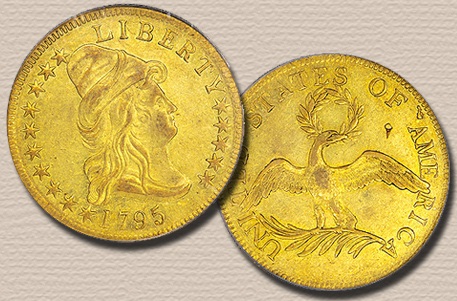
Seldom Seen Selections: One of the finest known 1795 Eagles
The famous 1795 American gold ‘eagle’ coin
The ten dollar gold pieces, given the name “eagle,” were the largest gold coins produced by the first U.S. Mint from 1795 through 1804. Like all early gold coins (and many early silver coins), these pieces did not carry an actual denomination as part of the design.
The 1795 BD1 is considered the first variety coined for the year, therefore it is the first eagle minted by the United States! There are more of them surviving today than all other 1795 varieties combined, and it is actually one of the five most common die varieties of the entire series from 1795 to 1804, a fact that would probably surprise most collectors. Quite a few examples survive in Mint State grades, giving collectors a reasonable chance of obtaining a high-quality example of the Small Eagle reverse design.
Many of the Mint State pieces have prooflike fields, including the coin we are featuring in our upcoming 2012 April 18-22 US Coins & Platinum Night CSNS Signature Auction. Although the fields are not deeply mirrored, they are clearly reflective. The surfaces are exceptional with only a few scattered abrasions. Faint adjustment marks are evident at the center obverse and on some of the obverse dentils. All design elements on both sides are sharply struck, suggesting to some the possibility that this may have been some type of presentation piece. This example is a relatively early die state of the variety, with faint obverse die cracks but no evidence of reverse cracks. Despite the existence of several Mint State pieces, this example is one of the most attractive we have handled.
A curious situation exists for both early half eagles and early eagles. For both denominations there were multiple varieties dated 1795 and only a single variety dated 1796, despite mintages that suggest this is illogical. During the course of 1795, just 2,795 eagles were minted from September 22 through November 27. In 1796, the Mint produced 6,934 eagles from January 9 through December 22. If we take these annual production totals at face value, an average of 560 coins per die marriage were struck in 1795 while a single die marriage produced all 6,934 coins in 1796. Clearly there is something wrong, unless many of the coins produced in 1796 were from dies dated 1795, and we can be certain that this was the case. According to the Guide Book, the 1795 mintage totaled 5,583 coins and the 1796 mintage totaled 4,146 coins, but even those figures are suspect, suggesting a survival rate of 10% for 1795 eagles and only 4% for 1796 eagles. This discussion illustrates the challenge that numismatists have today when attempting to reconstruct the events of the earliest years at the Philadelphia Mint. There were no records of mintages for individual die varieties, and any attempt to make such estimates today is plagued with problems.
In Early U.S. Gold Coin Varieties, John Dannreuther provides estimated mintages for every variety and for the number of survivors for each variety. The only thing we know for sure is the number of die marriages known from 1795 through 1804 (32) and the total mintage for that period (132,714 coins including 122 pieces reserved for assay). By using the midpoint of Dannreuther’s survival estimates, we can also establish an approximate survival rate for the series of 2.5%. Is this enough information to establish original “mintage figures” for each variety or even for each coinage date?
Mark Van Winkle has spent considerable effort over several years attempting to correlate mintage figures with individual varieties, and now feels that it is impossible. There are at least two variables that cannot accurately be determined. First, the exact emission sequence needs to be determined (including both die marriages and remarriages). In a series like the early eagles, the emission sequence alone is enough to give a numismatist nightmares. Once the emission order is known, an accurate estimate of the survivors must be established for each variety and remarriage, and this is nearly an impossibility. Finally, differing survival rates from one coinage date to the next must be pinpointed, a seemingly impossible task. CP for Heritage Auctions Dallas, Texas www.ha.com
Supplemental– The Numismatic Network of Canada for those interested in studying and collecting Canadian coins, tokens, paper money and related numismatic materials http://www.nunet.ca/
The Ontario Green's feel that merging all provincial school systems is a long-term solution to tackling the deficit by reducing redundancies.
Toronto, ON – “Putting the public interest before vested interests is the most equitable and efficient way to eliminate Ontario’s record deficit,” says Green Party of Ontario leader Mike Schreiner. Eliminating the deficit requires tackling vested interests in the province’s biggest budget categories: education, energy and health care, as well as bringing our tax system into the 21st century. The Green Party is putting forward long-term solutions to tackle the deficit:
ONE SCHOOL SYSTEM
Ontario must merge the Catholic and public school systems into a single French and English public system to build a high quality, financially responsible, and equitable education system. Two school systems is an obvious source of duplication in the Ontario budget. Ontario also has a financial and social obligation to end the discrimination that results from funding only one religious school system. [ http://www.oneschoolsystem.org/ CP ] STOP BORROWING BILLIONS TO SUBSIDIZE THE WASTEFUL USE OF ENERGY
Ontario cannot afford to borrow 1 billion dollars each year to reduce electricity bills by a few dollars each month. The province should not play a shell game with our money for a program that benefits the wealthiest the most. The misleadingly named Clean Energy Benefit should be scrapped and replaced with a targeted rebate program for low income families and seniors who need the help the most. Such a rebate would be more effective at a much lower cost. We all save money with programs that help people save energy. IT’S HEALTHY OUTCOMES THAT MATTER
Ontario must move from a sick care system focused on hospitals to a home and community care system focused on illness prevention. Funding priorities should focus on healthy outcomes and providing people the continuum of care they need to maintain health and treat illness at the lowest cost to the public purse.
Ontario’s current orientation to treating sickness is costly and unsustainable. We can do better by keeping people out of hospital in the first place. This starts with a funding formula that pays doctors for promoting health, not the quantity of services they provide. We need to empower all health professionals to operate at their full scope of practice. BRING OUR TAXES INTO THE 21ST CENTURY
The Green party believes the government made a serious mistake in establishing a commission that only addresses government expenditures. We also need a modern tax system that provides sufficient revenues to deliver public services. We need an equitable and efficient tax system that enriches quality of life and encourages job creation without damaging our natural capital. The government should cancel corporate tax cuts that we can’t afford. The Green Party calls on the McGuinty government to form a public commission on the reform and modernization of Ontario’s tax system.
CONCLUSION
“It’s time for politicians to stop punting problems to our kids,” says Schreiner. “The Green Party commends the Drummond Commission for tackling some tough issues. Now the government needs to engage the public in implementing solutions.”
Media Contact: Becky Smit Cell: 647-830-6486 Office: 416-977-7476 beckysmit@gpo.ca
Sent from Green Party of Ontario PO Box 1132 Toronto, ON M4Y 2T8 Canada
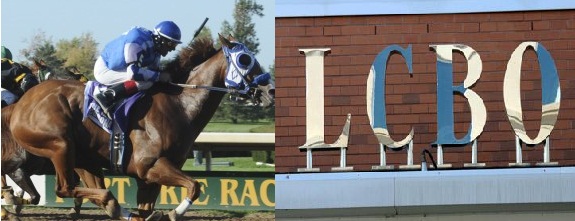
Ontario will end tax payers subsidy of horseracing and sell the LCBO headquarters in its efforts to combat the provinces deficit
Ontario’s newest actions to eliminate the deficit are critical to job creation and economic growth, says Minister of Finance Dwight Duncan. The Ontario government is moving forward with a responsible plan to eliminate the deficit so that more jobs are created and the economy continues to grow.
Since the introduction of the 2011 Budget, growth in the global economy has slowed. This means additional steps must be taken to slow down the rate of growth of government spending in order to keep the plan to eliminate the deficit on track.
Ontario Finance Minister Dwight Duncan outlined today the next steps in the government’s plan to eliminate the deficit. These steps will give Ontarians better value for money and lead to improved public services.
The LCBO headquarters, currently located on some of the most valuable, under-developed real estate in Canada, will be sold and redeveloped. A retail store will remain in the vicinity while the headquarters will be moved. The LCBO will realize ongoing savings and after the land is sold and a new, modern facility is built, it is expected to generate well over $200 million for taxpayers.
The government will move to greater involvement of the private sector in ServiceOntario through a strengthened public-private partnership. This will deliver better value for money and improve customer service for families.
Since 1998, Ontario taxpayers have been supporting horseracing with a subsidy of up to $345 million a year. The province will evaluate that subsidy given the need to continue to invest in health care and education.
Minister Duncan reiterated that the government is on track to meet its deficit target this year, and said these new measures will help ensure the government stays on track to eliminate the deficit by 2017–2018.
QUOTES
“Eliminating the deficit is essential to continued economic growth and job creation. A strong economy supports the schools and hospitals families rely on. Our plan will eliminate the deficit by 2017–2018.”
— Dwight Duncan, Minister of Finance
QUICK FACTS
The LCBO property currently includes head office space and a large warehouse dating from 1954. It also contains a flagship store, which will be redeveloped nearby.
About two-thirds of ServiceOntario’s in-person service locations are already operated by private sector partners.
With 17 locations, Ontario has more racetracks and provides more public funding than any other place in North America. The cost of the current horseracing subsidy would pay for over 27,800 hip or knee replacement surgeries or provide over 9 million hours of home care.
LEARN MORE
Read about the revitalization of Ontario Place. Read http://www.ontario.ca/en/initiatives/progressreport2011/index.htm
FOR MEDIA INQUIRIES ONLY:
Aly Vitunski, Minister’s Office, 416-325-9819
Scott Blodgett, Ministry of Finance, 416-325-0324 www.ontario.ca/finance-news
*Disponible en français
AYR, Ontario — In 2011 when AyrSpace held Canada’s only one hundred-woman art show for the
100th anniversary of International Women’s Day https://www.thesilo.ca/international-women-join-forces-through-art/ , the men took note. The idea of the painting exhibition “Men in Business 2012” was born.
“The idea came to me to encourage the hidden talents among us,” said John Redfern, a Customs
Brokerage executive at The Farrow Group just north of Ayr. Redfern helped realize last year’s effort.
“Jill said to me in an email -15 men would be a perfect number for an exhibition,” referring to Jill Yuzwa, Gallerist at AyrSpace, gallery of visual and functional art. And in similar style to the year prior, a call for collaborators went out through social networks. Men from all economic sectors were encouraged to respond – whether their works be an extension of their day to day or their alter-artistic ego.
Cosmonaut painting (far left) by Jarrod Barker.
And they did respond: a Vancouver architect, a celebrated Canadian documentary film maker, a custom furniture craftsman, educators and leaders of education, independent businessmen, lawyers and a specialized medical technician. The artworks are as varied as the gentlemen themselves. And coincidentally there are 15 collaborators. North Dumfries Mayor Rob Deutschmann will be on hand to welcome the collaborators and open the event on Friday February 3, 2012. “Men in Business 2012” will run through Sunday February 26, 2012.
The exhibition is dedicated to Ayr resident Stephen Gross who is currently undergoing cancer treatment. Mr. Gross is perhaps best known in the Region of Waterloo for his excellent work at the Kitchener Downtown Community Health Centre.
The 15 collaborators of Men in Business 2012 invite the community and collectors to this exhibition and have initiated that partial proceeds of their artworks be allocated to NewmanBoysTrustFund.ca in fond memory of Katherine (Bunny) Newman the Gallerist’s cousin. AyrSpace, gallery of visual and functional art, is located at 44 Stanley Street in downtown Ayr. The gallery opened in October 2008 as a socially innovative collaborative and now represents a range of Canadian artists. www.ayrspace.ca For the Silo, Jill Yuzwa.
Media contact:
Jill Yuzwa
AyrSpace
519.632.9030
art@ayrspace.ca
Farmers Fly into RCAF Museum Last Fall, on Saturday, November 19th, 30 members and 2 guests of the Ontario Flying Farmers (OFF) paid a return visit to the No. 6 RCAF Dunnville Museum at the Dunnville Airport. Four planes flew in from the Goderich, Kincardine and the Elora area. Poor weather prevented more from flying in, but members drove in from as far as Peterborough. Adrian and Hortense Verburg were the conveners of the event. Adrian was one of the first members of the No. 6 RCAF Dunnville Museum.
Among other objectives, the Ontario Flying Farmers (O.F.F.) promote the practical use of airplanes in agriculture*, and encourage landing strips close to towns and cities. The O.F.F. promote safe flying through continued education and upgrading; help develop the public acceptance of light aircrafts; speak on behalf of farm familites at a national level and cooperate with aviation organizations to promote general aviation through legislation.
A Hangar1 (which is home to the RCAF Museum) display of a World War 2 trainer
The No. 6 RCAF Dunnville Museum, which they visited, preserves the memory and artifacts of the No. 6 Service Flying Training School. Part of the British Commonwealth Air Training Plan, the No. 6 was one of 41 such facilities built in Canada during WW II. The Museum, housed in half of Hangar 1, has 4 WW II trainers that still fly as well as extensive displays of course records, photographs, uniforms, training materials, flight log books and other RCAF-related artifacts from WW II.
The Flying Farmers is an international organization that was established in 1945, members are families or individuals interested in flying and or agriculture.
The OFF are celebrating their 50th year in 2011.More information is available by sending email to gc.paisley@hotmail.com Please mention that y0u found this article at The Silo.
Ian Durand is the Vice-President of the No. 6 RCAF Dunnville Museum. The museum is located at the Dunnville Airport at 536 Port Maitland Rd. in Dunnville. Contact information is available at Silo Direct Link to Dunnville Airport
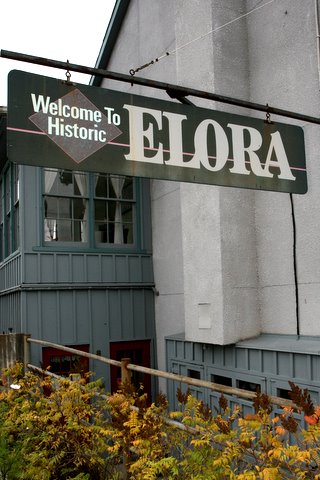
It’s worth saying again: One of the prettiest villages in Ontario is Elora. It’s so nice very time I visit this village of 5, 500 I want to move here. A lot of people have done just that. Elora is a place that grows on you from the minute you arrive. Over dinner at a local favourite eatery, The Shepherd’s PubI struck up a conversation with Nadine McEwen and Stan Winegard who told me they moved here about two and a half years ago from Timmons. Stan said, “It’s a real pretty place and a very welcoming community with an active artistic community. Since Nadine is a sculptor, it fits perfectly into our life style”. Even the owners of this authentic British pub had moved to Elora from Guelph just a few months ago. Throughout the weekend I bumped into others who made the move. Well now, let me think more about this moving thing.
Known for its unique limestone architecture, Elora was founded in 1832 by Captain William Gilkison, a British officer recently returned from India.
Shopping
Elora is an artists’ community specializing in handcrafted and one-of-kind items. The two main streets to stroll are Mills and Metcalfe.
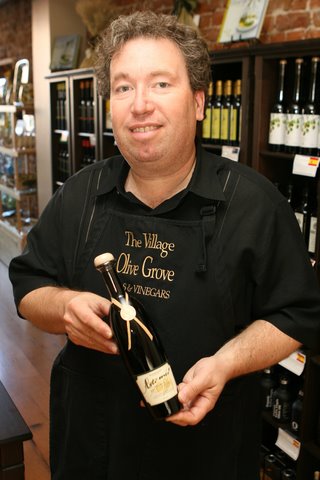
One stand out worth finding on Mill Street, near The Shepherd’s Pub, is The Village Olive Grove (it was the free olive oil tastings sign outside the store that first caught my eye). I met one of the owners, David Medeiros (He’s from Toronto). Medeiros believes their shop is the only one in Canada selling exceptional olive oils and vinegars from around the world. A few other shops that caught my eye were; Sante’s it’s a natural grocery store with organic and fair-trade foods and gifts. A Weed Bit Natural features hemp products and organic clothing. Jammed Lovely is filled with unique one of a kind gift items. Sweet Trash has clothing and accessories from the 1920’s and onwards. At Grand Gourmet KitchenwareI had to have some of the items explained to me as to what they were. You can tell how much time I spend in the kitchen.
The Village Olive Grove occassionally has free olive oil tastings.
Culinary Walking Tour
If you arrive on a Saturday sign up at the Village Olive Grove for the $10.00 walking tour between 1 and 3 pm. During the tour, you’ll sample specially created dishes from eight restaurants while learning about the history and architecture of the area.
One of the prettiest villages in Ontario-
Holiday Happenings
-Santa Claus Parade, Saturday, November 26 and Parade of Lights begin at 6pm.There’s another parade in nearby Fergus on December 3rd at 1:30 pm.
-Starlight Shopping November 24-25 until 9pm.
-Elora Centre for the Arts Show and Sale, December 8-22.
-The annual Elora Festivals Singers’ Christmas Concert series in December is an annual rite of winter.
The Elora Gorge
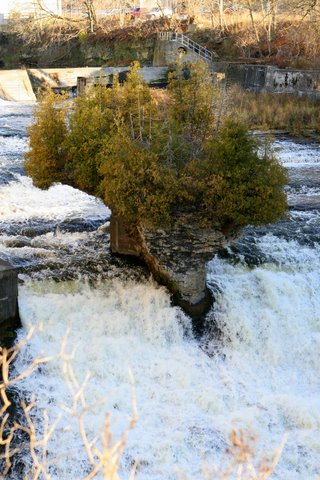
Here’s the gorge part. Elora is located on the Grand River where the Elora Gorge begins. The gorge has a waterfall that forms behind the Elora Innand continues for 4 kilometres. The Elora Inn is currently closed for renovations. In the middle of the falls is the, “Tooth of Time”. This is a huge rock that has become the symbol of the village of Elora.
The Elora gorge on the Grand River has a waterfall that forms behind the Elora Inn and continues for 4kms.
Where to Stay
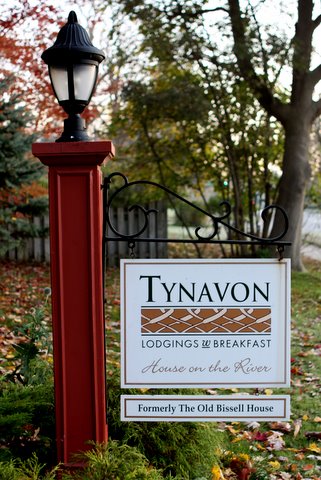
I picked the Tynavon Bed and Breakfast (Tynavon means House by-the-River in Scots Gaelic) to be home for the weekend. This quaint circa 1856 home at 84 Mill Street is a short walk from downtown. It has a gracious verandah overlooking the Grand River. Expect to pay around $125.00 a night for one of the best sleeps you’ll ever have and a scrumptious breakfast. (Silo Direct Link to Tynavon Bed and Breakfastor 1-866-334-3305).
Welcoming gate post- the Tynavon B and B
Here’s the goat part.
When you force yourself to leave Elora take a 10 minute trip on Highway 6 north to Arthur, Ontario. That’s where you’ll find River’s Edge Goat Dairy.(Silo Direct Link to Goat Milk Products Website or 1-800-209-7330) at 8102 Wellington Road 109, Arthur. If you have children with you they’ll love it. Chances are you’ll find owners Katie Kormet or Will Makxam tending to their herd of 120 mature does. The farm produces, with hard work, milk as well as cheese, yogurt and even soap.
Will told me- “We are a small goat dairy, and we process all of our own milk but we also raise the male goats for meat. In general, we tell our frequent customers, if our chain is down, come on in we are open. However, if our chain is up, we are unavailable but not necessarily closed or away. Not only are we artisan cheese makers, we are farmstead cheese makers. Not many farmers who do it all. We feed and milk our animals and make cheese on the farm. We are a provincially licensed dairy plant, like all other commercial dairy plants in the province. Our advantage: we use the freshest milk and process it into milk yogurt or cheese sooner than our competitors.
Visitors are welcome to visit the farm (no charge) and you might see the goats being milked. River’s Edge Goat Dairy hours of operation vary. Katie said, “Call us ahead of time to see if we’ll be home”.
The importance of Toronto for the world movie industry is becoming more and more substantial. It has already gained the nickname “Hollywood North“ and now the major Indian film studios are tightening their co-operation with the city of Toronto. More and more Bollywood movies are being shot in Toronto, a huge number of Torontonian cinemas screen Bollywood movies, and even this year’s International Indian Film Academy Award celebration Silo Direct Link to Intern’l Indian Film Academy Award Video took place in Toronto. It won’t be a surprise if Toronto becomes “Bollywood West” in a few years.
The Front Page from the Sun- Bollywood North. The GTA has embraced the Indian film industry
Cinemas Showing Bollywood Movies in Toronto and the GTA Golden Eye Media Cinemas Silo Direct Link to Golden Eye Cinemas
Golden Eye Media Cinemas include three very similar cinemas located in different parts of Toronto and the GTA. Albion Cinemas are located right in the centre of Etobicoke at the Albion Centre (1530 Albion Road Etobicoke). Woodside Cinemas can be found in east Toronto in the Woodside Square Shopping Centre (1571 Sandhurst Circle Scarborough). Bayfield Cinemas are located in Bayfield Mall (320 Bayfield Street) in Barrie.
Ticket prices in all three cinemas are very reasonable, and parking is free. If you want to see the latest and most popular Bollywood movies with your family, Golden Eye Cinemas are just what you’re looking for. It’s very easy to find them, and there are many different restaurants near each one where you can find something to eat after the show.
Cineplex cinemas have been playing Bollywood movies since the ‘90s and are very popular among Torontonian Bollywood movie lovers. Chief executive officer of Cineplex Theatres Ellis Jacob expressed his ambition to continue to screen Bollywood movies in a recent interview for The Globe and Mail, “We’ve been committed to it as a company for the longest time… There’s a great desire for us to continue to grow that business.” There were no doubts that Cineplex would be the main cinema partner of the 2011 IIFA film festival.
If you want to enjoy Bollywood movies with great sound and screen quality, visit one of these theatres: Sheppard Grande Toronto (4861 Yonge Street, Toronto, (416) 590-9974), SilverCity Brampton (50 Great Lakes Drive, Brampton, (905) 789-6797), Coliseum Scarborough (Scarborough Town Centre, 300 Borough Drive, Scarborough, (416) 290-5217), or Cineplex Odeon Eglinton Town Centre (22 Lebovic Avenue, Toronto, (416) 752-4494).
This huge cinema chain has been regularly showing Bollywood movies for the past several years. Watching Bollywood dancing and singing on a gigantic screen in an AMC cinema is a great experience, and you’ll definitely love it unless you prefer smaller independent cinemas. If you’re ready for a huge dose of Bollywood, visit one of these AMC theatres: AMC Courtney Park Mississauga (110 Courtney Park Drive E, Mississauga), AMC Kennedy Common Scarborough (33 William Kitchen Road, Scarborough), AMC Winston Churchill Oakville (2081 Winston Park Drive,
Oakville), or AMC Yonge and Dundas Toronto (10 Dundas Street East, Toronto).
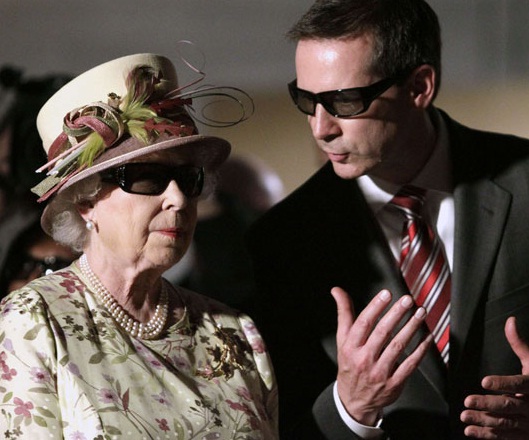
The Queen and Dalton McGuinty at the Bollywood North celebration 2011
Bollywood Movies Shot in Toronto
We’ve already mentioned that Toronto is a famous location for Bollywood movie producers. Let’s see in which parts of Toronto the most famous Bollywood movies were shot. The centre of the city (e.g. Yonge Street) is the most common place where movies are shot in Toronto, thanks to low production costs and Toronto’s resemblance to any other bigger city. This is also the case of Bollywood/Hollywood (2002) and Kal Ho Naa Ho (2003). Another very popular Bollywood movie, Thank You (2011), was shot at Toronto’s Flatiron Building, the Air Canada Centre, and Niagara Falls. There are many other spots in Toronto where parts of Bollywood movies were shot; the most common are St. Jamestown, University of Toronto, and the Old and New City Halls.
Bollywood Movie Rentals
One can easily recognize that there’s a strong community of approximately 550,000 Indian people living in Toronto and the GTA, thanks to the abundance of Indian restaurants, bistros, shops, dance schools, etc. However, it’s quite a surprise that it’s so easy to find a Bollywood movie rental in almost every neighbourhood in Toronto. They’re usually small, hidden shops with an astonishing collection of Bollywood flicks. If you want to have a Bollywood movie night in your home, try one of these rental shops: Bollywood ‘N Varieties (25 Overlea Boulevard), Bollywood 4 U (683 Markham Street), R K’s Bollywood Entertainment (1395 Queen Street W), Bollywood DvD Center (31 Street Dennis Drive, North York), Fieldgate Video (2465 Cawthra Rd.,Unit 127, Mississauga), or Golden Groceries Silo Direct Link to Golden Groceries(2975 Drew Rd. Mississauga; 5995 14th Ave. Unit A-1, Bldg. A, Markham; 305 Charolais Blvd. Brampton; 4525 Ebeneyer Rd., Brampton, Cottrelle Blvd. Brampton).
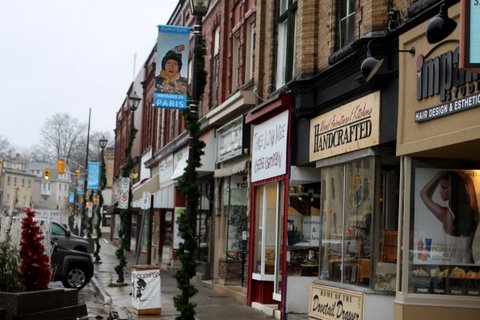
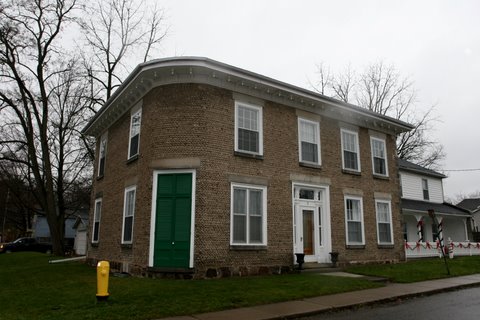
That’s Paris, Ontario. This lovely town of about 12,000 is an easy hour and a half hour drive from Niagara. It was amalgamated in 1999 to the County of Brant but the locals don’t like to admit to it. It’s named for the nearby deposits of gypsum used to make plaster of Paris. It is referred to as, “the cobblestone capital of Canada” because of the towns large number of aged cobblestone homes.
An example of one of the historical cobblestone homes found in Paris.
When I arrived a few weeks ago to do Christmas shopping, I found a vibrant downtown tucked away in a wide valley. It was sheltered from big-box retailing and I soon learned chronic 21st century hurry-up ism wasn’t here either. The place reminded me of earlier times when I would walk the downtown of my own hometown. The pace was slow. It reinforced in my mind, how nice the world can be.
Parking is free along Grand River Street, the Main Street, and there’s lots of interesting stores to explore.
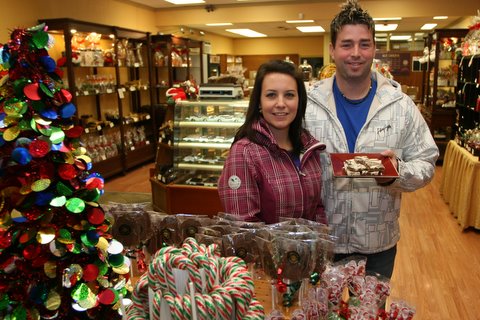
Always looking for a “sweet deal” I stumbled upon Chocolate Sensations Silo Direct Link to Chocoloate Sensations Website Like so many other shops in town, this delightful aromatic place is family owned by John and Sarah Chalmers. John said, “This business began as a humble home-based hobby in a family kitchen over 20 years ago. Today we do a thriving on site business and a large volume of catalogue sales”. Once inside chocolate enthusiasts will think they have died and went to chocolate heaven. I recommend before you leave take home some Christmas, Candy Cane Bark. Come on, you can afford to take out the belt a notch, after all it’s Christmas.
Sarah and John Chalmers inside their Chocolate Sensations shop.
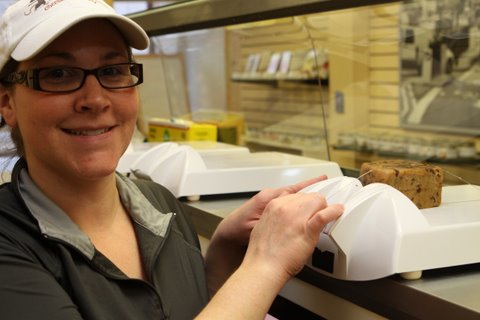
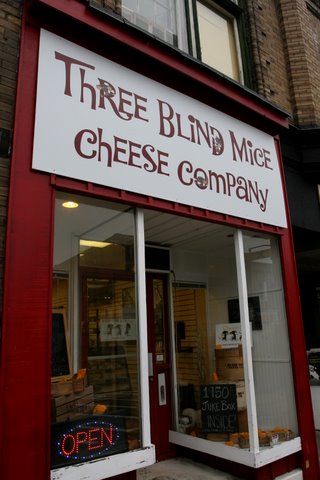
Next door is a “cheesy place”. The Three Blind Mice Cheese Company Silo Direct Link to Three Blind Mice Cheese Company WebsiteOkay, I promise no more cheesy stuff. The owner, Lindsay Dawdy with an ear to ear smile said, “We only opened in June of this year and so far it’s been a runaway success. So much so, we’ve opened another store in Elora”. Believe it or not, this is a fun place. Step inside and see what I mean. Ask Lindsay to push the reset button on her 1951 Juke Box and you can hear one of your golden-oldies. Sticky Toffee and Wensleydale with Cranberry are the featured cheeses for the holidays.
Lindsay Dawdy, owner of Three Blind Mice Cheese Factory shows us one of her unusual cheesesThe Three Blind Mice Cheese Company storefront
Down the road is the John N Hall House of Quality Linens. This is an old-fashioned dry goods store. Their heavy front doors are the same ones customer’s have been pushing since the 1860’s. If you’re looking for a ladies embroided white cotton nightgown or fleece or flannelette blankets you’ve arrived.
For starters, everything is made from scratch and from what I observed servers worked at spoiling their customers. They roast their own coffee and they specialize in nostalgic hard to find sandwiches like the classic Monte Cristo. The Apple Waldorf Salad platter is a crowd pleaser. I loved their Deep Dish Corn Meal Crust Quiche and hand crafted Hot Apple Fritters. The apples were prepared in front of me using an 1800’s hand operated peeler. I washed the meal down with chocolate milk delivered to my table in an old-fashioned dairy bottle. In the warmer months you can eat on the second floor outdoor patio that overlooks the Grand River that flows through town.
I stopped in 'at the dog' for a meal washed down with chocolate milk delivered in a retro glass bottle
Before you leave Paris walk to the end of the town to the Williams Street Bridge and take a photograph of the back of these historic buildings that house these shops. It will be a keeper.
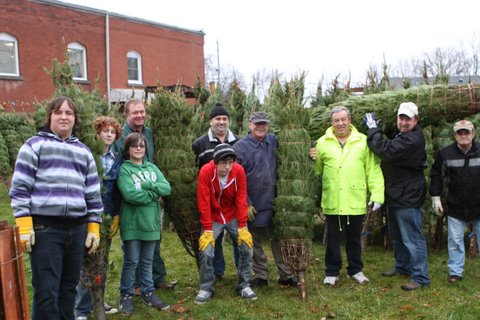
As I headed home I came across a group of people who were unloading Balsam Firs to be sold at their annual Christmas tree sale for St. James Anglican Church. It was a scene from a Norman Rockwell painting. One of the parishioners Steve Howes, who had lived in the town for 45 years told me, “This is a small town with a lot of heart. People still treat each other with respect. I wouldn’t want to live anywhere else”. That sums this town up nicely.
Christmas tree sale in support of St. James Anglican Church
How to get There
From Niagara take the QEW to Highway 403 towards Brantford. Cut off onto Highway 2 to Paris. GPS users can punch in 89 Grand River Street. North, Paris.
Since 1850 Ontario Parisians have been warmly welcoming visitors
Written and Photographed by George Bailey. George is a writer who has a unique way of finding ‘hidden gems’ and sharing his experience in words and pictures.
Definition of art is very difficult to pin down. As an oil painter I look at art one way. An actor would think of it another way. But really the definition doesn’t matter all that much. Art surrounds us wherever we are, if only we choose to see it. Sometimes though, we need to be reminded of that.
When I entered the concentration camp at Terezin in the Czech Republic that November day, the last thing I thought I would see was art. I didn’t know that the children who lived there drew pictures, coloured them, and even wrote poems. But there they were. The paintings and words hung up on the museum wall. The wall was at least 50 feet high. They had miraculously survived Terezin, even when the children themselves had not. I stood in front of that wall for a long time, hesitant to leave. Afraid that maybe I would need reminding again once I was back home.
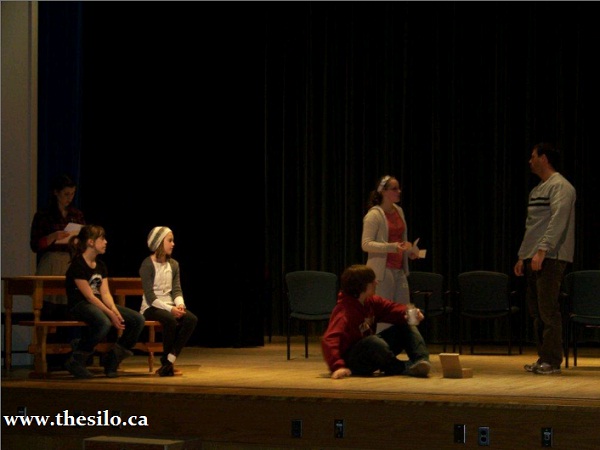
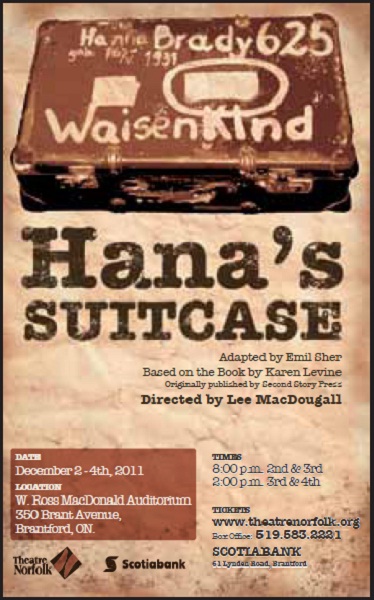
Fast forward a year and Terezin has touched my life again. Hana’s Suitcase, which is set in Terezin, is being presented by Theatre Norfolk and COMPASS Theatre Productions, in partnership with W. Ross MacDonald School for the Blind, and I had the opportunity to meet the cast and talk about my experiences at Terezin. I also had the opportunity to watch renowned actor and director Lee MacDougall guide the cast of talented local and emerging actors through the paces of this emotional, heart wrenching play which took me right back to that wall.
Silo Behind the Scenes: Rehearsal of Hanna's Suitcase
In this play child actors play some of the main characters. Hana was sent to Terezin when she was 11. This play is being performed for over 1200 students in Grades 4-12; Children teaching children and because this play is for everyone; children teaching adults. It speaks to hatred and intolerance. It also speaks to hope and beauty. It’s amazing how children are able to see both at the same time. I wonder when we, as adults, forget how to do that.
I hope that you will take the time to see Hana’s Suitcase and be reminded of all the things that you should never forget while watching art at its finest.
Hana’s Suitcase, adapted by Emil Sher based on the book by Karen Levine, is being presented at W. Ross MacDonald Auditorium Dec. 2nd, 3rd & 4th. Tickets are on
sale at Scotia Bank, Lynden Road, and at the Lighthouse Festival Theatre. For more info and to purchase tickets visit Silo Direct Link to Theatre Norfolk Website
The first thing I noticed was the pebbles. There had to be a hundred. Maybe more.
All perched lovingly atop the unmarked grave. I took a deep breath and went closer.
Each step taken with respect. To those underneath the pebbles, their families, their communities, their lives.
Time stopped.
I knelt.
My hand reached out. Hovered over the pebbles asking permission to enter their world for just a few hours.
I was humbled. I was ready.
I will never forget.
So began my journey to Terezin in the Czech Republic that November day. I knew it would change me. I knew what I would see.
I knew nothing. Absolutely nothing.
How could I know? I had not yet seen. I had not yet felt. I had not yet heard the door slam behind me.
I didn’t know about the children. I didn’t know they drew pictures. Pictures of flowers and trees, family and dogs. Pictures like all kids draw. Only they weren’t all kids. They lived at Terezin.
I was ready.
I had watched the movies.
I had watched the documentaries
in my comfortable chair in my warm living room.
Now I’ve stood where they stood.
Sat where they sat.
Cried where they cried.
I know it’s not enough.
But I will never forget.
Will always speak up.
Will always remember the pebbles.
Silo/HNARP- Can you tell our readers a bit about the history of the bridge, for example the year in which it was first built and its age?
The Grand River Cayuga Bridge is a 5-span through-truss bridge. Construction began in 1923 and was completed in 1924.
Silo/HNARP- So why is the bridge being redesigned and rebuilt?
To ensure our provincial bridges remain safe, Ontario is the only province in Canada to legislate that owners must inspect their bridges every two years by, or under the direction of a professional engineer. Taking it one-step further, MTO also conducts routine maintenance inspections of all 2,720 of our provincially owned bridges every year.
As part of our assessment, the Grand River Bridge, while currently still in safe condition, was identified as requiring future replacement, due to its age and declining condition. In 2005, the ministry initiated a Preliminary Design and Class Environmental Assessment (EA) Study to determine the long-term strategy for the bridge. Completed in 2008, the Study recommended the bridge be replaced with a 5-span, steel girder bridge. The Study received Environmental Clearance in November 2008.
Silo/HNARP- Can you explain to us the importance of archaeology to the MTO in Ontario and its support of the Heritage Act?
It is a requirement of the Ontario Heritage Act to address the impacts of any project on both archaeological resources and the built heritage environment, MTO achieves this as part of the Environmental Assessment we conduct for every MTO undertaking.
Silo/HNARP- Is the archaeology holding back the bridge’s development or is the project on schedule?
The ministry’s preliminary design and Class EA identified prehistoric and historic archaeological sites along the west side of the existing bridge, so it was acknowledged that some special measures and precautions would be necessary. The archaeological salvage work has been scheduled into the timeline of the project, and is on track.
Silo/HNARP- Did the MTO know in advance that extensive archaeological work was necessary?
The archeological assessment completed during the EA Study identified that prehistoric and historic archaeological sites are located along the west side of the existing bridge. Based on the results of a Stage 3 archaeological assessment (test trenches) completed during Preliminary Design, it was determined that a Stage 4 Archaeological Salvage had to occur to ensure existing artifacts are recovered before any areas are disturbed as a result of construction. In 2009, the ministry started the detail design study and retained a consultant (McCormick Rankin Corporation) and their sub-consultant, New Directions Archaeology Ltd., who are responsible for completing Stage 4 Salvage under an archaeological license issued by the Ministry of Tourism and Culture (MTC).
Silo/HNARP- The general public has noticed the excavation taking place one layer at a time. Why has this been important?
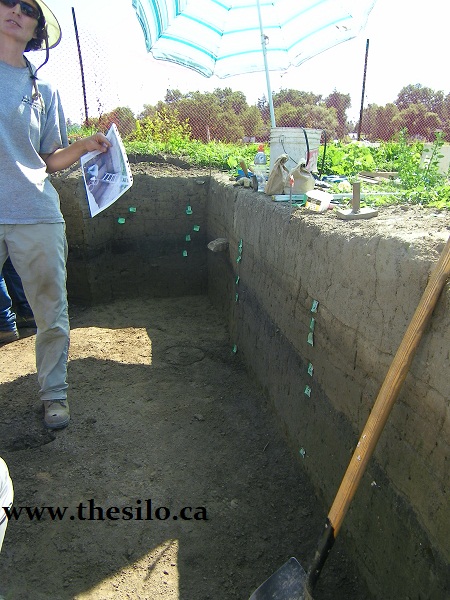
This is a very significant archaeological site made up of a series of cultural layers representing different historic and pre-contact occupations at this location. Based on previous studies, the artifacts range in age from the Archaic period, circa 8000 – 1000 B.C. through to the historic period circa 1700+ A.D. The west bank of the Grand River around Cayuga is a flood plain. Because the periodic flooding of the Grand River deposited silt over this flood plain, this site is made up of numerous levels of cultural material, each dating to a specific time frame, sandwiched between sterile layers of flood deposits. The goal of the excavation is to map and record these cultural layers before they are impacted by construction. To do this, the excavation is being completed in one metre by one metre squares, recording the original location of each artifact within the one metre square, including the depth at which it was recovered. The artifacts from each one metre square will be kept together, with individual levels kept separate in clearly identified bags. This will ensure that each artefact will be related to a specific cultural level and time period, to interpret the history of the site.
The excavation of each one metre square will continue downward until no further artifacts are recovered. Based on previous test excavation on the site, this will be at a depth of about 160 cm. The excavation will continue below this depth to ensure that all artifacts have been recovered, generally to a depth of approximately 180 cm (1.8 m).
Silo/HNARP- What unique discoveries have resulted at the site such as historic, pre-contact, archaic items?
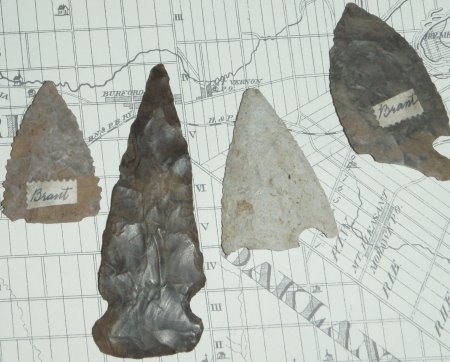
The site is yielding an array of artifacts, including ceramics (pottery), tools (scrapers, spear points, arrow heads), stone flakes from tool making and even a shell bead, thought to be an early trading item.
Silo/HNARP- Why has the Six Nations been involved with this project?
First Nation involvement is an important aspect of this project because of the significant archaeological resources at this site. MTO and our consultants have regular and ongoing consultation with interested First Nations regarding this project. People from Six Nations have been hired for the archaeological field investigations and monitoring of the salvage operations, as well as the follow-up lab work.
Silo/HNARP- What will the MTO do with the artifacts once the project is finished. Will there be any public education about what was found?
Once the excavation of each one metre square is complete, the artifacts will be removed from the site and taken to a lab where they will be washed and organized. The artifacts will be analyzed and discussed in a final report including conclusions about the prehistoric activities at this site. Given the scope of this excavation, the analysis and reporting of this site will take years to complete. Once the report is finished, the artifacts will be kept for posterity, available for other archaeologists who are interested in the site and the time periods represented. Discussions are currently underway with a few Ontario university repositories to house the artifacts.
Silo/HNARP- How and where can the community learn more about what was recovered and learned from the excavation when the project is finished? Is there for example, an online PDF document, field report or analysis report of artifacts?
A report will be prepared after the artifacts are analyzed. The report may take a few years to complete, due to the size of the excavation. It will be filed with MTC and also provided to the First Nations having an interest in the site. Due to local interest, we also expect to provide copies to local repositories, such as the Haldimand Museum.
Silo/HNARP- Will this be the last season of field work before the bridge reconstruction gets started or is another field season anticipated in 2012.
It is anticipated that the salvage work at the current site will be completed in the fall of 2011. Additional areas of archaeological salvage may occur in 2012, if it is determined that construction activities will cause disturbance to additional areas on the west side of the river not yet salvaged.
Silo/HNARP- Who can be contacted to learn more about this archaeological site and its history?
The salvage work and report preparation are being conducted by New Directions Archaeology Ltd., under the direction of Mr. Phil Woodley. Questions about the site should be directed to the Communications Coordinator for MTO West Region (519-873-4186), who will consult with Mr. Woodley for detailed information as required.
Silo/HNARP- When is work expected to begin on the bridge replacement?
Construction is anticipated to begin in 2012 and is expected to take two construction seasons to complete.
How can we honestly say that today’s rain and overcast skies influenced our choice for today’s 90’s flashback…umm, urr, we can’t. But this throwback track from R.E.M. rocks. Pack your umbrella for the next few days and if you’ve got room on your ipod (we’re guessing you do, and if you don’t drop us a line explaining why not) , add this song to your playlist. It just might be a cure-all for the turn in the weather. Now where did i put my can of orange Crush?
CP
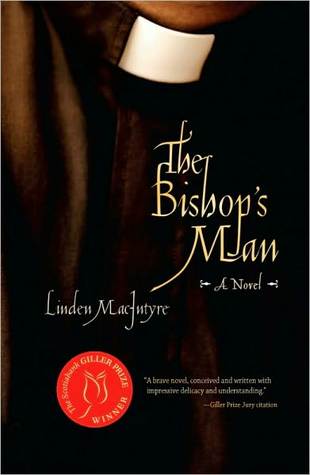
The Bishop’s Man by Canadian author Linden MacIntyre offers a deep and compelling story of one man’s struggle for atonement. The book revolves around a very controversial and current topic, the sexual abuse of children by Catholic Priests. However, this fictional work is much more than a critique on a current situation; it is a journey and dialogue on themes of loneliness, isolation, redemption and spirituality. This novel follows the characters from MacIntyre’s earlier work, The Long Stretch.
MacIntyre begins his story in the present day, sometime in the 1990s, in southern Cape Breton Island. From the beginning, the reader is taken on a journey through the eyes of Father Duncan MacAskill, a priest known as the Exorcist. Father MacAskill, who grew up in this area, is sent for a break from his regular duties, troubleshooting and cleaning up messes made by priests that threaten to embarrass the Catholic Church. Father MacAskill sees this trip home as less of a homecoming and more of a time of spiritual discovery through current events and reflection. MacIntyre weaves present day with the past as he unwinds Father MacAskil’s complicated and somewhat remorseful past.
Father MacAskill is very good at what he does—making troublesome priests disappear by sending them to far off parishes or rehabilitation in Ontario. Upon his return to Creiginish on southern Cape Breton Island, he befriends a young, 19-year-old Danny MacKay from whose father he purchases a boat. Danny’s character is troubled and before Father MacAskill can really reach him and understand the root of his trouble, he commits suicide. This is especially difficult to take in for Father MacAskill when rumours start to swirl that a relationship with a troublesome priest, Brendan Bell, who was sent away from Newfoundland to Craiginish by MacAskill, may have lead to the ruin of Danny MacKay. Upon this revelation, MacIntyre’s story starts to divulge into the past as Father MacAskill tries to sort through his current situation and his spirituality.
The absorbing narrative takes the reader through his missionary work in Honduras in the 1970s, where he has sent to forget what he saw as a young priest between a well respected priest and a young person. The Honduras narrative is threaded between the present day and other reflections. MacIntyre does this seamlessly throughout the novel. Father MacAskill’s stint as dean at St. Francis Xavier is also explored. It is while he is dean at the university he becomes the Bishop’s right hand man and is set out to extinguish potential fires in various churches across Canada. Through all the weaving and reflection, Father MacAskill sorts through his own demons, his past and his family’s problematic and mysterious history.
Although this fictional work discusses a very current and disturbing subject, the sexual abuse of children is never directly addressed or explained in the eyes of Father MacAskill. It serves as a constant undertone to the actions and thoughts of the main character. Linden MacIntyre’s narrative, through the eyes of a troubled priest, provides the reader with a rare insight into the inner workings of the priest hood and the powerful Catholic Church and its place in Canadian culture. For the Silo, Sarah Purdy.
From our Sept/Oct 2011 PRINT Edition (Jukasa has a whole new team of amazing people on board! Please check their website for a list of their amazing staff CP)
If I were to tell you that musicians like Willie Nelson, Steven Tyler, Snoop Dogg, Derek Miller and The Tea Party have spent time in Ohsweken Village, what would you say?
I know what I said: “Wow, why haven’t I heard about this place?” The place I am talking about is Jukasa Media Group. Jukasa Media Group is a $3 million dollar studio complex that is currently expanding – and rapidly I might add. Upon its construction in 2009 Owner Kenny Hill wanted a place for his son and friends to record their music. In 2010 Mix Magazine named Jukasa as 2010’s “top three new studios on the planet.” What brings such talented musicians to Jukasa? The Gear? The Studio? The Staff? The Price? All of the Above?
The answer is all of the above. Jukasa currently features 2300sq ft of beautifully architectured live recording space, their famous sound board the SSL 8072 Console that spent a decade Abbey Road Studio 3, living accommodations on site, a space for editing daily recordings, and they are currently building a second recording studio, and will be opening a private Recording Arts School as of October where students will be in classes of no more than 9, learning the theory of sound, while recording real artists with the mastering engineer Nick Blagona and other staff.
Mixer and Mastering Engineer Nick Blagona has been in the music industry for decades and brings his experience around the world to Jukasa. Blagona has worked with Chicago, The Beegees, Cat Stevens, Nazareth, Alexisonfire (R.I.P.), Kim Mitchell, Protest the Hero, The Police, and Deep Purple to name the tip of the iceberg. Also under the Jukasa roof is Stevie Salas, Director of Aboriginal Development and U.S. Operations who has received the Life Time Achievement Award from the Native American Music Awards, and has the largest deal Island Records has ever signed. Salas has also brought his long time friend Rob Lamothe into the mix. Rob Lamothe is the General Manager of Jukasa, he has received an Edison Award from Holland, and has toured over 30 European tours.
Aside from the Gear, the staff and the facility itself, what makes Jukasa so unique is the price for the quality. Prices for recording at Jukasa are comparable to prices to record in basement studios in the area however the final product is the highest of quality production, thanks to the experienced staff and incredible equipment available. For the Silo, Lacie Williamson
Okay you didn’t think we were going to NOT show you the famous SSL 8072 did you? Here it is-