Tag Archives: cybercrime

USA Sanctioning Ransomware Enablers in Coordinated International Action

The United States recently sanctioned one entity and two individuals — First VPN Service (1VPNS), its administrator Dmytro Rashevskyi, and Yegeniy Vladimirovich Silayev — for providing critical support to ransomware groups that have targeted North American hospitals, schools, businesses, and local governments.

These actors supplied ransomware groups with tools to hide their identities, disguise malicious software, and evade detection — enabling attacks that have caused billions of dollars in losses to U.S. critical infrastructure providers.

This action reflects the United States’ commitment to working with allies and partners to disrupt the global cybercrime ecosystem. Today’s designations are coordinated with the United Kingdom’s Foreign, Commonwealth & Development Office, and follow a May 2026 European law enforcement takedown of 1VPNS’s infrastructure, supported by the FBI.

By targeting not just ransomware operators but the service providers and tool suppliers who make their attacks possible, the United States and its partners are dismantling the broader networks that sustain cybercriminal activity worldwide.

The United States will continue to use every diplomatic and economic tool available to disrupt foreign cybercriminals and their enablers and hold them accountable. Ransomware is not only a law enforcement challenge — it is a foreign policy threat that undermines the security and economic stability of the United States and its allies.

This action is being taken pursuant to the authorities under Executive Order (E.O.) 13694, as further amended by E.O. 13694, as amended by E.O. 13757, E.O. 14144, and E.O. 14306 (E.O. 13694, as amended).

Click here to report cyber-enabled crime to the FBI.

1VPNS: VPN SERVICE ENABLING RANSOMWARE OPERATIONS

1VPNS is a VPN provider whose principal clients include ransomware actors and other cybercriminals.  VPNs, which allow users to encrypt their internet traffic and hide their computers’ true location, have legitimate uses for privacy and security, but can support malicious activity if misused.  Numerous ransomware groups have purchased infrastructure from 1VPNS, which they have leveraged in attacks on U.S. companies and institutions—including to hide the origins of their attacks, deploy malware, and manage exfiltrated data. Victims of ransomware attacks that involved the use of 1VPNS infrastructure have included U.S. businesses, financial services companies, hospitals, and municipal governments.

1VPNS and its administrator, Rashevskyi, have provided this technological support to illicit actors. Since 2014, 1VPNS has advertised its services on multiple online cybercriminal forums, stating that it does not keep logs of users’ identities or activities, and that it refuses to cooperate with law enforcement investigations into illegal activity originating from the servers it rents to customers.  Rashevskyi has used false identities, including “Maksim Sorin” and “Roman Chabanenko,” to buy infrastructure from companies that might otherwise refuse to do business with him because of complaints of abuse from internet service providers about illegal activity originating from 1VPNS servers.

OFAC is designating 1VPNS and Rashevskyi pursuant to E.O. 13694, as amended, for having materially assisted, sponsored, or provided financial, material, or technological support for, or goods or services to or in support of, cyber-enabled activities originating from, or directed by persons located, in whole or substantial part, outside the United States that are reasonably likely to result in, or have materially contributed to, a threat to the national security, foreign policy, or economic health or financial stability of the United States, and that have the purpose of or involve engaging in a ransomware attack, such as extortion through malicious use of code, encryption, or other activity to affect the confidentiality, integrity, or availability of data or a computer or network of computers, against a United States person, the United States, a United States ally or partner, or a citizen, national, or entity organized under the laws thereof.

OTHER ENABLERS OF THE CYBERCRIME ECOSYSTEM

In addition to 1VPNS and Rashevskyi, OFAC is designating Silayev, a Belarusian national and a cryptor provider who has supplied encryption and obfuscation services to ransomware operators targeting U.S. and allied entities.  Unlike legitimate encryption tools, which are designed to protect data and the privacy of the people that own it, cryptors are built specifically to make malware stealthier and more effective by disguising it as harmless files. 

OFAC is designating Silayev pursuant to E.O. 13694, as amended, for having materially assisted, sponsored, or provided financial, material, or technological support for, or goods or services to or in support of, cyber-enabled activities originating from, or directed by persons located, in whole or substantial part, outside the United States that are reasonably likely to result in, or have materially contributed to, a threat to the national security, foreign policy, or economic health or financial stability of the United States, and that have the purpose of or involve engaging in a ransomware attack, such as extortion through malicious use of code, encryption, or other activity to affect the confidentiality, integrity, or availability of data or a computer or network of computers, against a United States person, the United States, a United States ally or partner, or a citizen, national, or entity organized under the laws thereof.

SANCTIONS IMPLICATIONS

As a result of this action, all property and interests in property of the designated or blocked persons described above that are in the United States or in the possession or control of U.S. persons are blocked and must be reported to OFAC.  In addition, any entities that are owned, directly or indirectly, individually or in the aggregate, 50 percent or more by one or more blocked persons are also blocked.  Unless authorized by OFAC, or exempt, OFAC’s regulations generally prohibit all transactions by U.S. persons or within (or transiting) the United States that involve any property or interests in property of blocked persons. 

Violations of U.S. sanctions may result in the imposition of civil or criminal penalties on U.S. and foreign persons.  OFAC may impose civil penalties for sanctions violations on a strict liability basis.  OFAC’s Economic Sanctions Enforcement Guidelines provide more information regarding OFAC’s enforcement of U.S. economic sanctions.  In addition, financial institutions and other persons may risk exposure to sanctions for engaging in certain transactions or activities involving designated or otherwise blocked persons.  The prohibitions include the making of any contribution or provision of funds, goods, or services by, to, or for the benefit of any designated or blocked person, or the receipt of any contribution or provision of funds, goods, or services from any such person.  Non-U.S. persons are also prohibited from causing or conspiring to cause U.S. persons to wittingly or unwittingly violate U.S. sanctions, as well as engaging in conduct that evades U.S. sanctions.  Individuals located in the United States or abroad who provide information about sanctions violations to Treasury’s Financial Crimes Enforcement Network’s whistleblower incentive program may be eligible for awards if the information they provide leads to a successful enforcement action that results in monetary penalties exceeding $1,000,000 usd.

The power and integrity of OFAC sanctions derive not only from OFAC’s ability to designate and add persons to the SDN List, but also from its willingness to remove persons from the SDN List consistent with the law.  The ultimate goal of sanctions is not to punish, but to bring about a positive change in behavior.

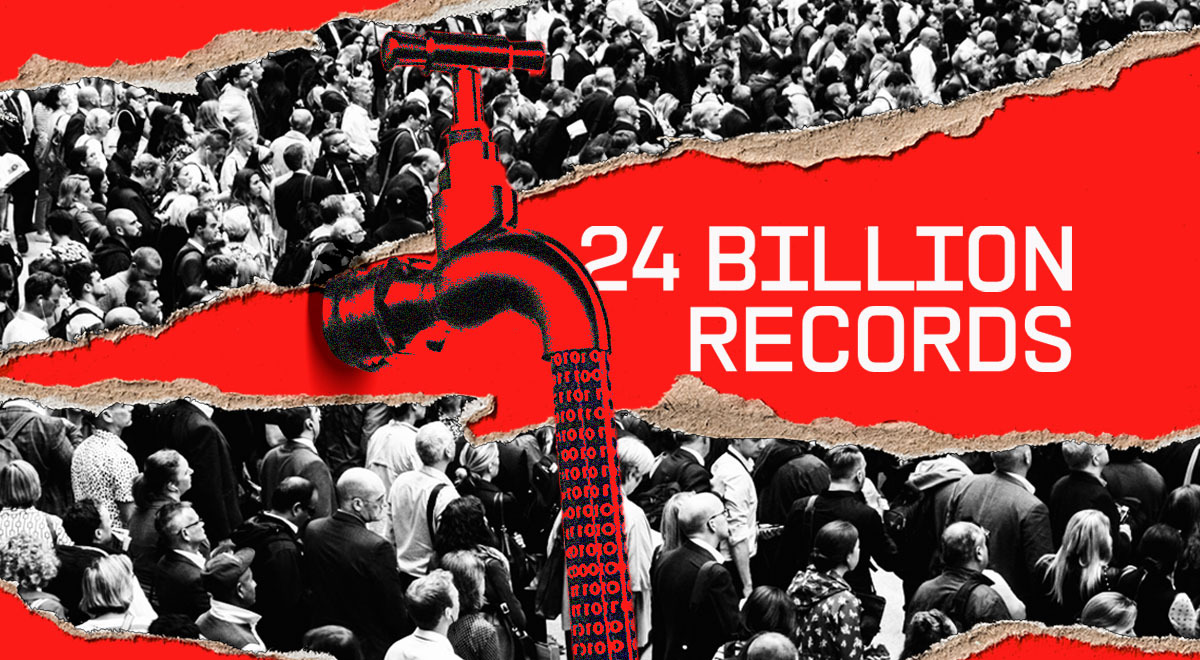
24 Billion Credentials Leaked In Database- Are Yours Included?

24 billion records, including usernames and passwords were just exposed in colossal data leak.


24 billion records data leak
Image by Cybernews.

Cybernews researchers discovered an exposed database containing 24 billion records, including usernames, email addresses, plaintext passwords, and login URLs. The data appears to come from infostealer malware logs, records stolen from infected devices and collected from Telegram channels, breach compilations, and other sources.

Key takeaways:

  • Cybernews researchers found an exposed Elasticsearch cluster containing 24 billion records and more than 8.3TB of data.
  • Most records appear to be infostealer logs, including usernames, emails, passwords, and login URLs.
  • The data came from 36 sources, including Telegram channels, breach compilations, and large “collections.”
  • Researchers cannot yet confirm how many records are duplicates or how many unique people were affected.
  • The database is no longer publicly exposed, but reused passwords may still put accounts at risk.

While data leaks spilling millions of records have become the norm, one involving 24 billion records, including usernames and passwords, is something else. That’s why the Cybernews research team had to triple-check their findings after uncovering over 8 terabytes of data exposed online.

Our team discovered what is likely to be one of the largest databases ever exposed on June 12th. The vast majority of the 24 billion exposed records, our researchers believe, were infostealer logs. In other words, stolen usernames, passwords, and services that these credentials were supposed to grant access to.

“The credential data leak is dangerous simply because of its enormous size. Since the data leaked online, billions of affected accounts are at serious risk of takeovers, especially if they are not protected with multi-factor authentication,” the team explained.

infostealer data sample
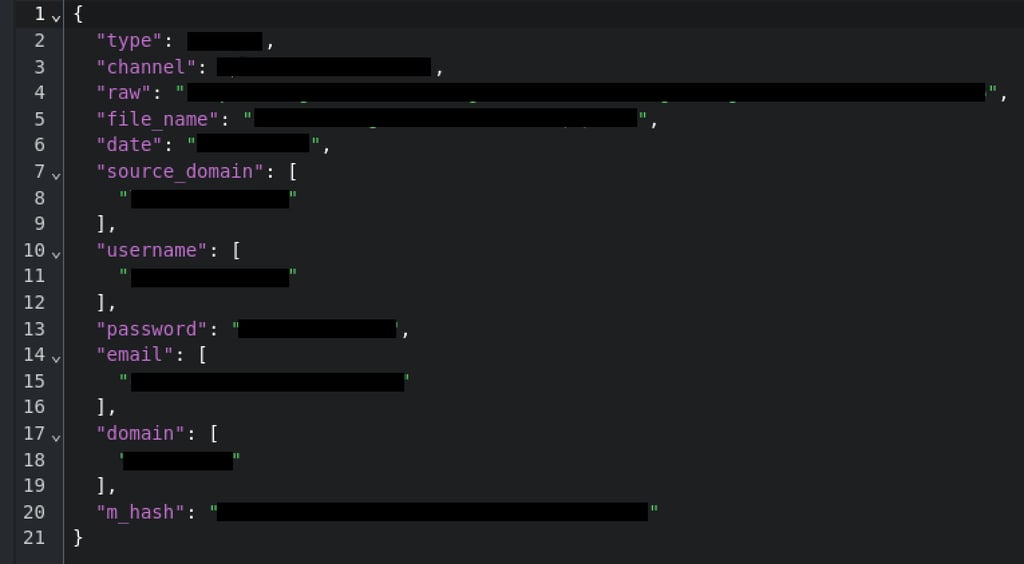
Infostealer log document example. Image by Cybernews.

What did the 24 billion record data leak reveal?

The records our team uncovered were stored on a publicly available Elasticsearch cluster, a group of interconnected search servers. The total volume of information in the cluster exceeded 8.3 terabytes.

Nearly all exposed records were infostealer logs, data collected by malicious software that steals sensitive information. According to the team, the logs revealed login credentials in raw format, with each login detail saved separately, including email addresses, usernames, and passwords in plaintext.

infostealer data sample2
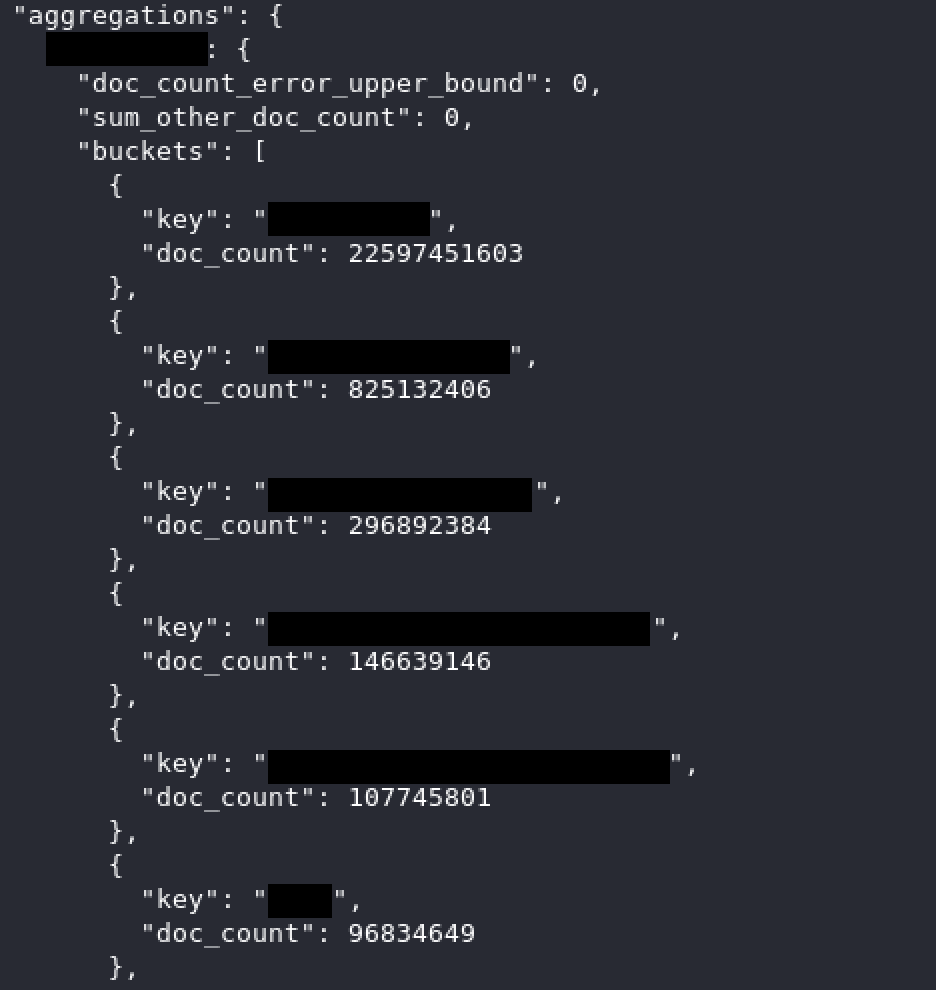
Document counts from different sources. Image by Cybernews.

Additionally, researchers identified URLs that the leaked credentials are supposed to grant access to, as well as the source of the logs.

The exposed credentials came from 36 distinct sources, varying from Telegram channels to combined data collections of previous data breaches and datasets exported directly from live target servers.

Which Telegram channels are involved in the data leak?

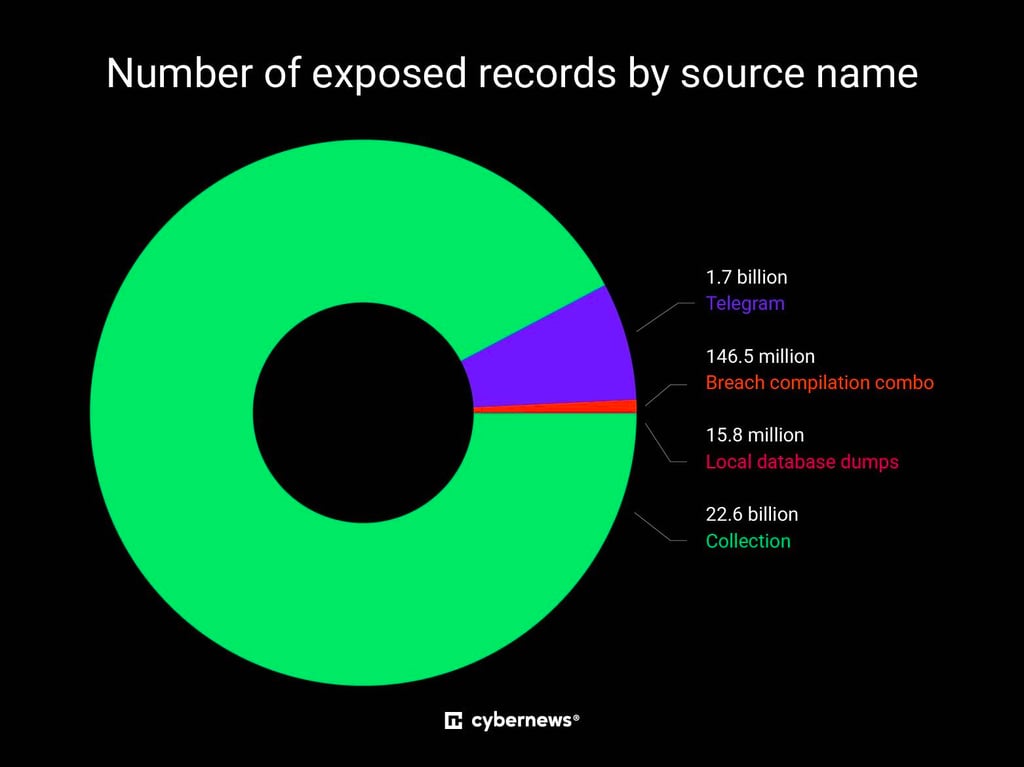
For example, over 1.7 billion records supposedly came from various Telegram channels. All channels appear to be involved in cybercrime, with a focus on stolen credentials and data breaches.

Most of the 36 data sources, over 30, are Telegram channels with a number of records ranging from hundreds of millions of exposed records to a few thousand. While most of the channels were in English, some were in Russian.

To avoid advertising Telegram channels that contain stolen credentials, we will not mention their names. However, most of the Telegram-based records were supposedly taken from hacking-related channels.

infostealer logs sources

Another category of Telegram channels includes access to stolen credit card data, with one channel apparently dedicated to sharing this information.

Interestingly, nearly 260 million records came from Telegram channels with “Darkside” in the title. Several years ago, Darkside was among the most prolific ransomware groups. The gang infamously attacked the Colonial Pipeline, causing fuel supply disruption on the US East Coast.

Billions of records in unknown “collections”

A staggering 22.6 billion records supposedly came from what the data owner named “collections.” These records could come from various infostealer collections previously leaked online, or they may indicate that the records are grouped by the services they are supposed to provide unauthorized access to.

Since the data was taken out of public view soon after the discovery, researchers could not further investigate the origin of the information within the so-called “collection” source.

The same reason prevented the team from deducing exactly which service providers were exposed. However, given the colossal number of records involved, it’s highly likely that they reveal access to services with very large user bases.

The team also noticed a source with 150 million records named “local database dumps.” Records from this source likely indicate they were exported directly from live target servers. Local database dumps typically involve downloading the contents of a certain database on a user device.

Check if your data has been leaked

Find out if your email, phone number or related personal information might have fallen into the wrong hands Check now by clicking the red box:

Check if your data has been leaked

In this particular case, “local data dumps” could mean the person running the server uploaded records to the collection themselves, or that they got the data from other sources.

“Additionally, records contained file names from where they were imported. In total, there were at least 195 distinct file names. Some of them indicated that the credentials in question came from the AntiPublic collection and what kind of accounts they include,” our researchers said.

AntiPublic collection is a stealer log combo list that first appeared in 2016 and contained around 600 million records. The AntiPublic-related information in the leak categorized credentials in the AntiPublic collection. For example, some files contained logins to only adult content services or only to streaming platforms.

Another 146 million records came from a source named “breach compilation combo” and most likely contain information from past data breaches that exposed user credentials. Attackers favor exploiting information from past breaches, since users often reuse credentials and rarely change passwords.

The source with the smallest number of records was named “Redline stealer” and only contained 27 records. RedLine stealer is a common infostealer that operates as a malware-as-a-service (MaaS), allowing low-skilled attackers to participate in cybercrime.

Owner interested in news articles and social media posts

Interestingly, our researchers found a small subset of data, around 17,000 records, containing information that’s rarely seen in data leaks. For example, over 9,500 documents contained CVE (Common Vulnerabilities and Exposures) IDs and descriptions, along with corresponding GitHub repository URLs.

One of the vulnerabilities identified in the exposed cluster involved a Valhall GPU Kernel Driver issue.

Moreover, over 5,200 documents contained logs of news articles related to recently occurred data breaches with article URLs, their contents, and short descriptions. One of the news articles was published as recently as February 2026 and covered a supply chain attack targeting the Python Package Index (PyPI) repository.

Another 2,900 documents were logs of social media posts related to cybersecurity incidents. One of the posts our team saw discussed operational details of the Babuk ransomware from 2021.

All of this points to the data owner actively monitoring the cybersecurity landscape, with a likely intent to update their vast collection of credentials with records from the latest data breaches and data leaks.

The known unknowns

While we are confident the data leak our team has uncovered indeed contains a whopping 24 billion records, there are limitations to what we know about the data inside the now-closed Elasticsearch cluster.

For one, the team had limited time to investigate the data leak, which prevented us from delving deeper into the types of information that may have been included in the “Collections” source.

Moreover, we cannot confidently estimate how many duplicates were included in the leak, leaving the potential number of exposed individuals a guessing game. However, it would hardly be a surprise that a data leak involving 24 billion records would affect more than a few online accounts.

At this point, we’re also unable to accurately say how old or new the leaked data is. Based on the February, 2026 news article contained in the data leak, it appears the data’s owner regularly updates the cluster with new information.

We also do not know who the data owner is, or why anyone would hoard so much data. Our team believes that “both a company and an individual threat actor could be collecting such information for various purposes.”

“Companies could collect this data for a monitoring service or a security check service, and threat actors could be collecting this data to aid in discovering fresh exploits to help them with data breaches,” our researchers said.

Meanwhile, our team believes that when it comes to historic data leaks, hoarding everything is the way to go.

“Why wouldn’t they hoard so much data? When it comes to historical leaked data and information on exploits and attacks, the more information you have, the better, as it allows for better insights, and helps detect more relevant compromised accounts, and ways that a given target could be breached,” the team explained.

What should you do now to protect your data?

To keep yourself safe, it’s important to be proactive and take some simple but crucial precautions. Users should change reused passwords as soon as possible, starting with key accounts like emails social media cloud storage, and banking.

Enabling multi-factor authentication where possible and using password manager to create strong and unique passwords is also a good idea. Users should also be weary of phishing messages that, in some cases, may advertise assistance to check whether user data was exposed.

Meanwhile, a few smart habits and tools can go a long way in protecting your personal data agains infostealers and making it much harder for threat actors to get a hold of it.

  • Use a VPN when you’re on public Wi-Fi. It will help keep your connection secure and private.
  • Be careful about clicking on links or downloading attachments from emails or messages you weren’t expecting or don’t trust.
  • Keep your apps and operating systems updated on all devices since updates often include important security fixes.
  • Turn on two-factor authentication (2FA) whenever it’s available for an extra layer of authentication.
  • Only download apps and software from official stores or trusted websites to avoid fake or infected versions.

Strong password generator

Upgrade the security of your online accounts.

Create strong passwords that are completely random and impossible to guess.

Strong Password Generator

Create a secure, random password instantly.

Leaking billions of records is becoming the norm

Unfortunately, datasets with billions of records are more often left publicly accessible. Earlier this year, our team discovered another exposed Elasticsearch cluster that contained over 160 indices, holding 8.7 billion of primarily Chinese records, ranging from national citizen ID numbers to various business records.

Meanwhile, last December, our team found a database with 4.3 billion records, some of which included LinkedIn-derived personal information. The 16TB-strong instance contained emails, photos, employment histories, and other personal data. A single collection alone contained 732 million records, including photographs.

In July 2025, Cybernews researchers uncovered one of the largest data leaks in history after discovering several collections of login credentials, containing a total of 16 billion records. The team found 30 exposed datasets, each containing tens of millions to more than 3.5 billion records.

However, the only data leak comparable to the recent discovery is the one our team found back in 2024. The supermassive leak contained data from numerous previous breaches, comprising an astounding 12 terabytes of information spanning over 26 billion records.

For the Silo, Vilius PetkauskasVilius Petkauskas/cybernews.com

Featured image- cartoonistgroup.com/ Creators Syndicate Mike Luckovich

Google and Microsoft products accumulated the most vulnerabilities in H1 2021

Cybercriminals are constantly attempting to exploit vulnerabilities that affect as many people as possible to maximize their profit opportunities. 

According to the recent Atlas VPN team findings, Google and Microsoft accumulated the most vulnerabilities in the first half of 2021. Although not all exposures can cause critical damage, hackers could exploit some of them for severe attacks. 

HSE cyber-attack: Irish health service still recovering months after hack -  BBC News

Google had 547 accumulated vulnerabilities throughout the first half of 2021. Exploiting Google products like Chrome is popular among cybercriminals. Next up, the second most exposures were found in Microsoft products — 432. State-sponsored threat actors from China abused Microsoft Exchange Server vulnerabilities to carry out ransomware attacks. 

Microsoft accuses China over email cyber-attacks - BBC News
Microsoft accuses China over e-mail cyber attacks. Image; BBC News

Oracle registered 316 total vulnerabilities in the first six months of 2021. Usually, the exploits are found in Oracle WebLogic Server, which functions as a platform for developing, deploying, and running enterprise Java-based applications. 

Networking hardware company Cisco accumulated 200 vulnerabilities. Lastly, the producer of software for the management of business processes SAP had 118 exploits in total. Cybersecurity writer and researcher at Atlas VPN William Sword shares his thoughts on Microsoft and Google vulnerabilities: “Exploiting vulnerabilities in Google or Microsoft products allow cybercriminals to probe millions of systems. While the tech giants are doing a fair job of keeping up with exploits and constantly updating their software, people and organizations need to follow suit and keep up with the updates to prevent further exploitation.”

Vulnerability tiers 

Exploits that can be turned into a severe attack get more attention from cybercriminals and companies themselves to fix the flaw as soon as possible. In the first half of 2021, there were 1,023 vulnerabilities found with a risk tier of 10.

One of the exploits that applied to such a tier is CVE-2021-22986, with a score of 9.8. National Vulnerability Database (NVD) issued risk tier 9 to 927 vulnerabilities. At this tier, exploit CVE-2021-28111 stood out with a score of 8.8. NVD recorded most vulnerabilities at a risk tier of 8 — 2,164. A notable exploit was CVE-2021-24092, with a score of 7.8. Finally, NVD recorded 501 vulnerabilities at risk tier 7. While second-most vulnerabilities — 1,765 — were found at tier 6. 

google-and-microsoft-accumulated-the-most-vulnerabilities-in-h1-2021

The Top Brands Most Impersonated In Phishing Attacks

Criminals continue to impersonate well-known brands to trick people into giving up their personal information. 

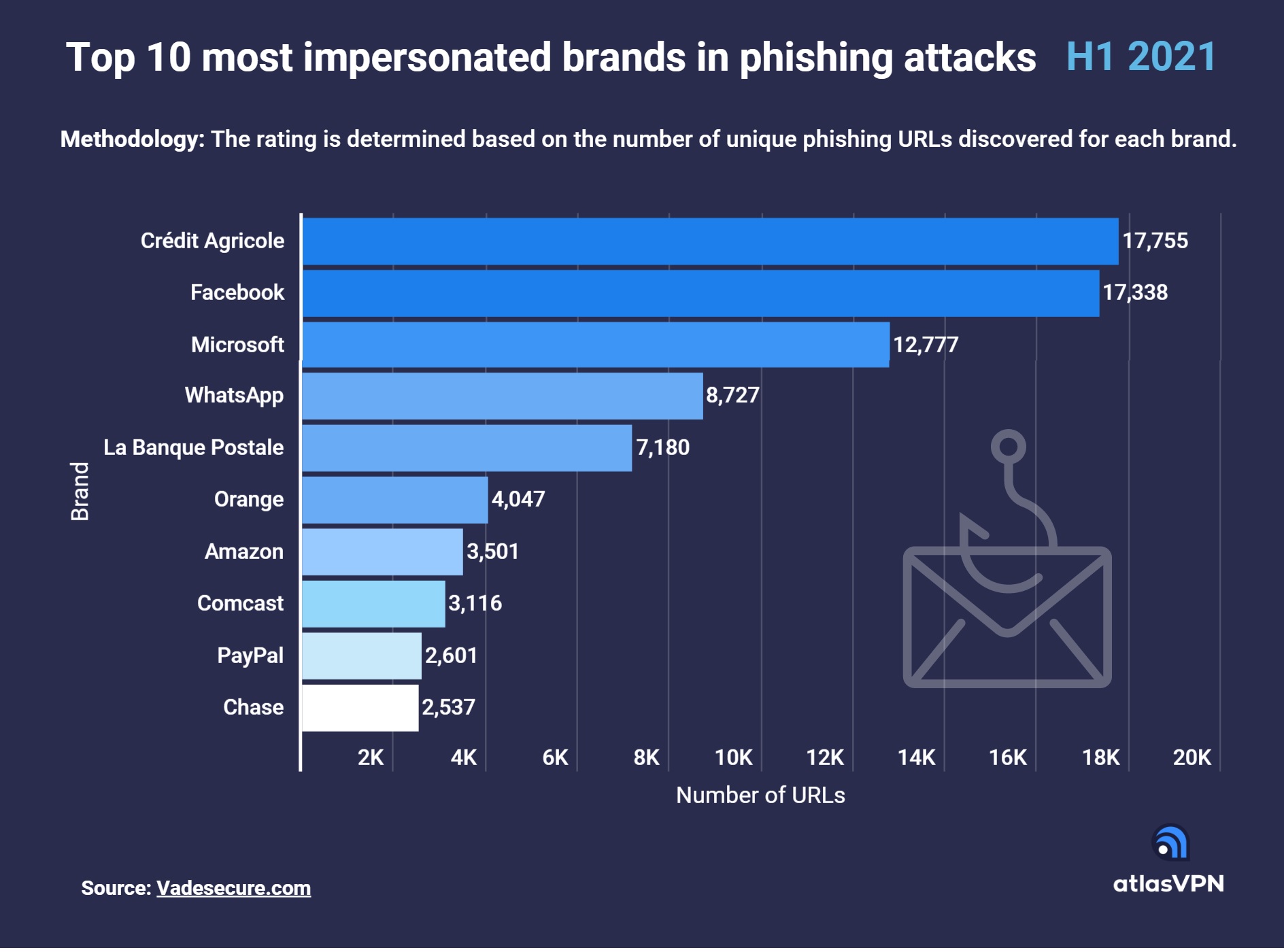
According to the data presented by the Atlas VPN team, Crédit Agricole, a French financial group, was by far the most used brand in phishing attacks in H1 2021. The brand was linked with 17,755 unique phishing URLs, followed by social media giant Facebook with 17,338 and Microsoft with 12,777.

The figures are based on Phisher’s Favorite Top 25 H1 2021 report by Vade, which looks at the 25 most impersonated brands in phishing attacks a few years ago from January 1, 2021, to June 30, 2021. 

Multi-platform messaging service provider WhatsApp is the second social media brand to make the top ten list. It was taken advantage of in 8,727 phishing attacks. Meanwhile, French bank La Banque Postale occupies the fifth spot with 7,180 attacks.

Other brands in the top ten list include multinational telecoms company Orange (4,047), the world’s largest online retailer Amazon (3,501), multibillion-dollar media, entertainment, and communications company Comcast (3,116), digital payment service provider PayPal (2,601), and American national bank Chase (2,537).

Most phishing assaults were perpetrated in Brazil, followed by Russia and Indonesia.

Financial brands were criminals’ favorite

Generally, cybercriminals choose highly-trusted brands in their phishing campaigns. However, brands in certain industries were more favored than others.

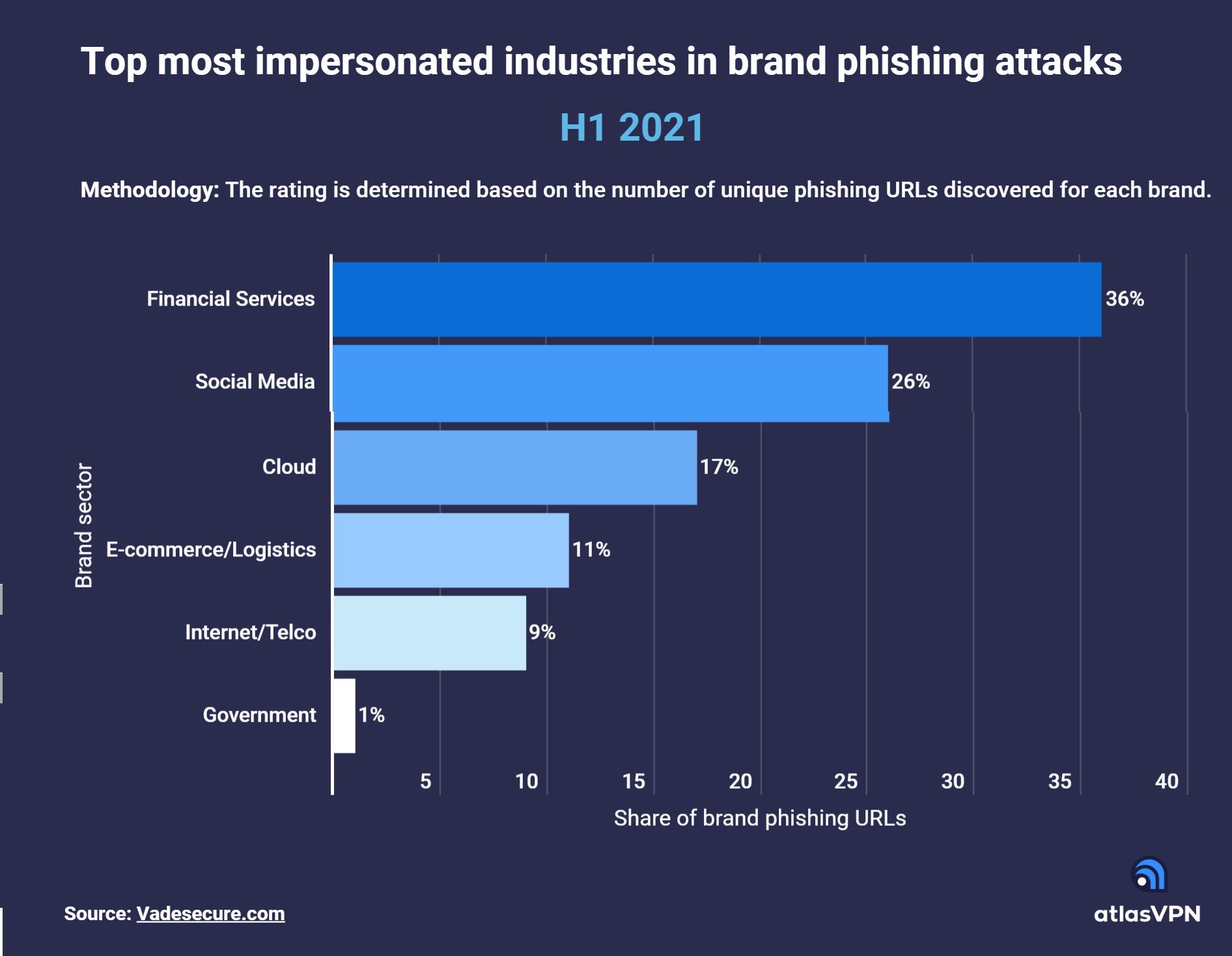
Financial service brands were particularly popular in phishing attempts due to the rise in digital payments and growing reliance on online banking during the pandemic. They accounted for 36% of URL phishing attacks in H1 2021. 

Cybercriminals spoofed well-known financial brands such as Crédit Agricole, La Banque Postale, PayPal, Chase, Wells Fargo, Square, HSBC, and Banque Populaire to lure out sensitive information from unsuspecting victims.

Social media companies were also heavily impacted. Social media brand impersonation accounted for over a quarter (26%) of all brand phishing attacks in the first half of this year. Apart from Facebook and WhatsApp, Instagram and LinkedIn were common choices for criminals.

Next up is the cloud sector. Cloud companies like Microsoft, Netflix, Adobe, and DocuSign were involved in 17% of URL phishing attacks. Meanwhile, 11% of phishing assaults targeted e-commerce and logistics companies, such as Amazon, DHL, Rakuten, Apple, and eBay.

The remaining 10% of brands spoofed in URL phishing attacks were internet and telecommunication companies, such as Orange, Comcast, Yahoo, SFR (9%), as well as government organizations (1%). 

Tips to avoid phishing scams

  • Keep your browser up to date. Look out for browser updates. They are released regularly and may contain security patches for vulnerabilities that were discovered on the browser. Cybercriminals often launch attacks to exploit known security vulnerabilities. Therefore it is essential to install any browser updates as soon as they become available. 
  • Inspect the website’s URL. Carefully inspect the website’s URL before taking any action. Criminals use visually similar characters such as lower case “L” and capital “I” to deceive people into thinking they are on a legitimate website. 
  • Look for an SSL certificate. Make sure the portal address starts with HTTPS (not with HTTP) and has a green padlock symbol before the web address. This means that the website has an SSL certificate, and the connection is encrypted. 
  • Beware of grammar mistakes. Scammers rarely hire professional writers to check their copy-cat website’s content for errors. If a website is riddled with spelling mistakes, there is a high chance it is not legitimate. 
  • Check if the website has been flagged. You can use URL checkers to see if the website has already been flagged. You can find many tools for this purpose by searching “Check URL safety” in Google.
  • Use Tracker Blocker. Take advantage of the Atlas VPN Tracker Blocker tool, which stops third-party trackers and blocks malicious websites for a safer browsing experience.

For the Silo, Jarrod Barker.

Current State of Cybersecurity Doesn’t Work

“You pay your money, as the saying goes, and you take your chances.” says Falkowitz, CEO of Area 1 Security. “More and more these days, it seems like this ‘policy’ is the rule rather than the exception, in everything from health care insurance to the commuter parking lot. Even though you’ve paid for the product or service, no one’s really responsible for some reason when you suffer damages while consuming whatever it is you bought. Or worse yet, you somehow find that whatever you bought doesn’t really do what you bought it for. And there’s an asterisk somewhere in the fine print to explain why. Unfortunately, nowhere is this more prevalent than in today’s cybersecurity industry.”

Despite the billions spent on cybersecurity we continue to suffer the most debilitating and expensive breaches imaginable, and some that cannot be imagined under any circumstances. Yet experts predict the worst is still to come. Cybercrime has moved from data theft and website defacement to a trajectory that includes data manipulation, data loss and eventually, if something is not done to change the economics of being a bad guy on the internet, threats to the stability of society itself.

“Cybersecurity companies seem to be content to collect their millions with the caveat that they can’t really offer protection in exchange,” continues Falkowitz. “Their customers likewise collect mountains of data on their customers and are appropriately contrite when that data is stolen or misused but the apology is not accompanied by compensation. Even the government can’t protect itself, or its citizens even if they’re attacked by another nation-state.”

Phishing

The excuses and the explanations are familiar: Cybersecurity is too complicated. Hackers are too clever. Attacks are unprecedented.

“Nonsense. Every bit of it.” says Falkowitz. “Cybersecurity is no more complicated than hundreds of other things we do routinely, from sending astronauts into space or open heart surgery. Hackers are human, just more persistent about how to fool the rest of us. And attacks are based on the same tried and true methods—phishing—they’ve been using for decades.”

Oren J. Falkowitz is the co-founder and CEO of Silicon Valley’s Area 1 Security. Oren held senior positions at the NSA and United States Cyber Command (USCYBERCOM) where he focused on Computer Network Operations & Big Data and is a predominant cybersecurity industry thought-leader committed to keeping high-level national security conversations relevant.  For the Silo, by Jennifer Vickery. 

Supplemental- What exactly is phishing?