Tag Archives: C.D. Howe Institute

How Canada Can Help Repair Today’s Global Trading System

The article below (Furthering the Benefits of Global Economic Integration through
Institution Building: Canada as 2024 Chair of CPTPP) was first published by the C.D. Howe Institute by Paul Jenkins and Mark Kruger.

Introduction

Over the last 10 to 15 years, the global economy has become fragmented. There are many reasons for this fragmentation – both economic and geopolitical. A particularly important factor has been the inability of the institutions that provide the governance framework for international trade and finance to adapt to the changing realities of the global economy.

This erosion is reflected in the cycles of outcome-based measures of globalization, such as trade-to-GDP ratios. Research indicates that the development of institutions that promote global integration is highly correlated with more rapid economic growth. To secure the benefits of economic integration, the international community should re-commit to a set of common rules. This should involve the renewal of existing institutions in line with current economic realities.


But institutional renewal alone is not sufficient. Nurturing and growing new institutions are also critical, especially ones reflecting the realities of today’s global economy. Most promising in this regard is the Comprehensive and Progressive Agreement for Trans-Pacific Partnership (CPTPP).


The CPTPP is seen as a “next generation” trade agreement. It takes World Trade Organization (WTO) rules further in several key areas, such as electronic commerce, intellectual property, and state-owned enterprises.
Expansion of CPTPP represents a unique opportunity to strengthen global trade rules, deepen global economic cooperation on trade and sustain an open global trading system. The benefits for Canada of an expanded CPTPP are further diversification of its export markets and deepened ties with countries in the Indo-Pacific region.

Trusted Policy Intelligence


The challenge to enabling broad-based accession to CPTPP is geopolitical, reflecting the rising aspirations of the developing world, the associated
heightened contest between democracy and autocracy, and the prioritization of security. Indeed, for many, today’s security concerns are at the forefront, trumping economic issues. We argue that recognition of the economic benefits
of global economic integration must also remain at the forefront, and that research presented in this paper shows that institutional building is at the core
of securing such benefits.


As 2024 Chair of the CPTPP Commission, Canada has an opportunity to play a leadership role, as it did in the creation of the Bretton Woods institutions 80 years ago, by again promoting global institution building, this time through the successful accession of countries to the CPTPP, both this year and over the long run.
  1. Cycles in Global Economic Integration
    Former US Fed Chair Bernanke points out that the process of global economic integration has been going on for centuries. New technologies have been a major force in linking economies and markets but the process has not been a smooth and steady one. Rather, there have been waves of integration, dis-integration, and re-integration.
    Before World War I, the global economy was connected by extensive international trade, investment, and financial flows. Improved transportation – steamships, railways and canals – and communication – international mail and the telegraph – facilitated this “first era of globalization.” The gold standard linked countries financially and promoted currency stability. Trade barriers were reduced by the adoption of standardized customs procedures and trade regulations. The movement of goods, capital, and people was relatively unrestricted.
    The outbreak of World War I frayed global economic ties and set the stage for a more fragmented interwar period. The Treaty of Versailles imposed
    punitive measures on Germany, exacerbating economic hardships. Protectionist policies, such as high tariffs and competitive devaluations, became widespread as countries prioritized domestic interests.
    The collapse of the gold standard further destabilized international finance. In contrast to the cooperation seen before the war, countries pursued economic nationalism and isolationism.
    Protectionism increased in the 1930s as a result of the dislocation caused by the Great Depression. In an attempt to shield domestic industries from foreign competition and address soaring unemployment, many countries imposed tariffs and trade barriers.
    The Smoot-Hawley Tariff Act in the United States exemplified this trend, triggering a series of beggar-thy-neighbour policies. These protectionist policies exacerbated the downturn and contributed to a contraction in international trade that worsened the severity and duration of the Great Depression.
    Mindful of the lessons of the 1930s, a more liberal economic order was established in the aftermath of World War II. The creation of the Bretton Woods Institutions – the International Monetary Fund (IMF), the World Bank and the General Agreement on Tariffs and Trade (GATT) – provided the principal mechanisms for managing and governing the global economy over the second half of the 20th century.
    Building on the GATT, the formation of the World Trade Organization in 1995 provided the institutional framework for overseeing international trade and settling disputes. China became the 143rd member of the WTO in 2001 and almost all global trade became subject to a common set of rules.
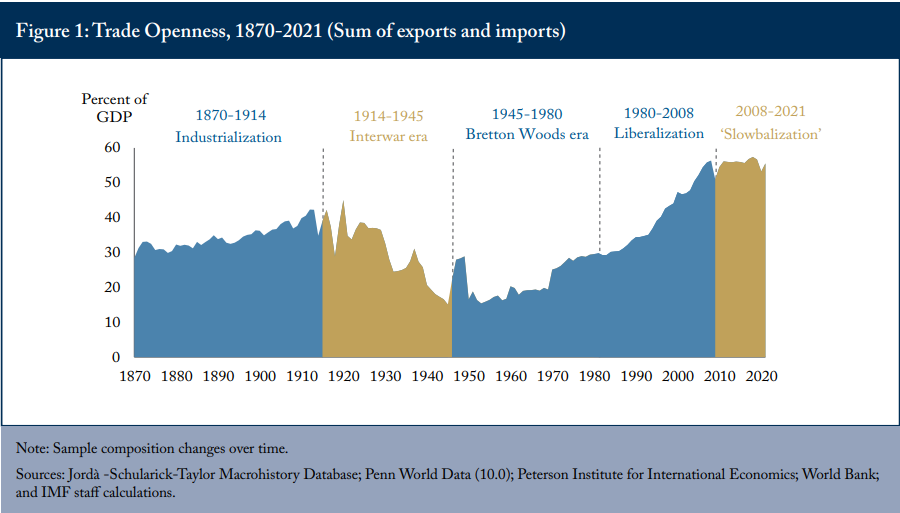
    The rise and fall of international economic governance are reflected in the cycles of outcome-based measures of globalization. Looking at trade openness, i.e., the sum of exports and imports as a percentage of GDP, the IMF divides the process of global integration into five periods: (i) the
    industrialization era, (ii) the interwar era, (iii) the Bretton Woods era, (iv) the liberalization era, and (v) “slowbalization” (Figure 1).
    Many factors have contributed to the plateauing of trade openness in the last 10 to 15 years. The fallout from the Global Financial Crisis was severe and the recovery was tepid. Brexit, with its inward-looking perspective, has disengaged the UK from Europe.
    Populist protectionism has led to “re-shoring” in an effort to address rising inequalities and labour’s falling share of national income. There has been far-reaching cyclical and structural fallout from COVID-19.
    And while the AI revolution portends significant opportunities, uncertainties over labour displacement abound.
    Geopolitics has also played a critical role. Security concerns have become more important, trumping economic issues in the eyes of many. This has led to multiple sanctions, along with export and investment controls, being imposed to protect national security interests.
    The IMF has carried out several modelling exercises that estimate the consequences of fragmentation if further trade and technology barriers were to be imposed. The studies employ a variety of assumptions regarding trade restrictions and technology de-coupling. In summary, the cost of further fragmentation ranges from 1.5 to 6.9 percent of global GDP. As with all modelling exercises, a degree of caution is warranted. At the same time, these studies should not be viewed as upper-bound estimates because they disregard many other transmission channels of global economic integration.
  2. De Jure and De Facto Globalization
    In assessing the evolution of globalization, however, it would be misleading to focus too narrowly on outcome-based measures such as the trade-to-GDP ratio depicted in Figure 1.
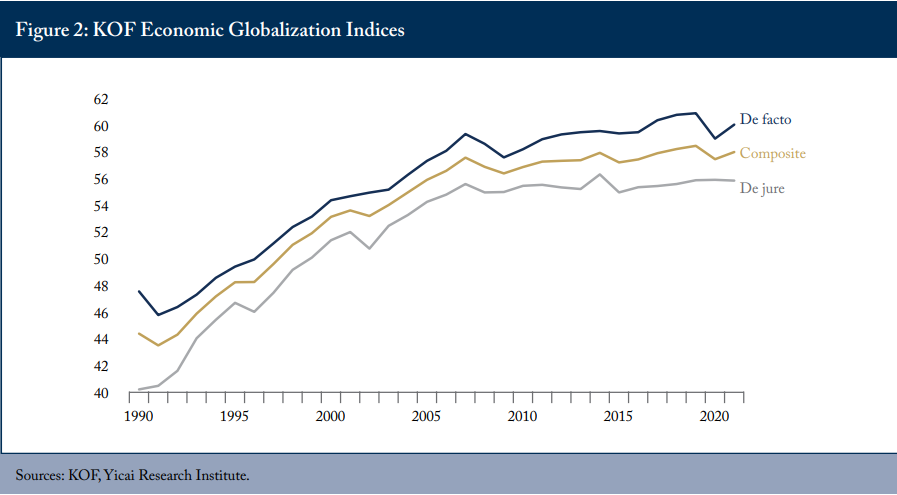
    The data compiled by KOF, a Swiss research institute, provide a more nuanced view of global economic integration. KOF constructs globalization
    indices that measure integration across economic, social, and political dimensions. Its globalization indices are among the most widely used in academic literature. KOF’s data set covers 203 countries over the period 1970 to 2021. Our focus here is on KOF’s economic indices.
    In terms of economic globalization, KOF looks at the evolution of finance as well as trade. Moreover, one of the unique aspects of KOF’s work is that it examines globalization on both de facto and de jure bases.
    KOF’s de facto globalization indices measure actual international flows and activities. In terms of trade, it includes cross-border goods and services flows and trading partner diversity. For financial globalization, its indices measure stocks of international assets and liabilities as well as cross-border payments and receipts.
    KOF’s de jure globalization indices try to capture the policies and conditions that, in principle, foster these flows and activities. For trade globalization,
    these include income from taxes on trade, non-tariff barriers, tariffs, and trade agreements. De jure financial globalization is designed to measure the institutional openness of a country to international financial flows and investments. Variables to measure capital account openness, investment restrictions and international agreements and treaties with investment provisions are included in these indices.
    The trends in KOF’s de facto and de jure economic globalization indices are shown in Figure 2. Both globalization measures increased rapidly from 1990
    until the Global Financial Crisis. Both measures subsequently plateaued. In 2020, as the global pandemic took hold, the de facto index plunged to its
    lowest level since 2011. In 2021, it recovered half of the distance it lost the previous year. The de jure index has essentially been flat for the last decade.
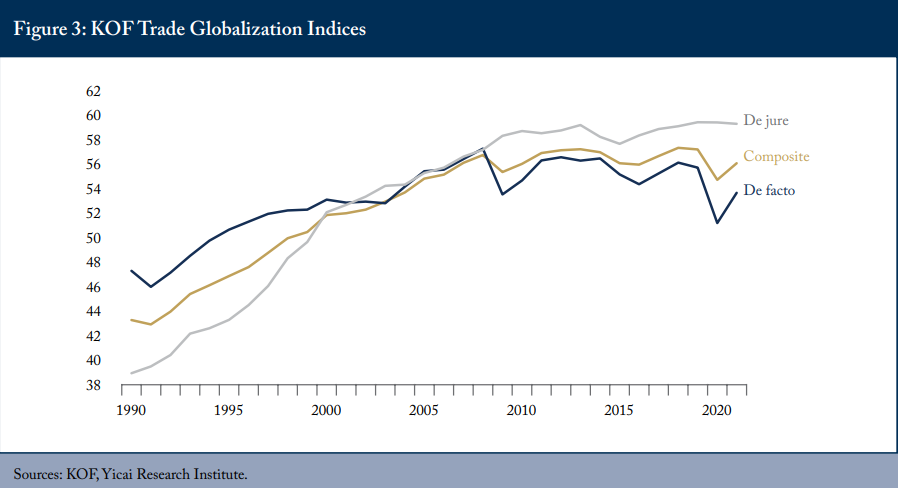
    There has been a sharp divergence between KOF’s de facto and de jure trade globalization measures in the last five years (Figure 3). By 2020, de facto trade globalization had dropped to a 25-year low. Although it recovered somewhat in 2021, it remains well below the average of the last decade. In contrast, de jure trade globalization levelled off after the Global Financial
    Crisis. It reached a modest new high in 2019 and has essentially remained there since then.
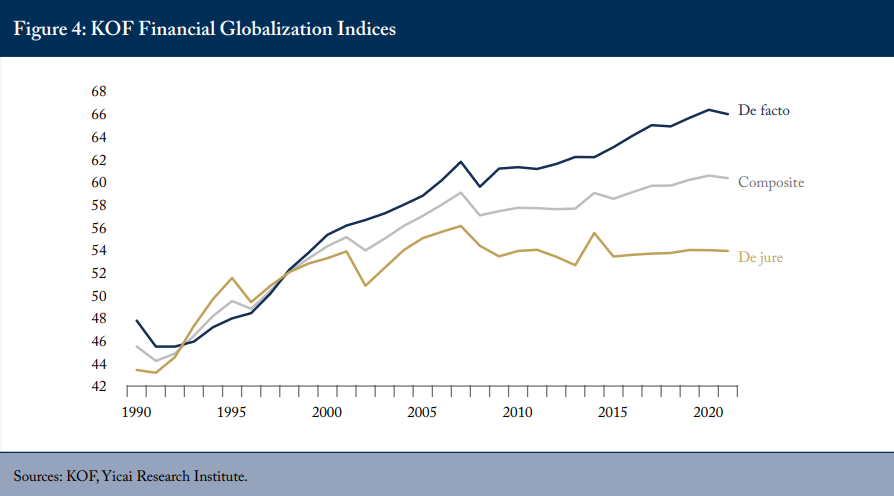
    The trends in financial globalization are almost the reverse of those of trade globalization. De facto financial globalization continued to increase through
    2020 and dipped slightly in 2021. De jure financial globalization has been essentially flat over the last two decades (Figure 4).
    The KOF researchers provide convincing econometric evidence that economic globalization supports per capita GDP growth. Importantly,
    their analysis shows that institutions matter. They demonstrate that the positive impact on growth from trade and financial globalization comes from
    institutional liberalization rather than greater economic flows. Through a series of panel regressions, the researchers show that it is the de jure trade and financial globalization indices that are correlated with more rapid per capita GDP growth. In contrast, there is no significant relationship between growth and the de facto indices.
    KOF’s conclusions are consistent with the work of Rodrik, Subramanian and Trebbi who examine the contributions of institutions, geography, and trade
    in determining relative income levels around the world. They find that institutional quality “trumps everything else.” Once institutions are controlled for, conventional measures of geography have weak effects on incomes and the contribution of trade is generally not significant.
    Thus, to recapture the economic benefits of free trade and open markets, countries need to recommit to finding ways to further de jure globalization; that is, putting in place the institutional building blocks in
    support of enhanced trade and financial integration.
  3. Geopolitical Realities
    Institutional reform, however, requires trust and mutual respect among partners. Many would argue that such trust and respect is in limited supply
    today, especially between the United States and China. The United States is willing to endure the costs of heightened protectionism to purportedly
    strengthen the resilience of its economy and secure greater political security. This has resulted in multiple sanctions, particularly in areas of digital technologies.
    In response, China, amongst other measures, has imposed export controls on critical minerals used in advanced technology in defence of its geopolitical goals.
    Yet, as discussed by Fareed Zakaria in a Foreign Affairs article, The Self-Doubting Superpower, China has become the second largest economy in the world richer and more powerful within an integrated global economic system; a system that if overturned would result in severely negative consequences for China.
    For the United States, its inherent strength has been its commitment to open markets and its vision of the world that has considered the interests of others. In many respects, it remains uniquely capable of playing the central role in sustaining the global economic system.
    Following a recent trip to China, Treasury Secretary Yellen stated that “the relationship between the United States and China is one of the most consequential of our time,” and that it “is possible to achieve an economic
    relationship that is mutually beneficial in the long-run – one that supports growth and innovation on both sides.”
    This means that the United States would need to accommodate China’s legitimate efforts to sustain a rising standard of living for its citizens, while
    deterring illegitimate ones. For China, it would mean a clear and abiding commitment to an open, rules-based global economic system.
    It appears that there is currently no clear path forward for this change in mindset, given what many see as insurmountable geopolitics in both the United States and China. Yet, history shows that achieving and sustaining long-term economic growth is in every country’s best interest, and that such growth is best secured through ongoing global economic integration.
  4. A Way Forward
    Recent discussions at the IMF’s Annual Meeting in Marrakech about IMF quota reform, including quota increases and realignment in quota shares to
    better reflect members’ relative positions in the global economy, are important signals of possible renewal.
    Similarly, calls to revamp the World Bank’s mandate, operational model, and ability to finance global public goods, such as climate transition, reflect a growing consensus that the Bretton Woods Institutions must change in the face of today’s realities.
    But institutional renewal alone is insufficient.
    Broad-based accession to the CPTPP represents a unique opportunity to strengthen global governance overall, and to address common challenges in ways that benefit both countries as well as the global economy.
    The CPTPP sets a high bar, requiring countries to:
  • eliminate or substantially reduce tariffs and other
    trade barriers;
  • make strong commitments to opening their markets;
  • abide by strict rules on competition, government
    procurement, state-owned enterprises, and
    protection of foreign companies; and
  • operate within, as well as help promote, a
    predictable, comprehensive framework in the critical
    area of digital trade flows.
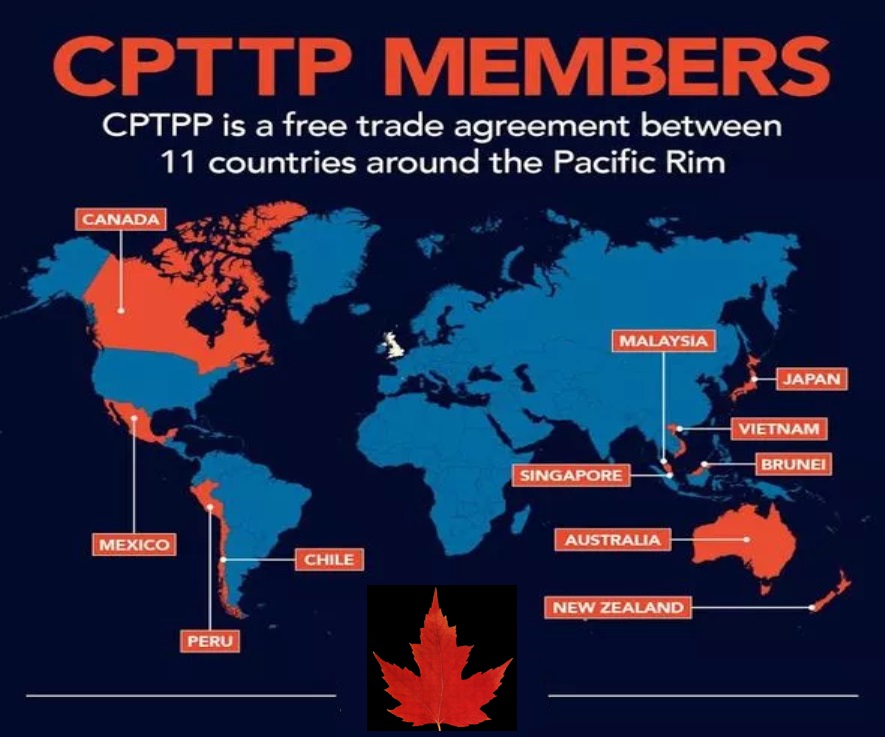
    The United Kingdom formally agreed to join the
    CPTPP in July 2023. Once its Parliament ratifies
    the Agreement, the UK will join Australia, Brunei
    Darussalam, Canada, Chile, Japan, Malaysia, Mexico,
    New Zealand, Peru, Singapore, and Vietnam in the
    trading block.
    Such a diverse membership clearly demonstrates
    that countries do not have to be geographically close
    to form an effective trading block.
    A half-dozen other countries have also applied
    to join the CPTPP, with China’s application having
    been the earliest received.
    Petri and Plummer estimate that joining the
    CPTPP would yield large economic benefits for
    China and the global economy. For the latter, the
    boost to global GDP would be in the order of $600
    billion annually. The United States in joining would
    gain preferential access to rapidly growing Pacific Rim
    markets. Much of the additional market access would
    come from China’s opening of its service sector.
    Industrial policy and state-owned enterprises,
    however, will continue to play a much larger role
    in China than they do in Western economies. The
    key for China is to demonstrate that a socialist
    market economy (i.e., one that has a mixed capitalist
    market and government-controlled economy) can be
    consistent with fair trade.
    The process of China joining the CPTPP will
    undoubtedly be time-consuming. It took 15 years of
    negotiations before China joined the WTO in 2001.
    This was five more years, on average, than it took
    those countries that joined after 1995.
    The challenge for Canada, and subsequent chairs,
    is to ensure that China’s entry maintains the high
    standards CPTPP members have met so far.
    Broad based accession to the CPTPP, including
    the United States and China, however, is best viewed
    Page 8 Verbatim
    Trusted Policy Intelligence
    as a long-term goal. China would need to undertake
    unprecedented reforms, involving complex political
    challenges, including Taiwan’s potential accession. For
    its part, the United States would need to step well
    back from its current mercantilist mind set, which
    risks worsening.

Canada as Chair in 2024

While efforts to renew existing global institutions to better reflect current economic realities are important, we see promoting broad accession to the CPTPP as the best means to turn today’s global economic fragmentation around.
At the heart of the global economic system is the open trading framework put in place at Bretton Woods in 1944. Many would see today’s fragmentation as becoming more acute, rather than getting better, due to geopolitical divisions.
But further fragmentation is no way to save the open, rules-based global trading system that has served so many countries so well for so long.


While restrictions reflecting legitimate security concerns are inevitable, an open, competitive trading system remains in the best interests of all countries.
As 2024 Chair of the CPTPP Commission, Canada has an opportunity to contribute to turning around the fragmentation of today’s global trading system and moving the global economy back along a path towards a
more open, rules-based trading system.


An important goal for Canada’s chairmanship would be to clarify the rules of accession. This would be a big step forward in sustaining expansion of CPTPP. While today’s geopolitical realities surrounding the applications of both China and Taiwan represent a particularly challenging area to advance, significant progress in other areas must be made. It should accelerate inclusion of Costa Rica, Uruguay, Ecuador, and Ukraine, all of whom have applied. And it should help move forward discussions with South Korea, Indonesia, Philippines, and Thailand, who have expressed interest in joining.


Over and above all that, however, at a more strategic level, Canada should also champion discussion and understanding of why building towards the long-run goal of broad accession to CPTPP is important. Open and inclusive institutions are at the core of providing the benefits of global economic integration to all countries.


Canada will also be Chair of the G7 Summit in 2025. This, along with the various ministerial and officials’ meetings leading up to the Summit, offers another critical avenue for Canada to take a leadership role in sustaining and promoting an open, rules-based global trading system.

    Quality Over Quantity: How Canada’s Immigration System Can Catch Up


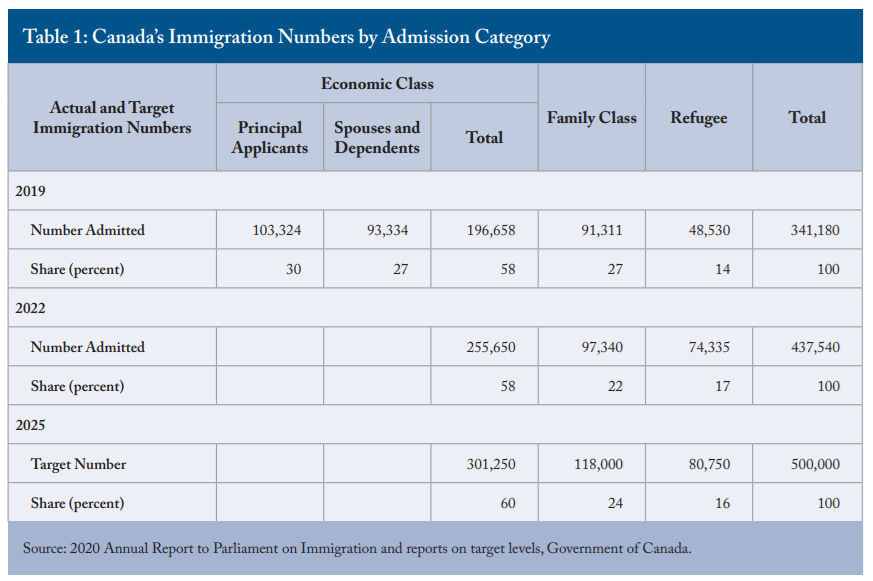
    Canada’s immigration point system is designed to select skilled immigrants who have the potential to contribute to the country’s economic growth and meet its evolving skills needs. However, Canada faces challenges in fully leveraging increased immigration levels to enhance the well-being of Canadians due to weaknesses in capital investment and a quantity/quality trade-off in selecting economic immigrants. Furthermore, recent reforms may work at cross purposes to this goal. They include category-based selection that targets low-paying occupations, which can discourage capital investment, and a recent surge in the number of temporary residents in low-wage jobs that also may have adverse effects on the quality of potential candidates for permanent residency.
     

    This study compares skilled immigration selection policy in Canada, Australia, New Zealand, and the UK, with the objective of identifying key areas for improvement in Canadian policy. The skilled immigration point systems in Canada and Australia share some similarities, with both prioritizing a two-step immigration process, placing an emphasis on English proficiency and workforce age, and requiring pre-migration credential and English proficiency assessments. However, the two countries differ mainly in their strictness of criteria and their emphasis on occupational and language skills. Furthermore, Australia has shown more agility and creativity in its skilled migration reforms. Reforms in the UK and New Zealand have also put them ahead in the competition for talent.
     

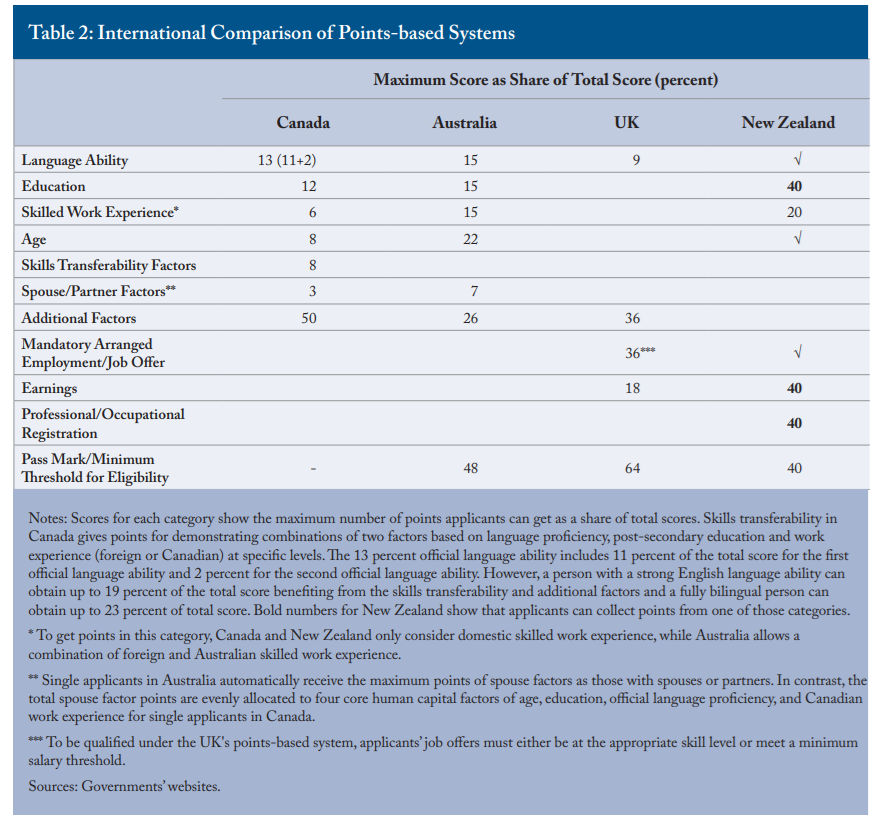
    Based on this international comparison, the author makes recommendations for improvement. They include: 1) Setting a Minimum Points Threshold for Eligibility. As it is, Canada imposes no minimum points threshold for eligibility in its Express Entry points-based system. 2) Considering a Pre-admission Earnings Factor. Studies show the importance of pre-immigration earnings in predicting immigrants’ outcomes after arrival. The UK, New Zealand and Australia include this factor. 3) Boosting Standards under the Language Requirement. Official language skills are as important in predicting the initial earnings of principal applicants admitted under Canada’s Express Entry system as pre-immigration Canadian work experience, and even more important than educational level and age at the time of immigration. 4) Raising Business Immigration Numbers. Canada faces the challenge of weak business investment but is failing to select business immigrants with entrepreneurial skills, putting it at a disadvantage compared to competitors like Australia and the UK.

    The author thanks Tingting Zhang, Charles DeLand, Rosalie Wyonch, Charles Beach, Jodi Kasten, Mikal Skuterud and anonymous reviewers for comments on an earlier draft. The author retains responsibility for any errors and the views expressed.

    Read the full report here.

    For the Silo, Parisa Mahboubi/C.D. Howe Institute.

    Parisa Mahboubi

    Parisa Mahboubi

    Parisa Mahboubi is a Senior Policy Analyst and leads the C.D. Howe Institute’s human capital policy program. Her research interest focuses on social policy with a concentration on demographic, skills, education, and labour market concerns. In addition to authoring research studies, she regularly writes a column for the Globe and Mail’s business section.

    Canadians Should Understand Their Private Healthcare System – And How It’s Changing


    The Study in brief

    The intense debate pitting private versus public healthcare in Canada needs a reality check. Private aspects of healthcare exist in different forms and to varying degrees across Canadian provinces, largely depending on their respective legislation and regulations.
     For healthcare professionals providing insured services, most bill through the public system, but not all. The current and future scope of their role is the pressing issue at hand.


     Health Canada has had success in eliminating extra billing and user fees under sections 18 and 19 of the Canada Health Act. However, provinces have considerable authority in determining key terms like “medically necessary” or “insured services” that are covered under the Act. The result has been a diversity of approaches.
     Provinces have the legislative tools to constrain the growth of private healthcare, if that is their objective. Similarly, provinces have considerable authority to increase the scope of private healthcare, if that is their objective (even within the current parameters of the CHA), by revising provincial legislation or regulation.


     Either way, the specific policy direction undertaken would be different for each jurisdiction, as the legislative and other barriers to private healthcare (such as market size limiting the viability of private delivery) vary across provinces. This Commentary provides clarity about the different forms of “private” healthcare and a comprehensive view of the current policy landscape defining the balance between public and private healthcare.

    All health systems incorporate some mix of public and private healthcare. In 2021, public sector spending in Canada amounted to 73 percent of total healthcare expenditure, exactly equivalent to the OECD average of 73 percent (OECD 2023). Yet these summary figures tell us little about the public/private contours of any healthcare system. Private healthcare can manifest in a multitude of ways, and the precise configuration of the relationship between public and private healthcare tells us more about the system than the absolute level of public or private spending.

    Under the Canadian Constitution, provinces have wide-ranging jurisdiction over the provision of healthcare in Canada, both explicitly (hospitals) and through judicial interpretation (“matters of a merely local or private nature,” as well as authority over insurance). The Canada Health Act (CHA) does provide a national framework (supported by federal transfer funds) that has, for several decades, ensured a certain level of congruence across provinces in the provision of public healthcare. But each province’s health legislation is unique, and it is this interplay between federal and provincial legislation that provides a regulatory space for private healthcare. Variation across provinces means private healthcare in Canada is not a uniform phenomenon.

    The objectives of this Commentary are fourfold: first, to describe the ways we can understand “private” healthcare; second, to explain the different ways provincial legislation permits or prohibits aspects of private healthcare; third, to discuss the supply- and demand-side variables causing private healthcare to take its current shape across provinces; and fourth, to analyze the relationship between provincial healthcare legislation and the CHA with reference to the expansion of private healthcare in Canada. This Commentary does not address the utility of private healthcare per se. Rather, it focuses on the confusion inherent in so many discussions referencing “private healthcare.” Both exponents and critics of private healthcare can pick and choose from numerous manifestations of private healthcare to support their respective positions. By requiring proponents and opponents to clarify precisely what they mean by “private healthcare,” the potential costs and benefits can be more clearly identified in each case.

    What do we mean by “Private Healthcare”?

    Critics of private healthcare point to the costs and inequities of the American healthcare system to argue against it, while proponents reference European mixed public/private models to show how effective it can be. Beyond the City Limits: Why Southern Ontario Families Are Prioritizing Emergency Preparedness First Aid Course Hamilton. Any discussion of the role of private healthcare should therefore first clarify what, precisely, is meant by “private healthcare.” Healthcare systems can generally be broken down into three constituent parts: delivery, financing, and regulation. Any of these elements can include a public or private (for-profit or not-for-profit) component (Wendt et al. 2009; Böhm et al. 2013; Marchildon 2022).

    Delivery of Healthcare Services

    Much healthcare in Canada is delivered by private providers. When medicare was introduced in Saskatchewan in 1947, physicians vehemently protested. A settlement was reached only when the province agreed to recognize physicians as private independent operators rather than as employees of the state (Marchildon 2020). This model was followed by other provinces as they introduced their own medicare legislation. Ambulance services across Canada are often private, with these companies negotiating service contracts with health authorities or provinces. Nursing care in hospitals and district nursing programs is generally provided publicly, but private nursing firms (such as the not-for-profit VON for home care, or for-profit firms supplying temporary placements in hospitals) are also commonly utilized.

    Historically, hospitals in Canada (especially those founded by religious orders) were largely based on a private, independent, not-for-profit model. As hospitals became amalgamated into health authorities, they were consolidated in provincial governments’ financial statements and their operation was generally subsumed within the public infrastructure – even as many (especially larger) hospitals with boards of directors remain not-for-profit organizations.

    Key Takeaways

    What, exactly, is a “not-for-profit” (NFP) organization in Canada, and how does it differ from a private or a public one? Legally, NFPs are “bodies corporate without share capital”: in other words, revenues must be directed to the mission of the organization rather than to shareholders. NFPs also enjoy specific tax breaks. Unlike fully public bodies, however, they are self-governing. Generally, they will have boards of directors who are accountable for funds raised and debts incurred. Like directors in a private company, these directors have a fiduciary responsibility to use resources wisely. Unlike private companies, directors of NFP organizations are directly responsible to the corporate entity rather than to members (i.e., shareholders). The corporate entity, in turn, is responsible to the government jurisdiction (federal or provincial) wherein it is incorporated.

    Increased attention has been paid to private surgical companies. Individual medical specialists are generally considered independent private operators who contract their services to medical facilities or universities, although their payment models often include elements such as base salary, research stipend, fee for service, etc. Surgical specialists have in many provinces established discrete private businesses where bulk services (a specific number of certain surgical services) are provided over a set period for a negotiated price (e.g., the Shouldice Hernia Centre in Ontario or Scotia Surgery in Nova Scotia). They may use public infrastructure (hospital operating rooms) or provide their own physical space. There is considerable debate whether contracting these services is superior to establishing them as part of the public system (e.g., Day 2023; Lewis 2022; Longhurst 2023). However, as the funding and administration of these services is controlled by provinces (or provincial health authorities), and as patients use these services as they would fully public services (i.e., free at point of delivery), they are not considered a “two tier” form of access to healthcare. Patients cannot access these services directly; rather, they are routed through the public system. Grey areas of private service delivery, described in more detail below, include the private delivery of medically necessary diagnostic services, infusion clinics on hospital sites, and certain forms of virtual care.

    Also relevant to the discussion of private delivery is the type of private entity under consideration. “Private” hospitals that are not-for-profit may in fact operate more like a public institution than a private one; here one might usefully distinguish institutions which are functionally embedded in provincial healthcare system (e.g., via accounting practices) from those that operate at arm’s length. Conversely, evidence from the United States suggests private not-for-profit hospitals can also show the kind of profit-driven behaviour more commonly seen in for-profit entities (Silver-Greenberg and Thomas 2022). Others have argued that small independent private health clinics (such as Algomed or Bluenose, in Canada) are in a different category from large American corporate entities (such as the Hospital Corporation of America) (Deber 2003).

    Financing of Healthcare Goods and Services

    As noted, some privately provided services (such as ambulance services or surgical clinics) are often funded publicly. And, while it is not as common, publicly provided services can be funded privately (e.g., in systems where money follows the patient, private insurers may be able to find places for their patients in publicly funded hospitals). Charitable NFP organizations can be another source of healthcare funding. In Canada, much attention is paid to the division of healthcare into services that are, or are not, insured publicly. For example, the provision of cosmetic surgery (undertaken for aesthetic reasons) is commonly private, and is paid for privately and directly out-of-pocket. The private provision of services that are publicly funded (such as cataract or hip replacement surgery), as noted, is more controversial, but is not uncommon within Canada. The main point of controversy in Canada is whether publicly insured services should also be available for direct purchase to individuals within the private sector, bypassing the public system altogether.

    Out-of-pocket financing in Canada is largely targeted to healthcare services that are not covered by public insurance (the precise list of insured versus non-insured services varies across provinces). Only 12.6 percent of Canadian healthcare expenditure in 2021 was comprised of out-of-pocket spending (WHO 2023); the remainder was covered by public or private insurance.

    So how is healthcare insurance structured in Canada?

    Public insurance: In all provinces, most medically necessary healthcare services are largely funded on a tax-based model, where citizens support healthcare services through their general tax contributions. Some provinces do require provincial inhabitants to pay “healthcare premiums” but, as these contributions simply go into the provinces’ general operating funds, rather than a bespoke account used only for healthcare, these premiums can be considered simply as another form of taxation. As a condition of receiving federal health transfers, the CHA requires that each province has a public insurer. Böhm et al. (2013) argue, for this reason, that states such as Canada and Australia, which are structured on a public insurance system, are more properly considered to possess “national health insurance systems” rather than “national health systems,” as typified by the UK.

    Each province has the authority to determine what it insures publicly (which is why coverage for “medically necessary services” varies across provinces). In general, medically necessary services provided by physicians and in hospitals are covered (as required by the CHA) but, as explained below, this is much more complicated than it appears. Services such as vision care and dental care provided in hospitals are also generally covered, as are diagnostics, physiotherapy, and other related services.

    Provinces are not required to cover everyone: those in the armed forces or federal penitentiaries, for example, are insured by the Government of Canada. Although provincial healthcare systems provide many of the services for these specific groups, the provinces are reimbursed by the federal government. Those injured in the workplace are usually covered by workers’ compensation. Certain categories of migrants (such as refugees) are also insured federally until they receive permanent citizenship status, whereupon they fall under provincial insurance. Depending on the type of work and the length of stay, migrant workers are insured both through provincial health plans and workers’ compensation programs (for a fuller discussion, see Fierlbeck and Marchildon 2023).

    Most provinces expand public health insurance beyond what is required by the CHA. While the CHA does not specifically mandate the public provision of dental care, optometry services, and pharmaceuticals outside of hospitals, provinces generally have some form of coverage of these services for vulnerable groups. These are determined either by cohort (e.g., seniors or children), service (pharmacare or dental care), income category (below a certain ceiling), or some combination of all three. These programs vary considerably across provinces.

    Private health insurance: Formally, there are several types of private health insurance, each serving a different function.

    • Supplementary health insurance covers any goods or services that are not covered by public insurance. In Canada, these include companies like Blue Cross, Sun Life, or Canada Life Assurance. Any healthcare system incorporating public insurance will also have an array of private and private not-for profit supplementary health insurance companies which generally cover vision care, physiotherapy, pharmaceuticals, travel insurance, etc.
       
    • Complementary health insurance completes the cost of a service, where public or social insurance only pays partial costs. In many countries, for example, public insurance will only cover around 60 percent – 80 percent of hospital stays, pharmaceuticals, primary care, and sometimes even emergency care. In these cases, private insurance will “top up” the remaining costs so patients do not have to pay out-of-pocket. Some insurers may ask patients to pay the remaining costs up front, and reimburse them after the fact; others may cover the costs at point of payment. This “top up” system is not common in Canada, but in Quebec (which mandates pharmacare insurance) private insurers are allowed to cover any co-pays for pharmaceuticals that patients must pay directly for amounts not covered by the mandated insurers.
       
    • Substitutive health insurance applies in systems (e.g., in Germany) where citizens earning above a set income are allowed to opt out of public insurance systems altogether, and use private for-profit insurance to cover medical needs.
       
    • Duplicative (or “dual” or “parallel”) health insurance is the source of most political controversy in Canada. Duplicative insurance privately covers services that are also offered in the public sector. Four provinces (Ontario, Manitoba, Alberta, and PEI) explicitly prohibit duplicative insurance, three (Saskatchewan, British Columbia, and Quebec) explicitly permit duplicative insurance under certain conditions (i.e., only for certain services, only if the insurer is private not-for-profit, only for services provided by practitioners outside of the public system), and three (Newfoundland, Nova Scotia, and New Brunswick) neither expressly permit nor prohibit it (Appendix Table A2).1 The advantage for those with duplicative insurance is that they can access these services quicker, or access more enhanced variants of these services. It is really with this particular kind of private insurance that the issue of “two tier” healthcare arises. The argument in favour of duplicative insurance is that it “takes pressure” off of the public system (e.g., Globerman 2020), while other research has found that public wait times actually increase when publicly insured services become privately available. One reason given for this is the depletion of resources from the public sector. Policy analysts also suggest that those offering private services have incentives to keep public wait times longer, as patients will only find private services attractive if they cannot easily access them in the public sector (e.g., Besley et al. 1998; Duckett 2005). Countries such as the UK that permit duplicative insurance nonetheless continue to have considerable issues with long wait lists in the public health system (e.g., Duncan et al. 2023).
       
    • Private not-for-profit insurance: Another category of health insurance that causes much confusion is statutory health insurance (SHI; also referred to as “social health insurance” or the “Bismarck health system”). This system is quite common in Europe, although the precise configuration varies across states. In this model, health insurance is not covered in the first instance through general taxation revenue. Rather, workers and employers pay into “sickness funds,” which provide health insurance benefits depending on the terms negotiated. These sickness funds are technically “private” bodies operating on a not-for-profit basis. They are, however, highly regulated in their authority and function. Because of the degree of regulation – and the importance of the social function they fulfill – they are generally considered a form of “public” insurance. However, governments tend to differ in their approach to consolidating these operations into government expenditures.2  Jurisdictions using this model of health insurance have different methods for covering unemployed or retired persons, often including funds directed from government taxation revenue or from pooled sickness funds.

    Regulation of Healthcare Financing and Delivery

    The nature of “private” healthcare is determined not only according to the way services are delivered or funded but, more importantly, according to the way they are regulated. Permitting a “private” form of health service or insurance is not an all-or-nothing condition; governments have the authority to determine the terms and conditions under which these services are to be offered. There can, for example, be limitations on the kinds of services offered or insured, on the professions allowed to offer them, on the prices that can be set for them, where they can be provided, and so on. These limits, as discussed below, can be enough to discourage the provision of health services even when these services are technically legal, as the terms within which private services are allowed may not be sufficiently profitable. In the European Union (EU), governments are more restricted in their ability to regulate private healthcare services because, ultimately, the ethos of the EU is to maintain the free movement of goods and services. Fully public health services are under the authority of member states but, where states utilize private components in their healthcare systems, attempts to limit the ability of private health firms to compete can result in charges of breaching fair-competition regulations. In Canada, however, there are fewer restrictions on the limits that provinces can place on private health providers, given the political will to do so. The regulatory aspects of healthcare financing and delivery will be addressed in more detail in the next section.

    Private-public Partnerships

    Another category of “private” healthcare is the implementation of private-public partnerships (P3s) in healthcare (McKee et al. 2006). In the past, this has been limited to large capital projects, such as the construction of hospitals, but more recently the implementation of P3s has expanded to the point where verdicts on their effectiveness can be rendered. Importantly, there is no single model of public-private partnerships; each is generally negotiated on its own terms. Proponents explain the logic of this approach as capturing the advantages of both systems: governments can access more competitive financing for projects, while firms undertake the process of construction more efficiently with each day of overrun increasing the cost of a project. Critics argue that the logic of P3s rests in the effectiveness of offloading costs to the other partner, and that the party with the most expertise in negotiating P3 contracts (generally large multinational firms with experience in this area) are those who are most able to shift costs. At the same time, because P3 projects allow costs to be diffused over a long period of time, budget-conscious governments have been eager to enter into these agreements.

    Empirical evidence suggests that the effectiveness of P3 projects in Canada has been quite varied (Murphy 2008; Vining and Boardman 2008; Siemiatycki 2015). More recently, provinces have expanded the use of P3s to include large outlays for medical infrastructure. These agreements, often known as “value partnerships” or “managed equipment service agreements,” generally focus on diagnostic equipment – providing MRIs, CT scans, and X-rays – and they range from 15 to 30 years. The private partner will source, install, and maintain this equipment over the life of the agreement. As the private partner owns the equipment and covers the cost of installation, there are minimal upfront costs for the public partner. Other advantages of this model include a reduction in equipment downtime, decreased administrative burden in monitoring equipment maintenance, protection from unpredictable costs involved in equipment failure (CADTH 2022), and a replacement plan for equipment that reaches the end of its recommended useful life. At the same time, long-term service contracts can diminish flexibility in accessing different equipment over the lifespan of the contract, and the private contractor may demand confidentiality agreements which could diminish the transparency and accountability of the process. Like other forms of P3s, the effectiveness of managed equipment services will largely depend on the specifics of negotiated agreements, including clearly defined outcomes and expectations, as well as transparent and accountable protocols and public scrutiny of this documentation (CADTH 2022).

    Internal Markets

    While “internal markets” are not formally an aspect of private healthcare per se, they frequently arise in discussions of the utility of private healthcare mechanisms in the reform of public healthcare. Most famously employed in the Thatcherite reforms of the National Health Service in the United Kingdom, this model simply divides public healthcare professionals into “purchasers” of acute care services (usually primary care professionals) and “providers” of acute care services (usually hospitals). The theory underlying the purchase-provider split is that GPs will select the best value for money, obliging hospitals to compete by offering quality services for less. While the results of Britain’s experiment with the internal market are mixed at best (for a discussion of the internal market reforms see, e.g., LeGrand, Mays, and Mulligan 1998; and Ham 2007), a number of other countries (such as the Netherlands) have since incorporated this mechanism into their own healthcare systems.

    Conclusions

    The nature and extent of private healthcare provision has always been a subcurrent in discussions of Canadian healthcare. As Flood and Archibald clearly demonstrated in 2001, however, the precise nature of private healthcare depends upon the structure of provincial legislation. In general, provinces with a critical mass of population and wealth had to be more actively restrictive in their policy instruments regarding private healthcare, with smaller provinces able to enjoy a more liberal legal framework safe in the knowledge that low demand would make the opportunity immaterial. While legal frameworks are generally holding firm, the practice and context of healthcare provision have been changing rapidly. Both supply and demand pressures are making private healthcare more available and more attractive to those requiring healthcare.

    This Commentary has not discussed the provision of duplicative private health insurance in Canada. The experience of post-Chaoulli Quebec has shown that the demand for duplicative insurance is still limited given the current policy framework (see Quesnel-Vallée et al. 2020). Nonetheless, if private service provision becomes widespread, and the demand remains constant (or increases), provinces that permit private insurance (but have not experienced demand) may well see its tentative development within their jurisdictions, while provinces where duplicative insurance is proscribed may experience greater political pressure to allow it.

    Laverdière (2023) has argued that a “plausible interpretation” of the CHA is that “transfer reductions can only occur when the public system in a province or territory does not provide satisfactory access to medically necessary services.” This is not an incorrect observation per se; it merely confuses the legal and political aspects of the CHA. Whether provinces have met the contractual conditions to expect the funds set out by Ottawa is a largely technical matter. The success that Health Canada has had in eliminating extra billing and user fees under sections 18 and 19 is illustrative of the utility of a clear and specific set of requirements that are monitored and enforced (with the added incentive that provinces can recoup any past losses if they make prospective changes). More complicated are the charges that provinces have been non-compliant with the CHA beyond sections 18 and 19. Because provinces have considerable authority in determining key terms like “medically necessary” or “insured services,” it is difficult to make justiciable claims against provinces for non-compliance more broadly. The contest over diagnostic services and virtual care will be an interesting one. But the terms of the dispute are more political than legal. As in the past, the federal government is using the CHA as a political statement to affirm its commitment to public healthcare; as such, the legal outcome of the controversy may be less important than the political battle.

    Is the CHA obsolete? The demand that the CHA should be revised, either to prevent or facilitate private healthcare, is misplaced. The instruments determining the extent of private healthcare largely rest, as they always have, with the provinces and the political will of their electorates. In the past, the best barrier to privatization has been an effective and responsive public system. For this reason Ottawa’s role in funding provincial healthcare remains paramount. Provinces have the legislative tools to constrain the growth of private healthcare, if that is their objective. Similarly, provinces have considerable authority to increase the scope of private healthcare, if that is their objective (even within the current parameters of the CHA), by revising provincial legislation or regulation.

    Either way, the specific policy direction undertaken would be different for each jurisdiction, as legislation and other barriers to private healthcare (such as market size) vary across provinces. For example, should Ontario wish to expand the private provision of healthcare, it could simply rescind sections 15(a) of the Ontario Health Insurance Act and section 10(3) of the Commitment to the Future of Medicare Act (along with the corresponding regulations). To expand the scope of private healthcare, the nine provinces that already allow physicians to opt out of the public insurance system have a number of mechanisms at their disposal. These include permitting physicians to charge above the current fee schedule where that is now explicitly prohibited, reimbursing patients who use private-sector physicians where they do not already do so, or permitting “dual” or “duplicative” insurance where it is currently prohibited. The greatest effect would be in the wealthier and more populous provinces where a critical mass of individuals who would be willing to pay to access these services would make private healthcare a viable commercial venture. The scope for expanding private healthcare in smaller provinces is more restricted, but still could be facilitated by, for example, allowing physicians to bill above the public fee schedule.

    Similarly, provinces can use legislative mechanisms at their disposal to further restrict the expansion of private healthcare by, for example, refusing to reimburse patients who have paid physicians directly for services listed as “insured services” (as some already do). Doing so could also potentially expand private healthcare by increasing the number of non-participating physicians (who are outside the purview of the CHA). However, this could in turn be addressed by restricting the fee schedule of non-participating physicians or, like Saskatchewan, by permitting liberal private care only up to the point that it is deemed to undermine public care. Moreover, simply by changing the definition of “insured services” from “medically required services provided by physicians” to “medically required services provided by physicians and nurse practitioners” (which can in some jurisdictions be done through orders-in-council alone), some provinces could forestall the expansion of private nurse-practitioner-run clinics. Provinces can also control the precise scope and nature of additional private healthcare services by tightly regulating the specific terms under which these services are permitted. Quebec, for example, has for years allowed private health insurance only for specific procedures; Saskatchewan permits private health insurance, but only if offered by non-profit entities. Privatization, in this way, does not necessarily entail a “wild west” of unrestricted commercial ventures. At the same time, provinces that pursue this route will also have to commit considerable resources for monitoring and ensuring compliance (where currently most provinces simply utilize a complaint-driven system).

    Canada’s unique federal system means that fears of privatization can also be useful in leveraging more funding from Ottawa. Rather paradoxically, provinces have an incentive not to contain the growth of private healthcare within their borders in order to make the case that more public funding is necessary. At the same time, Ottawa has agency with regard to going beyond the mandated provisions of sections 18 and 19. It could demand provinces cleave to the spirit of the CHA by publicly insuring services regardless of whether they are provided in the way they were when medicare was first conceived. Ultimately, however, governments are responsive to their electorates. The legal intricacies that exist in the nexus of provincial legislation and the CHA will always remain secondary to the wider political opposition to, or support for, private healthcare. To engage in this political debate, however, it is important to understand clearly what private healthcare is and is not, and how it manifests within the legislative landscape of each jurisdiction. For the Silo, Katherine Fierlbeck.

    Dr. Fierlbeck is cross-appointed to the Department of Community Health and Epidemiology, the Department of International Development Studies, and the European Studies Program at Dalhousie University. She is a Senior Research Fellow at the Healthy Populations Institute, and is on the research committee for the MacEachen Institute for Public Policy.

    How To Reboot Ottawa’s Zero Emission Vehicle Mandate

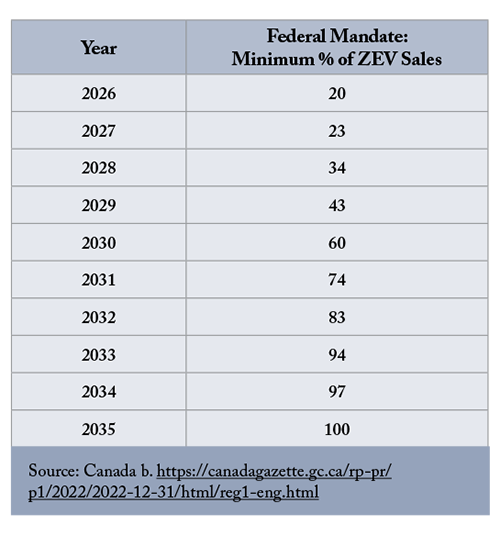
    The federal government has proposed regulations requiring the sale of a minimum numbers of Zero Emission Vehicles (ZEVs) in Canada (20 percent of all light vehicles in 2026, ramping up to 60 percent in 2030 and 100 percent in 2035). The flip side of this requirement is that the sale of internal combustion engine (ICE) light vehicles will be reduced and eventually prohibited in 2035.

    • This ZEV mandate will require an increase in ZEV sales from about 100,000 ZEV light vehicles in 2022 to 300,000 in 2026, 900,000 in 2030 and 1.5 million in 2035.
    • This paper examines whether or not Canadians will be able to buy enough ZEVs (either domestically produced or imported) to meet this ZEV mandate requirement. The findings show that Canada should be able to meet the 2035 100 percent ZEV mandate for about 270,000 passenger cars (only 18 percent of the market) but will be unlikely to meet the 2035 ZEV mandate for the 1,240,000 remaining light vehicles (pickup trucks, vans and SUVs/crossovers) comprising 82 percent of the market.
    • Canada cannot wait until 2035 to realize that the federal ZEV mandate will not be met. The gap between light-vehicle demand and forecasted ZEV light-vehicle supply will cause severe market disruptions. A better approach would be to reject a hardline ZEV mandate and instead to substitute a more flexible Plan B. Plan B should focus more on emissions rather than ZEV targets. For example, permitting some ICE light vehicles to be sold, particularly ones that can use renewable fuels. In addition, permitting plug-in hybrids (PHEVs) and hybrids to be included as ZEVs.
    • Finally, the federal government may have to accept that the 100 percent ZEV target is not feasible by 2035, and therefore must include flexibility in the federal ZEV mandate to back away from the 100 percent ZEV target.

    A ZEV mandate is government legislation that imposes a requirement on the sellers of light vehicles to sell a certain minimum of ZEVs in a year. (ZEV is used interchangeably with BEV for battery electric vehicle in this paper. PHEVs can also qualify as ZEVs to a limited extent). The theory is that this minimum requirement will give certainty to vehicle sellers that there will be a market for ZEVs, and will therefore give an incentive to companies to construct ZEV manufacturing facilities. In essence, the ZEV mandate assumes that the demand for ZEVs will be there and will displace the demand for ICE light vehicles, and therefore the increase in supply of ZEVs will occur.

    The federal government has introduced a ZEV mandate for all of Canada. In December 2022, the federal government issued proposed regulations under the Canadian Environmental Protection Act (CEPA). Section 30.3 of these proposed regulations state that all sales of light vehicles (passenger cars, pickup trucks, vans and SUVs/crossovers) must meet the thresholds for ZEV sales in a year shown in the table to the right.

    Minimum Percentage of ZEV sales

    The flip side to a ZEV mandate is that it imposes a prohibition on the sale of ICE vehicles, plus a penalty for contravening this prohibition. A company selling light vehicles in effect has an ever-shrinking quota for the maximum number of ICE light vehicles that it can sell in a year (none in 2035).

    A company creates one credit for each battery electric vehicle (BEV) it sells. A sale of a PHEV with a range of more than 80 kilometres can also create a credit, but this ability is capped at 20 percent from 2028 onward. For example, a company selling 100 percent PHEVs in 2028 would only get credits for 20 percent.

    If a company’s sales create fewer credits than required by the ZEV mandate, it can still remain in compliance by using two mechanisms. First, it can buy credits from another ZEV company that has exceeded its ZEV mandate. This mechanism will likely provide hundreds of millions of dollars of extra revenue to companies such as Tesla. An alternative second mechanism would allow the company to create a credit by contributing about $20,000 to specified ZEV activities such as supporting charging infrastructure. This second mechanism is capped at 10 percent of the ZEV mandate for the particular year, and is only available for the years prior to 2031.

    For the Silo, Brian Livingston/The C.D. Howe Institute.

    The author thanks Benjamin Dachis, Daniel Schwanen, Dave Collyer and anonymous reviewers for comments on an earlier draft. The author retains responsibility for any errors and the views expressed.

    Canada’s Surging Non-Permanent Resident Population Crisis

    Mahboubi, Skuterud – A Multi-Pronged Strategy for Managing Canada’s Surging Non-Permanent Resident Population
    January, 2024 – Recent years have seen an unprecedented increase in Canada’s non-permanent resident population, far surpassing increases in annual admissions of new permanent residents. This unbalanced growth in the two migration streams will inevitably result in a growing undocumented population and forced deportations. Both developments risk inflaming Canada’s immigration politics and undermining public confidence in the immigration system. It is imperative that the government take immediate steps to stem the ongoing growth in foreign student and temporary foreign worker entries. Here’s how it can do it.

    Recent years have seen an unprecedented increase in Canada’s non-permanent resident (NPR) population far surpassing increases in annual admissions of new permanent residents. This unbalanced growth in the two migration streams will inevitably result in a growing undocumented population and forced deportations. Both developments risk inflaming Canada’s immigration politics and undermining public confidence in the immigration system.  

    It is imperative that the government take immediate steps to stem the ongoing growth in foreign student and temporary foreign worker entries.

    Several factors have contributed to the NPR population surge, including ad-hoc programs aimed at expanding eligibility for permanent status, the well-documented postsecondary appetite for international tuition revenue, and eased employer access to temporary foreign workers, most notably in low-wage occupations.

    Statistics Canada estimates that by the fourth quarter of 2023, Canada’s non-permanent population had exceeded 2.5 million, while entries of new permanent residents remained below 500,000 and which the government has announced will stabilize in 2025. The tightening bottleneck in temporary-to-permanent residency flows is worsened because many permanent slots go to applicants residing abroad, not non-permanent residents.

    A key factor driving the growth in non-permanent inflows is the government’s repeated announcements of ad hoc programs aimed at easing the pathway to PR status for lower-skilled migrants who would otherwise struggle to clear the hurdle of the Express Entry skilled-based points system.

    Examples include the February 2021 decision to provide permanent status to all economic class candidates in the applicant pool regardless of their eligibility scores and the April 2021 provision of pathways to 90,000 “essential workers” including cashiers and truck drivers. And the government expanded the program in January 2023 to give PR status to undocumented construction workers and plans to broaden the program, allowing all undocumented people to apply for permanent status. 

    No wonder large numbers of migrants try their luck.

    But given limited permanent admissions, large numbers of justifiably hopeful NPRs will be unable to realize their dreams. As their study and work permits expire, many will be unable or unwilling to return to their home countries. This leaves them increasingly vulnerable to workplace exploitation, which can distort wage outcomes in lower skilled labour markets, and leaves them in poverty with no recourse to government supports because they are ineligible.

    Canada urgently requires a multipronged strategy to stem this ongoing NPR growth and restore the stability and integrity of the immigration system. In our view, policies should be aimed at helping applicants make better decisions about seeking NPR status in Canada by offering a straightforward, predictable system against which they can realistically assess their prospects.

    On international students, we recommend reintroducing the cap on off-campus work at 20 hours a week that was waived in October 2022 and recently extended to April 30. Continued policy punting is unhelpful in restoring predictability for prospective foreign students. Study permits have become de facto work permits, and brings job-seekers, not committed students.

    We also recommend restricting study permits to institutions of a certain standard. Designated Learning Institutions (DLIs) whose students are currently ineligible for Post-Graduate Work Permits should also be ineligible for study permits. The government should also revoke designation based on the measured immigration and labour market outcomes of an institution’s graduates. Those outcomes should be regularly published by the immigration department to help prospective migrants make informed decisions and combat false dreams pushed by education recruiters.  

    On temporary workers, extended measures allowing, for example, 30 percent of certain workforces to be low-wage temporary foreign workers, need reconsideration. Stemming the growth in the Low-Wage Stream of the Temporary Foreign Worker Program and restoring the pre-2020 hiring regulations recognizes recent evidence of adverse effects of this program on wages and local unemployment rates.

    Most important, the government needs to bring back predictability in its permanent resident admission system in the economic-class applicant pool. Though well intentioned, the one-off programs easing the pathway to permanent status are contributing to temporary resident explosion. The department needs to return to its Comprehensive Ranking System as it did before 2020. The transparency of its points system and a stable minimum eligibility score over time will mean that applicants can see what skills or training they need for entry, thereby advancing the objective of our skilled immigration program.

    If these policy levers are collectively applied, they can stem the unhealthy growth in Canada’s non-permanent population, restore fairness and transparency in the permanent admission stream, and secure the immigration system’s integrity and sustainability. In doing so, we can ensure that Canada continues to be a welcoming and prosperous country for all. *note this article was sent as a letter by the C.D. Howe Institute authors to  The Honourable Marc Miller, Minister of Immigration, Refugees and Citizenship Canada.

    Parisa Mahboubi is a senior policy analyst at the C.D. Howe Institute. Mikal Skuterud is a professor of economics at the University of Waterloo, director of the Canadian Labour Economics Forum and a fellow-in-residence of the C.D. Howe Institute.

    Investor-State Disputes Proliferating, Rules Remain Critical for Canada Business Investment

    May 9, 2023 – Investor-state disputes are proliferating around the globe as business investors seek redress for government actions they deem unfair or contrary to investment agreements, according to report from the C.D. Howe Institute. In “Investor-State Disputes: The Record and the Reforms Needed for the Road Ahead,” author and C.D. Howe Institute Senior Fellow Lawrence L. Herman reviews the record of investor-state dispute settlement (ISDS) procedures, the criticisms directed at them, and the reforms required.

    “Despite concerns and criticism, ISDS procedures in international investment agreements are an important development in global governance that should continue to be a part of our international fabric,” says Herman.

    Herman examines both Canadian and global cases involving ISDSs, which give private parties the right to bring binding arbitration against governments under International Investment Agreements (IIAs). These rights can be invoked when investors allege a lack of fair and equitable treatment, discrimination or expropriation without adequate compensation contrary to a country’s treaty obligations.

    “ISDS has become a significant feature for investments, particularly into developing countries in many parts of the world,” according to Herman.

    “However, because of the rights given to private parties, these agreements have become increasingly controversial – especially in an era of increasingly expanding governmental measures on climate change, sustainability, human rights and other issues impacting foreign investors and their investments in one way or another.”

    In response to these concerns, multilateral, regional and bilateral efforts are making continuing improvements to ISDS mechanisms when it comes to efficiency, transparency and aspects such as permanent appointments and a system of appeals.

    “While some countries have embarked on a program of terminating their bilateral investment agreements, these agreements will continue to remain as a part of the international fabric in many parts of the globe,” says Herman. “They are an important development in global governance and, even if not perfect, they not going to disappear in spite of concerns and criticisms.”

    Creating permanent rosters of tribunal members as well as adding an appellate review processes to existing IIAs would help improve ISDS procedures. Short of this, Herman says ongoing efforts could include: i) promoting model arbitration clauses to reduce legal uncertainty and enhance consistency and predictability of outcomes; ii) developing codes of conduct and best practices for adjudicators plus rules to ensure their independence; and iii) making sure appointments to tribunals are of highest quality. Governments should also publicly support the value of third-party arbitration as an objective and neutral process that leads to peaceful resolution of differences, he adds.

    Ultimately, investment protection treaties are about risk mitigation with host states bound by treaty to respect obligations of fair and equitable treatment and other rule-of-law standards and providing investors with a degree of assurance, says Herman. “While there are legitimate questions about the process and whether and to what degree investment treaties accomplish these objectives, these suggestions can assist in providing ways forward,” he concludes.

    There are some 2,500 international investment agreements (IIAs) in force around the world, whether as stand-alone treaties or incorporated into bilateral or regional free trade agreements (FTAs). They are a significant feature of the international business scene.

    A main feature of these agreements is to allow foreign investors to invoke binding arbitration where it is alleged that the host governments have breached fair and equitable treatment and other treaty obligations towards the investors. This is known as Investor-State Dispute Settlement or “ISDS”.

    The process gives foreign investors comfort that if things go wrong in host countries, they have recourse to neutral, third-party dispute resolution. It thus provides important elements of risk reduction for foreign investors and their investments, notably aiding the flow of capital from industrialized countries to the developing world.

    There has been dramatic escalation of investor arbitration claims over the last two decades. This makes it timely and useful to review the situation, looking at the value of ISDS as well as the criticisms that have emerged over the years. The conclusion is that IIAs and the arbitration process are valuable parts of the corpus of international order and will remain an integral part of the international business scene for the foreseeable future. The issue facing governments, therefore, is how to respond to criticisms by improving, as opposed to abandoning, the ISDS process. This paper suggests some pragmatic ways forward.

    A Canadian company, First Quantum Minerals, and the government of Panama are reported to have settled a long-standing tax dispute allowing the company to resume operations at the Cobre Panama mine in that country. Earlier reports were that if the dispute was not resolved by negotiation, the company would invoke arbitration rights under the Canada-Panama Free Trade Agreement.

    Had the dispute proceeded, it would have been another example of hundreds of arbitrations that have proliferated around the globe, initiated under various international investment agreements (IIAs) that give private parties the right to bring binding arbitration against governments under Investor-State Dispute Settlement ( ISDS) procedures. Those rights can be invoked, for example, where investors allege lack of fair and equitable treatment, discrimination or expropriation without adequate compensation contrary to that country’s treaty obligations.

    In addition to investment treaties, numerous free trade agreements incorporate separate investment dispute settlement provisions, including the former North American Free Trade Agreement (NAFTA); the Canada-EU trade agreement (CETA); the Trans-Pacific Partnership (CPTPP) Agreement; and bilateral free trade agreements, such as those between Canada and countries like Chile and South Korea, among others.

    As a consequence, ISDS has become a significant feature of the ground rules for investments in many parts of the world, particularly those made into developing countries. Because of the rights given to private parties, these agreements have become increasingly controversial, especially in an era of expanding governmental measures on climate change, sustainability, human rights and more that impact foreign investors and their investments.

    In light of these developments, it is useful to briefly update the ISDS record with regard to Canada, look at what lessons might emerge, both in the global and the Canadian context, and suggest some elements to monitor as we go forward.

    Criticisms Of ISDS Agreements

    As investor arbitrations have proliferated, so have the criticisms, making ISDS one of the more controversial aspects of global governance. Here are some of the main ones:

    • IIAs have given private companies broad rights to challenge host-country actions that can fall within legitimate fields of public regulation, especially now in an era of decarbonization and other national crises like COVID 19.
    • The process involves one-way litigation, with no corresponding right of host countries to bring arbitration cases against investors for disregarding laws, practices and standards of business conduct.
    • The growth of third-party financings of investor claims has stimulated, or at least encouraged, the initiation of ISDS cases.
    • Investment agreements bypass the customary international law norm that requires claimants to first exhaust local remedies before bringing an international claim against a host country.
    • The ISDS structure is defective because its ad hoc tribunals – put together to hear a particular case – make long-term, binding decisions affecting laws or policies enacted for the public interest.
    • Arbitrators’ decisions are final and binding with no avenue of appeal, whether on errors of fact or of law.
    • Because of its ad hoc nature, the system lacks institutional continuity. Public confidence in the system suffers.
    • Arbitrators are appointed from a small — if not closed – pool of international lawyers who are free to act for private interests as counsel in other cases, leading to appearances of conflict and adding to diminished public confidence in the process.7

    There are answers to these critiques but the over-arching response, as alluded to above, is that resolving investor-state disputes based on legal norms within an accepted procedural framework remains a significant achievement in the progressive development of international law. As observed in one analysis,

    “During the last decade a number of the shortcomings have indeed been addressed and remedied. It is reasonable to assume that this has been done – at least partially – based on the realisation that investment treaty arbitration is the most efficient and reliable dispute settlement mechanism for disputes between foreign investors and host States. There is simply no better, realistic alternative.”8

    As already mentioned, ISDS in its various manifestations provides an important element of stability and risk insurance when investing in jurisdictions where legal rules may not be mature or respected, aiding the flow of capital to developing countries and thus presumably helping to meet the international community’s aid and development goals. The system may not be perfect, but efforts are afoot to improve it at many levels.

    For the Silo, Lawrence Herman/C.D. Howe Institute.

    The author thanks Daniel Schwanen, Charles-Emmanuel Côté, Rick Ekstein, Ari Van Assche, Gus Van Harten and anonymous reviewers for comments on an earlier draft. The author retains responsibility for any errors and the views expressed.

    How Do Canada Provinces Grade In Taxpayer Fiscal Transparency?

    September 15, 2022 – Taxpayers and citizens need greater fiscal transparency from Canada’s federal, provincial and territorial governments, says the latest report from the C.D. Howe Institute.

    In “The Right to Know: Grading the Fiscal Transparency of Canada’s Senior Governments, 2022,” William B.P. Robson and Nicholas Dahir graded these governments’ budgets, estimates and financial statements on how well they let legislators and voters understand their fiscal plans and hold them to account for fulfilling them. The grades range from A to D. While some of the governments present helpful and timely budgets and financial statements, others fall badly short.

    The authors underline that budgets, estimates and financial statements must let interested but non-expert users find and understand and act on key information.

    “Taxpayers’ and citizens’ ability to monitor, influence and react to how legislators and officials manage public funds is fundamental to representative government,” say Robson and Dahir. “We need to check that legislators and government officials are acting in the interest of the people they represent, and we need to respond if we conclude that they are acting negligently or in their own interest. Financial reports are key tools for monitoring governments’ performance of their fiduciary duties.”

    image: Prime Minister of Canada Justin Trudeau website. Link to Transparency PDF: https://pm.gc.ca/en/news/backgrounders/2015/11/27/open-and-accountable-government

    While much of the financial information presented to legislators and the public by Canada’s governments has improved over time, the assigned grades reveal significant shortfalls. This year’s report card covers year-end financial statements for fiscal year 2020/21 and budgets and estimates for 2021/22. The results were as follows:

    • Manitoba, British Colombia and the Northwest Territories trailed the the class with grades of D;
    • The federal government got a D+ – which was actually an improvement from an F last year, when it failed to produce a budget;
    • Newfoundland and Labrador also got a D+;
    • Nova Scotia scored a C and Prince Edward Island scored a C+;
    • Quebec scored a B- and Ontario scored a B;
    • Nunavut, Saskatchewan, and New Brunswick each scored B+;
    • Alberta and Yukon topped the class with grades of A and A- respectively.

    These governments tax, spend and borrow hundreds of billions of dollars, and the fiscal impact of the COVID-19 pandemic will make their financial position all the more important in the future. The authors conclude: “This annual report card hopes to encourage further progress and limit backsliding. Canadians can get more transparent financial reporting and better fiscal accountability from their governments, if they demand it.” For the Silo, Lauren Malyk.

    For more than 60 years, the C.D. Howe Institute has researched and published on policy challenges and potential solutions aimed at improving the performance of Canada’s economy and raising Canadians’ living standards.

    Read the Full Report

    Featured image via GIFT- The Global Initiative for Fiscal Transparency

    Threat to Prosperity: Canada Should Mind Business Investment Gap

    August, 2022 – Business investment in Canada is so weak that capital per member of the labour force is falling, and the implications for incomes and competitiveness are ominous. Governments, particularly the federal government, need to get serious about growth to get workers more of the tools they require to compete and thrive, according to a new report from the C.D. Howe Institute.

    In “Decapitalization: Weak Business Investment Threatens Canadian Prosperity”, authors William B.P. Robson and Mawakina Bafale write that since 2015 Canada’s stock of capital per available worker has been declining and its rate of gross investment per worker has been well below that in the United States and other OECD countries.

    Capital= Business “bread and butter”

    They examine why Canada might be lagging as well as what action to take.

    “Business investment and productivity are closely related: productivity growth inspires investment by creating opportunities, and investment drives productivity growth by equipping workers with more and better tools,” says Robson. “Investment per available worker lower in Canada than abroad tells us that businesses see less opportunity in Canada, and prefigures weaker growth in Canadian earnings and living standards than in other OECD countries.”

    New investment per available worker in Canada, adjusted for purchasing power, was only slightly above 50 cents for every dollar of investment per available United States worker in 2021 – lower than at any point since the beginning of the 1990s. In addition, in 2022, OECD projections show that Canadian workers will likely enjoy only 73 cents of new capital for every dollar enjoyed by their counterparts in the OECD excluding the US, according to Robson and Bafale.

    The authors’ calculations from OECD projections for 2022 show $20,400 of new capital per available worker this year for OECD countries excluding the United States, compared to $14,800 for Canada.

    In other words, new capital per available worker in Canada will be more than one-quarter less than in those countries this year.

    Declines in the stock of machinery and equipment (M&E) and intellectual property (IPP) per member of the workforce are particularly worrisome, the authors explain, because those types of capital may be particularly important for economy-wide productivity. “Whatever special messages the recent M&E and IPP numbers may convey, the message from stocks of business capital overall is clear: the average member of Canada’s labour force began 2022 with less capital to work with than she or he had in 2014,” says Bafale.

    Robson and Bafale identify a few probable causes for Canada’s dismal investment performance. These include: weak business in the natural resource industries; restricted access to finance for small and mid-size firms; a loss in Canada’s competitive edge in business taxation, notably against the United States; an uncongenial environment for IP investment; regulatory uncertainly; unpredictable fiscal policy; and governments’ in-house spending and transfers to households that are steering resources into consumption and housing rather than non-residential investment.

    Is business investment capital trajectory predetermined?

    “The prospect that Canadians will find themselves increasingly relegated to lower value-added activities relative to workers in the United States and elsewhere, who are raising their productivity and earnings faster, should spur Canadian policymakers to action,” conclude Robson and Bafale. “The first step is to recognize that recent trends are a symptom of threats to Canada’s prosperity and competitiveness – that low business investment is a problem that governments can and should address.”

    Supplemental- Are you a small Canadian business frustrated with the difficulties involved in accessing capital? For example, our experience has shown that the multitude of Business Development Corporations operate with autonomy but without accountability, poor vision and nepotism. Essentially, gleaning business plans and strategies before revealing ‘jump through these application hoops” which include personal finance and personal life details. It is sobering to discover that they also receive a hefty commission % for every applicant they ‘certify as successful’. Do you agree or have you had a more positive experience? We want to hear from you in the comments below.

    Reboot Canadian Content Policy For Digital Age Says C.D. Howe Institute

    Canada should ditch Canadian content tools that are ill-suited for the digital age, says a new report from the C.D. Howe Institute.

    Image result for author Daniel Schwanen
    Daniel Schwanen

    In “Choosing Canada: Canadian Cultural Policy in the Twenty-first Century” author Daniel Schwanen sets out a plan to bring Canadian content policy into step with developments such as the emergence of digital competitors for Canadian viewers, including Netflix, Spotify and YouTube.

    Unfair Competition

    These digital competitors, notes Schwanen, are unconstrained by Canadian content requirements facing traditional TV or radio distributors. The consequence is a “slow bleed” in audiences for licensed TV broadcasters and radio stations while audiences for non-regulated digital channels (many based outside Canada), are rising sharply.

    Trends

    These trends negatively impact the revenues of traditional conduits for culture and information as advertising revenues migrate to digital channels. Compounding burden on traditional broadcasters, regulators maintain out-dated quotas of Canadian content in prime time and requirements to help fund Canadian TV and film production, whereas their emerging competitors on digital platforms are not subject to these rules. Furthermore, foreign online services such as Netflix are not required to charge their Canadian customers the Goods and Services Tax, unlike their Canadian competitors.

    Image result for disney+

    “As Canadians embrace new technologies and platforms to access their entertainment and information, the ability of quotas to affect Canadians’ viewing or listening habits is rapidly diminishing,” said Schwanen. Indeed, 2013 marked the first year in which the number of Canadian households subscribing to internet services exceeded the number of traditional television subscribers. Although 75 percent of Canadian households still subscribed to cable or satellite television distribution services in 2016 – down markedly from 83 percent only four years before – 87 percent of Canadian households subscribed to internet services. In the economy more generally, the culture, entertainment and information services offered online through digital technologies have boomed relative to other economic activities, and in particular relative to traditional cultural and information businesses.

    What Is True Demand?

    The report proposes an approach focused on more deliberately linking offerings of Canadian content with the potential demand for them. The report’s recommendations for regulators include:

    • Focusing the funding framework for public cultural agencies and cultural subsidies, including that of the CBC, on the production, dissemination, and exhibition of original artistic or literary works for which a commercial market is not yet established or for which there is a clear public rationale (e.g., educational, informational, or community benefits).
    • Establishing an arms-length “Canadian Connections Fund” that would replace some existing subsidies with support for initiatives that promote non-commercial Canadian content with Canadian audiences.
    • Working with Canadian broadcasters and distributors to facilitate the “discoverability” of Canadian content on digital platforms (through, e.g., search engine optimization, targeted online advertising, mobile applications, and the translation of Canadian works for both foreign and domestic audiences).
    • Eliminating mandated funding of Canadian content and Canadian content quotas for broadcasters while ensuring a level playing field for federal taxation applicable to digital media services purchased by Canadians
    • Reducing foreign investment restrictions applying to cultural industries, with the aim of attracting investment in Canada.

    Read the Full Report