Tag Archives: Black Friday

11% Of Male Cyber Monday Shoppers Will Pull Items Out Of Hands Of Others

Black Friday and Cyber Monday are a cultural phenom. One that American and (in the past few years) hard-boiled Canadian consumers look forward to each year. We brave the crowds, set out a savings mission plan and shop like a thrifty gladiator entering the battle arena of value.

WHEN IT COMES TO BLACK FRIDAY/CYBER MONDAY…

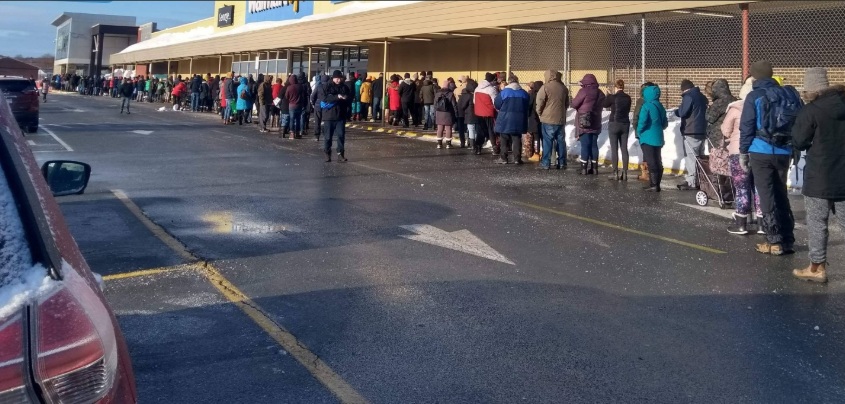
While images of people camped out in Walmart parking lots regularly dominates the Black Friday news cycle (as well as trampling and fights), we wanted to find out how people really intend to spend these consumer holidays-and more importantly, how much they intend to spend. We also looked at Holiday Gift searches from the last few years on our sister site-interestingly, there’s apparently a big market for discontinued perfumes.

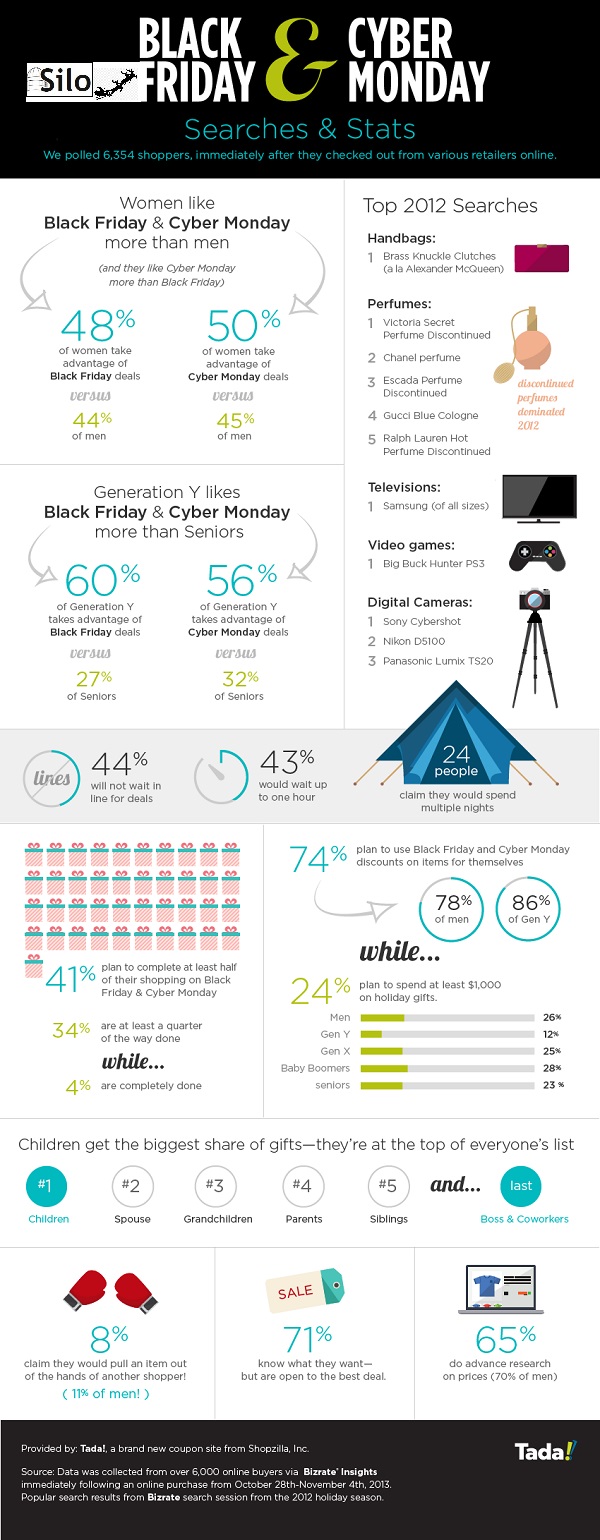
SOME INTERESTING FACTS FROM THE STUDY

* Men are much more open to violence on Black Friday/ Cyber Monday: One out of 10 guys (11%) would pull something out of the hands of another shopper.

* 86% of Generation Y intends to use Black Friday and Cyber Monday discounts on items for themselves.

* Men are the most generous: 26% of guys plan to spend at least $1,000 usd/ $1,410 cad (exchange at time of article) on holiday gifts.

* Very few people are procrastinating: While 4% claim they’re already finished with their holiday shopping, 41% intends to complete it on Black Friday/Cyber Monday.

* 43% will wait up to an hour on Black Friday; 24 people said they’d willingly camp out for MULTIPLE NIGHTS.

* Bosses and co-workers are at the bottom of everyone’s shopping list: Children, understandably rule (followed by spouses/significant others).

The following info-graphic is based on responses from 6,354 online shoppers who were surveyed last year immediately after checking out. Odds are things haven’t changed much this year.  Here’s more from our friends at Tada (or Pollpay depending on your region), they are awesomely obsessed with reporting on all the things that online shoppers value.  For the Silo, shopzilla.com/Jarrod Barker.

Supplemental-

What were shoppers interested in 13 years ago? Take a look at this data chart from 2012.


Silo Black Friday Cyber Monday

Black Friday Shopping: Fastest Growing Products, and Credit Card Trends

From Black Friday electronics deals and top appliance discounts to the best savings on furniture, sporting goods, and smartphones, North America’s biggest shopping event is fueled by one major factor: the use of credit cards for Black Friday purchases.

To understand how spending patterns have evolved, and how credit cards shape the Black Friday season, researchers from our friends at InvestorsObserver analyzed Black Friday shopping trends over the past three decades.

Though the focus was USA based (looking at trends on state-by-state and national sales data for durable goods, credit card transaction volumes, and shifts in consumer spending across key product categories like electronics, appliances, furniture, sporting goods, and jewelry), some parallels can be drawn between Canada and Mexico shopping habits.

The report reveals what was really driving Black Friday sales from 1997 till 2024. It shows which states and product categories had the biggest surge in spending, how much of that growth was fueled by increased credit card use, and which items have fallen out of favor with today’s shoppers.

Essentially, North Americans are using credit to buy smarter, invest in technology and fitness, and adapt their Black Friday shopping to reflect quickly changing priorities and lifestyles.

Key findings

  • Nationwide, US inflation-adjusted spending on durable goods during the Black Friday season increased by over 90% between 1997 and 2024, with states like Florida and Texas more than doubling their totals. Inflation is also a factor in Canada and Mexico.
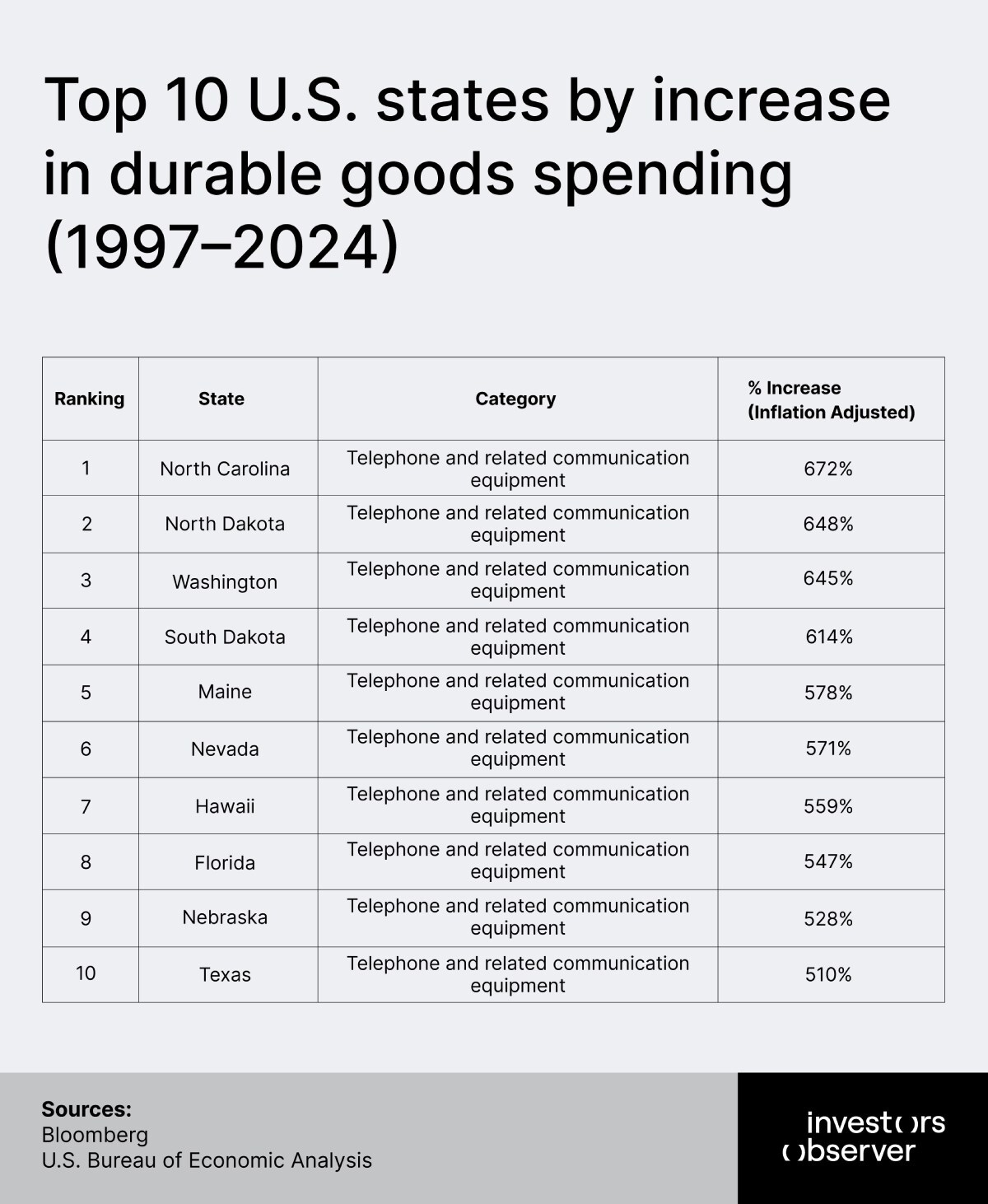
  • Spending on telephone and related communication equipment surged over 600% in the top states.
  • Average credit card balances at major issuers (Amex, Discover, Capital One) have grown at an average monthly rate of 0.5% (approximately 6% per year) since 2020, with bold spikes during the Black Friday season.
  • Spending on traditional Black Friday luxury items, such as jewelry and new vehicles, dropped in several states.
  • Spending on sporting equipment, guns, and related goods soared, making these some of the fastest-growing Black Friday categories nationwide.

The 10 states where Black Friday spending on durable goods has skyrocketed

Over the past 30 years, Black Friday has exploded into a huge shopping event, totally changing how and where North Americans splurge on big-ticket items.

A few states are crushing it, with locals ramping up real spending on durable goods at huge rates during Black Friday season. The top 10 show not just wild shopper hype, but big shifts in what people actually purchase when those deals drop.

These states have seen their Black Friday durable goods spending, especially in technology, surge ahead of the national average. When Black Friday advertising kicks in, shoppers increasingly target the best deals on electronics, particularly smartphones, tablets, and communication devices.

Retailers have responded to it, making Black Friday the primary opportunity to upgrade devices and connect households at a fraction of the regular price.

  • North Carolina and North Dakota lead with over 600% growth, showing how the appetite for electronics has exploded since the late ‘90s, as more homes gained internet connectivity and mobile devices.
  • The Pacific Northwest and Sun Belt, including Washington, Nevada, and Texas, have also surged, which aligns with fast-growing populations and tech-forward consumer culture.
  • Hawaii and Maine’s high growth rates highlight how even small, geographically unique states have embraced Black Friday to shop for technology that bridges distances – both literal and social.

The overwhelming increase in spending on communication technology during the Black Friday season shows how the event has become less about traditional holiday shopping and more about allowing households to seize the latest digital opportunities. For millions of North Americans, Black Friday is now the time to connect and upgrade their devices.

Where Black Friday spending fell: Top 10 states with the biggest drops in durable goods purchases

While most states saw Black Friday spending on durable goods soar over the past 25 years, not every category or region had gains. In fact, several states experienced notable declines, particularly in traditional big-ticket Black Friday items like jewelry, watches, and new cars.

This change reveals new consumer values, the impact of modern technology, and a growing focus on more practical or tech-driven purchases.

Jewelry and watches in retreat

The sharpest drop comes from jewelry and watches. Vermont, Maine, Connecticut, Iowa, and Michigan all had double-digit declines. This suggests that big-ticket jewelry has lost its luster as a Black Friday buy. Americans may be choosing technology upgrades and home improvements over luxury items that were once holiday staples.

New motor vehicles lose their spot

For decades, Black Friday was also the season of auto deals and year-end vehicle promotions. However, states like Illinois, Connecticut, Michigan, and Ohio had a significant real decline (–10 to –15%) in Black Friday spending on new cars. Today’s shoppers may be holding onto cars longer, buying used, or shifting their big December purchases toward electronics and appliances.

The fall of traditional electronics

West Virginia stands out as one of the few states where spending on video, audio, photographic, and information processing equipment has actually declined since 1997, dropping by 16% when adjusted for inflation. West Virginians are moving away from traditional Black Friday electronics, like older TVs, cameras, and stereo systems, and are investing less in these categories than they did a generation ago.

What’s behind these Black Friday drops?

  • Priorities are changing. North Americans are investing in what makes daily life more comfortable and modern, leaving behind items seen as old-fashioned luxuries.
  • The tech has taken over. Gadgets, home entertainment, and fitness equipment now win out over jewelry and autos for Black Friday deals.
  • Economic reality has shifted. The increasing role of credit cards and shifting family budgets means shoppers are looking for purchases that deliver daily utility rather than show status.

In other words, today’s Black Friday is less about “once-in-a-lifetime” traditional purchases and more about value, technology, and practical upgrades. The states with the biggest declines in jewelry and car sales are signals of this broader cultural and economic change.

America’s top 10 states for Black Friday durable goods spending (2024)

Black Friday remains the biggest shopping event of the year, and nowhere is this more apparent than in the nation’s leading states for durable goods purchases. Some states outpace the rest of the U.S. in total spending on high-value items, like appliances, electronics, home furnishings, and more, during the Black Friday season. Their money and excitement drive shopping trends across the country.

Massive market size

California, Texas, and Florida are not just the largest states by population. They’re also the biggest spenders. Together, they account for nearly a quarter of all U.S. durable goods bought during Black Friday. This shows the influence of large, diverse, and economically dynamic populations.

Urban economies and consumer power

States such as New York, Illinois, and Pennsylvania maintain their spots in the top ten thanks to their large metropolitan areas and strong traditions of holiday shopping, where residents spend big on household upgrades and electronics.

Quick growth in the Sun Belt

North Carolina and Georgia have shot up the rankings in recent years. Their booming real estate, ongoing migration trends, and family-driven consumption translate into strong demand for appliances, furniture, and home technology each Black Friday.

Consistent Midwest and Northeast strength

Ohio and New Jersey round out the list, proving that established economies with significant suburban populations continue to drive major Black Friday spending, particularly for goods that make life more comfortable and connected.

In essence, these top 10 states are the engine rooms of North American Black Friday shopping. Their combined impact shapes national retail sales and spotlights where the most dollars flow when the country’s biggest holiday deals are up for grabs.

Top 10 increases in durable goods spending 2020–2024

The years since 2020 have been some of the most dynamic for Black Friday shopping in North American history. Faced with a global pandemic, shifting work habits, and new priorities at home, North Americans unleashed a wave of spending on major purchases, especially during the Black Friday season when deals were too good to pass up.

Some American states stand out for their extraordinary growth in durable goods spending, which reveals where the economic recovery and post-pandemic demand have hit hardest and fastest.

Pandemic-era investment in the home

From 2020 to 2024, North Americans spent more time at home than ever before, fueling a rush on Black Friday for home electronics, appliances, workout gear, and home office upgrades. For example, this is reflected in the double-digit growth seen in states like North Carolina, Nevada, and Texas.

Southern and Mountain West States are leading

The Sun Belt and fast-growing Western states dominate the top of the list. With population inflows, a hot housing market, and greater focus on quality-of-life purchases, places like Florida, Nevada, and Idaho led the way in increased spending.

Credit card power and Black Friday strategy

More consumers used credit cards to access historic Black Friday discounts, and they didn’t hold back. Their willingness to borrow, upgrade, and outfit homes helped power this unprecedented jump in durable goods purchases.

The return of consumer confidence

After the initial shock of the pandemic, these states came roaring back with strong job markets and economic growth. This confidence spilled over into Black Friday shopping, with many households finally making upgrades or purchases they had delayed.

Not just the big states – smaller markets shine

States like Idaho, Utah, and New Hampshire emerged as “growth champions,” showing that the Black Friday boom was not limited to the biggest economies, but spread across America’s most dynamic regions.

In essence, between 2020 and 2024, Black Friday’s power as an engine for big purchases was on full display in these top 10 states. The post-pandemic years became a transformation period for millions of households, with Americans seizing the moment – and Black Friday deals – to upgrade, renovate, and invest in what matters most.

Methodology and sources

The Personal Consumption Expenditure (PCE) data is collected from the U.S. Bureau of Economic Analysis.

The data is provided for every U.S. state.

For each state, we collected data on consumption expenditures in the following categories:

  • Durable goods: New motor vehicles; Furniture and furnishings; Household appliances; Tools and equipment for house and garden; Video, audio, photographic, and information processing equipment and media; Sporting equipment, supplies, guns, and ammunition.
  • Other durable goods: Jewelry and watches; Telephone and related communication equipment.
  • Expenditures are expressed in millions of dollars. The data covers the years 1997 through 2024. Each year’s data is adjusted for inflation using the Consumer Price Index for All Urban Consumers: All Items in the U.S. City Average (CPIAUCSL)

We calculated how expenditures have changed over time (1997–2024). All calculations are inflation-adjusted.

We pulled monthly credit loan issuance data (2018–2025) for American Express, Discover, and Capital One straight from Bloomberg.

For the Silo, Živilė Kasparavičiūtė
Mattress Sales in Toronto: How to Find the Best Deals  

A mattress is a vital component of comfort in your home.

A poor-quality mattress can cause body aches and affect your life. It’s, therefore, crucial to purchase the right mattress from a reputable store at a reasonable price. For the best mattress sale in Toronto, you need to consider some factors to help you make the right decision. If you’re looking for a deal on your next mattress or bed set, keep reading for tips on finding the best mattress sale in Toronto and get the most significant savings with no compromise on quality. 

  1. Identify a Reputable and Reliable Mattress Store 

When shopping for a mattress sale in Toronto, it’s essential to identify reliable and reputable retailers. If you have friends or family members who have recently gone through a mattress purchase, they can give you good advice about specific stores that they found reliable. Local blogs or online forums dedicated to mattress purchases can also be good resources when looking at different brands and retailers.  

Once you’ve identified some potential stores, it’s time to look into their sales policies. Most reputable retailers will offer sales periodically throughout the year—especially around major holidays like Black Friday and Christmas—so knowing how long those sales last is critical to ensure you get a good deal. A good mattress store in Toronto like the Queensway Mattress will provide overall satisfaction from good customer service to quality products and after-sales services. So, look out for any complaints about delivery times, damaged goods, or unsatisfactory services before finalizing your decision. 

  1. Try Out Before You Buy 

Getting out of bed and trying out a mattress is an excellent way to be sure you’re making an informed decision. You can check how it feels, whether it’s too soft or too firm, and see if you like how it looks. If you want to buy a new mattress, try one out before purchasing—you may even decide that you can get by with what you already have. Leave enough time for your test drive; going from store to store will likely take more than a few hours. 

Ask about return policies: Most stores won’t accept returns once you take off mattresses from their premises. Asking these questions up front can save you time and energy later on. Therefore, if you’re looking for a mattress sale in Toronto, it’s crucial to ensure they allow you to sleep on your new mattress before deciding whether it meets your needs. 

The Most Uncomfortable Bed in the World - Touch a Life | OpenSea
  1. Go for The Best Quality and Comfort 

You might assume that high-quality, comfortable mattresses are expensive, but that’s not always true. You can get quality mattresses from reliable stores at reasonable prices if you know how to shop around. However, you need to know your needs and requirements before shopping for a new mattress to avoid wasting money on a product that doesn’t suit your needs. 

For example, if you need a mattress that can help you relieve some pressure points on your body, then you can invest in a Latex or Memory foam mattress. If you have problems with allergies, then it is better to buy a hypoallergenic mattress from a reputable store. It’s good to match your needs with quality, comfort, and economical pricing to decide what type of mattress you should purchase. 

  1. Check The Warranty 

Before you finalize your deal on a mattress sale in Toronto, check to see what kind of warranty it comes with to be safe. If your mattress wears out within five years and doesn’t have a solid product warranty, you might pay a lot more than you bargained for in the first instance. It’s also worth asking about details like return policy and restocking fees: some businesses are notorious for charging steep return fees or simply refusing to accept used or damaged products. 

Buying mattresses supported by the most reliable warranties will keep you from paying extra money later. Also, ask how long those warranties last; sometimes, they expire just months after purchase. Dedicated warranty periods may range between 2 and 15 years. 

  1. Take Advantage of Free Delivery and Removal 

When buying a mattress, ask about free delivery and removal. If a retailer doesn’t offer such services or charges too much for them, you can probably find them elsewhere. The point of getting great deals on mattress sales is not to deal with additional hidden fees. Just be sure to factor in other costs, like transportation and set-up, when you do your comparison shopping. 

For example, if one store offers free shipping, but another delivers right to your door at no extra charge, you might pay more overall by Option 1. However, some people prefer picking out their mattress; they say they can test it out before purchasing. You can also benefit from some retailers offering a mattress sale in Toronto who let customers try out mattresses at home—so check around! 

  1. Look for Economical Pricing and Flexible Payment Methods 

Many of us choose to buy mattresses online since they tend to be less expensive. However, if you’re going to buy a mattress online, make sure you find one with an economical pricing structure and flexible payment options. You don’t want to spend even more money paying interest or other fees because you bought your mattress online; shop smart and get a good deal. 

You can also search for reputable stores that offer mattress sales in Toronto at monthly installments and no-interest financing plans. This way, you won’t have to pay all at once but will still get to enjoy your new mattress immediately after making your purchase. 

Conclusion 

Those who know how to find deals on mattress sales in Toronto are doing a service to themselves, whether they choose to purchase online or offline. There are so many choices that come with different prices, but if you know where to look and what questions to ask, you can get what you need at a price that won’t break your bank. A reputable mattress store in Toronto will have all of their products clearly labeled and will be able to answer any questions you may have about their products. You need not settle for less than what you want when purchasing mattresses; do your research, ask your questions, and use these tips as a guide when looking for a deal on a mattress sale in Toronto. 

Canada’s Original Black Friday- ‘Cancelled Arrow’ Was Cutting Edge 1950s Jet Interceptor

The first Arrow RL-201

I began writing this post after an annual viewing pilgrimage of sorts. Each year on the eve of shopping’s busiest day, I crack open the well worn plastic jewel case and fire up the DVD player. It’s a fictional account but based in fact and is very entertaining and I can’t help but wonder what “might have been” after watching CBC’s 1996 mini-series “the Arrow” again. [You can watch this right here at the end of this post CP]

Over the decades fact and fiction have become tangled but the basic truths remain intact. In the late 1950’s a highly advanced jet interceptor designed to seek (and if necessary destroy) Russian nuclear bombers was conceived, designed, built and flown in Canada by a predominantly Canadian team. Here’s where things get fuzzy. The Arrow was developed when the federal Liberal party were in power but was finished and flown when the Conservatives were in power. It represented not only the technological capability of Canada’s aviation industry- but also the econo-political agenda of the mid-twentieth Century. So what happened at that time to help spell the doom of the Arrow?

-The ICBM- intercontinental ballistic missile was viewed as the future of warfare not the nuclear bomber. This meant that a jet interceptor was obsolete because it would be unable to intercept approaching missiles.

-Bad timing: on the day of the rollout of the very first completed Arrow, the Russians launched Sputnik, the world’s first artificial satellite. In the public eye jets seemed unimportant.

-The American Bomarc missile system was designed to intercept incoming nuclear bombers and ballistic nuclear missiles. The Bomarc had a small nuclear warhead which would detonate in the pathway of approaching missiles (or bombers) and create a nuclear ‘shield’. The Bomarc was highly controversial at the time because our Prime Minister did not want nuclear missiles on Canadian territory. However, our Defence Minister did not agree and eventually resigned over the matter. This defence ‘split’ exacerbated the Arrow program and any chance for an Arrow squadron legacy.

-The Canadian designed Iroquois engines were not  readied in time and were not fitted into the Arrow. These engines were innovative and theoretically could have propelled the Arrow to speeds of Mach 2.5 or possibly Mach 3.0- far beyond every fighter of the time with the exception of secret black technology projects like the American Blackbird SR-71. Had the Canadian engines been readied and proven, there seems little doubt that international orders would have offset some of the Arrow’s mounting costs.

Black Friday…….almost 15,000 workers lose their job.

Canadas Black Friday

There is no official record of just who ordered the destruction of the remaining Arrows. Other than a few recovered test models, an incomplete cockpit and a few seconds of in flight film, nothing remains of this wonderful airplane . For the Silo, Jarrod Barker.


The completed Arrows being cut up and readied for a Hamilton,ON scrap dealer.


Supplemental-

University of Saskatchewan The Nuclear Question in Canada http://www.usask.ca/diefenbaker/galleries/virtual_exhibit/nuclear_question_in_canada/

Post Featured Image- http://plunkettgw.deviantart.com/art/AVRO-ARROW-17-139364086

Boeing’s  Bomarc Missile http://www.boeing.com/boeing/history/boeing/bomarc.page