Category Archives: Culture

Bollywood Movies Popular In GTA

The importance of Toronto for the world movie industry is becoming more and more substantial. It has already gained the nickname “Hollywood North“ and now the major Indian film studios are tightening their co-operation with the city of Toronto. More and more Bollywood movies are being shot in Toronto, a huge number of Torontonian cinemas screen Bollywood movies, and even this year’s International Indian Film Academy Award celebration Silo Direct Link to Intern’l Indian Film Academy Award Video took place in Toronto. It won’t be a surprise if Toronto becomes “Bollywood West” in a few years.

Not sure what “Bollywood” means? Here’s a quick refresher: Silo Direct Link to Wiki’s Bollywood Def’n

The Front Page from the Sun- Bollywood North. The GTA has embraced the Indian film industry

Cinemas Showing Bollywood Movies in Toronto and the GTA
Golden Eye Media Cinemas Silo Direct Link to Golden Eye Cinemas
Golden Eye Media Cinemas include three very similar cinemas located in different parts of Toronto and the GTA. Albion Cinemas are located right in the centre of Etobicoke at the Albion Centre (1530 Albion Road Etobicoke). Woodside Cinemas can be found in east Toronto in the Woodside Square Shopping Centre (1571 Sandhurst Circle Scarborough). Bayfield Cinemas are located in Bayfield Mall (320 Bayfield Street) in Barrie.

Ticket prices in all three cinemas are very reasonable, and parking is free. If you want to see the latest and most popular Bollywood movies with your family, Golden Eye Cinemas are just what you’re looking for. It’s very easy to find them, and there are many different restaurants near each one where you can find something to eat after the show.

Cineplex Theatres
Cineplex cinemas  Silo Direct Link to Cineplex Theatres

Cineplex cinemas have been playing Bollywood movies since the ‘90s and are very popular among Torontonian Bollywood movie lovers. Chief executive officer of Cineplex Theatres Ellis Jacob expressed his ambition to continue to screen Bollywood movies in a recent interview for The Globe and Mail, “We’ve been committed to it as a company for the longest time… There’s a great desire for us to continue to grow that business.” There were no doubts that Cineplex would be the main cinema partner of the 2011 IIFA film festival.

If you want to enjoy Bollywood movies with great sound and screen quality, visit one of these theatres: Sheppard Grande Toronto (4861 Yonge Street, Toronto, (416) 590-9974), SilverCity Brampton (50 Great Lakes Drive, Brampton, (905) 789-6797), Coliseum Scarborough (Scarborough Town Centre, 300 Borough Drive, Scarborough, (416) 290-5217), or Cineplex Odeon Eglinton Town Centre (22 Lebovic Avenue, Toronto, (416) 752-4494).

Silo Direct Link to AMC Theatres

This huge cinema chain has been regularly showing Bollywood movies for the past several years. Watching Bollywood dancing and singing on a gigantic screen in an AMC cinema is a great experience, and you’ll definitely love it unless you prefer smaller independent cinemas. If you’re ready for a huge dose of Bollywood, visit one of these AMC theatres: AMC Courtney Park Mississauga (110 Courtney Park Drive E, Mississauga), AMC Kennedy Common Scarborough (33 William Kitchen Road, Scarborough), AMC Winston Churchill Oakville (2081 Winston Park Drive,
Oakville), or AMC Yonge and Dundas Toronto (10 Dundas Street East, Toronto).
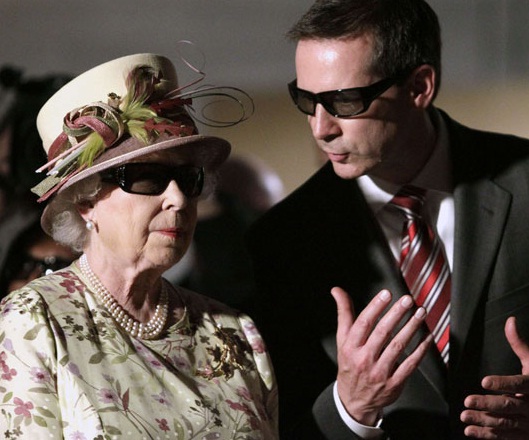
The Queen and Dalton McGuinty at the Bollywood North celebration 2011

Bollywood Movies Shot in Toronto
We’ve already mentioned that Toronto is a famous location for Bollywood movie producers. Let’s see in which parts of Toronto the most famous Bollywood movies were shot. The centre of the city (e.g. Yonge Street) is the most common place where movies are shot in Toronto, thanks to low production costs and Toronto’s resemblance to any other bigger city. This is also the case of Bollywood/Hollywood (2002) and Kal Ho Naa Ho (2003). Another very popular Bollywood movie, Thank You (2011), was shot at Toronto’s Flatiron Building, the Air Canada Centre, and Niagara Falls. There are many other spots in Toronto where parts of Bollywood movies were shot; the most common are St. Jamestown, University of Toronto, and the Old and New City Halls.

Bollywood Movie Rentals

One can easily recognize that there’s a strong community of approximately 550,000 Indian people living in Toronto and the GTA, thanks to the abundance of Indian restaurants, bistros, shops, dance schools, etc. However, it’s quite a surprise that it’s so easy to find a Bollywood movie rental in almost every neighbourhood in Toronto. They’re usually small, hidden shops with an astonishing collection of Bollywood flicks. If you want to have a Bollywood movie night in your home, try one of these rental shops: Bollywood ‘N Varieties (25 Overlea Boulevard), Bollywood 4 U (683 Markham Street), R K’s Bollywood Entertainment (1395 Queen Street W), Bollywood DvD Center (31 Street Dennis Drive, North York), Fieldgate Video (2465 Cawthra Rd.,Unit 127, Mississauga), or Golden Groceries Silo Direct Link to Golden Groceries  (2975 Drew Rd. Mississauga; 5995 14th Ave. Unit A-1, Bldg. A, Markham; 305 Charolais Blvd. Brampton; 4525 Ebeneyer Rd., Brampton, Cottrelle Blvd. Brampton).

For the Silo, Jamie Sarner.
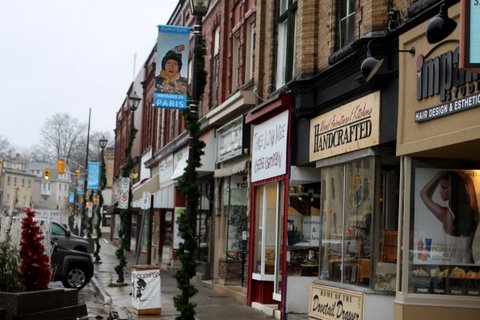
Paris (Ontario!) for the Holidays

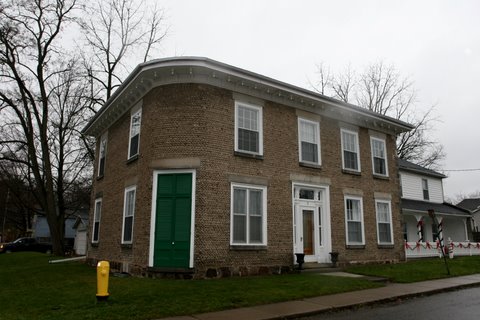
That’s Paris, Ontario. This lovely town of about 12,000 is an easy hour and a half hour drive from Niagara. It was amalgamated in 1999 to the County of Brant but the locals don’t like to admit to it. It’s named for the nearby deposits of gypsum used to make plaster of Paris. It is referred to as, “the cobblestone capital of Canada” because of the towns large number of aged cobblestone homes.

An example of one of the historical cobblestone homes found in Paris.

When I arrived a few weeks ago to do Christmas shopping, I found a vibrant downtown tucked away in a wide valley. It was sheltered from big-box retailing and I soon learned chronic 21st century hurry-up ism wasn’t here either. The place reminded me of earlier times when I would walk the downtown of my own hometown. The pace was slow. It reinforced in my mind, how nice the world can be.
Parking is free along Grand River Street, the Main Street, and there’s lots of interesting stores to explore.

Always looking for a “sweet deal” I stumbled upon Chocolate Sensations Silo Direct Link to Chocoloate Sensations Website Like so many other shops in town, this delightful aromatic place is family owned by John and Sarah Chalmers. John said, “This business began as a humble home-based hobby in a family kitchen over 20 years ago. Today we do a thriving on site business and a large volume of catalogue sales”. Once inside chocolate enthusiasts will think they have died and went to chocolate heaven. I recommend before you leave take home some Christmas, Candy Cane Bark. Come on, you can afford to take out the belt a notch, after all it’s Christmas.

Sarah and John Chalmers inside their Chocolate Sensations shop.

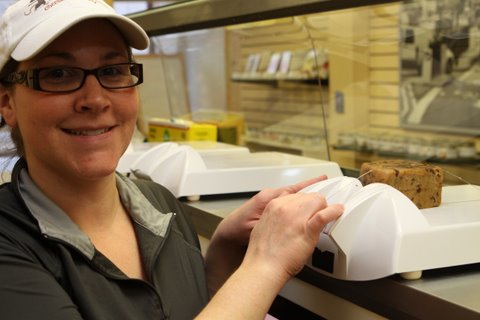
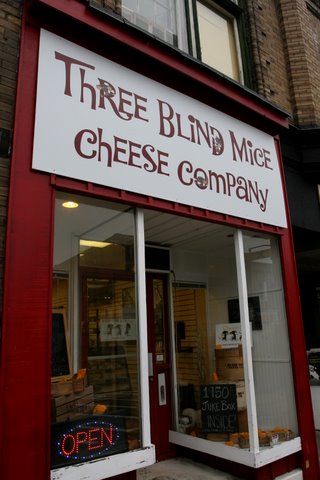
Next door is a “cheesy place”. The Three Blind Mice Cheese Company Silo Direct Link to Three Blind Mice Cheese Company WebsiteOkay, I promise no more cheesy stuff. The owner, Lindsay Dawdy with an ear to ear smile said, “We only opened in June of this year and so far it’s been a runaway success. So much so, we’ve opened another store in Elora”. Believe it or not, this is a fun place. Step inside and see what I mean. Ask Lindsay to push the reset button on her 1951 Juke Box and you can hear one of your golden-oldies. Sticky Toffee and Wensleydale with Cranberry are the featured cheeses for the holidays.

Lindsay Dawdy, owner of Three Blind Mice Cheese Factory shows us one of her unusual cheeses
The Three Blind Mice Cheese Company storefront

Down the road is the John N Hall House of Quality Linens. This is an old-fashioned dry goods store. Their heavy front doors are the same ones customer’s have been pushing since the 1860’s. If you’re looking for a ladies embroided white cotton nightgown or fleece or flannelette blankets you’ve arrived.

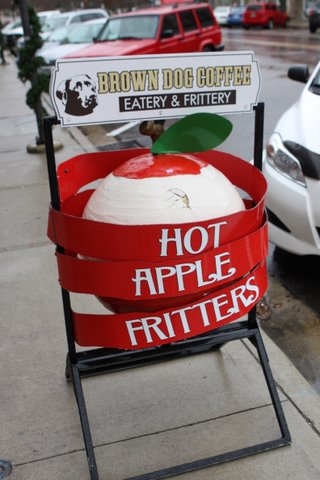
The Brown Dog Coffee Shoppe Silo Direct Link to The Brown Dog Coffee Shoppe Website at 63 Grand River St. N. was so popular with the locals there must have been something to it. And there was.

For starters, everything is made from scratch and from what I observed servers worked at spoiling their customers. They roast their own coffee and they specialize in nostalgic hard to find sandwiches like the classic Monte Cristo. The Apple Waldorf Salad platter is a crowd pleaser. I loved their Deep Dish Corn Meal Crust Quiche and hand crafted Hot Apple Fritters. The apples were prepared in front of me using an 1800’s hand operated peeler. I washed the meal down with chocolate milk delivered to my table in an old-fashioned dairy bottle. In the warmer months you can eat on the second floor outdoor patio that overlooks the Grand River that flows through town.

I stopped in 'at the dog' for a meal washed down with chocolate milk delivered in a retro glass bottle

Before you leave Paris walk to the end of the town to the Williams Street Bridge and take a photograph of the back of these historic buildings that house these shops. It will be a keeper.

As I headed home I came across a group of people who were unloading Balsam Firs to be sold at their annual Christmas tree sale for St. James Anglican Church. It was a scene from a Norman Rockwell painting. One of the parishioners Steve Howes, who had lived in the town for 45 years told me, “This is a small town with a lot of heart. People still treat each other with respect. I wouldn’t want to live anywhere else”. That sums this town up nicely.

Christmas tree sale in support of St. James Anglican Church

How to get There
From Niagara take the QEW to Highway 403 towards Brantford. Cut off onto Highway 2 to Paris. GPS users can punch in 89 Grand River Street. North, Paris.

Since 1850 Ontario Parisians have been warmly welcoming visitors

Written and Photographed by George Bailey. George is a writer who has a unique way of finding ‘hidden gems’ and sharing his experience in words and pictures.

Terezin,MacDougall and Hana’s Suitcase- So What’s the Connection?

Definition of art is very difficult to pin down.  As an oil painter I look at art one way.  An actor would think of it another way.  But really the definition doesn’t matter all that much.  Art surrounds us wherever we are, if only we choose to see it.  Sometimes though, we need to be reminded of that.

When I entered the concentration camp at Terezin in the Czech Republic that November day, the last thing I thought I would see was art.  I didn’t know that the children who lived there drew pictures, coloured them, and even wrote poems.  But there they were.  The paintings and words hung up on the museum wall. The wall was at least 50 feet high.  They had miraculously survived Terezin, even when the children themselves had not.  I stood in front of that wall for a long time, hesitant to leave.  Afraid that maybe I would need reminding again once I was back home.

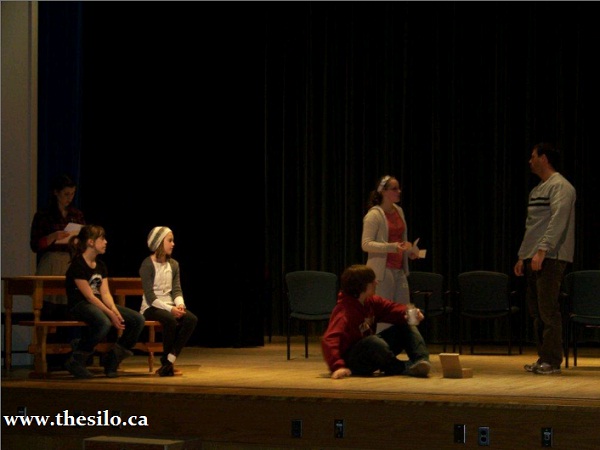
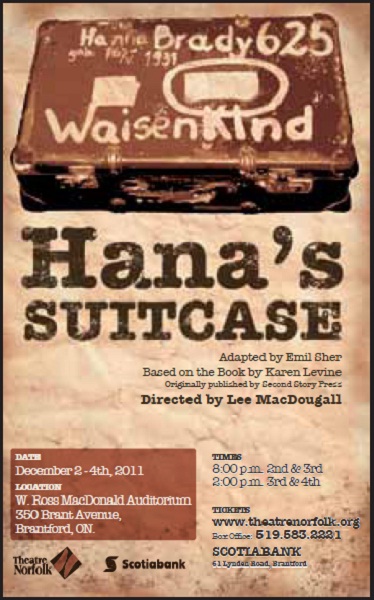
Fast forward a year and Terezin has touched my life again.  Hana’s Suitcase, which is set in Terezin, is being presented by Theatre Norfolk and COMPASS Theatre Productions, in partnership with W. Ross MacDonald School for the Blind, and I had the opportunity to meet the cast and talk about my experiences at Terezin.  I also had the opportunity to watch renowned actor and director Lee MacDougall guide the cast of talented local and emerging actors through the paces of this emotional, heart wrenching play which took me right back to that wall.

Silo Behind the Scenes: Rehearsal of Hanna's Suitcase

In this play child actors play some of the main characters.  Hana was sent to Terezin when she was 11.  This play is being performed for over 1200 students in Grades 4-12; Children teaching children and because this play is for everyone; children teaching adults.  It speaks to hatred and intolerance.  It also speaks to hope and beauty.  It’s amazing how children are able to see both at the same time.  I wonder when we, as adults, forget how to do that.

I hope that you will take the time to see Hana’s Suitcase and be reminded of all the things that you should never forget while watching art at its finest.

Hana’s Suitcase, adapted by Emil Sher based on the book by Karen Levine, is being presented at W. Ross MacDonald Auditorium Dec. 2nd, 3rd & 4th.  Tickets are on
sale at Scotia Bank, Lynden Road, and at the Lighthouse Festival Theatre.  For more info and to purchase tickets visit Silo Direct Link to Theatre Norfolk Website

By Karen Wilson.  Silo Direct Link to Karen’s artsco Gallery Page

Designed by Dean Gailbraith of Picasso Fish

Remembering The Children Of Terezin

The first thing I noticed was the pebbles. There had to be a hundred. Maybe more.

All perched lovingly atop the unmarked grave. I took a deep breath and went closer.

Each step taken with respect. To those underneath the pebbles, their families, their communities, their lives.

Time stopped.

I knelt.

My hand reached out. Hovered over the pebbles asking permission to enter their world for just a few hours.

I was humbled. I was ready.

I will never forget.

So began my journey to Terezin in the Czech Republic that November day. I knew it would change me. I knew what I would see.

I knew nothing. Absolutely nothing.

How could I know? I had not yet seen. I had not yet felt. I had not yet heard the door slam behind me.

I didn’t know about the children. I didn’t know they drew pictures. Pictures of flowers and trees, family and dogs. Pictures like all kids draw. Only they weren’t all kids. They lived at Terezin.

I was ready.

I had watched the movies.
I had watched the documentaries
in my comfortable chair in my warm living room.

Now I’ve stood where they stood.
Sat where they sat.
Cried where they cried.

I know it’s not enough.
But I will never forget.
Will always speak up.
Will always remember the pebbles.

There were a hundred of them.
Maybe more.

IF WISHES WERE PEBBLES by Karen Wilson

MTO Explain Archaeological Delays For Ontario Bridge

Eg's of type artifacts found in Cayuga area.
Eg’s of type artifacts found in Cayuga area.

Silo/HNARP- Can you tell our readers a bit about the history of the bridge, for example the year in which it was first built and its age?
The Grand River Cayuga Bridge is a 5-span through-truss bridge. Construction began in 1923 and was completed in 1924.

Silo/HNARP- So why is the bridge being redesigned and rebuilt?
To ensure our provincial bridges remain safe, Ontario is the only province in Canada to legislate that owners must inspect their bridges every two years by, or under the direction of a professional engineer. Taking it one-step further, MTO also conducts routine maintenance inspections of all 2,720 of our provincially owned bridges every year.
As part of our assessment, the Grand River Bridge, while currently still in safe condition, was identified as requiring future replacement, due to its age and declining condition. In 2005, the ministry initiated a Preliminary Design and Class Environmental Assessment (EA) Study to determine the long-term strategy for the bridge. Completed in 2008, the Study recommended the bridge be replaced with a 5-span, steel girder bridge. The Study received Environmental Clearance in November 2008.

Silo/HNARP- Can you explain to us the importance of archaeology to the MTO in Ontario and its support of the Heritage Act?
It is a requirement of the Ontario Heritage Act to address the impacts of any project on both archaeological resources and the built heritage environment, MTO achieves this as part of the Environmental Assessment we conduct for every MTO undertaking.

Silo/HNARP- Is the archaeology holding back the bridge’s development or is the project on schedule?
The ministry’s preliminary design and Class EA identified prehistoric and historic archaeological sites along the west side of the existing bridge, so it was acknowledged that some special measures and precautions would be necessary. The archaeological salvage work has been scheduled into the timeline of the project, and is on track.

Silo/HNARP- Did the MTO know in advance that extensive archaeological work was necessary?
The archeological assessment completed during the EA Study identified that prehistoric and historic archaeological sites are located along the west side of the existing bridge. Based on the results of a Stage 3 archaeological assessment (test trenches) completed during Preliminary Design, it was determined that a Stage 4 Archaeological Salvage had to occur to ensure existing artifacts are recovered before any areas are disturbed as a result of construction. In 2009, the ministry started the detail design study and retained a consultant (McCormick Rankin Corporation) and their sub-consultant, New Directions Archaeology Ltd., who are responsible for completing Stage 4 Salvage under an archaeological license issued by the Ministry of Tourism and Culture (MTC).

Silo/HNARP- The general public has noticed the excavation taking place one layer at a time. Why has this been important?
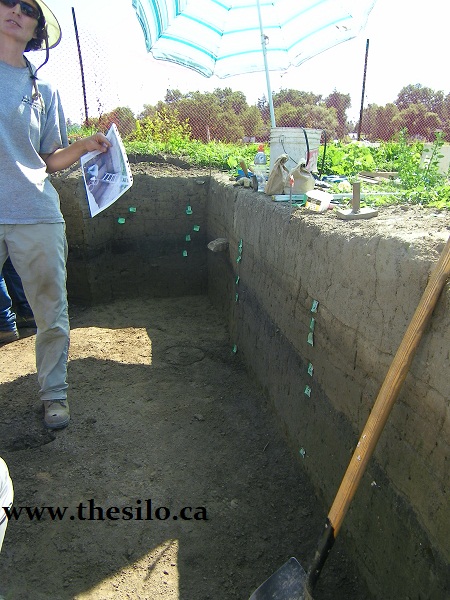
This is a very significant archaeological site made up of a series of cultural layers representing different historic and pre-contact occupations at this location. Based on previous studies, the artifacts range in age from the Archaic period, circa 8000 – 1000 B.C. through to the historic period circa 1700+ A.D. The west bank of the Grand River around Cayuga is a flood plain. Because the periodic flooding of the Grand River deposited silt over this flood plain, this site is made up of numerous levels of cultural material, each dating to a specific time frame, sandwiched between sterile layers of flood deposits. The goal of the excavation is to map and record these cultural layers before they are impacted by construction. To do this, the excavation is being completed in one metre by one metre squares, recording the original location of each artifact within the one metre square, including the depth at which it was recovered. The artifacts from each one metre square will be kept together, with individual levels kept separate in clearly identified bags. This will ensure that each artefact will be related to a specific cultural level and time period, to interpret the history of the site.
The excavation of each one metre square will continue downward until no further artifacts are recovered. Based on previous test excavation on the site, this will be at a depth of about 160 cm. The excavation will continue below this depth to ensure that all artifacts have been recovered, generally to a depth of approximately 180 cm (1.8 m).

Silo/HNARP- What unique discoveries have resulted at the site such as historic, pre-contact, archaic items?
The site is yielding an array of artifacts, including ceramics (pottery), tools (scrapers, spear points, arrow heads), stone flakes from tool making and even a shell bead, thought to be an early trading item.

Silo/HNARP- Why has the Six Nations been involved with this project?
First Nation involvement is an important aspect of this project because of the significant archaeological resources at this site. MTO and our consultants have regular and ongoing consultation with interested First Nations regarding this project. People from Six Nations have been hired for the archaeological field investigations and monitoring of the salvage operations, as well as the follow-up lab work.

Silo/HNARP- What will the MTO do with the artifacts once the project is finished. Will there be any public education about what was found?
Once the excavation of each one metre square is complete, the artifacts will be removed from the site and taken to a lab where they will be washed and organized. The artifacts will be analyzed and discussed in a final report including conclusions about the prehistoric activities at this site. Given the scope of this excavation, the analysis and reporting of this site will take years to complete. Once the report is finished, the artifacts will be kept for posterity, available for other archaeologists who are interested in the site and the time periods represented. Discussions are currently underway with a few Ontario university repositories to house the artifacts.

Silo/HNARP- How and where can the community learn more about what was recovered and learned from the excavation when the project is finished? Is there for example, an online PDF document, field report or analysis report of artifacts?
A report will be prepared after the artifacts are analyzed. The report may take a few years to complete, due to the size of the excavation. It will be filed with MTC and also provided to the First Nations having an interest in the site. Due to local interest, we also expect to provide copies to local repositories, such as the Haldimand Museum.

Silo/HNARP- Will this be the last season of field work before the bridge reconstruction gets started or is another field season anticipated in 2012.
It is anticipated that the salvage work at the current site will be completed in the fall of 2011. Additional areas of archaeological salvage may occur in 2012, if it is determined that construction activities will cause disturbance to additional areas on the west side of the river not yet salvaged.

Silo/HNARP- Who can be contacted to learn more about this archaeological site and its history?
The salvage work and report preparation are being conducted by New Directions Archaeology Ltd., under the direction of Mr. Phil Woodley. Questions about the site should be directed to the Communications Coordinator for MTO West Region (519-873-4186), who will consult with Mr. Woodley for detailed information as required.

Silo/HNARP- When is work expected to begin on the bridge replacement?
Construction is anticipated to begin in 2012 and is expected to take two construction seasons to complete.

Songs For Rainy Weather – What’s The Frequency, Kenneth?

How can we honestly say that today’s rain and overcast skies influenced our choice for today’s 90’s flashback…umm, urr, we can’t. But this throwback track from R.E.M. rocks. Pack your umbrella for the next few days and if you’ve got room on your ipod (we’re guessing you do, and if you don’t drop us a line explaining why not) , add this song to your playlist. It just might be a cure-all for the turn in the weather. Now where did i put my can of orange Crush?
CP

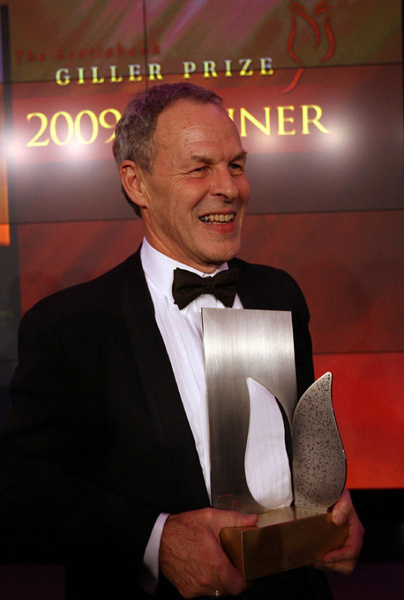
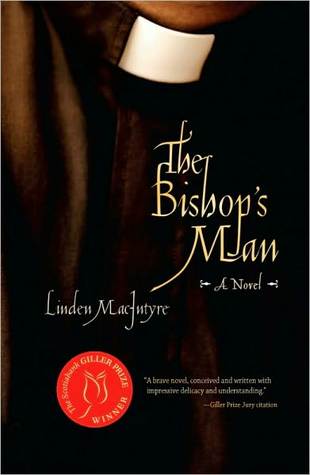
The Bishop’s Man By Canadian Author Linden MacIntyre

The Bishop’s Man by Canadian author Linden MacIntyre offers a deep and compelling story of one man’s struggle for atonement. The book revolves around a very controversial and current topic, the sexual abuse of children by Catholic Priests. However, this fictional work is much more than a critique on a current situation; it is a journey and dialogue on themes of loneliness, isolation, redemption and spirituality. This novel follows the characters from MacIntyre’s earlier work, The Long Stretch.

MacIntyre begins his story in the present day, sometime in the 1990s, in southern Cape Breton Island. From the beginning, the reader is taken on a journey through the eyes of Father Duncan MacAskill, a priest known as the Exorcist. Father MacAskill, who grew up in this area, is sent for a break from his regular duties, troubleshooting and cleaning up messes made by priests that threaten to embarrass the Catholic Church. Father MacAskill sees this trip home as less of a homecoming and more of a time of spiritual discovery through current events and reflection. MacIntyre weaves present day with the past as he unwinds Father MacAskil’s complicated and somewhat remorseful past.

Father MacAskill is very good at what he does—making troublesome priests disappear by sending them to far off parishes or rehabilitation in Ontario. Upon his return to Creiginish on southern Cape Breton Island, he befriends a young, 19-year-old Danny MacKay from whose father he purchases a boat. Danny’s character is troubled and before Father MacAskill can really reach him and understand the root of his trouble, he commits suicide. This is especially difficult to take in for Father MacAskill when rumours start to swirl that a relationship with a troublesome priest, Brendan Bell, who was sent away from Newfoundland to Craiginish by MacAskill, may have lead to the ruin of Danny MacKay. Upon this revelation, MacIntyre’s story starts to divulge into the past as Father MacAskill tries to sort through his current situation and his spirituality.


The absorbing narrative takes the reader through his missionary work in Honduras in the 1970s, where he has sent to forget what he saw as a young priest between a well respected priest and a young person. The Honduras narrative is threaded between the present day and other reflections. MacIntyre does this seamlessly throughout the novel. Father MacAskill’s stint as dean at St. Francis Xavier is also explored. It is while he is dean at the university he becomes the Bishop’s right hand man and is set out to extinguish potential fires in various churches across Canada. Through all the weaving and reflection, Father MacAskill sorts through his own demons, his past and his family’s problematic and mysterious history.
Although this fictional work discusses a very current and disturbing subject, the sexual abuse of children is never directly addressed or explained in the eyes of Father MacAskill. It serves as a constant undertone to the actions and thoughts of the main character. Linden MacIntyre’s narrative, through the eyes of a troubled priest, provides the reader with a rare insight into the inner workings of the priest hood and the powerful Catholic Church and its place in Canadian culture. For the Silo, Sarah Purdy. 

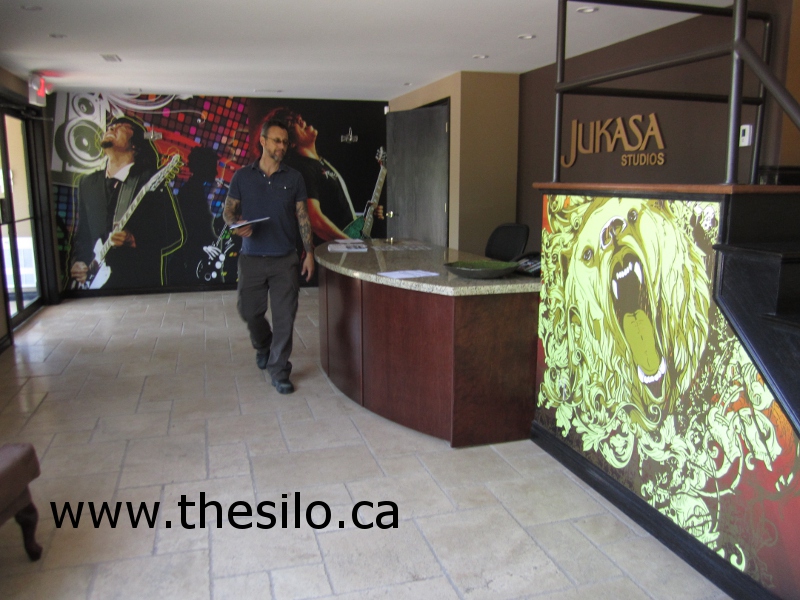
Jukasa: World Class Music Studio Open For Local Artists

From our Sept/Oct 2011 PRINT Edition (Jukasa has a whole new team of amazing people on board! Please check their website for a list of their amazing staff CP)

If I were to tell you that musicians like Willie Nelson, Steven Tyler, Snoop Dogg, Derek Miller and The Tea Party have spent time in Ohsweken Village, what would you say?
I know what I said: “Wow, why haven’t I heard about this place?” The place I am talking about is Jukasa Media Group. Jukasa Media Group is a $3 million dollar studio complex that is currently expanding – and rapidly I might add. Upon its construction in 2009 Owner Kenny Hill wanted a place for his son and friends to record their music. In 2010 Mix Magazine named Jukasa as 2010’s “top three new studios on the planet.” What brings such talented musicians to Jukasa? The Gear? The Studio? The Staff? The Price? All of the Above?


The answer is all of the above. Jukasa currently features 2300sq ft of beautifully architectured live recording space, their famous sound board the SSL 8072 Console that spent a decade Abbey Road Studio 3, living accommodations on site, a space for editing daily recordings, and they are currently building a second recording studio, and will be opening a private Recording Arts School as of October where students will be in classes of no more than 9, learning the theory of sound, while recording real artists with the mastering engineer Nick Blagona and other staff.


Mixer and Mastering Engineer Nick Blagona has been in the music industry for decades and brings his experience around the world to Jukasa. Blagona has worked with Chicago, The Beegees, Cat Stevens, Nazareth, Alexisonfire (R.I.P.), Kim Mitchell, Protest the Hero, The Police, and Deep Purple to name the tip of the iceberg. Also under the Jukasa roof is Stevie Salas, Director of Aboriginal Development and U.S. Operations who has received the Life Time Achievement Award from the Native American Music Awards, and has the largest deal Island Records has ever signed. Salas has also brought his long time friend Rob Lamothe into the mix. Rob Lamothe is the General Manager of Jukasa, he has received an Edison Award from Holland, and has toured over 30 European tours.


Aside from the Gear, the staff and the facility itself, what makes Jukasa so unique is the price for the quality. Prices for recording at Jukasa are comparable to prices to record in basement studios in the area however the final product is the highest of quality production, thanks to the experienced staff and incredible equipment available.  For the Silo, Lacie Williamson


Okay you didn’t think we were going to NOT show you the famous SSL 8072 did you? Here it is-

Click to view on I-tunes

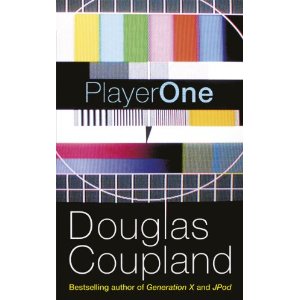
Douglas Coupland Player One

As the world teeters on the brink of disaster, four people converge in a Toronto Airport cocktail lounge. As oil prices suddenly approach $300 a barrel, power cuts out, planes stop taking off and cell phone signals die—a self imposed apocalypse sets into motion. As you read, four people come to terms with the situation, and more importantly, each other. Karen, the 40 year old receptionist at a psychiatric clinic who has flown to Toronto to meet a man she met on the Internet; Rick, the recovering alcoholic bartender who eagerly awaits the arrival of an obviously transparent self-help guru; Luke, a pastor, recently turned felon, who has run off with $20 000 from his church renovation fund; and Rachel, a beautiful, young autistic woman with the intention to find a man to be the father of her child.

“Cocktails and laughter—and what will come after?” asks the haunting voice of Player One after the self-narrated character introductions and before the announcement of the skyrocketing gas prices that quickly envelop the world in complete chaos. The novel follows a simple format: each character narrates their version of the same events, over a five hour period, followed by Player One’s omniscient and sometimes mocking narration. The identity of Player One remains a mystery up until the end of the novel where resolution is provided and final comments are made.

Player One is the first fiction selection for the CBC Massey Lecture series. Presented in a series of five, one hour, real-time lectures, Coupland explores what people do, talk about and think about as the world sits on the brink of total disaster. For anyone who has read Coupland, this novel addresses many familiar themes and ideas. Mild drama and in-depth dialogue where topics from humanity to sexuality fill the text of this lecture turned novel.


This book, simple in structure, but at times complicated in meaning, provides the reader with a scary dystopian view of what will become of us when a daily staple in most of our lives becomes virtually unavailable. The dialogue can drag on at times and the characters can be a little predictable and melodramatic, but this novel is more about what it leaves you with when you put it down. What would happen if gas became unaffordable? How small would our world actually get? Douglas Coupland will infect your mind with these questions long after you put down the book and forget about the meddling and self-loathing characters.

As Player One haunts the pages of this book, the ideas and inferences you read will haunt your mind every time you indulge in a modern day convenience, such as filling a vehicle up with gas, making this book a worthy read.  For the Silo, Sarah Purdy.

Supplemental:

iTunes link: Massey Lecture with Douglas Coupland


Politics in The Arts- Are Canadians Concerned With Art Funding?

During the Federal elections [circa 2011 Ed], it became clear that the Canadian public interest in an arts and cultural policy had declined since 2008, in fact the majority responded that this policy was unimportant to them in comparison to other policies. This leads me to question the degree of concerns Canadians do have with other policies. Perhaps the overall concerns are too great to allow a focus on more fun or abstract facets of their Canadian lifestyle such as arts and culture, or it may simply be that Canadians overall would rather engage with more mainstream topics.

It is interesting yet disconcerting to see that it is mainly the younger population, ages 18-30, that are the least interested in the arts and culture policy. If the younger generation doesn’t fuel the arts and keep them flourishing who will? In their (or our) defense though, little awareness about the policy and its impact is made known. Personally, I had never heard of an arts and cultural policy before reading the article critiquing the different Government parties’ role in the policy as discussed in The Arts Advocate publication.

The policy involves the government allotted a specific percentage of taxes that go towards varying sectors within the arts, for example advantages for artists or funding for different organizations. Each federal party has their different views on appropriate expenditure in the arts and culture sector, and specifically our Conservatives’ main commitment is to the children’s artistic activity tax credit, support to the Royal Conservatory of Music for a national examination program, and support to the Canadian Periodical Fund (Used to subsidize newspapers not including The Silo. Check the info box found on the bottom of page 2 in most papers to see if you are subsidizing their bottom line- CP).

With the Conservative party now being back in power, it is hard to say if the policy will see any positive growth. Although I understand and admire Harper’s plan to stabilize and improve the markets in the depths of a global recession, I feel it necessary to include arts and culture as a part of this. Canada has such a unique combination of cultures throughout its provinces and these are the people who create and work at the jobs Harper is trying to develop or advance.

So, should not this rich arts and culture naturally be showcased as it is echoed throughout the Canadian business world Harper is focused on? I believe Canadians on the whole would appreciate more recognition for their creative efforts that make our country special. Yes we need economic growth, but there needs to be a balance in the funding between businesses and the arts in order to make for a balanced country and to account for or showcase the people who inhabit it.

It is positive to note that the 2011 Ontario budget indicated spending at Tourism and Culture would grow $76 million.

The estimates confirm that $47 million of this is to continue support of the Community Cultural Fund (used to support local ‘big crowd’ draws such as last year’s Port Dover Marine Festival- http://www.ocaf.on.ca/en/project.aspx?ProjectUID=985 or 2005’s Norfolk County Fall Festival- http://www.ocaf.on.ca/en/project.aspx?ProjectUID=884 -CP), the small-scale (!) capital program administered by the Ontario Trillium Foundation to support diverse cultural organizations. As well, the Ontario Media Development Corporation will be permanently funded, showcasing the province’s commitment to the film sector of the policy and estimates show an increase of $8 million to $25.8 million. Although the Conservative platform for the policy is the most bleak of the Bloc Quebecois, Liberal, and NDP, perhaps a strengthened economy will help to account for areas our country’s arts and culture are struggling in.

In their platform it is stated that our “Government believes that a vibrant cultural, media, and sporting sector is crucial for our well-being and quality of life,” however many artists and cultural advocates still feel that the re-elected Conservatives will fall short in fulfilling the essential aspects of the policy and hearing the voices of those affected.  For the Silo, Jennifer Waslowski.


A Dollar For Compressed Air – Are You Getting Gouged?

The Silo does a lot of travelling and we take notice of the highs and the lows that go along with working in parts of four counties.  Some standouts are the comparative condition of the roads, the comparative prices of gasoline and diesel and one thing that surprised us: the rising cost of compressed air and the variations in the amount of time you get for the compressed air.

But why do we notice these things?

You see, we live in a wonderfully exotic environment. In just a few months time, air temperatures can vary between -20 degrees C to + 25 degrees C and this temperature jump combined with a (seemingly) growing number of potholes means checking your vehicles tire condition and pressure is a must. If you want to drive safely and economically and comfortably.

And that’s the rub

The vast majority of service stations are no longer Ma and Pa operations that cater to the automobile enthusiast. Sure they have candy and coffee and DVD’s and scratch lottery tickets. But what about putting the word ‘service’ back into service station? None of us on staff are old enough to remember a time when pulling your car into a gas station meant at a minimum a check under the hood. None of us are old enough to contemplate a time when your car was jacked up and inspected like a ship in dry dock. But all of us are aware of the rising cost of not only fuel but compressed air.

As we make our way around the different county lines and roads, our vehicles are taking a toll. On average, the roads are spotty and checking tire pressure has become a bit of an obsession. [If any of you are driving a vehicle with Nitrogen or another gas in your tires, please let us know if you’ve noticed a difference]

We are shocked by the rising costs of air pumps. The average cost of filling your tires is now 1$. The fill rates vary between pump manufacturers and it’s plausible that station owners may adjusting the length of time that 1$ will buy. We will report back our findings.  In the meantime- visit Burcham’s Service on Main St. in Port Dover for FULL service gas [sorry no diesel] and FREE compressed air. Pay attention to the warning sign above the air pump- this is a high pressure nozzle but when used properly, does a great job of filling your tires at no cost.  CP


Mourning The Macho Man

“Oh yeah”

Back in the mid 80’s, my high school buddies and I would travel every month or so from Simcoe to the Brantford Civic Center to get our fill of WWF wrestling.  It was great because in those days they used to do the TV taping right there in Brantford  for broadcast all over North America.  It was usually a long night of about 3 hours of wrestling for 3 different TV shows.  For $5 it was the best entertainment value around.  Sometimes the matches would drag on.

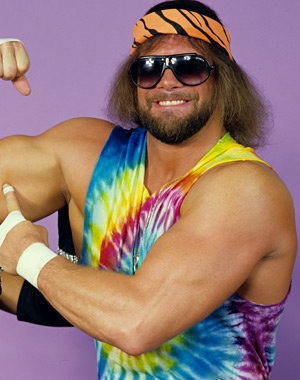
Harley Race and Nikolai Volkoff were not exactly the most captivating performers, but we would endure them waiting for something to peak our interest.  I’ll never forget the night a new wrestler was introduced to us.  The ring announcer welcomed him as Randy ‘Macho Man’ Savage.  Out he came in a garish, metallic robe which reflected the television lights in a million directions.  He had a maniacal look on his face and he revealed the craziest wild eyes when he finally removed his dark ski-goggle type sunglasses.  His matted hair was held back by a colourful headband and he sported an unruly beard.
Once in the ring, he took off the robe to reveal not the plodding weightlifter type body we were used to seeing, but the more sinewy muscularity of an athlete.  We, the veteran and savvy fans, took this new guy and his ring entrance with a grain of salt.  “Macho Man”?  Really?  “Who calls themselves the “Macho Man”?” we thought.  At that time our only reference to a Macho Man was voiced by a pop group named the Village People, and that was just plain challenging for a group of adolescent high school boys. So we watched on with wary eyes.  The bell rung, the match started, and then the Macho Man turned into a human whirlwind.

He raced around the ring delivering all his moves with expert efficiency, but at a hyper-speed we had never seen before.  He threw his man out of the ring, darted up to the top turnbuckle and came down hard onto the opponent’s backside with a double axe handle.   He then threw the poor sod back in,  picked him up and body-slammed him to the centre of the ring and jumped back up onto the top turnbuckle as quick as a cat.  What was he going to do now?  He raised his arms and pointed his fingers up high towards the arena roof and paused for a moment while the crowd held its collective breath.  Then….he leapt.  Sky-high into the air he launched, coming down with devastating force into the chest of his opponent with what would become his signature move, the Flying Elbow.  One, two, three, and it was all over in the blink of an eye.  We were awestruck.  A star was born.  After that display of wrestling awesomeness, it goes without saying that we were now all charter members of the Macho Madness fan club.

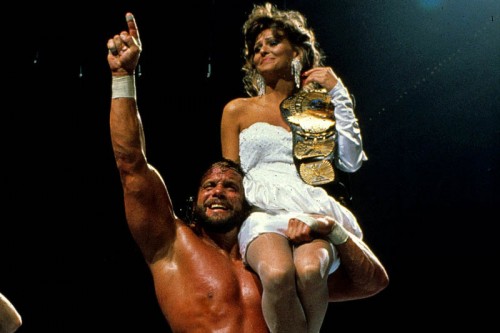
Savage’s “Oooooyyeeaaah” catch phrase and white-hot interviews would solidify his character, and his lovely manager Elizabeth would provide the eye candy which surely helped propel him to the highest heights of wrestling stardom.  Whenever his entrance music, “Pomp and Circumstance” hit, the excitement level dialled up to a fever pitch.  He would become a multi-time WWF champion and face off against Hulk Hogan in the top money-drawing program of the day.  His crowning achievement was likely his match against Ricky Steamboat at Wrestlemania 3 in what is widely regarded as one of the best wrestling matches of all time.

Randy Savage, real name Randy Poffo, died tragically in Florida last month after having a heart attack while driving his car and then colliding with a tree.  He leaves us at the too young age of 58. I know my buddies and I are not the only ones out there missing him.  I’m sure some of you have your own favourite Macho Man moments.

Maybe you should have a stroll down memory lane and check out some Macho Man on Youtube  In my mind, he was thegreatest of all time. John McIntosh is a favourite writer for The Silo.

25 Year Old Batman Original Comic Art Brings $448,125 At Auction


From Heritage Auction House- www.comics.ha.com

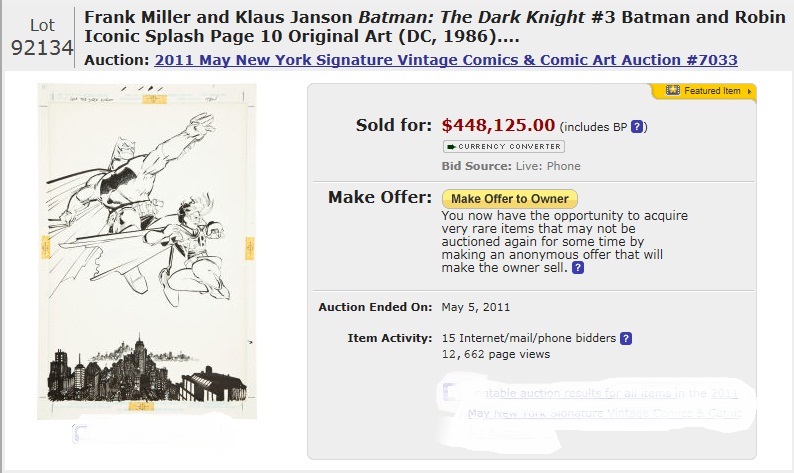
Frank Miller and Klaus Janson Batman: The Dark Knight #3 Batman and Robin Iconic Splash Page 10 Original Art (DC, 1986). Frank Miller’s The Dark Knight Returns defined the best of 1980s comics, and has since been universally acknowledged as one of the most important and influential stories ever published. Miller is arguably the greatest superhero writer/artist to work during this period, and Dark Knight is his undisputed masterpiece: the four-issue series rejuvenated Batman as DC’s most popular character and in the process helped revitalize the comics industry.

This splash page is to our minds the single most memorable image from the entire book and the greatest image from the decade ever to come to market — as well as one of the handful of most desirable pieces of original comic art from any era to come to market. A perfect stand-alone image of Batman and Robin (Carrie Kelley, the first female, full-time Robin) soaring high above Gotham City, an icon symbolizing the entire storyline — this one has everything going for it.  As demonstrated by the fact that we’ve only offered two Dark Knight panel pages previously — and the fact that no splash page, much less a such an undeniably classic image, has never been offered at auction — artwork from the famed series is much scarcer than anything else from the period. This gem has been locked away in a single collection since being purchased upon the series’ original publication and is the definition of “fresh to market.” And unlike many pages from the series, where differences between the original art and the published version are evident (as a result of Miller making changes on pasteovers), no changes were made to this artwork for publication, and the original contains no paste-ups or stats — it’s pure art, just the way it appeared in print.

Definitive is the only adequate description of this masterpiece, and as such, it was chosen to represent the entire time period in DC’s recent 75 Years of DC Comics: The Art of Modern Mythmaking book, serving as the chapter heading for “The Dark Age: 1984-1998,” and reproduced as a glorious color full-page image, leading off the chapter on page 556.   In 2005, Time magazine ranked The Dark Knight Returns as one of the top ten graphic novels ever created. As Alan Moore wrote about the series: “Beyond the imagery, themes, and essential romance of Dark Knight, Miller has also managed to shape the Batman into a true legend by introducing that element without which all true legends are incomplete and yet which for some reason hardly seems to exist in the world depicted in the average comic book, and that element is time… time has come to the Batman and the capstone that makes legends what they are has finally been fitted. In his engrossing story of a great man’s final and greatest battle, Miller has managed to create something radiant which should hopefully illuminate things for the rest of the comic book field, casting a new light upon the problems which face all of us working within the industry and perhaps even guiding us towards some fresh solutions.”

In short, this is one of the most important pieces of original comic book art Heritage has ever had the pleasure to offer.  This iconic masterpiece from “Hunt the Dark Knight” has an image area of 11.5″ x 17.75″, and aside from some very light paper aging in the image area and some passages of white-out, the art is in Excellent condition.

“I’ve always loved that drawing. Danced around my studio like a fool when I drew it. I hope it finds a good home.” –Frank Miller–

Miller, Frank: Frank Miller (American, b. 1957): is a multi-talented cartoonist, writer, and film director, most celebrated for his work on the Marvel characters Daredevil, Elektra, and Wolverine, as well as on his own characters for the Dark Horse titles Hard Boiled, 300, and Sin City. In the late eighties, Miler became the first and foremost of a new breed of “noir” comic book storytellers, thanks to the tremendous popularity of his work on the industry-changing Batman: The Dark Knight Returns series. He also directed the film version of Will Eisner’s The Spirit, and shared directing duties with Robert Rodriguez on Sin City, and produced the film 300..

Terroir

Wine and cheese pairing is not just for the snobby connoisseur or the elite diner. Anyone can be a part of this wonderful dining experience and spend an evening savoring it yourself. Since all of us are different and more importantly, all of our taste buds are different, what master vintners and world class fromagiers may say is a correct pairing, may not work for the rest of us. By all means listen to what they might suggest, because they have a lot of experience with taste –but, remember they are just suggestions.  It’s the differences that make life interesting.

Cheese and wine by their very nature are even different from vat to vat. You may be making the same product, but in the food world, there are many variables to production. Terroir plays a significant role in both wine and cheese.  Grapes taken from sunny slopes of Italy have a different terroir than grapes taken from valleys in France. It’s the same with cheese. Milk coming from animals in Swiss Alpine regions possesses distinct flavors that differ from milk from animals on Canadian Prairies.

Understanding the basic concepts of flavors and how they pair, will give you a platform to make your own pairing decisions.  Cheese influences the taste of wine more than vice versa. Wines with lots of flavour work with cheese that also have lots of flavour.  Subtle wines work with delicate cheese; therefore hard cheese with red wines and soft cheese with white. Fruity wines pair nicely with tangy acidic cheese. A sour salty cheese makes a wine taste milder. Sometimes, pairing wines with cheese from the same area works well together. Spicy flavored cheese work well with sweet desert wines.

Sometimes a heavy sugar wine works with a blue cheese. But, in the long run, it’s all up to you to try it out, and find out what sits well with you.  Your goal is to create a balance of flavors of wine and cheese together.

Here are a few pairings of wine and cheese that you might care to try out.

Florence Estate Winery from Langton has a delightful chardonnay -with its light oak and hints of fruit pairs well with the Swiss Alpine Gruyere from the Canton of Fribourg. The subtle textures of the cheese draw out the fruity hints of the wine.

Villa Nova Estate Winery has a Riesling that is clear and floral, and the terroir of their region adds a slight twist of richness that differs slightly German Rieslings. This makes pairing with the English Double Gloucester a true experience. The saltiness of the cheddar takes the edge from the sweetness of the wine.

I am looking forward to sampling the other Norfolk County wines from Burning Kiln, Burning Mills Villa Nova Estate and Wooden Bear-L , when I get the chance. Maybe this weekend I can give it a shot with some close friends and a board of cheese. For the Silo, Scott Jensen. 


Netflix Is The Good Life Without Cable

I’d about had it with Bell Canada. My internet, home phone and basic satellite TV charges had incrementally and infuriatingly risen each month until I was red-faced steaming every time the outrageous bill appeared in my mailbox. I needed to reduce that burden, but….I needed some sort of plan.

The first step, I thought, would be to get rid of the TV portion of my package. I didn’t think I could go cold turkey though, so I had to come up with a solution for replacing what I was going to lose. I continued to stew and pay the bills, but in the meantime I started exploring what I could get for free online. I also experimented with some old-school rabbit ears, but those things didn’t really cut it.

Then, out of nowhere, like manna falling from heaven, the sweetness known as Netflix became available in Canada. I pounced. Now for only $7.99 a month I have an all-you-can-eat buffet of TV series and movies right at my fingertips. It’s all available through my wireless internet, works in combination with my Nintendo Wii (you can also use an xbox360 or Playstation3) and is viewable on my television. All for the price of two video rentals.

Once my mind was suitably blown by Netflix, let me tell you how satisfying and liberating it was to call Bell and cancel my TV service. It went something like this: “Hey, Bell , just wanted to tell you that you can go screw yourself. Instead of dealing with your over-priced and over-rated service, I’ve got something that meets my viewing needs at next to no cost at all”. Ahhh. Now that was nice.

Bell has since been mailing thank you notes for my long time patronage, encouraging me to “give them a call” to learn about all the “savings they have in store for me.” I mean really, give me a break. Couldn’t the money they’re spending on that embossed greeting card, and postage, be better used? And why don’t they offer these “great deals” when you’re already a subscriber? Oh man, I’m starting to burn again…

Okay, with Netflix there are some serious sacrifices that you might not be willing to make. First of all: no live sports. For some this may be impossible to accept. However I’ve been a staunch Toronto Raptors fan since their inception, and I thought I’d miss them big time. But I found that I just stopped caring. Of course the Raptors extreme ineptitude certainly made things easier.

Overall, I found that if it’s out of sight it really is out of mind. Trust me, your mind will get filled up with something else. No American Idol? Maybe it’s time to challenge yourself. There’s always YouTube if you absolutely have to see that results show. What about reading a book as an alternative?

The movies on Netflix are not “right out of the theatre” but that doesn’t seem to bother me. There are so many genres to choose from, and so many films I’ve missed or forgotten about, that it’s all new to me anyway. If you still can’t bear the thought of losing your cable, consider using Netflix as a supplement.

Next on the agenda is to get rid of my home phone, another huge part of my bill with *****. When I called to cancel my TV they delighted in telling me I was under contract for telephone service until June, and would have to pay a $200 termination fee to cancel it. Like, whatever. Why am I even surprised? For the Silo, John McIntosh

Money For Nothing Is About Angry Men

I have been following, with some amusement, the media firestorm unleashed since the Canadian Broadcast Standards Council decided in mid-January that the classic, 25 year old Dire Straits song Money for Nothing must be censored. According to the CBSC, times have changed and the word “faggot” is now inappropriate for Canadian airwaves. The CBC, National Post, and newspapers from Edmonton to Ottawa have all weighed in, including our own Simcoe Reformer, expressing outrage over the censorship of a critically acclaimed work of art and, well, political correctness just generally gone mad. While I agree that this is a censorship issue, you have to dig to find commentary about why it’s such an interesting one.

If you put the lyrics together with the music video, the song appears to be written from the perspective of two furniture and appliance movers watching the early days of MTV at work. They are making their case to one another, colourfully, that rock stars get their “money for nothing” (you’ll recognize the song title) and their “chicks for free—” the implication being that if these two very hardworking fellows are getting any “chicks,” it’s because they’ve paid for them. The lyrics at the centre of the debate are as follows:

“The little faggot with the earring and the makeup (ya buddy, that’s his own hair).
The little faggot’s got his own jet airplane. The little faggot is a millionaire.”

Now that really is a lot of “faggots” for family hour, to be sure. But in context, the song does not read as homophobic. On the contrary, it is a parody of some hard-talking, blue collar guys and their feelings about rock stars—written, remember, by rock stars (and yes, that is Sting on background vocals).
I was in high-school when this song came out and I can’t tell you how many jocks and future frat boys sang it to me on the bus, thinking they were making a cruel and clever joke. The irony wasn’t lost on me. They weren’t paying attention: not to the song, or to themselves, or to the  disconnect between their affection for makeup and leotard wearing glam-metal bands like Poison and Cinderella—even Motley Crew—and calling me “gay” for dressing like I was in The Cure. But I guess that’s more hypocrisy than irony, and this is starting to become revenge.

Here’s another level of irony: censoring the word “faggot” actually neuters songwriter Mark Knopfler’s commentary on, if not homophobia, then at least a kind of prejudice based, seemingly, in resentment. Knopfler’s characters—and that is what they are—see the stars of MTV as representative of an easy life, as far away from their backbreaking drudgery as the moon. Looked at in this way, they are not quite the same as the blustery boys on my school bus. But they have something in common: for them, calling someone a “faggot” isn’t necessarily a comment on sexual orientation. It’s more a measurement of traditional masculinity.

But what about blatant racism? There’s another line in this song that’s not even part of the current censorship debate. “What’s that,” our refrigerator movers continue? “Hawaian noises? They’re bangin’ on those bongos like a chimpanzee.” OK, apparently there have been no angry calls to the Standards Council about that line. If there was any doubt before, Knopfler’s picture of these men is now crystal clear…if you’re paying attention.

The moral of this story? I’ll tell you my favourite: It is a dangerous thing to release a controversial work of popular art that requires careful reading. And one question remains: who taught the brainiacs at the CBSC to read? JS

CBSC is the Canadian Broadcast Standards Council, who act to ensure that an acceptable code of operation is met for media broadcast. This means that they control what you and I are “allowed” to hear and see. If you agree that censoring a classic rock song because it has been misinterpreted is wrong, please add a “like” to the link on our Facebook wall. It seems that Canadians have been blocked from viewing the unedited Dire Straits Money for Nothing video from Youtube as well, so here’s a little gem to enjoy instead. – Content Producer

Early Canadian Artist Decorated Ceramics From Nuttal Codex

Example of Eva’s work influenced by Aztec design.

Eva Brook was born in 1867, the year of confederation and, interesting as well, the incorporation of Moosehead Beer. Auspicious beginnings. Her Simcoe family owned The Brook Woollen Mill, and like many privileged children of her time she attended private school. She was fortunate to study art under Frederick Bell Smith, the renowned Canadian-Victorian painter, at Alma College in St. Thomas. Brook would later return to Alma as a teacher, and in fact headed the art department there.

In the 1890’s Eva emigrated to Mexico, where it seems she operated a bookstore, and where she may also have re-connected with her soon-to-be husband A.W. (Will) Donly, who she had known from school. After their marriage in Norfolk, the couple returned to Mexico where Will had taken the post of Canadian Trade Commissioner.

Eva’s skill as an artist continued to develop against the backdrops of her upper-class life in a diplomatic household, as well as the unrest following the 1910 Mexican revolution (though her paintings, as shown, do not reference the violence of that time). She made friends with the archaeologist Zelia Nuttal, who had developed a system for decoding the symbols of pre-Colombian art, and the current exhibition contains ceramics Brook-Donly decorated based on the Nuttal codex, as well pieces from her collection of Aztec pottery and artifacts.

After the Donly’s return to Canada Eva embraced the emerging, modern painting style of Tom Thomson and The Group of Seven, and her work began receiving more attention. In The Review of the Royal Canadian Exhibition, an article which appeared in Canadian Forum, December 1920, she is mentioned alongside Arthur Lismur, Franklin Carmichael and A.Y. Jackson. There are some hilly landscapes in some of her work that appear to directly quote Jackson’s treatment of the same.

It may be hard to fathom now but in 1920 The Group of Seven represented a revolution in Canadian painting, rankling the sensibilities of many  established and more naturalistic artists. That Eva was attracted to their work, and understood it, suggests a progressive spirit–that is if picking up and moving to Mexico in the 1890’s was not enough for you. Any doubt will surely be erased by her decision to study with the American artist and designer Ralph Johonnot. His use of colour was vivid and idiosyncratic and his images, as one writer of the time put it, were like “illustrations for a fairy tale.” Brook Donly’s experiments with this style veritably leap out from among her other paintings as if they were sitting under a black light.

The impact of Mexico continued to feature in her art through the 20’s as well. If she picked up an interest in pattern design from Johonnot, she combined it to great effect with Aztec and Maya motifs to create striking, two-colour images for ceramics.

Eva Brook Donly was an early figure of the Simcoe establishment and one of the first members of the Norfolk Historical Society. For the Silo, Chris Dowber.