Alec Baldwin and Mark Ruffalo join Jane Goodall legacy campaign as report says Americans import 57% of world’s hunting trophies
Hollywood stars and leading conservationists have joined forces to demand a global ban on trophy hunting after a new report claimed North Americans are importing more wildlife trophies than the rest of the world combined.
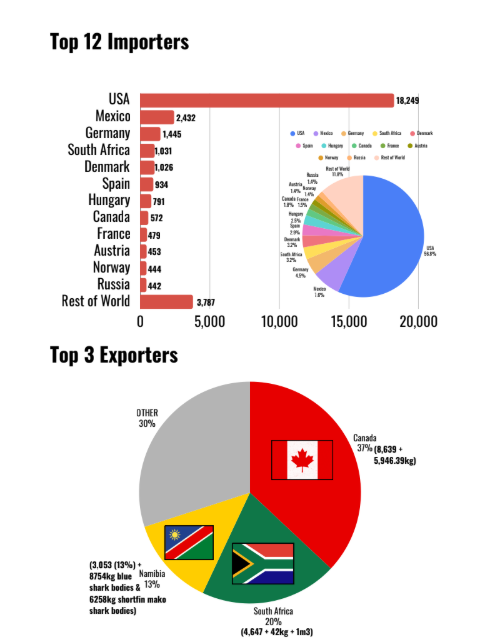
The Campaign to Ban Trophy Hunting says the United States is by far the world’s biggest importer of hunting trophies (and Canada making the top ten at number 8), with 18,249 recorded imports from protected species, accounting for 57 percent of the global trade.
The findings have prompted a new international push for an Abolition Declaration, backed by major names including Alec Baldwin, Mark Ruffalo, Priscilla Presley, Edie Falco, Bill Maher, Kim Basinger, Daryl Hannah, Isabella Rossellini, James Cromwell, Alicia Silverstone and Alyssa Milano.
The campaign was inspired by the late Dr. Jane Goodall, who called trophy hunting “unconscionable” shortly before her death and urged world leaders to act.
Speaking at an event marking the tenth anniversary of the killing of Cecil the lion, Dr Goodall said: “How on earth have we allowed this to continue for so long? Trophy hunting is unconscionable. It inflicts pain and suffering on animals for no other reason other than to boast of some ephemeral ‘prowess’. There is no material human need met by it.”
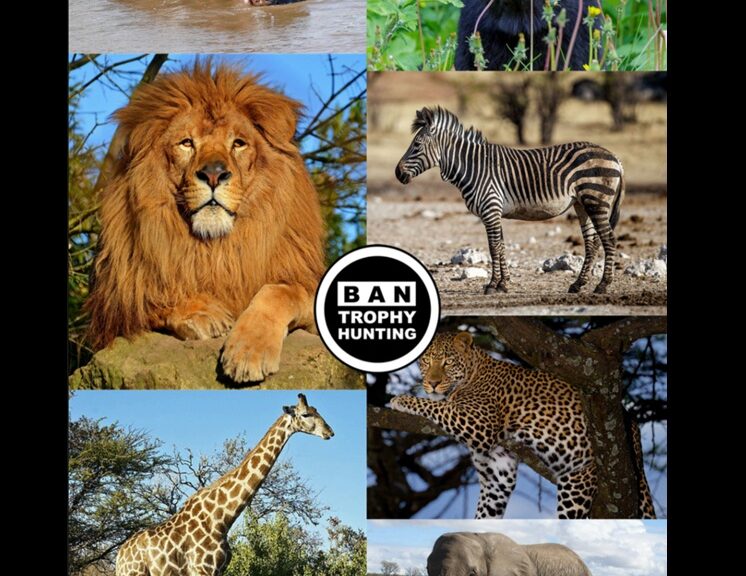
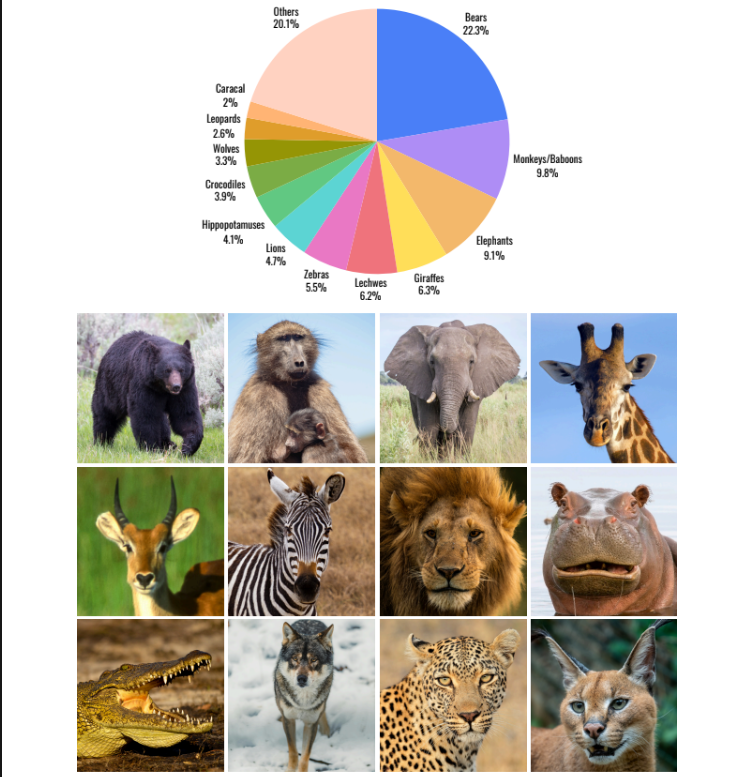
The new report says American hunters are driving demand for trophies from some of the world’s most iconic animals, including bears, giraffes, elephants, lions, leopards, monkeys and baboons.
It says the US is the leading importer of giraffe trophies, the top market for baboon and monkey trophies, and accounts for the majority of black bear trophies.
Alec Baldwin said: “I am proud to support The Campaign to Ban Trophy Hunting and to sign the Abolition Declaration. Trophy hunting belongs to another era.
“It sends the message that the lives of magnificent wild animals can be reduced to a photograph, a mounted head, or a personal goal.
“At a time when wildlife populations are declining across the globe, we should be investing in conservation, habitat protection and peaceful coexistence with nature.
“I hope this declaration helps build momentum for a future where respect for wildlife triumphs over cruelty and vanity.”
The report also turns the spotlight on Safari Club International, the US-based organisation described by campaigners as the world’s largest trophy hunting group.
According to the campaign, SCI has handed out around 20,000 awards to hunters, with some prizes requiring members to kill large numbers of animals across different species, continents and methods.
Seven of the world’s top 12 award-winning trophy hunters named in the report are American. They include George Harms, said to have killed 1,027 animals; Ben Seegmiller, with 913; Leon Munyan, with 866; and Larry Higgins, with 852.
Campaigners say the awards system turns wildlife killing into a competitive pursuit, with animals measured by skull size, tusks, horns and other body parts.
The most commonly imported trophies listed in the report were bears, making up 22.3 percent of the trade, followed by monkeys and baboons at 9.8 percent, elephants at 9.1 percent, giraffes at 6.3 percent and lions at 4.7 percent.
Dr Zara Bending, Resident Expert on Wildlife Crime and International Law at the Jane Goodall Institute Global, said: “Dr Jane Goodall DBE was a longstanding supporter of the Campaign to Ban Trophy Hunting. We at the Institute are committed to continuing that legacy in her name.
“As Dr Goodall said: ‘Trophy hunting is not only cruel but it is having a negative effect on endangered and threatened wildlife. Each one of these animals is an individual, with a personality, a mind, and emotions.’”
Professor Fred Bercovitch, former Executive Director of Save the Giraffes, said: “Trophy hunting is an abomination masquerading as a means of conservation.
“CITES has found that trophy hunters have killed thousands of individuals that belong to species threatened with extinction. Killing animals whose numbers are declining is antithetical to conservation.”
Dr Ian Redmond, a leading conservation scientist, said: “At a time when the number of wild animals has declined across the world, it is madness to allow tens of thousands of them to be killed for trophies.
“Trophy hunting is cruel and unethical, and does evolutionary damage to the species affected. Many of the targets are keystone species in globally important ecosystems.”
Priscilla Presley said the world had waited too long for action since the killing of Cecil the lion by American dentist Walter Palmer in Zimbabwe in 2015.
She said: “Ten years ago, the world learnt about the horrifying killing of Cecil the lion by an American dentist, Walter Palmer.
“Today it is learning about the terrifying scale of killing, even of endangered animals, that continues with the tacit blessing of governments.
“Policymakers have had ten years since Cecil was killed to act. Now they have no more excuses.”
Campaigners say trophy hunting is already rejected by the overwhelming majority of the public in the US and Europe, despite hunters continuing to import thousands of body parts each year.
They argue that wildlife watching, photographic safaris and community-led conservation provide far greater long-term benefits than allowing wealthy foreign hunters to shoot threatened animals.
Former Botswana President Ian Khama, who banned trophy hunting while in office, said: “With the decline of wildlife worldwide, and many species approaching extinction, how can there be justification in trophy hunting?”
Eduardo Gonçalves, founder of the Campaign to Ban Trophy Hunting, said the United States now had a moral responsibility to lead the world away from the trade.
He said: “America is the engine room of the global trophy hunting industry. The vast majority of people do not want endangered animals killed for heads, skins, tusks and bragging rights.
“This is not conservation. It is cruelty dressed up as sport.”
“Dr Jane Goodall understood that every animal is an individual. This declaration is about honoring that legacy and building a future where wild animals are protected, not turned into prizes.”
Fleur Dawes, Communications Director, In Defense of Animals, added, “Americans overwhelmingly reject trophy hunting, yet our tax dollars and import systems still facilitate it. We’ve seen the grief of elephant families torn apart, the orphaned cubs left behind after a lion is shot, wildlife communities that take generations to build and seconds to destroy.
“The age of treating sentient animals as collectibles must end, and the United States has both the power and the obligation to end it. The Abolition Declaration represents exactly the kind of moral clarity we need from policymakers. You cannot claim to respect wildlife and simultaneously issue permits to ship their skulls home as luggage.”
SAN RAFAEL, Calif. (Jan 9, 2018) – The shocking hidden suffering of captive elephants has been exposed today by In Defense of Animals on its respected annual list of the Ten Worst Zoos For Elephants in North America. The 2017 list reveals premature deaths, brutal breeding procedures, and flagrant violations of the Animal Welfare Act. Zoos all over the US and one zoo in Canada appear on the Ten Worst Zoos list, with Topeka Zoo in Kansas shamed as the #1 Worst Zoo for “gross neglect” of a dying elephant.
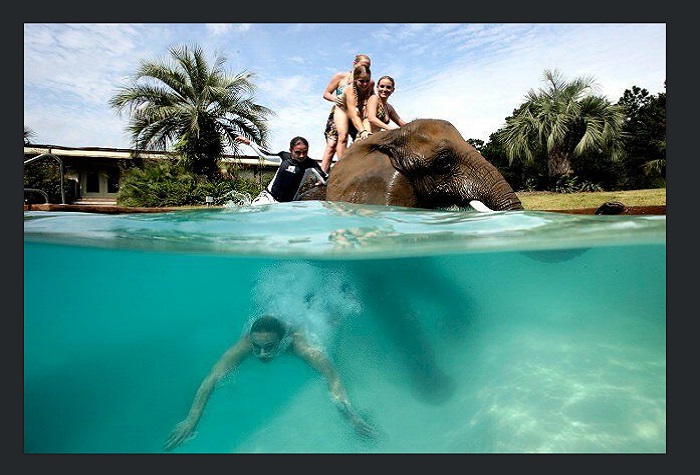
Bubbles the Elephant at Myrtle Beach Safari.
“Elephants have suffered horrendously in North American zoos in 2017,” said In Defense of Animals elephant scientist, Toni Frohoff Ph.D. “Zoos violate elephants’ rights and submit them to horrific and unnecessary abuses. Urgent action is needed to shut down the archaic zoo exhibits on this list, and retire the elephants to sanctuaries where they can live in peace.”
Elephants in zoos across North America are being subjected to barbaric bullhooks, sexual mistreatment, grossly inadequate conditions, egregious disregard for their needs, forced performances, captivity-caused health problems, unsuitable enclosures, cold climates, incompatible companions, and crushing solitary confinement.
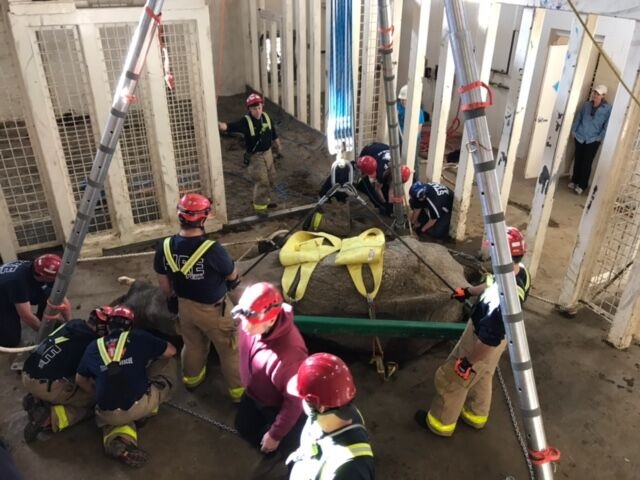
Topeka Zoo, named worst in 2017, has a long history of violating the Animal Welfare Act. The zoo failed miserably to adequately care for Shannon, a 35-year-old African elephant who died on December 11, 2017, after spending ten brutal hours down on her side without any monitoring from zoo staff who had left for the night. Shannon had to be hoisted to her feet by firefighters the day before, after enduring a lengthy “downed” ordeal.
Topeka Zoo Director Brendan Wiley himself admitted that for elephants, “lying down for several hours can potentially be fatal, given their body mass.” On the day of her death, Wiley said on camera, “We think she was down for a total of about 10 hours yesterday and… probably about the same amount of time today.” “That’s a lot of time for an elephant to be down.”
Shannon the Elephant at Topeka Zoo
The zoo chose not to keep someone on site to monitor Shannon’s video feed and staff went home for the night. Given the seriousness of Shannon’s condition, the zoo’s actions were nothing short of gross neglect and blatantly inadequate care.
“The gross neglect and death of Shannon at Topeka Zoo is only the tip of an iceberg that threatens the lives of all elephants who remain there”, said Dr. Frohoff. “It should be patently obvious that a severely sick elephant must be watched closely around the clock. Not bothering to check Shannon’s video feed for over 9 hours, the night after an emergency ordeal, is inexcusable. Proper observation would have likely minimized Shannon’s suffering, and could possibly have prevented her death. At 35-years old, Shannon should have been living some of her best years, yet she was sick and died at Topeka Zoo.”
Medical records indicate that Shannon was suffering for weeks, showing signs of pain, tremors, and weakness. Topeka Zoo reports that it has now bought a new video monitoring system, which is far too little – far too late.
Shannon’s death is indicative of the longtime problems that continue to plague Topeka Zoo and its animals. The zoo has been cited numerous times for violations of Federal Animal Welfare regulations which include animal deaths, injuries, and lack of proper veterinary care. In 2013, the zoo paid a $45,000 usd civil penalty to settle charges brought against it by the USDA for at least 51 willful violations of the Animal Welfare Act. The charges included failure to provide adequate veterinary care for elephants Tembo and Sunda, including problems with their skin, feet, and nutrition.
The elephants remaining at Topeka Zoo are at risk. Asian elephant Sunda has a history of chronic foot disease caused by lack of movement and standing on hard surfaces throughout many years. Topeka’s sub-freezing winters exacerbate health problems, as the elephants are forced to remain indoors for excessively long periods with minimal exercise. Cora, an Asian elephant, who came to the zoo in 2016 with Shannon, is particularly at risk because of the health issues associated with performing unnatural circus tricks, which she did for many years before coming to the zoo.
In Defense of Animals is calling for the urgent relocation of the Topeka Zoo elephants for their safety and wellbeing. Dr. Frohoff said, “We urge Topeka Zoo and the USDA to avert further tragedy and release elephants, Cora, Tembo and Sunda to an accredited sanctuary where they can receive the professional health care they need and deserve.”
10 WORST ZOOS
1. Topeka Zoo, Topeka, Kansas
2. Pittsburgh Zoo and International Conservation Center, Pittsburgh, Pennsylvania
3. Omaha’s Henry Doorly Zoo and Aquarium, Omaha, Nebraska
4. Louisville Zoo, Louisville, Kentucky
5. Oregon Zoo, Portland, Oregon
6. Myrtle Beach Safari, Myrtle Beach, South Carolina
7. Two Tails Ranch, Williston, Florida
8. St. Louis Zoo, St. Louis, Missouri
9. Natural Bridge Zoo, Rockbridge County, Virginia
10. Riverbanks Zoo and Garden, Columbia, South Carolina
DISHONORABLE MENTION – Repeat Offenders
Calgary Zoo elephant “Lucy”- image: savelucy.ca
Edmonton Valley Zoo, Alberta, Canada
Bronx Zoo, Bronx, New York
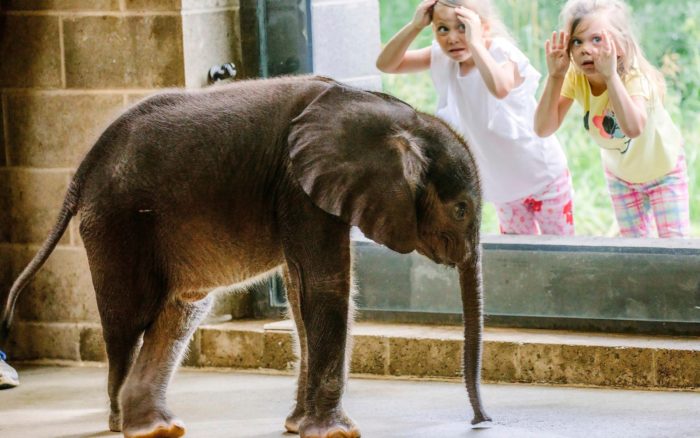
Featured image- Infant elephant at Pittsburgh Zoo by Andrew Rush/ AP
In Defense of Animals is an international animal protection organization with over 250,000 supporters and a 30-year history of fighting for animals, people and the environment through education, campaigns and hands-on rescue facilities in India, Africa, and rural Mississippi.
IN DEFENSE OF ANIMALS • 3010 KERNER BLVD. • SAN RAFAEL, CA 94901 • 415-448-0048