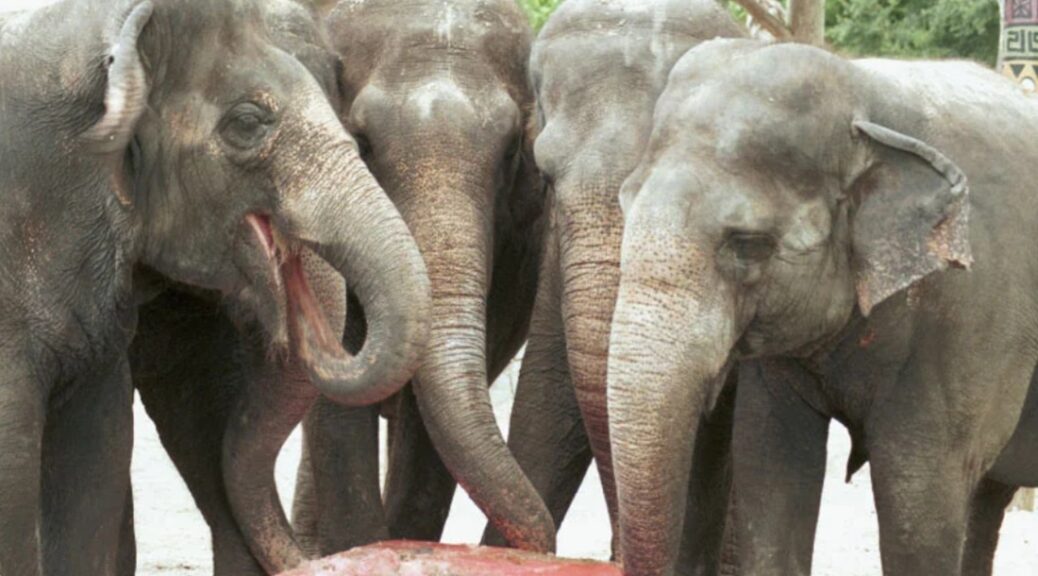
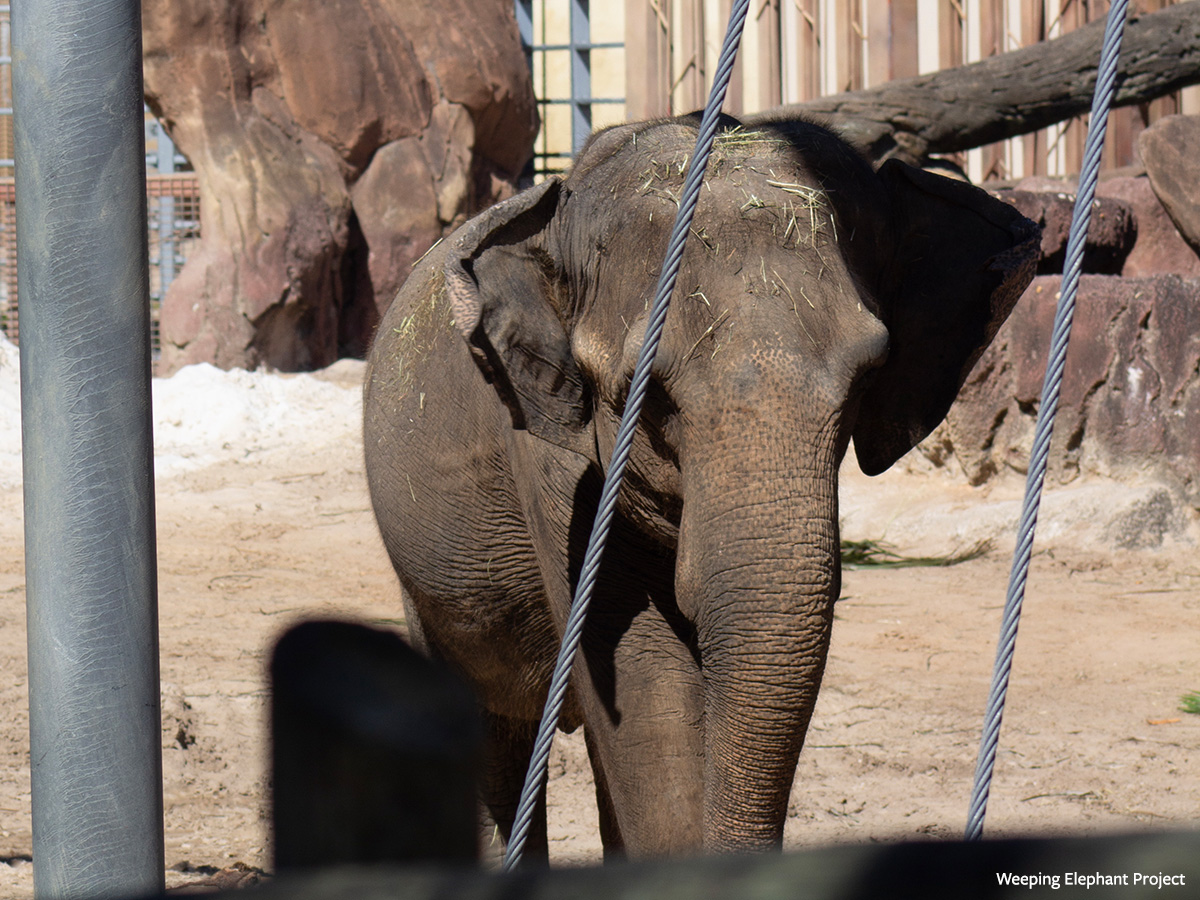
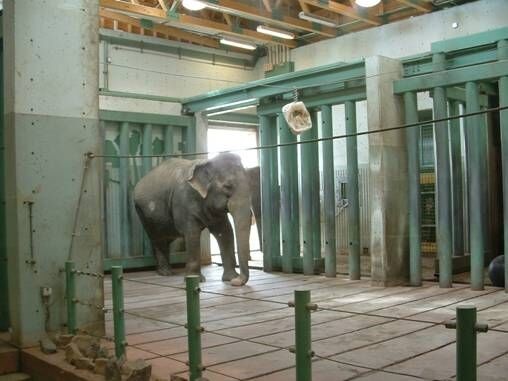
Elephants are surrounded on all sides by roller coasters and fireworks. Photo: Weeping Elephant Project
TAMPA, Fla. (August, 2026)— Following the death of a second elephant in less than two years, In Defense of Animals joins the Weeping Elephant Project in demanding an independent investigation into Busch Gardens Tampa Bay. Newly-released testimonies (see link to report below) from former zoo keepers expose severe animal welfare violations, a culture of retaliation against staff, and a massive conflict of interest protecting the theme park from accountability.
Calls For Investigation
The calls for an investigation follow the July 2026 death of Carina, a 54-year-old Asian elephant who was euthanized following three separate emergencies where she collapsed and was unable to stand within a six-day period. Her death closely mirrors the fate of Rosie, another 54-year-old Asian elephant who collapsed during a park fireworks event in 2022, and was left unable to stand for over five hours. She never fully recovered, and was euthanized two years later.
According to the Weeping Elephant Project’s damning new investigative report, park management willfully ignored the animals’ suffering and ordered staff to stop documenting stress behaviors.
“Staff asked if fireworks would be suspended until Rosie could make it back to the barn and be evaluated. The answer was a simple no. None of this was ever made transparent to the public,” revealed a former employee in an anonymous report submitted to the Weeping Elephant Project.
Formal Complaints Filed
Former animal care specialists filed formal complaints with the U.S. Department of Agriculture (USDA) and the Association of Zoos and Aquariums (AZA) in October 2024. Despite these filings, no corrective action was taken. More than 80 zoo employees have left since 2021, and dozens of animals have died, including eight endangered great apes.
Advocates point to a glaring conflict of interest as the primary reason complaints have been ignored by regulators: Dr. Chris Dold, Chief Zoological Officer at Busch Gardens’ parent company (United Parks & Resorts), currently serves as the Chair of the AZA Board of Directors — the primary body responsible for accrediting the park.
“With United Parks & Resorts’ Chief Zoological Officer simultaneously serving as Chair of the AZA Board of Directors, this is a glaring conflict of interest that allows the park to self-regulate without real accountability,” said Danielle Carnahan, Executive Director at Weeping Elephant Project.
Numerous issues are still negatively affecting animals at Busch Gardens, but major concerns lie with the treatment of the park’s surviving elephants, Karnaudi, Tina and Simba.
Kumba’s Revenge Rollercoaster Planned Close To Elephant
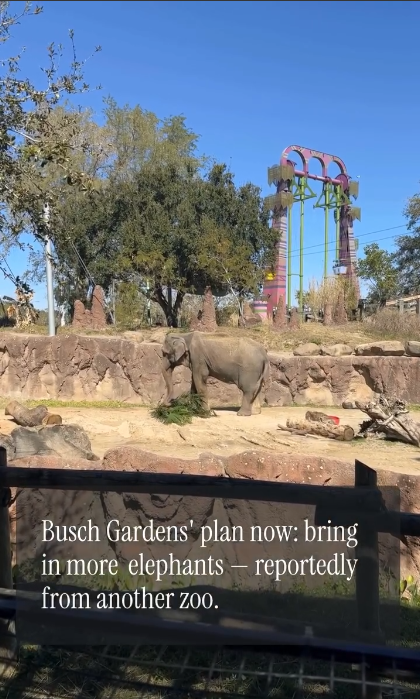
Despite proven noise and vibration trauma caused by existing rides, elephant-down emergencies, deaths and known stress caused by fireworks, loud guests, and construction, Busch Gardens is moving forward with “Kumba’s Revenge,” a new rollercoaster planned less than 600 feet from the elephants’ barn as part of a $100 million usd/ $138.7 million cad [exchange rate at time of posting] park expansion. Former keepers report the ground of the elephant barn shaking during previous coaster construction. While the park recently launched a drone show under the guise of animal welfare, it still concludes with an explosive fireworks finale.
Further alarming advocates, sources indicate the park is currently planning to import two elephants into this highly stressful environment.
This plan directly contradicts an independent veterinary specialist who consulted on Rosie’s collapse and stated in the October 2024 USDA complaint that she “would not advise the placement of additional elephants at Busch Gardens” given the “constant overexposure to loud music, screaming guests, and non-stop rollercoasters.”
Silencing Of Staff
“It is unconscionable that a facility currently failing its surviving elephants — and silencing staff who document their suffering — is actively planning to import more animals,” Carnahan added. “Busch Gardens is a theme park masquerading as a zoo, where profit and entertainment come first and dedicated care staff are threatened into silence when they speak up. We don’t need performative PR tweaks or more imported elephants; we need an immediate, independent investigation into this broken institution.”
Carina’s death has also triggered a social crisis for the remaining herd. Former keepers report that surviving elephant Tina is now entirely socially isolated, while 36-year-old Karnaudi is only compatible with Simba, a 58-year-old elephant suffering from blindness and severe cognitive decline.
“The Busch Gardens elephants should be retired to a sanctuary before they have to endure another traumatic coaster construction,” said Courtney Scott, Elephant Consultant for In Defense of Animals. “This whistleblower report makes it very clear how badly the elephants and the other animals at Busch Gardens were treated. Now the public can see exactly what they are supporting by purchasing a ticket to Busch Gardens Tampa Bay, and they have responded en masse, sending thousands of emails to management and corporate sponsors. People care about animal welfare. Now it’s time for this zootainment facility to do likewise.”
Over 37,000 emails have been sent to Busch Gardens management, and over 32,000 emails have been sent to the AZA and its Species Survival Plan, urging them not to bring more elephants into the park. Over 8,800 more have urged the zoo’s corporate partners to pull funding, including Advent Health, Suncoast Credit Union, Anheuser-Busch, Coca-Cola, Keel Farms, Tampa Bay Lightning, Woodie’s Wash Shack, and Yacht Starship.
SAN RAFAEL, Calif. (Jan 9, 2018) – The shocking hidden suffering of captive elephants has been exposed today by In Defense of Animals on its respected annual list of the Ten Worst Zoos For Elephants in North America. The 2017 list reveals premature deaths, brutal breeding procedures, and flagrant violations of the Animal Welfare Act. Zoos all over the US and one zoo in Canada appear on the Ten Worst Zoos list, with Topeka Zoo in Kansas shamed as the #1 Worst Zoo for “gross neglect” of a dying elephant.
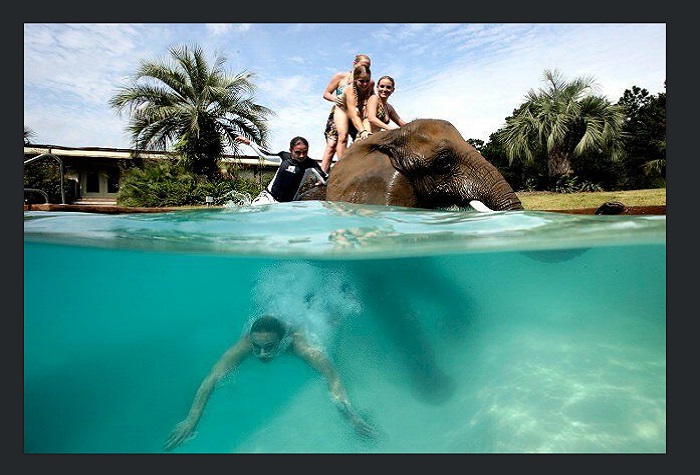
Bubbles the Elephant at Myrtle Beach Safari.
“Elephants have suffered horrendously in North American zoos in 2017,” said In Defense of Animals elephant scientist, Toni Frohoff Ph.D. “Zoos violate elephants’ rights and submit them to horrific and unnecessary abuses. Urgent action is needed to shut down the archaic zoo exhibits on this list, and retire the elephants to sanctuaries where they can live in peace.”
Elephants in zoos across North America are being subjected to barbaric bullhooks, sexual mistreatment, grossly inadequate conditions, egregious disregard for their needs, forced performances, captivity-caused health problems, unsuitable enclosures, cold climates, incompatible companions, and crushing solitary confinement.
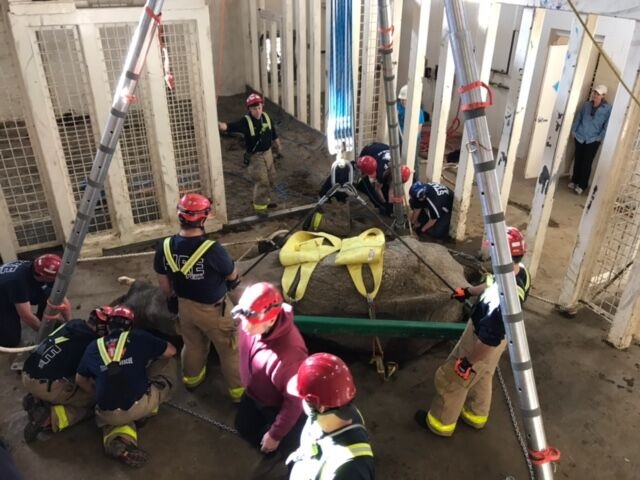
Topeka Zoo, named worst in 2017, has a long history of violating the Animal Welfare Act. The zoo failed miserably to adequately care for Shannon, a 35-year-old African elephant who died on December 11, 2017, after spending ten brutal hours down on her side without any monitoring from zoo staff who had left for the night. Shannon had to be hoisted to her feet by firefighters the day before, after enduring a lengthy “downed” ordeal.
Topeka Zoo Director Brendan Wiley himself admitted that for elephants, “lying down for several hours can potentially be fatal, given their body mass.” On the day of her death, Wiley said on camera, “We think she was down for a total of about 10 hours yesterday and… probably about the same amount of time today.” “That’s a lot of time for an elephant to be down.”
Shannon the Elephant at Topeka Zoo
The zoo chose not to keep someone on site to monitor Shannon’s video feed and staff went home for the night. Given the seriousness of Shannon’s condition, the zoo’s actions were nothing short of gross neglect and blatantly inadequate care.
“The gross neglect and death of Shannon at Topeka Zoo is only the tip of an iceberg that threatens the lives of all elephants who remain there”, said Dr. Frohoff. “It should be patently obvious that a severely sick elephant must be watched closely around the clock. Not bothering to check Shannon’s video feed for over 9 hours, the night after an emergency ordeal, is inexcusable. Proper observation would have likely minimized Shannon’s suffering, and could possibly have prevented her death. At 35-years old, Shannon should have been living some of her best years, yet she was sick and died at Topeka Zoo.”
Medical records indicate that Shannon was suffering for weeks, showing signs of pain, tremors, and weakness. Topeka Zoo reports that it has now bought a new video monitoring system, which is far too little – far too late.
Shannon’s death is indicative of the longtime problems that continue to plague Topeka Zoo and its animals. The zoo has been cited numerous times for violations of Federal Animal Welfare regulations which include animal deaths, injuries, and lack of proper veterinary care. In 2013, the zoo paid a $45,000 usd civil penalty to settle charges brought against it by the USDA for at least 51 willful violations of the Animal Welfare Act. The charges included failure to provide adequate veterinary care for elephants Tembo and Sunda, including problems with their skin, feet, and nutrition.
The elephants remaining at Topeka Zoo are at risk. Asian elephant Sunda has a history of chronic foot disease caused by lack of movement and standing on hard surfaces throughout many years. Topeka’s sub-freezing winters exacerbate health problems, as the elephants are forced to remain indoors for excessively long periods with minimal exercise. Cora, an Asian elephant, who came to the zoo in 2016 with Shannon, is particularly at risk because of the health issues associated with performing unnatural circus tricks, which she did for many years before coming to the zoo.
In Defense of Animals is calling for the urgent relocation of the Topeka Zoo elephants for their safety and wellbeing. Dr. Frohoff said, “We urge Topeka Zoo and the USDA to avert further tragedy and release elephants, Cora, Tembo and Sunda to an accredited sanctuary where they can receive the professional health care they need and deserve.”
10 WORST ZOOS
1. Topeka Zoo, Topeka, Kansas
2. Pittsburgh Zoo and International Conservation Center, Pittsburgh, Pennsylvania
3. Omaha’s Henry Doorly Zoo and Aquarium, Omaha, Nebraska
4. Louisville Zoo, Louisville, Kentucky
5. Oregon Zoo, Portland, Oregon
6. Myrtle Beach Safari, Myrtle Beach, South Carolina
7. Two Tails Ranch, Williston, Florida
8. St. Louis Zoo, St. Louis, Missouri
9. Natural Bridge Zoo, Rockbridge County, Virginia
10. Riverbanks Zoo and Garden, Columbia, South Carolina
DISHONORABLE MENTION – Repeat Offenders
Calgary Zoo elephant “Lucy”- image: savelucy.ca
Edmonton Valley Zoo, Alberta, Canada
Bronx Zoo, Bronx, New York
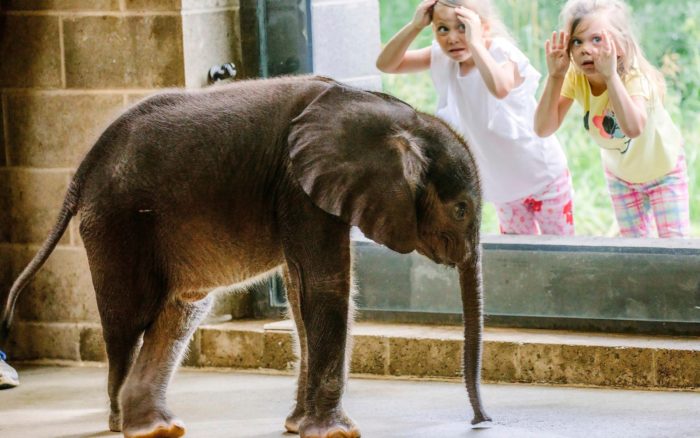
Featured image- Infant elephant at Pittsburgh Zoo by Andrew Rush/ AP
In Defense of Animals is an international animal protection organization with over 250,000 supporters and a 30-year history of fighting for animals, people and the environment through education, campaigns and hands-on rescue facilities in India, Africa, and rural Mississippi.
IN DEFENSE OF ANIMALS • 3010 KERNER BLVD. • SAN RAFAEL, CA 94901 • 415-448-0048