
Tag Archives: cosmos

Week With The Stars- My Experience At Almeria Spain Astronomy Days

A great night for stargazing. The Milky Way over a bioluminescent sea at Estorde beach, Galicia, Spain. Photo by Brais Lorenzo/Anadolu Agency via Getty Images

What a phenomenal week it’s been here in Almería Spain. If you’ve ever wanted to spend five nights surrounded by brilliant minds talking about the wonders of the universe—all for free—then the 13th Astronomy Days at Teatro Apolo was the place to be.

Every evening from Monday to Friday, I joined a packed house at the Teatro Apolo, right on Rambla Obispo Orbera, for one of the most engaging, inspiring, and surprisingly personal science events I’ve ever attended.

As someone with a love for astronomy (but definitely not a scientist), I wasn’t sure what to expect. Would it be too technical? Would the speakers feel out of reach? Turns out—not at all. The talks were not only fascinating, but the speakers themselves were so kind and approachable. I got to chat with all of them after their presentations, and almost everyone was fluent in both English and Spanish, which made the whole experience super welcoming.
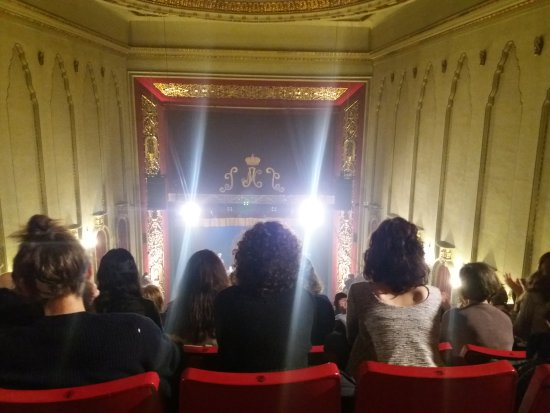
Here’s a recap of this unforgettable journey through the stars:

Monday, May 12 – John Mather

The week kicked off in the best way imaginable—with John Mather, Nobel Prize winner and NASA legend. He talked about the James Webb Space Telescope (JWST), and let me tell you: hearing about its mission straight from someone who helped design it was something else.
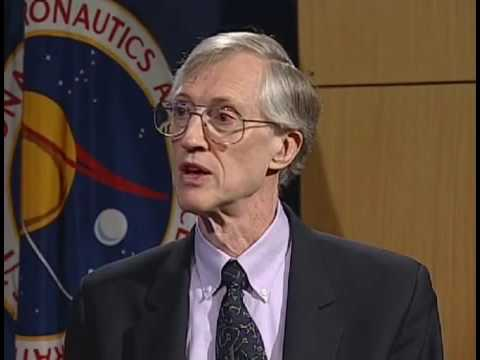
He explained how JWST is literally letting us see the earliest galaxies, basically time-travelling with light, in a way that even I could follow—and I only passed physics with a B.

After the talk, I was lucky enough to have a quick chat with him. He was gracious, humble, and even cracked a joke about how working with ancient starlight makes you feel a little ancient yourself.

Tuesday, May 13 – John E. Beckman

Next up was John Beckman from the Institute of Astrophysics of the Canary Islands (IAC). Originally from the UK, he’s spent most of his career here in Spain, and you can tell he really loves sharing his knowledge.

His talk was all about galaxies—how they form, why they behave the way they do—and it was filled with this kind of poetic curiosity about the universe. He made the whole room feel like part of the story.
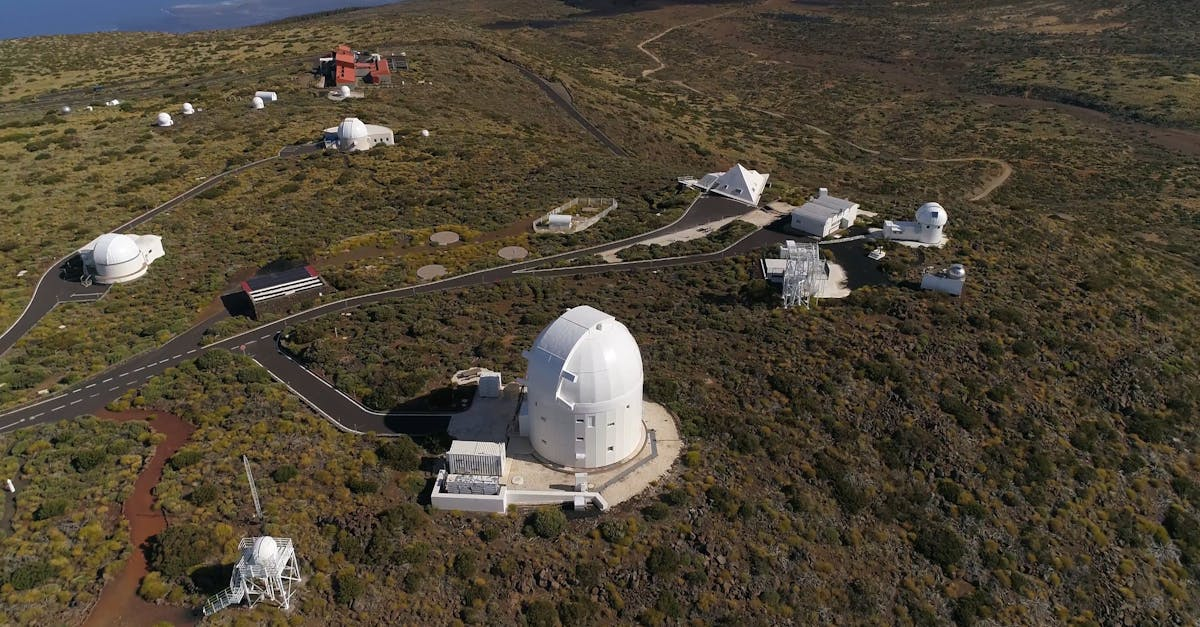
Institute of Astrophysics- The Canary Islands

He stuck around after the lecture, chatting with attendees like we were old friends. I asked him what keeps him inspired after decades of research, and he simply said, “The universe never runs out of surprises.”

Wednesday, May 14 – Martín Guerrero Roncel

Wednesday’s speaker was Martín Guerrero Roncel from the Institute of Astrophysics of Andalusia (IAA), and his passion was contagious. He dove into the bizarre beauty of planetary nebulae—those colourful clouds of gas released by dying stars.

I had no idea how important these structures are in spreading elements across galaxies. His visuals were stunning, and his explanations were super clear, even when things got a little technical.
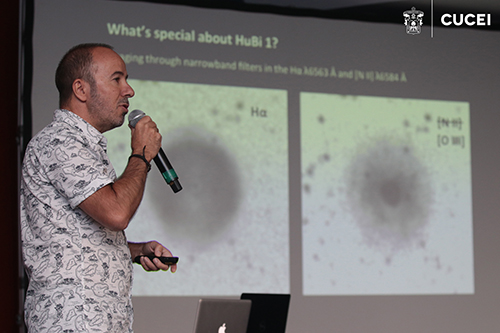
Afterwards, he was more than happy to answer everyone’s questions (and there were a lot), with patience and genuine enthusiasm. Super approachable and just a cool guy overall.

Thursday, May 15 – Sara García Alonso

Thursday brought us the incredible Sara García Alonso—astronaut candidate, molecular biologist, and all-around badass. She talked about her scientific work, the future of space missions, and what it’s like being one of the few selected to train as a European astronaut.
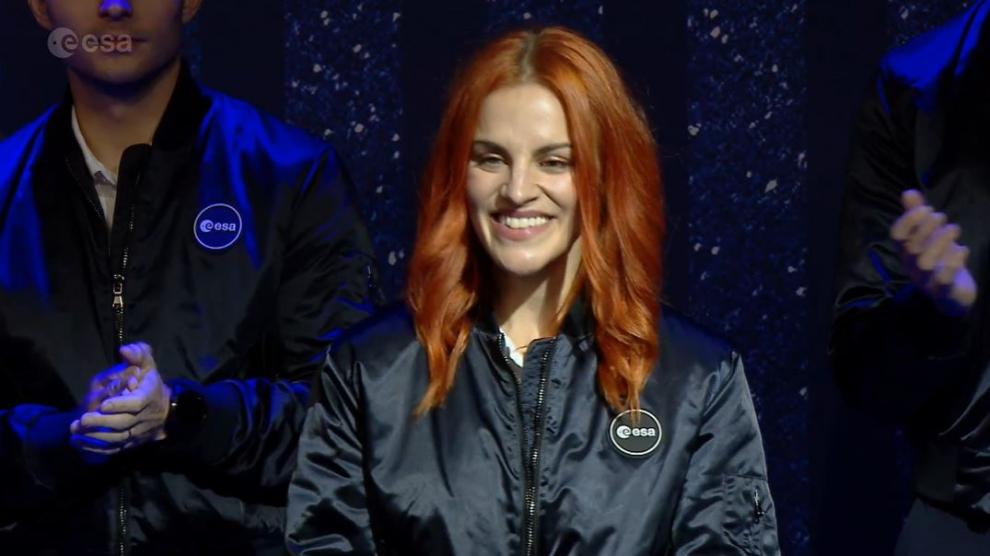
She brought this vibrant energy to the room, blending her love of biology and space exploration into a really inspiring talk. It was especially amazing to see so many young women and girls in the audience visibly lighting up as she spoke.

Friday, May 16 – Eva Villaver Sobrino

The week wrapped up with a bang with Eva Villaver Sobrino, the director of Space at the Spanish Space Agency. Her talk was both visionary and grounded—she spoke not just about scientific discoveries, but also about the future of Spain’s role in space exploration, the importance of collaboration across countries, and the ethical responsibilities we have as we reach further into the cosmos.

She’s been involved in some of the biggest European space missions, and her ability to combine scientific rigour with a big-picture vision of humanity’s place in the universe really struck a chord.

Questions afterward felt like chatting with a wise mentor. She encouraged everyone to keep asking questions and stay curious, no matter their background or age.

Final Thoughts

By the end of the week, I felt like my brain had been stretched in the best possible way. I learned about dying stars, distant galaxies, cutting-edge telescopes, and even the biology of space travel. But more than that, I walked away feeling deeply inspired.

What really made the event special was the human connection. Every speaker stayed around to talk, sign books, take photos, or just share a quiet word. No egos, no academic walls—just real people sharing their love for science.

Huge thanks to the organizers and to Teatro Apolo for making this all happen—and for making it free and open to everyone. Events like this remind us why curiosity matters and how lucky we are to have such brilliant minds willing to share their time and passion.

Already counting down to next year. Until then—keep looking up! For the Silo, Sandia Martin.

Supplemental-ESA Astronauts Train on Spanish Island for future Space Missions

Canada’s Ex-Minister of Defence Hellyer Claimed ‘We Shot Down UFOs’

The honorable Paul Hellyer (dec. August 2021), Canada’s former Minister of Defense, Aeronautical Engineer and Pilot appeared on Russian TV about a decade ago with Sophie Shevardnadze to discuss extraterrestrials and UFOs.

“We have a long history of UFOs and of course there has been a lot more activity in the last few decades since we invented the atomic bomb.” he said.

They are very concerned about that and that we might use it again, because the whole cosmos as a unity, and it affects not just us but other people in the cosmos, they are very much afraid that we might be stupid enough to start using atomic weapons again.

Hellyer has stated that “UFOs are as real as the airplanes that fly over your head.”

One-time Minister of Defence for Canada (!)- has Paul Hellyer become a publicity seeking 'kook' or an engaged humanitarian with secret information about the presence of 'aliens'?
Former Minister of Defence for Canada  Paul Hellyer

Shevardnadze asks Hellyer, “Why do you say that UFOs are as real as airplanes flying over our heads?” Hellyer responds, “Because I know that they are. As a matter of fact, they’ve been visiting our planet for thousands of years.”

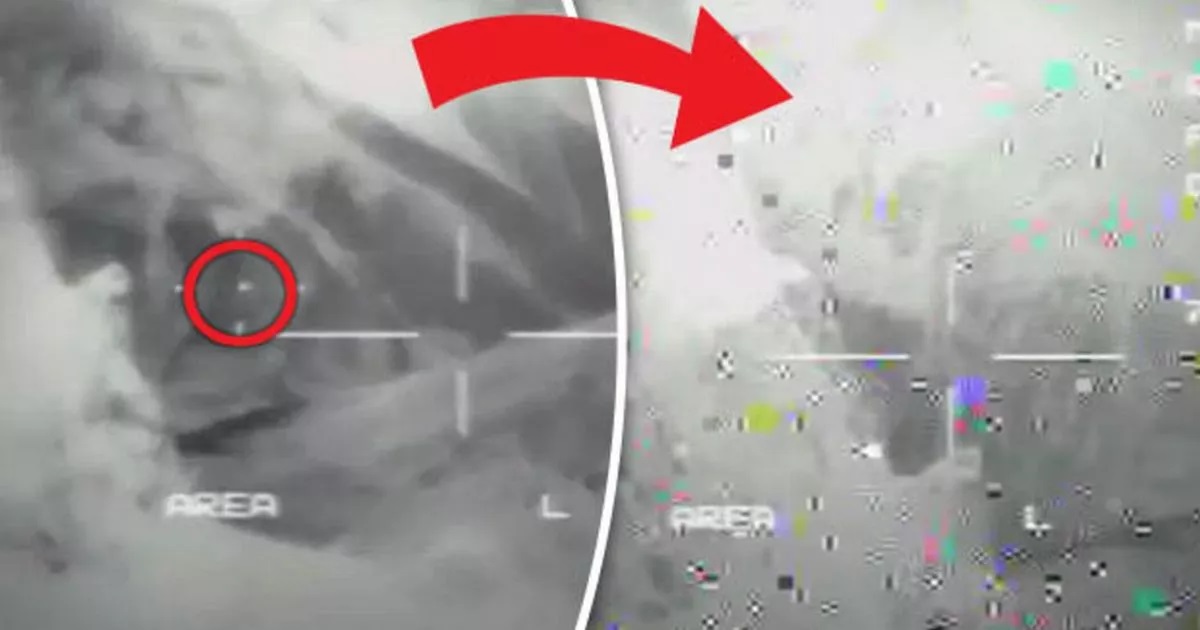
Hellyer claims that UFOs have been downed by military action, and alien technology has been harnessed by Earthlings.

He stated that, as far as technology is concerned, they are light years ahead of us, and we have learned a lot of things from them. A lot of the things we use today we got from them, you know – led lights and microchips and Kevlar vests and all sorts things that we got from their technology and we could get a lot more too, especially in the fields of medicine and agriculture if we would go about it peacefully.

But, I think, maybe some of our people are more interested in getting the military technology, and I think that’s wrong-headed, and that’s one of the things that we are going to have to change, because we’re going to have to work together, all of us, everywhere on the planet.

Shevardnadze asks Hellyer if shooting down these UFOs is risking an interstellar war, and, if so, “should we be creating a Star Wars force (President Trump created the United States Space Force while in office)  to defend ourselves from possible invasion or something like that?”  Hellyer responds, “I think it’s a possibility, but it’s a possibility especially if we shoot down every UFO that comes into our airspace without asking who they are and what they want. Right from the beginning we started scrambling planes, trying to shoot them down, but their technology was superior enough that we weren’t able to get away with it, certainly not for a long while.

During that period of time they could have taken us over without any trouble if they wanted to, so I think, rather than developing our own Star Wars to protect ourselves against them, we should work with the benign species that are of a vast majority and work together, and rely largely on them, of course, and cooperate, so that we would be contributing something at the same time; I don’t think there’s any point in us developing a galactic force that would tempt us to ride on our own and get into mischief.”

Mr. Hellyer being interviewed on Russian Television.

“We spend too much money on military expenditures and not enough on feeding the poor and looking after the homeless and sick,’ he said.

‘They would like to work with us and teach us better ways but only, I think, with our consent. They don’t think we are good stewards of our planet.

‘We are clear-cutting forests and polluting our rivers and our lakes. We are dumping sewage in the oceans. We are doing all sorts of things which are not what good stewards should be doing and they don’t like that.’

‘Our future as a species, and here I mean all of the species in the world, is potentially at risk if we don’t figure what’s going on and work together to try and make life more amenable for all of us, and to work with our neighbors from other planets as well.’

Aliens are also responsible for some of our modern technology including the microchip, LED light and Kevlar vest, he said.

Hellyer said there has been a lot more activity with aliens in the last few decades since we invented the atomic bomb.

One of the technological advances that humans have aliens to thank for are Kevlar vests. Hellyer described one group as ‘Short Greys’ who have very slim arms and legs and are about five feet high with large heads.

While Hellyer said he has never met an alien, but has seen a UFO near his cabin on Ontario’s Lake Muskoka.

Hellyer described several types of aliens including ‘Tall Whites’ who are working with the U.S. air force in Nevada. ‘They’re able to get away with that; they had a couple of their ladies dressed as nuns go into Las Vegas to shop and they weren’t detected,’ he claimed.

Another group of aliens are called ‘Short Greys’ who have very slim arms and legs and are about five feet high with large heads. A third group are called  ‘Nordic Blondes’ and Hellyer said that if you meet one you’d probably say, ‘I wonder if she’s from Denmark or somewhere.’ For the Silo, George Filer.


Moon Landing Included Lunaprise Museum First Beyond Earth

New York City – February, 2024 – In a historic moment that marks a significant milestone in the intersection of art, music, and space exploration, the Lunaprise Museum proudly announced the successful lunar landing of artworks as part of SpaceBlue’s’ curated and managed archive on the recent Lunar Lander as part of the historic space mission. Though not the first art project to involve the Moon (reported here by us July 2019), it is the first art project to remain on the Moon.

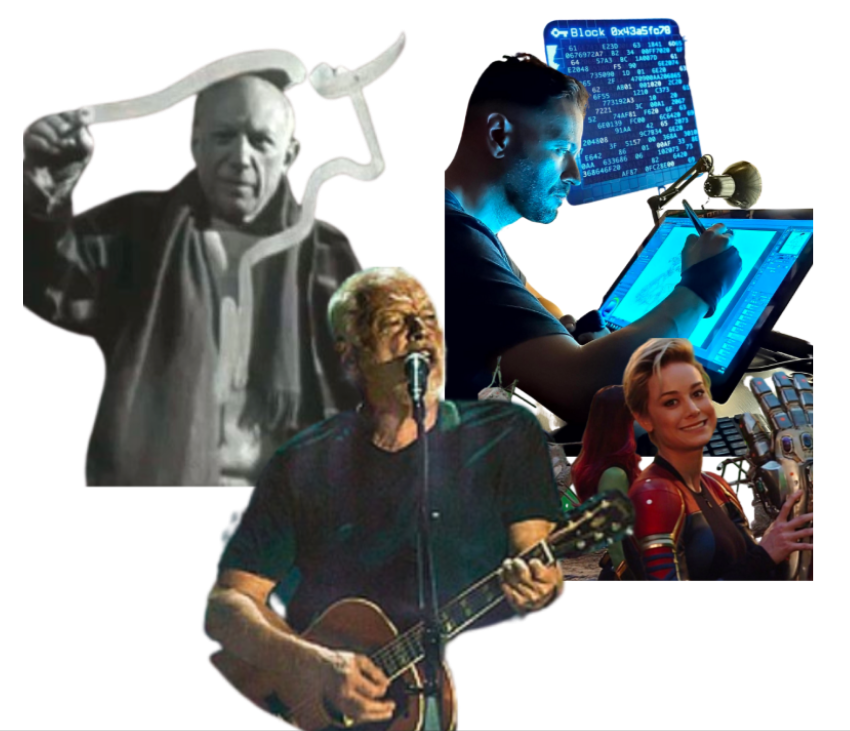
Among the historic pioneers is a pioneering trio: designer/artist Kelly Max, artist Samy Halim, and music producer/artist Brayden Pierce. This momentous event sees these creative visionaries become among the first artists in history to archive their works in the form of digital twins on the moon for over a billion years in a nano fiche disk, establishing a lasting legacy that transcends the boundaries of Earth.

A New Horizon for Art and Music

With the successful landing of the Lunar Lander on February 22, 2024 at 6:23PM EST the Lunar Landing has achieved a groundbreaking feat by hosting the first museum on the moon called Lunaprise. Among its prized collections are the collaborative efforts of Kelly Max and Samy Halim on the Modernist Art project, and Brayden Pierce’s musical compositions that have resonated with themes of space exploration and innovation.

The Modernist Art collection, highlighted by the “MoonRider” piece carrying 180 names pivotal to the artists’ journey, alongside a comprehensive collection of 420 Modernist Originals and 9,724 generative Modernist Genesis Artworks, represents a significant contribution to this lunar museum. Selected by Curator SpaceBlue and launched on February 15, 2024, these artworks not only celebrate the creative spirit but also symbolize human achievement and aspiration.

This nickel disc containing compressed files of the artwork is now curated on the Moon.

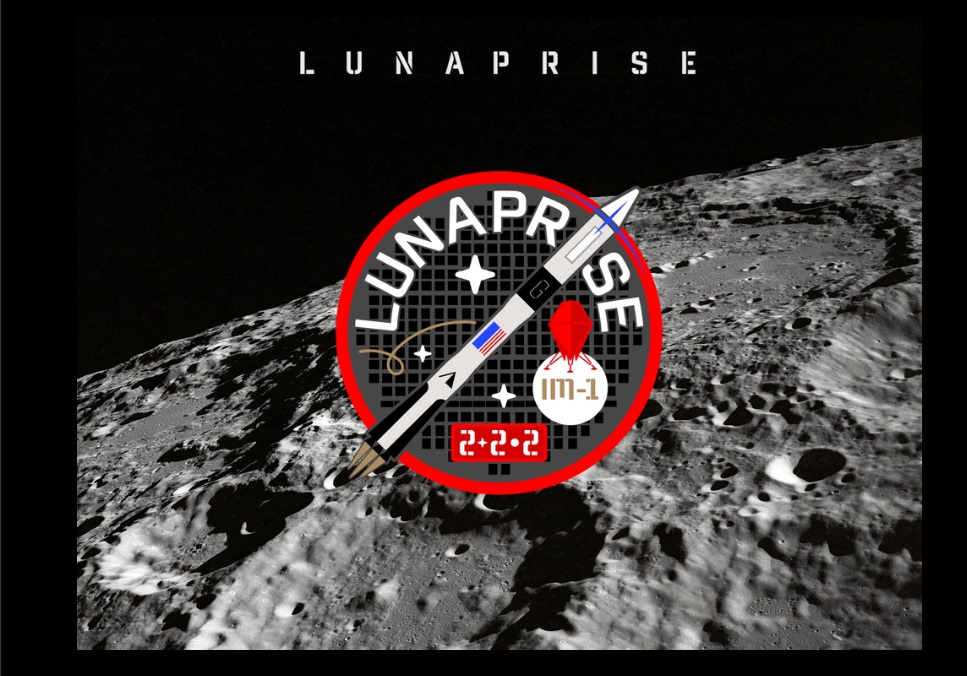
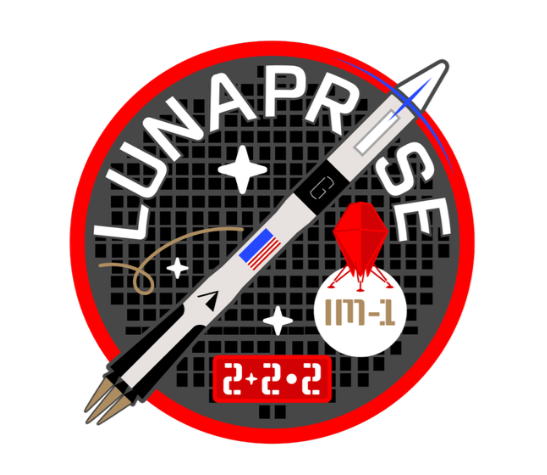
Kelly Max’s contributions to the Lunaprise Museum mission extend far beyond his collaboration with Samy Halim on the Modernist Art project. Together, Kelly and Samy designed the Lunaprise Mission Patch, a symbol of human creativity and resilience in the face of the vast unknown. Kelly’s visionary approach didn’t stop there; his role expanded as he became the lead designer for all key brand communications for the mission, showcasing his leadership and creative expertise in shaping the mission’s identity.

Brayden Pierce: Echoing Through Space

Introduced to the Lunaprise Museum mission by Kelly, Brayden Pierce’s artistic contributions have carved a unique niche in the halls of space history. As the first-ever EDM artist to have his music on the moon, Brayden Pierce’s “Capture The Moon” is immortalized on the moon in two versions: The Modernist Edition and the MOOON.PARTY Mix. This collaboration with Kelly underscores a synergy between the two creatives which exploded into the founding of MOOON.PARTY: a visionary venture that aims to blend art, music, space, and space content recording into a pioneering festival brand. This initiative, co-founded by Kelly and Brayden, is set to redefine immersive entertainment experiences, leveraging the backdrop of space to inspire and captivate audiences worldwide.

“Bringing art and music to the lunar surface goes beyond exploration; it signifies embedding humanity’s creative essence into the fabric of the cosmos. This endeavor isn’t merely a step forward for us as individual artists but represents a monumental leap for global art and culture. Collaborating with Samy, Brayden, and the Lunaprise Museum on this mission has unfolded as a profound journey of discovery, unity, and limitless creativity. Together, we’ve ignited a beacon of human expression on the moon, casting light across the cosmos to inspire future generations to dream beyond the confines of our known world. This project mirrors the moon’s impartial gaze upon Earth, reminding us that in its light, we are all seen equally. Our ultimate aim is to embody this universal perspective, fostering a tangible sense of unity on Earth, now enriched by the presence of art and music in the lunar realm.” adds Kelly Max.

Legacy Beyond the Stars

The Lunaprise Museum landing not only signifies the establishment of the first museum beyond Earth but also serves as a beacon of human creativity and ingenuity. Lunaprise is leading a historic disruption in space tech, leveraging patented technologies to archive and authenticate digital assets using blockchain, heralding the convergence of space exploration and digital technology. Collectors of music and art will delight in rare, verified assets that are one-of-a-kind, linked to identical twin digital files stored in the Lunaprise museum on the moon.  The artworks of Kelly Max, Samy Halim and Brayden Pierce, now permanently archived on the lunar surface, stand as a testament to the boundless potential of artistic expression. Their achievements herald a new era where art and music extend their reach into the cosmos, inspiring future generations to dream big and reach beyond the known limits.

For The Silo, Gabriela Gutiérrez.

Astrophysicist Wins Millions Of Dollars For Blackhole And Quasar Study

Schmidt Futures Grants Lehman Astrophysicist $2.94 Million USD For Study of Quasars, Black Holes

BRONX, N.Y. – (August , 2020) – A Lehman College astrophysicist has been awarded a $2.94 million grant by Schmidt Futures, for a five-year study about the structure and evolution of the universe, black holes, quasars and dark energy.

Where have all the quasars gone?

Schmidt Futures is a philanthropic initiative, founded by Eric and Wendy Schmidt. Eric Schmidt is the former CEO of Google. The grant will award $1.8 million directly to Lehman College and the remainder as a subaward to the University of Montreal.

“This by far is the biggest project we’ve ever attempted,” said Matthew O’Dowd, an associate professor in the Physics and Astronomy Department and writer and host of PBS Space Time. “It’s quite ambitious…and will define the next five years of our scientific lives.”

O’Dowd will lead a team of researchers and students from Lehman, the Borough of Manhattan Community College (BMCC) and the University of Montreal as they study data collected from the Vera C. Rubin Observatory (previously referred to as the Large Synoptic Survey Telescope (LSST), currently under construction on Cerro Pachón in Chile. It is an 8-meter-class telescope coupled to a 3.2-gigapixel camera – the world’s largest digital camera ever fabricated for optical astronomy.

A photograph and rendering mix of the exterior of the Vera C. Rubin Observatory building on Cerro Pachón in Chile. Image credit: LSST/NSF/AURA

The observatory, the first in the U.S. to be named after a woman, will survey the entire sky of the Southern Hemisphere every three days for the next decade, O’Dowd said, and will map the dynamic nature of the universe. Each single snapshot will cover an area 40 times the size of the full moon.

O’Dowd’s team will develop a machine-learning pipeline (also known as artificial intelligence) for the observatory “to analyze the flickerings of thousands of distant quasars whose light in the very distant universe is powered by violent storms of matter falling into gigantic black holes,” he said.

Due to the enormous dataset and the non-linearity of the problem, machine learning methods are the only viable method for integrating these effects into a model and analyzing thousands of quasars in real time.

“I believe I have assembled the only people in the world who can do this before LSST begins operation, including some machine learning leaders who have just taken faculty jobs at the University of Montreal,” he said. “So that’s our plan: to develop new machine-learning techniques and build them into an analysis pipeline for (the observatory).”

“People are fascinated by these things and we hope to extend their curiosity about the wonders of the universe,” O’Dowd said.

Once the team begins work, O’Dowd will invite Lehman graduates, post-doctoral fellows and current Lehman undergraduates to participate in the project.

“This project is exciting and will help us attract excellent grad students and if it also helps influence other students to come to Lehman, then that’s fantastic,” he said.

“This is an excellent project that will push the limits of precision of measurement and very difficult computing to clarify important questions in cosmology and high-energy astrophysics,” said Stuart Feldman, chief scientist of Schmidt Futures. “We are delighted to support this path breaking work.”

“This is an incredibly prestigious award and we are incredibly proud of Matt,” said Dr. Pamela Mills, dean of the College’s School of Natural and Social Sciences. “He is very good at communicating science and is an amazing physicist. He is, and has been tapped, as one our young leaders.”

Vision Quest Poetry Inspired By Spirit And Landscape Of Scotland

8bit Wendy E Slater Poet 2In her youth, Wendy E. Slater found her greatest gift of expression in poetry- and then went dormant. Years later, on a trip to Scotland, the fount reopened. She had been through a crucible of chronic illness that forever changed her, launching Slater on a quest for meaning and life reexamination. That quest opened a gateway into self-healing that resulted in 20 volumes of simmering, soul-searing and spiritual poetry that deftly points humankind toward a new awareness of our Oneness with all humanity, nature, the cosmos and the divinity.

Slater’s breathtaking dive into self-scouring, cleansing and finally transcendence offers hope for all who have been pulled down by the forces of self-blame, self-judgment and self-sabotage. The beauty of her soothing words and healing revelations clears the way for a new path to life-altering Unity, emerging from the alienation of separation.

Her awakening journey began first in the 1980’a where as a student studying science, she became increasingly aware of the inter-connectedness of all things. Struck down by an undiagnosed chronic illness in 1991 that incapacitated her for five years, she turned to alternative healing techniques when allopathic medicine failed her. This widely ranging exploration of holistic health and spiritual practices opened her eyes to a new way of being, brought forth consistently by healers from all societies and eras- an existence without “the false archetype of perfection.”

Says Slater, today a gifted alternative healer herself: “When blame and self-judgment are transformed, healed and cease to be, we have reawakened without myth, the mythos, of separation.”

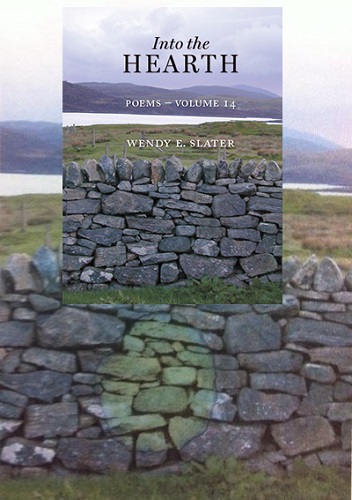
Into The Hearth CoverIt was on that one heart-opening trip to Scotland in 2001, that the poetry coalescing inside of her during that healing period began to pour forth. In subsequent trips to spiritually enriched landscapes, the words found their way to paper. Slater calls her work “Vision Quest” Poetry.

Into the Hearth, Poems-Volume 14, is actually the first of her volumes to reach publication. And it is already a widely-acclaimed Amazon.com #1 Bestseller:

“This is a very dangerous book of songs. You will find yourself overwhelmed, engulfed, and swept away into the very intimate heart fire of Wendy Slater, the feminine heart fire of love, and in the end you will be left in ashes, totally in love without any object whatsoever, yearning for more.: ~ John A. Perks, Author of “The Mahasiddha and His Idiot Servant,” Ven. Seonaidh Perks, Celtic Buddhist lineage

“Wendy E. Slater is that breed of poets who open our eyes, our hearts, and our minds with a warm arm around the shoulder, a sympathetic and empathic delivery that instantly binds the reader to her. These poems, quite simply, are eloquent, not only because they are offered with a desire to invite us to join her on the path to enhanced perception of the world and our place in it, but also because she manages to infuse that sense of spiritual respect that is so often absent in contemporary poetry.” ~Grady Harp, Amazon’s Hall of Fame, a Top 100 Amazon reviewer.

In the Hearth by Wendy E. Slater is available from Amazon.com and also on Kindle. To learn more about “Vision Quest” Poetry visit Traduka.com