Tag Archives: autism

What Are the 4 Functions of Child Behavior?

When a child misbehaves—either through screaming, hitting, or freezing up—parents will naturally feel flabbergasted or at a loss. One might ask, “Why is this occurring?” or “Is this simply bad behavior?” The reality is, behavior is communication. Regardless of the action, even behavioral actions, it’s for a reason.

Knowing the four functions of behavior allows support persons and professionals to respond with strategy and empathy. The functions are not simply clinical ideas—men can be observed with these functions around the block and with both kids and grown-ups. With proper support, families are able to more effectively handle these behaviors and bring about positive change with the help of something like Toronto, ON’s SenseBloom Therapy or at-home ABA therapy.

What are the 4 Functions of Behavior?

In Applied Behavior Analysis (ABA), all the behavior—particularly troublesome behavior—always comes under four basic functions:

  • Attention
  • Escape or Avoidance
  • Access to Intangibles (Services or Events)
  • Reinforcement

Image- autismspeaks.org

Sensory or Automatic Reinforcement

Both these functions account for the fact that the behavior is occurring. The proper function is the first step toward responding with a view to training for preferable behavior and the diminishment of suffering—for all parties.

1. Attention Seeking Behavior in Daily Life

Kids are naturally attention seekers, and that is all part of the developmental process. But if the attention is sparse or delayed, then the child will utilize negative actions to receive it. Some examples include whining, interrupting, or even violent temper flailing.

Real-life example: A kid begins screaming at dinner. The parents immediately go to try to settle the child down. The child learns that screaming gets an immediate response—albeit a negative one.

What to do: Integrate frequent, positive attention throughout the day. Reward tiny, proper behaviors (“Good job, waiting your turn”) and dismiss meek attention-seeking actions when it is safe to do so. Such services as at-home ABA treatment tend to assist parents in identifying and reacting to these instances with calm consistency.

2. Escape or Avoidance Behavior

When an activity is overwhelming, boring, or challenging, a child will attempt to escape it with tantrums, fleeing, or freezing. The function is particularly prevalent with transitions or new procedures.

Real-world application: The child balks at doing homework. The parent withholds the task until the child is relaxed. The child now equates that action with evading work.

How to assist: Divide tasks into minuscule steps. Apply visual schedules and explicit expectations. Reward effort, not merely completion. When the function is escape, do not reinforce it by retaining expectations and providing support. SenseBloom Therapy applies personalized strategies for children to eventually tolerate and execute challenging tasks.

3. Tangible Commodites Access

Occasionally, behavior is exhibited due to the want of something—such as a toy, a snack, or TV time. When an object is provided for following through with a behavior such as crying or hitting, that behavior tends to follow.

Real-world example: The child yell at the store for a candy bar. To prevent a scene, the parent purchases it. The child learns that yelling results in a reward.

How to assist: Educate children to ask for items politely. Give choices and incorporate “yes” opportunities the remainder of the day. Enforce boundaries firmly and steadily. Speak with a calm, firm voice and support waiting or saying the words. Instruction of these substitutes is an integral component of ABA therapy at home, aiding skill acquisition for the child within the natural environment.

4. Automatic or Sensory Behavior

Certain behaviors are to serve a sensory purpose—they are comforting or assist with emotional regulation. These are not other PEOPLE’s reactions, but rather self-needs. Some examples are hand-flapping, dancing or rocking, or humming.

Real-world example: A child rotates around and around. Even without an audience or reactions, the child repeats it because the feeling is soothing or exciting.

How to assist: Offer sensory-safe, age-appropriate outlets for sensory requirements. Fidget tools, movement time, or sensory routines are potential examples. Family collaboration with occupational specialists and ABA specialists is able to assist relatives to determine what sensory supports are the most effective. Clinics for sense, for example, SenseBloom Therapy, utilize sensory-sensitive areas to facilitate this process.

Why Knowing the Function Matters

Responding to a behavior without an understanding of why it’s occurring can result in band-aids for the moment—but not permanent repairs. Taking punishment for an attention-seeking child, for instance, can inadvertently strengthen the action if it affords interaction.

When the behavior is understood, the caregiver is able to substitution with a healthier, more effective behavior. The consequence is the encouragement of the emotional safety and ultimate success.

Effective Strategies for Caregivers and Parents

Note patterns: Carry around a mini-journal to mark when behaviors occur, what causes them, and the consequence.

Remain constant: Kids do best with clear expectations and definite consequences.

Model communication: Encourage children to verbalize with words, use gestures, or point with visuals.

Use soothing reactions: Refrain from reacting angrily. Remaining regulated enables the child to remain regulated too.

Receive professional help: Consulting with ABA therapists, particularly with in-home ABA therapy, allows for personalized techniques with your child’s requirements. A Humane Response to Behavior Behavior always has a meaning. Kids are not being obstinate—kids are communicating the best that they can. When families understand the four functions of behavior, families can respond with patience, with structure, with an awful lot of loving. With proper direction, all children can be taught to do it differently. Whether through formal sessions at SenseBloom Therapy or child-centered support at home, change is always achievable.


Temple Grandin

Temple Grandin, you may or may not know, is a person. I had not heard of her until recently, but I suspect her name is going to become much more recognized. Time Magazine named her one of their Time 100 for 2010. Sure that was awhile ago but consider this- she made the list of the hundred most influential people in the WORLD. She has a website. I highly suggest you check it out.

Temple Grandin (2010), the film, is the authorized movie biography of this remarkable woman and one of the first movies that treated autism with respect. She was diagnosed with autism in 1950, when the disorder was still called infantile schizophrenia. Her mother was told that Temple’s options for any measure of achievement or satisfying relationship in life were nil. Institutionalization was offered as the only practical option. But her mother wouldn’t give up. Claire Danes utterly transforms herself to tell us the story of Temple’s emergence from a relatively isolated kind of consciousness into the person she is today: author, lecturer, PHD, world renowned animal expert and autism advocate.

One of the first things we learn about Grandin is that she thinks in pictures, which makes film an especially potent medium for telling her story. Director Mick Jackson uses images throughout the film to help us understand how Grandin sees and feels the world. This is in keeping with what some have called Grandin’s greatest contribution to science- she was the first autistic person able to articulate to a wide audience what it is like to be autistic. Jackson’s film will widen the influence of her legacy further still. As well as a great story, it is a moving work of art.

I’m not sure if the brilliance of Claire Danes’ performance can be overstated, but I will simply say this: I had no idea. This woman is an ACTRESS!!  HBO films are not considered for Oscars, but  if they did she would certainly be a strong nominee. For the Silo, Junior Selector. 

8 Great Christmas Presents For Caregivers To Give To Themselves:

Peter Rosenberger, author of Hope for the Caregiver, offers these 8 great tips for caregivers to give to themselves for this holiday season and time of visiting family and friends.

1) Commit to seeing a doctor. More than 70% of caregivers don’t see a doctor

2) Commit to doing something that brings joy to your heart. It doesn’t have to be exotic: a good movie, watch a standup comedian, read a good book, paint, play the piano …something that speaks beauty and joy to you in the middle of your stuff.

3) Make a list of people you resent and forgive them and then burn the list. Lose the grudges but keep boundaries.

4) Make one small change in your diet. For instance, substitute water for a sugary drink. Grab a piece of fruit instead of a candy bar. Substitute a salad for a burger … olive oil for butter.

5) Send a Christmas card to yourself. Pick out a card your loved one would send if he/she were healthy emotionally and physically. And put a $10 bill in it.

6) Do something physical. Walk to the back of the house and back. Alan Alda walks around to John Phillips Sousa to help with his Parkinson’s. He’s not a doctor but he played one on TV …and it’s pretty good advice. He lifts up his knees. Something that simple can really benefit caregivers. Weight gain is common in caregivers. Peter quips, “I got so big my picture fell off the door and it took 2 dogs to bark at me!”

7) Isolation is crippling. Go to church or other places of worship. Slip in and listen to the music of the season.

8) Call a trusted friend and tell them you’re struggling. Take a leap of faith that they will listen. Don’t ask for solutions …just an ear and a tender heart.

A 30+ year caregiver for his wife, Gracie, who lives with severe disabilities, Peter Rosenberger understands the caregiver’s journey in ways few do. Broadcasting on Sirius XM’s Family Talk Channel (131) and an additional 180 stations through American Family Radio, Peter hosts the nation’s #1 show for family caregivers. From Autism to Alzheimer’s to Addiction, Peter addresses the needs of those caring for loved ones with chronic impairments.

Why The Future Of Healthcare Is Virtual Reality

Presently and in the not too distant future, virtual reality in healthcare will become the norm. In this piece, we’ll show you how VR can help detect, treat and cure patients in all sorts of different sectors, such as Surgery and Dentistry, as well as teaching the Nurses of the future.

VR will also be used to help the development of people suffering from mental disabilities such as Autism and help cure phobias and tend to soldiers dealing with Post Traumatic Stress Disorder. Via the Luminous Group, for the Silo, Georgia Davies. 
virtual reality healthcare infographic

$182 Million Spent On Autism Treatment 0$ Spent On Autism Service Dogs

Haldimand do not need an auditor general’s report to tell them that ASD services are in disarray. Our government should be commended for spending $182 million dollars on Autism treatment, however I have yet to meet a single Canadian family satisfied with their services. In 2007 there was thankfully, no wait list for Intensive Behavioral Intervention (IBI). Braydon spent two years working 24 hours a week, one-on-one with IBI therapists from Haldimand-Norfolk R.E.A.C.H. Essentially my toddler had a part-time job and after two years our family was unable to keep up the pace of it. Over $100,000 was spent on Braydon’s Autism Services, but now we were left to fend for ourselves.

Last week National Service Dogs for Children with Autism (NSD) asked a very interesting question on their Facebook page. Has the government considered Service Dogs? In 2012 my son was granted a Certified Autism Service Dog. Before that time, our only options for treatments were pharmaceuticals or privately funded and enormously expensive traditional therapies that were not effective at tracking results. Today, Braydon attends J.L. Mitchener Public School in Cayuga where he is thriving socially and academically. His service dog ‘NSD Whoopi’ attends school with him each and every day. Last month at Braydon’s Parent-Teacher interview I was told that my son was easy to integrate with his peers and all the students seemed to behave better when he and Whoopi were in the classroom. I have a very different little boy than I did a year ago, and the change in my son brings a flood of welcome respite to our home.

$30,000 might seem like an excessive amount of money for a Certified Autism Service Dog, however consider a Service Dog has a working life of 8-10 years. This means for some families like us; desperate for an alternative to treating our son’s autism with medication would receive 24 hour a day, 7 days a week support for 10 years for only $30,000! How much of the $182 million dollars spent on Autism Treatment this year was allocated to this alternative? Zero dollars!!! Incredibly National Service Dogs for Children with Autism provided us this option at absolutely no costs to us either. It is the generosity of the staff and volunteers at NSD and the support of our families and friends right here in Haldimand that brought accessibility for our family to our community. As a result, all of us are able to embrace a much higher quality of life than most families affected by Autism are able to experience.

So…let’s talk about making Certified Autism Service Dogs an available treatment alternative to more families. For the Silo, Jenny Tansley.

A New Light On Autism

Let there be light

Have you ever noticed how experts constantly refer to Autism as a ‘learning disability’?  I contemplate this term as I watch my nine-year-old son Braydon, effortlessly scale my counter tops to filch the salt and vinegar chips I hid in top shelf.  In fact, Braydon’s problem solving skills exceed that of his ‘neurotypical’ sister.

What would I change in my son’s treatment if I considered my son to have a communication disability rather then a learning disability?  Is this just a title or is it maybe a new perspective?

I am not an expert but here is what I do know.  Individuals who are visually or hearing impaired are considered to have a communication disability.

There are so many reasons why the sensory processing centers in the brains of certain individuals do not receive the input messages from their eyes or ears (or both like Helen Keller).  Autism looks much the same to me.  The sound of my voice competes with all the other sensory information that Braydon is so sensitive to.

The ticking of the clock, the air is too warm or too cold, his seat is too hard or too soft, the bathroom door is about to open and he is going to run away to close it.  These things make up only a fraction of the information coming at my son at all the same intensity!  Braydon’s moderate-severe Autism means that unlike those of us that experts consider ‘neurotypical’, he has no way to filter this information except to create an ‘output’ to counter it.  Experts call this behavior ‘stimming’.  I realize this all sounds confusing, but my point is that High Functioning Autism, like Blindness or Deafness comes down to being a sensory processing issue rather then an inability to learn as the term ‘learning disability’ seems to suggest.


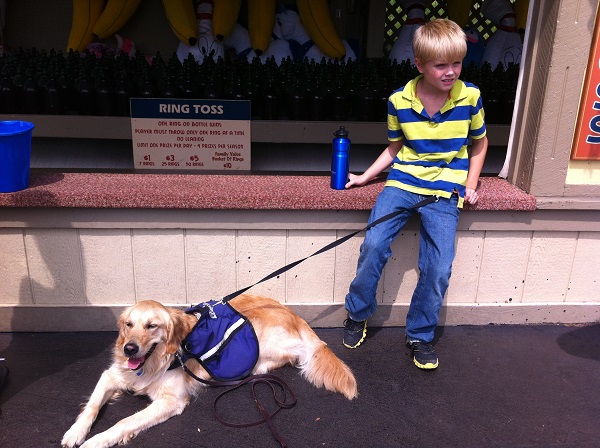
Braydon and Whoopi
Braydon and Whoopi

Perhaps this is the reason why a Certified Autism Service Dog has proven to be such an asset to our quality of life?  Service Dogs for the blind and hearing impaired are fairly common.  Is a service dog for a person with Autism a truly enormous stretch?  Trust me, it is a natural progression.

If perforated dots on a piece of paper can give a child who is born without the sense of sight an opportunity to read a book, or a computer can give Carly Fleichman, a girl with asphyxia and Autism the opportunity to find her voice, in theory my son could be able to learn the skills he is going to need to become a contributing member to his community.  Just look at all the things Dr. Temple Grandin was able to accomplish!

My goals suddenly look much different.  Instead of trying to convince my son to learn, perhaps I need only to teach him how to communicate. For the Silo, Jenny Tansley.

Supplemental- From the Silo Summer 2010 Temple Grandin article https://www.thesilo.ca/temple-grandin-a-silo-movie-review-issue2/