Is the Alien(s) franchise overdue for an official day of recognition and fan celebration? I think so. Fans of the original 1979 movie and the sequels and prequel that followed are a loyal bunch. They spend money on toys, posters, t-shirts, Blue-ray box sets and some like me, shelled out big bucks in 1987 for a pair of Reebok’s Bugstomper shoes. That’s dedicated fandom.
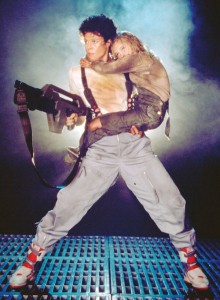
Perhaps I’m splitting hairs here. There’s a good chance that the re-issue shoes might be slightly different than the original Bugstompers. Images and an official 20th century fox poster being used to promote the re-issues show the Alien character Ripley in a pair of very noticeable “high top” Reebok Bugstompers. Back in the day, only “mid top” shoes were available.
What else besides shoes?
Beginning at midnight and lasting 24 hours, 4/26 (an homage to the planet LV-426) will be filled with product launches, nationwide screenings and a Twitter trivia contest that will give away ALIEN merch every 42.6 minutes. Now you know what that twitter hashtag #AlienDay426 is all about: make April 26 the de-facto fan day for the Alien franchise. CP
Did you know?
The most sought after Alien collectible is the 1979 Kenner 18″ Alien doll– a fine likeness of H.R. Giger’s design. Originally pulled from toy store shelves due to frightening parents and children alike.
UPDATED- Aliens | July 2016 Comic Con Full Panel (James Cameron, Sigourney Weaver, Bill Paxton)
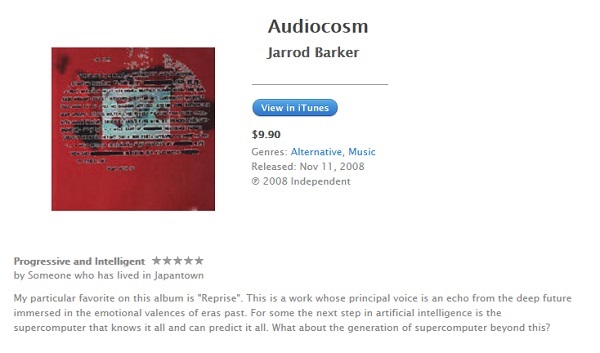
Click me! New Music created from early sci-fi soundtracks.
OCCUPY BLACK ROCK! THE METAPOLITICS OF BURNING MAN by MARK VAN PROYEN
As annual journalistic rituals go, the annual Time Magazine “Person of the Year” has been the most enduring barometer of the spirit of the moment of its announcement. For close to a century, the banner was “Man of the Year,” but after Corazon Aquino and Queen Elizabeth smiled at the world from the front cover of that influential publication, gender neutrality became the preferred modality. In 1982 “the computer” received the coveted award, so gender went out the window altogether. But the 2011 award was given to “the protestor,” and the representative image was a masked face of an angry-eyed anonymous person.
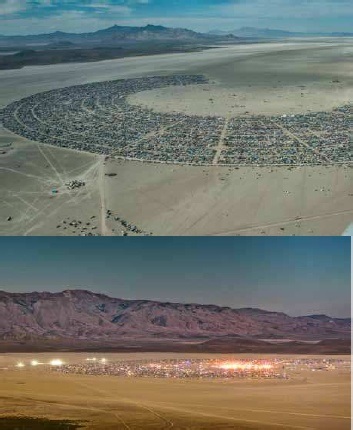
TOP Black Rock City from above Photo: AJPN Anthony Peterson BOTTOM Black Rock City seen from Old Razorback Mountain Photo: Peretz Partensky
This image followed a long year of public demonstrations that started at Cairo’s Tafir Square in late January 2011, spread to the shores of Tripoli and then moved on to Damascus. In September 2011, it arrived in New York’s Zucotti Park, a tiny sliver of public space surrounded on all sides by the world’s most prominent financial institutions. According to the surging multitudes that participated in what would come to be known as Occupy Wall Street, those institutions were evil, and needed to be called into account.It took the major media a full ten days to report the story of the occupation of that little park, although the story had already been thoroughly distributed via social media networks. The movement’s rhetoric was ingeniously crafted for those modes of distribution, and usually took the form of declarative slogans. These proclaimed that the protestors represented the 99 per cent of the American population that would no longer stand for being fleeced by irresponsible government tax policies, a lack of regulation of the financial markets and a vast system of political bribes routinely called “campaign contributions.” Conservative commentators squealed “Class War!” in comic disregard of an OWS placard reminding its readers “they call it class war when we fight back!” From the OWS point of view, that war had been ongoing since Ronald Reagan’s first term in office. When the major media did get around to picking up the story, “What do they want?” or “What are their demands?” were published everywhere, as if the protestors were unintelligible in their calls for economic justice and political fair play. OWS did not give in to the “demand for demands” and this is crucially important, because their movement never was nor is now a conventional exercise in political advocacy. It is much better to describe it as a case of spontaneous socio-cultural upheaval intended to reshape contemporary political priorities into a more ethical form. In an America where an uber- wealthy minority has garnered a proportionally larger piece of the economic pie for decades, one might have anticipated that the protesters would have adopted a more conventional form of utopian rhetoric. But theirs was decidedly pragmatist. They pointed at real problems that could and should be solved in a political practice governed by simple sanity. One sign read, “I don’t mind you being rich. I mind you buying my government out from under me.” The sign referred to the draconian political atmosphere created when the Supreme Court voted five to four to overturn the McCain/Feingold Campaign Reform Act in the now infamous Citizens United vs Federal Election Commission decision of 2010. 3
The real issue at stake in the Occupy Movement’s actions is the control that money exerts over the political process. The movement reveals the plutocratic Achilles heel of neoliberal corporatism’s claim that it is more democratic than its chief rivals in model government. I call these rivals “state capitalism” and “theocratic tribalism,” and intend them to be non-euphemistic names for what are conventionally called socialism and religion-based social organization. Because of its distinctly modern emphasis on upholding the prerogatives of individual political actors, neoliberal corporatism is easy to sell as the ideology of choice for free thinkers. But, as history shows, free thinking never stays free for long, because it too has to live in a marketplace of encouragements and discouragements governed by instrumental rationales that are epiphenomenal to the formation and protection of wealth. In other words, those who have the gold set the standards, regardless of any vision of or obligation to social fair play. This insures that instrumental reason will always protect itself from any utopian vision so that in the realms of conventional discourse, we are always given an “intelligentsia” that functions as the public face of bureaucracy and policy. However “oppositional” its posture of hidden loyalty might be, it will nonetheless always end up fleeing from the Socratic mandate that philosophical thinking helps its aspirants to actually live better. From the point of view of the Occupy movement, that mandate desperately needs to be returned to the core of any thinking that seeks to establish anything resembling a political priority.
When I refer to model forms of governmentality, I am not pointing to any operational political entity, any and all of which are circumstantial admixtures of the three models of neo-liberalism, state capitalism and tribal theocracy all achieving legibility much in the same way that tertiary colors do through the mixture of the primary hues of red, yellow and blue. For example, social democracy is really a blend of neo-liberal corporatism and state capitalism. Another example reminds us that there will always be a black market of goods and subversive ideology working in the shadows of any state capitalist system, or for that matter, within any theocratic tribe. Any system configured around any of these three model forms will also contain latent aspects of one or both of the others, arranged into dominant and subordinate formations. These are always in a perpetual state of change and reconsolidation.
They are also always in a state of subtle redefinition, and the factors that shape these redefinitions can sometimes come from surprising vectors. The Occupy Wall Street movement is one such example, surprising in that it refuses to operate according to the rules of normative political advocacy. Whereas the extremely conservative Tea Party rallies held during the previous year were examples of a durable tradition of anti-government American populism, the OWS movement is representative of an equally durable anti-bank populism that has a long-standing place in American history reaching back to early colonial laws against debtors’ prisons. Even though the two groups blamed different entities for the economic misery that swept the land after the 2008 financial crisis, there is an important difference: in an act of support for the second amendment, Tea Party activists often brought guns to their rallies. The only firearms seen at Occupy Wall Street (and its more contentious sister event, Occupy Oakland) were in the hands of over-zealous law enforcement officers. Occupy Wall Street events are significantly more complicated animals than their Tea Party predecessors. The movement has gone far out of its way not to be co-opted by the mass media or any collection of candidates for public office. Conversely, the Tea Party groups were all too happy to be ventriloquized by Rupert Murdoch’s Fox News affiliates. OWS had a justifiable concern that any such affiliation would inevitably lead to the seven stages of political futility: cooptation, division, dilution, pacification, neutralization, disappointment and betrayal. Because of these concerns, what one sees coming out of the Occupy movement is not an exercise of politics defined by the normal terms and conditions of any conventional political science. Rather, it operates as an example of what Alain Badiou has called a Metapolitics, that is, a strategic restaging of the ethical grounds by which political matters are imagined, understood, debated and acted upon. According to Badiou, Metapolitics is a form of “Resistance by Logic.” 4
No group, no class, no social configuration or mental objective was behind the Resistance… there was nothing in the course of this sequence which could have been described in terms of objective groups, be they ‘workers’ or ‘philosophers’…. Let us say that this resistance, proceeding by logic, is not an opinion. Rather, it is a logical rupture with dominant and circulating opinions…. For the contemporary philosophical situation is one where, on the ruins on the doctrine of classes and class consciousness, attempts are made on all sides to restore the primacy of morality. 5
It is particularly interesting to look at Badiou’s metapolitical thesis in light of his larger project to transform the most basic grounds of philosophical inquiry so as to place greater emphasis on ethics. He is well known for proposing a change in the basic categories of philosophy (metaphysics, ethics, logic and epistemology), seeking to restage them as the interdependent “truth procedures” of “art, love, politics and science.” 6
His metapolitical restaging of the truth procedure of political science can be understood to be of a piece with his postulation of an ethical “inaesthetics.” This seeks to deny the meditative subject/object relationship of contemplation with something suffused with “immanence and singularity,” leading to a “transfiguration of the given.” The Occupy Wall Street movement has followed suit on this score, fashioning itself as an immanent and singular metapolitical gesture that has embraced a unique resistance by logic that was and still is a vigorous disruption of logic. It has accomplished this by staging a theatrical moment that calls attention to the withering state of the commons, that being the place of democratic co-existence and rational debate where all citizens can freely enter and exist regardless of their inability to rent media time. And let there be no mistake: in the second decade of the twenty-first century, social media has become the new commons, needing only a shared event to galvanize its attention to the point of putting a wide-ranging discourse about political priorities into play on a vast and unregulated scale. Occupy Wall Street is one such event, one whose time has clearly come. But the model for this kind of actual/virtual exercise in reformulating a common space into a rhetorical congregation had been established two decades earlier in a very different public location that also galvanized a vast virtual community. It too was a brilliantly conceived exercise in a metapolitical “resistance by logic.” That space was and still is the vast Black Rock Desert, a dry lakebed in northwestern Nevada that is administered by the Federal Bureau of Land Management.
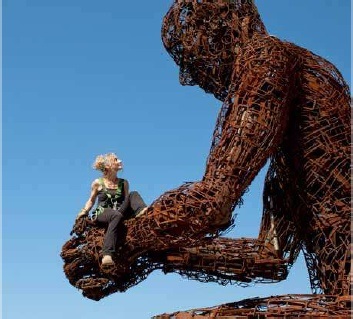
Karen on Eileen and George, from Crude Awakening PHOTO: ROGER MINKOW M.D.
The event was and still is Burning Man. Since the early beginnings of the Internet, many observers have postulated that there was revolutionary potential in its ability to widely and instantaneously distribute unmediated information. Some have proclaimed it to be the new commons, this in recognition of how the forces of neoliberal corporatism have turned the old commons into shopping malls of various kinds, those being places where the subtle doctrine of “pay to play” began to slowly displace all other opportunities for political participation. Burning Man was the first major instance of an organized recognition of this new communal possibility of the digital revolution, and the first to act upon it at any meaningful scale. It did so by “occupying” a piece of public land in a wilderness area, and then configuring itself as a kind of free city where monetary exchange and corporate advertising would not be allowed. Participation, collaboration and self-reliance were upheld as paramount civic virtues, and art was defined and welcomed as the product of any “radical free expression” that any person could devise, regardless of any lack of previous experience or education. When web-browsing software first became available in 1994, Burning Man was already nine years old, and had already been using email networks and virtual bulletin boards to distribute its messages to a growing audience. The emergence of such communications technologies were a natural fit for the event, and even to this day, it has never paid for any advertising beyond the printing and mailing of its own promotional materials. That was the same year that the mass media initially came out to report on the event. The following year, the population doubled, making it clear that a tax on participants was needed to cover necessary costs for staging the event on a much larger sale. Admission tickets were sold, and federal rules were re-written so that the federal Bureau of Land Management could charge the organizers of Burning Man a hefty fee to use the space. Soon after that, much more money was spent in legal fees to support litigation that should have never have come to any court’s attention, if constitutional guarantees of rights to free assembly and self-expression were deemed worthy of any respect. But they weren’t, because it was difficult to convince certain political operators that the self-expressive thing that had engendered Burning Man’s free assembly of pilgrims had anything to do with art. From their point of view, what was happening at an increasingly large scale every year in the Black Rock Desert on Labor Day weekend was much more frightening, in that its almost complete lack of artistic supervision portended something akin to a mass participation Satanic ritual.7 It also threatened to unmask the lie that art had become.
I
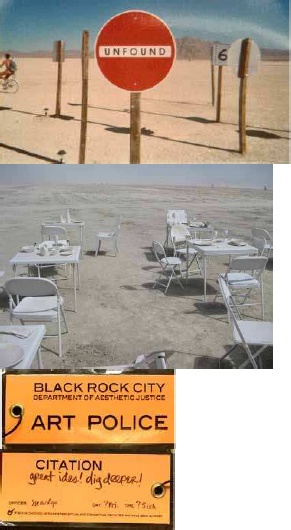
From the perspective of an art world populated by museum curators, globe trotting art collectors and the toney gallerists working the crowds at international art fairs, Burning Man represents a kind of Special Olympics for Art. To give credence to this view, all any nay-sayer would have to do is attend the event and take in its many starry-eyed unicorns and countless geodesic domes built in service to obscure comic-book deities fashioned from disfigured mannequins. If our nay-sayer were guided by courage and in search of additional evidence to support her initial observation, the next logical destination would be the large indoor exhibition space called the Café, which is usually decorated by the work of a great many amateur photographers and collage artists working on heavy doses of misinformed spiritual pretense and undeserved self-esteem. And yet, as revealing as the Café environment might be, it still pales in comparison to the best place to witness Burning Man’s culture of unfettered creativity, that being the array of unmapped theme camps located away from the Esplanade that separates the event’s semi-circular camping area from the mile-wide no-camping zone at its core. Here, one is liable to find a vast assortment of incomprehensible do-it-yourself efforts at representational makeshiftery, often times manifested in things that look more like distorted family entertainments than the objects of any conventional art history. Looking like the mutant offspring of a theme park and a slum conceived in the prop closet of George and Mike Kuchar’s Studio 8 Production Company, 8 these provisional amalgamations of such materials such as fluorescent fabric and solar powered lava lamps oftentimes seem to allegoricize the traumas and contradictions of a consumer culture blindly addicted to the debt-driven circulation of pseudo-goods and non-services; all saying something troublingly oblique about an America that is amusing itself to death in the age of Walmart.
The real value of Burning Man lies in how it reverses this model. It does so by simply allowing its participants to amuse themselves back to life through their participation in a week of collective catharsis. Fortunately for our dyspeptic pilgrim, the artistic offerings of Burning Man get bathed in a seemingly endless sea of electro-luminescent blinky lights when nightfall arrives, and her attention will then most likely be diverted by an omnipresent soundscape of pulsating techno music punctuated by the explosive flashings of propane fireballs surging into the sky. To this, add the lumbering peregrinations of large, slow moving vehicles that appear as grotesque carnival rides taken from a Dada-themed amusement park, and the picture of a vastly absurd semiotic entity comes close to completion, a relational esthetics
gesamtkunskwerk 9 that is metaphorically and geographically located at the exact half-way point between San Francisco’s Mission District and Robert Smithson’s Spiral Jetty protruding from the north shore of the Great Salt Lake. It is equal parts game space and refugee camp, and as such, it presents itself as a gargantuan omni-participatory rejoinder to the regulation of subjectivity embedded in the cognitive illusions bred by normative market-defined existence. And for this reason, the ensemble experience of participating in Burning Man provides a much-needed transfiguration of everyday assumptions about what passes for cultural nourishment. Its chief lesson lies in the way that it demonstrates how well a do-it-yourself social economy can work if and when it reframes itself in the terms of a do-it-with-others ethos, and this represents a profound political revelation as well as its chief metapolitical legacy to be later taken up by the Occupy Wall Street movement.
Rather than calling this vast entity by its proper name of Black Rock City, lets give it a more descriptive moniker: the living model of an alternative version of contemporary culture based on advancing an ethical glocalism as the highest of priorities. And then let us note that, in theatrically performing itself as such a model, it also forms itself into a fun house mirror reflection of the absurdities of twenty-first century existence, all-the-while organizing itself as a temporary corrective for many of that century’s social and political shortcomings, especially those pointed toward systematically excluding people from social participation for no good reason. At Burning Man, the stranger is always welcome, and there are always opportunities for any given participant to do things that she never imagined herself to be doing. And in so doing, she oftentimes learns a great deal about the roles that she plays in her everyday life, in turn allowing her to imagine and act upon other roles that might lead her to a better world, at least for herself and maybe for others. Yes, Burning Man does feature a great deal of so-called “New Age” art made by people who might best be called hippies, and yes, almost all of that art is at best a guileless exercise in naïve cluelessness that is scripted not so much by any “radical free expression” as it is by the simplistic recirculation of pop cultural cliché. At worst, it is something on a par with toenail fungus, but even that can be strangely entertaining when contrasted with the vastness of the desert. Indeed, accounting for maybe two- or three-dozen notable exceptions during the past decade, we would have to concede that almost all of the art at Burning Man is as bad as its detractors say that it is. But in admitting this fact, another obvious question comes to the fore: in the great scheme of things, how important is it whether any of it is bad or good? And following from this, another obvious set of questions: who or what are the entities that are empowered to decide on any such differentiation? What values do they represent? What is masked by the authoritative proclamation of said values? And again: why does any of it matter?
Turnabout being fair play, it now becomes obligatory to imagine what an everyburner might make of the current world of contemporary art, resplendent as it is when ensconced within opulent museum architecture and festooned with price tags that are the monetary equivalent of real estate when it is not. It is undeniable that those environments are the sites of a kind of authoritative coldness designed to intimidate the viewer into a kind of passive submission to the historical authority of those things that are beheld within them. It is also undeniable that the large majority of those snobjects contain very little that conveys the kind of truthful generosity that might reward the attention of the serious viewer who is not party to the vested interests that have been influence-peddled into the visible existence of their environment’s adoration.
And so, our everyburner would no doubt ask: given the sorry state of the world, why all the fuss? Presumably, money is part of the equation, although it is difficult for the uninitiated to see exactly how it plays out through the elaborate web of private, corporate and public support that buoy any given museum’s orchestration of the importance effect. As Paul Werner succinctly put it in 2005: “The illusion that art museums could be run for profit like everything else was derived from the notion museums themselves had worked so hard to foster: that art and capital were all one and circulated in the same manner.”10
Werner goes on to quote former Metropolitan Museum director Phillipe de Montebello’s statement that “It is the judicious exercise of the museum’s authority that makes possible the state of pure reverie that an unencumbered esthetic experience can inspire,”11 and then goes on to state that “by the same logic, the absence of ‘a state of reverie’ interferes with ‘the judicious exercise of authority.’” Werner drives this point home when he writes “What Brecht wrote of the Nazis then now applies to cultural apparatus of the twenty-first century: they want to turn the People into an audience. Same policy, different means.”12
Once again, we are reminded of the truism stating that propaganda works best when those who are being manipulated believe that they are acting on their own free will. How you might ask, and the answer is obvious: in the way of the translation of a certain class of objects—let’s call them symbolic commodities—into a certain class of equities. It is easy to suppose that said equity is simply gained from the fortuitous position that any given investor might take amid the normal value/worth fluctuation of the commodity in question. But works of art are not commodities in same way as are barrels of crude oil or tons of copper, nor is it a form of reserve currency as are ounces of gold or silver. The commodity value of a given work of art is instead a function of its status as a reliquary representation of its own myth status, and that is something that continues to be manufactured long after said work of art leaves the studio of the artist who created it. Ultimately, it is the museum that confirms the mythic status of the objects that it chooses to display and collect, creating a fortuitous feedback loop that points to how the world of contemporary art has been transformed into a rather perverse epiphenomena of the financial services industry.
Here is how the normative art economy actually works. Artist a) makes a work of art b) and shows it at the gallery of dealer c), who gets it written about by critic d) and then sells it to collector e) for f) amount of money. Collector e) hangs on to artwork while the reputation of artist a) rises by way others repeating the same machinations described in the aforementioned equation, and then, at a fortuitous moment, she either sells said artwork for profit f)+x , or more normally donates said artwork to museum g), for which she receives donor recognition h), which represents the fair market value that museum g) places on artwork b).
Because the work has been accepted into museum g)’s collection, its fair market value automatically rises, so that donor recognition h) is actually worth much more that the original purchase price f) of work of art b). And it is donor recognition h) that collector e) sends to the tax collector as a claim for a tax deductable charitable contribution that reduces collector e)’ s overall tax burden by a significant sum of money (yes, the federal government does support the arts!). The value added portion of this equation lies in how much greater a sum of money donor recognition h) represents in relation to original cost of artwork b), and in many cases that sum is ten or 20 or 100 times the original investment. Thus the economy of art is laid bare, and it can rightfully be called a speculative marketplace in objects that might represent a significantly enhanced tax-deductability that can be exercised at some future juncture, all assuming that museum g) is interested in acquiring work of art b) at any point in time. This means that work of art b) has to fit in with what museum g) considers to be a worthwhile esthetic experience, based in part on its own vested interest in perpetuating its ability to exercise such consideration. Werner gets that particular point right when he states that “if the Guggenheim, or any other museum, had actually covered its expenses through admissions, that would have harmed its true function: The manufacture of exclusiveness.”13
But, even though money is a major part of the equation, it by no means is all of it. It is worth noting that Werner’s remarks about the museum world point to a specific historical moment, and that moment was defined by the aftermath of the politically motivated reformulation of the National Endowment for the Arts that took place between 1989 and 1994. After that reformulation (which effectively ended government support for the arts in the United States), both the world of the museum and the larger world of contemporary art were momentarily recast as perverse sub-functions of the entertainment industry, with a reigning style called “Pop Surrealism”14
This coming to the fore as the stylistic marker for the art of that brief and bygone moment, and indeed, a perfectly useful and legitimate term that could accurately describe much of the art that one might find at any given iteration of Burning Man. In fact, it is a far more accurate term than the more common ascription pointing to it as new form of “outsider art.” This is so because at that particular moment, there was a major lack of clarity about what was inside or outside of anything other than what financially motivated turnstiles might keep in a state of separation, and in the wake of the cessation of government funding, an increase in audience size became an necessary institutional mandate. Thus, we had an art style that “took its inspiration from popular culture,” meaning that it was trying and failing to be popular culture, rather than the kind of critical comment on it that we saw with 1960s Pop Art. Part-and-parcel with the 1990s embrace of Pop Surrealism as an audience development strategy was another related trend called Postart spectacle, which transformed whole museums into elaborately staged pseudo-operas of the type made famous by Matthew Barney, Paul McCarthy and Martin Kippenberger—artists who all infused Pop Surrealist esthetics with the theme park ambience of an arena rock concert. Finally, it is worth noting that the rhetorical pendent that was hung around the neck of this esthetic shift toward popular entertainment was something called “art writing.” It did not come from the traditional world of art historically trained art critics, but instead issued from a new hybrid discourse that proclaimed itself to be something called “visual studies,” which in many cases was little more than culturally sensitive entertainment reporting—“celebrity porn journalism” to use a deservedly uncharitable term. Its most characteristic feature was a shameless willingness to be used as a tool for institutional audience development.
Nonetheless, in the art world, all of this was brief and transitional, because the focus would again shift in dramatic form after the 9/11 terrorist attacks, making Pop Surrealism suddenly look very anachronistic. Very soon thereafter, Globalism became the new buzzword for a suddenly robust emphasis on a transnational art hailing from under-recognized parts of the world. Presumably, Globalism represented an impetus toward encouraging the embrace of art as an instrument of national liberation, or failing that particular pretense, as a focal point for the kind of cultural lubrication that might politically facilitate desirable access to the labor, natural resources and markets of the developing economies so dearly prized by neoliberal corporatism. It might also represent a politically motivated usage of art as an instrument of pacification, that is, as an administrative technology for deflecting the potential for actual conflict into the containable realm of symbolic conflict. The visible shape that this newly globalized art took on was not manifested in any particular form of artistic cultural production, but instead, was revealed as a relatively new form of cultural presentation called the Mega-Exhibition. These were exemplified by such time-honored extravaganzi as Documenta and the Venice Biennial, but also by a metastasizing host of newer entries into the global mega-exhibition fray, held in such cities as Istanbul and Taipei. These are giant affairs that operate under the guidance of an elite class of internationally renown curatorial directors, and in addition to operating as certification mechanisms for the investability of the art contained by them, they also function as major engines of cultural tourism and transnational ideological propaganda that have been used to enrich the coffers of their host cities. It is also worth thinking about how other imperatives might be in play. As Okwui Enwezor has written, globalism embodies a new vision of global totality and a concept of modernity that dissolves the old paradigm of the nation-state and the ideology of the ‘center,’ each giving way to a dispersed regime of rules based on networks, circuits, flows, interconnection. Those rhizomatic movements are said to operate on the logic of horizontality, whose disciplinary, spatial, and temporal orders enable the mobility of knowledge, information, culture, capital, and exchange, and are no longer based on domination and control… globalism was part of the maturation of a certain kind of liberal ideal, which in its combination of democratic regimes of governance and free market capitalism was prematurely announced as the end of history.15
These attributes are all pointed at the imagination of “a truly unified world system whereby all systems of modern rationalism would finally be properly fused.”16
Of course, the inquiring mind will ask, to what end? And more importantly, to whose end? Of course, answers to these questions are never made clear, perhaps because they cannot be made clear. But it is worth pointing out that the impetus toward the aforementioned fusion is a very different thing than the impetus toward cultural diversity, and it is also interesting to note that among the many topics of cultural identity that have surfaced during the heyday of the global mega-exhibition, the debt obligations of post-colonial nation states is one that almost never comes up. That is because the thing instigating and benefiting from the aforementioned fusion is a global, trans-national banking system that has learned how to use both art and nation states as tools for its own purposes. That much said, we can go on to productively note Burning Man is also a mega-exhibition, but in many ways it is also an anti-mega-exhibition, especially in the ways that it prefigured, mirrored and satirized the “the rhizomatic logics of horizontality, interconnection and dispersal” that have become de rigueur themes in twenty-first century art. III
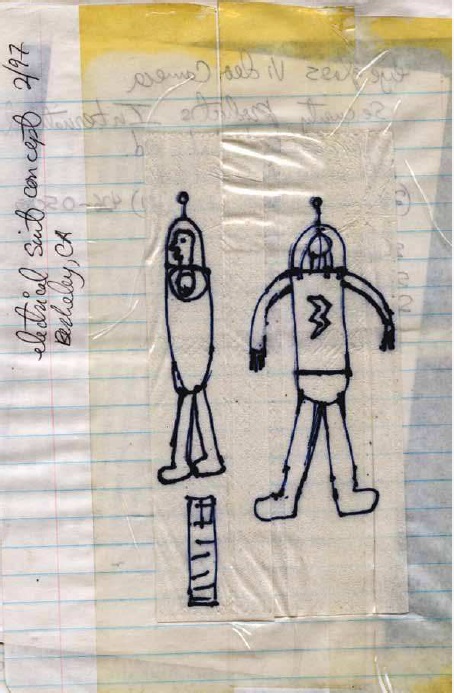
Electrical Suit sketch by Dr. Austin Richards AKA Dr. Megavolt
For all of Burning Man’s claims of being a place apart from the default world that it pretends to leave behind, it nonetheless does seem that the event sustains an oblique relationship to that world. During the technologically addled 1990s, Burning Man seemed to be prophetically far ahead of the cultural environment surrounding it. The chief reason for this was its far-reaching imagination of the ways that new technology could recast how social relations might be reconfigured in critical relation to what Naomi Klein would later call “Disaster Capitalism.”17
In those days, the presiding spirit of Burning Man was not any getting back to the mythical garden that so captured the imagination of the Woodstock generation so much as it was a celebration of various kinds of real and imagined love taking place amongst the post-apocalyptic ruins of rampant military adventurism and financial and ecological unsustainability. But in 2001, the specter of real apocalypse became traumatically evident when the 9/11 terrorist attacks ushered in an unfunded war wedded to the draconian trappings of the National Security State. Suddenly, the world caught up with Burning Man’s parsing of the utopian and dystopian themes of technologically-assisted social capitalism, making them seem redundantly similar to the mass media narratives about a brave new cyber-economy as well as the emergence of other forms of Postart spectacle that had come into prominence in the art world. The fact that Burning Man had become the putative darling of a kind of trivializing mass-media condescension did not help, and over time the event become more-and-more indistinguishable from the “wild and crazy” caricatures that were heaped upon it. By 2007, the event had clearly become a victim of its own clichés of flagrant silliness, mired in a repetitious cycle of nostalgia for the exuberant 1990s. Soon after that, that the world would pass it by, because in 2008, the story would take another turn, a downturn to be exact. The financial crisis that exploded in October of that year once again recalibrated the larger terrain of cultural understanding, and the urgency of that moment began to make Burning Man look every bit as indulgent and frivolous as it did the institutional art world. Soon thereafter, a new concern for the politics of social justice had come into the foreground, eclipsing the themes of alternative identity and self-sustaining community-of-desire that were such prominent features of the event during its 1990s heyday. It was time to pass the metapolitical torch of the do-it-with-others ethos so that a very different fire might be lit with the aid of a few well-placed Falstaffian pitchforks.
Returning to Badiou, we read that the ethical understanding of justice is something quite specific. It is based on the following injunction: “to examine political statements and their proscriptions, and draw from them their egalitarian kernel of universal signification.”18
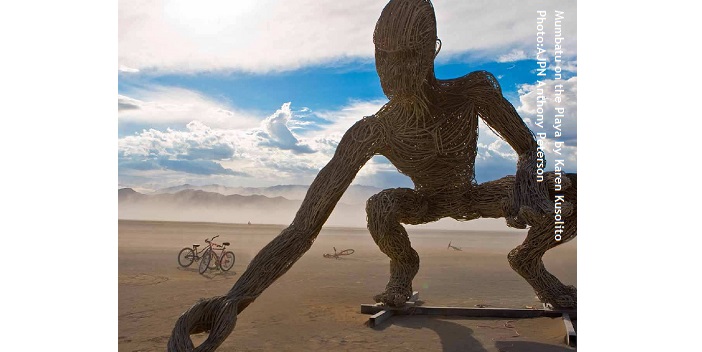
If Burning Man has done nothing else, it has certainly created an Archimedean ground from which such an examination might proceed, much more successfully than anything that happened in the institutional art world during the same time period. Following from this recognition, we might then ask how the metapolitical kernel of Burning Man was passed to Zucotti Park, as if, in an age of social media, the assertion and exertion of any influence on anything can somehow be supposed to not be operable until proven otherwise. We know that one of the key instigators of the OWS movement was Micah White, the Berkeley-based co-editor of the Vancouver-based journal Adbusters , therefore a Bay Area connection is easily made, although it is not clear if White was in any way influenced by Burning Man. Because there is a very large contingent of Burning Man participants that hail from New York City, one could easily suppose that their experience of the event might have had something to do with the encampment at Zucotti, especially since Occupy Wall Street initially took place just ten days after the conclusion of the 2011 Burning Man event. But there is one important kernel of indisputable influence that clearly stands out, and that is Bill Talen, who is better known in his performance guise of Reverend Billy of the Church of Stop Shopping, a New York-based performance group that has extensively toured the United States and is the subject of two widely circulated documentary films. What makes Talen’s performances so timely for this discussion is his evocation of the tropes of a theocratic tribalism that are severed from the politics of hate and fear, all enacted in service to the kind of communitarianism and pleas for justice that earmarked the earliest Christian communities of the second century. Obviously, those same values are in short supply among so-called evangelical churches populated by legions of CINOs (Christians-in-Name-Only), reminding us of how deeply perverted the gospel message has become in twenty-first century America. The fact that the more organized churches proclaiming allegiance to the gospels have been outdone on this score by a performance artist should be cause for concern, outrage and cruel mockery. Starting in 2002, the 30-member band and gospel choir of the Church of Stop Shopping has regularly performed at Burning Man, putting on a rousing revival show that is a stunningly convincing mimic of similar services consecrated to “the old time religion” a la Elmer Gantry, only at Burning Man, it was comically staged under the shadow of an 40-foot-tall effigy that echos the real old old old time religion of Neolithic cult worship.
At the forefront of the Church’s performance is Talen’s character named Reverend Billy, who preaches in passionate, Elvis Presley-inflected voice about the evils of consumerism and the tragic human cost of debt-driven consumption, backed up by a gospel chorus and small orchestra featuring a church organ. The chorus sings songs about the virtues of an economic democracy that is described as a promised land, and the mood is always persuasively festive, even joyous.
Talen’s passionate and eloquent sermons come across like rhapsodic poems made from the many fragments of Occupy Wall Street signage, and in fact, Talen did perform (sans choir) at the 17 September 2011 beginning of OWS, just a few days after returning to New York from Burning Man. Subsequently, he performed with the choir at Zucotti Park on several other days, to audiences that grew ever larger during the month of October. These were rousing and inspirational shows that galvanized the attention of ever-growing crowds in a way that gave them a coherent group identity, meaning that, for a few brief moments, the Occupy protesters found themselves attending a church of their own politically inclusive revelation, which allowed them to see themselves as being a part of something much larger than themselves.
As always, Talen’s performances were a brilliant obversion of the pernicious role that religion has come to play in American politics, where so-called “values” candidates have been using church affiliation for decades as the preferred excuse for supporting candidates and policies that embody the hateful opposite of Christian morality. Such ethically duplicitous rhetoric also has a metapolitical name, and that name is Neoconservatism when practiced by Americans who identify with Judeo-Christian tradition, and fundamentalism when practiced by others. Either way, the word “fundamental” applies in all of its many nuances, especially the one that highlights its definitional opposition to enlightened sophistication. Essentially, Neoconservatism is a subtle theologicization of the neoliberal doctrine that defines the subject along the secular lines of economic self-interest, but it deviates from that doctrine in that it assumes that self-serving moral edicts are required when the economic interests of cultural Others begins to gain too quickly in relation to the economic self-interest of the culturally entitled.
Talen’s Reverend Billy performances are so entertaining and well executed that it is easy to miss the seriousness of the metapolitical critique embodied in them. Certainly, they provide a thoughtful and dramatic critique of the empathy deficit disorder that is bred by neoliberal corporatism, and they command and entice their audiences to insist on ethical correctives. As for the relation of his work to his experience of Burning Man, Talen himself has a clear vision of the similarity between Burning Man and the OWS movement. He writes:Burning Man and Occupy Wall Street share this: we discovered that living together is a performance with long-range power. How we live—people watch and learn. Then they live back at us and we change too. We experience the decisions of how to live as drama, and (we found out) as protest—more than traditional theater which rarely has electrical charge these days. For years we were the butt of journalist jokes, calling us refried 60s protesters—angry people carrying signs and chanting. All that was wiped away by the glorious arrival of Occupy, which was the simple notion of living together in public, in a park under the scrapers of Wall. Sharing food, stories, making media, figuring out laws, discussing health, feeding each other—LIVING TOGETHER is the devastating protest form of our day. Burning Man’s fascination—you see it around the world—flows from living together under arid desert conditions for a week. BM also chucks the conventional stage and finds a new charged theater in sashaying in outrageous costumes and nakedness in front of 50,000 people who are doing the same thing back at you. Burning Man is great theater—leaves Broadway in its playa dust. And Wall Street guys are there too—wearing fluorescent underwear while they check out a 100-foot-long chandelier. How change comes to the world from these two forms of theatrical living— stay tuned! It has begun.” To this I can only say Amen.
notes- *apologies for layout issues, text spaces have been modified to allow for full citation listings.
1.
Alain Badiou,
Metapolitics
(1998), translated by Jason Barker, London: Verso Books, 2005, p. 19.
2.
Jean Tingley, “On Statics,” (text from a leaflet dropped near Dusseldorf in 1959. Recorded in
The Diary of Anaïs Nin, Volume VI
, edited by Gunther Stuhlman, New York: Harcourt, Brace and Jovanovich, 1966 p. 284.
3.
See Adam Schiff, “The Supreme Court Still Thinks That Coroporations Are People,” (July 18, 2012)
, translated by Norman Maderaz, State University of New York Press, 1999. Further references to Baudiou’s ideas are extracted from this source, unless otherwise cited.
7.
Claims of Burning Man being a socially dangerous satanic ritual were made on the 18 May 1998 broadcast of Pat Robertson’s 700 Club program on the
Christian Broadcast Network
.
8.
George Kuchar (1942–2011) and Mike Kuchar (b.1942) were San Francisco-based underground filmmakers whose low budget works used and misused exaggerated gender clichés to satirize the most preposterous aspects of conventional “sinematic” exposition. George Kuchar’s most well known film was titled
Hold Me While I’m Naked
, 1966, while Mike Kuchar is best known for his 1966 film titled
Sins of the Fleshapoids.
In 1997, they collaborated on a book of comic reminiscences titled
Reflections from a Cinematic Cesspool
(San Francisco: Zanja Press). Here we might note a persistent albeit unconfirmed rumor that San Francisco’s long-running stage play titled
Beach Blanket Babylon
was originally indebted in some way to the George Kuchar esthetic. In Jennifer Kroot’s 2009 documentary film titled
It Came From Kuchar,
it was revealed that Bill Griffith’s comic character named
Zippy the Pinhead
was modeled on George Kuchar.
9.
Gesamtkunskwerk
literally means “total work of art.” It was coined by Richard Wagner to describe his view opera production as a synthesis of all of the arts. See his
The Artwork of the Future
(1849, translated by William Ashton Ellis) at http://users.belgacom.net/wagnerlibrary/prose/wagartfut.htm. “Relational Esthetics” was a term originally coined by Nicholas Bourriard in 1986 as a way of calling attention to certain artistic practices that were/ are less concerned about the creation of a final product than they are about the social processes of inclusion and participation leading up to it. Bourriaud defined the approach simply as “a set of artistic practices which take as their theoretical and practical point of departure the whole of human relations and their social context, rather than an independent and private space.” (p. 113). See Nicholas Bourriard,
Relational Esthetics , Dijon, France: Les Presses du Reel , 2002. For a critique of Bourriard’s thesis, see Claire Bishop, “Antagonism and Relational Aesthetics,”
October 110, Fall 2004. Bishop points out that “The curators promoting this ‘laboratory’ paradigm—including Maria Lind, Hans Ulrich Obrist, Barbara van der Linden, Hou Hanru, and Nicolas Bourriaud—have to a large extent been encouraged to adopt this curatorial modus operandi as a direct reaction to the type of art produced in the 1990s: work that is open-ended, interactive, and resistant to closure, often appearing to be ‘work-in-progress’ rather than a completed object. Such work seems to derive from a creative misreading of poststructuralist theory: rather than the interpretations of a work of art being open to continual reassessment, the work of art itself is argued to be in perpetual flux. There are many problems with this idea, not least of which is the difficulty of discerning a work whose identity is willfully unstable. Another problem is the ease with which the ‘laboratory’ becomes marketable as a space of leisure and entertainment. Venues such as the Baltic in Gateshead, the Kunstverein Munich, and the Palais de Tokyo (in Paris) have used metaphors like ‘laboratory,’ ‘construction site,’ and ‘art factory’ to differentiate themselves from bureaucracy-encumbered collection-based museums; their dedicated project spaces create a buzz of creativity and the aura of being at the vanguard of contemporary production. One could argue that in this context, project-based works-in-progress and artists-in-residence begin to dovetail with an‘experience economy,’ the marketing strategy that seeks to replace goods and services with scripted and staged personal experiences. Yet, what the viewer is supposed to garner from such an ‘experience’ of creativity, which is essentially institutionalized studio activity, is often unclear.” (p. 52) Bishop goes on to quote Bourriard: “It seems more pressing to invent possible relations with our neighbors in the present than to bet on happier tomorrows” (p. 54;
Relational Esthetics,p. 45), Then she adds “This DIY, microtopian ethos is what Bourriaud perceives to be the core political significance of relational aesthetics.” (p.54). It is worth noting that there has never been much difference between Bourriard’s assertion of “Relational Aesthetics” art practices and Allan Kaprow’s much older advocacy of Happenings, the first principle of which being “the line between the Happenings and daily life should be kept as fluid as possible,” so that “the reciprocation between the handmade and the ready-made will be at its maximum power.” (Allan Kaprow, “The Happenings are Dead: Long Live the Happenings!” (1966) in Jeff Kelly ed., The Blurring of Art and Life: The Collected Writings of Allan Kaprow , Berkeley: University of California Press, 1996, p. 62). The key point lies in how both Relational Esthetics and the earlier Happenings resurrect the tenants of Lukasian social realism by substituting real-time face-to-face encounters for the older tropes of representing and/or narrating ideas of “class consciousness.” More recently, similar activities have again rebranded themselves as “Social Practice Art,” as a way of emphasizing more specific political ambitions. See Nato Thompson, Living as Form: Socially Engaged Art from 1991 to 2011,
Cambridge, MA. MIT Press, 2012. But even here, the obvious equation of institutionally supported “social practice art” with inefficacious postures of mild political concern (scented with the bad faith of loyal opposition) are never directly addressed. An important early instance of a Relational Esthetics artwork was San Francisco-based artist Tom Marioni’s Drinking Beer with Friends is the Highest Form of Art
, a weekly relational esthetics performance that has been ongoing since the mid-1970s. Clearly, San Francisco-based Burning Man is far and away the largest and most complex example. Neither was mentioned in Bourriard’s famous book.
10.
Paul Werner,
Museums, Inc.
, Chicago: Prickly Paradigm Press, 2005, p. 9.
11.
Ibid., p. 15.
12.
Ibid
.,
p. 58.
13.
Ibid
.,
p. 41.
14.
Pop Surrealism was the name of a 1998 exhibition organized by Richard Klein, Ingrid Schaffner and Dominique Nahas held at the Aldrich Museum in Ridgefield Connecticut. It contained the work of artists such as Peter Saul, Mike Kelly, Paul McCarthy, Lisa Yuskavage, Ed “Big Daddy” Roth, John Currin and Robt. Williams, and could be said to have reprised and expanded upon an earlier exhibition titled Helter
Skelter that was organized in 1992 by Paul Schimmel at the Museum of Contemporary Art in Los Angeles. The monthly publication Juxtapose (founded by Williams in 1994) has done much to promote many of the artists associated with the Pop Surrealism movement, but the publication’s claim that the movement originated in southern California is erroneous. The real historical sources of the Pop Surrealism movement is found in the earlier work of Bay Area-based artists such as Peter Saul and George Kuchar, as well as the underground comics movement that was based in the same area during the middle 1960s. Chicago artists of the early 1970s such as Jim Nutt, Gladys Nielson and Karl Wirsum were also important early influences. The most important aspect of the Pop Surrealism movement lied in its embrace of a populist turn in art that was responsive to circumstances related to the political controversies surrounding government funding for the arts. In 1998, the National Endowment for the Arts published the findings of a multi-year research project that concluded that the arts were widely perceived to be irrelevant and elitist. The project was called American Canvas
. See Gary O. Larson,
American Canvas: An Arts Legacy for Our Communities
, Washing ton D.C.: US Government Printing Office, 1998.
15.
Okwui Enwezor, “Mega-Exhibitions and the Antinomies of a Transnational Global Form,” in Andreas Huyssen ed.,
Other Cities, Other Worlds: Urban Imaginaries in Globalizing Art
, Duke University Press, 2008, pp. 148–149.
16.
Ibid
.,
p. 149. In an anonymous introductory remark made in the online journal
Italian Greyhound , we read that “Enwezor uses as an illustration of the serious and thoughtfully considered nature of righteous internationalists in fomenting new representations in academic programs and curated collections by pointing to a think tank he participated in 1997 in Italy whose members came from Brazil, Turkey, Cuba, Australia, South Africa, and Thailand, amid other countries. These panelists endeavored to recode the complex dialectics between globalization and the long process of modernization towards market basked-economies on the course of which much of the developing world was set since the early days of decolonization. Enwezor reports that this group drew and reached no conclusions other than to continue meeting at subsequent retreats and biennale exhibitions.” The same anonymous interlocutor also summarizes a response formulated by art critic George Baker to Enwezor’s essay that takes exception to its optimistic assessment of the equalizing nature of enormous international art fairs, arguing that “the only valid definition of globalization is one that must include an acknowledgement of the invasiveness of multinational corporations.” Baker defiantly asks “who and where is the audience for mega-exhibitions?” echoing Enwezor’s use of the words “spectatorship” and “spectacle.” The roving biennale, Baker says, “creates a traveling fair for global elites, excluding both artists and the local populations where such exhibits take place.” Baker dismisses Enwezor’s Trauma and Nation model concepts, claiming instead that “shows such as Documenta existed for years merely as a forum for exported American art and views of art.” Baker further argues “mega-exhibits are in fact created, like the Olympics, with the intent of defining, promulgating, and delineating American culture.” Baker asks “why it is that biennials,” (which are, he says, “essentially the same showcasing of many of the same works repeated in different time zones”) “are the new model for counter-hegemonic spectatorship?” (See the summary provided at athttp://italiangreyhounds.org/errata/2007/06/13/“mega-exhibitions-and-the-antimonies-of-a-transnational-global-form”-by-okwui-enwezor-vs-“the-globalization-of-the-false-a-response-to-okwui-enwezor”-by-george-baker/)
17.
See Naomi Klein,
The Shock Doctrine: The Rise of Disaster Capitalism,
New York: Henry Holt &Co., 2007.
18.
Badiou, Op. Cit., p. 17.
19.
Bill Talen, Email correspondence with the author, 7 April 2012.
This article discusses an approach to teaching linear improvisation to beginning jazz guitarists through the function of voice leading in harmonic progressions. The guitar student may gain a clear understanding of improvising melodies by establishing clear visual and aural relationships between the chordal and melodic textures.
Three dominant 7th chord voicings are introduced and applied to a twelve bar blues progression in F major. After learning the rhythm guitar accompaniment, single note guide tones consisting of the flat 7th and 3rd chord tones of each dominant seventh chord are extracted from the chord voicings and applied in a melodic texture following chromatic voice leading principles within the harmonic progression.
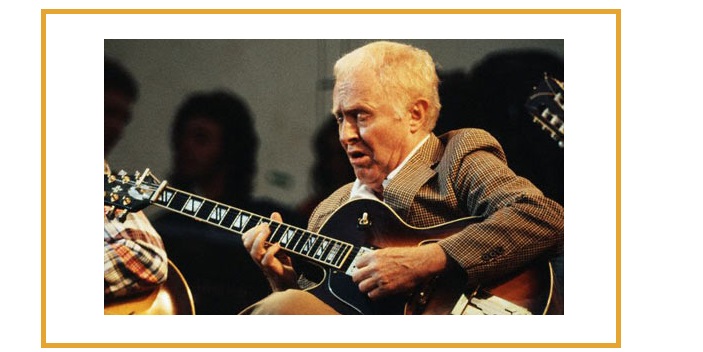
Musicality within the exercises is increased by the addition of a series of rhythmic variations that are applied to the guide-tone lines. Continuing with the concept, full dominant seventh arpeggios are introduced in order to expand the available note choices as a way to build a solid foundation for improvising within harmonic progressions prior to using diatonic scales. By Daniel Andersen from the Journal: Revista de la Lista Electrónica Europea de Música en la Educación Click here to read the full article. *Picture: Jazz Guitar legend Herb Ellis
(Queen’s Park): “Political fundraising in Ontario doesn’t pass the stink test,” says GPO leader Mike Schreiner.
Schreiner is challenging the Liberal government to ban corporate and union donations to political parties in Ontario. The GPO is also pushing the government to amend the Municipal Elections Act to allow municipalities to ban such donations. The City of Toronto has done this, but other municipalities do not have provincial authority to do it.
“People are sick and tired of reading stories about big ticket events that give deep-pocketed insiders special access to Ministers and the Premier,” says Schreiner. “Serious questions about special deals are being raised. Corporate and union donations have no place in politics.”
The federal government banned corporate and union donations to political parties in 2003 and extended the ban to include donations to candidates in 2006. The new Alberta government made banning corporate and union donations their first legislative act in 2015. The GPO believes it is time for Ontario to clean up its act.
“Citizens vote, not corporations,” says Schreiner. “Government policy should be focused on what’s good for the public. Even the perception that big money might have influence in securing special deals or driving policy decisions is bad for democracy. What about the 100 companies being given a free ride under the new cap-and-trade plan? Are any of them donors to the Liberal party?”
The Green Party of Ontario supports campaign finance reforms that ban corporate and union donations, limit third party advertising and provide some public financing for eligible parties.
“It’s past time to get big money out of Ontario politics,” says Schreiner.
The GPO is on a mission to bring honesty, integrity and good public policy to Queen’s Park. For the Silo, Becky Smit
The finishing touches are now being applied to the sixth episode produced by the fans behind Star Trek Continues, and we look forward to a debut screening in May at MegaCon in Orlando. This week, we’re launching another crowdfunding campaign to produce more episodes, which will bring to 10 the number of episodes in our web series. Support us here: https://www.indiegogo.com/projects/star-trek-continues#/ Episode VI — “Come Not Between the Dragons” — is an action-packed, dramatic story that deals with deeply personal issues. It guest stars Gigi Edgley of Farscape fame. And Episode VII — featuring the return of Erin Gray and other surprise guest stars — will, with the help of this campaign, be released in the fall.
Vic Mignogna as Kirk.
Between free viewings on Vimeo and YouTube, our five finished episodes have had more than four million views! And we’re pleased to be recognized with nearly a dozen accolades and awards, and even recognition from The Wall Street Journal, which calls Star Trek Continues “the flagship of the fan film fleet.” First and foremost, Star Trek Continues respectfully and graciously thanks CBS, the holder of the copyright to Star Trek. CBS’ understanding of the passion fans have for Star Trek is second-to-none, and we’re grateful to have the opportunity to pay tribute with our fan-based non-profit web series.
We are in no way affiliated with, nor endorsed by, CBS or Paramount Pictures. This latest campaign is already off to a strong start. And it’s the third time we’ve appealed for support in this way. Late in 2013, our first effort raised enough money to produce episodes 2,3, and 4. Last January, we launched a second crowdfunding campaign to continue our journey and produce two more episodes and build the enormous Engineering set. And that’s precisely what we did. STC’s track record speaks for itself. As deeply committed stewards of our precious fans’ donations, we do what we promise we will do. So many of our previous donors tell us they can’t wait to support us again. One needs only watch an episode to see these generous donations at work. We seek no return other than the joy of paying tribute to TOS — both in the creation of these episodes, and in the privilege of sharing them with beloved fans. All money raised goes to hard costs related to the development, filming, and post-production of these stories, such as:
Set construction, maintenance and materials
Studio rental and maintenance
Monthly utilities costs
Equipment rental
Prop production and replication
Wardrobe production and maintenance
Make-up equipment and supplies
Cast and crew travel, lodging, and food during the shoots
Post-production costs, hard drives, online data storage, etc.
Fundraising costs.
So if you believe in what we’re doing and you’d like to help, now is the time to donate to keep a good thing going.And we’ve got an exciting array of perks for contributors – including a selection of screen-used costumes.
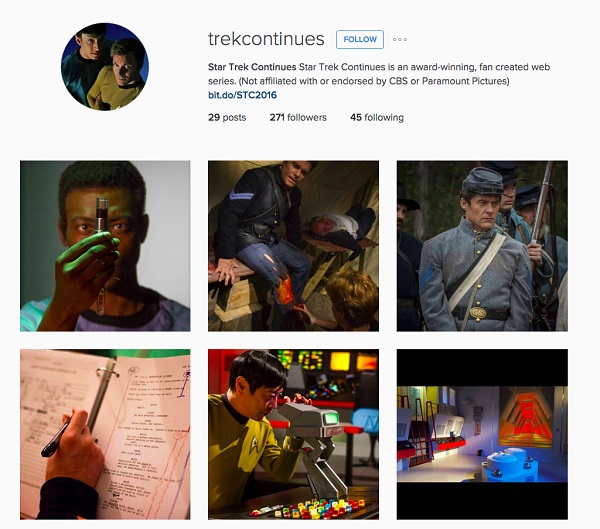
https://www.indiegogo.com/projects/star-trek-continues#/Find STC on Instagram! We are very pleased to announce that now you can follow Star Trek Continues on Instagram! We will be posting never before seen production stills, behind the scenes photos, crew features, concept art from our designers, and more! You can find us there @trekcontinues, and also on Tumblr at stcontinues. Thank you so much for all of your support and enthusiasm. Please continue to follow, like, share, and tell your friends! https://www.instagram.com/trekcontinues/http://stcontinues.tumblr.com/
Trek Prop Fans Relish a Visit to Stage Nine One of the ingredients that makes Star Trek Continues look authentic is attention to detail, and in particular the sets and props designed to look like they came from the soundstages in the 1960’s. The production relies on the skills of dedicated propmakers and fans who donate use of their treasures for our episodes. In December, prop collectors got a chance to tour the Enterprise – including the new Engineering Room – during a private visit to Stage Nine in southern Georgia.
Space.com staff artist Karl Tate came down from New York. His reaction to walking standing sets was typical. “I’ve been aboard the USS Enterprise. That’s all I can say. When you’re walking down that corridor, and the stage lights are lit, and all you see is Enterprise…I’m there,” Tate says. “It’s truly an achievement and I look forward to what Star Trek Continues comes up with next!” The one-day event was filled with special presentations on prop-making, and an opportunity for prop fans to show off their collections and hand-made treasures.
“Many of us have bucket lists, things we want to complete or do in this lifetime. I’ve had such a list since I was a kid. One of the items on my list, one I never thought possible, was to go back in time and see the Star Trek sets at Desilu Studios. Impossible, right? Well, after visiting the Star TrekContinues sets I was able to cross one more item off my bucket list,” explains Larry Chalkey from Virginia. “As I walked the corridors of the Enterprise, I imagined what it must have been like to be there in 1966. What it must have felt like to make the show we all love. This was truly an amazing experience and one I will always treasure.” By Vic Mignogna for The Silo.
Both Celine Dion and Puff Daddy have vastly reduced the prices on their mansion homes, featured this week at TopTenRealEstateDeals.com.
“Celine Drops Price on Florida Water Park Home” Grammy Award-winning Canadian singer Celine Dion and her manager husband, René Angélil, built their dream Florida home on Jupiter Island in 2010. The location offered the privacy the hard working couple wanted to relax with their children and friends and they designed an estate around a series of water features and outdoor sports activities that, along with pristine beachfront, took full advantage of the Florida sunshine and Atlantic Ocean breezes. But even for celebrities who seem to have achieved it all, life can throw curve balls.
For Sale -Now Reduced! Celine Dion’s Florida home.
Though René had successfully fully recovered from a bout of throat cancer in 1999, it reoccurred in 2013 when he had surgery for another malignant throat tumor. Dion announced in 2014 that she would suspend her performances indefinitely due to her husband’s worsening health. In August of 2015, she resumed her Las Vegas residency at Caesar’s Palace, but lost René to cancer in January 2016 and her brother only two days later. The couple and their three children had made the Las Vegas bedroom community of Henderson their home while Dion was performing at Caesar’s Palace. She returned to the stage on February 23rd for the first time since René’s death and paid tribute to his memory and their life together in her first performance.
Their Bahamian-inspired Florida oceanfront estate was first put up for sale in 2013, the year that René was re-diagnosed, for $72.5 million. Over a period of time with no buyer interest, the price was cut to $62.5 million and recently reduced to $45.5 million.
Among many five-star features, the 5.5-acre beachfront property’s centerpiece is the 500,000 gallon water park highlighted by a slow-current lazy river connecting two pools, bridges and a twisting water slide. There is also another pool located beachside. The two-story, 10,000-square-foot main residence has five bedrooms with a second-level wraparound terrace with ocean views and multiple main level terraces. The luxurious master suite walk-in closet has automated carousels for quick access to shoes and clothing at the touch of a finger. The open-plan main level is light and airy in keeping with the subtropical climate. There are also two separate four-bedroom guest houses, tennis house, simulated golf range, pool house and beach house. Celine’s Jupiter neighbors include Michael Jordan and Tiger Woods, and Palm Beach is just a few miles down the road.
Now settled in Nevada at least until the end of her Caesar’s Palace residency in 2019, Celine has stepped up her effort to sell her resort estate by engaging a new brokerage and lowering the asking price. Fenton Lang Bruner & Associates in Jupiter Island holds the listing.
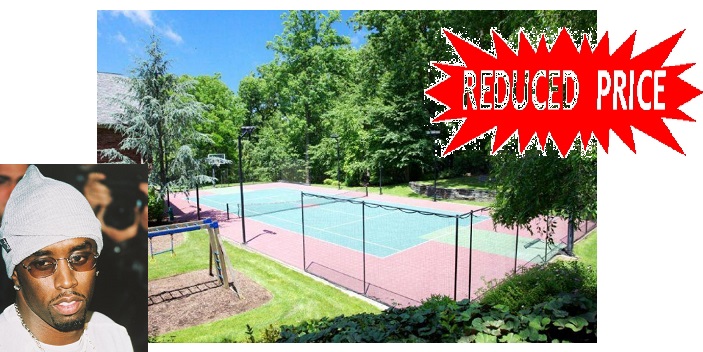
“Puff Daddy’s New Jersey Mansion” Whether called Puff Daddy, Puffy, P. Diddy, or his real name Sean Combs, the Grammy-winning rapper, actor and businessman is frequently in the news, whether for his recordings, his charity or his clothing line. Most recently, he has signed on as Pharrell Williams’ team adviser for season ten of “The Voice.” Listed as number one by “Forbes” as the wealthiest hip hop artist of 2015 with an estimated net worth of $735 million, Sean has reduced the price on his New Jersey mansion several times, now at $7.89 million.
For Sale- Now Reduced!- Puff Daddy’s NJ home.
Combs purchased his elaborate 3.25 acre estate in Alpine in 2004 for $6 million. Built in 1999, the home has all the glamour and amenities expected in the home of one of America’s most popular celebrities. The 8,000-square-foot home has six bedrooms, six baths, foyer with double staircase and expansive formal rooms with walls of glass filling the interior with light. The basement is the activity heart of the home with its own kitchen, wet bar, home theater, an aquarium and another bedroom with full bath. There is also an indoor basketball/racquetball court and a fully equipped gym with full bath. Outside is a swimming pool with waterfall, putting green, a lighted tennis court and a six-car attached garage. Originally, Sean put the property on the market in 2011 at $13.5 million. Without a buyer, he pulled it from the market and relisted it again in 2015 at $8.5 million. Again with no buyer, he has once again dropped the price to $7.89 million. The listing agency is Sotheby’s International in Alpine, New Jersey. For the Silo, Terry Walsh.
For the next month, North Americans will be celebrating and honoring women and their journey throughout history. But it’s also important to look at what’s in store for the future. Right now, more than 9 million women own a business in the U.S.A. alone. It’s all part of a change in tide as women gain more power in the workplace. But this shift has not come easy.
I should know. While I earned millions in the male-dominated industry of RV sales, my climb to the top has been tough. At my first owner’s meeting, they told me to “go home and bake cookies.” Instead, I pushed forward to outsell and out-service all the competition. I decided to stay at the office and build an empire, while paying someone to bake cookies for me.
The “good ole boys” network in the RV industry conspired to keep me out. But I learned to operate in a man’s world, carving out my path to success. Like other women, I have rewritten the rules and redefined the business climate, proving that any woman can succeed in any industry, regardless of gender boundaries.
My life story reads like a bestseller, complete with plot twists and shady characters. I’m a single mother who never completed high school. Early on in my career, a trusted father-figure mentor betrayed me, and on top of that, I was stabbed 21 times and left for dead—a steady dose of stress that should have put me out of commission before my 30th birthday.
While my drive and passion have helped me move forward, there were women in our history that broke down barriers for us all. Look at Lillian Vernon, the CEO of a mail-order empire. Or Debbi Fields, who went home, baked cookies, and made millions.
It was very early on in my life that was met with major hurdles, and many female entrepreneurs in American history will tell you the same. It was “sink or swim, and sinking wasn’t an option. What will keep you going is an inner drive, an inner hunger to prove to yourself and others that anything is possible. Yes, you will encounter many obstacles, but you can always find a way to move around the obstacle. And that’s the key to success.
My advice to any woman out there looking to succeed in business is to maintain your passion. . If you’re just starting out in the workforce, your mentality should be “work to LEARN,” not “work to EARN.” That way, you can get everything you need to be successful in a business of your own.
Remember that failing at one venture can help you become a millionaire, and don’t be afraid to leave your comfort zone. Becoming an unstoppable entrepreneur is all about doing things differently and finding those untapped areas of opportunity. Look at Oprah Winfrey, a media maven who constantly finds new endeavors to strengthen her brand.
Similarly, I have found ways to not only sustain, but also grow my business while my competitors are shutting their doors. Instead of solely relying on RV sales, I started to examine ancillary revenue sources, including an RV rental business, creating an in-house interior design team, and offering customized RVs for every industry, including mobile hair salons and spas, boutiques, and even chiropractor’s offices.
Right now in America, it is an amazing time for women to grow and expand professionally. We must appreciate our new opportunities, and never be afraid to find our entrepreneurial spirit. This Women’s History Month, let’s appreciate the past and charge into the future. For the Silo, Gigi Stetler -author Unstoppable! Surviving is Just the Beginning.

 Is the Alien(s) franchise overdue for an official day of recognition and fan celebration? I think so. Fans of the original 1979 movie and the sequels and prequel that followed are a loyal bunch. They spend money on toys, posters, t-shirts, Blue-ray box sets and some like me, shelled out big bucks in 1987 for a pair of Reebok’s Bugstomper shoes. That’s dedicated fandom.




 “Citizens vote, not corporations,” says Schreiner. “Government policy should be focused on what’s good for the public. Even the perception that big money might have influence in securing special deals or driving policy decisions is bad for democracy. What about the 100 companies being given a free ride under the new cap-and-trade plan? Are any of them donors to the Liberal party?”


 https://www.indiegogo.com/projects/star-trek-continues#/
 Space.com staff artist Karl Tate came down from New York. His reaction to walking standing sets was typical. “I’ve been aboard the USS Enterprise. That’s all I can say. When you’re walking down that corridor, and the stage lights are lit, and all you see is Enterprise…I’m there,” Tate says. “It’s truly an achievement and I look forward to what Star Trek Continues comes up with next!” The one-day event was filled with special presentations on prop-making, and an opportunity for prop fans to show off their collections and hand-made treasures.


 The “good ole boys” network in the RV industry conspired to keep me out. But I learned to operate in a man’s world, carving out my path to success. Like other women, I have rewritten the rules and redefined the business climate, proving that any woman can succeed in any industry, regardless of gender boundaries.