Tag Archives: research and development

Let’s Transform Canada’s AI Research Into Real World Adoption

October, 2025 – Canada has world-class strength in AI research but continues to fall short in widespread adoption, according to a new report from the C.D. Howe Institute. On the heels of the federal government’s announcement of a new AI Strategy Task Force, the report highlights the urgent need to bridge the gap between research excellence and real-world adoption.

In “AI Is Not Rocket Science: Ideas for Achieving Liftoff in Canadian AI Adoption,” Kevin Leyton-Brown, Cinda Heeren, Joanna McGrenere, Raymond Ng, Margo Seltzer, Leonid Sigal, and Michiel van de Panne note that while Canada ranks second globally in top-tier AI researchers and first in the G7 for per capita publications, it is only 20th in AI adoption among OECD countries. “This matters for the economy as a whole, because such knowledge translation is a key vehicle for productivity growth,” the authors say. “It is terrible news, then, that Canada experienced almost no productivity growth in the last decade, compared with a rate 15 times higher in the United States.”

The authors argue that new approaches to knowledge translation are needed because AI is not “rocket science”: instead of focusing on a single industry sector, the discipline develops general-purpose technology that can be applied to almost anything. This makes it harder for Canadian firms to find the right expertise and for academics to sustain ties with industry. Existing approaches – funding academic research, directly subsidizing industry efforts through measures such as SR&ED and superclusters, and promoting partnerships through programs like Mitacs and NSERC Alliance – have not solved the problem.

Four ideas to help firms leverage Canadian academic strength to fuel their AI adoption include: a concierge service to match companies with experts, consulting tied to graduate student scholarships, “research trios” that link AI specialists with domain experts and industry, and a major expansion of AI training from basic literacy to dedicated degrees and continuing education. Drawing on their experiences at the University of British Columbia, the authors show how local initiatives are already bridging gaps between academia and industry – and argue these models should be scaled nationally.

“Canada’s unusual strength in AI research is an enormous asset, but it’s not going to translate into real-world productivity gains unless we find better ways to connect AI researchers and industrial players,” says Kevin Leyton-Brown, professor of computer science at the University of British Columbia and report co-author. “The challenge is not that AI is too complicated – it’s that it touches everything. That means new models of partnership, new incentives, and new approaches to education.”

AI Is Not Rocket Science- 4 Ideas in Detail

Idea 1: A Concierge Service for Matchmaking

We have seen that it is hard for industry partners to know who to contact when they want to learn more about AI. Conversely, it is at least as hard for AI experts to develop a broad enough understanding of the industry landscape to identify applications that would most benefit from their expertise. Given the potential gains to be had from increasing AI adoption across Canadian industry, nobody should be satisfied with the status quo.

We argue that this issue is best addressed by a “concierge service” that industry could contact when seeking AI expertise. While matchmaking would still be challenging for the service itself, it could meet this challenge by employing staff who are trained in eliciting the AI needs of industry partners, who understand enough about AI research to navigate the jargon, and who proactively keep track of the specific expertise of AI researchers across a given jurisdiction. This is specialized work that not everyone could perform! However, many qualified candidates do exist (e.g., PhDs in the mathematical sciences or engineering). Such staff could be funded in a variety of different ways: for example, by an AI institute; a virtual national institute focused on a given application area; a university-level centre like UBC’s Centre for Artificial Intelligence Decision-making and Action (CAIDA); a nonprofit like Mitacs; a provincial ministry for jobs and economic growth; or the new federal ministry of Artificial Intelligence and Digital Innovation.

Having set up an organization that facilitates matchmaking, it could make sense for the same office to provide additional services that speed AI adoption, but that are not core strengths of academics. Some examples include project management, programming, AI-specific skills training and recruitment, and so on. Overall, such an organization could be funded by some combination of direct government support, direct cost recovery, and an overhead model that reinvests revenue from successful projects into new initiatives.

Idea 2: Consultancy in Exchange for Student Scholarships

Many businesses that would benefit from adopting AI do not need custom research projects and do not want to wait a year or more to solve their problems. The lowest-hanging fruit for Canadian AI adoption is ensuring that industry is well informed about potentially useful, off-the-shelf AI technologies. We thus propose a mechanism under which AI experts would provide limited, free consulting to local industry. AI experts would opt in to being on a list of available consultants. A few hours of advice would be free to each company, which would then have the option of co-paying for a limited amount of additional consulting, after which it would pay full freight if both parties wanted to continue. The company would own any intellectual property arising from these conversations, which would thus focus on ideas in the public domain. If the company wanted to access university-owned IP, it could shift to a different arrangement, such as a research contract. This system would work best given a concierge service like the one we just described. The value offered per consulting hour clearly depends on the quality of the academic–industry match, and some kind of vetting system would be needed to ensure the eligibility of industry participants.

Why would an AI expert sign up to give advice to industry? All but the best-funded Canadian faculty working in AI report that obtaining enough funding to support their graduate students is a major stressor. Attempting to establish connections with industry is hard work, and such efforts pay off only if the industry partner signs on the dotted line and matching funds are approved. There is thus space to appeal to faculty with a model in which they “earn” student scholarships for a fixed amount of consulting work. For example, faculty could be offered a one- semester scholarship for every eight hours set aside for meetings with industry, meaning that one weekly “industry office hour” would indefinitely fund two graduate students. Consulting opportunities could also be offered directly to postdoctoral fellows or senior (e.g., post-candidacy) PhD students in exchange for fellowships. In such cases, trainees should be required to pass an interview, certifying that they have both the technical and soft skills necessary to succeed in the consulting role. The concierge service could help decide which industry partners could be routed to PhD students and which need the scarcer consulting slots staffed by faculty members.

The system would offer many benefits. From the industry perspective, it would make it straightforward to get just an hour or two of advice. This might often be enough to allow the company to start taking action towards AI adoption: there is a rich ecosystem of high-performance, reliable, and open-source AI tools; often, the hard part is knowing what tool to use in what way. Beyond the value of the advice itself, consulting meetings offer a strong basis for building relationships between academics and industry representatives, in which the academic plays the role of a useful problem solver rather than of a cold-calling salesperson. These relationships could thus help to incubate Mitacs/Alliance-style projects when research problems of mutual interest emerge (though also see our idea below about how restructuring such projects could help further).

For academics, the system would constitute a new avenue for student funding that would reward each hour spent with a predictable amount of student support. Furthermore, it would offer scaffolded opportunities to deepen connections with industry. The system would come with no reporting requirements beyond logging the time spent on consulting. The faculty member would be free to use earned scholarships to support any student (regardless, for example, of the overlap between the student’s research and the topics of interest to companies), increasing flexibility over the Mitacs/Alliance system, in which specific students work with industry partners. Students who self-funded via consulting would learn valuable skills and would expand their professional networks, improving prospects for post-graduation employment.

Finally, the system would also offer multiple benefits from the government’s perspective. It would generate unusually high levels of industrial impact per dollar spent (consider the number of contact hours between academia and industry achieved per dollar under the funding models mentioned in Section 3). All money would furthermore go towards student training. The system would automatically allocate money where it is most useful, directing student funding to faculty who are both eager to take on students and relevant to industry, all without the overhead of a peer-review process. And it would generate detailed impact reports as a side effect of its operations, since each hour of industry–academia contact would need to be logged to count towards student funding.

Idea 3: Grants for Research Trios

Our third proposal is an approach for expanding the Mitacs/Alliance model to make it work better for AI. Industry–academia partnerships leverage two key kinds of expertise from the academic side: methodological know-how for solving problems and knowledge about the application domain used for formulating such problems in the first place. In fields for which the set of industry partners is relatively small and relatively stable, it makes sense to ask the same academics to develop both kinds of expertise. In very general-purpose domains like AI, it holds back progress to ask AI experts to become domain experts, too. Instead, it makes sense to seek domain knowledge from other academics who already have it. We thus propose a mechanism that would fund “research trios” rather than bilateral research pairings. Each trio would contain an AI expert, an academic domain expert, and an industry partner. This approach capitalizes on the fact that there is a huge pool of academic talent outside core AI with deep disciplinary knowledge and a passion for applying AI. While such researchers are typically not in a position to deeply understand cutting-edge AI methodologies, they are ideally suited to serve as a bridge between researchers focused on AI methodologies and Canadian industrial players seeking to achieve real-world productivity gains. In our experience at UBC, the pool of non-AI domain experts with an interest in applying AI is considerably larger than the pool of AI experts. One advantage of this model is that projects can be initiated by the larger population of domain experts, who are also more likely to have appropriate connections to industry. Beyond this, involving domain experts increases the likelihood that a project will succeed and gives industry partners more reason to trust the process while a solution is being developed. The model meets a growing need for funding researchers outside computer science for projects that involve AI, rather than concentrating AI funding within a group of specialists. At the same time, it avoids the pitfall of encouraging bandwagon-jumping “applied AI” projects that lack adequate grounding in modern AI practices. Finally, it not only transfers AI knowledge to industry, but also does the same to both the domain expert and their students.

Idea 4: Greatly Expanded AI Training

As AI permeates the economy, Canada will face an increasing need for AI expertise. Today, that training comes mostly in the form of computer science degrees. Just as computer science split off from mathematics in the 1960s, AI is emerging today as a discipline distinct from computer science. In part, this shift is taking the form of recognizing that not every AI graduate needs to learn topics that computer science rightly considers part of its core, such as software engineering, operating systems, computer architecture, user interface design, computer graphics, and so on. Conversely, the shift sees new topics as core to the discipline. Most fundamental is machine learning. Dedicated training in AI will require a deeper focus on the mathematical foundations of probability and statistics, building to advanced topics such as deep learning, reinforcement learning, machine learning theory, and so on. Various AI modalities also deserve separate study, such as computer vision, natural language processing, multiagent systems, robotics, and reasoning. Training in ethics, optional in most computer science programs, will become essential.

Beyond dedicated training in the core discipline, we anticipate huge demand for broad-audience AI literacy training; for AI minors to complement other disciplinary specializations; for continuing education and “micro-credential” programs; and for executive education in AI. There is also a growing need for “AI Adoption Facilitators”: bridge-builders who can help established workers in medium-to-large organizations understand how data-driven tools could offer value in solving the problems they face. Training for this role would emphasize business principles and domain expertise, but would also require firmer foundations in machine learning and data science than are currently typical in those disciplines.

Read the full report via our friends at C.D. Howe Institute here.
Audio-Technica Intros NARUKAMI Ultra-High-End Tube Headphone Amplifier & Headphones

STOW, OHIO,USA, March, 2024 — For more than 60 years, Audio-Technica has sought to expand the limits of audio technology. With the introduction of its NARUKAMI ultra-high-end audio products, Audio-Technica has taken the pursuit of analog sound reproduction to a remarkable new level of excellence.

Making their U.S. premiere at CanJam NYC 2024 (March 9 – 10 at the Marriott Marquis, New York), the NARUKAMI HPA-KG NARU Tube Headphone Amplifier and ATH-AWKG Closed-Back Dynamic Wooden Headphones are stunning, ultimate-quality works of audio art.

Narukami- the Japanese thunder god.

Taking their name from the Japanese god of thunder, NARUKAMI products are designed to ignite elemental passions, while embodying the meticulous Japanese craftsmanship that is an Audio-Technica hallmark.

Audio-Technica NARUKAMI HPA-KG NARU Tube Headphone Amplifier

The front and side panels of the HPA-KG NARU tube amplifier/preamplifier (SRP: US$108,000 / CAD$145,400) are crafted from precious kurogaki wood, Japanese black persimmon wood with striking wavy black figuring that can be found nowhere else. The metal mesh covering that protects the vacuum tubes is evocative of the pattern of the flat needles of the Ayasugi tree. The top of the HPA-KG NARU tube amplifier/preamplifier is styled to reflect the appearance of a KARESANSUI or dry landscape garden, representing water flows.

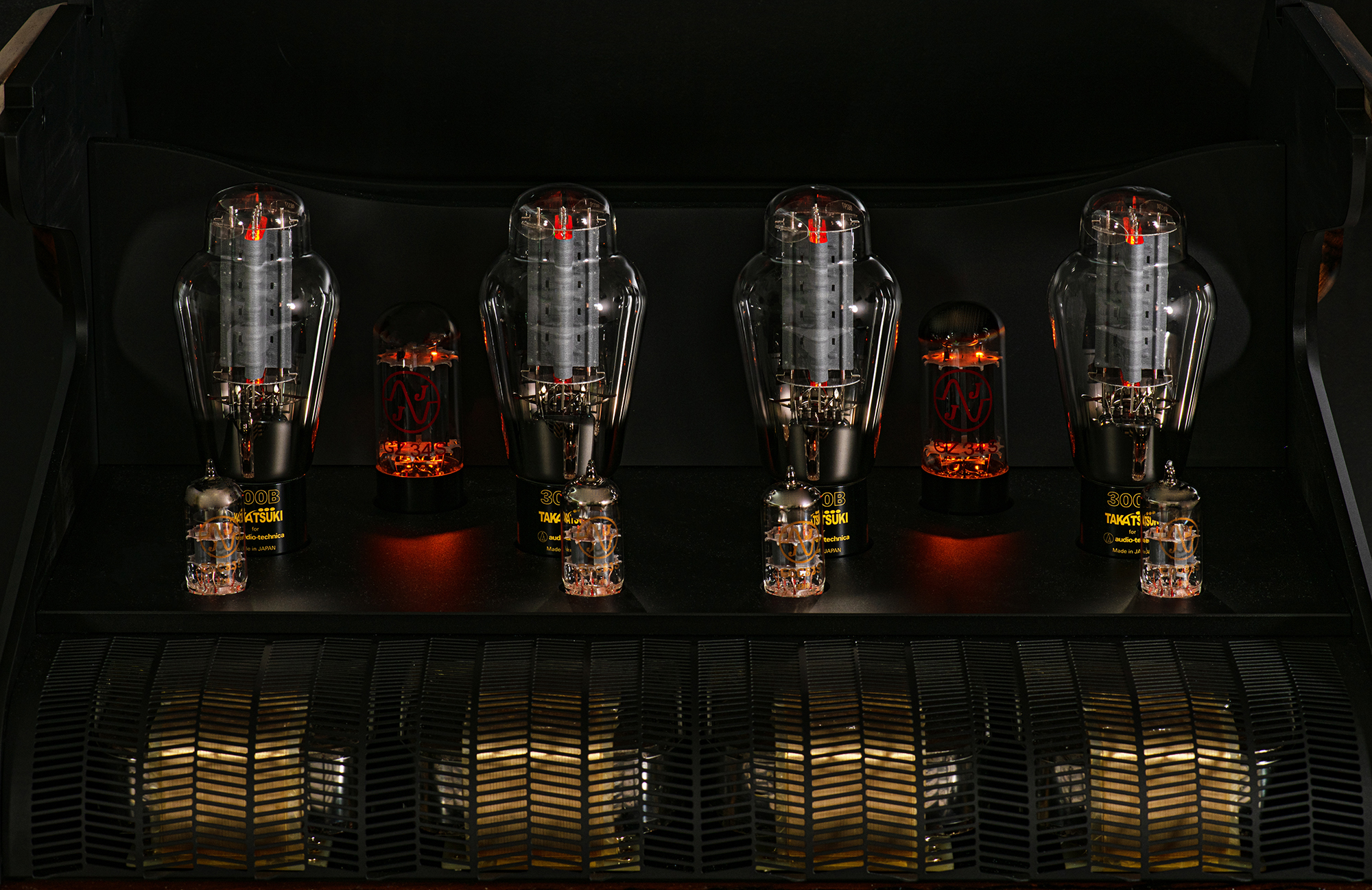
The HPA-KG NARU is as technologically refined as it is beautiful. The headphone amplifier/preamplifier employs four Takatsuki 300B power tubes, considered by connoisseurs to be among the finest of their type ever produced, and with ECC83S gold pin small-signal tubes. The HPA-KG NARU utilizes a dual-mono configuration and has a fully-balanced drive design, for richly detailed sound with remarkable depth and presence. It offers both balanced 4.4 mm and standard 1/4-inch headphone jacks.

The amplifier provides an impedance selector switch to perfectly match with the widest range of headphones. No effort was spared in the quality of the internal components, which include amorphous-core silver-wire Lundahl input and output transformers to deliver the highest level of sonic clarity. In addition to its unsurpassed capabilities as a headphone amplifier, the HPA-KG NARU serves as a preamplifier, and offers balanced and single-ended inputs and outputs. Companion AW-KG NARU headphones are included with the HPA-KG NARU amplifier.

“We spent 10 years creating the HPA-KG NARU amplifier in an arduous process, working our way through 11 prototypes before settling on a design that met our high expectations,” said R&D engineer Koichi Irii. “The lifelike sound of the HPA-KG NARU is a testament to the power of our human approach.”

The ATH-AWKG headphones (SRP: US$4,200 / CAD$5,650) are equally exceptional. Like the HPA-KG NARU, the headphones are handcrafted in Tokyo, Japan, from rare kurogaki wood. In addition to its distinctive appearance, the acoustic properties of the kurogaki housings contribute to the headphones’ extraordinary sound quality. The hand-applied lacquer finish brings out the wood’s natural beauty.

Audio-Technica NARUKAMI ATH-AWKG Closed-Back Dynamic Wooden Headphones

The ATH-AWKG features purpose-designed 53-mm drivers with Permendur magnetic circuitry. Each driver is equipped with a titanium flange and a 6N-OFC high-purity oxygen-free voice coil to ensure precise movement and optimum signal transfer. Audio-Technica’s exclusive D.A.D.S. Double Air Damping System provides smooth, accurate bass response.

The ATH-AWKG is designed for maximum long-wearing comfort, and is supplied with an additional set of ZMF Universe Hybrid earpads for a unique alternate listening experience. The headphones are equipped with Audio-Technica’s A2DC jacks and two 9.8-foot (3.0 mm) detachable cables with 4-pin balanced and standard 1/4-inch jacks. Adding to its elegance, the ATH-AWKG comes in a presentation box with kurogaki wood accents.

Audio-Technica was founded in 1962 with the mission of producing high-quality audio for everyone.

Though these latest releases are aimed at those with deep pockets and the means to buy the ultimate in design and offering, we have grown in other areas and just as importantly to design critically acclaimed headphones, turntables and microphones at all price points. We have retained the belief that great audio should not be enjoyed only by the select few, but accessible to all. Building upon our analog heritage, we work to expand the limits of audio technology, pursuing an ever-changing purity of sound that creates connections and enriches lives.

Ontario Set to be First Province to test Auto-driving Vehicles and Technology

Ontario First to Test Automated Vehicles on Roads in Canada

Province Supports Innovation in Transportation Technology


You should take auto-driving cars seriously- every major Auto manufacturer is venturing forward with concepts like this one- GM's EN-V
You should take auto-driving cars seriously- every major Auto manufacturer is venturing forward with concepts such as this one from General Motors- the GM EN-V


Ontario is launching a new pilot to allow for the testing of automated vehicles on Ontario roads.


Automated vehicles are driverless or self-driving vehicles that are capable of detecting the surrounding environment using artificial intelligence, sensors and global positioning system coordinates. Automated and connected vehicle technologies have the potential to help improve fuel efficiency as well as reduce traffic congestion, greenhouse gas emissions and driver distraction.


Beginning on January 1, 2016, Ontario will lead Canada as the first province to test automated vehicles and related technology on-road. Currently there are nearly 100 companies and institutions involved in the connected vehicle and automated vehicle industry in the province. The pilot will enable those companies to conduct research and development in Ontario rather than in competing jurisdictions, as well as support opportunities to bring automated vehicles to market.


The province is also pledging an additional $500,000 in funding to the Ontario Centres of Excellence Connected Vehicle/Automated Vehicle Program, in addition to the $2.45 million in funding recently provided. The program brings academic institutions and business together to promote and encourage innovative transportation technology.


Ensuring Ontario’s place as a world leader in the auto, transportation, information and communications technology sectors are part of the government’s plan to build Ontario up. The four-part plan includes investing in people’s talents and skills, making the largest investment in public infrastructure in Ontario’s history, creating a dynamic, innovative environment where business thrives, and building a secure retirement savings plan.

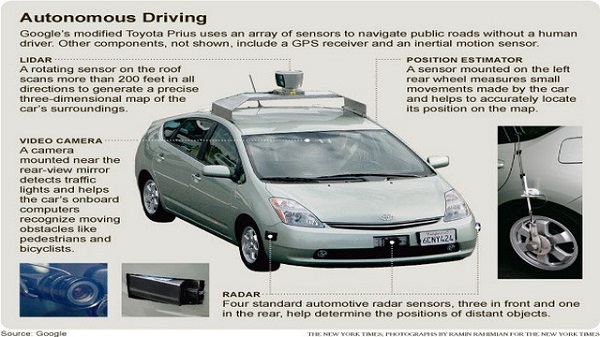
Not all concepts are futuristic looking such as Google's modded Prius. We're betting Ontario will test more conservatively styled auto-drivers such as this one. CP
Not all concepts are futuristic looking such as Google’s modded Prius. We’re betting Ontario will test more conservatively styled auto-drivers such as this one. CP image: New York Times

QUOTE


“In the world of transportation, Ontario has the opportunity to show leadership on automated technology. Today, Ontario is making its claim in the global marketplace by taking the next steps in automated vehicle innovation. The automated vehicle pilot will ensure that the province’s roads remain safe without creating burdens that stifle investment and innovation in Ontario’s dynamic business environment.”

— Steven Del Duca, Minister of Transportation


“Ontario is a global leader in developing and manufacturing the next generation of vehicles.

This new pilot program will build on our success, and help Ontario lead the development of automated and connected car technologies. In this highly competitive global economy, investing in people’s talents and skills to create the next generation of innovative technologies is good for business, and can help lead to the easier movement of goods and services across the province.”

— Brad Duguid, Minister of Economic Development, Employment and Infrastructure


QUICK FACTS


  • Information about applying for the pilot will be available online from the Ministry of Transportation in late November.
  • The Institute of Electrical and Electronics Engineers forecast that by 2040, autonomous vehicles will account for 75 per cent of all vehicles on the road.


LEARN MORE


Ontario Investing in the Next Generation of Connected Vehicles

Connected Vehicle/Automated Vehicle (CVAV) Research Program


Who wouldn't want to ride/drive Chevrolet's FNR concept car?
Who wouldn’t want to ride/drive Chevrolet’s FNR concept car?


Disponible en français:
L’Ontario est la première province à mettre à l’essai les véhicules automatisés La province encourage l’innovation dans les technologies des transports 
L’Ontario lance un projet pilote en vue de la mise à l’essai de véhicules automatisés sur ses routes.
Les véhicules automatisés sont des véhicules sans chauffeur ou autoconduits qui peuvent détecter l’environnement avoisinant grâce à l’intelligence artificielle, aux capteurs et aux coordonnées fournies par le système de positionnement global. Les technologies relatives aux véhicules automatisés et connectés ont le potentiel d’améliorer le rendement du carburant et de réduire la congestion routière, les émissions de gaz à effet de serre et la distraction au volant.
Dès le 1er janvier 2016, l’Ontario sera le premier lieu au Canada à mettre à l’essai les véhicules automatisés et les technologies connexes sur la route. Près d’une centaine d’entreprises et d’établissements œuvrent actuellement dans le secteur des véhicules connectés et automatisés dans la province. Le projet pilote permettra à ces entreprises de mener des activités de recherche et de développement en Ontario plutôt que dans les territoires concurrents, en plus de créer des possibilités qui favoriseront l’introduction des véhicules automatisés sur le marché.
La province s’engage aussi à injecter 500 000 $ de plus dans le Programme de recherche sur les véhicules connectés et autonomes par l’intermédiaire des Centres d’excellence de l’Ontario, outre le financement de 2,45 millions de dollars récemment alloué. Ce programme réunit des établissements universitaires et des entreprises en vue de promouvoir les technologies de transport novatrices et d’encourager leur utilisation.
S’assurer de faire de l’Ontario un chef de file mondial dans les secteurs de l’automobile, du transport et des technologies de l’information et des communications s’inscrit dans le plan du gouvernement visant à renforcer la province. Ce plan comprend quatre volets : investir dans les talents et les compétences de la population, faire le plus important investissement dans l’infrastructure publique de l’histoire de l’Ontario, créer un environnement dynamique et novateur où les entreprises prospèrent, et établir un régime d’épargne-retraite sûr.
CITATIONS
« L’Ontario a l’occasion de montrer l’exemple par le recours à la technologie automatisée dans le domaine des transports. L’Ontario marque aujourd’hui le marché mondial de son empreinte en franchissant une nouvelle étape pour stimuler l’innovation dans l’automatisation des véhicules. Le projet pilote sur les véhicules automatisés sera mis en œuvre de façon à s’assurer que les routes de la province restent sûres sans créer des fardeaux qui étoufferaient l’investissement et l’innovation dans le dynamique environnement commercial de l’Ontario. »— Steven Del Duca, ministre des Transports
« L’Ontario est un chef de file mondial dans la conception et la fabrication de la prochaine génération de véhicules. Ce nouveau projet pilote misera sur notre succès et aidera la province à prendre les devants dans le développement des technologies des véhicules automatisés et connectés. Dans cette économie mondiale hautement concurrentielle, le fait d’investir dans les talents et les compétences de la population afin de créer la prochaine génération de technologies innovatrices est bon pour les affaires et peut faciliter un mouvement plus fluide des biens et des services dans l’ensemble de la province. »— Brad Duguid, ministre du Développement économique, de l’Emploi et de l’Infrastructure
FAITS EN BREF

  • Le ministère des Transports offrira de l’information en ligne sur la présentation de demandes dans le cadre du projet pilote à la fin novembre.
  • L’Institut des ingénieurs électriciens et électroniciens prévoit que les véhicules autonomes compteront pour 75 p. 100 de tous les véhicules sur la route d’ici 2040.

 POUR EN SAVOIR DAVANTAGE
Soutenir l’innovation dans les technologies de transportProgramme de recherche sur les véhicules connectés et autonomes

BenQ releases Curved 35-Inch Immersive Gaming Display

COSTA MESA, Calif.  — BenQ America Corp., an internationally renowned digital lifestyle solutions provider and professional gaming monitor pioneer, today introduced the company’s all-new XR3501 curved gaming display. Designed to provide a more immersive gaming experience, the 35-inch panel brings gamers a dramatic 2,000R curvature — the highest of any LCD monitor — as well as a lightning-fast 144-Hz refresh rate, ultra-wide 21:9 aspect ratio, and BenQ’s RevolutionEyes™ technology — allowing gamers to experience enhanced visual comfort, a larger viewing area, and seamless peripheral views for a more authentic sense of engagement with today’s dynamic content.

35-Inch PC Display Featuring 2,000R Curvature and 144-Hz Refresh Rate Adds a New Level of Entertainment.

“BenQ’s new XR3501 monitor is set to transform gaming into a faster, wider, and more engaging all-around experience,” said J.Y. Hu, Vice President, Business Line Management at BenQ America Corp. “Featuring a 2-meter curvature, a fast-action refresh rate, and a 2560×1080 resolution, the panel provides breathtaking visuals that surround users with edge-to-edge excitement. Players will experience their favorite games in an entirely new way while features such as Black eQualizer, RevolutionEyes technology, and PIP will definitely put them ahead of the pack.”

BenQ’s XR3501 monitor has been designed for casual gamers looking for a more enveloping gaming experience. With over 20 options for color vibrance, the VA panel provides higher color reproduction with better viewing angles, which proves vital when using such a large curved screen by adding an extra layer of color optimization. Users can also adjust color levels directly via OSD or DisplayPilot for complete color control. Using Black eQualizer, the panel brightens darker scenes within games without over-exposing white levels — giving gamers the advantage of seeing details more clearly than their competitors, while picture in picture allows multiple sources to be connected and viewed on the monitor. 

With a focus on “Eye-Care” and visual comfort, the XR3501 is equipped with BenQ’s RevolutionEyes technology. Featuring ZeroFlicker™, the monitor eliminates flickering at all brightness levels, reducing visual strain to provide a more comfortable viewing experience. When combined with the device’s built-in Low Blue Light modes, the monitor also successfully filters the exposure of emitted blue spectrum light — effectively reducing eye fatigue and elevating gaming performance to provide exceptional visual comfort, even during long hours of gaming or dynamic content viewing.

BenQ’s curved XR3501 monitor is now shipping across North America at an MSRP of USD$999. Details on BenQ’s full line of gaming monitors can be found at http://gaming.benq.com.


About BenQ America Corp. 
The BenQ digital lifestyle brand stands for “Bringing Enjoyment ‘N’ Quality to Life,” fusing lifestyle with technology, enjoyment with productivity, and aesthetic design with purpose-built engineering. It is this mantra that has made BenQ the No. 1-selling projector brand powered by TI DLP® technology in The Americas(1). BenQ America Corp. offers an extensive line of visual display and presentation solutions that incorporate the very latest technologies. The company delivers a broad range of Colorific™ projectors, RevolutionEyes™ monitors, interactive large-format displays, mobile audio products, cloud consumer products, and lifestyle lighting for any application and market — education, home, gaming, enterprise, government, house of worship, digital signage, A/V, and IT — with cutting-edge models that lead the industry in performance, reliability, environmental sustainability, and aesthetics. Whether it’s interactive digital whiteboards for classrooms, full HD 3D projectors for home theaters, short-throw projectors for boardrooms, interactive flat-panel displays for digital signage, or LED-backlight monitors for professional gaming, BenQ continues to defy the limits of digital displays. The company’s products are available across North America through leading value-added distributors, resellers, and retailers. 


(1) Based upon Q1’15 Quarterly Projector Shipment and Forecast Report from PMA Research

About BenQ Corporation
Founded on the corporate vision of “Bringing Enjoyment ‘N’ Quality to Life”, BenQ Corporation is a world-leading human technology and solutions provider aiming to elevate and enrich every aspect of consumers’ lives. To realize this vision, the company focuses on the aspects that matter most to people today — lifestyle, business, healthcare, and education — with the hope of providing people with the means to live better, increase efficiency, feel healthier, and enhance learning.

Click to view on I-tunes

Such means include a delightful broad portfolio of people-driven products and embedded technologies spanning digital projectors, monitors, interactive large-format displays, audio products, cloud consumer products, mobile communications, and lifestyle lighting. Because it matters. 

About BenQ Group
The BenQ Group is a $22+ billion powerhouse comprised of nearly 20 independent companies operating in over 30 countries across numerous industries with a combined workforce of over 100,000 employees. Each Group member is a recognized leader in its own field, contributing to the BenQ Group’s vast resources, broad R&D, and distinct strategic strengths. By leveraging each company’s vertical specialization to create true scale across horizontal markets, the BenQ Group controls a highly efficient value chain with the unrivaled ability to deliver critical components and world-class solutions in the following industries: TFT-LCD, green energy, fine chemicals and advanced materials, lighting, IC design, precision components, system integration, branded business, and service. The Group is committed to profitable and sustainable businesses that share its long-standing vision of Bringing Enjoyment ‘N’ Quality to Life. The BenQ Group companies are: BenQ Corporation, AU Optronics Corporation (world’s top manufacturer of large-size TFT-LCD panels), Qisda Corporation, Darfon Electronics Corporation, BenQ ESCO Corp., BenQ Materials Corp., BenQ Guru Corp., BenQ Medical Center, BenQ Medical Technology Corp., BenQ AB DentCare Corp., Daxin Materials Corp., Dazzo Technology Corp., Forhouse Corp., Lextar Electronics Corp., LILY Medical Corp., and Raydium Semiconductor Corp.

All trademarks and registered trademarks mentioned herein are the property of their respective owners.

Ont. Liberals – Our Province Second Only To California For Foreign Direct Investment

Today Minister of Economic Development and Innovation Brad Duguid announced that Ontario is partnering with companies for projects that will help create 550 new jobs and protect 1,056 existing jobs for families. The province is supporting company investments which will create new jobs for families, help spur growth and strengthen local economies.  These new jobs build upon the 97,700 net new jobs that have already been created in Ontario so far this year alone.

Ontario Helps Create Jobs
McGuinty Government Partners With Companies To Strengthen The Economy
NEWS October 27, 2011

Ontario is partnering with companies for projects that will help create 550 new jobs and protect 1,056 existing jobs for families.  The province is supporting company investments which will create new jobs for families, help spur growth and strengthen local economies.  These new jobs build upon the 97,700 net new jobs that have already been created in Ontario so far this year alone.
In the face of global economic uncertainty, Ontario continues to provide strong and stable business conditions which are helping companies create jobs with new
investments across the province. Partnering with local businesses and supporting business is part of the McGuinty government’s plan
Silo Direct Link to Ontario Government Budgets Website  in moving forward to create and support new and existing jobs across the province.

QUOTES
“The foundation of Ontario’s economy is our skilled workers and innovative companies.  Our government will continue its proactive approach to partner with business and industry. We will invest strategically to help companies grow, create jobs and help Ontario progress in this period of economic uncertainty.”
– Brad Duguid, Minister of Economic Development and Innovation
QUICK FACTS
*                     Since October 2003, Ontario has created 524,100 new jobs.

*                     In 2010, Ontario was named a top destination for foreign direct investment in North America, second only to California. The province attracted a total of 127 Foreign Direct Investment projects, which created more than 11,200 jobs.

*                     In June of this year, Ontario created more jobs than the rest of Canada and the United States combined.

*                     KPMG calculates that Ontario has an 11.3 per cent cost advantage for research and development relative to the United States.

*                     As a result of the tax changes implemented in Ontario, taxes on business investment were cut in half, making Ontario more competitive and encouraging business growth.

LEARN MORE

Read Ontario’s Progress Report 2011
Silo Direct Link to Ontario Governments Progress Report Website Check out government-funded programs and services.

Visit the Ministry of Economic Development and Innovation’s Silo Direct Link to Ministry of Economic Development and Innovation Website  website for comprehensive economic and trade news, including a toolkit for businesses.
Andrew Block, Minister Duguid’s Office, 416-276-0511
Neil Trotter, Communications Branch, 416-325-6716
Silo Direct Link to Ontario Governments Economy News Website

Disponible en français
NOUVELLES
Ministère du Développement économique et de l’Innovation

L’Ontario contribue à la création d’emplois
Le gouvernement McGuinty fait équipe avec des entreprises pour renforcer l’économie
NOUVELLES                                                                           Le 27 octobre 2011

L’Ontario fait équipe avec des entreprises en vue de réaliser des projets qui permettront de créer 550 nouveaux emplois et de protéger 1 056 emplois existants
pour les familles. La province aide les entreprises à faire des investissements qui créeront de nouveaux emplois pour les familles, stimuleront la croissance et renforceront les économies locales. Ces nouveaux emplois s’ajoutent aux quelque 97 700 nouveaux emplois nets qui ont déjà été créés en Ontario depuis le début de l’année.
Alors que la situation économique mondiale est incertaine, l’Ontario continue d’offrir aux entreprises un environnement solide et stable qui les aide à créer des
emplois en faisant de nouveaux investissements dans toute la province. Faire équipe avec des entreprises locales et donner du soutien aux entreprises sont
deux éléments du plan du gouvernement McGuinty de créer de nouveaux emplois et de maintenir les emplois existants dans la province.
www.fin.gov.on.ca/en/budget/ontariobudgets/2011/index.html
CITATION
« Les travailleurs spécialisés et les entreprises innovantes constituent le fondement de l’économie ontarienne. Notre gouvernement maintiendra sa démarche
proactive en faisant équipe avec les entreprises et l’industrie. Nous ferons des investissements stratégiques pour aider les entreprises à prendre de l’expansion, à
créer des emplois et à contribuer à la croissance de l’Ontario en cette période d’incertitude économique. »

– Brad Duguid, ministre du Développement économique et de l’Innovation

FAITS EN BREF
*                     Depuis octobre 2003, l’Ontario a créé 524 100 nouveaux emplois.

*                     En 2010, la province de l’Ontario figurait au deuxième rang des principales destinations pour les investissements directs étrangers en Amérique
du Nord, après la Californie. La province a attiré au total 127 projets d’investissement direct étranger qui ont créé plus de 11 200 emplois.

*                     En juin, l’Ontario a créé plus d’emplois que le reste du Canada et les États-Unis combinés.

*                     D’après KPMG, l’Ontario dispose d’un avantage de 11,3 % au niveau des coûts par rapport aux États-Unis en matière de recherche-développement.

*                     Par suite des modifications fiscales apportées en Ontario, les impôts sur les investissements des entreprises ont été réduits de moitié, ce qui rend la province plus compétitive et favorise la croissance des entreprises.
POUR EN SAVOIR DAVANTAGE
Consultez le Rapport d’étape 2011
http://www.ontario.ca/fr/initiatives/ProgressReport2011/ONT05_039201.html  de l’Ontario.
Renseignez-vous sur les programmes et services financés par le gouvernement http://www.ontario.ca/fr/business_program/index.htm  destinés aux entreprises
ontariennes.
Visitez le site Web du ministère du Développement économique et de l’Innovation http://www.ontariocanada.com/ontcan/1medt/fr/home_fr.jsp  pour obtenir des
nouvelles détaillées sur l’économie et le commerce, ainsi qu’une trousse destinée
aux entreprises.

Andrew Block, bureau du ministre Duguid, 416 276-0511
Neil Trotter, Direction des communications, 416 325-6716
www.ontario.ca/economie-nouvelles