Tag Archives: Old Faithful

Yellowstone: The World’s First National Park

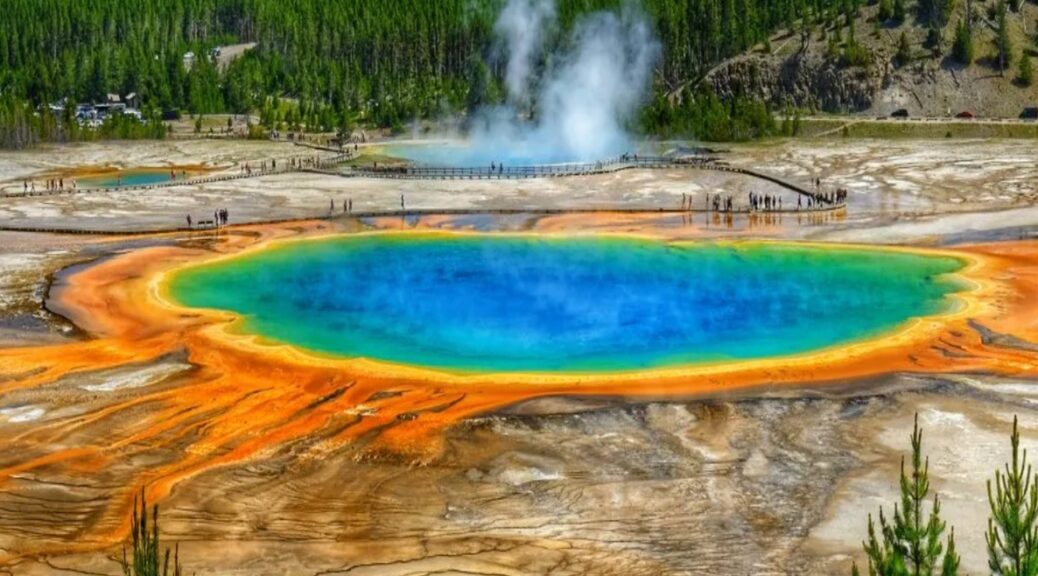
People walking on boardwalk around Grand Prismatic Spring at Yellowstone National Park (© Vaa Eriksen/Adobe)
The Grand Prismatic Spring is among the Yellowstone sites created by underground volcanic activity. (© Vaa Eriksen/Adobe)

With its fluorescent natural wonders and diverse wildlife, Yellowstone National Park attracts 4.5 million visitors each year.

The world’s first national park was created on March 1, 1872, when President Ulysses S. Grant signed the Yellowstone National Park Protection Act. The law decreed that the headwaters of the Yellowstone River be “dedicated and set apart as a public park or pleasuring-ground for the benefit and enjoyment of the people.” The decision led to the creation of the National Park Service, which now protects more than 400 sites  across the United States.

What are Geysers?

Sprinkled amid the hot springs are the rarest fountains of all, the geysers. What makes geysers rare and distinguishes them from hot springs is that somewhere, usually near the surface in the plumbing system of a geyser, there are one or more constrictions.

Geysers are hot springs with constrictions in their plumbing, usually near the surface, that prevent water from circulating freely to the surface where heat would escape. The deepest circulating water of the system can exceed the surface boiling point of water (199°F/93°C). Surrounding pressure increases with depth, much as it does with depth in the ocean. Increased pressure exerted by the enormous weight of the overlying water and rock prevents the water from boiling. As the water rises due to heating, steam forms and expands, increasing pressure in the constricted plumbing near the surface. At a critical point, the confined bubbles actually lift the water above the surface vent, causing the geyser to splash or overflow. This decreases pressure on the system, and violent boiling results. Tremendous amounts of steam force water out of the vent, and an eruption begins. Water is expelled faster than it can enter back into the geyser’s plumbing system, and the heat and pressure gradually decrease. The eruption stops when the water reservoir is depleted or when the system cools.

There are more geysers in Yellowstone than anywhere else on Earth. Old Faithful, certainly the most famous geyser, is joined by numerous others big and small, named and unnamed. Though born of the same water and rock, what is enchanting is how differently they play in the sky. Riverside Geyser, in the Upper Geyser Basin, shoots at an angle across the Firehole River, often forming a rainbow in its mist. Castle Geyser erupts from a cone shaped like the ruins of some medieval fortress. Grand Geyser explodes in a series of powerful bursts, towering above the surrounding trees. Echinus Geyser spouts up and out to all sides like a fireworks display of water. And Steamboat Geyser, the largest in the world, pulsates like a massive steam engine in a rare, but remarkably memorable eruption, reaching heights of 300 to 400 feet.

Vastness of Yellowstone

While mostly in Wyoming, Yellowstone’s 2.2 million acres (8,900 square kilometers) extend into neighboring Idaho and Montana. The massive park covers an area larger than the U.S. states of Delaware and Rhode Island combined.

People watching geyser erupting (© Wasin Pummarin/Adobe)
Spectators watch an Old Faithful eruption. (© Wasin Pummarin/Adobe)

Yellowstone was established to protect an extraordinary collection of 10,000 thermal features, including geysers, hot springs, fumaroles and boiling mud pots created by underground volcanic activity. With 500 geysers, the park has more than half of all the world’s erupting hot springs.

While waiting for Old Faithful, the world’s most famous geyser, is a Yellowstone tradition, the park also boasts abundant wildlife viewing opportunities. With the largest concentration of mammals on the U.S. mainland, Yellowstone is home to bison — the U.S. national mammal — as well as black bears, bighorn sheep, deer, elk, moose and mountain goats.

You may also glimpse predators, such as one of the 1,000 grizzly bears known to inhabit the area, along with lynx, wolverines and wolves.

Bison licking calf (© Michael Underwood/Adobe)
A mother bison cares for her calf. (© Michael Underwood/Adobe)

Bird lovers will relish the opportunity to see 300 species of birds. The park service provides a checklist for bird watchers hoping to spot them all.

While Yellowstone offers something in every season, services are limited from early November through late April. Bad weather can change road conditions at any time, so check operating dates  and conditions before visiting.

For those unable to visit, Yellowstone’s 10 webcams  offer glimpses of the park. So whether you’re planning to feel the mist from an Old Faithful eruption or looking for a brief virtual escape, Yellowstone offers an experience unlike any other. For the Silo, Jarrod Barker.

Featured image- Daphne Zheng via Getty Images
Early-season snowstorm snarls travel throughout Rocky Mountains

A yardstick / meterstick was needed to measure snow in one part of Montana, and the disruptive storm proved “irritating” for one motorist in the middle of a 20-plus-hour drive.

Autumn is in full swing across the United States with Halloween candy filling the shelves at grocery stores and pumpkin spice-flavored beverages being served up at coffee shops across the country. But one region just had a full-scale preview of winter.

The first widespread snowstorm of the season blanketed the Intermountain West over the weekend and through the first part of the week, causing disruptions from the mountains of Montana to the rim of the Grand Canyon.

AccuWeather National News Reporter Bill Wadell was in Montana for the storm where some trees were still sporting vibrant foliage amid the wintry scene.

The storm left behind more than a winter wonderland.

Over a foot of snow / 0.3 M blanked parts of the northern Rockies, including the higher elevations of Montana and Wyoming. Thundersnow was even reported amid some intense bursts of snow.

A yardstick / meterstick was also required to measure the accumulation in Pony, Montana, where snow totals approached the 30-inch / 76.2 cm mark in just 24 hours.

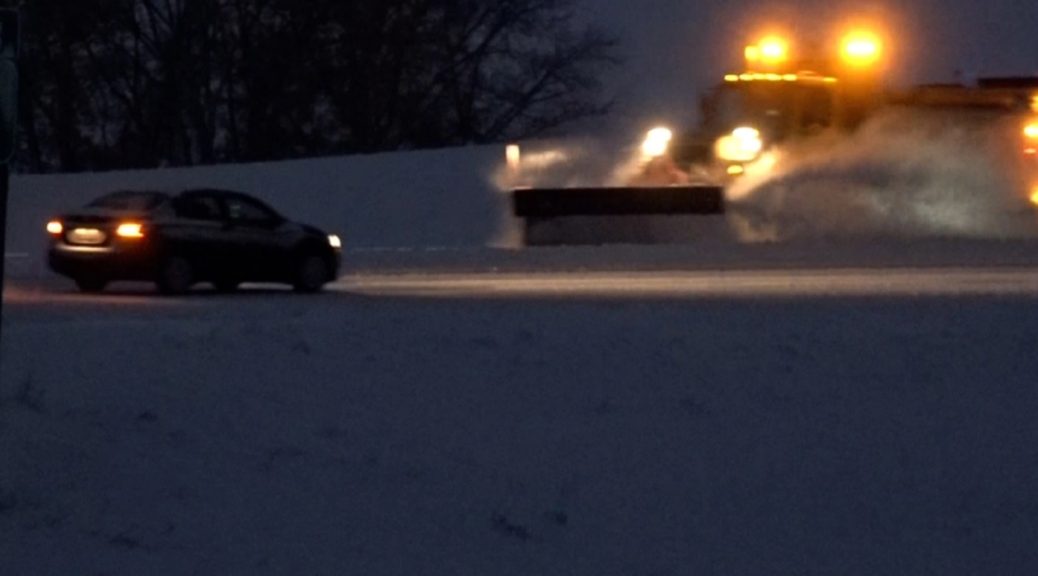
Traffic through mountain passes, such as Bozeman Pass in Montana, ground to a halt at times as poor road conditions clogged the roads for a time. Traffic was flowing again at Bozeman Pass by Tuesday afternoon, although the snow was still slowing down some traffic.

A 50-mile / 80.4 km stretch of Interstate-25 reopened on Wednesday after being closed for almost 24 hours due to the winter storm, Wadell reported. Some sections of Interstates 25, 80 and 90 remained closed in Wyoming as of late Wednesday morning.

In Buffalo, Montana, Wadell caught up with Spokane, Washington, resident Sonia Lasoya, who was hitting plenty of wintry hurdles in her cross country drive to Uvalde, Texas. In Buffalo, off of Interstate 90, Lasoya saw those travel plans run into closed road signs due to the heavy snow.

“It is irritating because I’ve got 20 more hours to go yet, so now hopefully they’ll open the road, but we don’t even know if they’ll open it,” she said.

With a bag full of clothes packed for the warm weather of Texas, Lasoya said she wasn’t totally prepared to have to spend a night stuck in the cold grip of an early-season storm.

“I had this coat, which is really warm. I didn’t really pack warm clothes because it’s like 85 down there in Uvalde,” she said. “I’m not really ready for winter yet, but up in Spokane they kind of start to winterize early… I guess I’m in denial.”1/11

Heavy snow caused I-25 to close in Buffalo, Wyoming October 12. Bill Wadell reports.

In other areas of the region, colorful leaves still clung to trees, wreaking power outage havoc for some. Sheridan, Wyoming, resident Phil Jackson told Wadell that seeing the mix of fall foliage and wintry precipitation was an uncommon alignment, but something he felt prepared for.

“It’s not something we normally get every year in October, but it can happen and it’s something to be prepared for,” Jackson said. “Because a lot of the leaves are still on the tree, that’s the big deal, it’s usually the heavy wet spring type snow that can cause some havoc, but it can happen.”

Jackson told Wadell that his house, along with many of his neighbors, lost power as “6 to 8 inches ” / 15.2 to 20.3 cm fell, although he said it was hard to measure because of how quickly it melted on the ground.

After such a sweltering summer, he added, the quick turn to winter was a shock, but not all that unwelcomed.

“For this year, it’s been a hot, dry summer so I don’t mind the wet snow at all, but it can play havoc with you,” he said. “It doesn’t usually happen, but I’m not surprised, just the nature of it. Branches coming down, there are branches coming down all over the place. Just the nature of it.”

Sonia Lasoya told AccuWeather National Reporter she was in the midst of a cross-country drive from Washington to Texas when the snowstorm snarled her travel plans. (AccuWeather/Bill Wadell)AccuWeather / Bill Wadell

Yellowstone National Park was one of the more mountainous areas that saw snow with the steam from Old Faithful blending into the snowy scenery surrounding the famous geyser.

Over 500 miles / 804.6 km to the southwest, snow was also accumulating at the rim of the Grand Canyon with park officials warning visitors of snow-packed and icy roads on Tuesday morning.

The same system responsible for the snow also sent chilly air across the region. No daily record lows were broken, but temperatures did dip as much as 15 to 30 degrees Fahrenheit / 9.4 to 18.8 C below normal.

The mercury in Missoula, Montana, dipped down to 17 F / -8.3C early Tuesday morning, the lowest temperature in the town since Feb. 28.

It was not quite as cold in Salt Lake City, but residents had to bundle up when stepping outside on Tuesday morning when AccuWeather RealFeel® Temperatures bottomed out at 20 F / -6.7 C.

The early-season snowstorm may have been disruptive, but it did have some benefits.

“Some people are not ready for this blast of winter weather, but the snow and cold is a welcome relief for fire crews that have been battling wildfires out here for weeks,” Wadell said.

The rain and snow are also a step in the right direction to help with the widespread drought across the interior West, although this storm was just a drop in the bucket for what is needed to end the long-term drought. For the Silo, AccuWeather Public Relations, State College, PA, USA.