Tag Archives: Karen Hayhurst

Would You Use AI For Buying A Car? One In Four Buyers Already Do

A recent consumer survey backed by similar results from Elon University reveals that AI adoption for car shopping is skyrocketing, rapidly becoming a standard part of the automobile buying process. This as fully one in four buyers have already used AI tools this year to research, compare prices, negotiate and otherwise outsmart dealerships, and an overwhelming 88% found it helpful. Signaling a seismic shift in the way North Americans are now shopping for cars, nearly half of consumers indicated plans to use AI in their next purchase. Not just for buyer benefits, dealerships are gleaning critical business intelligence from AI to inform sales strategies, train staff and elevate customer engagement. The below  report from our friends at CarEdge, which offers its own AI Negotiator car buying tool saving shoppers thousands, details the first data-backed look at how AI tools are reshaping the car buying experience.
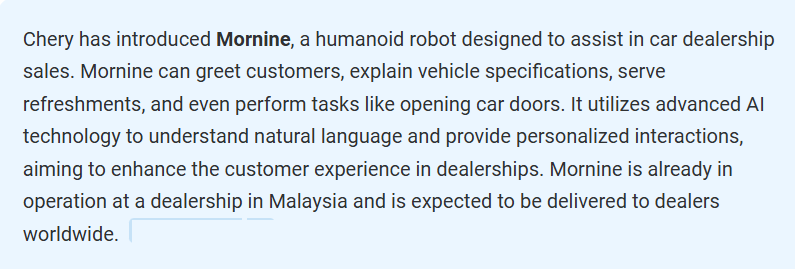

Mornine- AI powered car dealership robot.

Study: 1 in 4 Car Buyers Tap AI for Better Deals


Artificial intelligence is changing the way North Americans buy cars, and it’s a transition that is happening quickly. In the first-ever survey of its kind, CarEdge asked 500 car shoppers if they’re using AI tools like ChatGPT to research, compare, and negotiate during the car buying process. The results confirm a major shift is underway. One in four car buyers in 2025 are already using AI tools to gain an edge, and future buyers are even more likely to embrace these technologies.

Car buyers are finding AI to be a valuable tool. Among those who used tools like ChatGPT, Perplexity, Google Gemini, and others, 88% said it was helpful. AI is quickly becoming a trusted co-pilot for car buyers.

Key Findings: Car Buying Is Changing
The 2025 CarEdge AI & Car Buying Survey reveals a clear and growing trend: AI tools are quickly becoming part of the car buying process for a significant portion of consumers. Here are the standout findings:

1 in 4 Car Buyers Use AI 

25% of car buyers in 2025 say they used or plan to use AI tools like ChatGPT during the shopping or buying process. This contrasts with a recent survey by Elon University that found 52% of Americans now use AI large language models. While signs point towards increased adoption of AI tools, the CarEdge survey found that most car buyers are still in the early stages of integrating these tools into high-stakes decisions like vehicle purchases. This suggests there’s still significant room for growth in AI adoption amongst car buyers.

AI Use Is Accelerating

Among those who haven’t bought a car yet this year, 40% say they are using or plan to use AI tools during their search or deal-making. This is nearly 3x higher than the 14% seen among those who already bought a car earlier in the year.

AI Tools Deliver Results

Among those who used AI:

  • 88% say the tools were helpful
  • 32% found them very helpful
  • 60% used them “a lot” during the process

The AI Holdouts: Drivers Who Lease

Of the respondents who had already leased a car in 2025, none reported using any AI tools.

The AI-Adopting Buyer: Who’s Using It, and How?

AI adoption among car buyers is still in its early stages, but clear trends are beginning to emerge.

Among Buyers Who Already Purchased in 2025:

Just 14% of those who already bought a vehicle this year used AI tools during the process. Adoption rates were nearly identical across new and used buyers, with 14% in each group saying they used AI tools.

Among Future Car Buyers:

The numbers jump significantly when looking at those who haven’t yet bought in 2025. Among this group — who represent 39% of total respondents — 40% say they either already use or plan to use AI tools during their car search and buying process.

That’s more than triple the current usage rate among recent buyers, suggesting AI adoption is accelerating as awareness grows and tools become easier to use.

This group also appears to be more proactive: 60% of those who used AI tools during their buying journey said they used them “a lot,” while 40% used them only occasionally.

What Car Buyers Are Using AI Tools

AI tools are quickly becoming essential research companions for car shoppers looking to make more informed, confident decisions. After all, why go it alone when a wealth of automotive knowledge powered by large language models (LLMs) is right in your pocket?

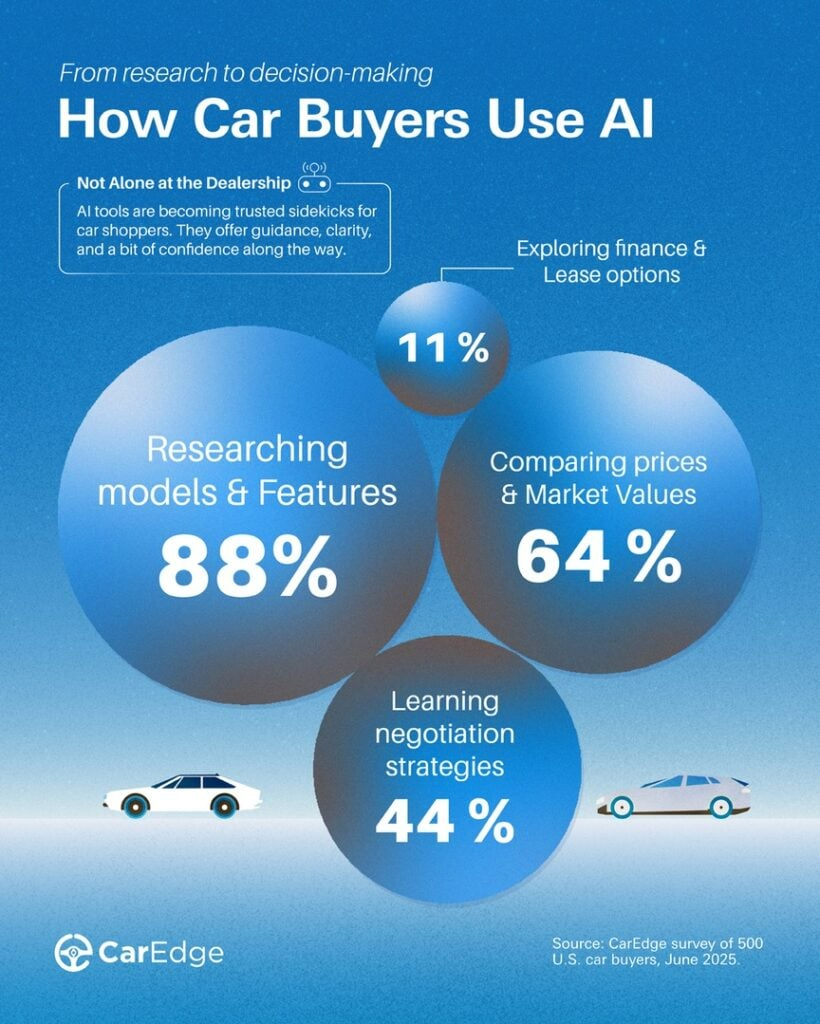
Among buyers who used AI tools during their car purchase or lease process, here’s how they put them to work:

88% — Researching Vehicles

The most common use by far, AI tools helped buyers learn about different models, trims, features, and reliability. For many, it was like having an always-available expert to explain the pros and cons of their options.

64% — Comparing Prices and Market Values

Buyers used AI to better understand fair pricing, from invoice pricing to out-the-door. 

44% — Learning Negotiation Strategies

Nearly half of AI users leaned on these tools to prepare for conversations with salespeople. Whether role-playing negotiation scenarios or asking how to spot add-on fees, this group used AI to level the playing field at the dealership.

11% — Exploring Finance and Lease Options

A much smaller portion of buyers used these tools to become familiar with leasing vs. financing, how to calculate payments, and similar queries.

Industry Implications

Car buying has always been tilted in favor of the dealership. Information asymmetry — what the dealer knows versus what the customer knows — has long been the source of consumer frustration, confusion, and overpayment.

That dynamic is beginning to shift.

This survey confirms what many in the industry are only starting to realize: AI is giving car buyers the upper hand. Tools like ChatGPT are helping consumers cut through the noise, ask smarter questions, and avoid common dealership traps. Instead of relying on guesswork or scattered advice, buyers are turning to AI for fast, personalized guidance at every step.

But one auto industry veteran has words of caution for buyers relying heavily on AI tools.

It’s both surprising and a little scary to see how quickly people are turning to AI to guide such a major financial decision,” said Ray Shefska, Co-Founder of CarEdge. “While tools like ChatGPT can be powerful, they’re only as good as the data behind them. AI should complement your research, not replace your own critical thinking.

That perspective underscores the real takeaway of this report: AI works best when it’s used thoughtfully as a tool, not as a crutch. In an age where automation raises fears of job loss or decision-making without human oversight, this survey offers a more optimistic view — one where technology helps everyday consumers make smarter choices. Used wisely, AI can help level the playing field and bring more transparency and fairness to the car buying experience.

Methodology

This survey was conducted by CarEdge between June 19 and June 24, 2025. A total of 500 U.S. respondents participated, recruited through the CarEdge email newsletter and social media channels. Questions were tailored based on buying status to better understand how and when AI tools were used in the car shopping process.

For the Silo, Karen Hayhurst.

About CarEdge
Founded in 2019 by father-and-son team Ray and Zach Shefska, CarEdge is a leading platform dedicated to empowering car shoppers with free expert advice, in-depth market insights, and tools to navigate every step of the car-buying journey. From researching vehicles to negotiating deals, CarEdge helps consumers save money, time, and hassle, hundreds of thousands of happy consumers have used CarEdge to buy their car with confidence. With trusted resources like the CarEdge AI Negotiator tool, Research Center, Vehicle Rankings and Reviews, and hundreds of guides on YouTube, CarEdge is redefining transparency and fairness in the automotive industry. Follow them on YouTubeTikTokX,  Facebook, and Instagram for actionable car-buying tips and market insights. Learn more at www.CarEdge.com.

Why So Many Struggle With Brain Fog

Why are so many people still struggling with brain fog, chronic fatigue, low energy, impaired memory, diminished focus, high stress and ADHD symptoms—even despite years of trying treatments for many? Neurotologist Dr. Kendal Stewart believes it’s because we’re too often treating symptoms, not causes. He’s spent the last 25 years addressing that with science-backed ways to help people at every age improve how they feel and function, both immediately and long-term. As an authority in everyday brain health, Dr. Kendal Stewart helps individuals optimize focus, memory, resilience and other brain health concerns by transforming complex neurological science into simple, actionable lifestyle-based strategies.  


Dr. Stewart has spoken at length and has written many editorials to discuss real-world habits, tactics and solutions to reduce brain fog, feel more energized, support focus, maintain emotional balance, and preserve cognitive health as one ages. A variety of related topics that include:

  • What brain fog, anxiety, and immune dysfunction have in common—and how to address all three holistically
  • Fueling your brain and immune system based on your unique DNA
  • Actionable daily habits to support brain and immune system health
  • How your genetics dictate your brain & immune health–and how to decode it
  • Why the future of medicine is personalized and already here
  • What are neuroimmune disorders, and why are we seeing a rise in conditions like chronic pain?
  • How genetic testing removes guesswork in treating complex neurological conditions
  • Hope for the undiagnosed: Dr. Stewart’s approach to finding the ‘source’ when other treatments fail
  • Why we’re still getting brain fog wrong—and what to do instead
  • A neurotologist’s take on impaired memory, focus, stress and fatigue: stop treating just the symptoms
  • Easy ways to support your brain & immune system every day
  • Does your DNA hold the key to focus, energy & emotional balance?
  • Genetics meets neuroscience for personalized brain health

What distinguishes Dr. Stewart?

  • Medical Maverick: One of the few specialists bridging neurotology (brain-ear balance) and neuroimmune genetics to treat complex disorders.
  • DNA-Driven Results: Nearly every patient receives genetic testing to eliminate guesswork—a game-changer for conditions like autism, chronic fatigue, and concussions.
  • Science Meets Storytelling: From IV therapies to nutrigenomics, he translates cutting-edge science into actionable steps for families and high performers.
  • Media-Ready: A charismatic speaker and podcast personality with patented tech, a supplement line (Neurobiologix), and a mission to “recover” patients, not just manage symptoms.


About the Expert
Dr. Stewart is a board-certified neurotologist and nationally recognized expert in neuroimmune disorders—including genetic abnormalities, chronic pain, ADD/ADHD and autism spectrum conditions. With advanced training in both surgery and cellular science, he’s made it his life’s work to uncover root causes and tailor individualized solutions through genetic testing, functional medicine, and integrative care. His approach emphasizes prevention as much as treatment, using lifestyle, nutrition, and nervous system support as daily fuel for better brain function. Through his work, he provides practical tools to regulate stress, stabilize energy and boost mental clarity.

He’s also a sought-after keynote speaker, inventor, and founder of multiple healthcare innovations, including GX Sciences, SensoryView, and Neurobiologix—a company dedicated to improving individual well-being by developing cutting-edge nutritional supplements rooted in the science of nutrigenomics. Dr. Stewart brings not only clinical authority but also an empowering, real-world lens—helping families, patients, and professionals better understand and improve nervous system and immune function. For the Silo, Karen Hayhurst.


Jewelry Company Disrupting Industry Via Guaranteed Value Buyback Feature

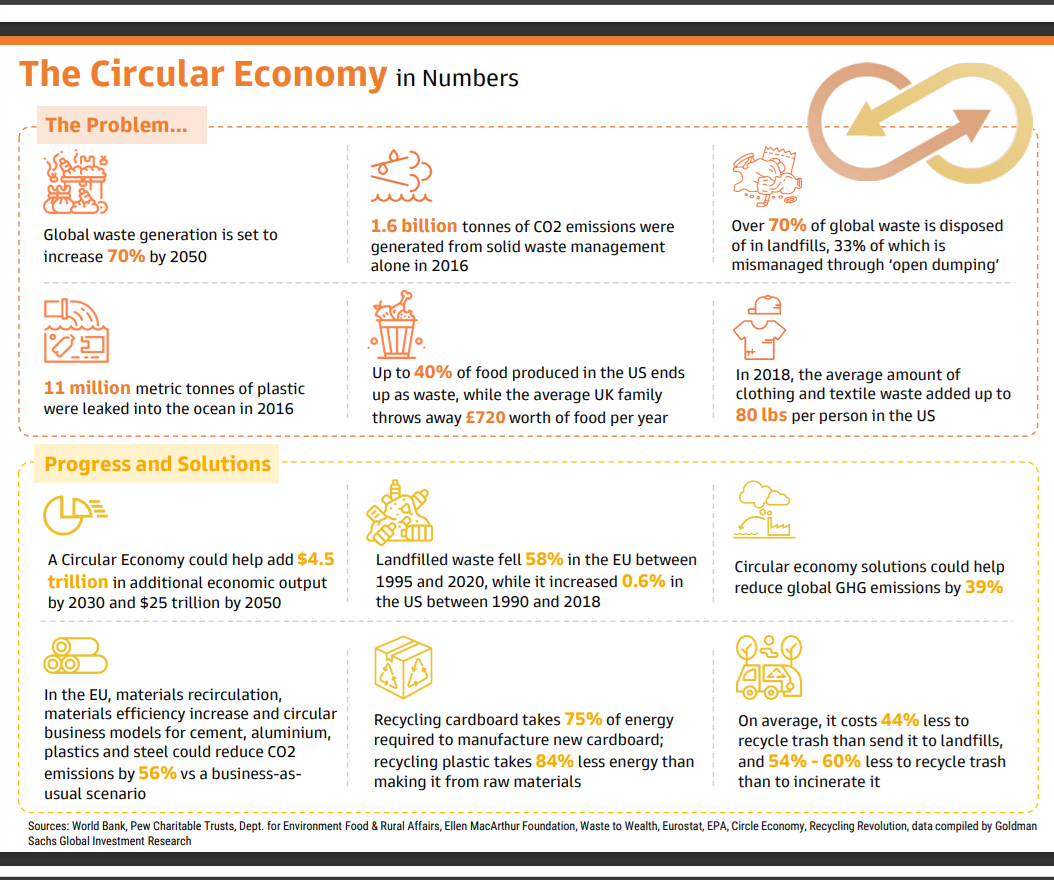
With the “circular economy” spurring a seismic shift toward sustainability and resource efficiency across sectors, industries are redefining themselves by transforming waste into lasting value. With projections of up to $4.5 trillion usd/ $6.4 trillion cad in economic benefits by 2030, companies are rethinking traditional models to protect the environment, cater to green consumerism mindsets and boost financial performance. At the forefront of this movement in the fine jewelry category is Sonalore, an innovative eTailer turning gold jewelry into a smart, sustainable investment amid its lifetime buyback guarantee. Sonalore not only ensures that every piece of 18-karat gold jewelry endures as a valuable asset, but also champions a closed-loop system that minimizes waste and preserves natural resources as detailed below.

Gold Into Green Investments

A seismic “circular economy” shift is happening across industries, as businesses rush to minimize waste and maximize resource value. This transformation isn’t just about sustainability—it’s about creating smarter business models that benefit both customers and the environment. So impactful this approach, Goldman Sachs projects the circular economy could deliver up to $4.5 trillion in economic benefits by 2030. Companies across sectors are citing  how they’re “shaking things up” to waste less—and reap the financial benefits in the process. Geopolitics are also fostering this approach, as Goldman Sachs further asserts that “operating in this way could become ‘critical’ in the face of the rising cost of raw materials” among other drivers.

One innovative eTailer—Sonalore—is leading this change in fine jewelry, transforming how people buy, wear and sell their gold pieces. The company’s approach turns traditional gold jewelry from a depreciating purchase into a liquid investment, while naturally promoting sustainability. Its “lifetime buyback guarantee” program not only transforms its wares into bona fide commodity investments for consumers, but also ensures its products can be easily recycled and reborn.

“We sell 18-karat gold jewelry from the perspective of it being a sound investment—not an expense—that enduringly holds its value,” said Sonalore CEO Nidhi Singhvi. “Our buyback promise allows consumers to sell back their items at a fair current price valuation of gold, which has the potential to increase beyond the purchase price of the item. Gold is, after all, a heralded investment commodity amid its historically proven performance in various economic environments.”


In doing so, the company is also fostering circular economy principles. Here are three ways Sonalore is reshaping the industry:

1. Sustainability That Makes Business Sense –

 Most sustainable initiatives ask you to pay more for less. Sonalore flips this on its head. When you’re done with a jewelry piece, they buy it back at market rates and recycle the gold into fresh designs. No more jewelry gathering dust, no unnecessary mining, and you get real value back. It’s sustainability that puts money in your pocket, not the other way around. This isn’t just good for the environment, it is plain smart business. The closed loop system reduces dependency on mining while preserving metal value. Sonalore’s market-rate buyback makes sustainability financially rewarding.

2. True Value, Finally Unlocked – 

For a circular economy to work, you need a product with intrinsic value at the center. Fine jewelry should be a very good natural candidate for a circular economy. However, traditional retail markups of 3-5x have broken this cycle, trapping customers in a cycle of overpaying and undervaluing. Sonalore strips away artificial markups, showing customers exactly what they’re paying for – from metal content to craftsmanship. When gold prices rise, so does the value of your piece. This transparency extends beyond purchase – customers can track their jewelry’s value in real-time, treating each piece as the investment it should be.

3. Freedom to Change your Mind – 

Life changes, and your jewelry should too. Most fine jewelry sits unworn, losing value in drawers or becoming a guilt-inducing reminder of money spent. Sonalore’s lifetime buyback guarantee transforms this dynamic. Want to switch styles? Trade up. Need liquidity? Convert to cash at market rates. Moving abroad? Downsize without loss. This flexibility turns jewelry from a static purchase into a dynamic asset that adapts to your life changes.

In today’s hugely competitive jewelry marketplace, Sonalore is reimagining not just how jewelry is sold, but also how it creates lasting value. By combining transparent pricing, investment potential and environmental responsibility, the company proves that luxury retail can evolve to meet modern demands for both sustainability and smart value.


As the circular economy gains momentum across industries, Sonalore’s innovative model shows how businesses can transform traditional products into dynamic assets that benefit customers, companies and the environment, alike. For the Silo, Karen Hayhurst.