Tag Archives: JFK

Behind The Scenes: A Look Back at the Cuban Missile Crisis

This article provided by our friends at Share America/ US Department of State.

President John F. Kennedy and others around table (White House/Cecil Stoughton/John F. Kennedy Presidential Library and Museum)
President John F. Kennedy meets with members of the Executive Committee of the National Security Council regarding the crisis in Cuba, in October 1962. (White House/Cecil Stoughton/John F. Kennedy Presidential Library and Museum)

The Cuban missile crisis of October 1962 was the moment that the United States and the Soviet Union came closest to nuclear war. The conventional wisdom is that decision-making occurred “with relatively little input from the respective bureaucracies  typically involved in the foreign policy process.”

In fact, the lawyers in the State Department’s Office of the Legal Adviser played a crucial role in crafting a strategy that would simultaneously project American strength and maximize decision-makers’ political flexibility.

A brewing crisis

In July 1962, the Soviet Union secretly agreed with the Castro regime to place medium and intermediate range ballistic nuclear missiles in Cuba, a mere 90 miles off of the Florida coast, targeting the entire eastern and middle United States and a large portion of Mexico, Central and South America.

A right side view of two vehicle-mounted Soviet R-14 Chusovaya (NATO code name SS-5 Skean) intermediate-range ballistic missiles.

In early September 1962, U.S. intelligence discovered evidence of a general Soviet arms buildup, including IL-28 “Beagle” tactical nuclear bombers.

On September 4, 1962, the White House issued a statement  that “All Americans, as well as all of our friends in this hemisphere, have been concerned over the recent moves of the Soviet Union to bolster the military power of the Castro regime in Cuba,” that approximately 3,500 Soviet military technicians were “in Cuba or en route,” but that there was “no evidence” of “offensive ground-to-ground missiles; or of other significant offensive capability either in Cuban hands or under Soviet direction and guidance. … Were it to be otherwise, the gravest issues would arise.” Then-President John F. Kennedy promised that the United States “shall continue to make information available as fast as is obtained and properly verified.”

On October 3, 1962, the Congress passed a joint resolution  declaring that “the United States is determined to prevent by whatever means may be necessary, including the use of arms, the Marxist-Leninist regime in Cuba from extending, by force or the threat of force, its aggressive or subversive activities to any part of this hemisphere.”

On October 14, 1962, a U.S. U-2 aircraft took several pictures clearly showing sites for nuclear-armed, medium-range and intermediate-range ballistic missiles under construction in Cuba.

Map of Cuba showing locations of Soviet military equipment (John F. Kennedy Presidential Library and Museum)
A map of Cuba, with a partial listing of Soviet military equipment, used during the president’s meetings with political and military advisers. (John F. Kennedy Presidential Library and Museum)

The president and his advisers considered a range of options. Some, including all members of the Joint Chiefs of Staff, argued for an air strike to destroy the missiles followed by a U.S. invasion of Cuba. Others argued for warnings to Cuba and the Soviet Union without action. The president decided upon a middle course. On October 22, 1962, he ordered a naval “quarantine” of Cuba.

The use of the word “quarantine” legally distinguished this action from a blockade, which assumed a state of war existed. The use of “quarantine” instead of “blockade” also enabled the United States to receive the support of the Organization of American States. The goal was to prevent further military deliveries to Cuba and to apply pressure on the Soviet Union to remove the existing missiles and bombers.

That same day, the president sent a letter  to Soviet Premier Nikita Khrushchev declaring that the United States would not permit offensive weapons to be delivered to Cuba and demanding that the Soviets dismantle the missile bases already under construction or completed and return all offensive weapons to the Soviet Union.

The letter was the first in a series of direct and indirect communications  between the White House and the Kremlin throughout the remainder of the crisis. That evening, Kennedy announced to the nation via a televised address  that the United States had confirmed that a series of offensive Soviet missile sites were in “preparation” and that their purpose “can be none other than to provide a nuclear strike capability against the Western Hemisphere.”

On October 23, 1962, the president issued Proclamation 3504 , “Interdiction of the Delivery of Offensive Weapons to Cuba.” The order included “Surface-to-surface missiles; bomber aircraft; bombs, air-to-surface rockets and guided missiles; warheads for any of the above weapons; mechanical or electronic equipment to support or operate the above items; and any other classes of materiel hereafter designated by the Secretary of Defense for the purpose of effectuating this Proclamation” and provided that “to enforce this order, the Secretary of Defense shall take appropriate measures to prevent the delivery of prohibited materiel to Cuba, employing the land, sea and air forces of the United States in cooperation with any forces that may be made available by other American States.”

On October 25, 1962, the U.S. military was ordered to DEFCON 2, the alert state just short of nuclear war and the highest-level alert ever issued in U.S. history.

A Russian IL-28 bomber.

On October 28, 1962, the Soviet Union announced the dismantling of its missiles in Cuba.

On November 20, 1962, following the Soviet Union’s agreement to withdraw the IL-28 nuclear bombers from Cuba, the president terminated the quarantine.

Marked low altitude reconnaissance photo (Department of Defense/John F. Kennedy Presidential Library and Museum)
A low-altitude reconnaissance photograph shows destroyed launch pads at medium-range ballistic missiles site number 2 in San Cristóbal, Cuba. (Department of Defense/John F. Kennedy Presidential Library and Museum)

How the legal adviser empowered U.S. decision-makers

The State Department’s Office of the Legal Adviser played a pivotal role by creating options for the president and other U.S. decision-makers to shape U.S. diplomatic strategy.

In September 1962, after it became clear that the Soviet Union was rapidly building an offensive military capability in Cuba, the White House tasked the State Department’s Office of the Legal Adviser with assessing the United States’ international legal obligations and commitments. The Kennedy administration thought that the best option available — short of military invasion or an aerial campaign — was to prevent any additional military equipment  from reaching Cuba.

A problem was that Secretary of State Dean Rusk and Vice President Lyndon Johnson had both recently testified to Congress that a blockade of Cuba would be “an act of war.” Legal Adviser Abram Chayes advised against such a blockade in a now-declassified legal memo:

Legal memo excerpt (John F. Kennedy Presidential Library and Museum)
An excerpt from September 10, 1962, memorandum  by State Department Legal Adviser Abram Chayes (John F. Kennedy Presidential Library and Museum)

Accordingly, the administration shifted from the idea of a blockade to a “defensive quarantine.” The State Department’s Office of the Legal Adviser had proposed that shift during a meeting of the Executive Committee of the National Security Council on October 19, 1962. While a defensive quarantine would not be an act of war, it would still be a use of force. Thus, a defensive quarantine would be analyzed under Article 2(4) of the United Nations Charter : “All Members shall refrain in their international relations from the threat or use of force against the territorial integrity or political independence of any state, or in any other manner inconsistent with the Purposes of the United Nations.”

The Office of the Legal Adviser analyzed the word “other” in Article 2(4) to mean that only threats or uses of force inconsistent with the purposes of the United Nations were prohibited. In other words, even measures that might impinge on the territorial integrity or political independence of a state would not necessarily violate Article 2(4) as long as such measures were not inconsistent with the purposes of the U.N. The purpose of the quarantine was to safeguard peace and stability in the region, and Article 52 of the U.N. Charter affirms that regional organizations could enact their own solutions for peace and security.

The Office of the Legal Adviser therefore turned to the Organization of American States Charter and the Rio Treaty . Article 6 of the Rio Treaty sets forth a broad authorization for regional security: When a situation “might endanger the peace of America,” the Member States would “meet immediately in order to agree on … the measures which should be taken for the common defense and for the maintenance of the peace and security of the [American] Continent.” Based on that, the State Department concluded that a defensive quarantine — and even a blockade — authorized by the Organization of American States would be consistent with the purposes of the U.N. and international law.

On October 23, 1962, the same day that the president issued Proclamation 3504, the secretary of state presented in person to the Organization of American States  to invoke the Rio Treaty and introduce a draft resolution to authorize a use of force for the quarantine:

Declassified document excerpt (John F. Kennedy Presidential Library and Museum)
Now-declassified Top Secret account  of the critical Organization of American States’ meeting on October 23, 1962 (John F. Kennedy Presidential Library and Museum)

The member states unanimously adopted the U.S. resolution, authorizing them to “take all measures, individually and collectively including the use of armed force which they may deem necessary to ensure that the Government of Cuba cannot continue to receive from the Sino-Soviet powers military material and related supplies which may threaten the peace and security of the Continent and to prevent the missiles in Cuba with offensive capability from ever becoming an active threat to the peace and security of the Continent.” Notably, Cuba had been suspended  from the Organization of American States earlier that year because its communist government threatened the region.

The United States’ deployment of a quarantine consistent with international law proved highly effective. On October 24 and 25, some Soviet ships turned back from the quarantine line, while others were stopped by U.S. naval forces but allowed to proceed after confirming they were not carrying offensive weapons. The quarantine helped convince Soviet dictator Nikita Khrushchev to come to the negotiating table. By October 28, the United States and the Soviet Union reached a deal for the removal of the Cuban missiles, effectively ending the crisis.

Lessons learned

The Cuban missile crisis case study proves that creative legal advice can help counter U.S. adversaries, build international coalitions and preserve peace. Then, the Office of the Legal Adviser developed practical alternatives providing American political and military leaders maximum flexibility in action while at the same time informing and supporting the administration’s public diplomacy strategy. Today, the Office of the Legal Adviser provides the legal advice needed to help our clients advance American interests worldwide, and the results are evident: from Gaza to the Caucasus to eastern Africa and beyond, the president, the secretary of state, and other senior policymakers are leveraging the Office of the Legal Adviser’s innovative ideas to help make America safer, stronger and more prosperous.

For the Silo, Reed D. Rubinstein/ Legal Adviser of the U.S. Department of State.

Supplemental- How Canada was affected by the Crisis
Cuban Missile Crisis

The Cuban Missile Crisis heightened military readiness in Canada, strained U.S. Canada relations, and had lasting political implications for the Canadian government.

Military Readiness and Alert Status

During the crisis, Canada faced a direct threat from the Soviet missiles stationed in Cuba, capable of reaching both the United States and Canada. In response, Canadian armed forces were placed on heightened alert. National Defence Minister Douglas Harkness requested that Canadian military units raise their alert level to the “Ready State”, equivalent to the U.S. DEFCON 3. This decision was delayed due to internal cabinet debates, reflecting the cautious approach of Prime Minister John Diefenbaker, who was hesitant to fully commit Canadian forces without U.S. approval.

Political Implications

Diefenbaker’s indecisiveness during the crisis soured relations with the United States. His reluctance to provide unequivocal support for U.S. actions, such as the naval blockade of Cuba, led to tensions between the two countries. Diefenbaker’s government faced criticism for its handling of the crisis, which contributed to the its downfall in the 1963 election. The crisis highlighted the complexities of Canada-U.S. relations, particularly regarding military cooperation and sovereignty issues, as Diefenbaker sought to assert Canada’s independence in foreign policy.

Military Cooperation and Lessons Learned

The crisis also underscored the importance of military cooperation between Canada and the United States. Canadian naval forces participated in patrols to locate Soviet submarines in the North Atlantic, demonstrating the close coordination between the Royal Canadian Navy (RCN) and the U.S. Navy. The experience gained during the crisis influenced future Canadian military operations and emphasized the need for readiness in the face of potential threats.

Conclusion

Overall, the Cuban Missile Crisis had a profound impact on Canada, affecting its military posture, political landscape, and diplomatic relations with the United States. The events of October 1962 served as a critical moment in Canadian history, sharing its approach to defense and foreign policy in the subsequent Cold War era.
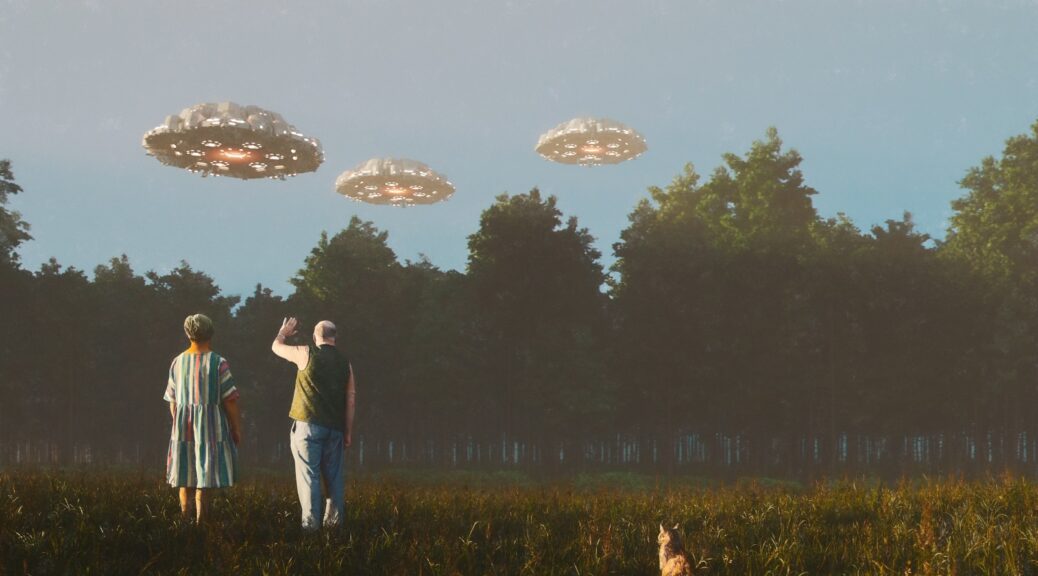
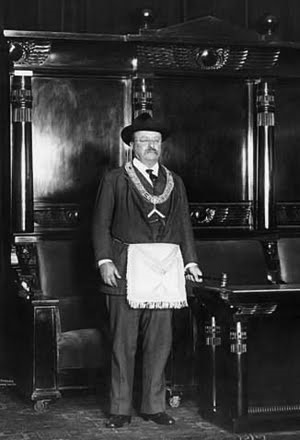
Connections Between UFOs, UAPs and Presidents Of The United States

Theodore "T.R." Roosevelt, Jr. was an American politician, author, naturalist, soldier, explorer, mason and historian who served as the 26th President of the United States.
Theodore “T.R.” Roosevelt, Jr. was an American politician, author, naturalist, soldier, explorer, mason and historian who served as the 26th President of the United States.

Remember last year, when there was ongoing UAP/Drone activity hitting the news cycle and without any official explanation of what was happening over the skies of New Jersey and the rest of the world? There is still no answer and  it is fascinating to consider that this phenomena is in fact not new and has been reported for over one hundred years.

The drones have become unsettlingly frequent in Monmouth County, New Jersey (Picture: Monmouth County Sheriff’s Office. Dec 2024)

When one thinks of U.S. Presidents and UFOs several of our Chief Executives come to mind. Firstly, there is President Eisenhower purportedly meeting aliens at Edwards Air Force Base in 1954.

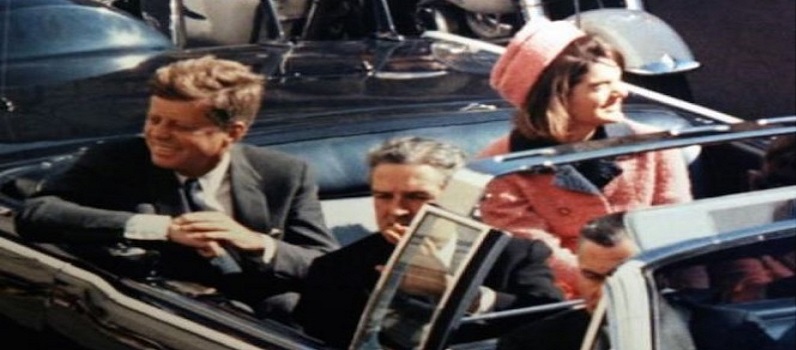
Then there is JFK’s memo to the CIA asking for disclosure on UFOs ten days before his assassination:

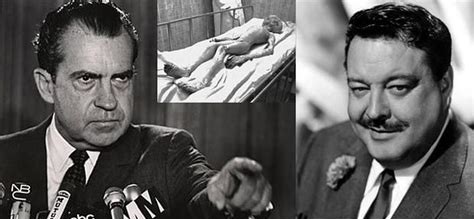
More humorously but perhaps true is the story of Richard Nixon treating comedian Jackie Gleason to a view of dead alien Grays at Homestead Air Force Base in 1974. 

But what about Teddy Roosevelt?

Is anyone in the UFOlogy Community even aware of a documented UFO sighting over the 26th US president’s home, Sagamore Hill, in Oyster Bay, New York on August 1, 1907 when he was in his second term of office?

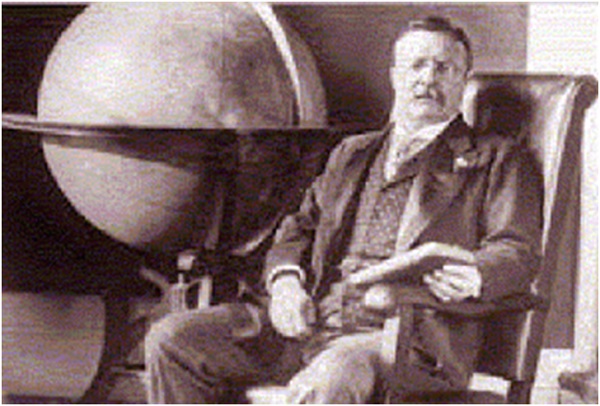
Teddy Roosevelt Globe

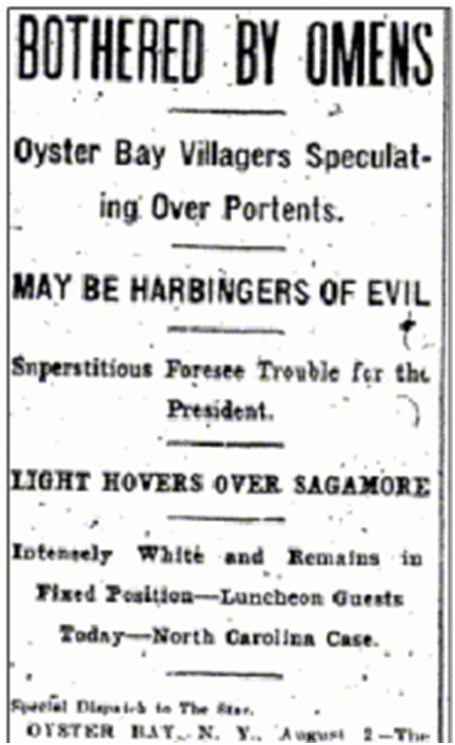
According to an old clipping found by UFOlogist Kay Massingill from a newspaper called the D.C. Evening Star dated August 2, 1907, two events of a mysterious nature occurred in the town of Oyster Bay in a twenty-four hour period and both concerned Mr. Roosevelt.

In the latter, the town librarian Miss Denton opened up the library on the morning of the 1st and discovered a beautiful mahogany chair donated by Teddy to the museum from his days as Governor of New York had split down the backside sometime the night before. More peculiar was the fact that on the reverse back of the chair was the Bald Eagle Seal of the United States of America and it was split in half! An ominous sign indeed! Was it an omen?

Newspaper Headline Lights Over Sagamore

However, the main event occurred the evening before between the hours of 9 p.m. and 11 p.m. when a brilliant white light was seen to hang motionless over Sagamore Hill.

According to the dispatch, it was a light “considerably larger than a star” and hung about 300 feet in altitude over the house according to numerous witnesses. It was an “intense white light” and after 11 p.m. it began to fade to a spark and then extinguished. Meanwhile in the library a short distance away, a chair associated with Sagamore Hill’s occupant was coming undone in a most mysterious way.

The home on Sagamore Hill

Was Mr. Roosevelt home the night of the UFO sighting? The article doesn’t say and we’ll probably never know but it is known that Sagamore was called Roosevelt’s Summer White House and it was the middle of summer.

So the main question to ask is why would a ball of light attend to Mr. Roosevelt in the heat of 1907? Two clues can be found concerning his agenda as President that year.

One clue was his December 3, 1907 Annual Address to Congress.

The speech is mundane for the most part dealing with anti-trust actions, railroads, the Department of Agriculture, conservation, unions and such but near the end of it Roosevelt begins to lay out the groundwork for creating the world’s most dominant modern navy. It seemed Roosevelt had a great grasp of what was happening in the world concerning Japan, Germany and China and their eventual rise on the world’s stage. He specifically recommended dredging Pearl Harbor to make it a world class naval base and increasing Alaska’s defenses. Did he know something about the world no one else did? His maneuvering just months after the Sagamore Hill incident directly led to America’ emergence as the modern world’s greatest Suprerpower. Did he have help from E.T. whispering in his ear? During his tenure America’s Navy grew from 5th to 3rd in the world in size.

The second clue is the very interesting coincidence of the Second International Peace Convention held at The Hague, Netherlands that year from June 15 to October 18, 1907 which was during the Sagamore Hill sighting. That convention was the brainchild of none other than Teddy Roosevelt! It was an attempt to codify the rules of war – particularly naval warfare. More importantly, it was seen as the world’s first attempt at an international governing body – a forerunner to the League of Nations and the United Nations.

The Tin Foil Hat Question 

Are aliens attempting to lay out the groundwork for, or interfere with, the earth’s direction in the 20th and 21st centuries? And might they have been in contact with American Presidents long before Eisenhower’s 1954 encounter? To see the complete newspaper clipping go to http://www.worldufowatch.com/historical_newspaper_clippings    For the Silo, Robert Spearing.

Day Marks Another Anniversary Of JFK Assassination

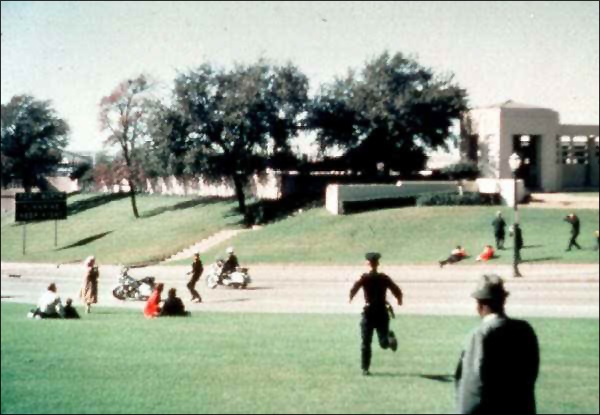
The Grassy Knoll at Dealey Plaza.

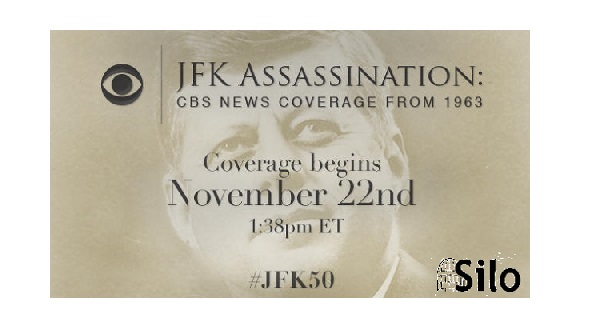
2015’s historic JFK 50th assassination Special was a riveting and powerful demonstration of media technology. We co-hosted the CBS feature which “rebroadcast” their original assassination television coverage in real-time, fully and completely. Every detail was reproduced exactly as it was shown on that fateful day- even the interruption of a certain soap opera with the first “bulletin” announcement. Live internet coverage began at 1:38 EDT exactly 50 years to the minute of the initial CBS news broadcasts.

If you have any #JFK thoughts (perhaps you even remember that fateful day)- or if you watch the archived live stream please share your feelings by commenting below at the end of this post. We will respect all requests for anonymity.

In the meantime, you may want to view Newsmax TV documentary: “I killed JFK” claiming to showcase a newly revealed “confessed killer”. In 1978 a US Congressional Investigation into Kennedy’s death determined that there were likely more than one shooter/killer.

RIP JFK CBS coverage

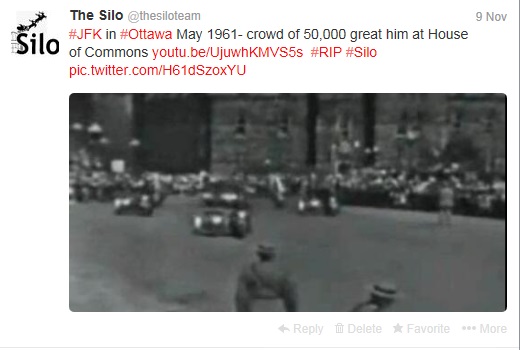
JFK visits Ottawa 1961:

Silo Tweet JFK Ottawa 1961


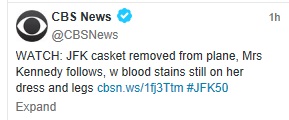
@CBSNews live tweeting during this historical rebroadcast event- image:CBS Twitter


Supplemental- The United States National Archives Report of the Select Committee on Assassinations of the U.S. House of Representatives
References: I. Findings in the Assassination of President John F. Kennedy

Canadian Authors Released Book Chronicling Time Traveler John Titor II

This is an entertaining article 😉  The United States spends millions of dollars every year covering up something they say doesn’t exist – Extraterrestrials. In fact, the U.S. military not only recognizes three alien species but for nearly 70 years has been working with the Greys, the Reptilians and the Tall Whites under signed treaties. America also has diplomatic relations with the Anunnaki.

But the cover-up goes even deeper.

The U.S. military has the capability of time travel using interstellar spacecraft capable of flying faster than the speed of light.

Time Traveler John Titor II

Based at Area 51, John Titor II began travelling through time on missions for a highly-secretive arm of the U.S. Air Force in 1979 and served as commander of the 177th Time Travel Division from the years 2030 to 2036.

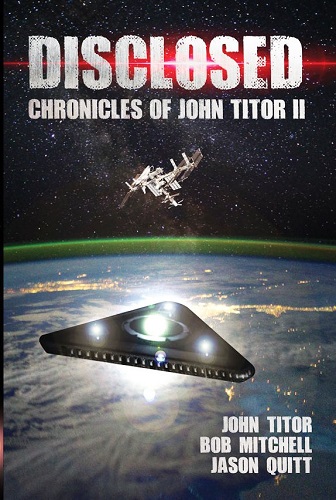
His life story is told for the first time in “Disclosed:Chronicles of John Titor II” – a new book co-written by Canadian authors Bob Mitchell and Jason Quitt.

“In return for allowing the Greys, the Reptilians and the Tall Whites to have hidden bases on Earth with unlimited access to resources – and the U.S. never revealing to the public they exist – the ETs have provided black technology to the military beyond anybody’s wildest imagination,” Titor II said.

Disclosed Book Cover FullTitor II reveals the hidden truths behind humanity’s biggest cover-ups.
These include;

  • The existence of at least two different off-world colonies.
  • The U.S. military has a fighting force of thousands of genetically-engineered cloned super soldiers.
  • Who really killed President John F Kennedy?
  • Our timeline has been changed without us knowing it.
  • Humanity’s extinction and Earth’s inevitable environmental Armageddon.

Mitchell, Quitt and John Titor II will discuss their mind blowing book for the first time on Coast to Coast with George Noory on Sept. 1, the same day it goes on sale on Amazon. .

Bob Mitchell
Bob Mitchell

“Once you read this book you will never look at the world the same way again,” author Bob Mitchell said. “Parts of it scared the hell out of me, especially when John revealed what our future will be like.”

“Disclosed has the potential to shake up the entire conspiracy/UFO world,” author Jason Quitt said. “People all over the world are demanding disclosure. This bookwill push the boundaries.

Disclosed:Chronicles of John Titor II is a perfect follow the international sensation Forbidden KnowledgeRevelations of a multi-dimensional time traveler,” which was co-written by Mitchell and Quitt and released in March 2016.

“It’s important to understand that John Titor II isn’t the John Titor, who suddenly popped up on the Internet in 2000 claiming to be a time traveler with so many outlandish predictions,” Mitchell said. “In our new book, John Titor II doesn’t make predictions. He has experienced what has and is about to happen.”.

Jason Quitt
Jason Quitt

“John Titor II is the real deal,” Quitt said..

Although no longer time traveling, John Titor II continues to consult with the Department of Defense. He lives in a heavily-secured compound with 24-hour security in southern California.  For the Silo, Sigmund George Smith.

Music from the Future. Click me.
 Click me.


Victura: beloved sailboat taught JFK about life, family, leadership and winning

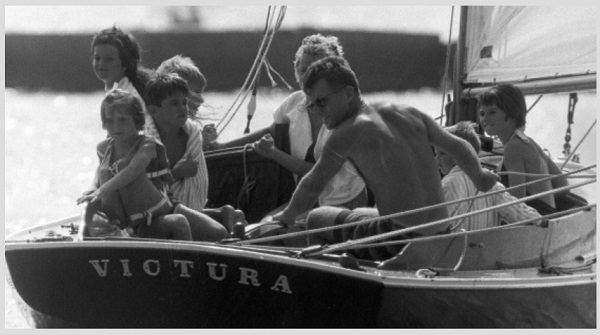
Victura and the Kennedy's


James W. Graham’s new book — Victura: the Kennedys, a Sailboat, and the Sea –offers new insights into the dynamics and magic of the Kennedy family and their intense relationship with sailing and the sea. Many families sail together, but the foot sloop purchased in 1932 shortly s move to Hyannis Port, stands apart.

Throughout their brief lives, Joe Jr., Jack and Bobby spent long hours on Victura, competing in countless races every summer. They were joined by their younger brother Teddy when he grew old enough. Joe Jr. and Jack ranked among the best collegiate sailors in New England, driven by their father Joseph P. Kennedy who insisted that winning was essential. Among their sisters, Eunice emerged as a gifted sailor and fierce competitor, the equal of any of her brothers.

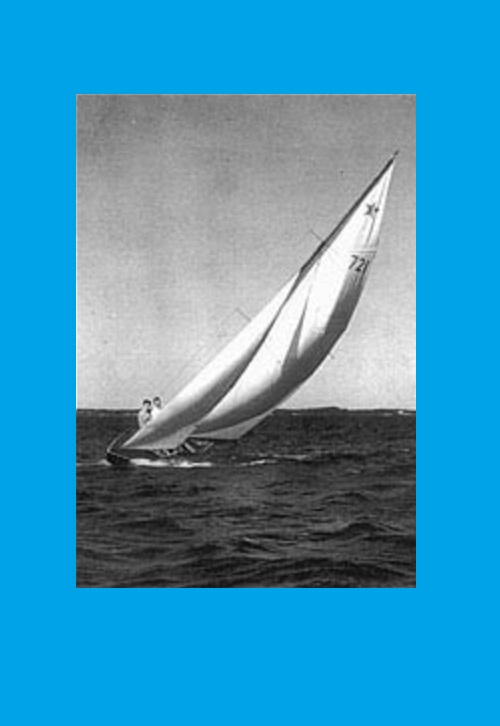
JFK Sailing Victura

Tracking their story beginning in 1932 when Jack was 15 and continuing today in an identical family boat of the same name, readers will learn to admire the Kennedys for what Victura taught them about life, family, leadership, determination, winning, and dealing with tragedies.

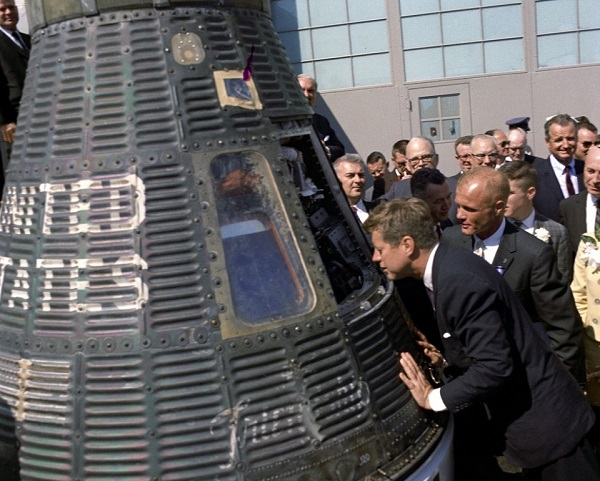
Celebrating the sailboat’s deep influence on Jack, Bobby, Ethel, Ted, Eunice and other Kennedys, it offers a new way of experiencing their intimate sibling relationships and growth as an extended family. Kennedys credit young Jack’s sailing with helping him survive the sinking of his PT boat in the Pacific. Life magazine photos of Jack and Jackie on Victura’s bow helped define the winning Kennedy brand in the 1950s. Jack doodled sketches of Victura in Oval Office meetings, and his love of seafaring probably played a role in his decision to put a man on the moon, an enterprise he referred to as “space-faring.”

The notion of "Space-fairing" developed by JFK came about as a result of his sailing experiences and love for adventure. CP
The notion of “Space-fairing” developed by JFK came about as a result of his sailing experiences and love for adventure. CP

When the Kennedy siblings married, sailing connected them with their children and nephews and nieces. Sailing was an everyday event, even in dangerous weather and in the darkness of night.  The sport influenced how they celebrated and observed happy events, managed grief, and grew close to one another.

Ted loved Victura as much as any of them. In the years following the untimely deaths of his three older brothers, Ted sailed with his children and the children of his lost brothers as crew. He also sailed past the shoals of personal shortcomings and an ebbing career to become known as the “Lion of the Senate,” helping fulfill patriarch Joe Sr.’s desire that his children pursue careers in public service rather than in business.

Rich with colorful and intimate anecdotes, the book features author interviews with family members, including children of Ted, Robert and Ethel Kennedy.  Victura is a story of redemption, strong family bonds, character, sport, tragedy, the power of metaphor and the influence of a little boat on the lives of great men and women.

In Victura, James W. Graham charts the progress of America’s signature twentieth century family dynasty, in a narrative both stunningly original and deeply gripping. This true tale of one small sailboat is an invaluable contribution to our understanding of the impressive story of the Kennedys. For the Silo, Jim and Lynda O’Connor, and Paul Krupin.

Victura
The Kennedys, a Sailboat, and the Sea
James W. Graham

ForeEdge, an imprint of the University Press of New England
$29.95 cloth 978-1-61168-411-7
$22.99 ebook 978-1-61168-599-2
Official publication date: April 1, 2014
280 pp., 28 illus., 6 x 9″

For more information visit

About the Author

James W. Graham, a communications and public affairs professional for a major-brand retailer, was a senior adviser to former Illinois Governor Jim Edgar and the Illinois House of Representatives. He races and cruises his sailboat Venturous out of Wilmette Harbor, north of Chicago.

What People Are Saying

“This wonderfully-written book takes a well-worn subject — the Kennedys — and gives it as fresh a gust as the sailors on the sturdy, little Victura themselves must have felt a thousand times off the Nantucket shore. In going to sea on board the Victura, Joe, Jack, Bobby and Teddy Kennedy entered their metaphor of quest, braced themselves for the unknown, and left their country, in the end, with an imperishable poignancy in its heart.”

— Richard D. Mahoney, author, Sons and Brothers

“The Kennedys saw the world and nature as a magical place, full of mystery and adventure. They especially enjoyed challenges and the freedom of activities like sailing, skiing, river running, climbing and just being outside. Two thirds of the surface of planet earth is liquid: the sea is vital to life — a huge source of both pleasure and fear — and a great teacher. Victura, a small wooden sailboat, became
the center of adventure, companionship and love for this remarkable family. Author Graham knows the sea, sailing and the Kennedys. Sail on Victura, to new horizons.”

— Jim Whittaker, first American to summit Mt. Everest, former CEO of REI, author of Life on the Edge: Memoirs of Everest and Beyond.

“Victura is more than Graham recounting the sailing experiences of the Kennedys. In this well-researched but warmly written book, Graham sometimes goes several pages describing an election, or a Kennedy family intrigue, and then gracefully brings the
story back to the sea, showing how, in best and worst of times, the family pulled together around sailing.”

— Rich Evans, book review, SAILING magazine, March 2014

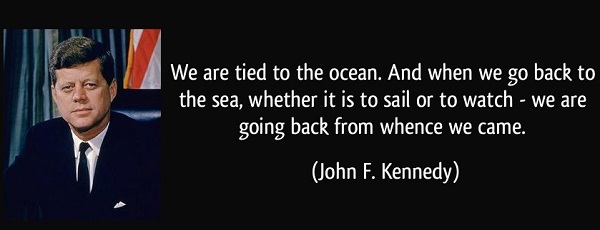
JFK Sea Quote


Window Fishing Or The Night We Caught Beatlemania

Window Fishing

A Silo Canuck Book Review

I’ve never particularly been a Beatle’s fan. I like some of their songs. I like a number of them very much, but if I was asked the now proverbial question, “The Beatles or The Rolling Stones?” I would probably say, Oh, I don’t know, maybe The Who? The body of work of Mark Knopfler. Massive Attack were massive for me.

But I was not a child of the sixties, “an age of assassins,” John B. Lee writes in his poignant and powerfully executed preface, when “[o]ur childhood martyred almost all the heroes that we’d had.” John F. Kennedy. Robert F. Kennedy. Martin Luther King (Malcolm X, not mentioned but later, yes). “The list is overlong,” Lee says. “It will not end.” I understand more fully than ever these life-shattering moments, for Americans and Canadians alike; for so many  Across the Universe . Into this near death of hope came The Beatles. The Beatles came to America, came on a Sunday night in January 1964 to The Ed Sullivan show and, and as Lee exclaims with no exclamation mark, “sang my life awake.”

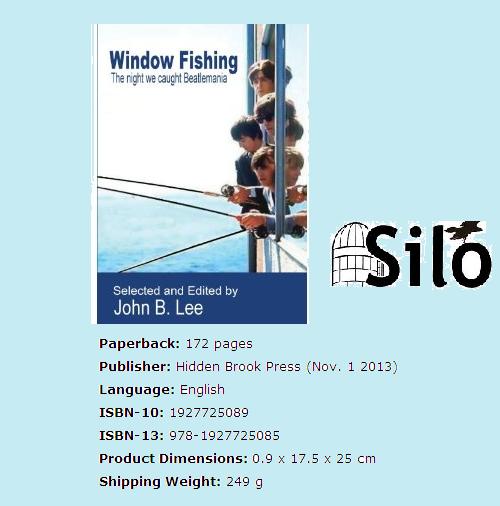
It’s not a perfect looking book. Yet as I read, the grainy cover photo (by an unknown photographer) of four dapper mop-tops fishing out the window of their Seattle hotel—they literally weren’t allowed to leave—starts to resonate. It’s imperfection could be viewed as integral, evoking a time in music when moments of “perfect imperfection,” as Michael Shatte calls them in his essay, were more common in pop; “happy accidents” which would not be tolerated in this era of hyper-produced top-forty songs, when singers voices are routinely, digitally “auto-tuned” in the studio, and we get used to being disappointed when we hear them live. Then there’s lip-synching. I don’t need to go on. There is great music being made by great musicians right now. But that’s not what we’re here to talk about. This is about a particular moment in pop-music history, in cultural history, and many of the moments that followed.

PaulMcCartneyBlur

The book is selected and edited by John B. Lee, a Canadian poet and writer who has published more than fifty books and received over 70 prestigious awards for his work. If you haven’t heard of him don’t feel too bad. He tells me openly there is little money in poetry, reminding me it’s not about that anyway. If it was it probably wouldn’t be poetry.

If you haven’t read him it might be time to start: his verse and prose catch the beauty of rural life, farm life, family life, hockey, human sexuality—life. Just Google him. He’s from home, you know. Right around here, right around me, the Poet Laureate of Brantford, Ontario and Norfolk County, home as well to Alexander Graham Bell and Wayne Gretzky, a poet of sport. Like McEnroe was one of the poets of my youth, making tennis beautiful, thrilling, creative; revolutionary. How I tried to emulate him…

Window Fishing Cover

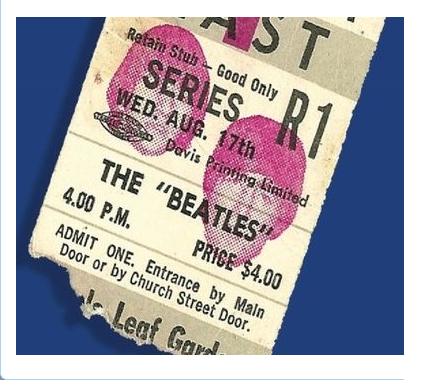
Window Fishing is about a time of Revolution, evolutions in culture, and about growing up in the thick of it all. I wasn’t here yet, but as I read this book I learn. It is a literary volume. The cover photo and torn ticket stub on the back page are its only images. Or are they? Because black words on white paper are also images. And the book’s words, artistically rendered, conjure images as well as ideas. It is poetry, and prose poetry, and personal essays; fine writing by a collection of fine writers.

I learn that for most of the men, who were boys then, pubescent, the Beatles were all about music: musical discovery, even ecstasy. And style too. There was style.

For the women who write about the phenomenon of Beatlemania, there was music too. Absolutely. But there was something else. Something profound: the awakening of sexuality. Even a kind of love. Suddenly I understand all the screaming and crying, the fainting. For emerging, young (straight) women, the Beatles were more than musical. They were also beautiful. Sexy. As Susan Whelehan puts it in her essay: “John. He was mine and I was his…I was going to be his FOREVER. And I am.”

While many parents of the day may have dismissed The Fab Four at first as a silly “boy-band,” we might say now, shaking their longish (for the time), round hair-cuts—singing “Ooooo!” and “Yeah Yeah Yeah!”—fact is from the beginning The Beatles were always at the very least competent, and obviously compelling, musicians. Writes Honey Novick in her probing, poetic essay: “You could actually dance to their music.” And we know they became more and more sophisticated as they progressed through their careers, eventually making challenging, often satisfying real art-music, the way Radiohead did for me in my 20’s.

All this beautiful literature about The Beatles and the 1960’s has inspired me to listen, finally, seriously, to the music. Even if you thought, at the time, “Yeah Yeah Yeah” was just bubblegum for kids, consider the lyrics. One friend to another: “You think you lost your love/Well I saw her yesterday. She says it’s you she’s thinkin’ of/And she told me what to say: She says she loves you.” She loves you man. Yeah! (Yeah! Yeah!). What more is there to celebrate? Ecstatically.

If you were there, or if you want to learn, or if you care about music or culture or the 1960’s or just literature, embrace the “perfect imperfection” of this unique and potent book. Some of the poems made me close my eyes and shut the pages. To savour, digest. Bruce Meyer made me cry. I was 8 years old when Lennon was shot. Assassinated. It made no impact on me then. I wasn’t really there yet. The book put me there, as close as I can ever come.  For the Silo, Alan Gibson.