Alec Baldwin and Mark Ruffalo join Jane Goodall legacy campaign as report says Americans import 57% of world’s hunting trophies
Hollywood stars and leading conservationists have joined forces to demand a global ban on trophy hunting after a new report claimed North Americans are importing more wildlife trophies than the rest of the world combined.
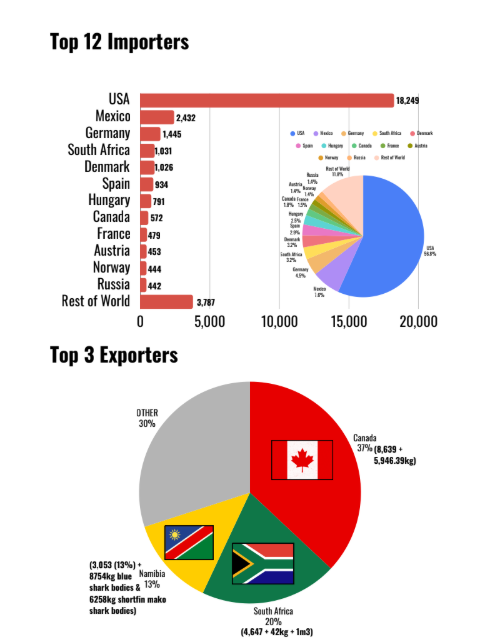
The Campaign to Ban Trophy Hunting says the United States is by far the world’s biggest importer of hunting trophies (and Canada making the top ten at number 8), with 18,249 recorded imports from protected species, accounting for 57 percent of the global trade.
The findings have prompted a new international push for an Abolition Declaration, backed by major names including Alec Baldwin, Mark Ruffalo, Priscilla Presley, Edie Falco, Bill Maher, Kim Basinger, Daryl Hannah, Isabella Rossellini, James Cromwell, Alicia Silverstone and Alyssa Milano.
The campaign was inspired by the late Dr. Jane Goodall, who called trophy hunting “unconscionable” shortly before her death and urged world leaders to act.
Speaking at an event marking the tenth anniversary of the killing of Cecil the lion, Dr Goodall said: “How on earth have we allowed this to continue for so long? Trophy hunting is unconscionable. It inflicts pain and suffering on animals for no other reason other than to boast of some ephemeral ‘prowess’. There is no material human need met by it.”
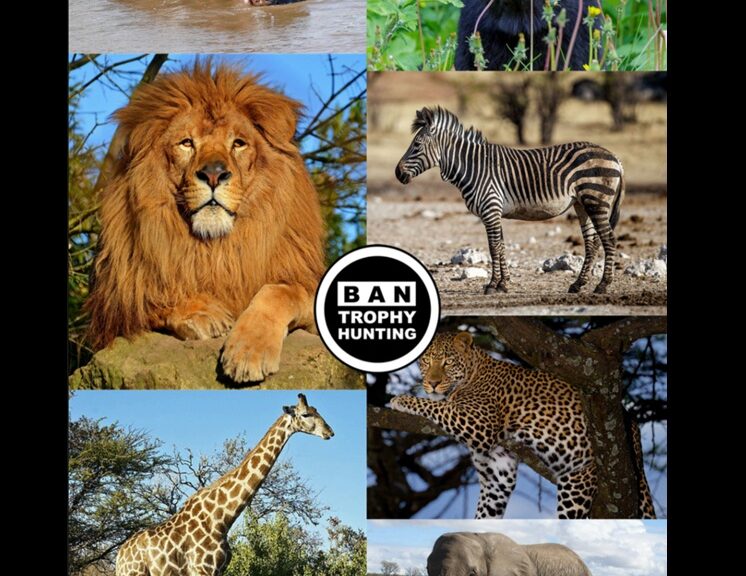
The new report says American hunters are driving demand for trophies from some of the world’s most iconic animals, including bears, giraffes, elephants, lions, leopards, monkeys and baboons.
It says the US is the leading importer of giraffe trophies, the top market for baboon and monkey trophies, and accounts for the majority of black bear trophies.
Alec Baldwin said: “I am proud to support The Campaign to Ban Trophy Hunting and to sign the Abolition Declaration. Trophy hunting belongs to another era.
“It sends the message that the lives of magnificent wild animals can be reduced to a photograph, a mounted head, or a personal goal.
“At a time when wildlife populations are declining across the globe, we should be investing in conservation, habitat protection and peaceful coexistence with nature.
“I hope this declaration helps build momentum for a future where respect for wildlife triumphs over cruelty and vanity.”
The report also turns the spotlight on Safari Club International, the US-based organisation described by campaigners as the world’s largest trophy hunting group.
According to the campaign, SCI has handed out around 20,000 awards to hunters, with some prizes requiring members to kill large numbers of animals across different species, continents and methods.
Seven of the world’s top 12 award-winning trophy hunters named in the report are American. They include George Harms, said to have killed 1,027 animals; Ben Seegmiller, with 913; Leon Munyan, with 866; and Larry Higgins, with 852.
Campaigners say the awards system turns wildlife killing into a competitive pursuit, with animals measured by skull size, tusks, horns and other body parts.
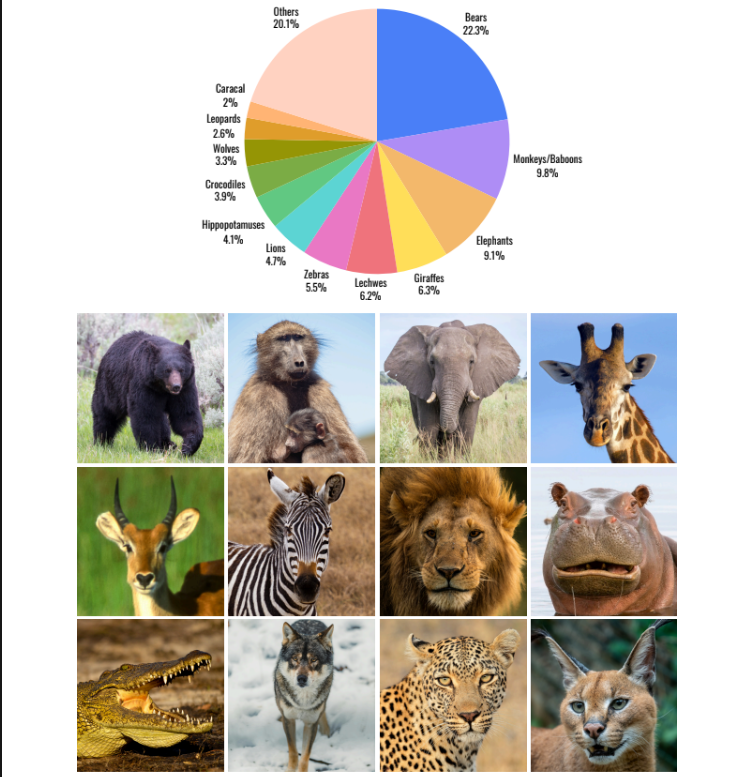
The most commonly imported trophies listed in the report were bears, making up 22.3 percent of the trade, followed by monkeys and baboons at 9.8 percent, elephants at 9.1 percent, giraffes at 6.3 percent and lions at 4.7 percent.
Dr Zara Bending, Resident Expert on Wildlife Crime and International Law at the Jane Goodall Institute Global, said: “Dr Jane Goodall DBE was a longstanding supporter of the Campaign to Ban Trophy Hunting. We at the Institute are committed to continuing that legacy in her name.
“As Dr Goodall said: ‘Trophy hunting is not only cruel but it is having a negative effect on endangered and threatened wildlife. Each one of these animals is an individual, with a personality, a mind, and emotions.’”
Professor Fred Bercovitch, former Executive Director of Save the Giraffes, said: “Trophy hunting is an abomination masquerading as a means of conservation.
“CITES has found that trophy hunters have killed thousands of individuals that belong to species threatened with extinction. Killing animals whose numbers are declining is antithetical to conservation.”
Dr Ian Redmond, a leading conservation scientist, said: “At a time when the number of wild animals has declined across the world, it is madness to allow tens of thousands of them to be killed for trophies.
“Trophy hunting is cruel and unethical, and does evolutionary damage to the species affected. Many of the targets are keystone species in globally important ecosystems.”
Priscilla Presley said the world had waited too long for action since the killing of Cecil the lion by American dentist Walter Palmer in Zimbabwe in 2015.
She said: “Ten years ago, the world learnt about the horrifying killing of Cecil the lion by an American dentist, Walter Palmer.
“Today it is learning about the terrifying scale of killing, even of endangered animals, that continues with the tacit blessing of governments.
“Policymakers have had ten years since Cecil was killed to act. Now they have no more excuses.”
Campaigners say trophy hunting is already rejected by the overwhelming majority of the public in the US and Europe, despite hunters continuing to import thousands of body parts each year.
They argue that wildlife watching, photographic safaris and community-led conservation provide far greater long-term benefits than allowing wealthy foreign hunters to shoot threatened animals.
Former Botswana President Ian Khama, who banned trophy hunting while in office, said: “With the decline of wildlife worldwide, and many species approaching extinction, how can there be justification in trophy hunting?”
Eduardo Gonçalves, founder of the Campaign to Ban Trophy Hunting, said the United States now had a moral responsibility to lead the world away from the trade.
He said: “America is the engine room of the global trophy hunting industry. The vast majority of people do not want endangered animals killed for heads, skins, tusks and bragging rights.
“This is not conservation. It is cruelty dressed up as sport.”
“Dr Jane Goodall understood that every animal is an individual. This declaration is about honoring that legacy and building a future where wild animals are protected, not turned into prizes.”
Fleur Dawes, Communications Director, In Defense of Animals, added, “Americans overwhelmingly reject trophy hunting, yet our tax dollars and import systems still facilitate it. We’ve seen the grief of elephant families torn apart, the orphaned cubs left behind after a lion is shot, wildlife communities that take generations to build and seconds to destroy.
“The age of treating sentient animals as collectibles must end, and the United States has both the power and the obligation to end it. The Abolition Declaration represents exactly the kind of moral clarity we need from policymakers. You cannot claim to respect wildlife and simultaneously issue permits to ship their skulls home as luggage.”
Immediacy? “Nothing important comes into being overnight; even grapes or figs need time to ripen. If you say that you want a fig now, I will tell you to be patient. First, you must allow the tree to flower, then put forth fruit; then you have to wait until the fruit is ripe. So if the fruit of a fig tree is not brought to maturity instantly or in an hour, how do you expect the human mind to come to fruition, so quickly and easily?” -Epictetus
The Worm (2008) and Watershort (2008) are time-contemplative short films by Canadian sound and visual artist Jarrod Barker.
In the natural world, immediacy is rarely a concept. While it is true the Mayfly lives only for a day, it is also true that each fly is one infinitesimal link in the long succession of the species. As humans have increasingly stepped beyond the boundaries of nature, we have begun to forget the importance of waiting and patience. We live surrounded by cheap treasures gotten easily and quickly. But like the Mayfly, these spoils of instant gratification perish quickly leaving us desiring more. No longer do we answer to the rhythm of nature, preferring instead to force the world to step up to our breakneck pace. All the while we are saturated with reminders that “good things come to those who wait” but too often choose to ignore this time tested wisdom.
Stefan Klein works in Berlin. Presently he is examining the concept of waiting. To this end, he has conducted quite a lot of field research. Waiting, he says, “is something that’s so routinely existing in our daily lives but at the same time has this very existential dimension to it so that almost everybody can relate to it but at the same time it’s a very abstract topic.” Another project, titled Introduction to Microeconomics is a book documenting Klein’s repeated ordering and return of a book by the same name. In this way, he examined documentation as a vital element of a whole work. Much of Klein’s work investigates complex systems through performative means. In September, Klein will begin a series of waiting sessions with people from various disciplines. He will meet with guests at a bus stop (a place of waiting) for a conversation. His audience will be comprised of both those who came to see the performance and those who happened to be waiting for the bus. In this way, Klein will access waiting from many perspectives.
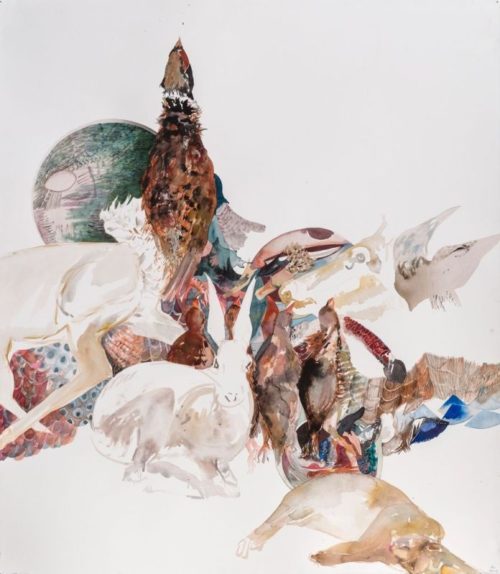
untitled watercolor Emilie Clark 2015
Emilie Clark is a New York City based artist who spends part of the year in New Hampshire. Much of her work is based on the work of nineteenth-century natural historians and scientists, most of them women. She also explores the literal interpretation of the word ecology (earth’s household) incorporating historical texts and working in the landscape. In New Hampshire, Clark works in a floating research station surrounded by the natural world. In New York City her experience is quite different though she has noticed similarities in plant species between the two locations. From her research station, Clark collects specimens, makes sound recordings, draws, paints, preserves, and fully immerses herself in nature. This process is rooted not only in creating but in learning.
Brainard Carey
A Few Words to Keep in your Pocket
A work of art, a career, a relationship, anything worth investing our hearts and minds in, must be given time. We must relearn to wait, to fall back in step with the world around us. For the Silo, Brainard Carey.
Brainard is currently giving free webinars on how to write a better Artist bio and statement and how to get a show in a gallery – you can register for that live webinar and ask questions live by clicking here.