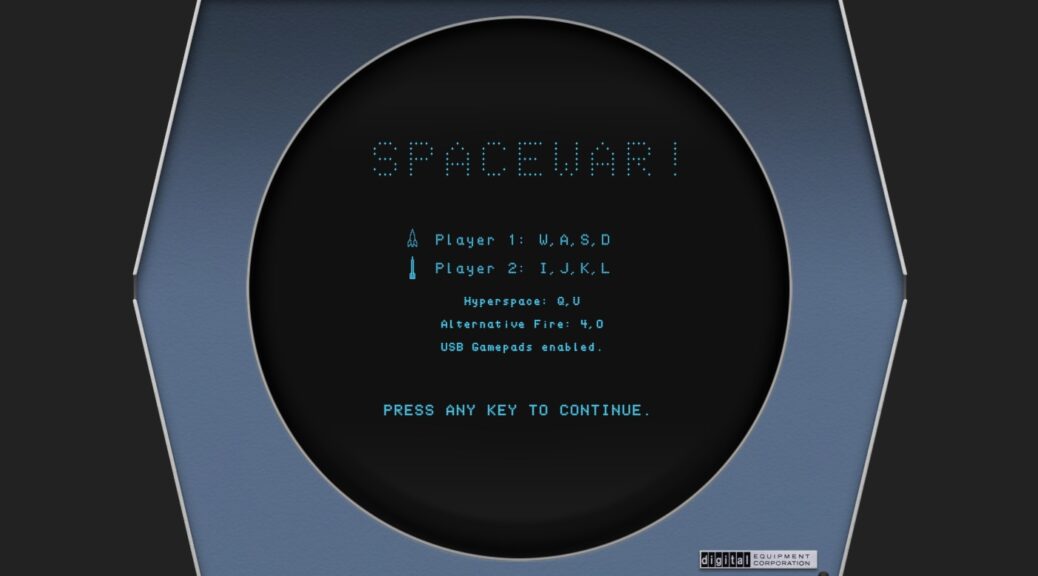
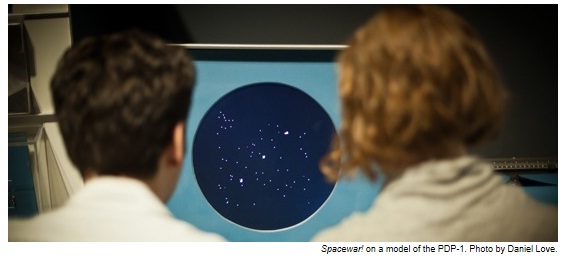
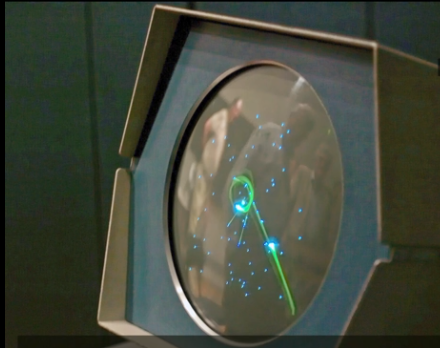
Spacewar! the first digital video game first ran as a demo in 1961 on an DEC Digital Equipment Corporation PDP-1 (Programmed Data Processor-1) computer and holds a central place in the development of video games as a cultural form.
Made In house
Spacewar! was created by a group of students and researchers (including Steve Russell) at the Massachusetts Institute of Technology (MIT) in 1961, conceived of as a demonstration for the new Digital Equipment Corporation PDP-1 computer.
The completed game premiered at the 1962 Science Open House at MIT, and was later shared and modified at computer labs around the United States. This “computer toy” influenced untold technological advances and gave rise to the cultural phenomenon now known as video games.
All the Basic Building Blocks Of Modern Videogames
Among other things, Spacewar! set the template for the game development industry and its relationship to technology, established shooting as a core game mechanic, and inspired space and science fiction themes for future games including the Atari classic Asteroids and many others. Spacewar! was even an early cartridge game ported to the Atari VCS / 2600 in 1978 and deserves extra consideration for being an important title for the collector- it was one of the first home adaptations of a computer game.
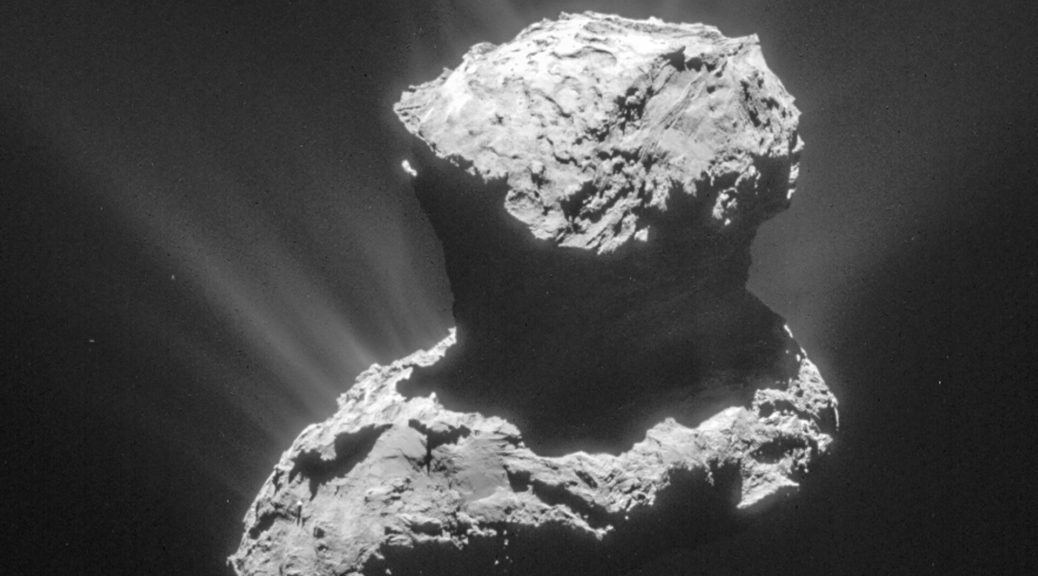
It’s been eight years since an historic landing took place between an European Space Agency drone and a comet.(which looked suspiciously a lot like an asteroid to us!)
At that time a report from Deep Space Industrieslaid out their business plans up to 2020 and what they had committed to sounded more like science fiction than fact.
But it wasn’t and they’d already secured investors.
A 2019 announcement from NASA stating that it would be the National Space Administration in the lead instead ( NASA will soon begin hunting a nickel laden asteroid ) spoke volumes about not only the possibility of asteroid prospecting- but also to its inevitability in the private sector.
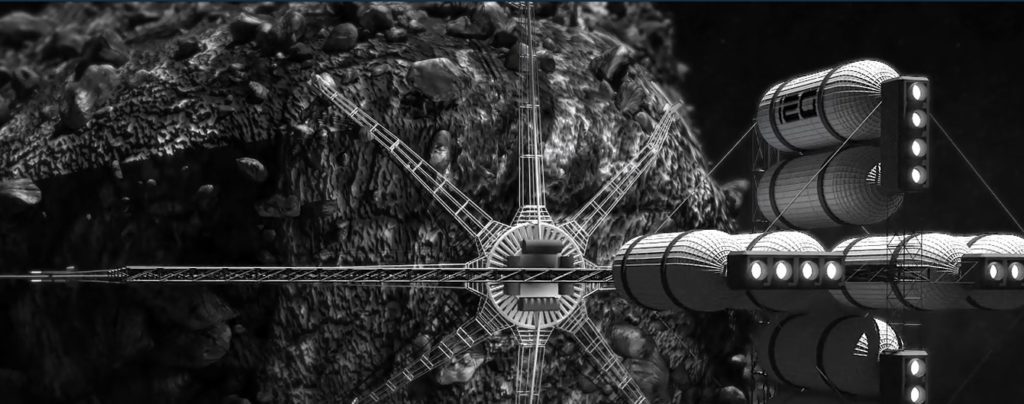
DSI concept of “coming soon” asteroid mining.
And yet, things have changed…..again.
In early 2020 Deep Space Industries (along with the only other asteroid mining company, Planetary Resources) were purchased by Bradford Space Group and ConsenSys Group respectively and all plans for private asteroid mining were shelved indefinitely. Deep Space Industries is now focused on developing space propulsion systems and ConsenSys is now focused on developing blockchain security applications for space technology.
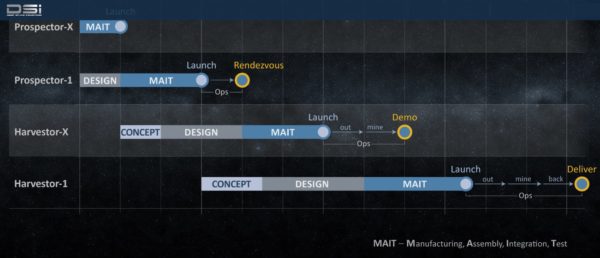
What could have been- Deep Space Industries ambitious plan before the take over
Their plan was to send an entire fleet of prospector spaceships to Near-Earth asteroids in order to harvest them for precious metals and other undisclosed resources. (space rubies anyone?). Starting in 2015, Deep Space Industries were to begin their operation by sending three small spacecraft called FireFlies to selected asteroids near earth for sample taking and photo reconnaissance. One year later, bigger craft called DragonFlies were to leave on four year missions to retrieve asteroid samples and bring them back to Earth. An ambitious project to be sure and not surprisingly, the timeline had been regularly pushed back.
This press release from DSI said a precursor mission was scheduled to launch in 2017: “Recently, Deep Space Industries and its partner, the government of Luxembourg, announced plans to build and fly Prospector-X™, an experimental mission to low-Earth orbit that will test key technologies needed for low-cost exploration spacecraft. This precursor mission is scheduled to launch in 2017. Then, before the end of this decade, Prospector-1 will travel beyond Earth’s orbit to begin the first space mining exploration mission.”
Valuable materials exist in abundance in space and have strong economic potential. Using their tested indicators as investment attractors, Deep Space will move towards securing a commercial space operation and start into the next phase of its business plan. This involves concentrating firstly on processing rocket fuel from asteroid-harvested water.
This fuel, harvested and processed in space will save millions of dollars, since existing communications satellites will no longer be ‘thrown away’ when their fuel supply has been used up. (Satellites that can longer ‘move’ and stay in orbit by using their rocket engines are left to slowly fall towards earth and burn up in the atmosphere ).
Deep Space Industries past-CEO David Gump estimated that a satellite ‘refueled’ and saved from burn up is worth up to $8,000,000 per month. Those figures start to add up when you factor in the number of satellites in use and being launched every year. Another plan during this phase of their business operations is to return precious group metals such as platinum and gold back to earth.
After all, if you’re splitting up asteroids and discover metal commodities, why not bring it back down to earth?
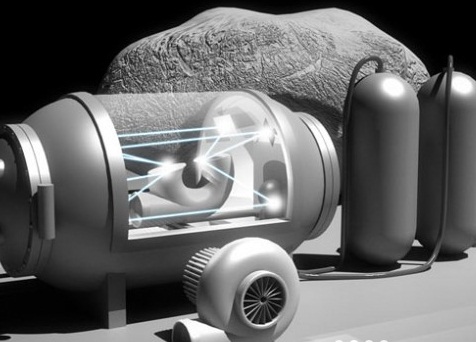
Deep Space believed that other metals harvested from asteroids also have an in-orbit value. They are developing the Microgravity Foundry- a type of 3D printer that will be used to fabricate and machine metal parts in space from pure asteroid metal such as high strength nickel parts.
Deep Space cgi mockup of their planned 3D space printer.
Since this factory will operate in space and in zero gravity and produce parts in space, the idea of permanent space development and human habitation is economically feasible. Stephen Covey co-founder of Deep Space Industries and inventor of the Microgravity Foundry process: “What’s cool about the [3D] printer is that it can take its own parts, grind them up, and recycle them into new parts.”
Stephen Covey- inventor of the Microgravity Foundry process
Deep Space Industries past-CEO David Gump: “Using resources harvested in space is the only way to afford permanent space development. More than 900 new asteroids that pass near Earth are discovered every year. They can be like the Iron Range of Minnesota was for the Detroit car industry last century- a key resource located near where it is needed. In this case, metals and fuel from asteroids can expand the in-space industries of this century. That is our strategy.” Company estimates place a value of 1 ton of raw asteroid material at a worth of $1,000,000 [usd] in orbit.
Buy outs over the last few years have all but ended the dream and it will be the various space agencies such as NASA and ESA that will fulfill Deep Space Industries abandoned plan. For the Silo, Jarrod Barker.