Tag Archives: art exhibition

The Met to Present a Major Exhibition Dedicated to the Careers of Lee Krasner and Jackson Pollock

Featuring over 120 works from more than 80 U.S. and international lenders, this exhibition marks the first major New York presentation of either artist’s work in over two decades—and their first at The Met.

Exhibition Dates: October 4, 2026–January 31, 2027
Exhibition Location: The Met Fifth Avenue, Gallery 899, The Tisch Galleries


(New York, February, 2026)—Krasner and Pollock: Past Continuous at The Metropolitan Museum of Artis a major exhibition that charts the full arc of the careers of Lee Krasner (1908–1984) and Jackson Pollock (1912–1956) in parallel, examining the distinct yet connected practices of these artistic peers and life partners. On view October 4, 2026, through January 31, 2027, it marks the first major New York presentation devoted to either artist in more than 20 years, introducing their work to a new generation while reassessing their enduring impacts on modern and contemporary art.

A meeting of two great artists


Krasner and Pollock were emerging artists in New York when they met on the occasion of being included in a 1942 exhibition organized by the artist John Graham. They married in 1945 and moved to Springs, Long Island, where they remained entwined personally, artistically, and professionally until Pollock’s death in 1956. Pollock’s life’s work had secured his legacy, while the nearly three decades that Krasner survived him marked some of the most transformative years of her career. Drawing its subtitle, Past Continuous, from a 1976 painting by Krasner, the exhibition traces parallel lives and practices, first forged by lived experience and then shadowed by memory. It foregrounds the range and art historical significance of Krasner’s work while offering a sustained examination of Pollock’s rich and complex practice.
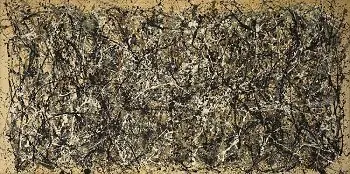
Number 31. 1950. Jackson Pollock

Outstanding philanthropy


The exhibition is made possible by Kenneth C. Griffin and Griffin Catalyst, Marina Kellen French, and the Barrie A. and Deedee Wigmore Foundation.
Additional support is provided Trevor and Alexis Traina, the Aaron I. Fleischman and Lin Lougheed Fund, The Huo Family Foundation, and Joyce Kwok.
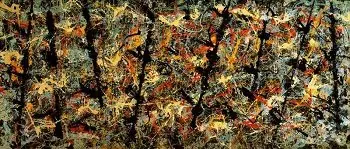
Number 11. 1952. Jackson Pollock

A novel way of reexamining modern art


“With its distinctive premise and scope, Krasner and Pollock: Past Continuous exemplifies The Met’s commitment to reexamining modern art through rigorous scholarship and fresh perspectives,” said Max Hollein, Marina Kellen French Director and Chief Executive Officer of The Metropolitan Museum of Art. “By considering each artist on their own terms while also foregrounding their consequential relationship, the exhibition situates Krasner’s and Pollock’s work within a broader cultural and artistic context—an approach central to the mission of The Met’s Department of Modern and Contemporary Art and to the vision of the forthcoming Oscar L. Tang and H.M. Agnes Hsu-Tang Wing, opening in 2030. This project affirms Krasner and Pollock not only as defining figures of their moment, but as artists whose work continues to shape and inspire future generations.”

What makes an artist revolutionary?


Krasner and Pollock: Past Continuous begins with the fundamental premise that these artists are equals, partners in life, giants in the history of art, and revolutionaries who defined what abstraction could be,” said David Breslin, Leonard A. Lauder Curator in Charge, Department of Modern and Contemporary Art, The Met. “Each found a partner who would insist on the primacy of art over life; and they both aspired to an art that was forged out of historical connections but that also promised freedom and radical possibility in a world forever changed by war. The exhibition concerns entwined lives but is also about how different artistic directions come from shared terrain.”

Krasner and Pollock: Past Continuous approaches these artists not as a single story, but as two practices unfolding in proximity over time,” said Brinda Kumar, Associate Curator, Department of Modern and Contemporary Art, The Met. “The exhibition examines how Krasner and Pollock shared a commitment to testing the possibilities of abstraction—through shifts in scale, material, and form—and how those investigations continued to evolve along distinct trajectories.”

Krasner and Pollock: Past Continuous follows each artist’s life and work.

The exhibition highlights their differences as much as their interrelation, with some galleries that place the artists together and others where they are presented independently. Krasner and Pollock were shaped by their distinct upbringings and formative trainings. Krasner adopted and negotiated the tenets of the European avant-garde, particularly Pablo Picasso, Henri Matisse, and Piet Mondrian. Her training under Hans Hofmann was key to her development. Pollock’s network of broad influences included Thomas Hart Benton and American Regionalism, Mexican mural traditions, Surrealism, and even his own family of artists.

Their early paths unfold as complementary divergences, tracing distinct strands of American modernism that would ultimately converge in the rupture known as Abstract Expressionism. For Pollock, his breakthrough was the “drip” technique, a radical mode of painting that flourished in a condensed but prolific period from 1946 to 1951. Krasner’s varied practice was typified by ceaseless explorations of abstraction, often cued by her abiding interest in the possibilities of nature and color. This manifested in bold collages, gestural canvases and vividly hued hard-edge painting. Historically, Pollock’s reputation has eclipsed Krasner’s. LIFE Magazine asked in 1949 if Pollock was “the greatest living painter in the United States.” His early death and posthumous media attention further amplified his fame and eclipsed critical appraisal of Krasner’s contributions. Today, both artists’ practices are rightly recognized as key to the innovations of art from the mid-20th century onwards. This exhibition continues and amplifies this reevaluation.

Rarely loaned works
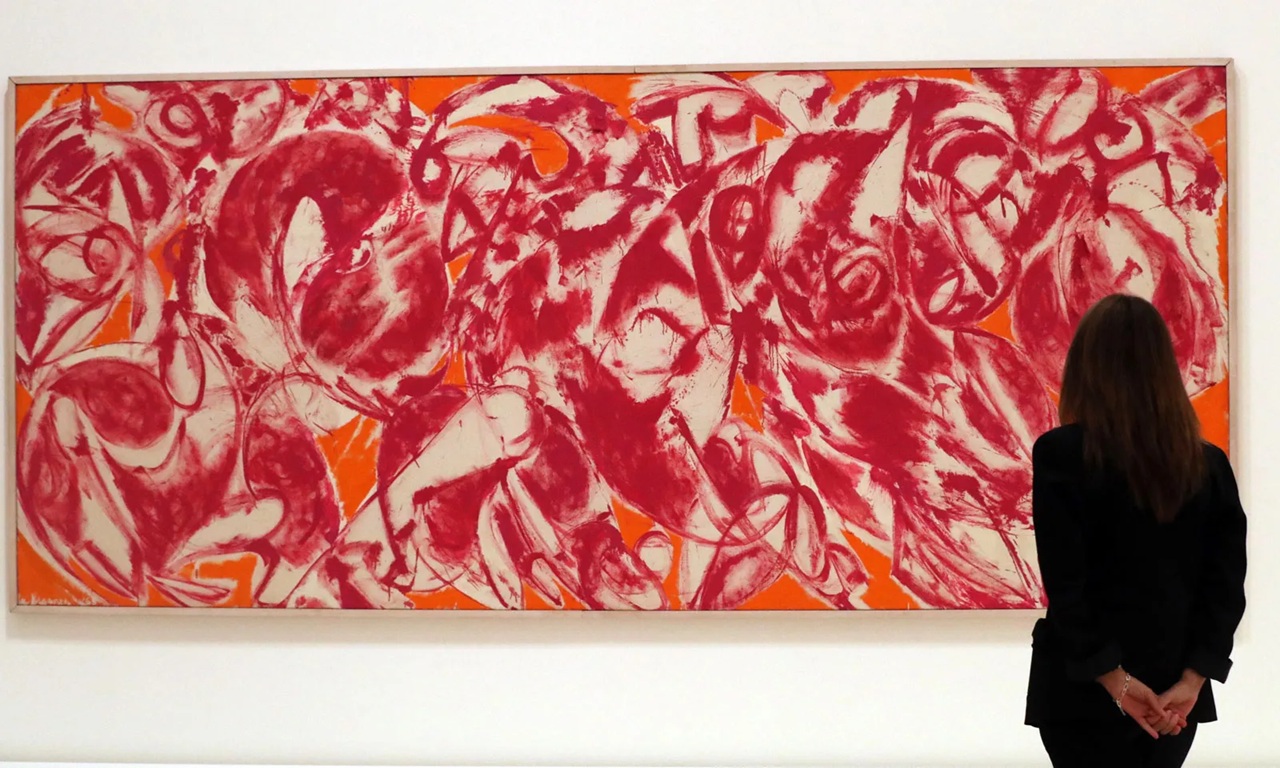
Combat. 1965. Lee Krasner


The exhibition draws on The Met collection and rarely loaned works from more than 80 U.S. and international lenders, bringing together over 120 paintings, works on paper, and ephemera to reconsider Krasner’s and Pollock’s careers—both on their own terms and in dynamic relation to each another and their shared artistic context. Major institutional lenders include Peggy Guggenheim Collection, MoMA, the Whitney Museum of American Art, Tate, National Gallery of Art, National Gallery of Victoria, Centre Pompidou, Buffalo AKG Art Museum, Dallas Museum of Art, The Art Institute of Chicago, and SFMoMA. The exhibition will also include several rarely seen works from important private collections.

Organized into 12 chapters that span each artist’s career and are punctuated by defining moments, Krasner and Pollock: Past Continuous unfolds from the 1930s through the postwar years to the end of their respective lives, moving between moments of convergence and difference. The exhibition’s design, informed in part by historic spaces and installations, enhances moments of exchange—across time and practices—while allowing for discrete encounters with works by each artist, from Krasner’s Little Images series and Pollock’s drip paintings of the late 1940s to his monumental canvases in the 1950s and Krasner’s Umber and Earth Green series. The exhibition charts ongoing dialogues—Pollock’s late return to earlier motifs in the mid-1950s and Krasner’s extended engagement through the 1960s and 1970s with artists such as Klee, Picasso, Mondrian, and Matisse. This presentation will reveal two artists in constant negotiation with each other, themselves, and the cultural, political, and aesthetic stakes of their time.

A constellation of landmark works anchor the exhibition’s exploration of both artists’ practices, including Lee Krasner’s Composition (1949), The Seasons (1957), The Eye is the First Circle (1960), and Combat (1965), along with Jackson Pollock’s Stenographic Figure (1942), Guardians of the Secret (1943), Number 1, 1950 (Lavender Mist) (1950), and The Deep (1953). Two earlier exhibitions, Krasner/Pollock: A Working Relationship (co-organized by Guild Hall and Grey Art Gallery, 1981) and Lee Krasner-Jackson Pollock: Kunstlerpaare Kunstlerfreunde (Kunstmuseum Bern, 1989–90), concentrated on the approximately 15-year overlap in the artists lives, from 1941, when they met, until Pollock’s death in 1956. Krasner and Pollock: Past Continuous is the first exhibition to consider both artists’ practices, in their full chronological sweep, together.

The Met has long been significant for both Krasner and Pollock.

Pollock first exhibited a painting at The Met in 1943 in an exhibition in support of World War II. By the end of the decade, he would be among the artists—The Irascibles—who mounted a notable critique of the Museum’s then-prevailing attitude to contemporary art. However, a short while after Pollock’s death, The Met acquired the landmark painting Autumn Rhythm (Number 30) (1950). The Met’s collection of works by Lee Krasner—from her earliest self-portraits to her late magnificent Rising Green (1972)—includes important gifts to the Museum by the artist during her lifetime. The Met was notably also the venue for Krasner’s memorial service in 1984. Krasner and Pollock: Past Continuous builds on this history, marking the Museum’s first major exhibition devoted to either artist. A focused survey, the exhibition traces the arcs of their artistic developments, offering fresh perspectives on two of the most influential figures of 20th-century art.

The exhibition also reflects The Met’s commitment to showcasing artists whose work continues to shape how art is made and understood today. Krasner’s and Pollock’s contributions to modernism and their serious engagement with the possibilities of painting continues to be significant for the work of contemporary artists. In advance of the opening of the Tang Wing for Modern and Contemporary Art, opening in 2030, Krasner and Pollock: Past Continuous models a curatorial approach that reexamines canonical narratives and connects 20th-century innovations to the concerns of today’s artists and audiences.
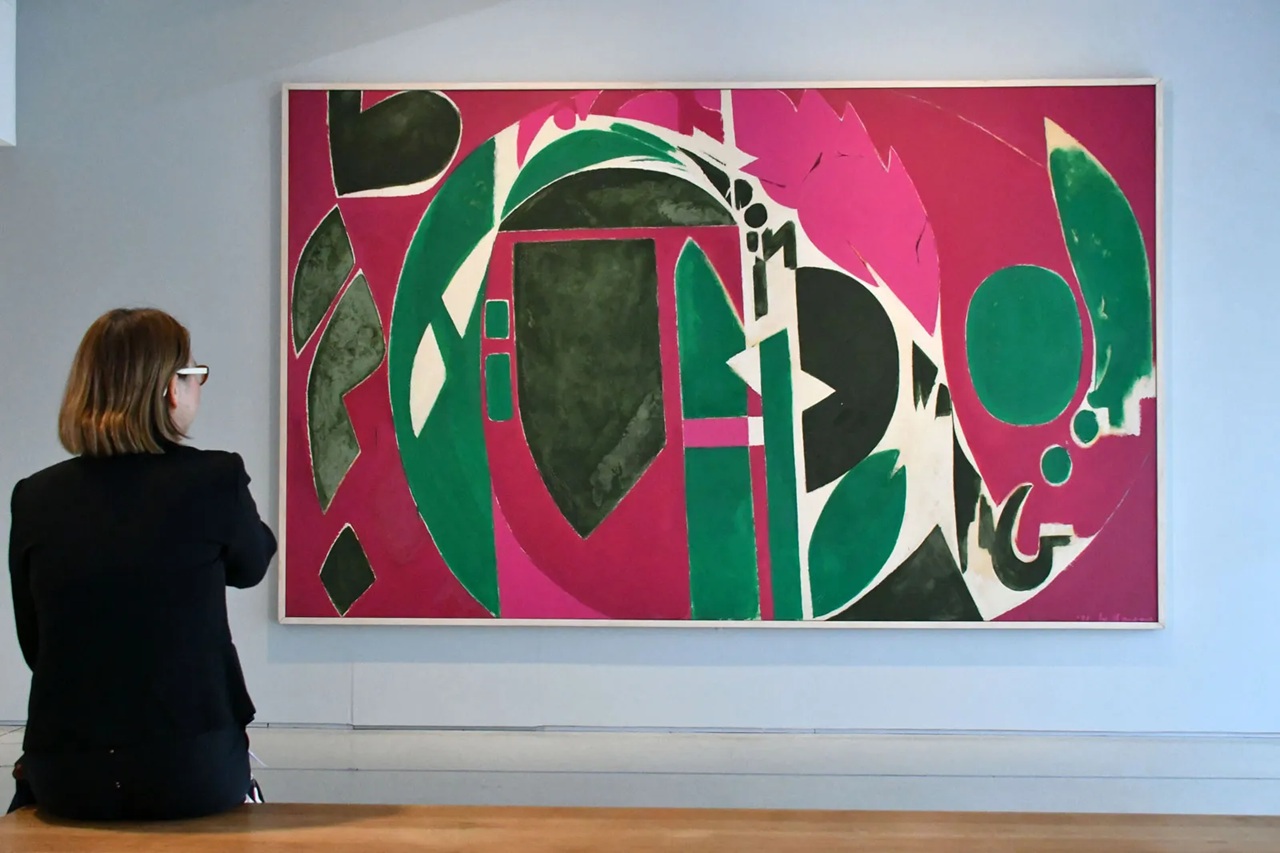
Palingenesis. 1971. Lee Krasner

Exhibition Catalogue


The exhibition’s accompanying catalogue, Krasner and Pollock: Past Continuous, expands the project’s central themes through newly commissioned texts. Featured essays by the exhibition’s curators as well as Johanna Fateman, Prudence Peiffer, and Matthew Holman consider a range of topics, including Krasner and Pollock’s intertwined creative lives as an artist couple, their strategies of abstraction in the 1950s, and the transatlantic reception of their work, while artist Amy Sillman offers a contemporary painter’s perspective on artistic breakthrough and legacy. The volume also includes an illustrated, interwoven chronology as well as reflections by leading contemporary artists, underscoring the enduring resonance of Krasner’s and Pollock’s work across generations.

The catalogue is made possible by the Pollock-Krasner Foundation.

Additional support is provided by the Aaron I. Fleischman and Lin Lougheed Fund, The Robert David Lion Gardiner Foundation, Karen and Sam Seymour, the Wyeth Foundation for American Art, Suzanne Deal Booth, and Kelly Williams and Andrew Forsyth.

For the Silo,  Julie Niemi.

Credits and Related Content
Krasner and Pollock: Past Continuous is curated by David Breslin, Leonard A. Lauder Curator in Charge, and Brinda Kumar, Associate Curator, with the assistance of CJ Salapare, Research Associate, all of the Department of Modern and Contemporary Art, The Met.

The Met will host a variety of exhibition-related programs, to be announced at a later date.

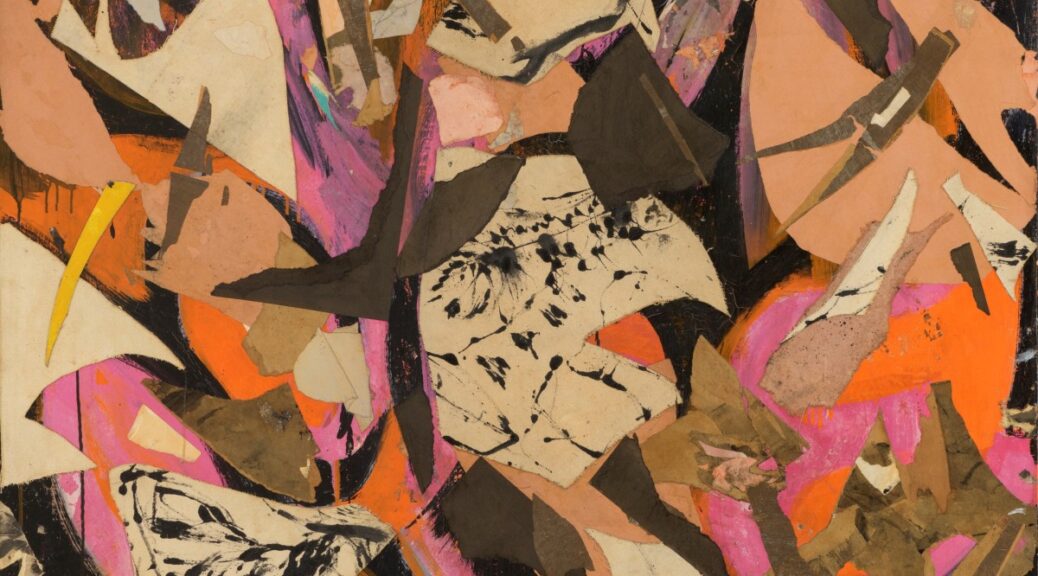
Featured Image: Lee Krasner (American, 1908–1984), Bald Eagle, 1955, Oil, paper, and canvas collage on linen, 77 × 51 1/2 in. (195.6 × 130.8 cm), ASOM Collection © 2026 Pollock-Krasner Foundation / Artists Rights Society (ARS), New York
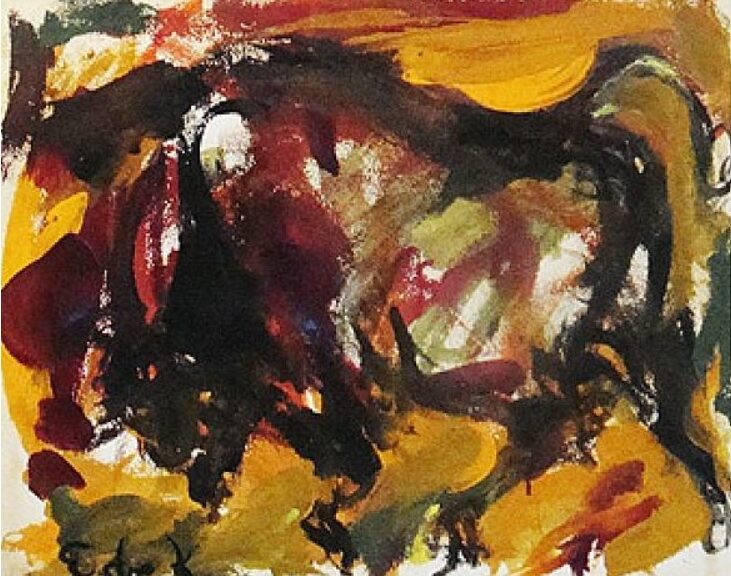
American Federation Of Arts Leader of Travelling Exhibitions Since 1909

American Federation of Arts Announces New Season
of Touring Exhibitions for Fall 2025 through 2027 ‒ Museums in over 11 cities will headline art exhibitions created by
the American Federation of Arts, with more cities to come ‒


The American Federation of Arts (AFA), the leader in traveling exhibitions worldwide since its founding in 1909, proudly announces the new season for the fall of 2025 through 2027. So far, museums in over 11 cities will headline several art exhibitions created by the AFA and its partners, with more cities to come. Throughout its celebrated 116-year history, the nonprofit institution has helped to spearhead the course of art for generations by enriching the public’s experience and understanding of the visual arts.

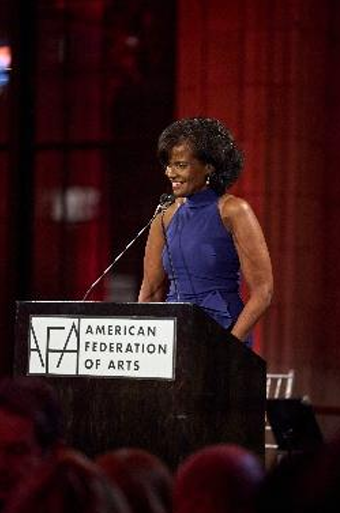
Pauline Forlenza at the 2024 AFA Gala in New York (Photo by Alycia Kravitz)


“The AFA’s expansive panorama of new exhibitions demonstrates the importance of listening to the input of visual arts leaders nationwide, focusing on what audiences want to see, and continuing our legacy of shining a light on new artists and trends,” says Pauline Forlenza, the Director and CEO of the American Federation of Arts. “Our longstanding commitment to touring art exhibitions, publishing exhibition catalogues with scholarly research, and developing educational programs is vital – now more than ever.”

These traveling museum shows will open doors to creativity for the next sixteen months to museumgoers. Some of the shows include:

Abstract Expressionists: The Women • Alex Katz: Theater and Dance
Civic Virtue in Rembrandt’s Amsterdam: 17th-Century Group Portraits
from the Amsterdam Museum • Presence: The Photography Collection of Judy Glickman Lauder • Making American Artists: Stories from the
Pennsylvania Academy of the Fine Arts, 1776–1976 • Experimental
Ground: Modernist Printmaking in Paris & New York at Atelier 17

Making Their Mark: Works from the Shah Garg Collection, and more.
Links to all of the AFA’s 2025 through 2027 exhibition tours may be
viewed at: current shows and upcoming tours.
Pauline Forlenza at the 2024 AFA Gala in New York (Photo by Alycia Kravitz)


Some of the museums across the country include: National Museum of Women in the Arts, Wichita Art Museum, Muscarelle Museum of Art, Southampton Arts Center, The Gibbes Museum of Art, Taubman Museum of Art, Peabody Essex Museum, Indianapolis Museum of Art,
New Orleans Museum of Art, Mobile Museum of Art, and the Museum of Contemporary Art San Diego, among others.


Since 1909, the AFA has toured more than 3,500 exhibitions that have been viewed by millions of people in museums in every U.S. state,
and in Canada, Latin America, Europe, Asia, and Africa.
From the Smithsonian – “A vital part of American art history, the AFA was one of the first organizations to develop successfully the concept of traveling art exhibitions on a national and international level. Many arts organizations and museums have followed the AFA’s precedent. This national nonprofit museum service organization is recognized for
striving to unite American art institutions, collectors, artists, and museums.”


“Through the years, the AFA has also had an impact on patronage in the arts. During its 116-year history, the Federation’s exhibitions of contemporary art provided collectors with knowledge of new artists and avant-garde art forms, creating a broader demand and market for this type of work. Museums and collectors began purchasing work by
new or obscure American artists whom they learned about through AFA exhibitions and programs. The AFA also recognizes the importance of the exchange of cultural ideas.”

“Throughout its history, the organization has concentrated on its founding principle of broadening the audiences for contemporary American art, breaking down barriers of distance and language to expand the knowledge and appreciation of art. The touring exhibitions have brought before the public contemporary American artists and craftspeople, genres, and artistic forms of experimentation – exposing viewers to new ways of thinking and expression.”

Highlights from the New Season


View the full list of tours at: amfedarts.org/exhibitions/current and amfedarts.org/exhibitions/upcoming-exhibitions/.
The complete lists of current and upcoming touring museum shows are updated regularly, as new exhibitions and new museum dates are added. Following are highlights of eight of the AFA exhibitions that will be touring during the fall of 2025 through 2027.


Abstract Expressionists: The Women


Explores the vital, under-acknowledged innovation of women artists in
the Abstract Expressionist movement, the first internationally renowned
artistic movement to originate in the U.S. • Featuring 47 works from
The Levett Collection, by more than 30 women artists who worked in
New York, California, and Paris from the early 1940s through the 1970s.

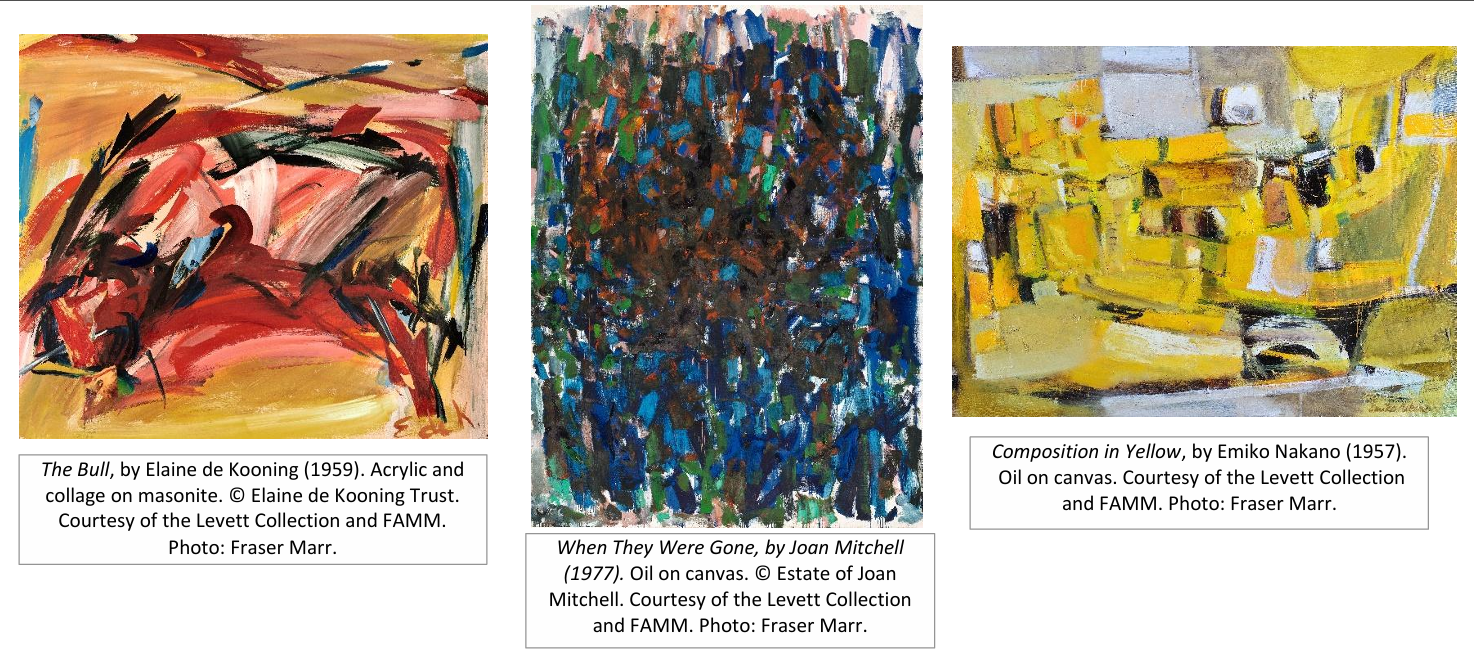
Stove, by Pat Passlof (1959). Oil on linen. © The Milton Resnick and Pat Passlof Foundation. Courtesy of Eric Firestone Gallery, the Levett Collection, and FAMM. Photo: Fraser Marr.

Features a never-before-seen grouping of works by Lee Krasner, Joan
Mitchell, Elaine de Kooning, Helen Frankenthaler, Emiko Nakano,
Pat Passloff, Mercedes Matter, Sonja Sekula, and more. • The paintings
of the Abstract Expressionist movement have historically been
associated with male creativity. • Until recently, the historical and
critical reception of Abstract Expressionism has almost uniformly
marginalized its women practitioners • This exhibition upends this
gendered narrative, demonstrating that these women were not merely
acolytes or interpreters, they were ambitious innovators all their own.
Stove, by Pat Passlof (1959). Oil on linen. © The Milton Resnick and Pat Passlof Foundation.
Courtesy of Eric Firestone Gallery, the Levett Collection, and FAMM. Photo: Fraser Marr.


Abstract Expressionists: The Women (continued)


“Too often, the canon of art history has relegated women artists to supporting roles in major art movements,” says Pauline Forlenza, the Director and CEO of the AFA. “This exhibition upends that narrative, asserting that women painters were critical contributors to the formulation of Abstract Expressionism from the very beginning.


Equally talented and visionary, the female artists featured in this show helped put American art on the map,” adds Forlenza. The exhibition is organized by the American Federation of Arts from the Christian Levett Collection and FAMM (Female Artists of the Mougins Museum), France. This exhibition is curated by Ellen G. Landau, PhD,
Andrew W. Mellon Professor Emerita of the Humanities at Case Western Reserve University.


17th-Century Group Portraits from the Amsterdam Museum


The large group portraits in this exhibition have rarely left
Amsterdam since they were commissioned in the 1600s, and have
never traveled in the U.S. as a group. • The show traces how life
in the largest and most important city of Holland was based on
the collective responsibility of the burghers, who combined their
mercantile wealth with political power. • Amsterdam’s economic
success, however, was the result of ruthless trade wars within
Europe, colonization and enslavement overseas. • Artists include
Adriaen van Nieulandt, Gerrit Berckheyde, Ludolf Bakhuizen,
Frederik Jansz, Dirck Santvoort, Ferdinand Bol, Bartholomeus
van der Helst, Nicolaes Eliasz Pickenoy, Jan Victors, and of
course, Rembrandt van Rijn. • By governing and guarding the
city, by organizing and managing a social safety net for the poor and needy, and by stimulating scientific and industrial developments, the burghers contributed to making Amsterdam the most prosperous city in Europe.

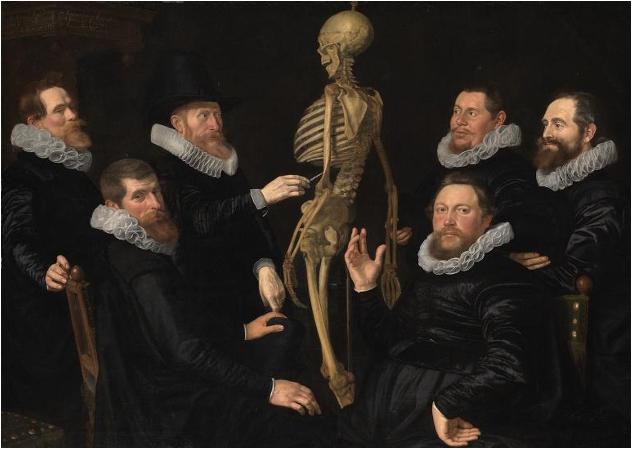
The Osteology Lesson of Dr. Sebastiaen Egbertsz, artist unknown (1619). Oil.


Presence: The Photography Collection of Judy Glickman Lauder
100 photographs by 70 artists. • Explores the concept of presence through the tenderness of portraits, the awe within landscapes, the clarity of reportage, and the spontaneity of cityscapes. • Works by Merry Alpern, Diane Arbus, Richard Avedon, Irving Bennett Ellis, Nan Goldin, Dorothea Lange, Danny Lyon, Sally Mann, Susan Meiselas, Helmut Newton, Ruth Orkin, Gordon Parks, Edward Steichen, Joyce Tenneson, James Van Der Zee, Todd Webb, Edward Weston, and more. • Photographs can be imprinted with the totality of human experiences, and this exhibition embraces that totality, examining the deeply
humanistic history of photography.

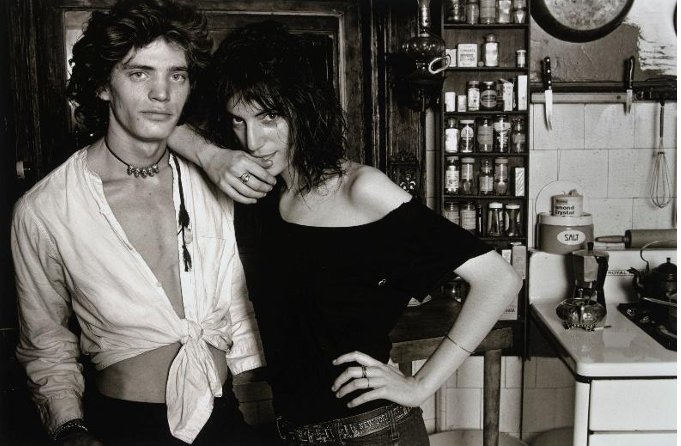
Robert Mapplethorpe and Patti Smith, New York, by Norman Seeff (1969). Archival pigment print. Portland Museum of Art, promised gift from the Judy Glickman Lauder Collection.


Making American Artists: Stories from the Pennsylvania Academy
of the Fine Arts, 1776–1976


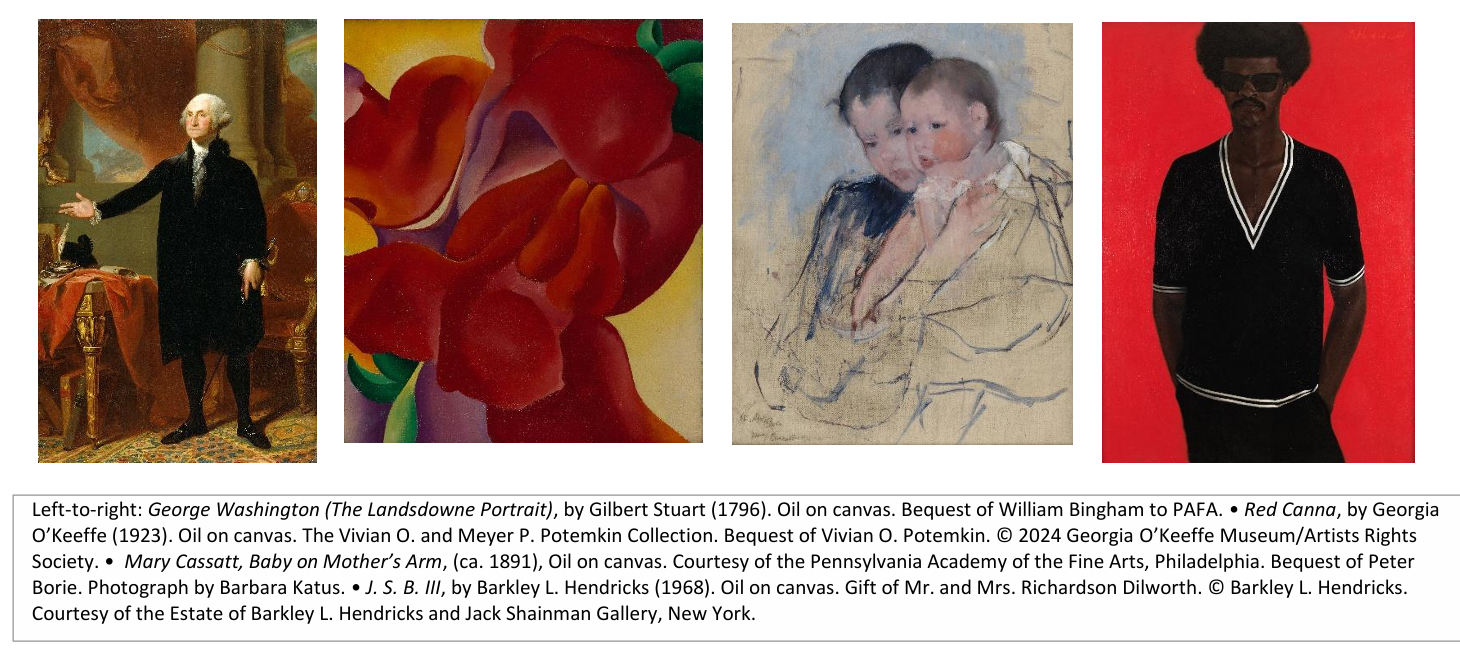
Presenting more than 100 of the most acclaimed and recognizable works of American art. • New narratives of the history of American art, embracing stories about women artists, LGBTQ+ artists, and artists of color, alongside iconic works traditionally associated with PAFA. • Women artists participated in PAFA’s exhibitions as early as 1811, and
this show includes paintings by Sarah Miriam Peale, Mary Cassatt, Cecilia Beaux, Alice Neel, and May Howard Jackson (the first African American woman to receive a scholarship to attend PAFA, in 1895). • By 1900, PAFA acquired its first work by a Black artist, Henry O. Tanner. PAFA educated African American artists and acquired their works
throughout the twentieth century, and this show features works by Joshua Johnson (one of the first professional Black artists in America), Dox Thrash, Laura Wheeler Waring, Edward Loper, and Barkley L. Hendricks.

Curated by Anna O. Marley, PhD., a scholar of American art and material culture from the colonial era to today.


Alex Katz: Theater and Dance

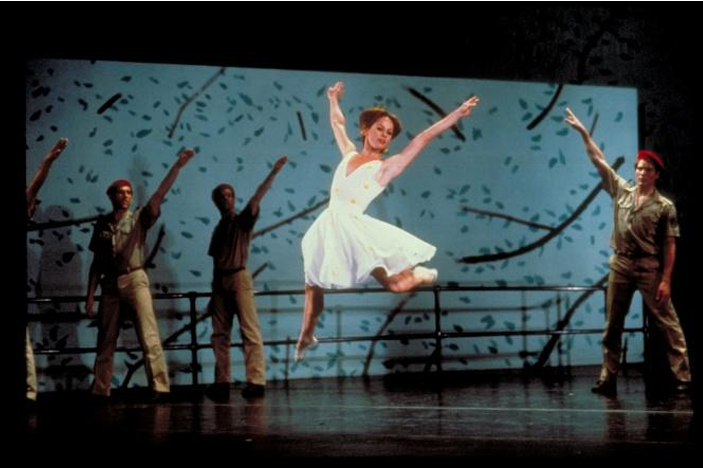
Above: Paul Taylor Dance Company’s Sunset, with set design by Alex Katz (1983). Photo by Johan Elbers. © 2025 Alex Katz/Licensed
by VAGA at Artists Rights Society. Courtesy of the Paul Taylor Archives and American Federation of Arts.


The first comprehensive museum presentation of Katzʼs highly collaborative and playful work with choreographers, dancers, and members of avant-garde theater ensembles over six decades. • Showcases Katz’s deep and lasting influence on the history of the American performing arts. • Rare archival materials, major sets
and paintings, and previously unexhibited sketches from more than two dozen productions. • Spotlights fifteen productions that Katz produced with Paul Taylor, exploring their creative partnership that generated some of the most significant postmodern dance and art of the twentieth century. • Artworks from the show are drawn from the Alex Katz holdings at the Colby College Museum of Art (home to a collection of nearly 900 works by the artist), from Paul Taylor Dance Archives, and from the artist’s studio.

• Provides an innovative kind of retrospective: that of an artistic sensibility. • Attesting to the intertwined histories of painting and stage design in Katzʼs works. • Curated by Levi Prombaum, former Katz Consulting Curator, Colby College Museum of Art.


Willie Birch: Stories to Tell


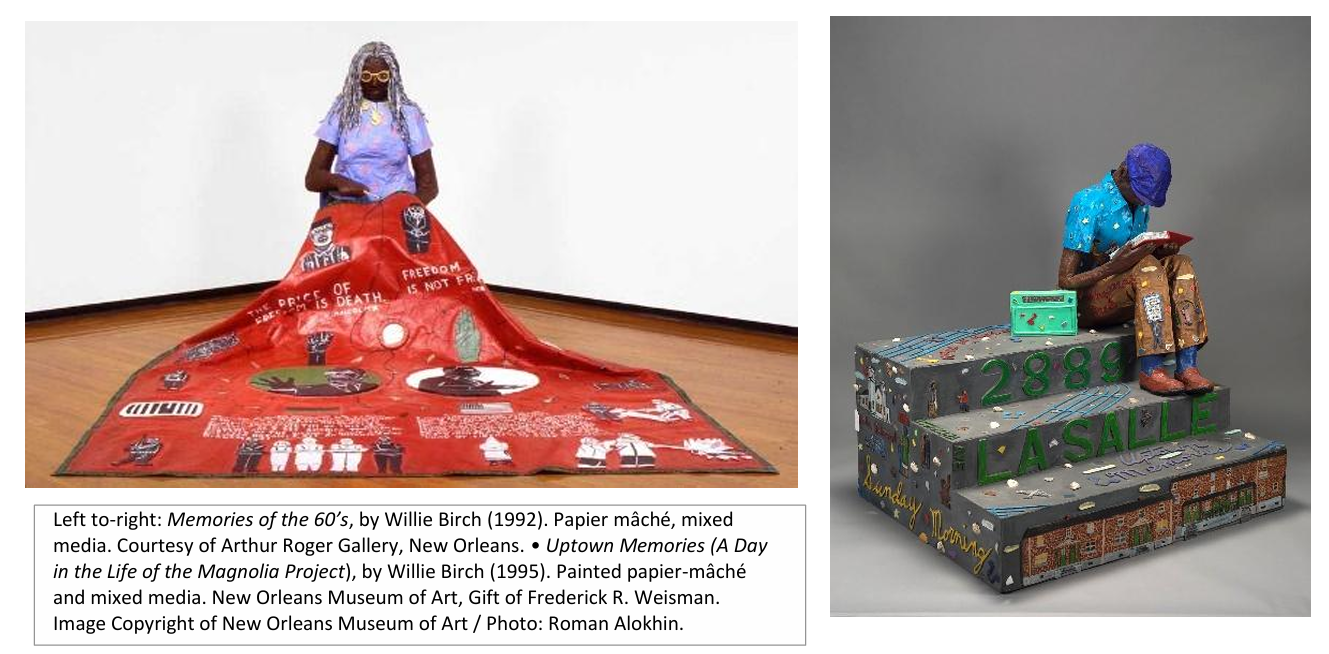
Chronicles Birch’s unique vision of the Black American experience and examines the interconnected nature of global art forms. • The first ever career retrospective brings together groundbreaking works from the early 1970s to the present.

Throughout his career, the artist has explored how African traditions have been retained in music, art, and culture in America and beyond. • Birch was raised in New Orleans and trained in Europe, Baltimore, and New York. • His work as an artist, community organizer, and cultural provocateur questions why certain things are retained and not others,
unearthing uncomfortable truths about American identity, but also offering possibilities for greater cultural awareness.  


Left to-right: Memories of the 60’s, by Willie Birch (1992). Papier mâché, mixed media. Courtesy of Arthur Roger Gallery, New Orleans. • Uptown Memories (A Day in the Life of the Magnolia Project), by Willie Birch (1995). Painted papier-mâché and mixed media. New Orleans Museum of Art, Gift of Frederick R. Weisman.
Image Copyright of New Orleans Museum of Art / Photo: Roman Alokhin.


Making Their Mark: Works from the Shah Garg Collection


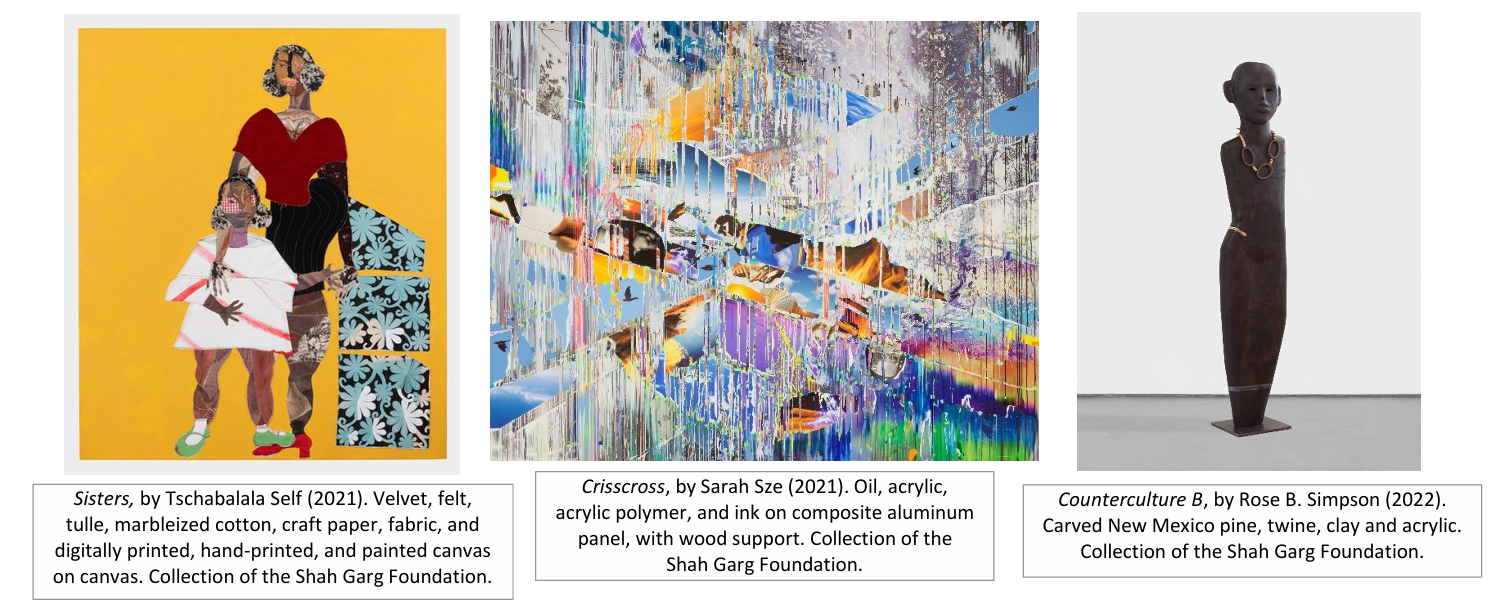
Reveals the intergenerational relationships fostered among women artists over the last eight decades, assembling over 70 works made by 60 women artists between 1946 and today. • Sculpture, painting, installation, textiles, pottery, and mixed media works all converge. • Pioneering examples of post-war abstraction —including early works by Janet Sobel, Judy Chicago, and Mary Corse — are shown alongside compositions by leading contemporary artists such as Julie Mehretu, Lorna Simpson, and Aria Dean. • Paintings and mixed media works by Christina Quarles, Tschabalala Self, and Firelei Báez blur the boundaries between abstraction and figuration. • Connections between the handmade and digital emerge in the various forms of piecework employed in Faith Ringgold’s quilts, Howardena Pindell’s collages,
and the pixelated, hypermediated canvases made by Jacqueline Humphries and Anicka Yi.

Works by the Freedom Quilting Bee, Françoise Grossen, and Sheila Hicks explore irregular geometries and eccentric abstractions via fabric and fiber. • Curated by Cecilia Alemani of High Line Arts in New York City. Sisters, by Tschabalala Self (2021). Velvet, felt, tulle, marbleized cotton, craft paper, fabric, and digitally printed, hand-printed, and painted canvas on canvas. Collection of the Shah Garg Foundation.
Crisscross, by Sarah Sze (2021). Oil, acrylic, acrylic polymer, and ink on composite aluminum panel, with wood support. Collection of the
Shah Garg Foundation. Counterculture B, by Rose B. Simpson (2022).
Carved New Mexico pine, twine, clay and acrylic. Collection of the Shah Garg Foundation.


Experimental Ground: Modernist Printmaking


In Paris & New York at Atelier 17

The first large-scale survey of original prints made at Atelier 17 to tour
the U.S. in 50 years. • This revolutionary printmaking workshop (1927
to 1988) was famous for its impact on the development of modern art.

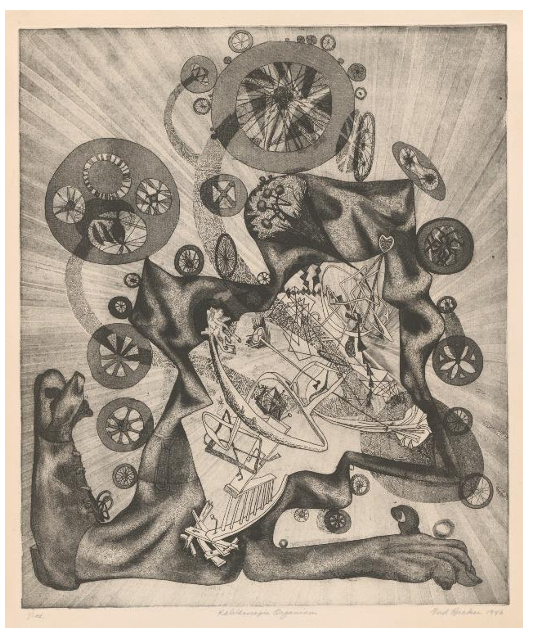
Kaleidoscopic Organism, by Fred Becker (1946). Softground etching.
Courtesy of O’Brien Art Project Foundation.

It served as a hub of artistic and intellectual exchange — first for
Surrealists in interwar Paris, and after World War II for the exploration of abstraction and other modernist styles. • Commemorates 100 years since the founding of the studio. • Presents works by notable artists who
gained formative skills at Atelier 17, such as Joan Miró, Yves Tanguy,
Louise Bourgeois, Franz Kline, Jackson Pollock, Louise Nevelson, and
Krishna Reddy, among many other artists who participated in intense
collaborations at the studio. • Atelier 17 attracted hundreds of
international artists, drawn to the radical vision of printmaking as a mode for experimentation rather than reproduction.


About the American Federation of Arts


The American Federation of Arts (AFA) is the leader in traveling exhibitions in the U.S. and worldwide. One of the first to successfully tour art exhibitions on a national and international level, the organization unites American art institutions, collectors, artists, and museums.
The AFA has toured more than 3,500 exhibitions that have been viewed
by millions of people in museums in every U.S. state, and in Canada,
Latin America, Europe, Asia, and Africa.


A nonprofit organization founded in 1909, AFA is dedicated to enriching
the public’s experience and understanding of the visual arts through
organizing and touring art exhibitions for presentation in museums
around the world, publishing exhibition catalogues featuring important
scholarly research, and developing educational programs.


Abstract Expressionists: The Women is organized by the American Federation of Arts from the Christian Levett Collection and
FAMM (Female Artists of the Mougins Museum), France. The exhibition is curated by Dr. Ellen G. Landau. It is generously supported by Berry Campbell Gallery, Betsy Shack Barbanell, Monique Schoen Warshaw, Christian Levett, and Clare McKeon and the Clare McKeon Charitable Trust. Additional support has been provided by the Pollock-Krasner Foundation and the Every Page Foundation.


Making Art, Making History: 200 Years of American Stories from the Pennsylvania Academy of the Fine Arts is co-organized by the American Federation of Arts and the Pennsylvania Academy of the Fine Arts. Lead support was provided to PAFA by the William Penn Foundation, with additional support from the Richard C. von Hess Foundation and donors to PAFA’s Special Exhibitions Fund. In-Kind support is provided by Christie’s and Gill & Lagodich Fine Period Frames, New York. This exhibition is supported by an indemnity from the Federal Council on the Arts and the Humanities.


Alex Katz: Theater and Dance is organized by the American Federation of Arts and Colby College Museum of Art. This exhibition is curated by Levi Prombaum, former Katz Consulting Curator, Colby College Museum of Art. The 2022 presentation of Alex Katz: Theater and Dance was organized by the Colby Museum with curatorial guidance
from Robert Storr.


Willie Birch: Stories to Tell is co-organized by the American Federation of Arts and the New Orleans Museum of Art. Major support for the exhibition and catalogue is provided by the Andy Warhol Foundation for the Visual Arts, the Henry Luce Foundation, Wyeth Foundation for American Arts, and the Terra Foundation for American Art.


Making Their Mark: Works from the Shah Garg Collection is organized by the American Federation of Arts and the Shah Garg Foundation. The exhibition is curated by Cecilia Alemani, the Donald R. Mullen, Jr. Director and Chief Curator of High Line Arts in New York City.


Experimental Ground: Modernist Printmaking in Paris & New York at Atelier 17 is organized by the American Federation of Arts. This exhibition is curated by Ann Shafer and Christina Weyl. Civic Virtue in Rembrandt’s Amsterdam: 17th-Century Group Portraits from the Amsterdam Museum is organized by the American Federation of Arts.


Presence: The Photography Collection of Judy Glickman Lauder is co-organized by the Portland Museum of Art, Maine, and the American Federation of Arts.

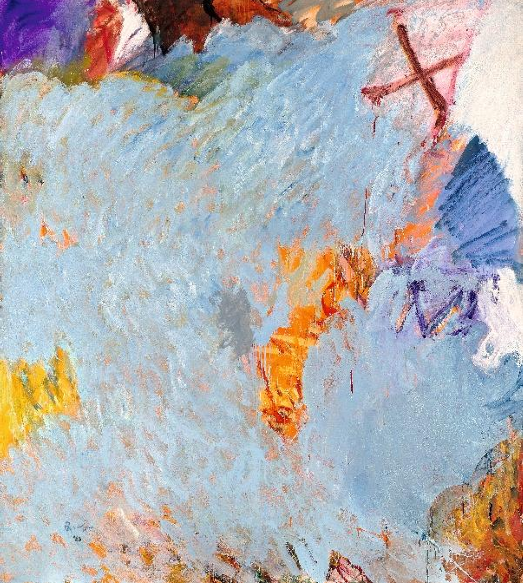
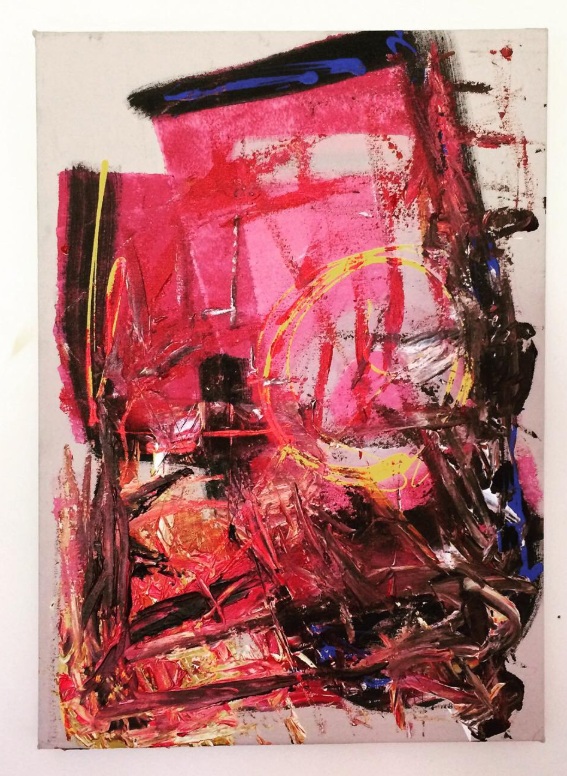
Untitled. abstract expressionism- oil on canvas Jarrod Barker 2021

For the Silo, Jarrod Barker.

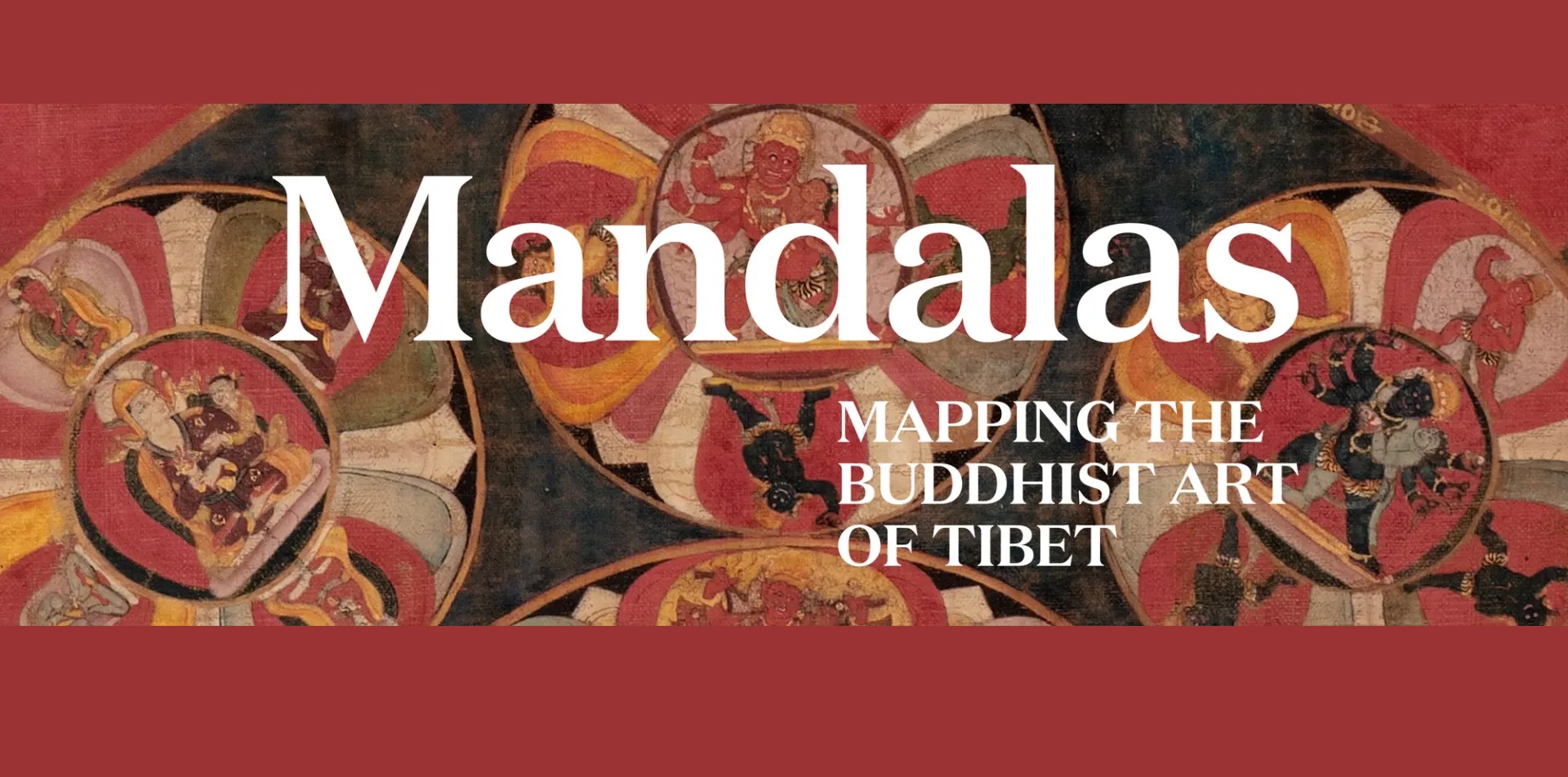
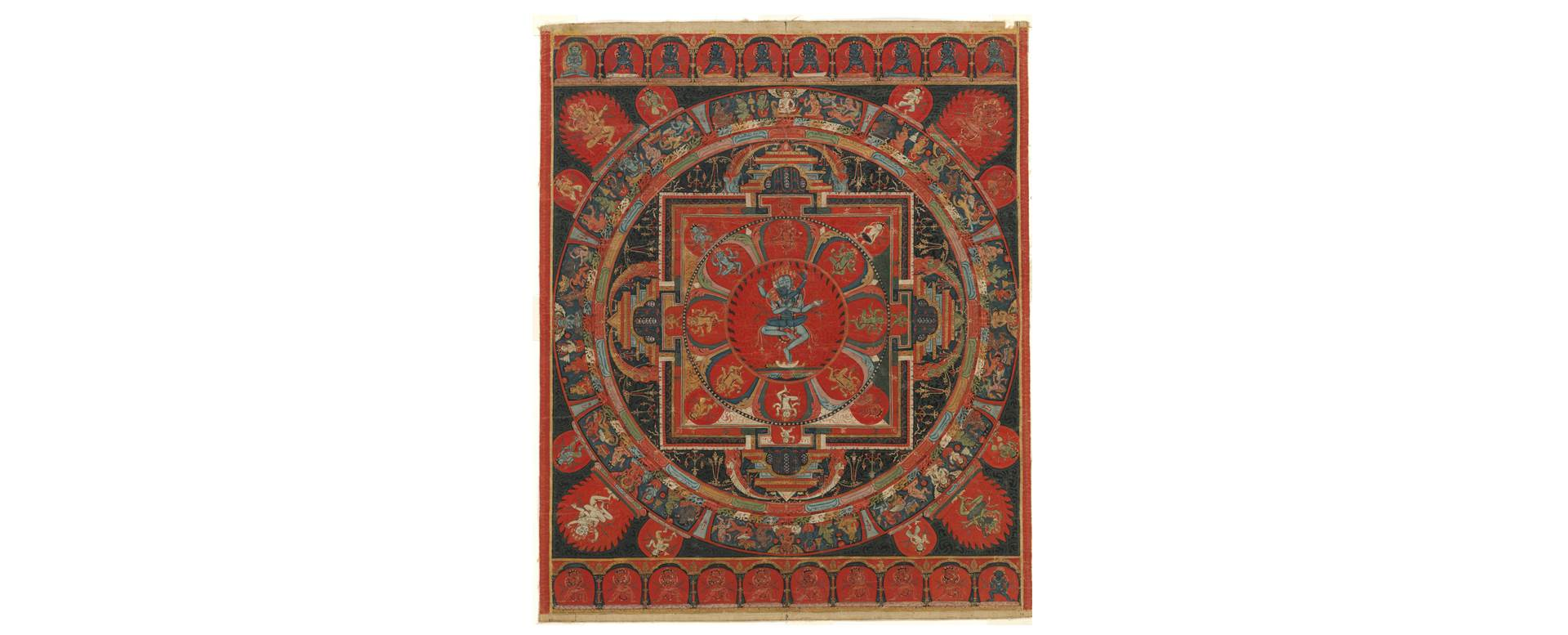
Mandalas- Buddhist Art Of Tibet Coming To The Met

A mandala is a diagram of the universe—a map of true reality that in Tibet is used to conceptualize a rapid path to enlightenment.

September 19, 2024–January 12, 2025

Upcoming at The Met Fifth Avenue in Galleries 963–965

This exhibition explores the imagery of the Himalayan Buddhist devotional art through over 100 paintings, sculptures, textiles, instruments, and an array of ritual objects, mostly dating between the 12th and 15th centuries.

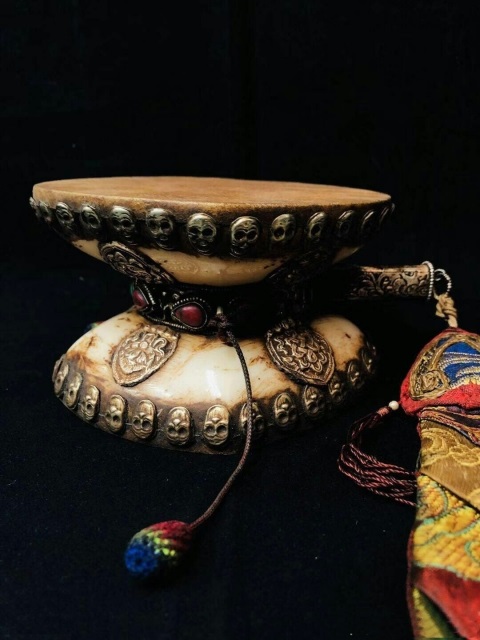
“Tibetan Dharma drum, one of the eight dharma instruments of Tibetan Buddhism, is one of the dharma instruments in Tibetan Buddhism. There are many kinds of dharma instruments, such as big drum, bronze drum, waist drum, crank drum, jie drum and gapala drum. Mainly used in buddhist celebrations, religious festivals, living Buddha sitting on the bed, kaiguang ceremony and other major festive activities. The drum hammer of a crank drum is bent, like a bow.

The drum is about one meter in diameter. When chanting, the lama holds the drum handle in his left hand and hits the accompaniment with a crank drum hammer in his right hand. Kala drum, also known as “zama ru” in Tibetan, is made of wood, ivory and human skulls. The falbala is played with the diamond bell.” rugrabbit.com

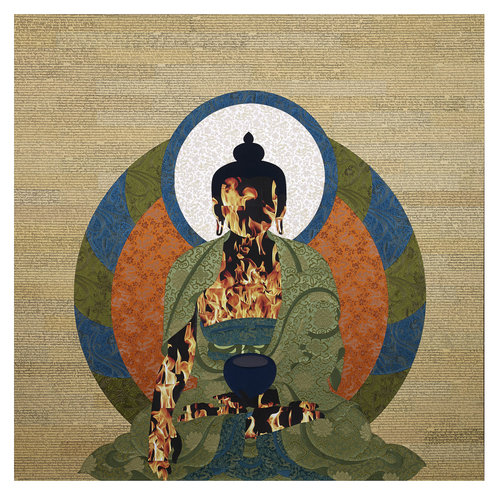
This dazzling visual experience provides a roadmap for understanding Himalayan Buddhist worship through early masterworks, juxtaposed with a newly commissioned contemporary installation by Tibetan artist Tenzing Rigdol.

From emmanuelgallery.org- “Tenzing Rigdol’s imposing buddha silhouettes greet the viewer in their recognizable cross-legged seated positions—a posture often associated with meditation and peace—and with a stunning visual effect enhanced by the use of silks and fire imagery. The work brings vivid colors and interesting patterns to the eye, but the fires seemingly emerging from the bodies of the buddhas are also direct acknowledgements of the 155 Tibetans who have self-immolated since February 27, 2009.

In an ultimate act of sacrifice, these Tibetans set themselves on fire with the hope of bringing attention to the oppression currently faced by their society under the laws of the Chinese government. And yet, the buddhas seem peaceful, even welcoming in their balanced postures, their calming presences perfectly harmonized by an artist well-versed in representing both destruction and construction.

The contradictions on display are meant to challenge the viewer. They are simultaneously safe and subversive: beautiful to look at, devastating to comprehend. They are emblematic of this ambitious imagery created by Tenzing Rigdol, a Tibetan artist who has never set foot in Tibet.”

The Met exhibition is made possible by the Placido Arango Fund and Lilly Endowment Inc.

Additional support is provided by the Florence and Herbert Irving Fund for Asian Art Exhibitions and the E. Rhodes and Leona B. Carpenter Foundation.

Inuit Artwork On Display At South Korean Art Biennale

Six Inuit and three Korean artists have been selected to share their drawings as part of a Canadian pavilion during the 15th annual Gwangju Biennale in Korea. It’s the first Canada-Korea collaboration of its kind and is a feature of the 2024-2025 Year of Cultural Exchanges between the two nations.

It’s the second time Inuit artists from West Baffin Cooperative have shared their artwork at the biennale, and builds on the growing relationship between Kinngait Studios and its counterparts in Gwangju, Korea.

Kinngait Studios

Earlier this year, West Baffin Cooperative hosted two Korean cultural delegations in Toronto, Ottawa, Iqaluit, and Kinngait. During the visits they learned more about each other’s cultural practices and found a genuine fascination about the places in which each other respectively live.

Those preliminary cross-cultural exchanges served to inform this year’s pavilion, which ultimately led to the exhibition’s main theme that explores definitions of home.

In some cases, interactions between the artists were observational, about landscape, climate, or traditional attire. Other conversations were more nuanced, about linguistics and speculations around ancient Asia-Arctic migration. There were also intimate moments between the two groups, including demonstrations of identity through cuisine; exchanges of maktaaq and kimchi, palauga, and soju.

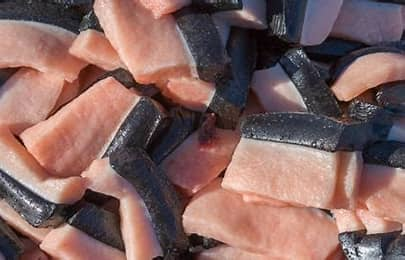
Maktaaq- a traditional food of Inuit and other circumpolar peoples, consisting of whale skin and blubber.

There were also political discussions about the still complex and often strained relationship between the government of Canada and Inuit people and those paralleled histories in Korea.

The exhibit features a set of six framed drawings taken from the 2023 pavilion, as a nod to the previous exhibition and a collaborative lithography commissioned for this project. 

Seol-a Kim Art Installation (via instagram )

The six Kinngait artists include: Saimaiyu Akesuk, Shuvinai Ashoona, Qavavau Manumie, Pitseolak Qimirpik, Ooloosie Saila and Ningiukulu Teevee. The three participating Korean artists are Sae-woong Ju, Joheum Lee and Seol-a Kim. For the Silo, Paul Clarke. Featured image- 핏설악 퀴미르픽, 무제(고향과 또 다른 장소들), 2024, 종이에 잉크 Pitseolak Qimirpik, Untitled (Home and Other Places) 2024, ink on paper.

Rice University Art Exhibition Focuses On Human Body & Land Connections

Resonant Earth: Contemporary Perspectives on Land and Body features works from Kelly Akashi, Lisa Alvarado, Eddie Rodolfo Aparicio, Andrea Chung, Sky Hopinka, and Anna Mayer On view through August 17, 2024.
Kelly Akashi, Life Forms, 2022. Collection of Barbara and Michael Gamson. Courtesy of the artist. Photo by Paul Salveson.
March, 2024 [Houston, TX]— The Moody Center for the Arts at Rice University announces the exhibition Resonant Earth: Contemporary Perspectives on Land and Body opening May 31 and on view through August 17, 2024. Bringing together new and recent work by six contemporary artists based in the United States, the exhibition explores vital connections between the human body and the land. This focused presentation emphasizes how art and artists can build awareness toward integrated ecosystems in the face of intergenerational trauma, continued exploitation of the Earth’s resources, and climate change. 

Featured artists include Kelly Akashi, Lisa Alvarado, Eddie Rodolfo Aparicio, Andrea Chung, Sky Hopinka, and Anna Mayer. Spanning a variety of media, including sculpture, painting, ceramics, collage, photography, video, and sound, the presentation also features two site-specific interventions commissioned by the Moody. Lisa Alvarado will create a monumental wall mural and Anna Mayer will mount an installation with locally sourced clay consisting of more than fifty new objects. The diverse practices presented in Resonant Earth demonstrate a critical engagement with histories of the land, primarily in the Western and Southern United States. Collectively, the exhibition addresses the local environment while considering the forced migration and displacement of people and plants across geographies.  

Executive Director Alison Weaver notes, “This project foregrounds artworks that speak to our lived experience in the United States, highlighting how personal and social histories shape our natural surroundings and our individual bodies. This summer we look forward to welcoming visitors who bring their own experiences to the galleries.” 
Sky Hopinka, Mnemonics of Shape and Reason,2022. Still. Courtesy of the artist.
About the Exhibition Resonant Earth: Contemporary Perspectives on Land and Body seeks to illuminate the intertwined social and material histories of specific ecologies, ranging from farms along the US-Mexico border, to former Japanese American internment camps in Arizona, to the extraction of land in and around Houston. With geographical references that privilege biological memory and somatically inherited knowledge over a dominant linear history, these artists highlight the intergenerational pain of displacement and the healing power of reconnection to our place on the planet.
The artworks on view echo our fraught engagement with the environment, while implying webs of interdependence in which the natural and the cultural are inseparable. The six selected artists draw on Indigenous and diasporic forms of knowledge, culture, and materials to envision modes of transformation and regeneration in relation to ongoing struggles for environmental and social justice. 
A selection of new and recent work by Kelly Akashi underscores the artist’s interest in temporality and memory as contained in the land and the body. Her sculptural work incorporates a range of material processes and is installed spatially as a constellation of objects that reference her personal and family history as well as the passage of time, the ephemerality of the human body, and the impermanence of the natural world. For example, in Conjoined Tumbleweeds, Akashi cast entangled plants growing at the site of a Japanese American incarceration camp in Poston, AZ. The bronze sculpture refers to her father’s imprisonment there during World War II.
A cast of the artist’s own body, fragmented, appears as a blue crystal hand in Inheritance. Adorned with Akashi’s grandmother’s ring, the fingers wrap around a stone from Poston, invoking the biological memory of the body as well as geological time.  Through double-sided hanging paintings, and a major site-specific wall mural accompanied by a sound installation, artist and musician 

Lisa Alvarado explores social histories of the land, including the Chicana/o Movement and her own family’s experience along the US-Mexico border. Her free-hanging abstract paintings allude to generations of migrant farmers in the region, while referencing textile traditions and muralism of the Americas.

Compositionally anchored at the corner of the gallery space and expanding outward along horizontal and vertical planes, Alvarado’s site-specific mural suggests “being in-between,” both spatially and conceptually. In the monumental painting that encompasses the viewer, Alvarado also considers meridians—both celestial, in relation to one’s position on Earth and the sky, and those used in traditional non-Western medicine to trace the pathways within one’s own body. Cast from the trunks of non-native trees in Los Angeles, large-scale sculptural works from Eddie Rodolfo Aparicio’s Caucho (Rubber) series reference intertwined histories of plants and people. The artist, whose family is from El Salvador, considers experiences of migration, solidarity, and civil war that resonate with some Central American communities in Los Angeles.
Deeply invested in the social histories of materials, Aparicio’s artistic media suggests layers of meaning and the inseparability of the natural and the cultural. For instance, his use of rubber, which is made from the bloodlike sap of trees, recalls its importance as an Indigenous Mesoamerican technology and subsequent exploitation by colonialist extraction and trade. An immersive planetarium installation together with collages by Andrea Chung reflect the interconnected histories of materials, processes, and places of the island nations in the Caribbean Sea and Indian Ocean. In her research-based practice, Chung often subverts tools of European colonialism while considering the multiplicity of the relationships that enslaved people had with the Earth. Inspired by star charts, and seeking to invert colonial maps, The Westerlies: Prevailing the Winds is a dome structure shrouded in cyanotype canvas that invites the viewer to be surrounded by the night sky and ocean as both expanse and enclosure.
In collages featuring late-nineteenth-century ethnographic photographs of African women, Chung adorns the images with intricate beadwork, gold ink, and reproductions of delicate flora atop traditional birthing cloth, exploring the relationship between the people depicted and the land. Videos by filmmaker, photographer, and poet Sky Hopinka portray landscapes traversed by the artist, interweaving personal and collective memory. A member of the Ho-Chunk Nation of Wisconsin and the Pechanga Band of Luiseño Indians, Hopinka explores Indigenous homeland and language through rhythmic and poetic accounts. In the selected videos, the artist layers visual and audio recordings, music, and text, to consider intergenerational connections to a place as well as the ongoing effects of colonialism while prompting the viewer to consider one’s own relationship to landscape and memory. 
Twenty-five pairs of newly created wall-mounted ceramic vessels and sculptures will be part of a site-specific installation by Houston-based artist Anna Mayer, who engages with the land locally. Known for her social and sculptural practice, Mayer’s process involves analog firing techniques while critically engaging pre- and post-petroculture. In her hand-built ceramics, the artist incorporates what she calls “gleaned clay” (available as a by-product of other processes such as flooding, drought, or construction), sourced from the Houston area. 
Described as “implements” by the artist, the shapes of the wall-mounted objects reference drill bits and hammers as well as body parts and geological sediment. The series will be installed over photographic wallpaper depicting damp cement, suggesting water seeping up from the ground into the gallery. Additionally, Mayer is making new large-scale ceramic vessels that will be positioned among existing furniture at the Moody, underscoring their corporeal presence and connection. 
This new body of work examines how tools function as an extension of the body, commonly used to excavate earth, while reflecting a polyvalent approach to the land. Resonant Earth is curated by Molly Everett, Assistant Curator, Moody Center for the Arts. The exhibition is made possible by the City of Houston through Houston Arts Alliance, the Brad and Leslie Bucher Artist Endowment, the Tamara de Kuffner Fund, the Kilgore Endowment Fund, and the Sewall Endowment. 
Eddie Rodolfo Aparicio, Ruta de las flores, 2022. Courtesy of the artist and Commonwealth and Council, Los Angeles
About the Artists Kelly Akashi’s (b. 1983, Los Angeles, CA) major solo exhibition, Kelly Akashi: Formations, originated at the San José Museum of Art (2022–23), and traveled to the Frye Art Museum in Seattle (2023), and the Museum of Contemporary Art San Diego (2023–24). Her work is currently the subject of a solo presentation at the Henry Art Gallery, University of Washington, Seattle, WA (2023–24) and has been included in several group exhibitions internationally. Akashi is based in Los Angeles, CA. 

Lisa Alvarado (b. 1982, San Antonio, TX) has exhibited and performed widely, with recent solo exhibitions at the Wadsworth Atheneum Museum of Art, Hartford, CT (2023) and at REDCAT, Los Angeles, CA (2023). Originally from San Antonio, TX, Alvarado now lives and works in Chicago, IL. 

Eddie Rodolfo Aparicio’s (b. 1990, Los Angeles, CA) work is the subject of a solo exhibition at The Museum of Contemporary Art, Los Angeles, CA, on view until June 16, 2024. His work is featured in the 2024 Whitney Biennial in New York, NY, and Prospect.6 in New Orleans, LA. The artist lives and works in Los Angeles. 

Andrea Chung (b. 1978, Newark, NJ) has received solo presentations at the John Michael Kohler Arts Center, Sheboygan, WI (2023), the Art Gallery of Ontario, Toronto (2022), and the Museum of Contemporary Art San Diego, CA (2017). Her work has been exhibited at the J. Paul Getty Center, Los Angeles, CA (2021), the Pérez Art Museum, Miami, FL (2019), and in Prospect.4, New Orleans, LA (2017). Chung grew up in Sugar Land, TX, and is now based in San Diego, CA. 

Sky Hopinka’s (b. 1984, Ferndale, WA) work has been the subject of several solo exhibitions, including at the Museu de Arte de São Paulo, Brazil (2023), LUMA Arles, France (2022), Speed Art Museum, Louisville, KY (2022), and the Center for Curatorial Studies, Bard College, Annandale-on-Hudson, NY (2020). He is a 2022 MacArthur Fellow. Hopinka recently joined the faculty at Harvard University as an Assistant Professor in the Department of Art, Film, and Visual Studies, and is currently based in Cambridge, MA. 

Anna Mayer’s (b. 1974, Macomb, IL) practice spans Los Angeles and Houston. Her recent solo presentation at the Houston Center for Contemporary Craft (2021) was preceded by exhibitions at Ballroom Marfa, Marfa, TX (2016–17), and the Hammer Museum, Los Angeles, CA (2012). She lives in Houston, TX, and is an Associate Professor of sculpture at the University of Houston. 
Lisa Alvarado, Spinning Echo, 2023. Courtesy the artist and Bridget Donahue, New York.
Special EventsFriday, May 31, 6–8 p.m. Opening Reception for Resonant Earth: Contemporary Perspectives on Land and Body Celebrate the start of the exhibition with the artists.Saturday, June 1, 4–6 p.m. Dimensions Variable: National Information Society Together with her band National Information Society, featured artist Lisa Alvarado will activate the gallery space with a special musical performance.Fridays, June 7, 14, 21, and 28 at 12 p.m.

The Moody Wellness Series Join us on Fridays in June for meditation and yoga in the galleries, offered through a collaboration with the Barbara and David Gibbs Recreation and Wellness Center. Saturdays, June 8, 15, 22, 29, 2–4 p.m.

Moody ArtLab Guests of all ages are invited to create a hands-on craft inspired by artwork featured in the summer exhibition at our self-guided activity station on Saturdays in June. Materials and instructions provided. Saturday, July 20, 12–5 p.m.

Summer Jam Community Day Celebrate summer at this all-day, family-friendly event featuring an indoor farmer’s market, art activities, and local food vendors. 
Featured image: Mnemonics. Sky Hopinka
About the Moody Center for the Arts Inaugurated in February 2017, the Moody Center for the Arts at Rice University is a state-of-the-art, non-collecting institution dedicated to transdisciplinary collaboration among the arts, sciences, and humanities. The 50,000-square-foot facility, designed by acclaimed Los Angeles-based architect Michael Maltzan, serves as an experimental platform for creating and presenting works in all disciplines, a flexible teaching space to encourage new modes of making, and a forum for creative partnerships with visiting national and international artists. The Moody is free and open to the public year-round.

Website: moody.rice.edu

Social Media: @theMoodyArtsPhone: +1 713.348.ARTSAddress: Moody Center for the Arts at Rice University6100 Main Street, MS-480, Houston, TX 77005(University Entrance 8, at University Boulevard and Stockton Street)

Hours & Admission Exhibition spaces are open to the public and free of charge Tuesday through Saturday from 10 a.m. to 5 p.m. and closed on Sundays, Mondays, and holidays. Events and programs are open to the public. For schedule, tickets, and prices as applicable, visit moody.rice.edu.

Directions & Parking The Moody Center for the Arts is located on the campus of Rice University and is best reached by using Campus Entrance 8 at the intersection of University Boulevard and Stockton Street. As you enter campus, the building is on the right, just past the Media Center. There is a dedicated parking lot adjacent to the building. Payment for the Moody Lot is by credit card only.
For campus maps, visit www.rice.edu/maps.

About Rice University Located on a 300-acre forested campus in Houston, Rice University is consistently ranked among the nation’s top 20 universities by U.S. News & World Report. Rice has highly respected schools of Architecture, Business, Continuing Studies, Engineering, Humanities, Music, Natural Sciences and Social Sciences and is home to the Baker Institute for Public Policy. With 3,879 undergraduates and 2,861 graduate students, Rice’s undergraduate student-to-faculty ratio is 6-to-1. Its residential college system builds close-knit communities and lifelong friendships, just one reason why Rice is ranked No. 1 for quality of life and for lots of race/class interaction and No. 2 for happiest students by the Princeton Review. Rice is also rated as the best value among private universities by Kiplinger’s Personal Finance.

Nanni Balestrini Political Art Retrospective Exhibition Includes Early Computer Works

CENTER FOR ITALIAN ART ANNOUNCES NEW EXHIBITION: 
NANNI BALESTRINI: ART AS POLITICAL ACTION ONE THOUSAND AND ONE VOICES ON VIEW NOW UNTIL- JUNE 22, 2024
Nanni Balestrini, Cavallo, 1963. Collage on paper. Private collection, courtesy Frittelli arte contemporanea, Florence
(New York, February/March, 2024) – The Center for Italian Modern Art (CIMA) has launched its new exhibition, NANNI BALESTRINI: ART AS POLITICAL ACTION. ONE THOUSAND AND ONE VOICES, curated by Marco Scotini. This is the first retrospective exhibition in the United States of Nanni Balestrini (1935-2019), an Italian experimental visual artist, poet, and novelist known for his revolutionary artistic practice and passionate involvement in the social-political movements of the 1960s and 1970s. 
Born in Milan in 1935, Balestrini was a key protagonist of post-WW2 Italian literary and social avant-garde movements: he approached experimental poetry with a visual sensibility stemming from the artistic use of collage, and with a compositional practice that gave importance to the editing and recombining of existing texts (especially newspapers, magazines, and political slogans) in search for the expression of a collective enunciation.

Nanni Balestrini born July 1935 died May 2019

Nanni Balestrini, 65000 Ètudiants, 1972. Mixed media on panel. Collezione Emilio Mazzoli, Modena
Nanni Balestrini, Cronogramma, 1960s. Collage on paper. Private collection.
He worked side by side with contemporary composers interested in the creative potential of stochastic music and the relationship between computer technology and art. Much of his radical artistic and literary research also developed in dialogue with his participation in the student and workerist movements of the late 1960s and 1970s, and their explosive political charge. Much emphasis has been placed on the exclusively typographical character of writing in Balestrini’s artistic works. This exhibition will instead draw attention to the double acoustic and visual level of Balestrini’s word or, better yet, to what Paolo Fabbri described as its “phonic-optic indiscernibility.”

NANNI BALESTRINI: ART AS POLITICAL ACTION. ONE THOUSAND AND ONE VOICES, curated by Marco Scotini, focuses on two crucial decades in the career of Balestrini, the 1960s and the 1970s. It includes over 70 works by the artist, along with a range of documentary material. The works from the 1960s illustrate a creative phase when Balestrini shared research interests with Luigi Nono, one of the most important 20th-century experimental composers, and when the neo-avant garde literary movement Gruppo 63 was also founded. The creative relationship between Balestrini and Nono lasted an entire decade, and the exhibition sheds light on the search for the disalienation of the word pursued by both, as well as on their use of technology as a way to seize and subvert the means of industrial production and explore their artistic potential.

The final works in the exhibition date back to the late 1970s; some of them were conceived in connection with a poem dedicated to the New York City electricity blackout of 1977. Planned as an “action for voice” to be performed by Greek-Italian lyricist and vocal experimenter Demetrio Stratos in May 1979, the work was never performed due to the premature death of Stratos and Balestrini’s indictment surrounding the political movement Autonomia Operaia.

The exhibition also includes a reconstruction of Balestrini’s Tape Mark I (1961), one of the earliest examples of computer-generated art. A combinatory poem produced by an algorithm written in the Unix programming language on a massive IBM mainframe computer, Tape Mark I anticipates many of the contemporary questions surrounding Artificial Intelligence, and was featured in the 1962 edition of the Bompiani Literary Almanac, which was dedicated to “the application of computers to ethics and literature”, a theme of utmost relevance today. 

To provide context to Balestrini’s work, the show features a selection of early words-in-freedom works by Futurist artist Carlo Carrà, a form of avantgarde visual poetry that liberated words and letters from the conventions of grammar and syntax, making them part of visual and performative compositions. This technique was co-opted by the Italian Neoavanguardia in the 1960s, due to the revolutionary potential of the early Futurist movement.
NANNI BALESTRINI: ART AS POLITICAL ACTION. ONE THOUSAND AND ONE VOICES is on view at CIMA (421 Broome Street, 4th Floor, New York, NY 10013) from February 22nd – June 22nd, 2024. See visiting hours below. 

Python reconstruction of 1961 electronic poem “TAPE MARK 1”

Nanni Balestrini, Giornale di bordo (La partita a carte), 1964. Collage on paper. Private collection, Mirano (Venezia)
CIMA OPEN HOURS: • Friday and Saturday: 11am to 6pm with guided tours at 11am and 2pm (last entry at 5pm)• Members-only hours: Monday-Thursday by appointment• General admission: $15usd for guided tours; $10usd for open hours• Members & students: free
ABOUT CIMA:Founded in 2013, CIMA is a public non-profit dedicated to presenting modern and contemporary Italian art to international audiences. Through critically acclaimed exhibitions—many of them bringing work to U.S. audiences for the first time—along with a wide variety of public programs and substantial support for new scholarship awarded through its international fellowship program, CIMA situates Italian modern art in an expansive historic and cultural context, illuminating its continuing relevance to contemporary culture and serving as an incubator of curatorial ideas for larger cultural institutions. CIMA works to add new voices to scholarship on modern Italian art with annual fellowships that open fresh perspectives and new avenues of research. A visit begins with a complimentary espresso, followed by an informal exhibition tour with one of the resident fellows. Visitors are welcome to linger for additional viewing and conversation.

ABOUT CURATOR MARCO SCOTINI: Marco Scotini is an art critic and curator. He currently is artistic director of FM Centro per l’Arte Contemporanea in Milan, a center specializing in the preservation and enhancement of private collections, artists’ archives and the promotion of contemporary art. Since 2004, he has been director of the Department of Visual Arts at Nuova Accademia di Belle Arti of Milan and Rome. He is scientific director of the Gianni Colombo Archive, the Bert Theis Archive, the Clemen Parrocchetti Archive and the Nanni Balestrini Archive. Since 2014, he has been responsible for the exhibition program of PAV- Parco Arte Vivente in Turin. He was artistic director of the 2nd Yinchuan Biennale in 2018 and was a member of the Italian Council from 2019 to 2021. He has curated exhibitions for leading national and international art institutions, including the Albanian pavilion at the Venice Biennale (2015), three editions of the Prague Biennale (2003, 2005, 2007), Anren Biennale (2017), 2nd Yinchuan Biennale (2018) and was advisor for Bangkok Biennale (2020 and 2022). He took part in the 17th Istanbul Biennale (2022) and the BETA Timișoara Biennale (2022). He has been part of the project TV Politics at documenta 14 (2017). Scotini’s project Disobedience Archive is part of the 60th Mostra Internazionale d’Arte della Biennale di Venezia (2024), curated by Adriano Pedrosa.

Large Scale Landscapes At Chicago Gray

GRAY Chicago | Sep 8 – Oct 28, 2023
 

[CHICAGO – August, 2023] – Alex Katz: Autumn is the artist’s tenth solo exhibition at GRAY and the first exhibition of large-scale landscapes since 2018. The exhibition follows his lauded career retrospective, Gathering, which opened at the Guggenheim Museum in New York in the fall of 2022. As Guggenheim curator Katherine Brinson described: “[One] might be surprised by the unbound rapture of the landscape paintings that have consumed much of the artist’s still-considerable energy in recent years. But [these works] are in fact the culmination of a lifelong artistic project that aspires to compress everything into ‘a single burst of energy… to paint it wide open.'”

Alex Katz has painted figures and landscapes in equal measure throughout his career. Expressed at great scale and in vivid color, the paintings exhibited in Autumn present enveloping compositions measuring as wide as fourteen feet. “I started to think about the environmental landscapes [as] being really an environment that wraps around you,” as Katz notes, “There is no narrative. You’re dealing with perception.”

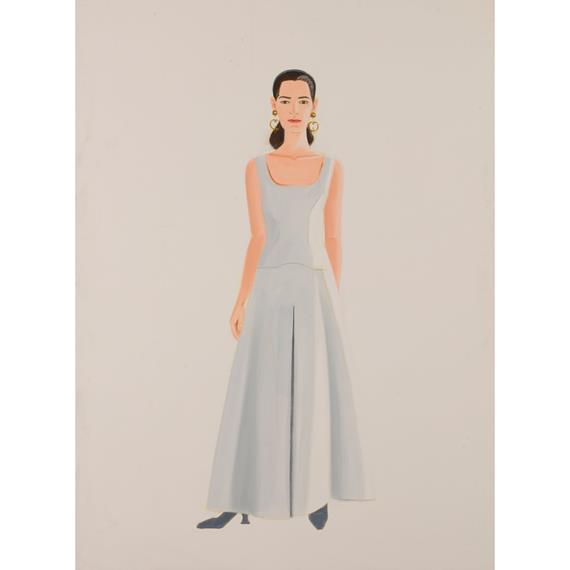
Wedding Dress by Katz shows how much of a departure his new landscape paintings are.


Across eleven monumental canvases, Katz depicts the vibrant foliage, sweeping fields, and windblown trees of the changing season. Created between 2022 and 2023, Katz’s Autumn series relies on a bright fall palette, while other paintings in the exhibition, from the related series Field’s End and Tree Top, present quieter responses to the landscape in muted greens, yellows, and grays. The paintings are exhibited alongside a series of sixteen new portraits on paper. Each drawing possesses an economy of line and is titled after its sitter – Vivien, Niki, Levi, Isaac, Vincent, and others– in reference to the friends, family members, poets, dancers, and artists most central to the artist’s life. 

Alex Katz: Autumn opens at GRAY Chicago (2044 West Carroll Avenue) with a public reception on Friday, September 8, from 5-7 PM CT, and will be on view through October 28, 2023. The exhibition will be accompanied by a fully illustrated catalogue featuring a new poem by Vincent Katz.

Featured image: Sparkling Sea 2007 by A. Katz

 
Continue Reading…
 

SwissArtExpo 2023 Will Be Most Visited Hotspot In Zurich

   
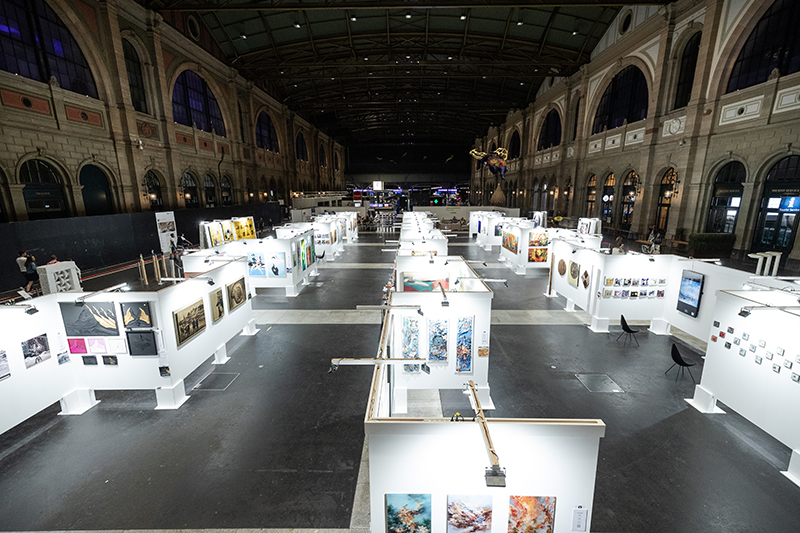
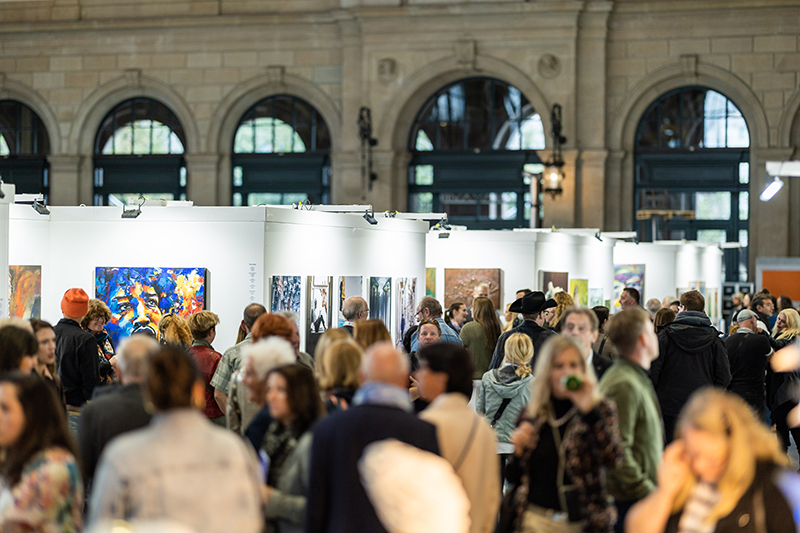
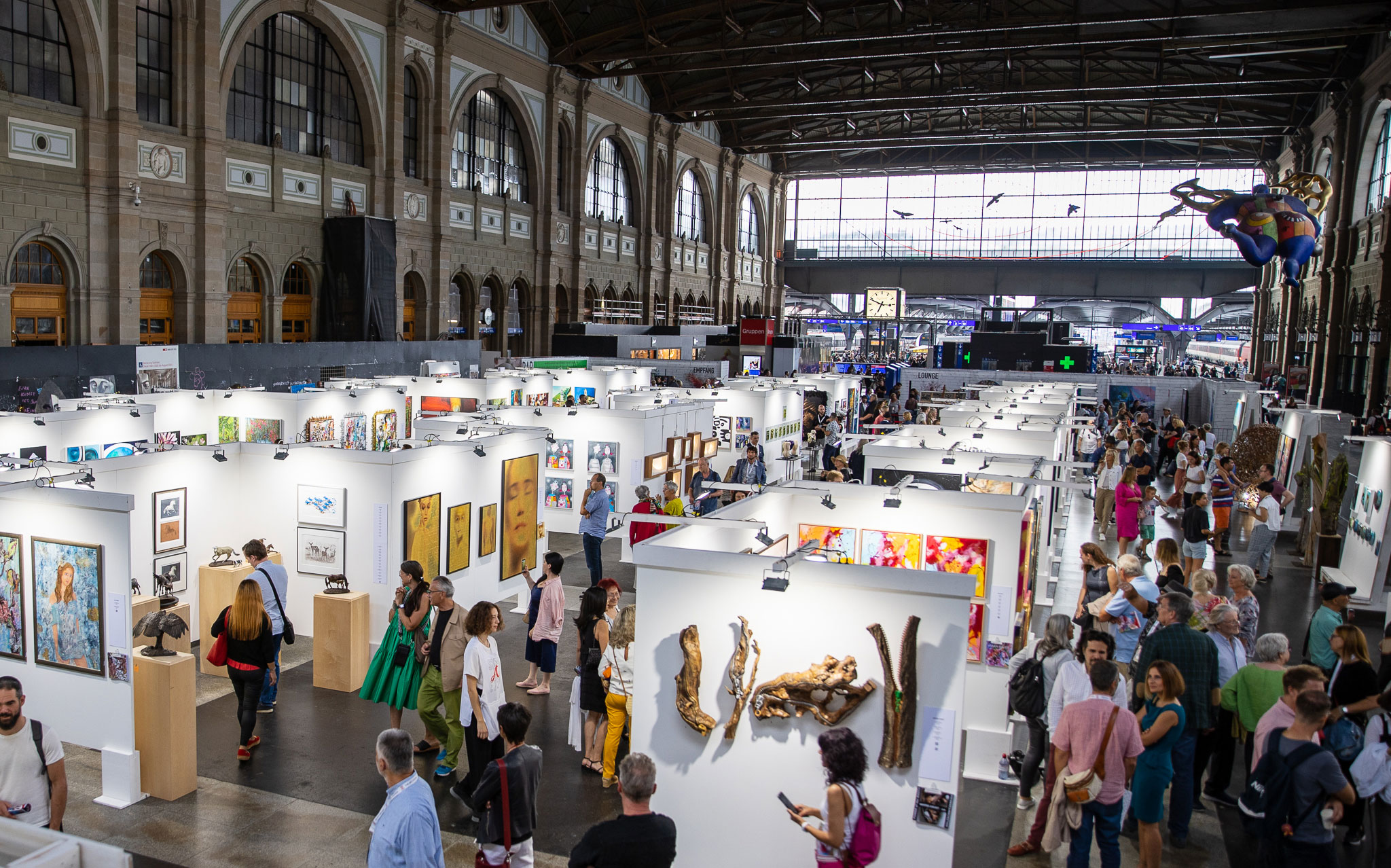
This year’s SWISSARTEXPO 2023 will be held in the beautiful Zurich main station. The art festival expects to draw 80,000 passers-by every day at the most visited hotspot in Zurich!
   
What is the ARTBOX.PROJECTS?
The ARTBOX.PROJECTS have been taking place at regular intervals since 2015 at the most sought-after art hot spots worldwide. The aim of the ARTBOX.PROJECTS is to provide a platform for specially emerging artists so that they can be seen by a large audience. So far, for example, very successful exhibitions have been held in the following locations: Miami during Art Basel, New York during Armory Art Week, Basel during Art Basel, Barcelona, Venice during the Biennale d’Arte and many more!
How does the ARTBOX.PROJECT Zurich 5.0 work?
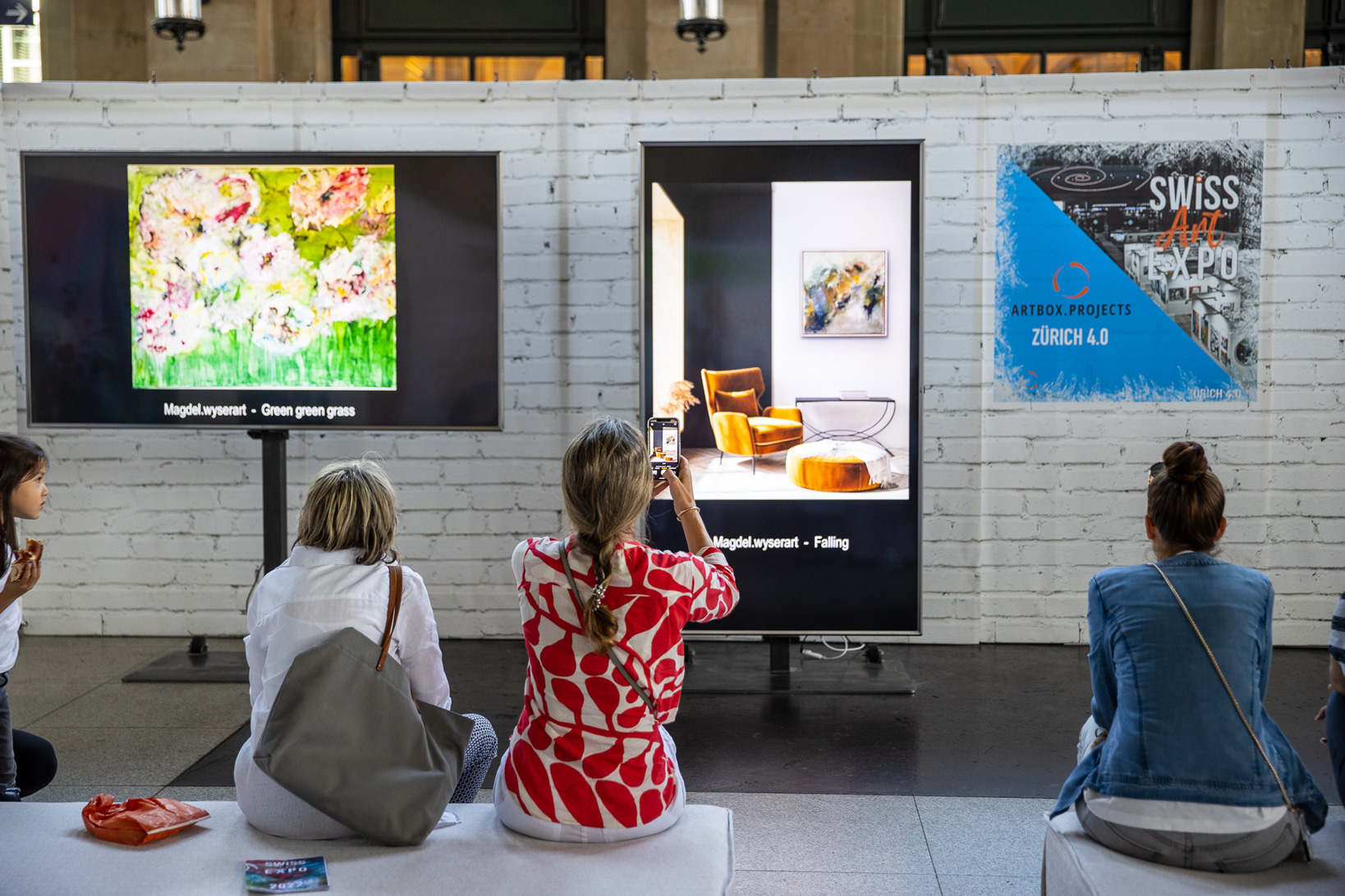
Our most popular art project, the ARTBOX.PROJECT Zurich, takes place every year during the SWISSARTEXPO. SWISSARTEXPO is a Swiss art festival that takes place in late summer in Zurich’s venerable Main Station Hall and presents over 100 artists from all over the world. The ARTBOX.PROJECT has a very prominent place in the front part of the exhibition, where the two 86″ HD screens are located, on which the artworks of the ARTBOX.PROJECT Zurich participants are presented digitally throughout all exhibition days.