Category Archives: Earth

Fined $2K For Possessing Living Snakehead “Frankenfish”

Frankenfish- the other name for the Snakehead. Frankenfish usually refer to genetically modified fish (search genetically modified salmon for more) but due to the 2004 movie "Frankenfish" which starred a Snakehead- this term is being used more and more for The northern snakehead, (Channa argus). This invasive species is now being discovered throughout North America and the United Kingdom. CP
Frankenfish- the other name for the Snakehead. Frankenfish usually refer to genetically modified fish (search genetically modified salmon for more) but due to the 2004 movie “Frankenfish” which starred a Snakehead- this term is being used more and more for The northern snakehead, (Channa argus). This invasive species is now being discovered throughout North America and the United Kingdom. CP

A Chatham man has been fined $2,000 for illegal possession of snakehead fish. Yung-Chieh Liu pleaded guilty to illegally possessing live invasive fish. In addition to the fine, two snakehead fish were also forfeited to the Crown.

Justice of the Peace Malcolm Rogers heard the case in the Ontario Court of Justice, Blenheim, on April 17, 2013.

The Ministry of Natural Resources reminds residents that it is against the law to have certain invasive species in your possession, because they pose a serious threat to native species and ecosystems. 

“The Northern Snakehead might enjoy life in Canada, but it would not be welcome here. This fish, native to eastern Asia, has invaded parts of the United States, where it threatens to disrupt ecosystems and native fish species unaccustomed to its presence. Scientists at Fisheries and Oceans Canada (DFO) want to stop the snakehead from establishing a base in Canadian waters – and building a strong defence is the key to success.

The risk posed by snakeheads is very real. Several of the 36 species have a long history of invasions, and are very hardy. They can even live out of the water for a time – to pursue their prey or find a new home if the former one dries up. They survive winter under the ice of northern lakes; some have even recovered from being frozen! The Northern Snakehead, in particular, thrives on conditions that are similar to many Canadian waters. It is a voracious predator, and it grows rapidly to an adult length of 1.5 metres or more.

In their native waters, some snakehead species are fished for food or used for aquaculture. Many are exported to other countries where they may be sold live in food markets and pet shops. Scientists believe that the Northern Snakeheads found in lakes in some US cities may have originated from food markets. Some may have been released to the wild in an ill-advised attempt at fish stocking or because they were no longer wanted as pets.” Department of Fisheries and Oceans Canada
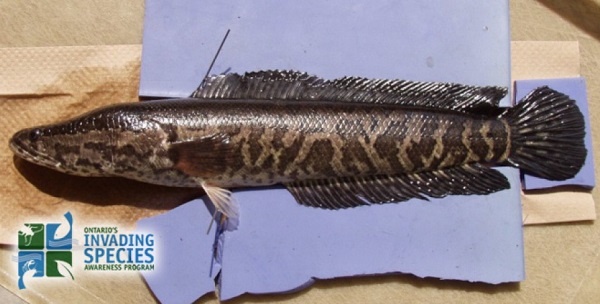
Be on the lookout for the Snakehead. Report any sightings and help keep this invader out of Ontario's waters.
Be on the lookout for the Snakehead. Report any sightings and help keep this invader out of Ontario’s waters.

For further information about fishing regulations, please consult the 2013 Recreational Fishing Regulations Summary, available at ServiceOntario/Government Information Centres, licence issuers and at ontario.ca/fishing.


To report a natural resources violation, call 1-877-TIPS-MNR (847-7667) toll-free any time or contact your local ministry office during regular business hours.  You can also call Crime Stoppers anonymously at 1-800-222-TIPS (8477).


Our Wildlife: The (Canadian) American Bullfrog


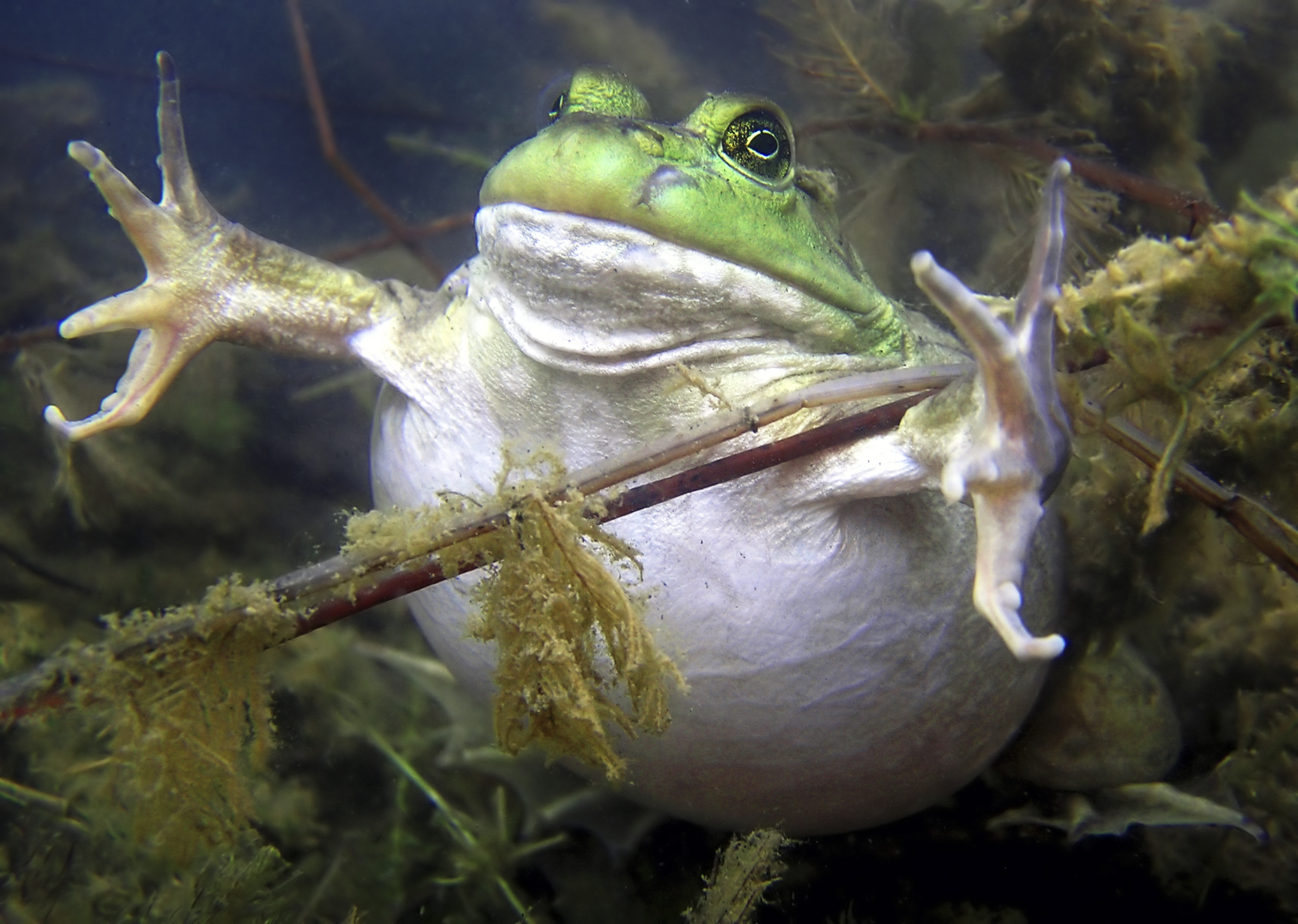
The American Bullfrog (Rana catesbeiana -CP)  is the largest of all North American frogs. They can be  found in freshwater ponds, lakes and marshes  with lots of vegetation, especially water lilies. Photograph by D. Greenwood

Bullfrogs are typically green or gray-brown with brown spots and have easily identifiable circular eardrums, or tympanum, on either side of their heads.

Females are slightly larger than the males, but only the male Bullfrog emits the trademark
baritone bellow Click for sounds of american bullfrog calls and their choruses can be heard during the day or night.

Nocturnal predators, Bullfrogs will ambush and eat just about anything they can fit in their  mouths, including insects, mice, fish, birds, and snakes.  Search “Dixie Greenwood” on the top of any page on our site to view more of Dixie’s nature photographs.

Asian Silver Carp Set To Invade Great Lakes

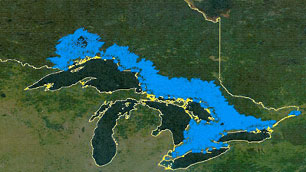
The Great Lakes are one of the world’s most important natural resources – holding one fifth of the world’s fresh surface water, home to more than 150 species of fish, and vital to the economy of Ontario and neighbouring U.S. states. But several kilometres from Lake Michigan lurks a threat that could change the Great Lakes forever. The fish known as Asian carp could wipe out native fish species, devastate sport and commercial fisheries, and cause far-reaching changes to the Great Lakes ecosystem.

If you need proof of the danger to the Great Lakes, take a look at the Mississippi River Basin. After escaping from aquaculture ponds in the southern U.S. in the 1970s and 80s, Asian carp have spread steadily northward. In parts of the Mississippi and other rivers, invasive, voracious Asian carp have crowded out native fish and make up as much as 90 per cent of all fish by weight. Only electric barriers in a canal near Chicago are currently keeping the fish out of Lake Michigan.

The need for a coordinated plan to fight Asian carp led the Ontario Ministry of Natural Resources, with support from the Department of Fisheries and Oceans Canada, to host a “table-top exercise” in March. The exercise simulated an incident where Asian carp get into Ontario waters. The aim was to test if the agencies involved are ready to respond quickly and effectively.

“Preventing Asian carp from spreading into the Great Lakes is the most cost-effective control measure we’ll ever have,” says Ontario Minister of Natural Resources Linda Jeffrey. “This exercise was about making sure all the agencies involved work together, and identifying areas where we’re vulnerable.”

For the March exercise, participants rehearsed how they would respond IF an accident on a bridge over the Thames River in southwestern Ontario caused a truckload of live Asian carp to be dumped in and near the river. It was a timely choice – only a week earlier a fish importer had been fined $50,000 for trying to truck 1,800 kilograms of live Asian carp across the Windsor/ Detroit border to sell in the Greater Toronto Area. It’s illegal to possess live Asian carp in Ontario.

The term “Asian carp” includes four species – bighead, silver, grass and black carp. The bighead and silver carp currently pose the biggest threat. They weigh up to 45 kilograms and can grow to more than a metre long. As filter feeders that can eat 20 per cent of their body weight a day in plankton, they’re able to grow and multiply faster than native species. In some areas in the U.S. carp populations are doubling every year.

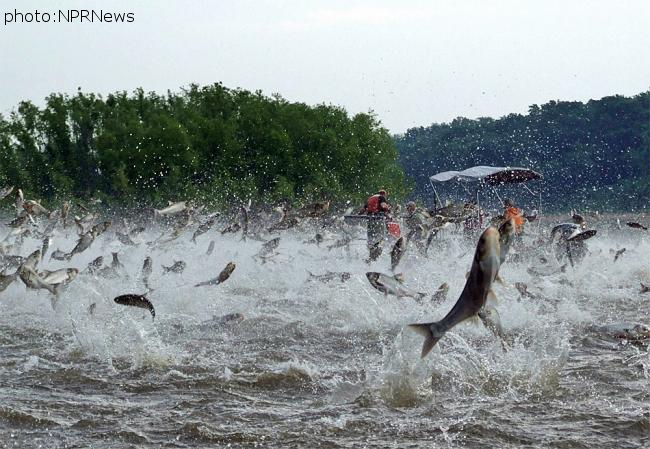
Silver carp are also a hazard to people on the water. When disturbed by boat motors, the fish jump as much as two metres out of the water. Boaters and water skiers on the Illinois River have already been hit and injured.

Canadian and U.S. experts agree that Asian carp would thrive in the Great Lakes, and that quick action is the only way to prevent Asian carp from spreading if they are found in the Great Lakes Basin.

During the table-top exercise, local MNR staff described how they would place nets upstream and downstream to catch and identify fish in the river, test the fish to find out if they could reproduce, and confirm if the river habitat was suitable for Asian carp. The agencies involved also had to decide if any local species at risk might be harmed by the control measures, and keep governments, partners, the public and the media informed.

“Ontario’s recreational fishery contributes $500 million to the province’s economy each year, our commercial fishery is worth up to $215 million a year, and the Great Lakes ecosystem is priceless,” says Minister Jeffrey. “With so much at stake, we have to be prepared.” For the Silo, Lacey Williamson. 

Surviving Hurricane Sandy

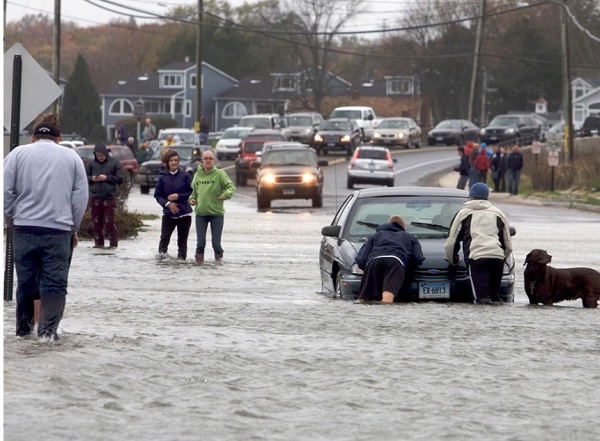
Pedestrians come to the aid of a motorist stuck on a flooded-out road along the shoreline area of Milford, Connecticut ahead of Hurricane Sandy October 29, 2012. The storm began battering the U.S. East Coast on Monday with fierce winds and driving rain, as the monster storm shut down transportation, shuttered businesses and sent thousands scrambling for higher ground. photo: REUTERS/Michelle McLoughlin

Dear Silo- I live in Jackson, N.J., about 10 miles inland, and did not get the devastating storm surge from Hurricane Sandy. And yet, I have never experienced such a catastrophic weather event.
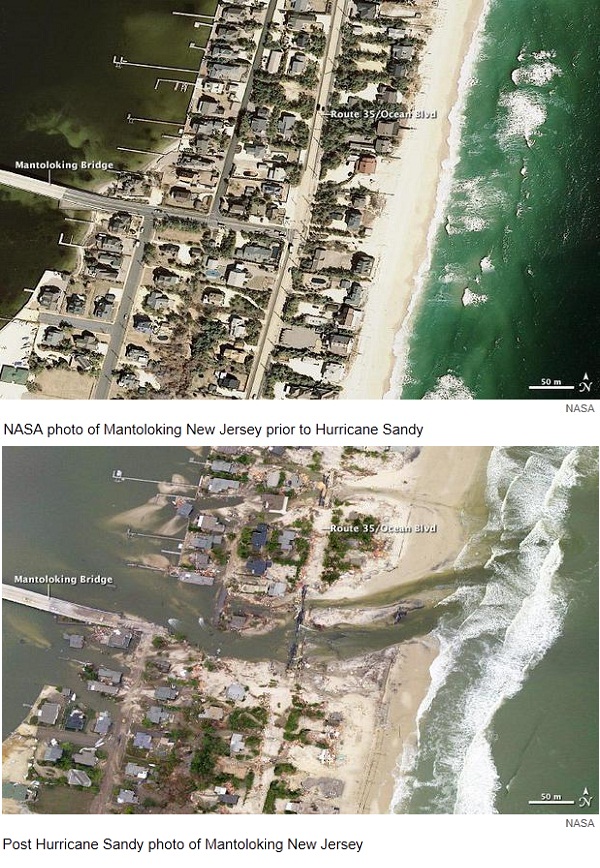


High winds brought down thousands of trees, taking out power lines and crashing into homes. The destruction here is something I never imagined I would see.

images courtesy: NASA imaging

The Mantoloking Bridge, where the sea came into the bay, is where I crab all summer. It’s now crumpled in the water, surrounded by flooded homes. It’s heartbreaking to see images of the place you love destroyed.

Since most homes did not have power or internet immediately after the storm, we did not get to see the images of ravaged iconic Jersey Shore towns like Seaside Heights, Point Pleasant, Manasquan, Mantoloking, Atlantic City and Asbury Park. Local residents are shocked at the extent of the devastation revealed in newspaper photos. Entire shore towns are gone; there is nothing left.

People are starting to lose it by the day; they’ve never gone so long without power. People in New York are eating from Dumpsters. The lines for gas, if you can find it, are miles long. A few more days like this and I worry civilization will start to break down.

Thankfully, my family is OK. I’m nutty about preparation, so we have everything we need. It is so important to be prepared for disaster.

Since I had a generator and plenty of fuel, the loss of power was tolerable. I was able to run my refrigerator and freezer, charge my cell phone and iPad, light my house and watch DVDs on the flat screen. The biggest complaint from those without generators has been boredom.

My 4G iPad was a lifesaver. I was able to tune into local radio stations and keep up with the news; view pictures and videos of the
devastation; and play games to pass the time.

Water is worth its weight in gold during a crisis, you can never have too much. Canned food, candles, flashlights and batteries are other must-have prep items.

It is very difficult to get gasoline as many stations have no power or have not had any gas delivered. There are mile-long lines at the stations that do have power and gas. The traffic around them is incredible — it’s a wild scene!

Why did so many people have so little gas that they would line up for hours to fill their tank? Because they did not prepare for the major disaster that had been forecast for the greater part of a week. My three cars are all full because I filled up BEFORE the storm.

The Jersey Shore will come back, but it will take a very long time. I feel a profound sadness seeing the beautiful shore destroyed and witnessing the suffering of those who have lost everything.

Please use this tragedy to prepare your family for disaster natural or man made. The best investment you can make is a generator. Buy one BEFORE a crisis hits.  Louis Scatigna


Five Summer Road Trips

Ahhh, the Summer road trip. Time for cooler packing, map folding (or GPS charging) and a car tune up. Does anyone drive a station wagon anymore?

Within the past 12 years I have traveled to and written about over two hundred travel destinations, many within a few hours drive of Niagara. That said, I ‘m often asked what are my favorites. Well, I’ve finally taken the time to think back and jot them down. Before I begin, I should say that I have learned to love the journey just as much as the destination. My primary route to get to a place, when possible, is usually the back way, not the highway, preferably with lots of twists and spectacular scenery. I don’t sweat about getting lost; I’ve found some of my most interesting adventures that way. Another thing that makes for a pleasant journey is to travel on the arm of someone you love. The following are the Coles Notes version of some of my favorite trips.

A yummy car. Memories of old old spice (you know the white bottle?), adidas shorts, sweatbands, the Cars on 8-track and road trips….lots of road trips. #thepastwasablast

Port Rowan, Ontario (138 kilometers)
When you discover this lovely community that hugs the northern shoreline of Lake Erie you’ll be charmed. Nothing shouts. When we walked their tiny main street, which consisted of restored century old stores, we could feel the past. At one end was one of the prettiest habors in Ontario. The whole world slows down when we walked the mature tree-lined side streets where we found historic turn-of-the-century homes that called out to be photographed. If you decide to stay over there are plenty of cozy Bed and Breakfast places to choose from.
Stratford, Ontario (159 kilometers from Thorold- the center of Niagara)
This is a jewel of a city located on the Avon River surrounded by a plethora of affordable eateries, restored Victorian homes on streets lined with majestic mature trees. We fell in love with their walkable downtown filled with plenty of unique shops and a majestic 12–sided red brick building with Queen Anne features built in 1898-99 that serves as their City Hall. The place was buzzing with life. Stratford Tourism offers two free escorted walking tours, a Downtown Historic Tour and a River Walk Heritage Tour.
And of course, there’s the Stratford Festival which serves up top-notch live theater. This season’s calendar opened in mid-April with the musical 42nd St.
This is the home of teen idol Justin Beiber and your teenagers can get a free map from the tourist folks outlining his favorrite places.
www.visitstratford.ca or 1-800-561-7926

The author George Bailey: “I’m often asked what are my favourite [travel destinations] withina few hours drive of Niagara. Well, I’ve finally taken the time to think back and jot them down.”
Elora, Ontario (126 kilometers)
This lovely 177 year-old village is a place that will grow on you the minute you arrive. It’s located on the Grand River where the Elora Gorge begins. Check out the magnificent waterfall and the high rock known as The Tooth of Time, behind the Elora Mill Inn.
We continued to explore the shops, boutiques and restaurant found on Mill and Metcalfe Streets. One unique shop is The Village Olive Grove. It’s one of the few stores in Canada that sells (and allows you to sample) exceptional olive oils and vinegars. One site not to miss is the reflection in the Grand River of the back of the downtown stores.
www.elorafergus.travel or 519-846-0971.

[If you are planning a long road trip with a dash of night driving- remember to fully rest up and stop driving when you are feeling tired CP]

We have to agree with luckysod04 on this…but check out TOSH.0 parallel parking a Mini Cooper LOL

Lindsay, Ontario (229 kilometers)Lindsay is the gateway to the Kawartha Lakes tourist region. It’s pretty as a picture. One of the main features is Kent Street, the town’s wide main street. It looks like a Norman Rockwell painting. The first to fall under the lens of my camera was the renovated 1893 Academy Theatre at one end of town. Lindsay’s renovated City Hall and Firehall also weren’t too shabby to photograph.
Their Saturday morning Farmer’s Market proved to be a real farmer’s market. It was filled with real farmers who sold produce they have grown on family owned farms for centuries. www.explorekawarthalakes.com or 1-866-397-6673

Aylmer, Ontario (187 kilometers)
Like many of my trips, you have to look beyond what’s found in the tourism publications to experience a community. It’s more than the location of the Ontario Police College. It has a large farming community. Take a ride along the back roads where you will share the road with an industrious Amish community who travel by horse and buggy and operate farms without most modern-day luxuries. Aylmer’s indoor/outdoor Farmer’s Market held on a Tuesday is top-notch. Check out the nearby quaint village of Sparta where you’ll come upon examples of restored period homes dating back to 1825.Don’t miss visiting the Winter Wheat attraction set in a five-acre forest of towering pines.
http://www.aylmer.ca/. or 1-519-773-3164.

for the Silo by George Bailey  [email protected]

Click to view on I-tunes

Being Green Is Not Impossible

When I took my boyfriend to see a new Muppet movie, he had never seen anything by the Muppets before, and being a dedicated fan since early childhood, I felt it my right and honorable duty to share the mahna-mahna’s with him. Needless to say, it was a fantastic and heart-felt show that we both laughed the whole way through. A few weeks later, we were out shopping and found this “one-of-a-kind” Kermit shirt, and couldn’t resist buying it. Like Miss Piggy, I suddenly noticed myself more attracted to everything green.

photo:H. Richards

I realized being “green” is not impossible even though we are living in such a technologically consumed world. Yet, it is technology that has provided us so many outlets to become more ecologically responsible.  Bills, schedules, licence plate renewals, the yellow pages, and even airline tickets are available paperless. Due to the impact of the Internet, television programs, and advertising we are more connected, and more globally aware of products available to help protect the environment.

In the home, especially if you are privy to daytime television, like City Line, the Mariyln Denis Show or the Nate Berkus Show, I guarantee that at least one segment a week focuses on how and where you can buy, reuse or create products with a green-scheme in mind. They prove that you can choose a range of products that will help sustain the environment, while still providing beautiful, sleek and modern finishes. The Home Depot has a link on their website  to a section called “Eco Options,” where it is easy to locate the product type you are looking for, from flooring to appliances to décor, there is a product to help manage your carbon footprint.

Major grocery stores have become more eco-friendly as well. By providing large reusable bags/bins, made out of recycled materials and typically at a cost of $1, consumers are given a convenient eco-option. Even if you forget your reusable bags at home and buy a plastic bag for 5 cents, the plastic bag has become noticeably larger in order to try and reduce the volume of plastic bags and encourage the purchase of reusable ones. As well, food itself has taken on the green trend; I was always taught to “eat the green stuff, it’s delicious,” and now, eating green, organic food like avocado, broccoli, spinach, and kale is trendy too.

The trend in the fashion world has also become environmentally friendly. For example, H&M has created the “Conscious Collection.” It is H&M’s “action for a more sustainable fashion future.” This collection uses greener materials such as organic cotton and recycled polyester. Originally when the campaign came out in April 2011, and the colour scheme was mainly different shades of white and muted earth tones. However, one year later, they are still producing the collection but have amped up the colour pallet. Walking into the store this season, you will be bombarded—you guessed it—with green. Emerging mainly in pastel and mint, but with occasional pops of emerald, green is popping up all over the fashion world and the colour is going to be very popular this spring.

So maybe it was the resurgence of Kermit the Frog, or maybe it is because being eco-conscious has spanned to every aspect of our lives, but I am happy to say that it’s never been so easy being green. For the Silo, Hannah Richards.


Southern Ontario Four Hundred Billion Years Ago

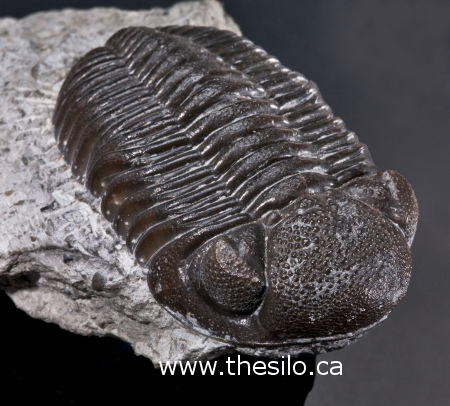
Phacops rana roughly translates to “frog eyes”

Picture yourself swimming in the shallows of Lake Erie over 400 million years ago. You might come up with all kinds of ideas of what primitive life was like. Some might imagine archaic sharks and bony, lobe-finned fish, but I bet very few would conjure up Phacops Rana.

Great Eyesight

This specialized trilobite can be found throughout Norfolk County in shale deposits and occasionally on our beaches, embedded in fossilized chunks of coral. One member of The Silo team discovered a beautiful specimen preserved this way, but it takes a keen eye to recognize them. That’s because the only way to find them is to identify the one feature of Phacops Rana that is its namesake: phacopid eyes. You see, this trilobite had two large eyes that were full of round, swiveling lenses, giving the creature an advantage when it came to escaping predators.

Cultural Artifacts Complicate Plans For Any Construction

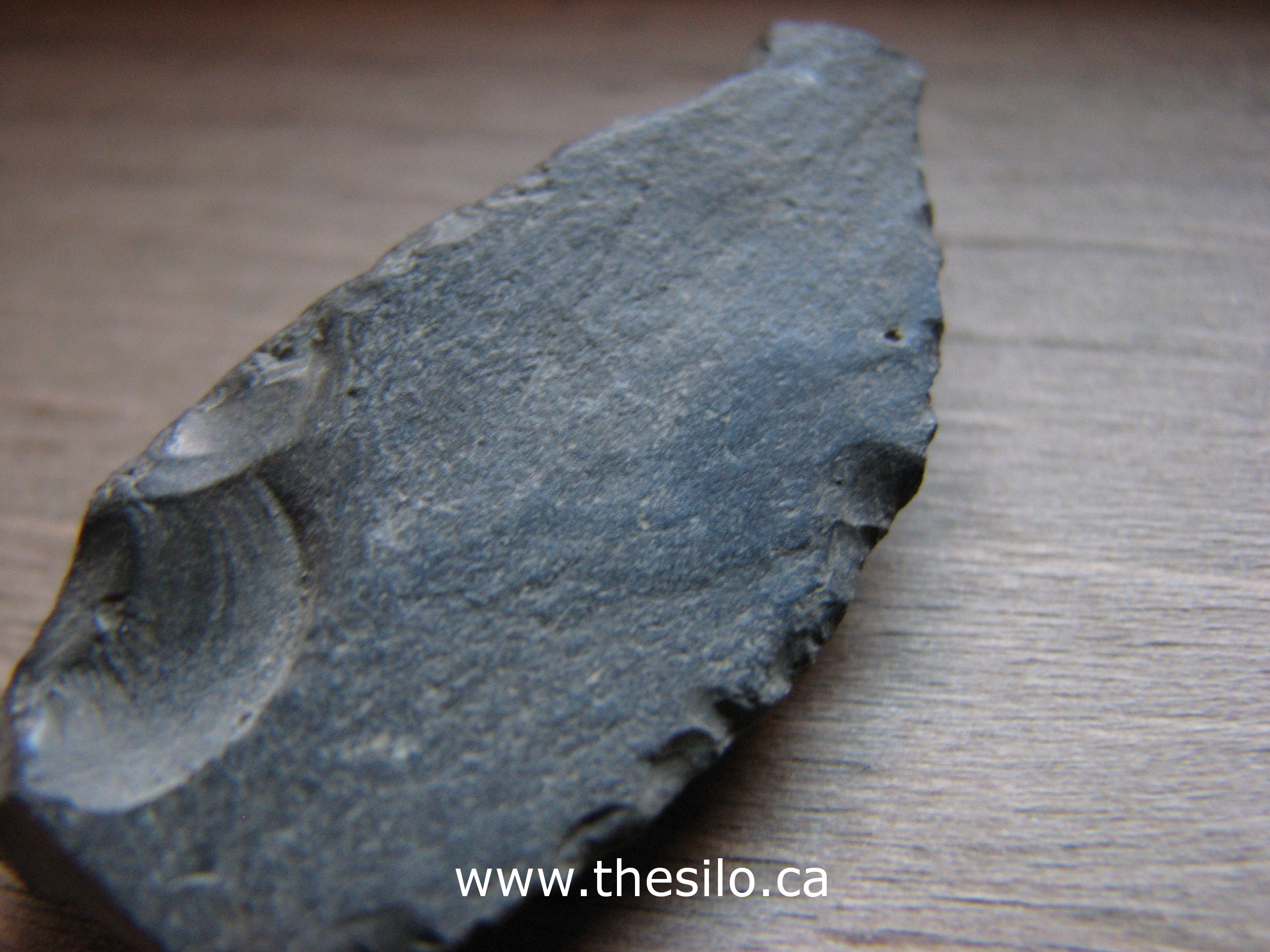
Flaking and percussion bulbs point towards human manufacture

This stone shows signs of ancient human manufacture. Percussive bulbs result from being hammered and chipped, and facial flaking along the sides are strong indicators. It was retrieved in April 2010 from the then drained shoreline of Silver Lake millpond in Port Dover, Ontario. In the vicinity of the stone were animal bones and glacial till.

According to Ontario’s Heritage Act– municipalities must

  • Provide clear standards and guidelines for the preservation of provincial heritage properties.
  • Enhance protection of heritage conservation districts, marine heritage sites and archaeological resources.

Even when cultural artifacts are not immediately discovered, a cultural assessment must take place to establish any archaeological remains. The Cayuga Bridge construction project was delayed due to this requirement.

Rural Ontario Archaeology

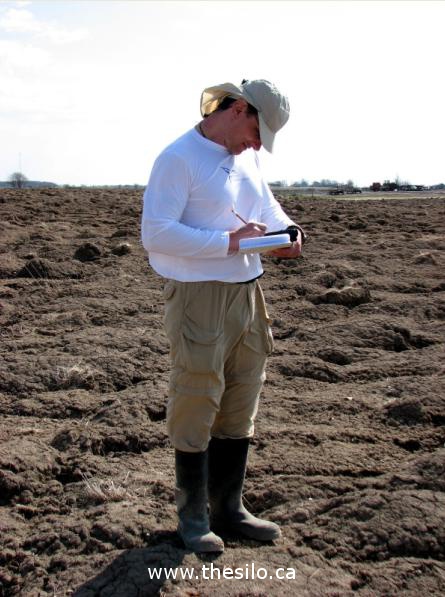
Lorenz taking notes in the field

I was raised in the dairy farming community of Jarvis in Haldimand County.  Since dairy was on the decline my family and I decided I would go to university. I began the study of archeology, and The Haldimand Norfolk Archaeological Research Project (HNARP) is a scientific study intended for my doctoral dissertation.

I selected this region because as a youth I walked across many of the county concessions and came to have an understanding of the landscape. In addition, there is continuous encroachment on the farm lands in the form of housing subdivisions in growing communities, industrial development along the lakeshore, and external landowners waiting to develop the land. The long term goal of the HNARP is to improve current evidence of prehistoric climate change and to determine its impact on early people. A study has never before been undertaken in Ontario over such a large parcel of land, and it needs to be done now before the opportunity is lost forever.

When the Laurentide ice sheet began receding 20,000 years ago the lands left behind were devastated by glaciers that destroyed plant life and any chance for animal or human survival. The first hints of people in the region date back 11,000 years. Evidence of their existence is in the form of stone debris and tools left behind on the ground. In fact,  Haldimand is the locus of our study because of the abundant chert formations in the region (chert is a type of flinty rock). These were a continuous draw for early people constantly in need of stone for tools and weapons. This same geology is the source of the quarry rock that provides jobs and careers in the community today.

Which brings us to one of the most rewarding outcomes of this kind of archeology: the people of Haldimand-Norfolk will begin to understand their relationship to the land as part of a 10,000 year history of human habitation. By systematically studying the major watersheds we can learn much of both archeological and environmental importance. Settlement patterns emerge. We begin to see how fluctuations in the climate of the Great Lakes region impacted plant and animal life, and the seasonal availability of certain foods. As we learn about the past we discover connections to the present, and can plan more effectively for the future. But the evidence we need can only exist under certain conditions, and development is not one of them. The HNARP must act now to learn what we can.

Our success depends on agricultural landowners acting as stewards, to preserve and protect archaeological sites so they can be properly interpreted and understood. People are often concerned about what an archeological study on their lands might mean. Let me alleviate some of those concerns. The HNARP regional study is conducted on private property. That means simply: your land remains your land. All information relating to this scientific study is strictly private and confidential. No information is made public or shared with any institution or public organization.  Generally, landowners can continue their farming practices without any interruption from this study.

One of the most interesting aspects of our work is something we call “community archaeology.” Interested community members can volunteer to be trained in to work with HNARP members, and become part of the discovery themselves.  For the Silo, Lorenz Bruechert.

Disaster Themed Comedy Not Funny

Dear Silo, I’m tired of jokes about the oil spill. Leno. Letterman. On June 1st  2010 John Stewart dedicated the entire “fake news” portion of his show to jokes about the spill. It’s true that much of the humour contained social and political commentary. But it wasn’t “funny.” Still, Stewart and his audience were killing themselves. Appropriate, I guess, since this issue highlights how we are all killing ourselves.

On the other hand, I like that his whole show was about this. Why is anyone talking about anything else? I know, life continues (for now). The World Cup is on. The Canadian auto sector is rebounding (perfect). Activists are crashing the Gaza blockade.

But you know what, I don’t care. Why aren’t we all parking our cars until we can convert them to run on biodiesel or excrement? Why are we watching Glee or driving to Dairy Queen or making love? Why are we not all in the streets in sackcloth and ashes, of one accord?

The world’s experts aren’t able to fix this leak, proving, as an acquaintance of mine pointed out, that there actually are no experts on how to fix deep sea oil leaks. They just know how to pump oil. And we all seem content to let them keep pumping oil for us. We shake our heads at the television footage and point fingers at negligent corporations and politicians, and then go back to pumping gas. Pumping hands. Making business deals. Making love.

In Cat’s Cradle, Kurt Vonnegut proposes that at the end of the world, when the planet is truly and fully dead, the few surviving mammals will lose their sex drive. No drive to reproduce (what for?), to survive. No drive. Now that’s funny. Alan Dowber.