Tag Archives: SUV

Collector Car Market’s Big Winners And Losers In 2025

Mecum

Part of what makes this hobby and the markets surrounding it so interesting is how organic and ever-changing they are. Tastes shift, new people start participating in the old car world, and prices adjust to reflect that. That’s why Hagerty updates our price guide four times per year.

Over the past 12 months, words like “cooling,” “softening,” or “more cautious” have dominated conversations about the market as a whole, but that doesn’t mean there weren’t big moves for certain individual vehicles. Below are the ones that moved the most up, and the most down, in 2025.

1948-52 Ford F-Series
1949 Ford F1 pickup
Mecum

Median condition #2 change: -32%

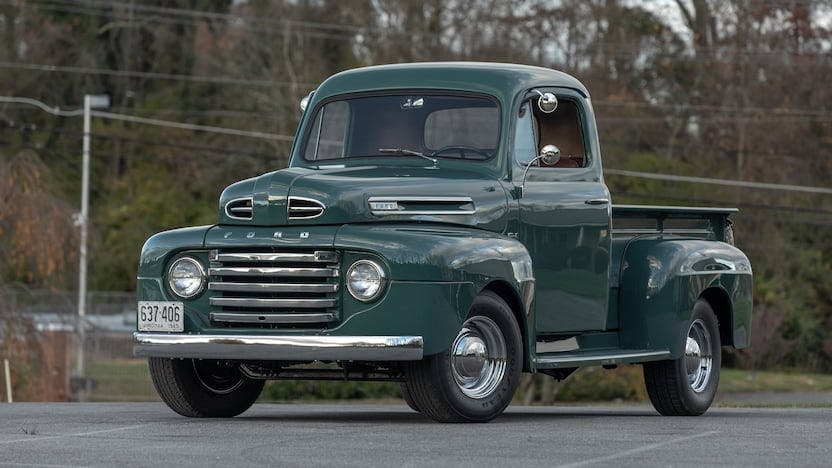
These pickups were showroom rivals to GM’s Advanced Design line. They were also Ford’s first all-new postwar vehicles, as well as the very first F-Series, which has since become the most recognized and best-selling line of pickups out there.

The field of classic trucks, however, is a crowded one. Although these first-gen F-Series effectively doubled in value from 2015 to the early 2020s, they’ve been sliding since the beginning of 2024. The current median #2 value is $31,800 usd/ $43,887 cad, which is lower than it was at the beginning of 2019, before even adjusting for inflation.

1966-83 Fiat 1241983-85 Pininfarina Azzurra

Fiat 124 Sport Spider Pininfarina front three-quarter
Flickr/Gilles Péris y Saborit

Median condition #2 change: +45%

Fiat marketed attractive convertible models in the U.S. and Canada starting in the 1950s. They were typically lower-priced but less lively than the alternatives from Alfa Romeo. This trend continued into the 1960s with the 124 Spider, introduced in 1966. The handsome, Pininfarina-styled convertible started with a 1.5-liter twin-cam engine but displacement changed over the years, even if the basic styling and layout of the car didn’t. After Fiat left the U.S. market (for the first time) in ’83, Pininfarina picked up the mantle and sold the same basic car as the “Pininfarina Azzurra” for another few years. For decades, these svelte Fiats and Pininfarinas were one of the cheapest ways into motoring dolce vita, but prices have definitely gone up, especially this year.

This is less a story of big-dollar gains than it is one of percentages. In excellent condition, most Fiat-badged versions can be had in the low-$20K usd/ $27,600 cad range. The Pininfarina versions are rarer, supposedly better built, and have a more premium badge, but they still sit at $33K usd/ $45,540 cad in excellent condition. Few classic Italian drop-tops can be had for so little.

1951-57 Hudson Hornet

Median condition #2 change: -30%

Hornets are neat cars. They rode on Hudson’s unique “step-down” chassis that gave it a lower, sleeker profile and driving position than other American cars of their day, and despite the early models’ six-cylinder engines, Hornets regularly bested more powerful competition in early ’50s NASCAR racing.

But Hudson also became a defunct brand before many car enthusiasts were even born. Even with some star power as “Doc Hudson” in the Pixar movie Cars, the Hornet doesn’t have the staying power and wider cultural relevance as something like a Tri-Five Chevy, ’57 Thunderbird, or ’59 Cadillac. Hornet prices grew a bit during the early 2020s along with just about every other classic car, but have been falling since last year. The current median #2 value of $32,300 usd/ $44,577 cad is roughly the same as it was three years ago in pure dollar terms. Adjusted for inflation, though, the value is about where it was in 2013.

1985-91 Honda CRX

1991 honda crx si teal
Mecum

Median condition #2 change: +50%

Honda’s famous two-seater hatchback, the CRX, brought cheap and cheerful fun to enthusiasts across North America and became an icon of tuner culture. These little cars are definitely still cheerful, but they’re not so cheap anymore, as the supply of clean, unmodified, low-mileage examples has dwindled in front of higher demand.

Indeed, the CRX has made several of these “winner” lists from the Hagerty Price Guide in recent years, and since the beginning of 2020 the median condition #2 value is up by a whopping 168%. The desire for these pocket rockets is so strong that one of the 1988-91 cars in excellent shape is currently worth $45,500 usd/ $62,100 cad. That much money will almost buy you a brand new Civic Type R, which comes with exactly triple the horsepower as well as a warranty, but doesn’t come with the same old-school charm.

1984-91 Jeep Grand Wagoneer

Median condition #2 change: -28%

On the new car market, the love for pricey, premium luxury 4x4s in North America is as strong as ever. The roots of our affection for luxury SUVs go back a lot further, though, and Jeep’s 1984-91 Grand Wagoneer was the weapon of choice in the affluent suburbs and vacation towns of yuppie-era America.

Nostalgia for those woodgrain-clad boxes helped pull prices up in the late 2010s and values exploded during the early 2020s. In the gotta-have-it, pay-whatever-it-costs craziness of 2022, we even asked if a $154K usd/ $212.5 K cad Grand Wagoneer sale was “peak market insanity.” Yep, turns out it was. Sale prices have definitely come back down to earth since. The median #2 value for Grand Wagoneers at the end of 2025 is $45,900 usd/ $63,350 cad . At first glance that looks a lot higher than the $36,600 usd/ $49,680 cadit was at the beginning of 2020, but when you adjust for inflation the two numbers are within a hundred bucks of each other.

1979-1992 Mercedes-Benz G-Class (W460)

Mercedes-Benz

Median condition #2 change: +68%

Like the Grand Wagoneer in the ’80s, the Mercedes G-Wagens mostly serve as bougie-mobiles that don’t see anything rougher than a gravel driveway, but the earliest versions (aka the W460) were rugged and relatively simple off-roaders, sort of like a German Land Rover. Mercedes-Benz didn’t market the W460 in America, as we identified the three-pointed star with luxury and high-performance, whereas this was a spartan runabout with underpowered four-, five-, and six-cylinder gas or diesel engines. W460s are therefore pretty rare here.

Several huge sales over the past 12 months have been impossible to ignore, however, and it appears the W460 is gaining a big following. Current values vary widely depending on body style, engine, and model year. Certain hardtop wagon models can be had for under $40K usd/ $55.2 cad (exchange rate at time of posting) in excellent condition, while certain convertibles are nearly 90 grand. For the Silo, Andrew Newton.
These American 1990s Concept Cars Were Cool AF

Flickr/Alden Jewell

Our friends at Hagerty know a thing or two about cars and really love talking about concept cars of every era, but the 1990s have a special place in their heart. Read on and tell us which one is your fav and why in the comments section below.

It was a good decade for automotive diversity, especially for enthusiasts: SUVs were emerging as a hot new segment, true, but none of them purported to be a coupe or track star. Sport sedans thrived. So did hot hatches. The Miata debuted in 1989, kicking off the roadster craze. Chrysler was, for most of that decade, just Chrysler—not some confusing multinational conglomerate with a name that no one remembers.

Even the automotive ideas that didn’t make production had pizzazz—in a few cases, as you’ll see below, perhaps a little too much pizzazz. We’ve covered ’90s concepts before, but after a spin through the treasure trove that is Alden Jewell’s catalog of car brochures on Flickr, we decided it was time to focus on the concept cars from the U. S. of A., rather than the European contingent that dominated that last list.

Step back in time with us to an era when Buick was thinking of wild sedans, Pontiac was still cool, Mercury … existed, and Dodge was high off the Viper.

1999 Buick Cielo

1999 Buick Cielo concept convertible
Flickr/Alden Jewell

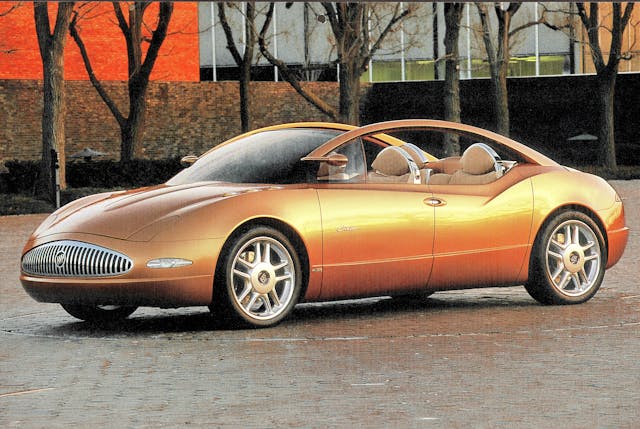
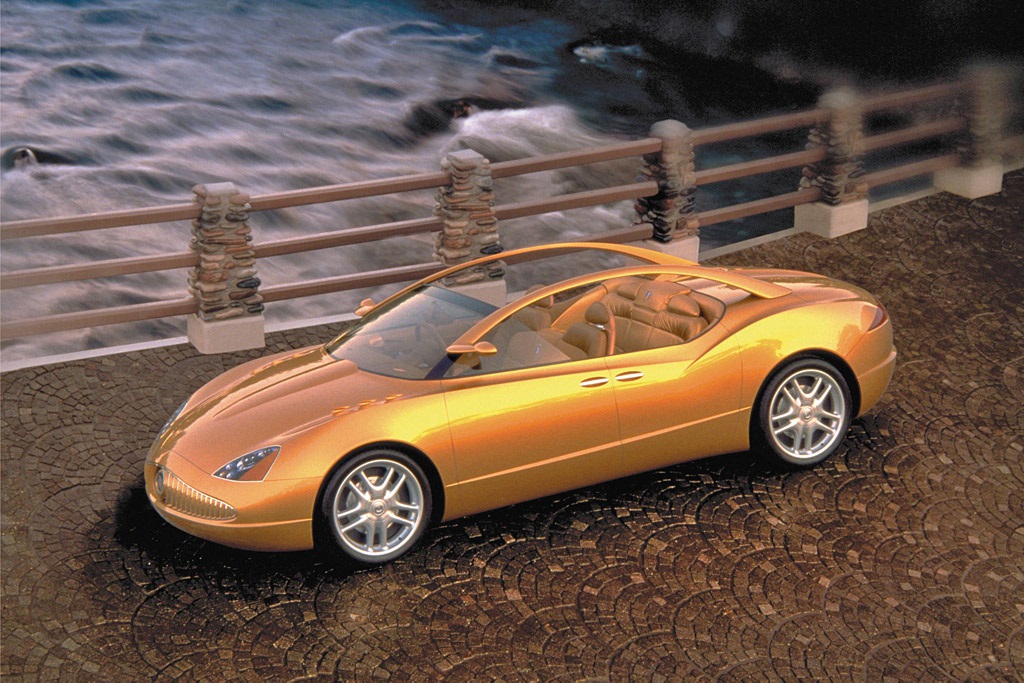
If you thought Buick’s newest concept car was unorthodox, prepare yourself: The Cielo is much, much more out-of-the-box. (Despite that throwback grille texture, which is very Y-Job.) A four-door convertible, with retractable headlights and voice-operated doors? You’d never know this thing was based on a highly modified Regal GS. The top, complete with its rear glass, stowed beneath a panel at the back thanks to a cable system hidden in the two arches that frame the “roof.” Power came from a supercharged 3.8-liter V-6 making 240 horsepower.

Judging by the much tamer concept of the same name that Buick showed off the following year—and marketed as a possible limited edition—the automaker thought the convertible four-door idea had legs. In Buick’s words, the Cielo “proves just how broad and flexible and contemporary the idea of a premium family car really is.” Little did Buick know that, 15 years later, the only premium family car the people would want was an SUV …

1999 Buick Cielo concept convertible
Flickr/Alden Jewell

1997 Mercury MC4

1997 Mercury MC4 concept
Flickr/Alden Jewell

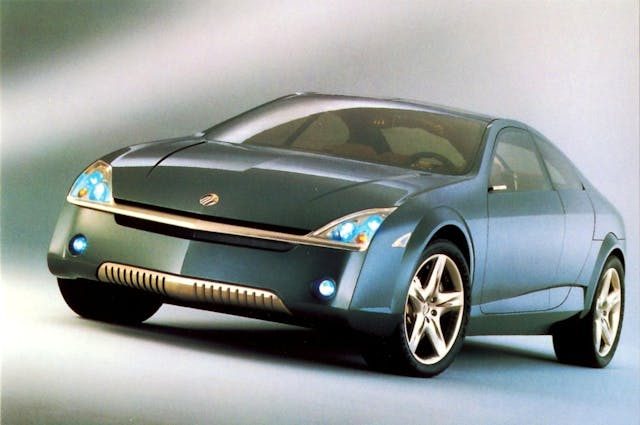
Motortrend got rather excited about the MC4 when it debuted in 1997: “The MC4 is for Mercury what the Viper Roadster was for Dodge nine years ago.” Yes, it was far more interesting to look at than the blob-like Mystique or the softly contoured Mountaineer … but no one knew that, 13 years later, Mercury would stop producing vehicles, its sales cannibalized by parent company Ford.

In 1997, however, Mercury’s star shone far brighter. The MC4 wore the edgy, minimalist look characteristic of Ford’s New Edge design language, initiated by the GT90 concept in 1990 and most familiar to folks on the 1999 Mustang. A trapezoidal grille and emphasized wheel arches are common to both that Mustang and the MC4, which actually started life as a V-8–powered ’96 Thunderbird. Unlike the T-Bird, the Mercury concept boasts four doors and a rear cargo area accessed by a pair of gullwing doors. It had style, space, and, of course, a healthy dose of tech that hadn’t quite been readied for production: video cameras instead of side- or rearview mirrors, nickel-chrome plate bedazzling the interior, and heated and cooled cupholders.

1997 Pontiac Rageous Concept

1997 Pontiac Rageous Concept
Flickr/Alden Jewell

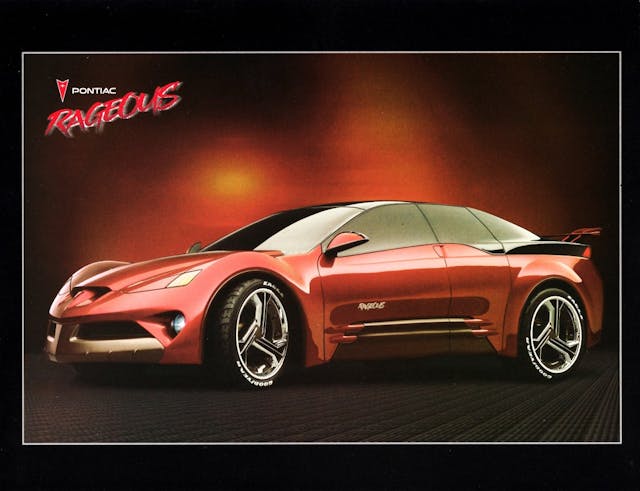
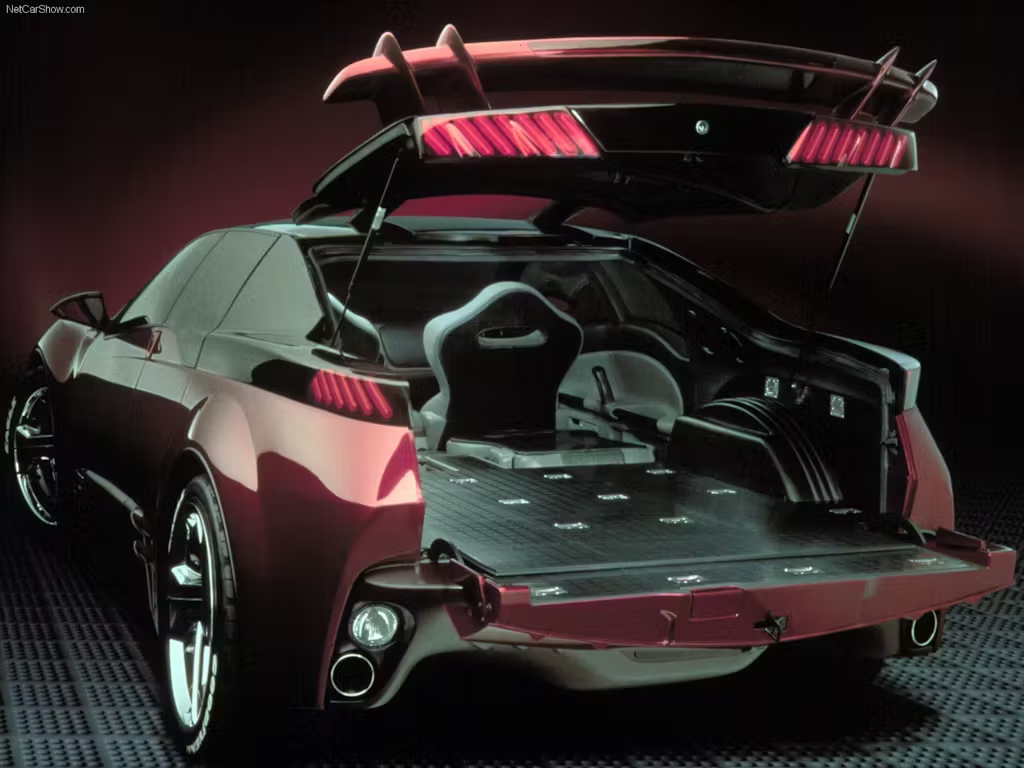
In 1997, Pontiac had four-door cars, and it had V-8–powered cars, but it didn’t have any V-8–powered, four-door cars. The Rageous, with its 350-cubic-inch small-block and vestigial set of rear doors, aimed to fix that. It could carry four people, but the trunk was accessed via a top-hinged hatch, making this more of a hatchback than a sedan. The Rageous had a six-speed manual transmission and a heavily vented, pointy schnoz that put that of the contemporary Firehawk to shame.

1997 Pontiac Rageous concept interior
Pontiac

1994 Dodge Venom

1994 Dodge Venom concept
Flickr/Alden Jewell

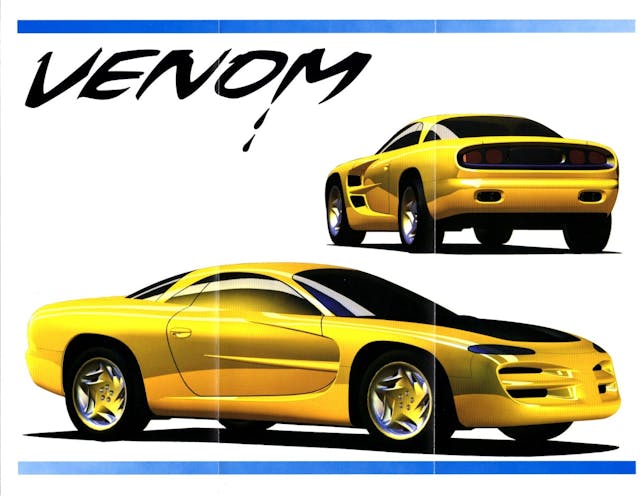
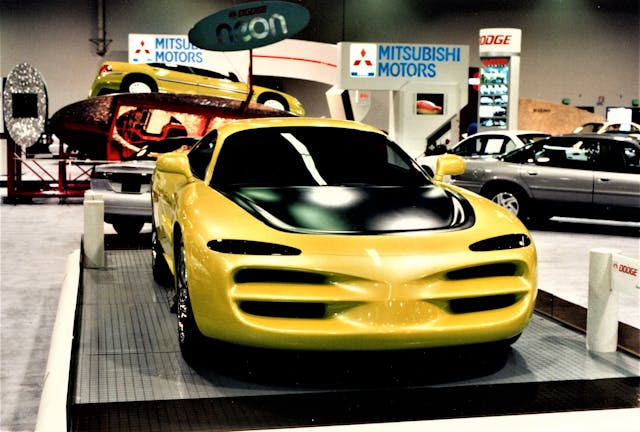
If the Dodge Venom reminds you of a Neon, you’re on the right track: This 1994 concept was built on a version of the Neon’s platform. Unlike that compact, however, the Venom was rear-wheel drive. Compared to the sportiest Neon, the SRT-4, the Venom boasted an iron-block six-cylinder engine with 24, rather than 16, valves, and more power: 245 rather than 215 horses. The Venom looked like the perfect little brother to the Viper, which it honored with that side-scoop and squinty headlights atop a four-section grille. The concept even made the cover of Car and Driver‘s March 1994 issue, accompanied by the question: “Dodge’s pony car of the future?”

We wish such an affordable, spunky two-door had made production: Dodge wouldn’t have a direct competitor to the Mustang and the Camaro until the Challenger, which hit the streets 14 years later.

1994 Dodge Venom concept
Flickr/Alden Jewell

1995 Chevrolet El Camino SS Concept

1995 Chevrolet El Camino SS Concept
Flickr/Alden Jewell

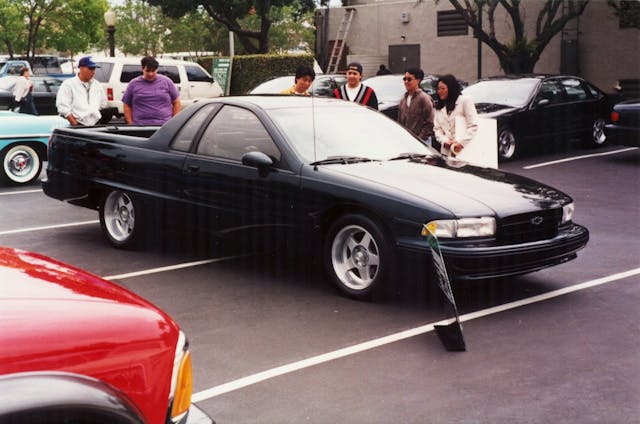
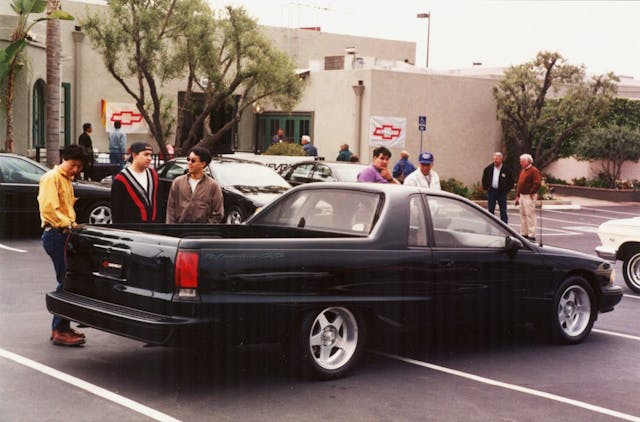
It may remind GM fans of a Holden, but the El Camino SS Concept ute is a GM B-body at its core. GM’s Advanced Vehicle Development Center in North America built this ute out of a Caprice station wagon in just 16 weeks, grafting onto that people-hauler the nose of an Impala SS. Many of the steel body panels were made by hand. Power came from a 300-hp version of the LT1 V-8 found in the Corvette and the Impala SS (in different tunes) and was channeled to the rear wheels via a 4L60E Hydramatic transmission. Unfortunately, the platform that gave it birth spelled its doom: GM killed the age-old B-body at the end of 1996. RIP.

1995 Chevrolet El Camino SS Concept
Flickr/Alden Jewell

1994 Plymouth Expresso Concept

1994 Plymouth Expresso Concept
Flickr/Alden Jewell

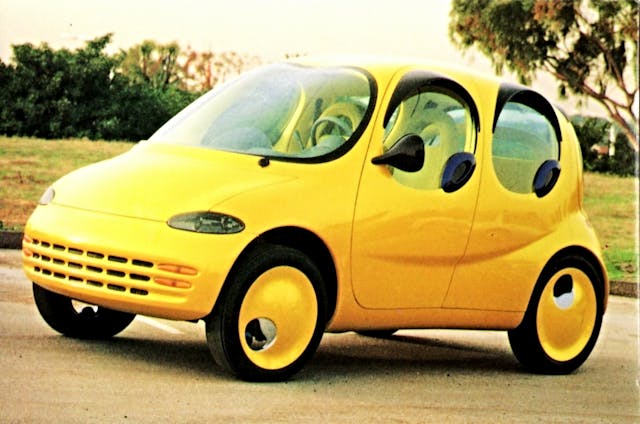
Would you believe us if we said this was a Plymouth? Maybe not, because the Expresso is more interesting than anything Plymouth made in the ’90s … until the Prowler arrived for the 1997 model year, at least. (That retro-mobile debuted in concept form the year before the urban runabout Expresso debuted.) The Expresso was built on the shortened frame of a Neon, to be sold under both the Dodge and Plymouth brands, and used the compact’s 2.0-liter four-cylinder to power its front wheels.

The four-door bubble would never reach production, but its name stuck around in the Plymouth lineup as a trim package on the Neon, the Voyager, and the Breeze. Be prepared to explain yourself if you mention this concept in front of a coffee snob: This weirdo’s name really is EX-presso, not Espresso. The proper pronunciation would be too … well, proper. For the Silo, Grace Houghton/Hagerty.

How To Reboot Ottawa’s Zero Emission Vehicle Mandate

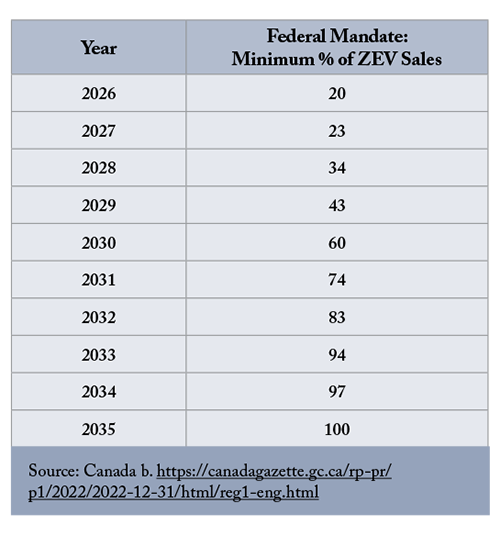
The federal government has proposed regulations requiring the sale of a minimum numbers of Zero Emission Vehicles (ZEVs) in Canada (20 percent of all light vehicles in 2026, ramping up to 60 percent in 2030 and 100 percent in 2035). The flip side of this requirement is that the sale of internal combustion engine (ICE) light vehicles will be reduced and eventually prohibited in 2035.

  • This ZEV mandate will require an increase in ZEV sales from about 100,000 ZEV light vehicles in 2022 to 300,000 in 2026, 900,000 in 2030 and 1.5 million in 2035.
  • This paper examines whether or not Canadians will be able to buy enough ZEVs (either domestically produced or imported) to meet this ZEV mandate requirement. The findings show that Canada should be able to meet the 2035 100 percent ZEV mandate for about 270,000 passenger cars (only 18 percent of the market) but will be unlikely to meet the 2035 ZEV mandate for the 1,240,000 remaining light vehicles (pickup trucks, vans and SUVs/crossovers) comprising 82 percent of the market.
  • Canada cannot wait until 2035 to realize that the federal ZEV mandate will not be met. The gap between light-vehicle demand and forecasted ZEV light-vehicle supply will cause severe market disruptions. A better approach would be to reject a hardline ZEV mandate and instead to substitute a more flexible Plan B. Plan B should focus more on emissions rather than ZEV targets. For example, permitting some ICE light vehicles to be sold, particularly ones that can use renewable fuels. In addition, permitting plug-in hybrids (PHEVs) and hybrids to be included as ZEVs.
  • Finally, the federal government may have to accept that the 100 percent ZEV target is not feasible by 2035, and therefore must include flexibility in the federal ZEV mandate to back away from the 100 percent ZEV target.

A ZEV mandate is government legislation that imposes a requirement on the sellers of light vehicles to sell a certain minimum of ZEVs in a year. (ZEV is used interchangeably with BEV for battery electric vehicle in this paper. PHEVs can also qualify as ZEVs to a limited extent). The theory is that this minimum requirement will give certainty to vehicle sellers that there will be a market for ZEVs, and will therefore give an incentive to companies to construct ZEV manufacturing facilities. In essence, the ZEV mandate assumes that the demand for ZEVs will be there and will displace the demand for ICE light vehicles, and therefore the increase in supply of ZEVs will occur.

The federal government has introduced a ZEV mandate for all of Canada. In December 2022, the federal government issued proposed regulations under the Canadian Environmental Protection Act (CEPA). Section 30.3 of these proposed regulations state that all sales of light vehicles (passenger cars, pickup trucks, vans and SUVs/crossovers) must meet the thresholds for ZEV sales in a year shown in the table to the right.

Minimum Percentage of ZEV sales

The flip side to a ZEV mandate is that it imposes a prohibition on the sale of ICE vehicles, plus a penalty for contravening this prohibition. A company selling light vehicles in effect has an ever-shrinking quota for the maximum number of ICE light vehicles that it can sell in a year (none in 2035).

A company creates one credit for each battery electric vehicle (BEV) it sells. A sale of a PHEV with a range of more than 80 kilometres can also create a credit, but this ability is capped at 20 percent from 2028 onward. For example, a company selling 100 percent PHEVs in 2028 would only get credits for 20 percent.

If a company’s sales create fewer credits than required by the ZEV mandate, it can still remain in compliance by using two mechanisms. First, it can buy credits from another ZEV company that has exceeded its ZEV mandate. This mechanism will likely provide hundreds of millions of dollars of extra revenue to companies such as Tesla. An alternative second mechanism would allow the company to create a credit by contributing about $20,000 to specified ZEV activities such as supporting charging infrastructure. This second mechanism is capped at 10 percent of the ZEV mandate for the particular year, and is only available for the years prior to 2031.

For the Silo, Brian Livingston/The C.D. Howe Institute.

The author thanks Benjamin Dachis, Daniel Schwanen, Dave Collyer and anonymous reviewers for comments on an earlier draft. The author retains responsibility for any errors and the views expressed.

How Cell Phone Behavioral Data Can Help Save Our Planet

Zurich, Switzerland- A report from a few years ago deserves a second look. That study demonstrated how leveraging mobile network data can estimate levels of carbon emissions and air pollution in cities, an approach that could substantially reduce the cost of implementing the Paris Agreement.

  • The study analyses mobility patterns derived from mobile network data to estimate the usage of different transport modes within a city and derive conclusions about the respective pollution they cause.

  • This innovative methodology allowed scientists to estimate the concentration of air pollutants in urban areas with up to 77% accuracy.

  • The method could provide a scale-able and cost effective way to help understand and combat greenhouse gas (GHG) emissions in cities worldwide.

Big data analytics company and ETH Zurich spin-off Teralytics, Telefónica NEXT and sustainability solution provider South Pole Group conducted the  study in Nuremberg, Germany and revealed the analysis of mobile network data is an effective way to estimate CO2 and NOX emissions in urban areas at very low cost. To achieve this, Teralytics examined aggregated and anonymized data, which is generated when mobile devices communicate with Telefónica’s mobile communication cells during user calls, text messages or while using phones to browse the internet. Teralytics was able to refine this raw data into human mobility patterns to understand how the different modes of transport, for instance trains or cars, are frequented. Combining this information with data on the emissions of the different transport modes, the three entities were able to estimate air pollution and GHG emissions in the city.

As each form of transportation produces a unique amount of CO2 and NOX emissions, understanding urban mobility patterns is vital to understand the source of emissions. The study in Nuremberg used this information to estimate with up to 77 per cent accuracy the concentration of air pollutants in the city. These findings encourage further exploration of how big data can be used to understand and ultimately solve environmental issues such as air pollution in cities across the world. This is particularly interesting with regards to the lower cost of analyzing and interpreting data compared to the higher cost of production and maintenance of elaborate measuring stations. The novel approach could thus allow an ongoing analysis on a nationwide scale.

George Polzer

“While our contemporary urban lifestyles result in the generation of harmful greenhouse gasses, it also generates large amounts of behavioural data. Our mission at Teralytics is to use this data for the benefit of society,” says Georg Polzer, CEO of Teralytics. “Our findings from Nuremberg showed that this data can be used to give city planners insights into how human mobility contributes to pollution. This is a vital part to efficiently design and implement clean air and low carbon strategies. We are looking forward to further exploring this opportunity.”

Using a three-level process, the fully anonymized and aggregated data was first transformed into movement flows by the data scientists at Teralytics, identifying over 1.2 million transportation routes during the analyzed time period, as depicted in Figure 2. The sustainability solution expert South Pole Group then used an atmospheric model to estimate air pollution levels caused by the usage of the different modes of transportation, taking into account meteorological data and information on the respective traffic carriers’ emission levels from the German Federal Ministry for the Environment (BMUB). In the third step, the accuracy of the method was examined by comparing the findings with existing data from air pollution measuring stations. The values measured at these stations were found to correlate up to 77 per cent with those from the Teralytics’ calculations.

The results of this pilot study in Nuremberg constitute a sound basis to further develop the methodology.

Following its success, the consortium was able to secure financial support from Climate KIC’s Low Carbon City Lab (LoCaL), an initiative that brings together cities, business, academia and NGO’s to deliver high environmental and societal impact. With this backing, the research partnership will expand and improve the methodology, focusing on short travel routes and taking into account local emission factors like airports, large-scale events, and types of vehicles on the road (i.e. electric cars and SUVs). Moreover, the influence of factors such as traffic jams and red lights will be taken into account in order to make even more accurate estimations of the air pollution levels in a city.

“The results from this pilot study exceed our expectations,” says Maximilian Groth, responsible for Business Development & Partnerships at Teralytics. “We are confident that we will soon be able to scale this product to cities worldwide to support urban planners in making our air cleaner and achieving the goals of the Paris Agreement at the lowest possible cost.”

This research follows other successful studies on usage of mobile network data, including a smart data analysis for transport in Stuttgart by Teralytics, Telefónica Germany, and Fraunhofer IAO.

Renat Heuberger

“Approximately 70 per cent of global greenhouse gas emissions are generated in cities, meaning that they play a key role in climate protection. We see great potential in the use of continuously generated data, such as mobile network data, to measure and reduce pollution levels in cities.” States Renat Heuberger, CEO of South Pole Group.

Florian Marquart

Florian Marquart, Managing Director of Telefónica NEXT for Advanced Data Analytics: “The pilot project in Nuremberg has clearly shown the specific added value of anonymised mobile network data for the environment. This is data from people for people. We see great potential in the results and will start the next phase of our research. The goal is to develop a product that German cities, German states and the German federal government can use to better face the challenges of emissions pollution”.  For the Silo, Ricky Sutton.

About Teralytics

Teralytics is the trusted data analytics partner for some of the largest telecom operators in North America, Europe and Asia. Using technology built for operators by data scientists, they have perfected the ingestion, modelling and transformation of raw signals from subscriber actions and movements on operator networks to deliver meaningful and actionable insights, that delivers new value to our mobile operator partners. By unlocking and processing a massive scale of device movement and consumer intelligence data from location and behavioral signals, they can analyze people, places and things and offer actual insights to help city planners, venue owners, retailers, NGOs and media companies make informed decisions, optimize operations and maximize ROI. Headquartered in Zurich, Teralytics has offices in New York, and Singapore.

How Great Are Today’s Vehicles? Look At Lincoln’s Luxurious Aviator

C:\Users\user001\Desktop\SEO pics\Colony Lincoln\How Great are Todays Vehicles Look at Lincolns Luxurious Aviator - image.jpg

Lincoln is one of America’s all-time classic luxury automakers, but the manufacturer has also been praised for making vehicles which respond to the needs of today. So it’s natural, then, that anybody who wants a glimpse into the best cars on today’s markets takes a look at Lincoln. 

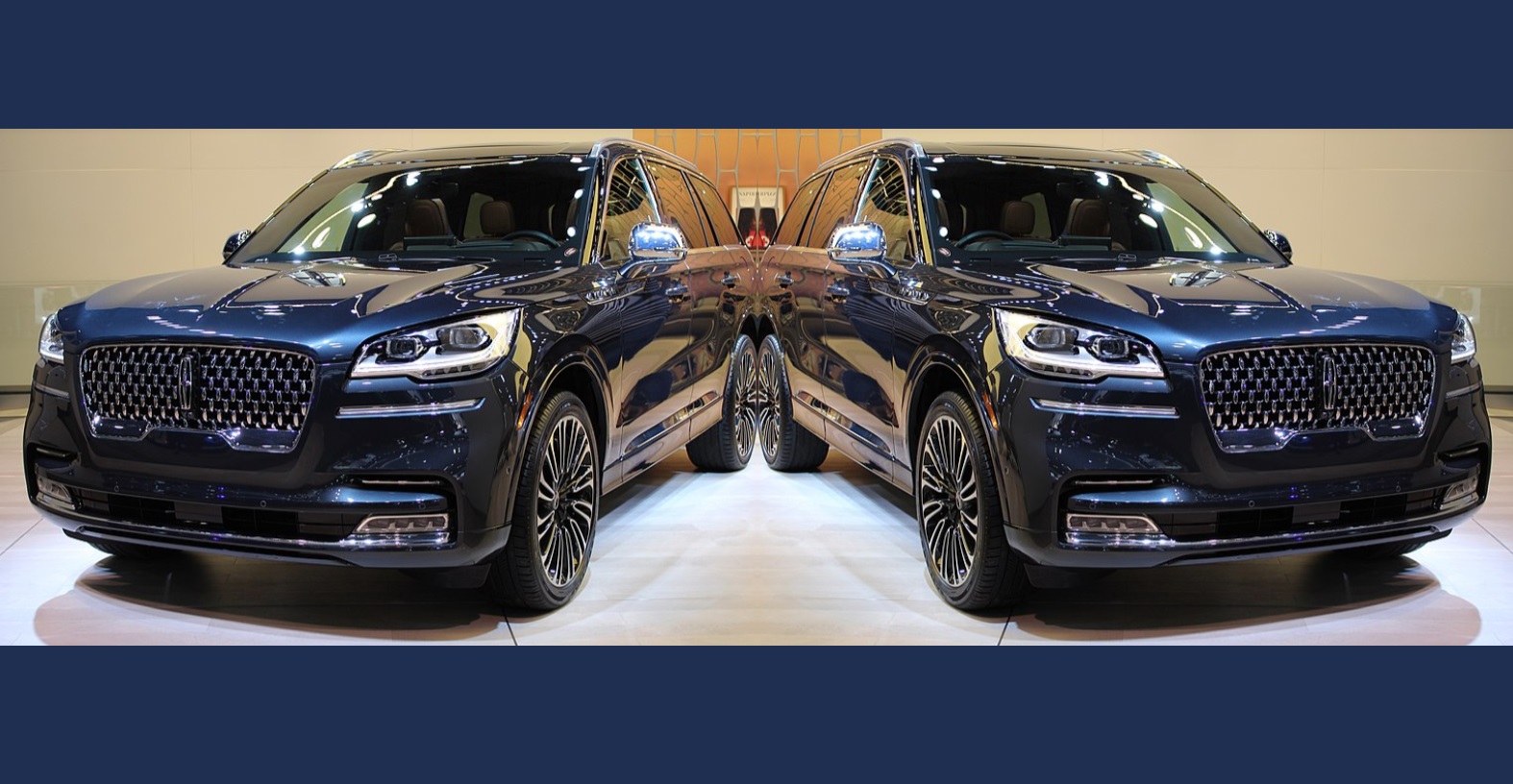
Let’s see what’s going on with the 2020 Lincoln Aviator, a mid-size luxury SUV that shuttles everybody around in safety and unmatched style.

Under the Hood

The Lincoln Aviator lets you choose from different powertrain options, so it’s easy to get all the power you need or want. The standard Twin-Turbocharged 3.0L V6 engine generates 400 horsepower and is good for 415 lb.-ft of torque. This should be more than enough, but in case it isn’t, the Grand Touring Aviator utilizes a battery-powered electric motor paired with the Twin-Turbocharged engine for a total of 494 horsepower and a killer 630 lb.-ft. of torque.

If you drive into Colony Lincoln today and find the Aviator you need, you’ll drive out with a much more powerful vehicle!

Sumptuously Appointed

One look at the Lincoln Aviator is enough to know you’re not looking at a normal SUV. This luxury mid-size SUV has even more trimmings than other comparable vehicles — this is a three-row SUV designed to indulge everyone inside the car, both drivers and passengers.

Rich features like Savannah leather, premium suede cloth and special woods communicate to everybody that this is a very special vehicle. The level of detail combined with an attitude that never cuts corners on luxury will genuinely thrill everybody who comes across it.

Technology For Comfort, Safety And Entertainment

Whether you’re carpooling all the kids or you’d like to keep yourself comfortable, connected and entertained on a solo drive, the Aviator has everything you need. The available Perfect Position Seat with Active Motion conforms to your back, and takes comfort to another level.

Advanced safety features are bundled together in the available Co-Pilot360™ Plus package, which includes Evasive Steering Assist, Reverse Brake Assist, Active Park Assist Plus and Adaptive Cruise Control with Traffic Jam Assist, and too many more to name.

The Heads-Up Display puts essential information the driver needs right on the windshield, so you don’t need to take your eyes off the road. There are even features to take all the stress and worry out of parking.

Lincoln and the sound engineers at Revel Audio teamed up to create a 28-speaker system that will make your favourite music sound better than ever. The car itself is a 4G LGE Wi-Fi hotspot, which makes it possible for you and all your passengers to keep connected to friends and family, as well as remain occupied during long drives.

If you’re looking for some of the highest accomplishments in luxury vehicle manufacturing, check out the latest Lincoln Aviator. For a beautiful ride that keeps you, your passengers and everybody on the road safer, comfortable, and even entertained, the Lincoln Aviator is representative of the best vehicles made today. 

Supercars At London Motor Show Include Rolls Royce Dawn

London’s famous Motor Show is back! Thanks to our friends at selectcarleasing.co.uk for the nifty infographic.

London Motor Show 2016 Infographic