Tag Archives: sustainable development

Chief Economists Warn of Weak Growth as Economic Environment Shifts

中文 | 日本語 | Español 
Quick Takeaways
-72% of chief economists expect global economy to weaken in 2026 as disruptions in trade, technology, resources and institutions signal a shift to a new economic environment.
-Regional growth pathways are diverging: 56% anticipate greater divergence between advanced and developing economies, with MENA and South Asia emerging as bright spots.
-Debt risks are intensifying in advanced economies, with 80% of respondents expecting vulnerabilities to grow.


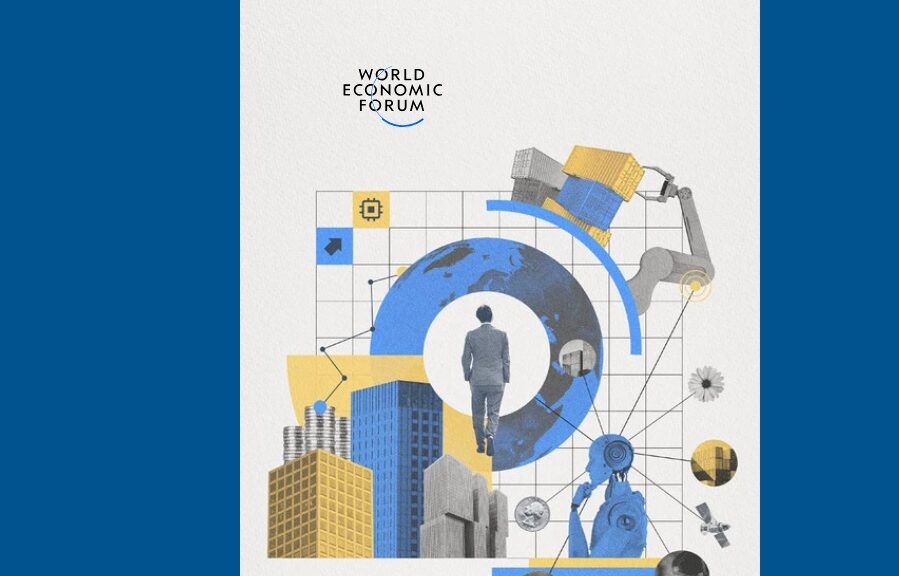
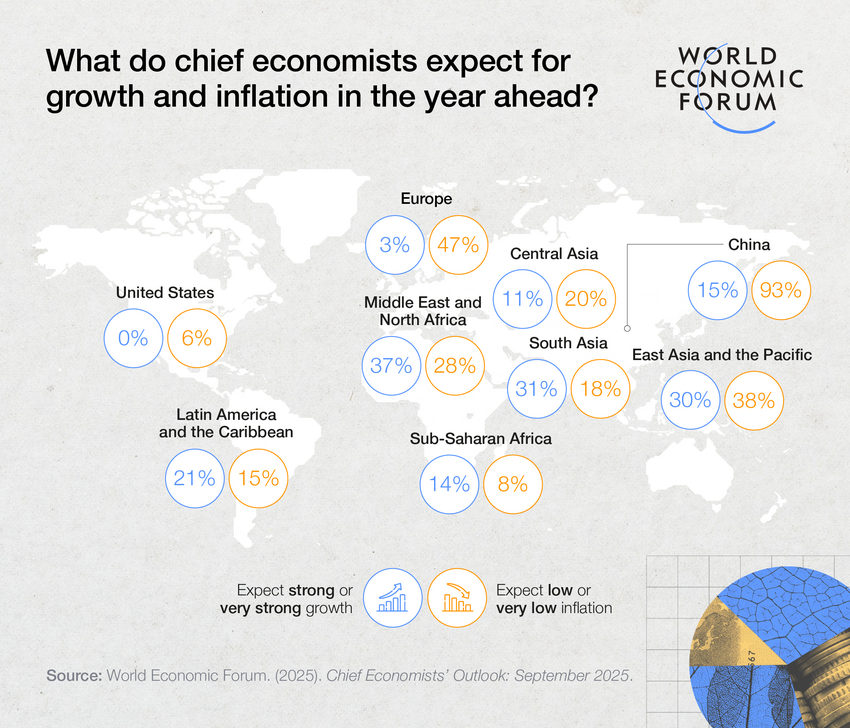
New York, USA, October 2025 – The global economy is entering a period of weak growth and systemic disruption, according to the World Economic Forum’s latest Chief Economists’ Outlook, published today. Some 72% of surveyed chief economists expect the global economy to weaken over the next year, amid intensifying trade disruption, rising policy uncertainty and accelerating technological change. The findings point to the emergence of a new economic environment shaped by persistent disruption and growing fragmentation.

 
Diverging Pathways in a Fragmented Global Economy
The Outlook highlights sharp regional fault lines. Emerging markets are anticipated to be the main engines of growth, with the Middle East and North Africa (MENA), South Asia and East Asia and Pacific seen as bright spots. One in three chief economists expect strong or very strong growth in these regions. The outlook for China is more mixed, with 56% of chief economists anticipating moderate growth, though deflationary pressures are expected to persist. Growth is expected to remain more stagnant in advanced economies. In Europe, 40% expect weak growth with fiscal loosening (74%) and low or moderate inflation (88%). In the United States [& Canada ed.], most chief economists (52%) anticipate weak or very weak growth and high inflation (59%) as monetary policy is loosened (85%).
 
The chief economists warn that advanced and developing economies are on increasingly divergent growth pathways – 56% expect greater divergence over the next three years.
 
Towards a New Economic Environment
Chief economists overwhelmingly agree that today’s disruptions are structural rather than cyclical. Large majorities anticipate long-term disruption in natural resources and energy (78%), technology and innovation (75%), trade and global value chains (63%) and global economic institutions (63%). This marks an important shift. The global economy is not so much weathering isolated shocks as realigning, raising the stakes for new forms of leadership, cooperation and resilience.
 
“The contours of a new economic environment are already taking shape, defined by disruption across trade, technology, resources and institutions,” said Saadia Zahidi, Managing Director, World Economic Forum. “Leaders must adapt with urgency and collaboration to turn today’s turbulence into tomorrow’s resilience.”
 
Trade Realignment, Fiscal Strain and Debt Risks
Structural shifts in the global economy are playing out most visibly in trade, fiscal policy and debt. Some 70% of surveyed chief economists rate the current level of trade disruption as “very high”, far above other domains of the economy, and over three-quarters also expect disruption to trade and global value chains to cascade into other domains. In financial markets and monetary policy, 45% of surveyed economists rate disruption as high or very high, yet only 21% expect it to last. Even so, while 52% see a major near-term crisis in advanced economies as unlikely, 85% warn that any shock could have wide systemic effects.
 
With global public debt levels mounting, the chief economists surveyed highlight that debt vulnerabilities, once largely associated with emerging economies, are increasingly centred in advanced ones – 80% expect risks in advanced economies to grow in the year ahead. Fiscal vulnerabilities are also more frequently identified among the top growth inhibitors in advanced economies (41%) compared to developing economies (12%).
Follow the Sustainable Development Impact Meetings 2025 here and on social media using #SDIM25.
 
About the Chief Economists’ Outlook
The report builds on extensive consultations and surveys with chief economists from the public and private sectors, organized by the World Economic Forum’s Centre for the New Economy and Society. The report supports the Future of Growth Initiative, aiming to foster dialogue and actionable pathways to sustainable and inclusive economic growth.
 
About the Sustainable Development Impact Meetings 2025
The Sustainable Development Impact Meetings 2025 takes place from 22 to 26 September in New York, bringing together over 1,000 global leaders from diverse sectors and geographies. Held ahead of the World Economic Forum Annual Meeting 2026, these meetings are part of the Forum’s year-round work to accelerate progress on the growth, resilience and innovation through multistakeholder dialogues and action. 

For the Silo, Jarrod Barker.
Children Worldwide Call For Promises Of Universal Education

New York – Through an innovative, children-led campaign delivered by the UN’s global fund for education in emergencies, Education Cannot Wait (ECW), crisis-impacted girls and boys worldwide are sharing “Postcards from the Edge” to call on world leaders and public and private sector donors to make good on promises to ensure education for all by 2030 as outlined in the Sustainable Development Goals.

These first-person accounts and drawings offer inspiring and thought-provoking portraits of the challenges facing girls and boys caught in conflict and protracted crises around the world.

“They are inspiring and compelling stories of hope and an incredible resilience in the face of adversity and testaments to the amazing power of education to transform lives. We must listen to the world’s children. They deserve their human right to an education. Their voice must speak to our decency, they deserve to be heard,” said Yasmine Sherif, Director of Education Cannot Wait.

To date, more than 50 letters, drawings and videos have been received from crisis-affected girls and boys supported through ECW-funded programmes across more than 20 of the world’s toughest country-contexts.

ECW’s strategic partners – including Educo, Plan International, Save the Children, Street Child, UNESCO, UNHCR, UNICEF, World Vision and many others – continue to collect these first-person accounts to highlight the singular power of education to end violence, hunger and poverty, and build a more peaceful world for generations to come.

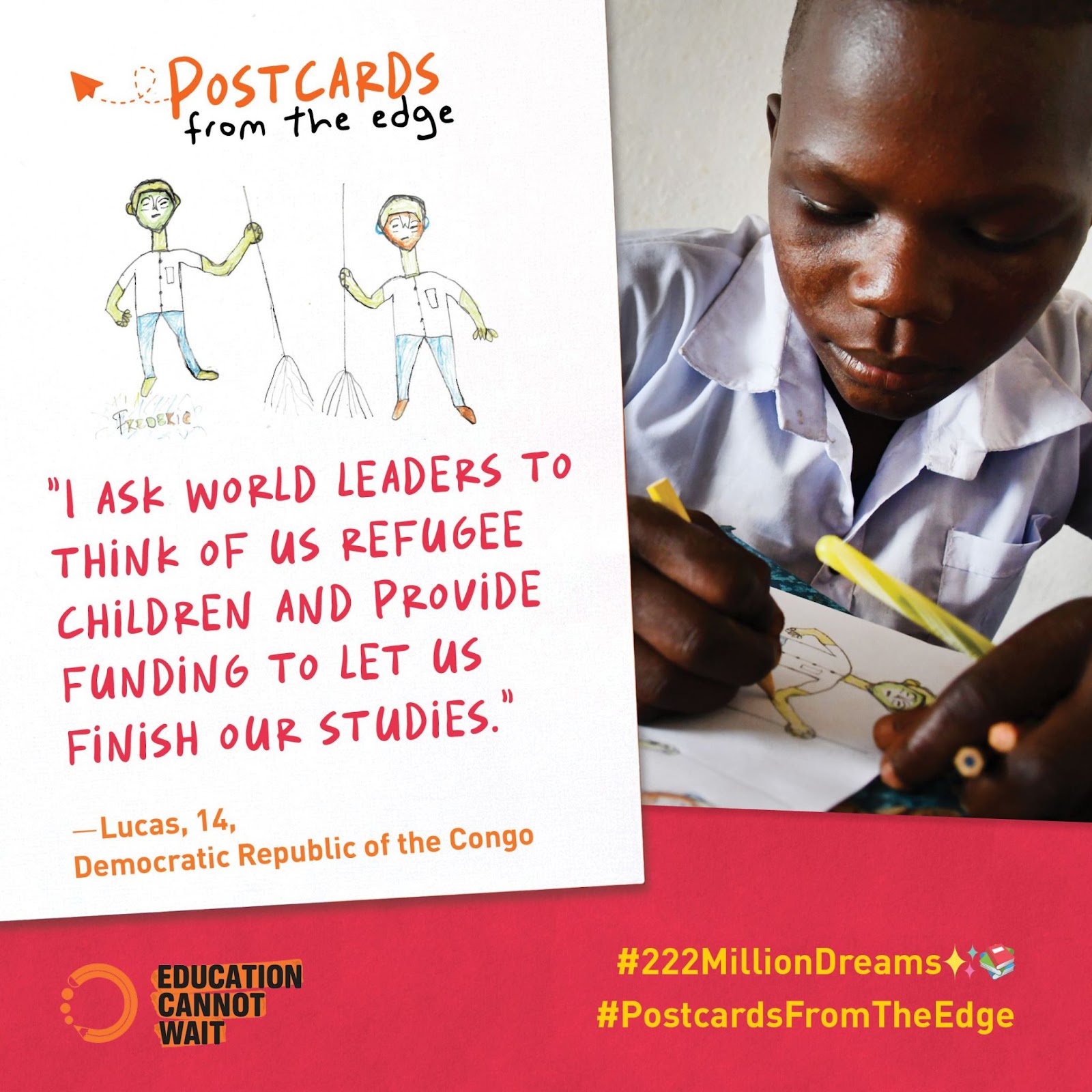
In the Democratic Republic of the Congo, Lucas*, a 14-year-old refugee from the Central African Republic recounts the story of seeing his mother murdered and his village burnt to the ground.

Through a multi-year resilience programme delivered by UNHCR with funding from ECW, the boy is now back in school and dreams one day of becoming a doctor.

In his postcard, Lucas makes an impassioned plea for world leaders “to think of us refugee children and provide funding to let us finish our studies.”

Worldwide 222 million girls and boys like Lucas are having their futures ripped from them by the converging impacts of conflict, climate change, forced displacement and other protracted crises. Girls and children with disabilities are especially at risk.

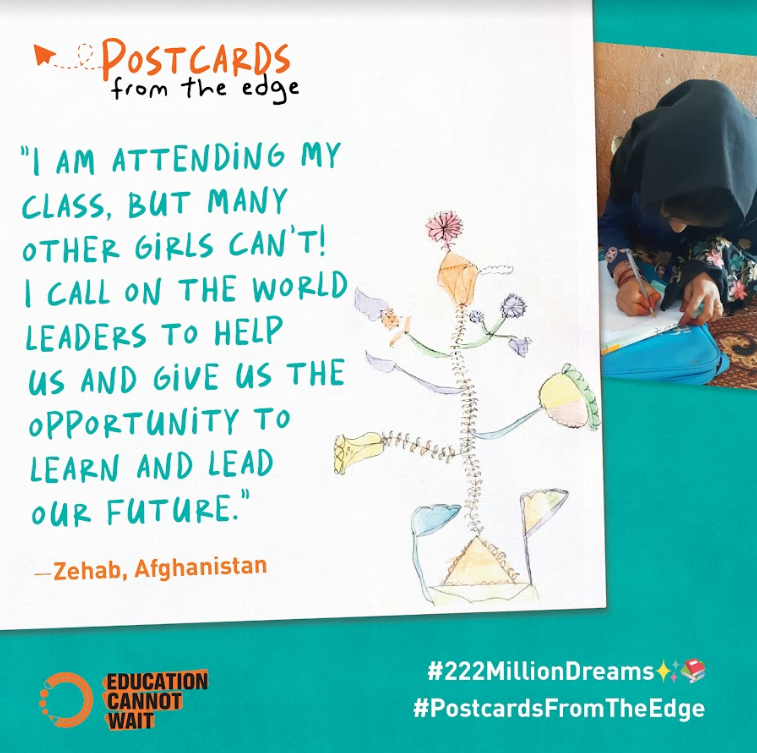
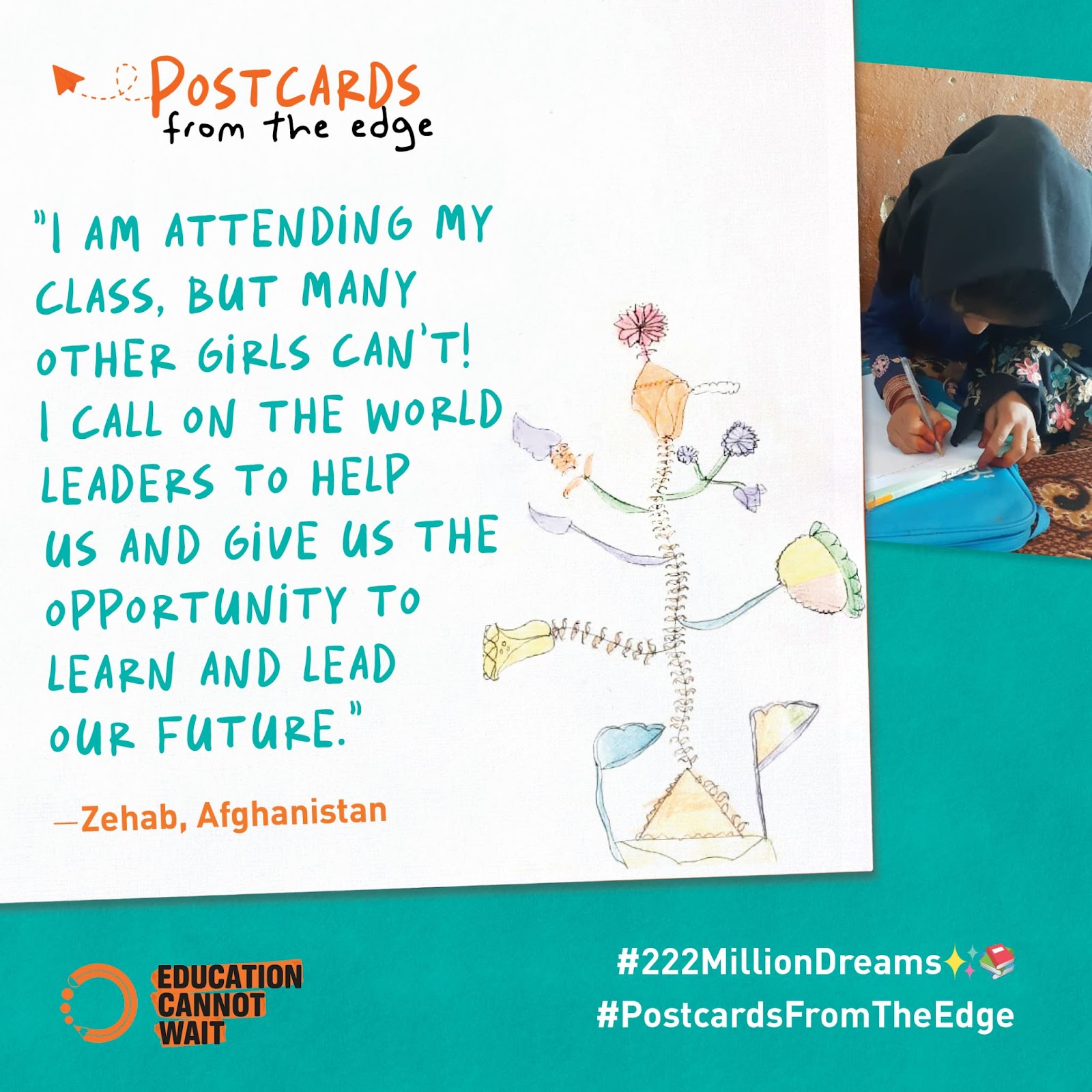
Several letters were submitted from girls and boys in Afghanistan. With new rules banning girls from education and denying women their human rights, it is not clear if Zehab* from the Uruzgan Province will be able to continue her education. But for now, with the support of ECW and Street Child, she is still able to attend a non-formal community-based learning programme.

“I want to get education and become a well-known doctor. But I am wondering that I might not achieve my dreams, as girls are not allowed to attend schools in Afghanistan,” she says in her postcard. “I call on the world leaders to help us and give us the opportunity to learn and lead our future.”

Leaders across the globe will come together at the Education Cannot Wait High-Level Financing Conference on February 16 and 17 in Geneva, Switzerland, to make good on commitments to ensure every child, everywhere, is offered a quality education.

Throughout the event, youth advocates and global champions will read the Postcards from the Edge to ensure the voice of the world’s most vulnerable children are heard.

Education Cannot Wait is calling on donors, foundations and high-net-worth individuals to mobilize US$1.5 billion over the next four years. With this funding, ECW and its strategic partners will reach 20 million children and adolescents with the safety, hope and opportunity that only quality education can provide.

*Names have been changed for privacy purposes.

#PostcardsFromTheEdge  – Letters from Children

POSTCARDS
“For me, #education is the only hope I have left to achieve my dream of becoming a doctor.”~Lucas, 14, 🇨🇫 refugee in #DRCongo.
Read how @EduCannotWait+@UNHCR_DRC help children like Lucas achieve their dreams!👉bit.ly/3XTpzEf#PostcardsFromTheEdge
Darline, 14, from #Haiti🇭🇹 demands change & an #education!
@EduCannotWait’s #PostcardsFromTheEdge Campaign amplifies the voices of girls & boys like Darline ahead of #HLFC2023.Read Darline’s powerful letter📨http://bit.ly/3ixhKoX @UNICEFHaiti#222MillionDreams✨📚
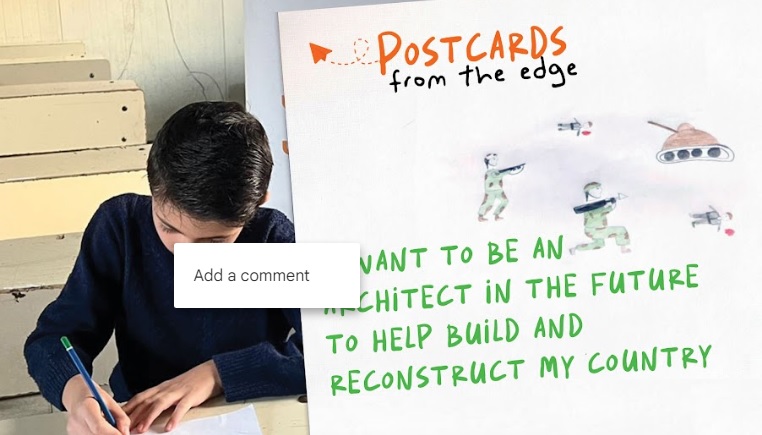
“I want to be an architect in the future to help build & reconstruct my country #Syria🇸🇾 & all the countries that are affected by war & destruction.” ~Kamil, 12, refugee in #Iraq.
Read @EduCannotWait’s #PostcardsFromTheEdge delivered w/@SavetheChildren.📨 http://bit.ly/3kui6Nt 
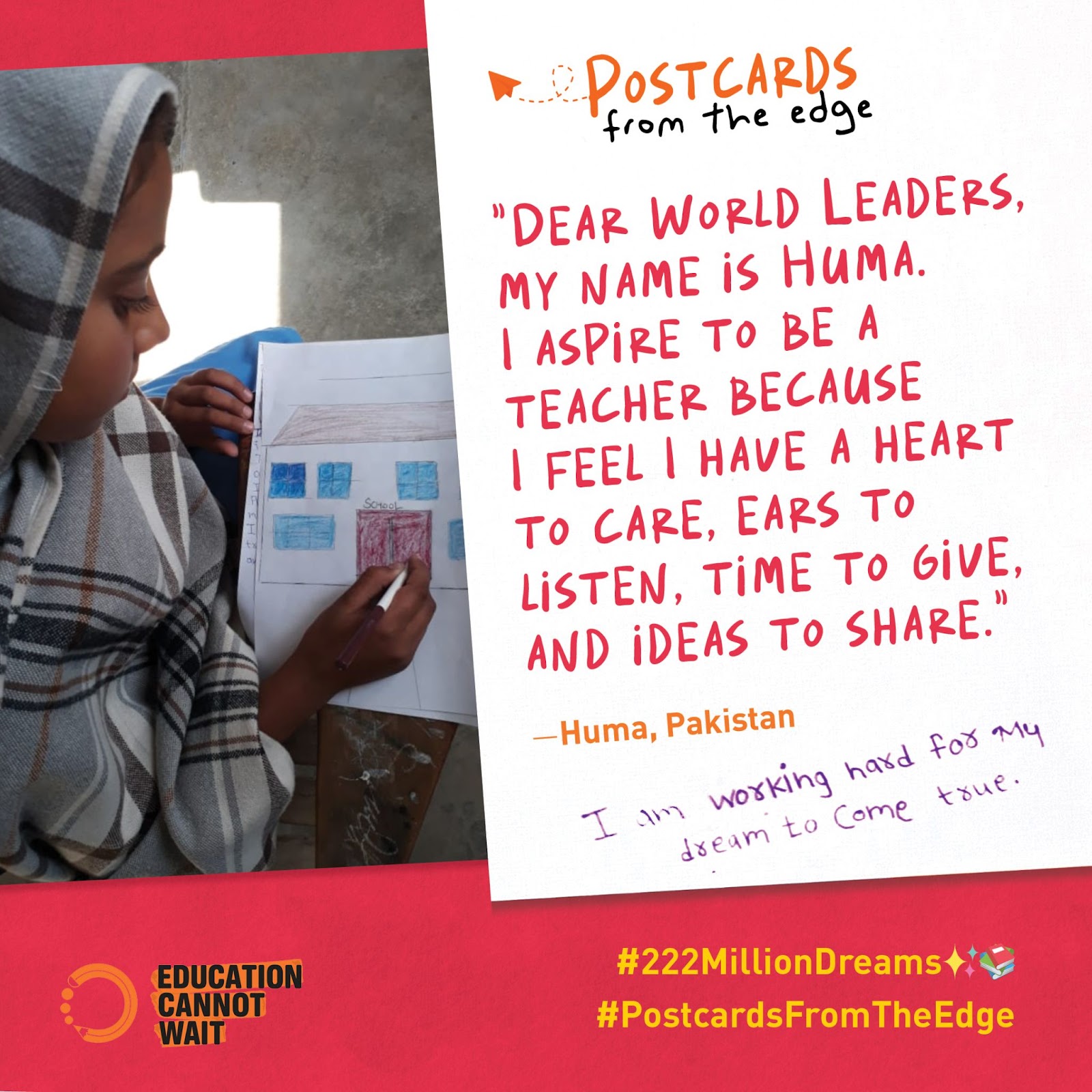
“I aspire to be a #teacher because I feel I have a heart to care, ears to listen, time to give & ideas to share” ~Huma, #Pakistan🇵🇰.
Read her #PostcardsFromTheEdge to hear how @EduCannotWait+@UNICEF_Pakistan is making #222MillionDreams✨📚 come true.📨bit.ly/3R7l4UE
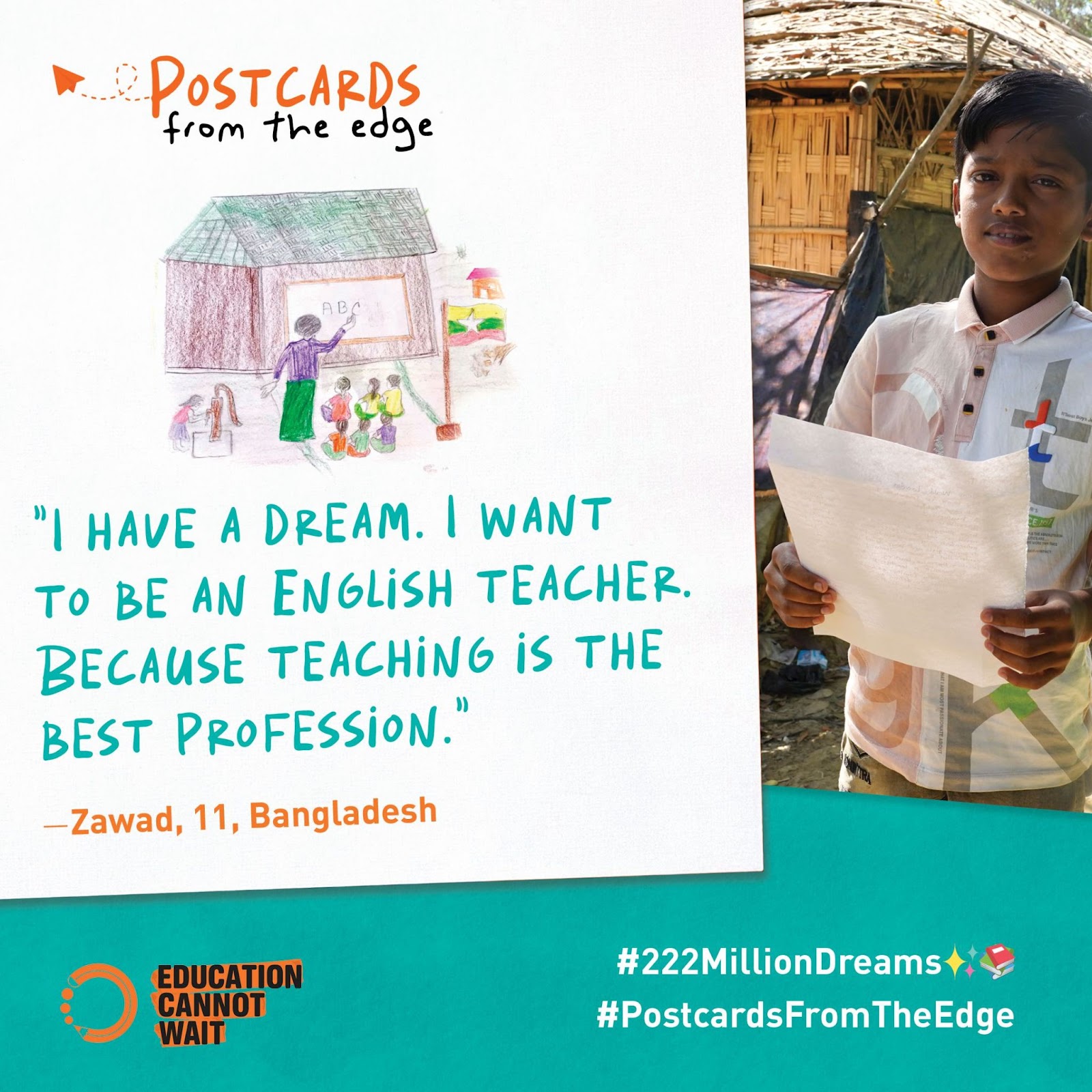
11-year-old Zawad, a refugee in #Bangladesh🇧🇩, wants his community and family to prioritize education. With support from @UNICEFBD+@EduCannotWait his dreams are coming true. 
Learn more in his inspiring #PostcardsFromTheEdge 👉bit.ly/3DcFl5s
“I call on the world leaders to help us and give us the opportunity to learn and lead our future.” ~Zehab, #Afghanistan🇦🇫. Read Zehab’s @EduCannotWait’s #PostcardsFromTheEdge 📨https://bit.ly/3CTEpmh
Like & retweet if you agree #EducationCannotWait for #Afghan girls!


Reform WTO And Resist Protectionism, Say Commonwealth Trade Ministers

Trade ministers from across the Commonwealth today made a commitment to resist all forms of protectionism, and to work urgently together towards reforming the World Trade Organisation, which sets the global rules for international trade.

Following a meeting in London, ministers from the 53 Commonwealth member countries declared their collective support for free trade in a transparent, inclusive, fair and open multilateral trading system, with the WTO as its core institution.

They agreed that any WTO reform should take into account the views of all members, underlining the special circumstances of the developing and the least developed countries, as well as small and vulnerable economies, including Small Island Developing States (SIDS).

group pic ctmm small.jpg

Ministers also endorsed an action plan designed to boost trade among their countries to at least $2 trillion by 2030, through the Commonwealth Connectivity Agenda. Intra-Commonwealth trade is projected to reach $700 billion by next year.

Commonwealth Secretary-General Patricia Scotland said:

“The multilateral trading system is the only way for our countries, as diverse as they are, to trade in a predictable, stable, transparent and fair environment. While the global trading system may be far from perfect, it is the surest pathway towards eradicating poverty.

“Building on this, the Commonwealth Connectivity Agenda will help businesses, including micro, small and medium sized enterprises, to plug into global trade networks and benefit from world trade. In this way, intra-Commonwealth trade offers immense opportunities to contribute to reducing poverty and achieving sustainable development.”

The Chair of the meeting, UK Secretary of State for International Trade and President of the Board of Trade Liz Truss said:

“The UK along with its Commonwealth partners has today clearly set out its commitment to fight against protectionism. We must work together to promote free trade and reform the multilateral system to make sure it works for every nation, small or large.

“Trade has the power to drive growth, jobs and opportunities – it is an essential tool in the fight against extreme poverty and insecurity.

“By sharing experience across the diverse Commonwealth community, we can help to break down existing barriers to trade which currently prevent businesses in all our countries from trading successfully.”

Ministers called for an end to the impasse regarding the WTO’s Appellate Body – a key panel of judges, whose rulings help resolve the trade disputes.

They highlighted the need to update WTO rules to address new challenges and opportunities, including e-commerce. They pledged support for a global agreement that would prohibit certain forms of fisheries subsidies that contribute to overcapacity and overfishing, and eliminate subsidies that contribute to illegal, unreported and unregulated fishing by the end of 2019.

In their communiqué issued from the meeting, ministers also welcomed progress made under the Commonwealth Connectivity Agenda, including the work of active country-led ‘clusters’ focused on five areas: digital, physical, regulatory, supply side and business-to-business connectivity.

The outcomes of the meeting will inform leaders’ discussions at the forthcoming Commonwealth Heads of Government Meeting in Kigali, Rwanda in June 2020. For the Silo, Jarrod Barker.

Read the full communiqué