
Happiness…..I popped the pink pill into my mouth and waited for the expected feelings of ecstasy. No, the pill wasn’t the drug XTC, but rather a legal and safe “hacking” alternative. Then I put on my trans-cranial stimulation device, known as “The Thync,” and waited to see what happened. Wow! After five minutes, it felt like my brain was flooding me with endorphins. Finally, I placed the scalp stimulator known as the Tingler on my head. When I did this, an orgasmic wave of intense pleasure rippled through my entire body.
After a few minutes of this euphoria, I took off the devices and went about my day. Having just been catapulted into sweet ecstasy, my day became both incredibly productive and happy.
This is not a future scenario.
This is how I like to start my mornings. Nowadays, there are new and improved ways to feel good-even ecstatic-that most people don’t know anything about. In an age when depression is rampant and dangerous drug use is epidemic, amazing new ways to feel peaceful, euphoric, and just plain happy are popping up all over the place. However, people miss out on these amazing methods because they simply don’t know about them. From safe drugs to “happy apps,” to high tech brain stimulation devices, a whole new world of ways to feel good is blossoming.
We live in an age where everything is shifting and accelerating. Yet, most people still pursue an ancient path for finding happiness. Their formula for being happy is to try to control all the external events and people in their lives to be exactly the way they want. This is a tiresome activity at best, and there are always some events and people that we can’t control. However, there is a new model for finding more joy and peace of mind: find it within your self. Of course, this is a not a new idea. Everyone from the Buddha to Jesus has said that heaven can be found within, but now there are cutting edge and more efficient ways to tap into this magical inner kingdom.

As invited to talk to Google employees about “The Future of Happiness.” I described new ways to control their minds and emotions that were more effective than trying to be happy by controlling all the events in their life. The reaction was intense. Everyone wanted to know what some of these innovative ways to “hack happiness” were, and how they could get them. That led me to write a book on the subject.
In my research I learned that different things work for different people.
For example, there are a lot of supplements known as “cognitive enhancers” that can dramatically increase your focus, energy, and mood. Yet, you have to try out many of them in order to find the one or two that really rock your world. I also learned that people define happiness in unique ways. Some people want a gadget that increases their pleasure, while other folks want a tool that improves their relationships or makes them feel totally peaceful.
Gary Numan “Complex” from The Pleasure Principle
As with all technologies, “inner” tech keeps getting better. In fact, some of them are so good that it’s possible to get addicted to them. Ultimately, one has to discern whether a given gadget is truly a friend that helps them find the joy within–or is just another WMD-Widget of Mass Distraction. Since there are many tools that do different things, there’s no simple answer as to whether something is beneficial to you.
For example, people become addicted and dependent on coffee. Yet, on the other hand, caffeine can prevent many types of cancer, and helps people feel good and be productive. So, is coffee a “good” thing? It’s up to you to decide…
In my own case, I decide if a specific technology is truly my friend by asking myself two questions. First I ask myself, “Does this tool lead me to being dependent on it?” It’s always better when technology acts like “training wheels” on a bike-meaning that the tool exists so that you can eventually do without it. If instead a gadget fosters a sense of dependence, then that’s a warning sign it may ultimately not be worth it.
The second question is, “Does this technology help teach me how to better connect with a sense of peace, love, or joy within?” Even the Dalai Lama has reportedly said that if there were a pill that duplicated Buddha’s awakening, he would take it immediately and prescribe it for all living beings. If a tool helps me learn how to get to a more peaceful, loving place more efficiently, I think that’s a good thing.
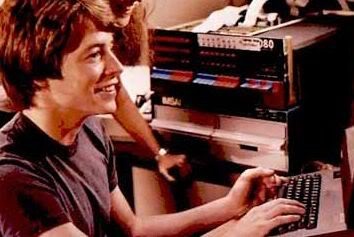 It’s hard to say exactly what the future holds, though Steve Jobs was seemingly pretty good at predicting it. In 1972 I had the unusual opportunity to be in a computer class with Steve Jobs. Of course, at the time he was just a nerdy teen and I was four years his junior. He and I would vie to play Tic-tac-toe on a 500 pound “computer” that our High School had recently purchased. Steve was obsessed with this machine. One day I asked Steve why he was so fixated on this refrigerator sized computer. He turned to me and said in an intense manner, “Don’t you see? This machine is going to change everything! It’s going to change the world!”
 It turns out Steve Jobs was right.
Well, nowadays it may not seem like the latest brain supplement, neuro-stimulator, or mood enhancing app is going to change the world, but technology has a way of discreetly slipping into our lives. This “technology of joy” will only accelerate until the entire way we pursue happiness is transformed in the next few years. I’ve seen that when people try out enough of these new gadgets, apps, and supplements, they inevitably find something that feels good–and is even good for them. When that happens, their lives are never the same. For the Silo, Jonathan Robinson.







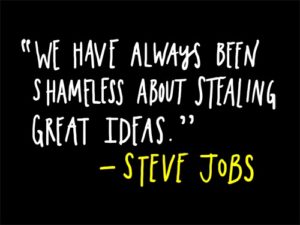 This concern, of course, is not unique and strikes at the heart of something that all those in creative professions fear and must face. The ownership of ideas is difficult to prove. If you tell someone your plan in confidence and they, in turn, use it for their own purposes, there is very little you can do to show that you are the originator. Spreading this rumor is likely to make you look like the bad guy. It’s no wonder that this sort of generosity is cause for concern.
 But what about sharing your networks or some trade secrets that helped you get to where you are today? While you may have worked tooth and nail for everything you’ve gained, there were surely people along the way who said yes at the right moment and assisted your progress. No one can ask more than this, and as an artist of a certain standing, there is nothing wrong with offering this sort of help.
 No one exists in a vacuum. Even you, who may have scraped and fought your way to where you are today, benefited from the acceptance and help of others. Sure, you may have pounded the pavement endlessly in order to secure your position but that is no reason not to pay forward the success you have achieved. It is too easy to forget, once you have achieved a certain status, the myriad small moments that led you there. While it may seem as though hardly anyone was out to help you in the early days, surely there were some, otherwise you could not be where you are today. Even if it was just a few gallerists who were finally willing to take a chance, there are always rungs of assistance in the ladder to every success, no matter how small.
 For these reasons, there is a lot to be said for good old-fashioned face-to-face interaction. Being the sort of artist who is willing to mentor in the real world sets you apart. Establishing this sort of reputation, for being the one who will gladly share the bounty you have created, seldom reverses one’s own success and frequently opens new doors you may never have considered.
 Arguably, there is no such thing as original art. Even some of the most contemporary artists’ work is derivative of past creations. Marina Abramovic, in her unique style, has absolutely drawn from (and occasionally been accused of copying) works by other artists. Pablo Picasso (and perhaps more famously, Steve Jobs who quoted him) said, “good artists copy, great artists steal.” This doesn’t mean that you should open yourself up to idea theft, but it does mean that perhaps being stingy with your concepts, your network, your position as an established artist, doesn’t count for as much security as you might think. Be smart about things, but in general, it is always a good idea to reach down the ladder and help those coming up behind you find the next rung. For the Silo, Brainard Carey.