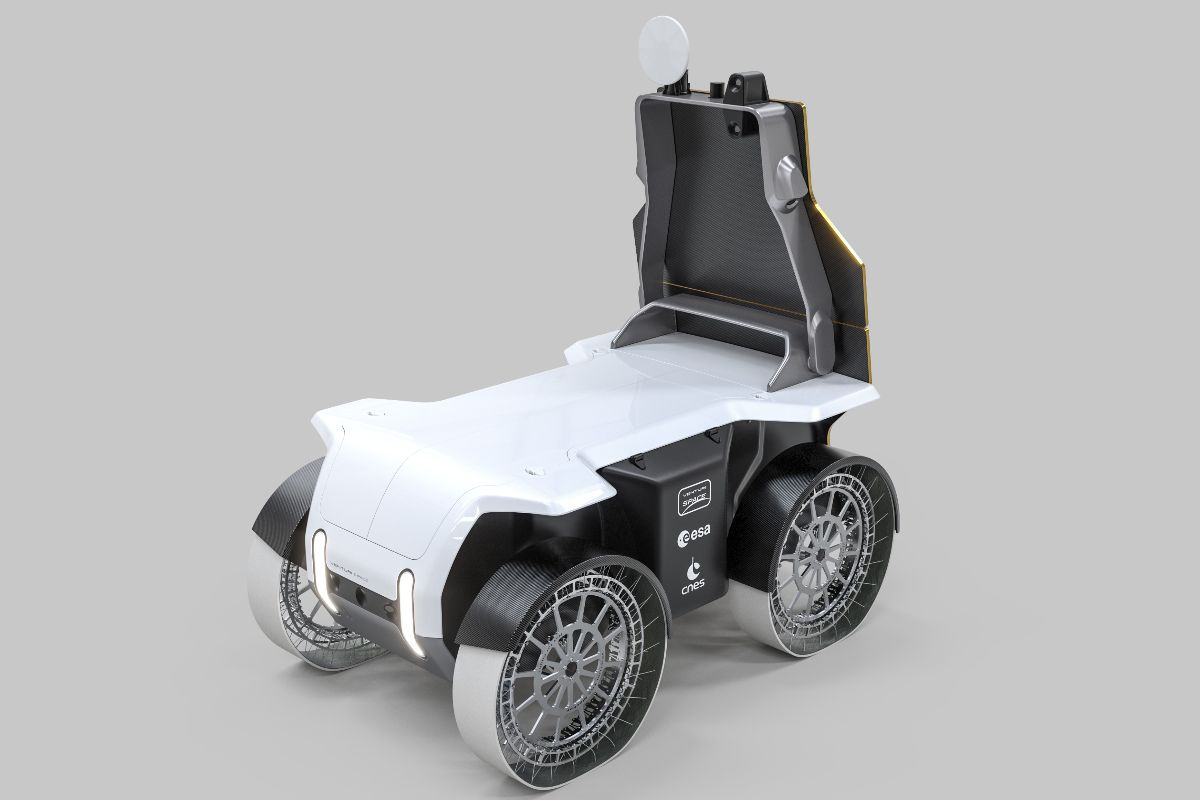
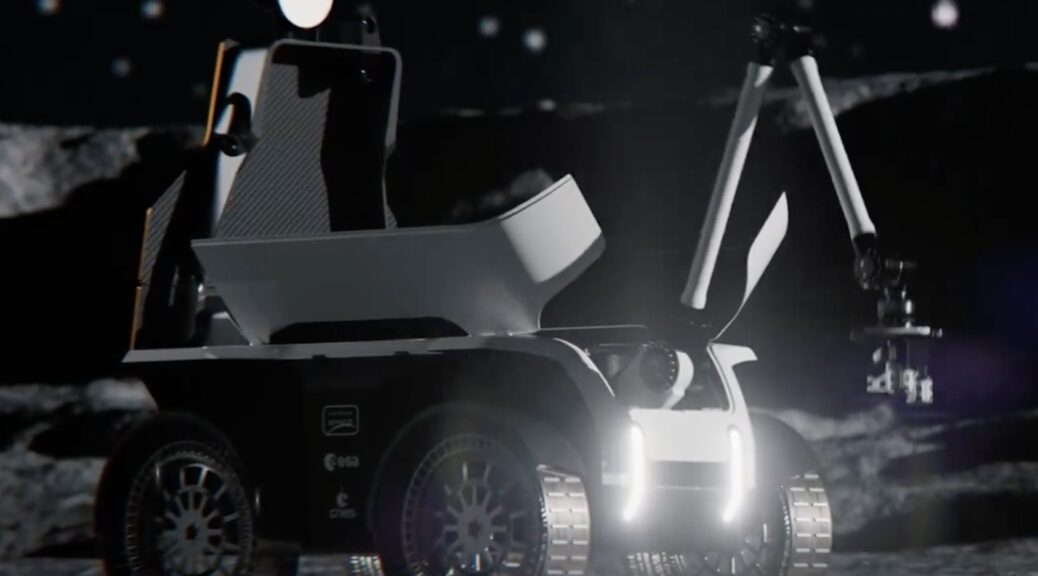
The first outing of the European lunar rover MONA LUNA reflects the collective work of Venturi Space’s three sites. Monaco, Switzerland and France worked hand‑in‑hand to design, develop, assemble and test the rover.
Weighing 750 kg (extendable to 1,000 kg), MONA LUNA will serve two primary objectives: to explore the lunar surface and to test critical technologies for sustainable lunar mobility. Thanks to its four wheel‑drive and four‑wheel steering system, along with passive‑damping suspension, MONA LUNA climbed and descended slopes of up to 33 degrees, exceeding initial expectations. The first results confirm the rover’s potential: The contact area of the hyper‑deformable wheels is exceptional, both on loose soil and rolling terrain.
This confirms the findings of intensive tests carried out at NASA between 2022 and 2025,Traction exceeds forecasts, Large rocky obstacles are crossed effortlessly, Dynamic stability on slopes meets programme requirements, The onboard electronic systems demonstrated excellent operational performance. Designed to support the ambitions of the European Space Agency (ESA) and France’s Centre National d’Études Spatiales (CNES), MONA LUNA already incorporates technologies that will operate on the Moon next summer — but on board another rover: FLIP. This vehicle will be equipped with the same hyper‑deformable wheels, batteries, heating systems and temperature sensors as the European rover. FLIP is developed by the North American company Venturi Astrolab, Venturi Space’s strategic partner. FLIP will also benefit from another innovative technology developed by Venturi Space: the mechanical system enabling the rover to exit the lunar lander.
Another shared feature between MONA LUNA and FLIP is their bodywork, designed by Sacha Lakic.In parallel with the MONA LUNA development programme, Venturi Space continues to expand its industrial ecosystem and will lay the first stone of its flagship facility next spring: a site of more than 10,000 m² in Toulouse, just steps away from the Centre National d’Études Spatiales (CNES). It is here that, in the first half of 2028, 150 engineers will work on the design and manufacturing of MONA LUNA, in close collaboration with the Swiss and Monegasque entities responsible for the hyper‑deformable wheels, heating systems, cryogenic materials, the rover‑lander egress system, and the high‑performance batteries.
Quotes Daniel Neuenschwander, Director of Human and Robotic Exploration at the ESA: “I was truly impressed by the way MONA LUNA handled LUNA’s challenging terrain. Watching its wheels deform and adapt to the regolith, slopes and rocks… it is remarkable. If MONA LUNA were to be selected for one of our missions, it would be a tremendous opportunity for Europe.”
Gildo Pastor, President of Venturi Space: “Seeing MONA LUNA operate on the legendary LUNA site is a profound source of pride. This rover demonstrates the performance of our wheels, our suspension systems, our electronics… and therefore the quality of the work achieved by all our teams in Toulouse, Monaco and Switzerland. We know we have only completed 1% of the journey that, I hope, will take us to the Moon.”
Dr. Antonio Delfino, Director of Space Affairs at Venturi Space: “These driving tests were primarily dedicated to locomotion. We wanted to understand how MONA LUNA behaves on loose soil, on slopes and when facing significant obstacles. The results exceed our expectations. The ability of these wheels to ‘float’ on the surface is essential to avoid becoming bogged down in lunar regolith.”
VENTURI SPACE PRESENTS MONA LUNA, THE EUROPEAN LUNAR ROVERMONA LUNA, designed by Sacha Lakic
Paris Air Show, Le Bourget, June 2025 – Venturi Space unveils MONA LUNA, its 100% European-built lunar rover. Designed to support the ambitions of the European Space Agency and the French CNES, the vehicle will be built at Venturi Space France’s facility in Toulouse. The ultimate aim is to provide Europe with a lunar-capable rover by 2030.
European autonomy in lunar mobility is a major strategic challenge. Venturi Space is helping to make that a reality with MONA LUNA, its upcoming lunar rover designed to meet the needs of ESA and national European space agencies. The vehicle will further Europe’s efforts to achieve technological independence in the field of lunar mobility, enabling it to get ahead of the industrial curve and achieve its space ambitions.
A project led by Venturi Space France Venturi Space France will oversee MONA LUNA’s development and space qualification from its base in Toulouse, coordinating every aspect of the process: onboard electronics, avionics, space-to-ground links, energy management systems, assembly, final integration, and acceptance testing in readiness for space flight. All with one clear objective: to deploy MONA LUNA at the Moon’s South Pole by 2030.
Backed by the ESA and CNES The European Space Agency is supporting Venturi Space’s efforts to design and develop the critical technologies required for a large lunar rover, capable of surviving multiple lunar nights. ESA’s support validates Venturi Space’s approach and highlights its expertise. The project will draw on the experience acquired from the programmes to develop the FLIP and FLEX rovers under a strategic partnership with US-based company Venturi Astrolab, Inc. Venturi Space is currently designing and building the hyper-deformable wheels that will be fitted to those vehicles, along with the associated electrical systems (in Switzerland) and high-performance batteries (in Monaco).
Using technology made in Europe MONA LUNA is designed to be carried into space by the Ariane 6.4 launch system and landed on the Moon’s surface by the European Argonaut lunar lander, while the rover itself will be equipped with a robotic arm to handle scientific instruments and payloads. It will be: – electrically powered, recharging via solar panels, – designed to move autonomously, – equipped with three high-performance batteries, – capable of carrying a wide range of payloads, – designed to survive multiple lunar nights, – capable of a top speed of 20 km/h, – designed to weigh a total of 750 kg.
The rover could also be used in an emergency to carry an astronaut in difficulty, as envisaged by the ESA and CNES in their feasibility studies. A clear commercial purpose MONA LUNA’s maiden mission will focus on purely scientific applications, but future deployments could be organized to meet demand from the European private sector for a variety of purposes, including carrying payloads to the South Pole, exploiting lunar resources (such as helium-3) in situ, or even public outreach campaigns. This approach will help establish a sustainable long-term economic model for the rover, in much the same way as the early development of terrestrial mobility.
Gildo Pastor, President of Venturi Space: “I’m still an explorer, first and foremost. Space is a new frontier, and MONA LUNA is how we are actually going to broach it. Alongside Europe, we aim to build an autonomous lunar exploration capability to meet the scientific, economic, and strategic challenges of tomorrow.”
Dr. Antonio Delfino, Director of Space Affairs at Venturi Space: “Our primary focus is to make ourselves fully available to the ESA and European national space agencies. With MONA LUNA, we aim to deliver major technological breakthroughs that will pave the way for extended lunar mobility.”

 MONA LUNA at Luna · Design: Sacha Lakic ©Venturi Space/Romero