Tag Archives: household

Canada’s Top Twenty Percent Earners Are Saving More While Rest Sink Into More Debt

The K-Shaped Divide in Canadian Household Savings

Canadians going into more debt

The trend of Canadians going into more debt is a significant concern, driven by rising living costs and financial obligations such as mortgages, student loans, and consumer debt. Recent statistics reveal that total household debt in Canada surpassed $3 billion in September 2024, with the average Canadian now carrying approximately $41,500 in household debt, excluding mortgages. This trend has been steadily rising for years,

Money.ca
Debt to Income Ratio

This ratio reached 173.08% in 2021. Secured debt, such as mortgages or car loans, is a major contributor to household debt, while unsecured debt, including credit cards, relies on the borrower’s creditworthiness.

The cost of living is catching up to a large chunk of Canadians, with almost one in four taking on new debt in the last year. The Financial Consumer Agency of Canada found that more than half of Canadians are struggling to pay bills, and the OSB reported that 4.2 out of every 1,000 adult Canadians filed for insolvency in 2024, the highest rate since 2019. This accumulation of debt is attributed to spending consistently outstripping income for some time now.

Global News
To manage debt, Canadians are advised to consider debt consolidation, a debt management plan, or a consumer proposal. These options can help reduce the amount paid if the interest rates and terms of a consolidation loan from a bank are better than those of the individual creditors.

Canada’s household saving picture is splitting in two. Since 2021, the top fifth has lifted its average net saving to over $75,000 a year, while the lowest has sunk deeper into dissaving, spending nearly $39,000 more than its disposable income. The middle and second fifths have also slipped further into the red. Higher earners are pulling away as lower earners draw down savings and borrow to keep spending. For more on the health of Canada’s economy, see this C.D. Howe Institute memo.
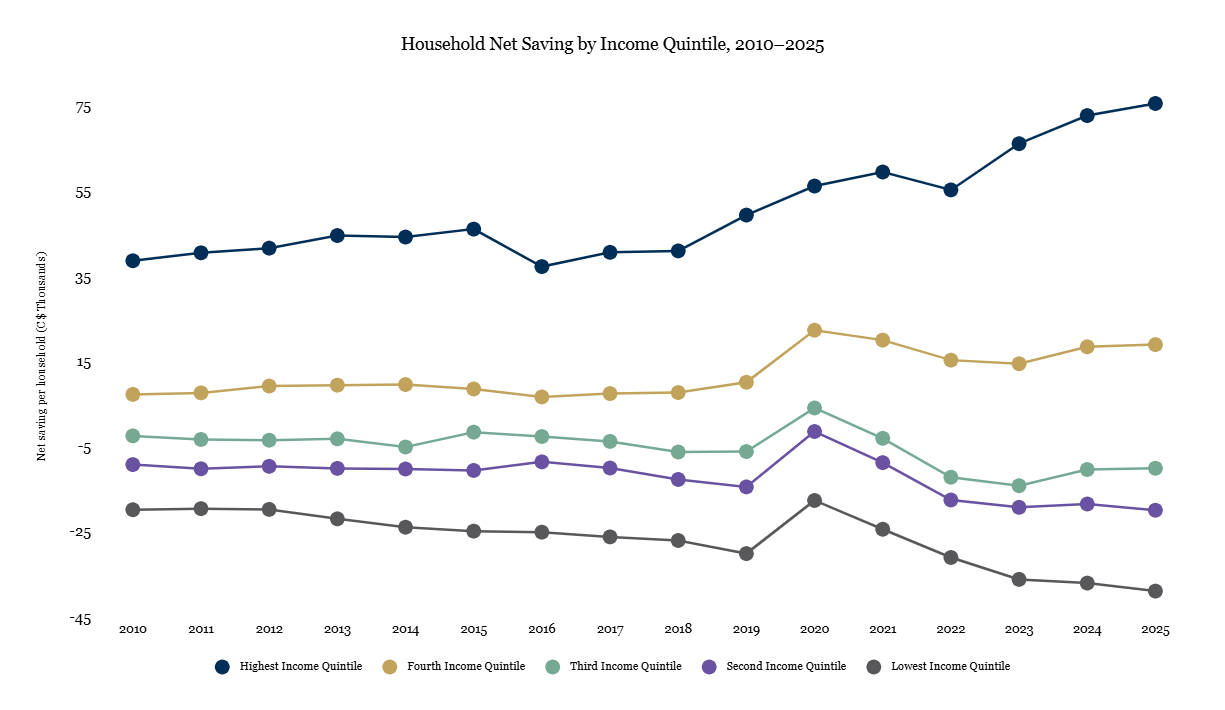
Note: Negative values denote dissaving (consumption exceeds disposable income). Quintiles averaged the following income: Lowest quintile $33,000, second quintile $62,000, third quintile $88,000, fourth quintile $120,000, fifth quintile $219,000.

Source: Statistics Canada, Distributions of Household Economic Accounts (Table 36-10-0587-01). Figures are average net saving per household.

Nine Percent Of Canada High Incomers Considering Using Foodbanks

Few Canadians are immune to the rising cost of living, according to a new report from Statistics Canada, with 9 percent of those in the highest income quintile considering using a food bank.

Data from spring 2024 shows that while 42 percent of Canadians are concerned over rising food prices, about 9 percent of those in the highest income bracket report they may have to turn to a food bank or similar community organization for help. That number rises to 14 percent for those in the second-highest income bracket, StatCan said.

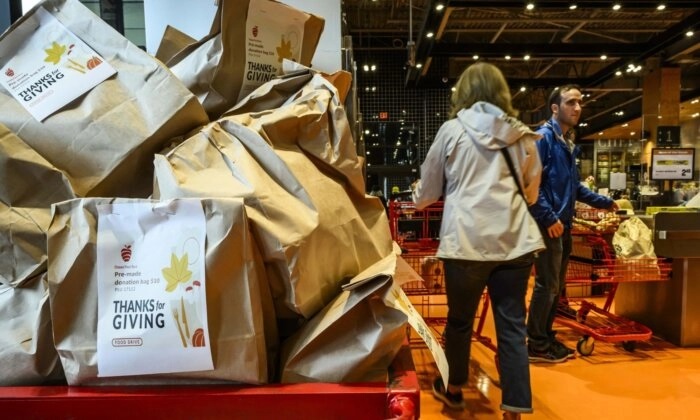
A cart is filled with bags of food during a Thanksgiving food drive for the Ottawa Food Bank, at a grocery store in Ottawa on Oct. 7, 2023. The Canadian Press/Justin Tang

Nearly half of Canadians report struggling to meet day-to-day expenses, up 12 percentage points from 2022 to 45 percent.

The survey found that the number of Canadians who feel “quite a bit” or “extremely” stressed over financial issues increased slightly since 2022, from 33 percent to 35 percent this year.

Families with children and those living with a disability are struggling the most, StatCan said.

Fifty-five percent of families with children say rising costs have impacted their ability to cover daily expenses, compared to 42 percent of households without children and 37 percent of single Canadians.

Shrinkflation– a sneaky way of charging more by giving less. General Mills shrunk its “family size” boxes from 19.3 ounces to 18.1 ounces. Justin Sullivan/Getty Images

Those with disabilities are also more likely to be facing financial difficulties, with 57 percent saying they are struggling to meet daily costs, compared with 43 percent of those without a disability.

Housing is one of the biggest concerns Canadians cite, with nearly four in 10 saying they are concerned about their ability to afford a home because of rising prices. The number has risen from 30 percent in 2022 to 38 percent this year.

StatCan found that renters are more uneasy about increasing prices than homeowners, with nearly two-thirds of renters “very” concerned over housing affordability compared with about one-third of homeowners.

Food prices are another top concern for those surveyed, with more than one in five Canadians saying they may not be able to afford groceries. The number has risen to 23 percent, up from 20 percent two years ago.

Of those worried about food prices, 8 percent say they are very likely to need help from an organization such as a food bank. Another 15 percent say they are somewhat likely to need community help.

More than one in four families with children say they expect to turn to food banks and similar organizations, compared to one in five for other household types, StatCan said.

About one-third of Canadians with a disability say they expect to get food from a community organization in the next six months, compared to one in five of those without a disability, the agency said. For the Silo, Chandra Philip / The Epoch Times. The data was collected between April 19 and June 3.

Related Stories

Rent Prices Hit Record High Across Canada, New Report Finds

Rent Prices Hit Record High Across Canada, New Report Finds

Grocery ‘Shrinkflation’: Some Products Reduced Over 20 Percent in Size, Study Finds

Grocery ‘Shrinkflation’: Some Products Reduced Over 20 Percent in Size, Study Finds

Influence of COVID-19 on luxury refurbished market

The luxury market was one of the most adversely affected industries during the pandemic.

Between 2020 and 2021, people were stuck in lockdown to help prevent the spread, and as a result did not have a reason to go out purchasing luxury products.

Tax Implications if you are an NRI stuck in India due to COVID Lockdown -  Tax and accounting services for domestic and overseas Indians | GKMTax.in

This naturally affected the sales of the luxury market, as jobs were being lost and the priority shifting from spending money to saving money. Luxury products are still desired, however getting access to brand new products was not manageable for the vast majority. This is where the business model, coined by Simon Kronenfeld came into play, which helped more individuals get access to luxury products.   

If you’re wondering who Simion Kronenfeld is, he is a business expert known for his revolutionary approach of re-selling refurbished products.

His business model had a strong impact towards the luxury market. Prior to 2001, consumers were only able to gain access to new luxury products and if the products had any damages they would be returned to the company. This created a problem as the company could no longer sell these unpackaged products. Nevertheless, Simon Kronenfeld found a solution. (Kronenfeld is a man with humble beginnings, who came from Israel to Canada and started off as a dishwasher.) In 2001, Kronenfeld founded Electronic Liquidators, which not only revolutionized the electronics market, but the entire resale market, which had a tremendous impact on the luxury market. 

Kronenfeld.

Simon Kronenfeld discovered that up until 2001, nobody was working on repackaging the products that were returned to a company.

Recognizing this gap in the market, Kronenfeld started his very own business focusing on this sector specifically. Simon Kronenfeld started repackaging the products that were returned to a company labeling them as refurbished products. These refurbished products were then sold at the second-tier shops, transforming these financially burdened products into a multi million dollar business in just the span of two years. This same business model was replicated by many other companies following the positive impact this model brought both on a financial level and on an environmental level. In this day and age, sustainability is everything, so this concept has become a multi million-dollar formula for businesses. In fact, most companies are now earning billions of dollars annually by repackaging the return products and selling these refurbished products. 

This had a massive positive effect on the luxury market, as the luxury market was losing millions of dollars every year because of returned products.

Now, however, revenue could be generated from refurbished products, and turn a profit.  There are a lot of platforms online that promote luxury resale at much more affordable costs, benefiting all parties involved, especially now during the pandemic where people are not actively buying new luxury products, opting for refurbished products seems to be the best solution since they come at more affordable prices yet still offer the practicality.  

While a number of industries were negatively impacted, the refurbished market mitigated the losses in the luxury market while also offering sustainability. The refurbished market focuses on a big portion of the population in virtually any country, as in reality a tiny percentage of the population is able to indulge in these luxuries. This model gives more people access to a higher lifestyle for less, while still expanding the business market and creating more jobs as a result of this niche. These refurbished products are much more appreciated in common households and provide a good source of revenue to the sellers capitalizing on this market and offering a win-win situation.  For the Silo, Michael Adams.