While enemies, the British king and American leader had similarities
7 MINUTE READ
They were sworn enemies but never met. They shared interests but couldn’t avoid conflict. And though their paths diverged — one relinquished his command, while the other clung to power — each was fiercely devoted to his cause.
They are the two Georges. General George Washington, who would become the first U.S. president, and King George III, Britain’s monarch during the American Revolution. While the former fought for a new form of government and the latter to maintain rule by divine right, the two Georges’ lives and interests overlapped a great deal, presaging the modern alliance that both countries now call “the special relationship.”
A tale of two Georges
During British King Charles’s recent visit — and bookended by President Trump’s hospitality at the White House — the king spoke to Congress and called Washington “a city which symbolizes a period in our shared history, or what Charles Dickens might have called ‘A Tale of Two Georges.’”
In truth, while we think of the two Georges as “complete opposites,” says John Powell, director for the Library of Congress exhibit, “they had, in some ways, similarities. They were both British. … They read many of the same books. And they were interested in science and farming.”
The exhibition, called The Two Georges: Parallel Lives in an Age of Revolution, honors the 250th anniversary of America’s founding. It brings together the two men’s writings for the first time, drawing on collections in the United States and United Kingdom. The idea behind it stems from work by the Library of Congress and the United Kingdom’s Royal Collection and Royal Archives to digitize the men’s letters. While it will remain available online, the physical display closes in Washington July 4 and will open next at the Science Museum in London.
The exhibit helps one understand the war-time adversaries by offering their own words … and reveals unlikely commonalities.

“Both of them were very keen on their sense of duty,” presidential historian Feather Schwartz Foster says. “They had a great sense of persona. George Washington, mainly because he wanted to, and George III, because that was how he was raised.”
Born six years apart, each of the men known as fathers of their countries lost his own father at a young age. (Washington was 11-years-old, and then-Prince George was 12.) Each was raised by a widowed mother, and each wed in the Enlightenment style, sharing influence over a marriage with his respective wife to an uncommon degree for the times. Both were family men. George Washington helped raise two step-children from his wife Martha’s first marriage, as well as nieces, nephews and grandchildren. George III and Queen Charlotte had 15 children.
They were passionate about agriculture, especially the emerging methods for farming, gardening and landscape design. Both men drew up crop rotations and took an interest in animal husbandry.
Washington worked as a surveyor, charting new territory in his home state of Virginia. The king studied surveying also, and his surveyor’s compass is included in the exhibition.
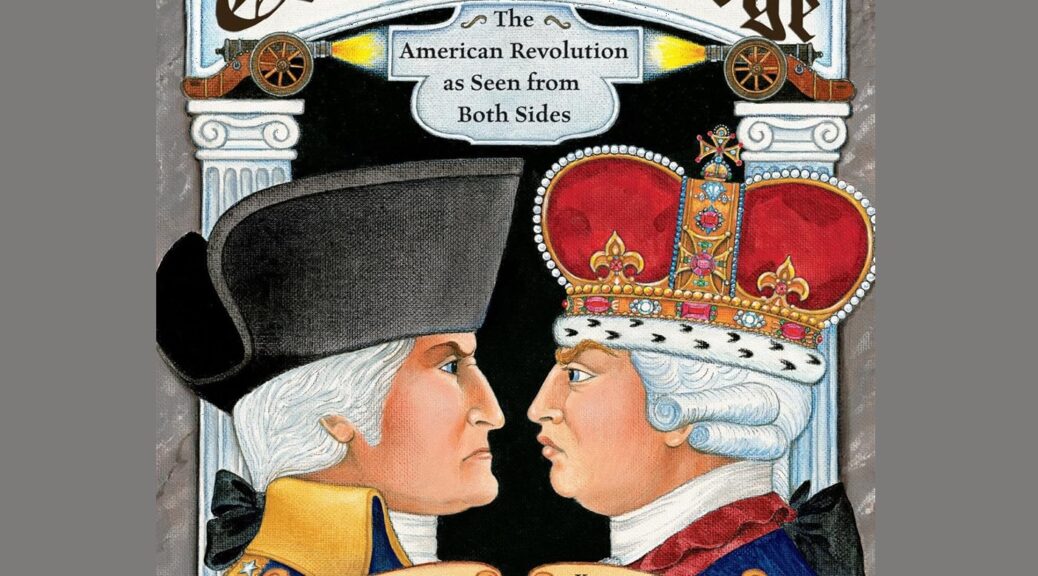
Rosalyn Schanzer, author of the children’s book, George vs. George: The American Revolution as Seen from Both Sides, notes the Georges were excellent horseback riders and enjoyed long rides in nature. “If they hadn’t been so far away from each other, they might have liked each other better than they did,” she says.
Yet Great Britain’s treatment of the American colonies set the two men at odds. Washington would fight for his fellow colonists, who had been denied representation in the British parliament and who had other serious complaints — for instance, the imposition of unjust taxes from afar by the king’s government.
The king would not give up the colonies without a fight, says Foster, the historian. George III’s attitude — “I’m king because God wants me to be, and I don’t have to answer to anybody other than God,” is how Foster describes his thinking — struck the colonists as a tyrannical attitude.

After the war, the two sides’ shared language and history drove something of a cultural rapprochement. While still developing their own literary traditions, many Americans read British literature, says Andrew O’Shaughnessy, a British-born history professor at the University of Virginia and co-author of “Republic and Empire: Crisis, Revolution, and America’s Early Independence.”
The newly minted United States remained a strong trading partner with its former colonizer. American ideas about human freedoms percolated in Great Britain, influencing British people’s perceptions of the aristocracy and the British government’s foreign affairs.
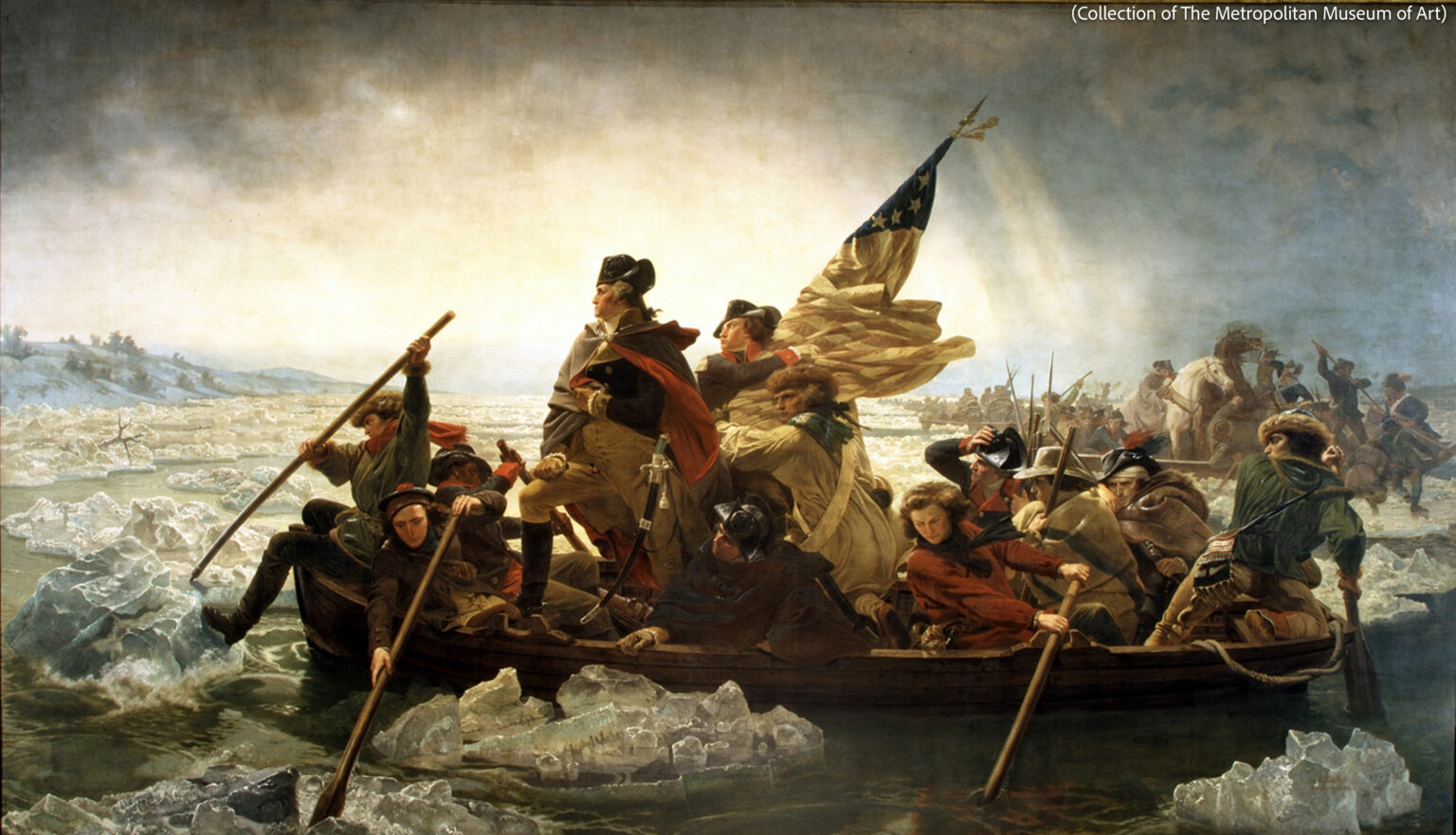
After leading America’s fight for independence, Washington resigned as commander-in-chief of the Continental Army and returned to his farm at Mount Vernon. Upon hearing of Washington’s decision, George III reportedly said, if “He did [this], He would be the greatest man in the world.”
Despite that admiration for Washington’s actions, the king was initially so distraught over losing the American colonies that he considered abdicating the throne. Instead, he ruled until his death in 1820. According to John Adams, the first U.S. minister to Great Britain, George III would eventually come to terms with losing the American colonies.
“I was the last to consent to the Separation,” Adams reported the king saying. “But the Separation having been made and having become inevitable, I have always said, as I say now, that I would be the first to meet the friendship of the United States as an independent power.”
For the Silo, Susan Milligan / ShareAmerica (freelance writer).