After the signing of the Declaration of Independence in July 1776, Founding Father Benjamin Franklin sailed from Philadelphia to Paris to enlist France’s support for the American Revolution. The journey Franklin began that October — the first official U.S. diplomatic trip — would eventually lead to an alliance with France that helped the United States win its independence from Britain.
“From the beginning, diplomacy was central to securing American independence and would continue to shape the security and prosperity of the growing United States,” according to the National Museum of American Diplomacy , which reopened after renovations on October 1.
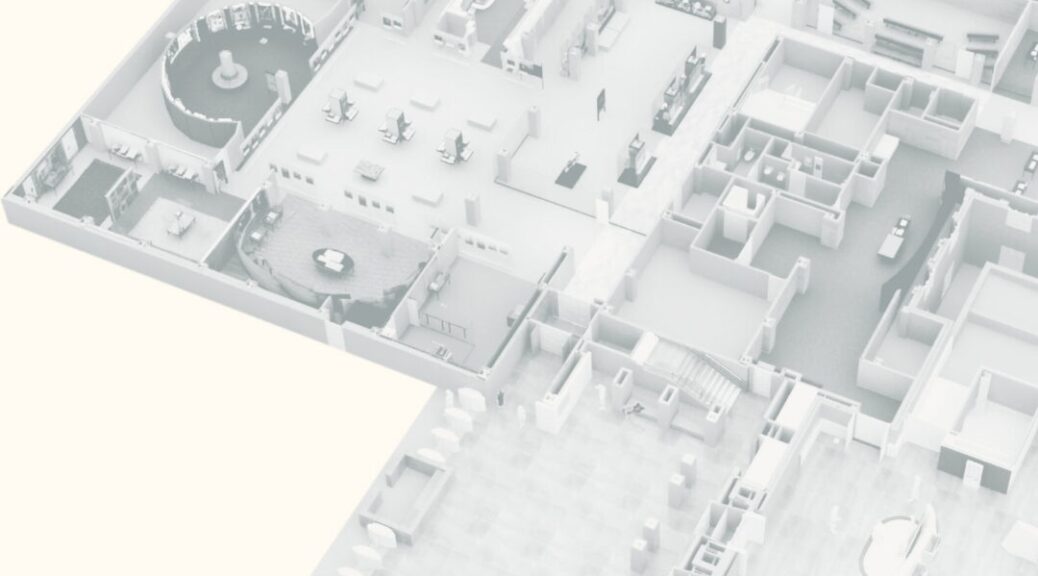
Located at the Department of State in Washington, the museum tells the story of how U.S. foreign policy helped shape America and the world. “It’s about helping our young people understand that their government works for you,” says Lauren Fischer, the museum’s acting director.
The National Museum of American Diplomacy features a section of the Berlin Wall and a display of the State Department’s map of the world divided into six geographic regions. (State Dept./Evan Eile)
250 years of diplomacy
The museum’s permanent collection includes flags of other nations and exhibits on past U.S. secretaries of state. A digital map shows the world through the eyes of a U.S. diplomat — divided into six geographic regions — a nod to the scope of American diplomacy.
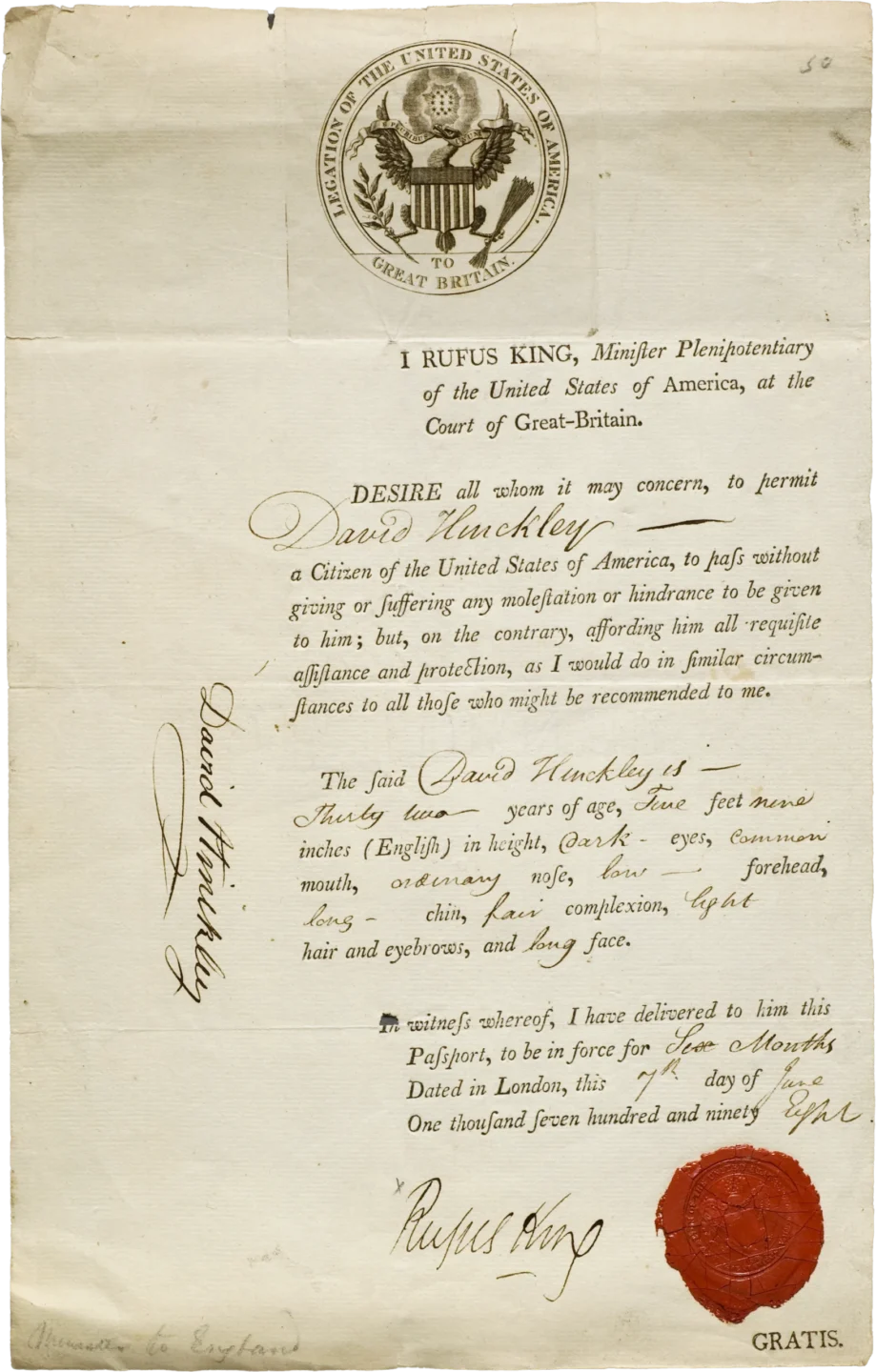
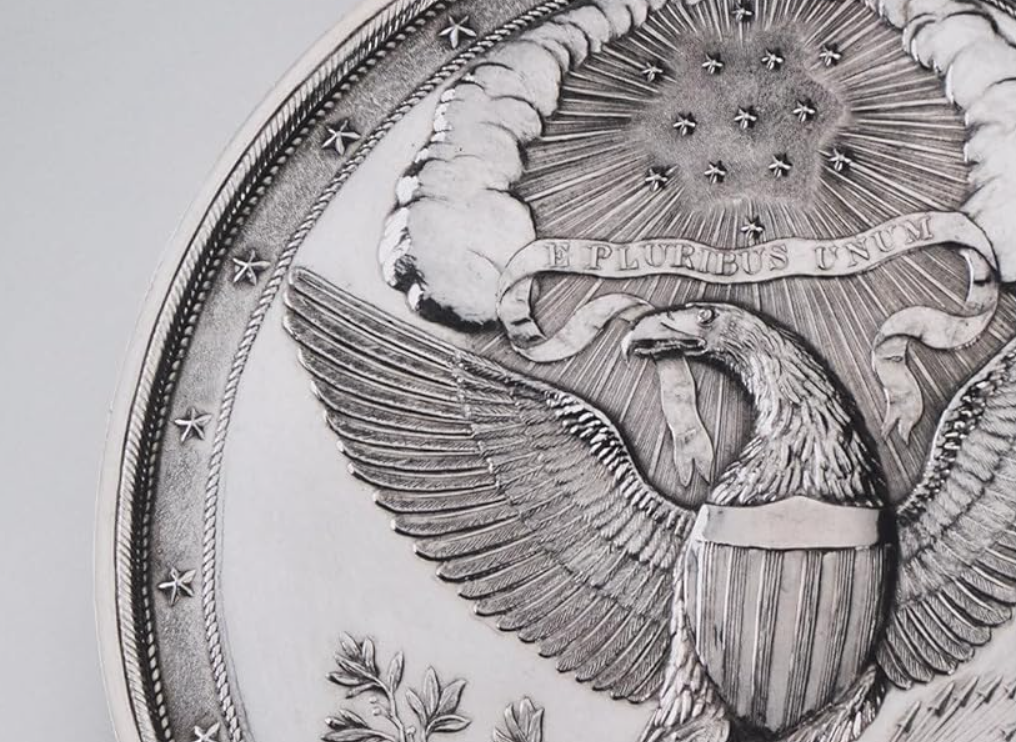
The museum reopens with a new exhibition, Among the Powers of the Earth , which runs through summer 2027 and showcases 30 objects from U.S. diplomatic missions since the country’s founding. Featured items include a smallsword worn by U.S. diplomats in the 18th century, the original signature page of the 1783 Treaty of Paris, which is on loan from the National Archives and Records Administration until early January 2027, and a copy of the Declaration of Independence, commissioned in 1823 in advance of the 50th anniversary of America’s founding.
Negotiated by Franklin, John Adams and John Jay, the Treaty of Paris ended the American Revolution and “codified the intention stated in the 1776 Declaration to place the United States equally ‘among the powers of the Earth,’” says Alison Mann, the museum’s historian and head curator. The 1823 copy of the Declaration of Independence was among those created from a copperplate engraving that President John Quincy Adams, the sixth U.S. president and a former secretary of state, commissioned to preserve the Founders’ words for future generations.
From left: A copy of the Declaration of Independence made from an 1823 engraving, a diplomat’s sword and the signature page of the Treaty of Paris. (National Museum of American Diplomacy)
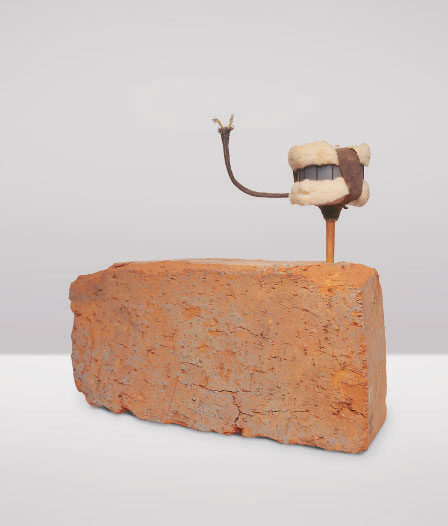
Bugged Brick from U.S. Embassy Moscow
Soviet Unionc. 1960
Throughout the Cold War, the United States and the Soviet Union engaged in espionage against one another in the hope of gathering information that could give them some sort of advantage in the relationship, or if a direct military confrontation ever occurred. Efforts to eavesdrop inside secure embassies, or on diplomatic personnel in general, were one such effort. This unusual looking device protruding from a brick is an electronic “bug”—essentially a microphone that could transmit conversations remotely. It was found in the U.S. Embassy in Moscow in the 1960s by Diplomatic Security personnel conducting a search for such devices. The narrow “stick” protruding from the electronics (the end with the wire) was a hollow tube that could covertly protrude through a very narrow hole drilled through a brick. The sound would travel through the hollow tube and into the electronics, which allowed them to be transmitted.
Source/Credit:Transfer from the Bureau of Diplomatic Security, Department of State
The exhibit’s online resources examine how the Founding Fathers’ carefully chosen words maximized the Declaration of Independence’s global influence, making it a model for the founding documents of other countries, including Ireland.
The museum’s interactive displays, public outreach and online resources offer insight into how diplomacy works. Online simulations featuring real-world scenarios, from nuclear nonproliferation to wildlife trafficking, allow students to see how, as Mann says, “Diplomacy makes the impossible seem possible.”
“No other museum brings diplomatic history to the forefront in its exhibits, and no other institution is solely dedicated to collecting items of American diplomacy and the stories of the men and women who practice diplomacy,” says Fischer.
The National Museum of American Diplomacy is open on Tuesdays and Thursdays. See here for details on the reopening and visitation.
Then-President James Monroe, seen in an 1819 portrait, rejected foreign interference in a landmark 1823 address to Congress, known as the Monroe Doctrine. (White House Historical Association/Samuel F.B. Morse, National Archives)
In 1817, when James Monroe was inaugurated as America’s fifth president, the United States was a young country finding its place in the world.
It had been a few decades since the signing of the Declaration of Independence, yet European powers still held lands in the Western Hemisphere. Spain was fighting to retain control of Mexico, which won independence in 1821. And during the War of 1812, the British occupied Washington and burned the White House.
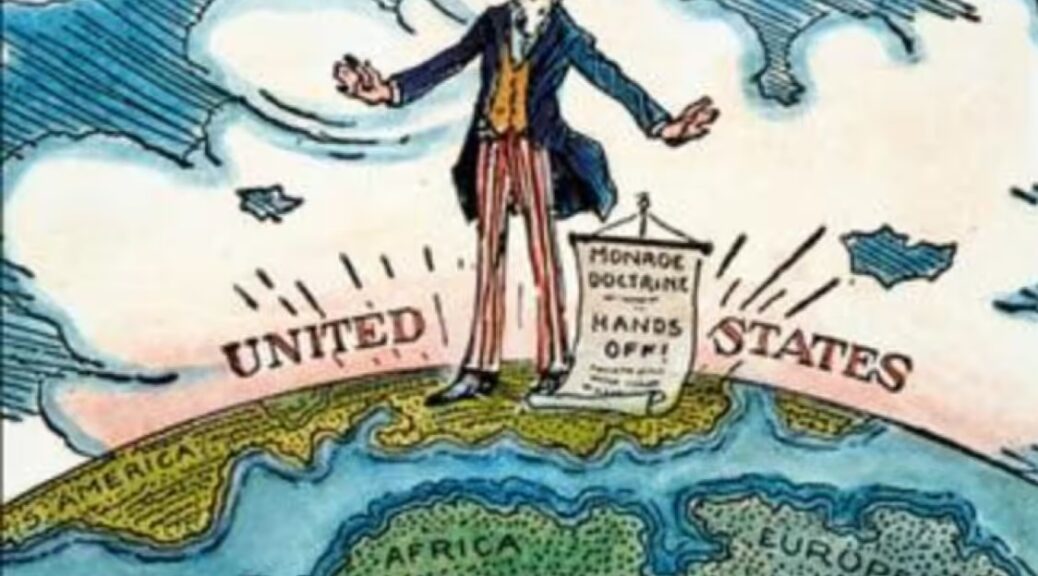
In a December 2, 1823, address to Congress, President Monroe rejected foreign interference in the Western Hemisphere and asserted U.S. leadership in the region. “The American continents, by the free and independent condition which they have assumed and maintain, are henceforth not to be considered as subjects for future colonization by any European powers,” he said.
As America celebrates its 250th anniversary, the Monroe Doctrine stands as a milestone of U.S. sovereignty. Crafted with then-Secretary of State John Quincy Adams, the policy called for separate spheres of influence for the Americas and Europe, and opposed European colonization and interference in the Western Hemisphere.
Echoes of the founding
The Monroe Doctrine served “as a way to build the consciousness of America as independent” and promoted a “sense of nationhood and citizenship and common purpose,” says John Grant, a political science professor at Hillsdale College.
Grant notes the doctrine followed the U.S. defense of Washington during the War of 1812, which showed Britain, “you’re not going to reconquer us; that’s not going to happen.”
Alison Mann, a curator of the Department of State’s National Museum of American Diplomacy in Washington, says the Monroe Doctrine built on the earlier-President Thomas Jefferson’s efforts to assert U.S. economic power and avoid European entanglements. Monroe consulted Adams on whether the young nation could resist foreign influence, asking if a European power were to try to colonize the United States, could the country rebuff the attempt with economic and military might. Adams said yes.
For Grant, the Hillsdale professor, the doctrine asserts America’s founding principles in a changing world. Monroe and Adams — who after serving as secretary of state would succeed Monroe as president — were the last U.S. presidents to have participated in America’s founding.
Monroe crossed the Delaware River with George Washington on Christmas night 1776 for an ambush that turned the tide of the Revolutionary War.
Adams served as an aide to his father, John Adams, during negotiations for the Treaty of Paris, which ended the war and secured U.S. independence.
As Americans honor the 250th birthday of the United States in 2026, people around the world are joining them in marking the occasion. Other countries are commemorating America’s founding in a variety of ways, from minting coins and planting trees to flying over U.S. cities.
Kaci McEwan’s tribute is a red, white and blue tartan made with threads signifying early milestones in American history. “For me, the tartan was about telling a story,” said McEwan of Scotland’s Heriot-Watt University’s School of Textiles and Design. “Every thread and colour represents a moment in the journey towards the Declaration of Independence.”
Her Old Glory-themed take on the traditional Scottish pattern has been selected to serve as a symbol of the close cultural ties between the United States and Scotland. McEwan will deliver the tartan to Washington on July 4, Independence Day.
Here are a few more ways other countries are honoring America’s 250th birthday.
At the time of King Charles III and Queen Camilla’s visit to the White House in April, the United Kingdom’s Royal Mint issued a commemorative coin in honor of America’s 250th anniversary celebration. The large decorative coin features King Charles III on one side and America’s national bird, the bald eagle, on the other.
“Every detail tells a story of independence, partnership and the values that continue to unite our two nations,” the British Embassy in Washington said in April, when U.K. Ambassador to the United States Christian Turner delivered the coin to the White House.
Japan gifted the United States 250 new cherry blossom trees for the anniversary. The trees will replace aging ones dating to Japan’s original 1912 gift of 3,020 cherry blossom trees. The blossoms draw 1.5 million people a year to Washington for the National Cherry Blossom Festival, a springtime tradition that honors the friendship between the United States and Japan.
The United States has sent dogwood trees to Japan in return, establishing a unique diplomatic tradition. President Trump has praised the cherry blossom trees as a “living symbol of the cherished friendships” between our two nations.
The Spanish Royal Mint has issued three limited-edition coins paying tribute to early ties between the United States and Spain. The coins honor Spanish-born Jordi Farragut, who fought alongside the Continental Army in the American Revolution, as well as Spain’s King Charles III, who supported America’s fight for independence from Britain. The third coin recognizes an early U.S. coin modeled after Spanish currency.
The French Air and Space Force’s aerobatic flight team, the Patrouille de France, is commemorating France’s support for the American Revolution with a monthlong tour of flyovers of major East Coast sites, culminating July 4. Dubbed Liberté 250, the mission features aircraft painted red, white and blue in honor of the American and French flags and bearing the names of U.S. Founding Fathers Benjamin Franklin and George Washington.
French pilots will fly alongside American counterparts with the U.S. Navy’s Blue Angels and the U.S. Air Force’s Thunderbirds.
The Italian Navy’s Amerigo Vespucci, a tall sailing ship named for the 16th-century explorer who became a namesake for the United States of America, will visit New York City July 4. The Vespucci will participate in Sail4th 250 , a parade of ships from 20 countries, including Argentina, Germany, the Netherlands and Peru, making it the largest international maritime gathering in modern American history.
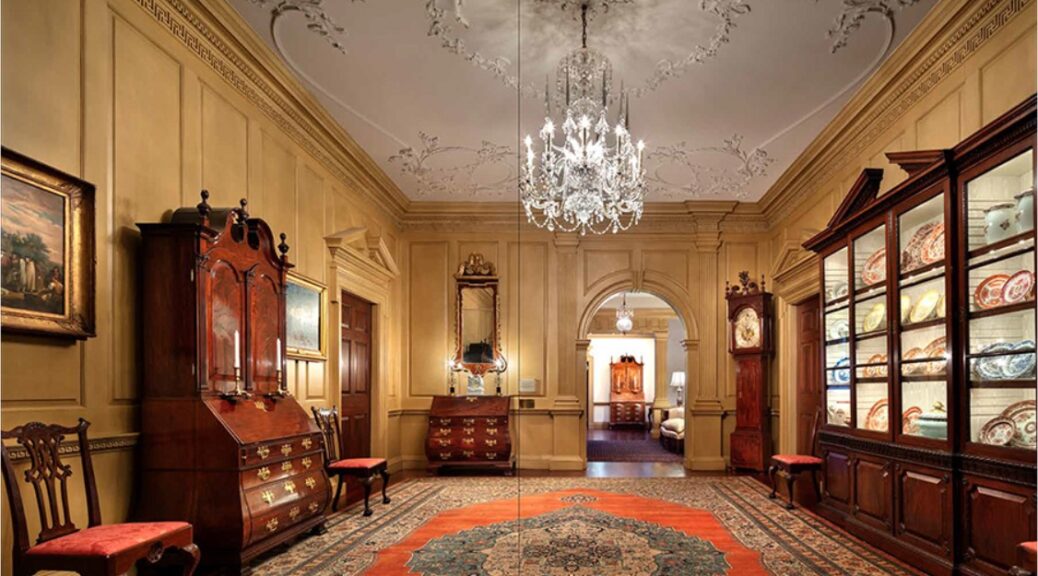
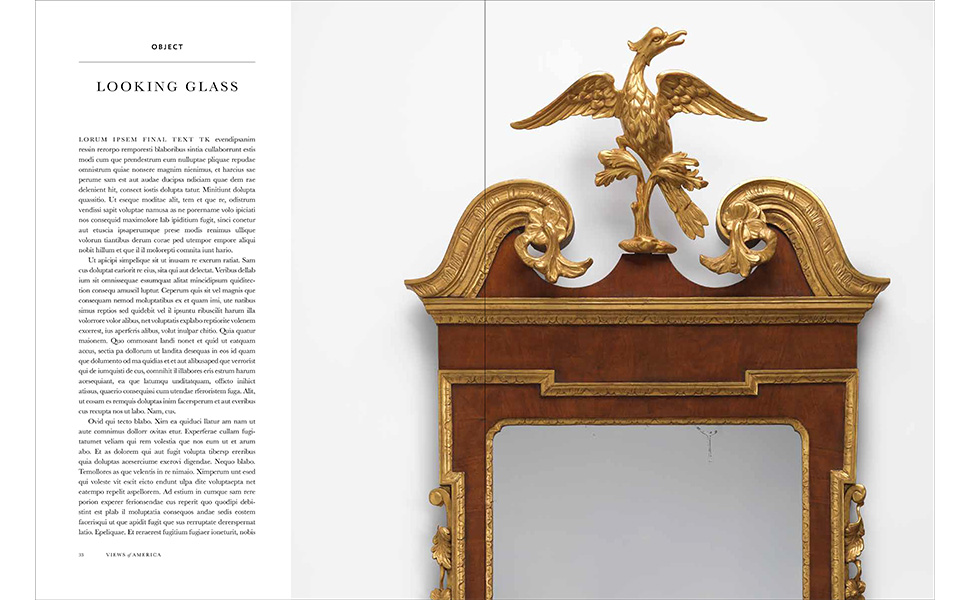
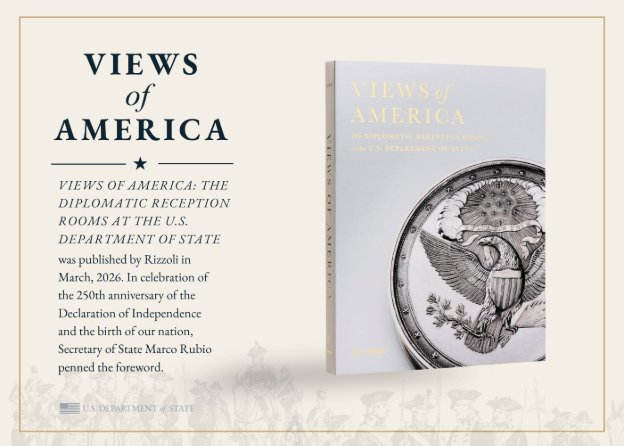
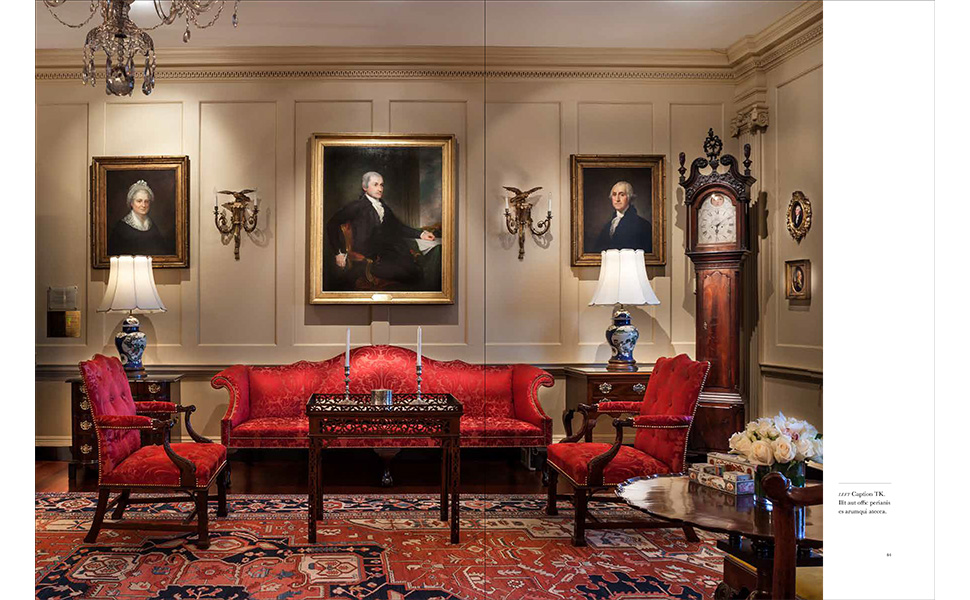
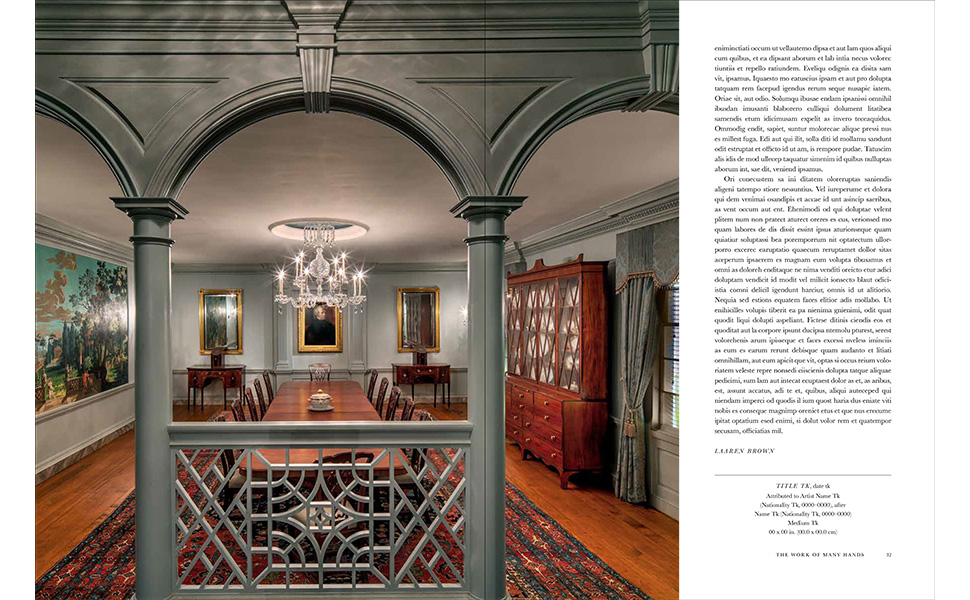
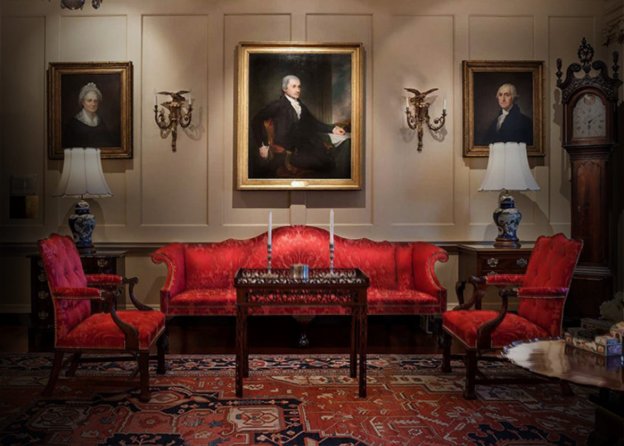
Back on March 31, 2026, Rizzoli released Views of America: The Diplomatic Reception Rooms at the U.S. Department of State, a richly illustrated volume celebrating the fine and decorative arts housed in 42 rooms at the Harry S. Truman building in Washington D.C. These rooms, which are open to the public, are home to a significant yet little-known cultural collection.
Many of the objects in the Diplomatic Reception Rooms were created, owned, and used by the men and women who dreamed of self-government and who made independence a reality. The collection reflects the pride, craftsmanship, and spirit of 18th- and early 19th-century America.
Remarkably, the Rooms and their collection were constructed, amassed, and continue to be maintained exclusively through the private gifts of philanthropic and patriotic individuals. Collectively, they are a testimony to the civic engagement and generosity of the American people and to their desire to advance American diplomacy.
In celebration of the 250th anniversary of the Declaration of Independence and the birth of the nation, Secretary of State Marco Rubio penned the following foreword to Views of America:
Perhaps the greatest architectural symbol of American diplomatic hospitality is named in honor not of a Secretary of State or President but of one of our first diplomats. At first glance, the monumental Benjamin Franklin State Dining Room – with its gold-topped neoclassical columns, expansive and sumptuous carpets in the style of the finest 18th century British country estates, and magnificent views of our capital city – might seem at odds with the homespun reputation of the father of American diplomacy.
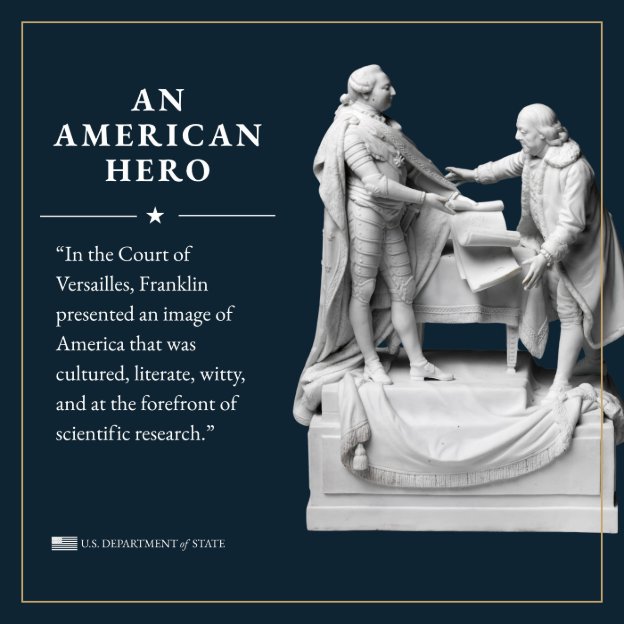
This porcelain group depicts Louis XVI of France in courtly martial costume, united with the American cause for independence, represented by Benjamin Franklin, plainly clothed and gesturing humbly.
But on reflection, besides being an appropriate tribute to an American hero, the room reflects the uniquely American perspective on diplomacy that developed even from Franklin’s vital diplomatic mission during the Revolutionary War, when he set sail for France in the months following our Declaration of Independence two hundred and fifty years ago.
In the Court of Versailles, Franklin presented an image of America that was cultured, literate, witty, and at the forefront of scientific research in its leisurely mid-eighteenth-century mode. At the same time, by intentionally setting aside the fashionable clothes he had worn in his earlier 1767 visit in favor of a more frontier-like demeanor, with a homely brown suit, spectacles and (famously) a large fur hat, he symbolized a new democratic polity. Franklin intrigued his audience in the court of Louis XVI through this synthesis of Old World charm with the virtues of the New World to create an American original.
Perhaps, Franklin was making the most of things in his own canny way. One suspects that he did not usually wear the rustic fur cap with which he charmed the Parisian salons when he was out and about on the streets of Philadelphia. But the contrast of these two missions to France, the rejection of a mere imitation and an embrace of the power of an authentic American perspective, reflects a deeper truth about the wellsprings of American diplomacy.
In the courts of the European powers, American diplomats faced key disadvantages. In the social milieu of diplomacy, rank, seniority, and access depended in part upon the personal rank of diplomats within the aristocratic hierarchies of Europe. Emissaries representing monarchs attained diplomatic privileges that those representing republics did not. The United States, a republic headed by a lowly citizen, ranked lower in diplomatic etiquette than the smallest European monarchy until well into the 19th century.
Many of the objects in the Diplomatic Reception Rooms were created, owned, and used by revolutionary Americans.
The United States did not have many diplomats from families found in the Almanach de Gotha or Debrett’s Peerage. So, what could this young country hang its diplomacy on? The answer that began to emerge, even in the waning days of colonial rule, was an emphasis on classical inheritance and excellence in all that we did.
The Founding Fathers and their generation did not believe themselves to be colonial subjects of one far-flung outpost of the British Empire. Rather, they understood themselves to be inheritors of a great tradition, the descendants (through a British common law branch) of Christian Europe and of classical Greco-Roman civilization. The foundations of statesmanship they learned in Plutarch, Cicero, and Aristotle were more ancient and prestigious than any European noble house, and they taught the virtue and dignity of republican government for the common good of a free citizenry. This classical tradition (as renewed and reclaimed in the work of Montesquieu, Locke, and others) gave the early leaders of our country confidence and pride in the American experiment in self-government, one that sustained them in the face of European condescension and disregard.
And one lesson, clearly conveyed in the Roman histories which our Founders knew intimately from their schoolboy days, was the central importance of virtue and merit to the long-term success of a republic. As Thomas Jefferson and John Adams agreed in their post-presidential correspondence, the United States needed to be led by a “natural aristocracy” consisting not of inherited wealth or privileged birth but of those who had been endowed by their Creator with the “virtue and talents” necessary for good government and successful enterprise. Meritocracy was, for our Founders, a vital ingredient in the “long and perilous contest for our liberty and independence,” an advantage against European states still hidebound by hereditary class and monarchical privilege.
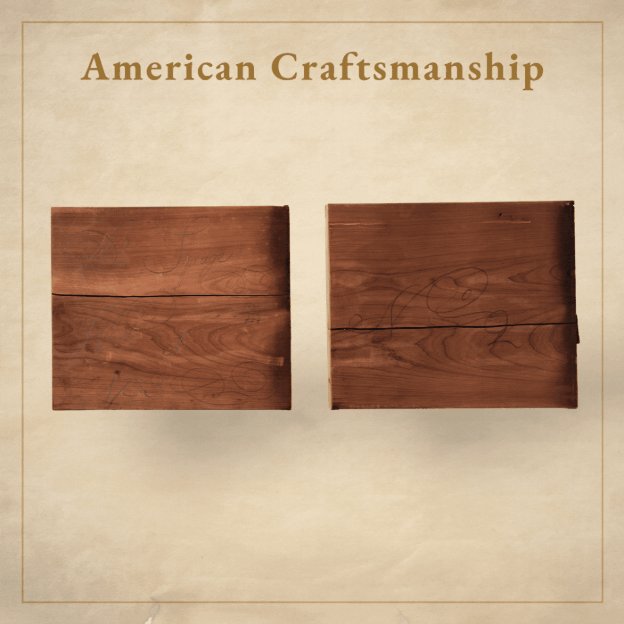
This commitment to excellence without ostentation, rooted in our classical Western inheritance, defined American diplomacy, extending to the architecture and decorative arts of the places in which it was practiced. In this respect, the Diplomatic Reception Rooms are an outstanding symbol of the heart of a uniquely American diplomacy. In interiors crafted by classical architects inspired by the 1960s Americana revival, these 42 rooms pull together a unique collection of furniture, art, and artifacts generously provided by the American people through private donations to reflect the best of our traditions of craft and art.
This desk and bookcase was made by Benjamin Frothingham in 1753 when he was 20 years old. It is the first documented piece of bombé-shaped furniture made in America.
The excellence and craft that suffuses these rooms speaks to the dignity and worth of the American worker, and the ability of the United States to cultivate the best talent in the world. On July 4th, 1821, our 8th Secretary of State (and later president) John Quincy Adams gave a speech reflecting on what the young country had already contributed to the world in not yet half a century. While focusing on the glories of American liberty, Adams also extolled the industry, invention, and skill of America’s great craftsmen, artists, and entrepreneurs.
In a humbling way, the beauty of these objects contains a bitter lesson about the Americans we at the State Department are privileged to represent. At some point between the early years of the Republic (represented artistically and architecturally in the Diplomatic Reception Rooms) and the present, America’s foreign policy leaders lost sight of the everyday Americans they were called to represent. As we see throughout the Secretary of State’s office suite and the Diplomatic Reception Rooms, the Western tradition and a commitment to excellence are married in the very objects of our diplomatic practices. But the important industries that sustain that harmony have been destroyed by reckless policies. In the ten years after the U.S. lowered tariff barriers and agreed to let China join the WTO in 1999, more than half of the furniture makers in North Carolina lost their jobs. The halls of the State Department are still filled with furniture made in America, but today too few homes in this country or around the world can say the same.
As we celebrate the two hundred and fiftieth anniversary of the Declaration of Independence and the birth of our nation, let us rededicate ourselves to a foreign policy for the common good of the American people. Inspired by the art and architecture of the Diplomatic Reception Rooms, let us restore a diplomacy rooted in the Western inheritance and the cultivation of virtue. The essays and artwork of this volume are a noble tribute to our fine tradition of uniquely American diplomacy, and a fitting inspiration for the work remaining to us, to ensure a bright future for the next two hundred and fifty years of this great nation.