Frank Lloyd Wright Homes Were Designed For Michigan Pharma Scientists

In the late 1940s, the Upjohn Pharmaceutical Company was the largest employer in Kalamazoo, Michigan with a company emphasis on family and quality of life. It was a national leader in providing benefits to its employees including group life insurance and shorter work weeks. Also in the 1940s, Frank Lloyd Wright was the most famous architect in the world and was devoting much of his time to his Usonian homes for the middle class. About 60 of the Usonian homes were built between 1936 and his death in 1959.

Frank Lloyd Wright Scientist Home Exterior

In 1949, a group of twelve scientists from Upjohn sought out Wright to design a community of homes. With simplicity, form and function in mind, Wright’s Usonian designs met their criteria. They wanted houses that they could build themselves or with limited help and chose a 70-acre parcel of open and wooded land with a three-acre pond in Galesburg, Michigan. They originally named it Galesburg County Homes Acres but later shortened it to The Acres.  Each scientist wrote a letter to Wright requesting his help to design the project. The Acres plat outline consisted of 22 homes on one acre each with 50 acres left natural for the enjoyment of the residents.

The Acres’ homes were Wright’s first foray into organic ranch-style architecture. They were affordable but tailor-made to the individual client’s needs – practical, functional and blended in with their surroundings. They were organic in that they appeared to come “out of the ground and into the light” as Wright was fond of saying. Access to nature, both physically from every room in the house and visually from inside the home interiors, played a major role in defining Usonian style. Homes were built with natural materials, walls of glass for winter passive solar collection, radiant-heated floors, flat roof lines with overhangs, carports and built-in furniture.
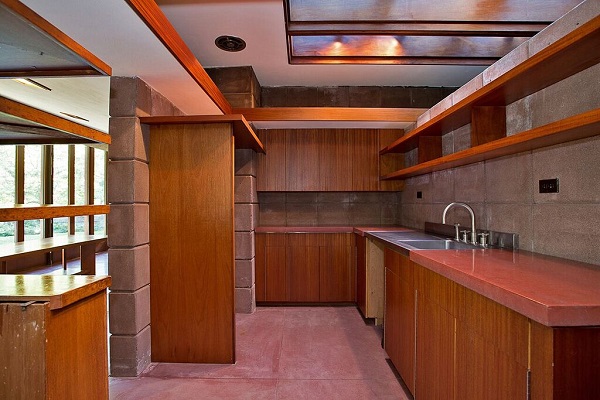
Frank Lloyd Wright Scientist Home Interior 3

Although the project had many supporters at Upjohn, it was a bit of a drive from Kalamazoo before Interstate 94 was built and perhaps too unusual for midwestern tastes. Only four Wright homes were ever built at The Acres.

Frank Lloyd Wright Scientist Home Interior 2Samuel Eppstein was a research scientist and Dorothy a researcher at the Upjohn labs. They had only been married six months when they commissioned their new home and construction was completed in 1953. The 2,250-square-foot Usonian includes three bedrooms, two baths, two fireplaces, and a general purpose room used as an additional living room. Though the kitchen has been rebuilt by a local craftsman in the Wright style, the home has all of Wright’s built-ins including two tables that were reconstructed to exact specifications. Ten-foot walls of glass are positioned to capture idyllic views of valley and meadows. There is also a swimming pool that was added in later years.

Rare opportunity to own a Wright Usonian in a 70-acre, fully Wright-designed community kept completely intact since its inception. Asking $455,000 usd, it is the lowest priced Wright home currently on the market. The listing agent is Fred Taber of Jaqua Realtors in Kalamazoo, Michigan. For the Silo, Terry Walsh.

Visit TopTenRealEstateDeals.com for more famous, spectacular and celebrity homes and real estate news.

Click me! Music for Scientists and their friends!

University Of Maryland Will Investigate AI Limitations Via Army Research Grant

COLLEGE PARK, MD: University of Maryland College of Information Studies (UMD iSchool) researchers, led by principal investigator Dr. Susannah Paletz, have been awarded a three-year $616,700 usd grant funded by the Army Research Office (ARO), overseen by ARO Program Manager Dr. Edward Palazzolo. This project examines how teams of intelligence analysts can work together and with artificial intelligence (AI). AI has the potential to support intelligence analysts in reviewing potentially hundreds of thousands of source documents, pulling out key findings, and assembling them into actionable intelligence. AI can also aid in the flow of information and projects among members of the intelligence team, improving the efficiency and accuracy of their work.

“AI-driven technology has sometimes been touted as a replacement for human intelligence,” said Dr. Adam Porter, the project’s co-principal investigator, professor at the UMD Department of Computer Science, and Executive and Scientific Director of the Fraunhofer USA Center for Experimental Software Engineering (CESE). “In practice, however, AI doesn’t always work, or gives limited or biased answers. Human oversight is still required, and it’s therefore critical that we deeply understand how humans and AI can work best together.”

The Human-Agent Teaming on Intelligence Tasks project coordinated through the iSchool will focus on two particular research areas; 1.) how interactive AI agents, such as chatbots, have the ability to mitigate or exacerbate the communication and coordination problems that can occur with shift handovers of intelligence work, such as inaccuracy blindness and overlooking potentially relevant information, and 2.) examining how humans could potentially deal with these blind spots, biases, or inaccuracies. 

The research team plans to develop an experimental infrastructure to help test team cognition challenges within the work completed by intelligence analysts consisting of task-relevant input materials, such as mission descriptions and source documents, activity recording tools, experimental monitoring capabilities, and different AI supports for human analysts, such as chatbots offering advice on a particular task. 

“We want to develop a task that can raise the problems with asynchronous team cognition in intelligence tasks, but is simple enough to be used by research participants with minimal training,” said Dr. Susannah B.F. Paletz, research professor at the UMD iSchool, and affiliate at the UMD Applied Research Laboratory for Intelligence and Security (ARLIS). 

Susannah Paletz
Dr. Susannah B.F. Palletz


This task will substantially increase insight into the strengths and weaknesses of AI technology to support intelligence tasks, help shed light on how and when human analysts can safely place their trust in AI technology, and how they can proactively identify problems in AI-generated input. It will also aid teams of humans, including asynchronous teams, working together in situations that include AI-generated input.

“This basic research is an important step in the early process of learning how humans and agents can collaboratively become a single team with considerably greater capacity and productivity than human only teams,” Palazzolo said. “Moreover, this research has broad implications into the work of many teams focused on knowledge work and information management such as medical teams involved in shift work, collaborative software development teams, and research teams.”

In addition to Porter, the Fraunhofer USA team also includes Dr. Madeline Diep, Senior Scientist, and Jeronimo Cox, Software Developer, at Fraunhofer USA CESE. The Fraunhofer USA team will lead the effort to create configurable AI agents used in the experimental tasks, and a data collection and analysis infrastructure for capturing and understanding participant behaviors.

The UMD iSchool team includes graduate students Tammie Nelson, a fourth year PhD student, Melissa Carraway, incoming first year PhD student, and Sarah Valhkamp, incoming first year PhD, in Information Science.

The grant proposal team includes UMD Office of Research Administration Contract Manager, Stephanie Swann; iSchool Business Manager, Jacqueline Armstrong; and former iSchool Business Manager, Lisa Geraghty.

Outside of UMD, Dr. Aimee Kane, the Harry W. Witt Faculty Fellow and an Associate Professor of Management in the Palumbo-Donahue School of Business at Duquesne University, will be a consultant and an intellectual contributor on this project.

ARO is an element of the U.S. Army Combat Capabilities Development Command’s (CCDC) Army Research Laboratory. The Human-Agent Teaming on Intelligence Tasks project (grant no. W911NF-20-1-0214) is slated to run through June 30, 2023. For the Silo, Mia Hinckle.

DTCare Reports Monumental Cleanup Task Following Deadly Beirut Explosion

August, 2020 (Beirut, Lebanon) – Two weeks after a devastating blast in Beirut’s port area that killed close to 200 people and injured thousands more, cleanup efforts are still underway. According to locals on the ground working with American NGO, DTCare, they’ve barely scratched the surface of the monumental task of cleanup, and are now facing the looming threat of a COVID-19 shutdown. 

The DTCare Lebanon ground team, in coordination with their United States office, was among the first American NGO on the scene following the deadly explosion on August 4th. The organization had been in Lebanon developing an NGO to help Syrian refugees, and because of their close proximity, they were some of the first responders to the scene, able to mobilize and provide aid to the people of Beirut the same night of the blast.  

The DTCare team on the ground coordinated with the Municipality before the start of the cleanup mission and were allocated a specific landfill just 8 Kilometers away from the cleaning locations. Over the course of seven days, the DTCare team has cleared 200 tons of debris a day (1,000 tons) from the narrow streets of Beirut, a challenge considering the near-constant traffic paralyzing the mobility and speed necessary for machinery and volunteers.  

The blast destroyed a major grain silo, which is critical considering Lebanon imports a majority of their wheat. To help cope with the food scarcity, the DTCare team is distributing 10 rations, daily, to families affected by the blast. Currently, they have been able to distribute 55 food rations, with each ration capable of feeding a family of four for a period of three months. Items included in the DTCare ration box include rice, flour, sugar, salt, tuna, oil, mushrooms, beans, chickpeas, and local grains other than wheat.

For the mission, DTCare partnered with the Contingency Operations Group (COG), which has been set up as a special purpose vehicle for any and all matters with US Corporations represented in Lebanon, helping facilitate all of their business interests in the region. Being the first US organization to jump to the rescue of Lebanon in this time of crisis by sending funds, products and support related to the relief effort, DTCare gained COG’s trust, attention and priority. Their independent status has allowed them to be successful in their efforts, as they remain free of ties to specific religious or political affiliations. 

COG team members have served and supported the US troops who were deployed in Afghanistan and Iraq under the Operation Enduring Freedom (OEF) from 2001 and through the extent of Operation Iraqi Freedom (OIF) 2003 to 2010. DTCare’s management team is very well versed in US defense contracting and State Department operations in the region, following all policies, procedures, regulations and, most importantly, transparency and compliance.

Although the operation is a small dent in the overall relief effort, the DTCare team has been incredibly effective and efficient in their mission, and will remain engaged for the duration of the cleanup effort. Currently, the team is racing to do as much as possibly before the rainy season arrives in October. DTCare predicts the cleanup effort to last between 3 to 5 months in total, weather permitting. For the Silo, Lainya Magaña.

British MPs Say Government Too Slow To Help These At Risk Arts

A friend of mine from Europe sent me this news story a couple of weeks ago about how the cultural landscape is facing its biggest threat in a generation.

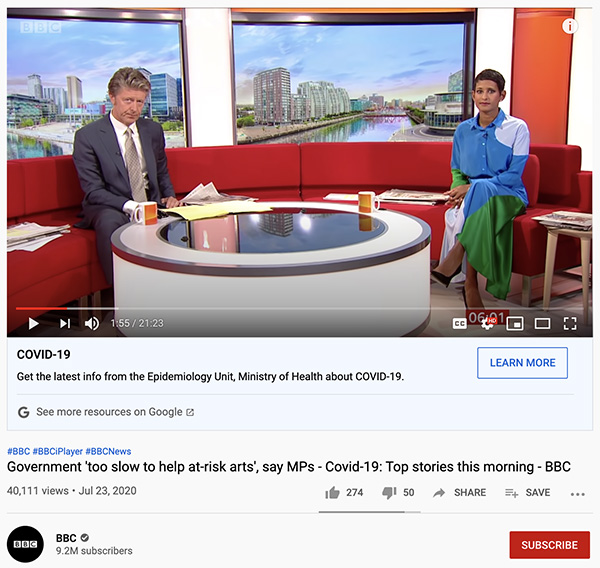
It says the UK government was too slow to provide support for the arts industry, and that without more help, many parts of Britain could become “cultural wastelands”:

https://youtu.be/pPw8na16nuk

This should be a crude wake-up call for artists.

Realistically, governments around the world will NOT make it a priority to save art businesses. Why? Because governments care most about issues that will get them votes. 

And, sadly, most of the public simply does not care about the arts the way artists do.

Want proof?

Check out the comments on that BBC video:

Then if you go down the rabbit hole and dig deep into the replies to these comments, you find a lot of artists desperately trying to show these people that the arts, and theatres, and galleries are very much “essential” to artists who rely on them to provide for their families:

The take-home lesson here?

Artists are on our own. 

It’s unrealistic – unwise, even – to wait for the government to swoop in and rescue the arts industry.

In times like these individual initiative is more important than ever. 

Artists must redouble their efforts to connect with curators, build a list of collectors, find patrons for their studio, maybe even transition to showing (and selling) some work online.

It is difficult, but it is not impossible. For the Silo, Brainard Carey.

Featured image- www.theatlantic.com

Astrophysicist Wins Millions Of Dollars For Blackhole And Quasar Study

Schmidt Futures Grants Lehman Astrophysicist $2.94 Million USD For Study of Quasars, Black Holes

BRONX, N.Y. – (August , 2020) – A Lehman College astrophysicist has been awarded a $2.94 million grant by Schmidt Futures, for a five-year study about the structure and evolution of the universe, black holes, quasars and dark energy.

Where have all the quasars gone?

Schmidt Futures is a philanthropic initiative, founded by Eric and Wendy Schmidt. Eric Schmidt is the former CEO of Google. The grant will award $1.8 million directly to Lehman College and the remainder as a subaward to the University of Montreal.

“This by far is the biggest project we’ve ever attempted,” said Matthew O’Dowd, an associate professor in the Physics and Astronomy Department and writer and host of PBS Space Time. “It’s quite ambitious…and will define the next five years of our scientific lives.”

O’Dowd will lead a team of researchers and students from Lehman, the Borough of Manhattan Community College (BMCC) and the University of Montreal as they study data collected from the Vera C. Rubin Observatory (previously referred to as the Large Synoptic Survey Telescope (LSST), currently under construction on Cerro Pachón in Chile. It is an 8-meter-class telescope coupled to a 3.2-gigapixel camera – the world’s largest digital camera ever fabricated for optical astronomy.

A photograph and rendering mix of the exterior of the Vera C. Rubin Observatory building on Cerro Pachón in Chile. Image credit: LSST/NSF/AURA

The observatory, the first in the U.S. to be named after a woman, will survey the entire sky of the Southern Hemisphere every three days for the next decade, O’Dowd said, and will map the dynamic nature of the universe. Each single snapshot will cover an area 40 times the size of the full moon.

O’Dowd’s team will develop a machine-learning pipeline (also known as artificial intelligence) for the observatory “to analyze the flickerings of thousands of distant quasars whose light in the very distant universe is powered by violent storms of matter falling into gigantic black holes,” he said.

Due to the enormous dataset and the non-linearity of the problem, machine learning methods are the only viable method for integrating these effects into a model and analyzing thousands of quasars in real time.

“I believe I have assembled the only people in the world who can do this before LSST begins operation, including some machine learning leaders who have just taken faculty jobs at the University of Montreal,” he said. “So that’s our plan: to develop new machine-learning techniques and build them into an analysis pipeline for (the observatory).”

“People are fascinated by these things and we hope to extend their curiosity about the wonders of the universe,” O’Dowd said.

Once the team begins work, O’Dowd will invite Lehman graduates, post-doctoral fellows and current Lehman undergraduates to participate in the project.

“This project is exciting and will help us attract excellent grad students and if it also helps influence other students to come to Lehman, then that’s fantastic,” he said.

“This is an excellent project that will push the limits of precision of measurement and very difficult computing to clarify important questions in cosmology and high-energy astrophysics,” said Stuart Feldman, chief scientist of Schmidt Futures. “We are delighted to support this path breaking work.”

“This is an incredibly prestigious award and we are incredibly proud of Matt,” said Dr. Pamela Mills, dean of the College’s School of Natural and Social Sciences. “He is very good at communicating science and is an amazing physicist. He is, and has been tapped, as one our young leaders.”

Philadelphia Artist Goes To Space With Augmented Reality Artwork Initiative

Hello Siloites (Siloers?) my name is David Bradford and I would like to share my art story with you, one involving augmented reality artwork that I have recently activated on the International Space Station and Mars as part of my Go Love Universally initiative. This is the first fine art activation of its kind in terms of distance (62,368,540 miles, to be exact) is aptly called Future. In case you were wondering, Yes there will be a Guiness World Record attempt based on this achievement. 

A picture containing outdoor, motorcycle, water, bicycle

Description automatically generated

A look to the stars. My next (virtual) canvas with new augmented reality fine art activation, titled, Go Love Universally.

This art initiative comes at a time in which much of the world is still under travel restrictions due to COVID-19 and was designed to include everyone around the planet and those orbiting, watching from above. Born out of exploring a way to express and distribute fine art to the public while using consumer technology, I started with using bus stops as fiducial markers (QR codes) in Philadelphia, New York City, San Francisco, and London.

When I was asked to initially introduce my augmented art initiative in the Philadelphia Weekly, I said that while I’ve been social distancing, I came up with a way to share positive messages with people using AR and recognizable visual triggers found easily around Philly.

It is a way for a mass amount of people to interact with their surroundings in a safe way that also creates positive feelings through the messages being communicated.

Within two weeks of launching Go Love Universally, I took my art initiative into space, bringing the art from Philadelphia to Mars. For curious consumers of this activation, all pieces can be viewed at select locations using the Artivive app, a free augmented reality fine art app available for iOS and Android.

Steve Morrison, co-host of Philadelphia morning show Preston & Steve (93.3 WMMR), said to me: “Hey, this is pretty cool!  What if the aliens in They Live just wanted to spread positive messages?  Well, you have a potential answer with this project.  Kudos to you, Sir!”

Go Love Universally is an ongoing project, as future collaborations with artists are to be announced.

Intelligence Operative- Iran Source Of Explosives Causing Beirut Nuke Like Destruction

Beirut / Tehran – The 2,750 metric tons of ammonium nitrate which caused a massive explosion in the port of Beirut originated in Iran before being loaded onto the Russian ship MV Rhosus whose cargo ultimately ended up being unloaded in the port of Beirut.

This revelation comes from an intelligence operative within Tehran’s government who has been secretly working with pro-democracy activists. The information comes from the NGO ‘The New Iran’ which has a track record of successfully smuggling sensitive information out of Iran, including much of the video footage seem in the media of widespread protests within Iran following the Iranian military shooting down Ukraine National Airlines flight PS752. 

Intelligence Operative Connected to Pro-Democracy Movement

The intelligence operative communicated the details over a secure messaging technology The New Iran uses for coordinating with their democratic allies within the country.  

Lebanese government sources have disclosed that the ammonium nitrate was seized in 2013. This date is perhaps significant the source says because it follows shortly after the opening of an ammonium nitrate factory within Iran.  

“Our source is risking his life to bring us this information,” says Dr. Iman Foroutan, Chairman of The New Iran, “because he believes that recent developments within the government are going to make these kinds of disasters more common.”

At the end of June, the government of Iran approved an agreement for a “25-year comprehensive cooperation plan between Iran and China.”

The two countries are calling it a “strategic partnership.”

The agreement is designed to help Iran get around the punishing sanctions of the United States, which more and more is being looked at as a common enemy by both Tehran and Beijing. China will be investing $400 billion USD into Iran with an immediate payment of $320 billion USD – a substantial portion of which is going into strengthening ports and military capability.  

“The Iranian regime is the world’s leading sponsor of terrorism,” says Dr. Foroutan who along with other influential Iranians in exile are working to fully expose the danger of Ayatollah Ali Khamenei’s radicalism and eventually free the Iranian people. “Now with the cover of China, one of the world’s rising superpowers, Iran will be able to move more weapons and weapons components throughout the region and the world.” 

Hezbollah leader Hassan Nasrallah has already twice threatened to blow up the port of Haifa in Israel. Hezbollah allegedly sought to acquire ammonium nitrate via Syria since 2009 and tried to infiltrate the agriculture ministry in Lebanon to do so, according to leaked diplomatic cables.  

In February 16, 2016 Nasrallah also said that ammonia is stored in Haifa and that there are 15,000 tons of gas Haifa and that explosions there might cause the deaths of tens of thousands of people. “the expert added that this is exactly like a nuclear bomb. In other words, Lebanon has a nuclear bomb. This is not an exaggeration.” Nasrallah laughs as he says this in the video. 

https://youtu.be/hp_Pdew_sG8

“With the agreement between China and Tehran allowing the regime to ship under the cover of China, potentially deadly materials like ammonia nitrate [may be] circumventing US sanctions,” says Iman Foroutan, “The next explosion may not be an accident.” For the Silo, Lance Laytner.

Discog’s Most Collected Album Releases Of July Include Canadian Neil Young

PORTLAND, OR. August, 2020:  Discogs, the world’s record store, today released its list of the Top 10 Most Popular Records released in July 2020.  

The following rankings — the 10 most popular albums overall and the 10 most popular albums by genre — are determined by how many people worldwide have added these items to their record collections on Discogs. Discogs’ abundant data is made available from the over 400 million items cataloged in the Collections of its 7.3 million users. On average, the Discogs Community is adding 7 million items to their Collections monthly and has passed 12.8 million releases in its open-source user-driven Database.

View the complete list of the Top 10 Most Collected Records by genre

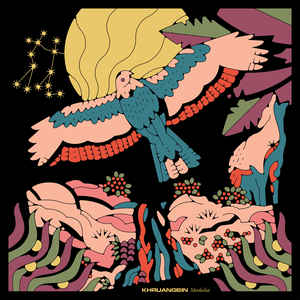
1 Khruangbin ‎– Mordechai | 4,528

Mordechai album cover

2 Bob Dylan ‎– Rough And Rowdy Ways | 3,673

Rough And Rowdy Ways album cover

3 Fiona Apple ‎– Fetch The Bolt Cutters | 3,538

Fetch The Bolt Cutters album cover

4 Phoebe Bridgers ‎– Punisher | 2,376

Punisher album cover

5 Neil Young ‎– Homegrown | 2,099

Homegrown album cover

6 Lady Gaga ‎– Chromatica | 1,844

Chromatica album cover

7 The Rolling Stones ‎– Living In A Ghost Town | 1,792

Living In A Ghost Town album cover

8 Paul Weller ‎– On Sunset | 1,625

On Sunset album cover

9 Haim ‎– Women In Music Pt. III | 1,323

Women In Music Pt. III album cover

10 Dance Gavin Dance ‎– Afterburner | 1,319

Afterburner album cover