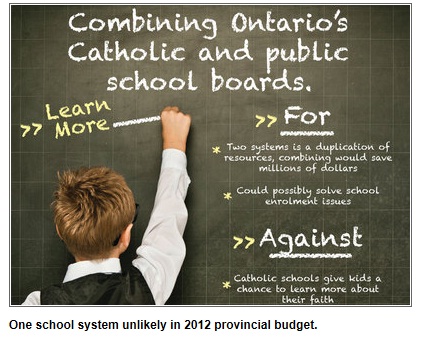
Though some provinces provide a variation of funding to independent, religious schools, Ontario is the only province to exclusively fund a Catholic school system for its students.
“Ontario’s financial future is at risk, and Premier McGuinty lacks the will to make the hard, long-term decisions we need,” says GPO Finance critic Kevin O’Donnell. “He’s already passed over obvious, big ticket savings. In contrast, our budget priorities don’t shy away from the realities facing Ontarians.”
The GPO believes eliminating the deficit requires challenging the status quo in the province’s biggest budget categories: education, energy, health care, and bringing our tax system into the 21st century. ONE SCHOOL SYSTEM: The GPO believes there is a better solution than laying off thousands of critical classroom aids and blocking students who need a fifth year to get help. The Liberal government should do the obvious — eliminate massive and costly duplication by merging the best of the Catholic and public school systems into a one French/English public system. The result benefits everyone –a high quality, financially responsible, and equitable education system.
STOP BORROWING BILLIONS TO SUBSIDIZE WASTEFUL ENERGY CONSUMPTION: Ontario cannot afford to borrow $1.2 billion to subsidize pollution and electricity bills with the misleadingly named ‘Clean Energy Benefit’. Instead, we should help lower-income families with the rising cost of living by raising the Ontario Child Benefit as planned at a much lower cost of $90 million. It makes more sense to help businesses and households save money by increasing energy efficiency — a strategy that’s cheaper, stimulates job creation and ultimately boosts government revenue. The government must not cave in to the NDP/Conservative HST Coalition that would borrow more money to subsidize pollution.
INVEST IN ILLNESS PREVENTION: Ontario’s current “sick care” system focused predominantly on hospital treatment is unsustainable. We need to invest more in illness prevention within home and community care settings. This budget must commit at least .5% of healthcare spending to prevention, raise taxes on cigarettes and commit 2% of the transportation budget to infrastructure for human powered mobility — serving both our community health and environmental objectives.
EFFICIENT AND FAIR TAX REFORM: The GPO calls for the elimination of unsustainable corporate tax cuts and a commitment to forming a public commission on the reform and modernization of Ontario’s tax system. We support a tax system that generates the funds necessary for required public services while creating jobs that enrich our natural wealth and our communities.
“It’s time for politicians to stop punting problems to our kids,” says GPO leader Mike Schreiner. “Now is the time to put politics aside and tackle head on these big ticket items in order to balance the books efficiently and fairly.”
CONTACT: Jaymini Bhikha Cell: 416-275-8573 Office: 416-977-7476 jbhikha@gpo.ca
Green Party of Ontario PO Box 1132 Toronto, ON M4Y 2T8 Canada
TORONTO: Green Party of Ontario (GPO) leader Mike Schreiner is calling on MPPs to vote against Tim Hudak’s bill to nuke the province’s long-term, green energy strategy.
“Mr. Hudak’s willingness to sacrifice homegrown green jobs in a politically expedient attempt to exploit fears over rising energy prices is just bad economics,” says Schreiner. “I want him to look farmers and small business owners in the eye and explain how he wants to kill their businesses and their chance to earn income producing pollution-free electricity.”
Mr. Hudak’s Bill 42 [this Bill was defeated on second readinghttp://www.ontla.on.ca/web/bills/bills_detail.do?locale=en&Intranet&BillID=2587 CP ] , being considered in the legislature today [ March 22nd CP ] , would abolish the Feed-In Tariff (FIT) program. The FIT program provides stable fixed-rate, long-term contracts to green energy producers.
“Let’s not kill the FIT program, but fix it so that it better benefits communities,” says Schreiner. “The GPO will continue to push for a community-based green energy program with local ownership, decision-making and benefits.”
Although Conservatives claim that green energy is causing prices to rise, the reality is this — most cost increases are due to infrastructure upgrades and nuclear cost overruns. The Liberal and Conservative support for new nuclear will drive up costs far more than FIT contracts for green energy.
“The establishment parties are completely out of touch with the true causes of rising electricity prices,” says Schreiner. “Energy efficiency, combined heat and power, hydro imports from Quebec, and a diverse mix of other renewables provide our most flexible, low cost options.”
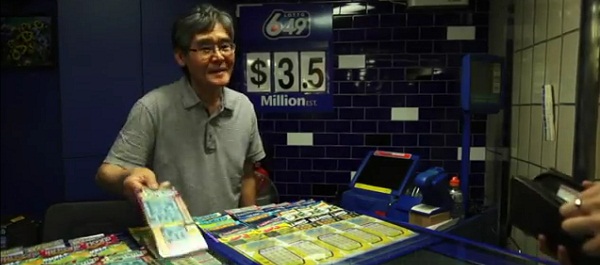
The Ontario Lottery and Gaming Corporation (OLG) developed a powerful analytic tool to provide instant access to billions of lottery transactions dating back to 1999. Dubbed the Data Analytic and Retrieval Technology (DART), OLG developed the solution in six months for about CAN$1.1 million (U.S.$1.15 million) with Microsoft and HP supporting technologies—a sharp contrast to the three-to-five years and more than $10 million needed with other BI solutions evaluated by OLG. Searches that used to take weeks can now be done in seconds. With the DART tool, OLG can identify play patterns to confirm legitimate winners and identify potentially fraudulent behavior and claims. DART builds on other OLG antifraud and player protection initiatives, delivering on the organization's pledge to better inform and protect those who play its games and lotteries.
OLG to Modernize Gaming- New Strategic Direction Will Create Jobs, Support Schools and Hospitals The Ontario government has received a report from the Ontario Lottery and Gaming Corporation (OLG) that proposes modernization of the system, an increase in its revenues by more than $1 billion a year, and the creation of 2,300 net new jobs in the gaming industry and nearly 4,000 additional jobs in the hospitality and retail sectors by 2017-18.
With internet-based gaming growing, a higher Canadian dollar and U.S. border communities building their own gaming sites, our gaming system has to change. These reforms will modernize gaming in Ontario by allowing safe, responsible access to gaming opportunities.
The government has directed the OLG to implement a number of the proposals:
Reconfigure the number of gaming sites and tailor the types of gaming activities made available at each site
Launch multi-lane sales of lottery tickets at major retail outlets, including grocery stores
Increase operational efficiencies by expanding the role of the private sector
Stop annual payments to the horse racing industry by ending the Slots at Racetracks program on March 31, 2013, and allowing slot facilities to be located more strategically
Implement a new fee model for municipalities hosting gaming sites; and
Allow one new casino in the GTA, subject to an OLG business case and municipal approval.
These initiatives will allow OLG to meet the demands of a changing gaming marketplace.
QUOTES
“We are focused, more than ever, on balancing the budget while continuing to provide the best education and health care in the world. Modernizing OLG’s operations and business model is an example of how we are ensuring our assets are delivering the greatest value to taxpayers.”
– Dwight Duncan, Minister of Finance
QUICK FACTS
OLG is the biggest non-tax revenue generating Crown agency in Ontario, and the largest gaming organization – and jurisdiction – in North America, with 27 gaming sites and 10,000 lottery points of sale.
In July 2010, the government directed OLG to undertake a review of its land-based gaming operations and lottery distribution network, to see how revenue from these could be optimized. The government’s plan to transform how OLG does business is a result of this review.
Eight million people in Ontario play lotteries at least once every year, and 2.7 million Ontarians went to an OLG gaming site at least once last year.
OLG generated $2 billion in net revenue for the province in 2010-11.
Since 1975, OLG lotteries, and OLG Slots and Casinos have generated more than $28 billion for Ontario.
Since 1998, OLG has provided nearly $3.7 billion to horseracing in Ontario through the Slots-at-Racetracks program. This year’s payment is estimated to be $345 million. That’s more than is spent on road safety or water safety. It’s also enough money to pay for more than two million house calls from doctors, nine million hours of home care or 27,800 hip or knee replacement surgeries.
Provincial proceeds from gaming activities help support key government services, including health care and education.
Ontario spends nearly $50 million annually on problem gambling treatment, prevention and research – more than any other jurisdiction in North America.
SUPPLEMENTAL- retail lottery fraud-the ‘switching of lottery tickets’ was a problem in the past and the OLG has developed new innovations to combat fraud-
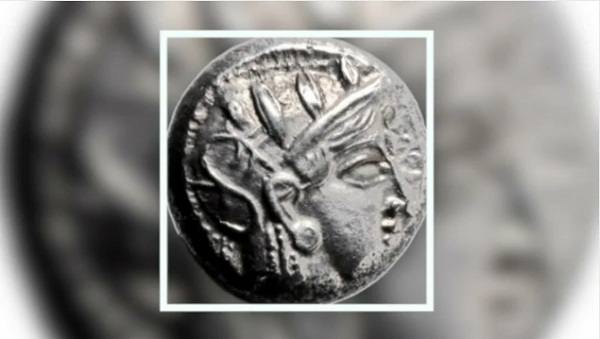
Incredibly rare “Owl type” Silver Drachm (opposite face with Jerusalem lily) image:courtesy Heritage Auctions
The first silver shekel struck in Jerusalem by Jewish forces rebelling against Roman oppression in the first century CE, one of only two specimens known, brought a world record price of $1,105,375 at Heritage Auctions on March 8 as part of the auction of The Shoshana Collection of Ancient Coins of Judea. The coin sold to an anonymous overseas collector. Overall, this auction realized over $7.6 million, with the whole of the collection, consisting of more than 2200 coins in total, expected to realize more than $10 million in multiple auctions this year.
“This Year 1 silver shekel, struck shortly after the Jewish War began in May of 66 CE, is an incredible piece of history,” said Cris Bierrenbach, Executive Vice President of Heritage Auctions. “This is literally one of the very first coins the Jewish rebels struck after the ousted the Romans from Jerusalem, sending shockwaves through the empire. That history, as evidenced by the spirited bidding and the superb price realized, obviously continues to resonate today, more than 2,000 years later.”
The Shoshana Collection, assembled over the course of four decades by an American collector, is the greatest assembly of ancient coins related to the foundation of ancient Israel ever offered, spanning more than 11 centuries.
Other highlights from the collection include an incredibly rare gold aureus as Caesar (69-79 CE), struck at an Eastern mint in 69 CE, likely Tyre, anticipating the subjugation of Judaea, which the Romans achieved with the fall of Jerusalem in 70 CE, which brought $956,000, while one of only two known surviving silver quarter-shekels of Year 1 (May 66-March 67 CE) in existence brought $896,250.
A few of the additional highlights included:
Jewish War (66 – 70 AD). AR half shekel. Year 4. Hendin 1365. TJC 209. AJC 262,25. Samuels 980 (this coin). Extremely Fine. One of six recorded specimens. Realized: $358,500.
Vespasian (69 – 79 AD). AE sestertius. AD 71 Rome. Hendin 1500b. RIC 71,161. BMC 543. Impressive Good Extremely Fine. Realized: $262,900.
Jewish War (66 – 70 AD). AR shekel. Year 5. Hendin 1370. TJC 215. AJC 263,31. Samuels 94 (this coin). Very Fine. Ex: Nelson Bunker Hunt. Realized: $262,900.
Jewish War (66 – 70 AD). Year 5. Hendin 1370. TJC 215. AJC II 263,31. Brand 3. Bromberg II, 309 Good Very Fine. Realized: $179,250.
Divus Vespasian (69 – 79 AD). AV aureus. Struck by Titus, AD 80-81, Rome. Hendin 1581. RIC 230,363. Cohen 143. BN 89. Superb. Realized: $131,450.
Aelia Capitolina (Jerusalem, renamed by Hadrian) Collection, 164 coins. Realized: $107,550.
Titus as Caesar (79 – 81 AD). AV aureus. AD 72-73 Rome. Hendin 1469. RIC 84, 370. BMC 520. BN 73. About Extremely Fine. Realized: $101,575.
Vespasian (69 – 79 AD). AE sestertius. AD 71 Rome. Hendin 1500b. RIC 71,161. BMC 543. Samuels 146 (this coin). Extremely Fine. Realized: $95,600.
Bar Kokhba Revolt (132 – 135 AD). AR sela. First year (132/133 AD). Mildenberg 125,4.1 (this coin). Hendin 1373. TJC 218c (this coin). AJC 264,1c (this coin). Samuels 98 (this coin). Superb. Realized: $89,625.
Bar Kokhba Revolt (132 – 135 AD). AR sela. First year (132/133 AD). Mildenberg 124,3.5 (this coin). Hendin 1373. TJC 218 (these dies). AJC 264,1 (these dies). Samuels 97 (this coin). Superb. Realized: $89,625.
Auction of US coins continues on New York and over the Internet at www.HA.com/Coins through Sunday, March 11.
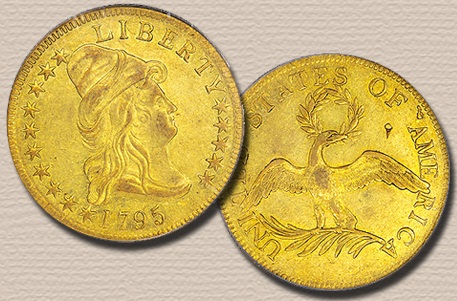
Seldom Seen Selections: One of the finest known 1795 Eagles
The famous 1795 American gold ‘eagle’ coin
The ten dollar gold pieces, given the name “eagle,” were the largest gold coins produced by the first U.S. Mint from 1795 through 1804. Like all early gold coins (and many early silver coins), these pieces did not carry an actual denomination as part of the design.
The 1795 BD1 is considered the first variety coined for the year, therefore it is the first eagle minted by the United States! There are more of them surviving today than all other 1795 varieties combined, and it is actually one of the five most common die varieties of the entire series from 1795 to 1804, a fact that would probably surprise most collectors. Quite a few examples survive in Mint State grades, giving collectors a reasonable chance of obtaining a high-quality example of the Small Eagle reverse design.
Many of the Mint State pieces have prooflike fields, including the coin we are featuring in our upcoming 2012 April 18-22 US Coins & Platinum Night CSNS Signature Auction. Although the fields are not deeply mirrored, they are clearly reflective. The surfaces are exceptional with only a few scattered abrasions. Faint adjustment marks are evident at the center obverse and on some of the obverse dentils. All design elements on both sides are sharply struck, suggesting to some the possibility that this may have been some type of presentation piece. This example is a relatively early die state of the variety, with faint obverse die cracks but no evidence of reverse cracks. Despite the existence of several Mint State pieces, this example is one of the most attractive we have handled.
A curious situation exists for both early half eagles and early eagles. For both denominations there were multiple varieties dated 1795 and only a single variety dated 1796, despite mintages that suggest this is illogical. During the course of 1795, just 2,795 eagles were minted from September 22 through November 27. In 1796, the Mint produced 6,934 eagles from January 9 through December 22. If we take these annual production totals at face value, an average of 560 coins per die marriage were struck in 1795 while a single die marriage produced all 6,934 coins in 1796. Clearly there is something wrong, unless many of the coins produced in 1796 were from dies dated 1795, and we can be certain that this was the case. According to the Guide Book, the 1795 mintage totaled 5,583 coins and the 1796 mintage totaled 4,146 coins, but even those figures are suspect, suggesting a survival rate of 10% for 1795 eagles and only 4% for 1796 eagles. This discussion illustrates the challenge that numismatists have today when attempting to reconstruct the events of the earliest years at the Philadelphia Mint. There were no records of mintages for individual die varieties, and any attempt to make such estimates today is plagued with problems.
In Early U.S. Gold Coin Varieties, John Dannreuther provides estimated mintages for every variety and for the number of survivors for each variety. The only thing we know for sure is the number of die marriages known from 1795 through 1804 (32) and the total mintage for that period (132,714 coins including 122 pieces reserved for assay). By using the midpoint of Dannreuther’s survival estimates, we can also establish an approximate survival rate for the series of 2.5%. Is this enough information to establish original “mintage figures” for each variety or even for each coinage date?
Mark Van Winkle has spent considerable effort over several years attempting to correlate mintage figures with individual varieties, and now feels that it is impossible. There are at least two variables that cannot accurately be determined. First, the exact emission sequence needs to be determined (including both die marriages and remarriages). In a series like the early eagles, the emission sequence alone is enough to give a numismatist nightmares. Once the emission order is known, an accurate estimate of the survivors must be established for each variety and remarriage, and this is nearly an impossibility. Finally, differing survival rates from one coinage date to the next must be pinpointed, a seemingly impossible task. CP for Heritage Auctions Dallas, Texas www.ha.com
Supplemental– The Numismatic Network of Canada for those interested in studying and collecting Canadian coins, tokens, paper money and related numismatic materials http://www.nunet.ca/
When I took my boyfriend to see a new Muppet movie, he had never seen anything by the Muppets before, and being a dedicated fan since early childhood, I felt it my right and honorable duty to share the mahna-mahna’s with him. Needless to say, it was a fantastic and heart-felt show that we both laughed the whole way through. A few weeks later, we were out shopping and found this “one-of-a-kind” Kermit shirt, and couldn’t resist buying it. Like Miss Piggy, I suddenly noticed myself more attracted to everything green.
photo:H. Richards
I realized being “green” is not impossible even though we are living in such a technologically consumed world. Yet, it is technology that has provided us so many outlets to become more ecologically responsible. Bills, schedules, licence plate renewals, the yellow pages, and even airline tickets are available paperless. Due to the impact of the Internet, television programs, and advertising we are more connected, and more globally aware of products available to help protect the environment.
In the home, especially if you are privy to daytime television, like City Line, the Mariyln Denis Show or the Nate Berkus Show, I guarantee that at least one segment a week focuses on how and where you can buy, reuse or create products with a green-scheme in mind. They prove that you can choose a range of products that will help sustain the environment, while still providing beautiful, sleek and modern finishes. The Home Depot has a link on their website to a section called “Eco Options,” where it is easy to locate the product type you are looking for, from flooring to appliances to décor, there is a product to help manage your carbon footprint.
Major grocery stores have become more eco-friendly as well. By providing large reusable bags/bins, made out of recycled materials and typically at a cost of $1, consumers are given a convenient eco-option. Even if you forget your reusable bags at home and buy a plastic bag for 5 cents, the plastic bag has become noticeably larger in order to try and reduce the volume of plastic bags and encourage the purchase of reusable ones. As well, food itself has taken on the green trend; I was always taught to “eat the green stuff, it’s delicious,” and now, eating green, organic food like avocado, broccoli, spinach, and kale is trendy too.
The trend in the fashion world has also become environmentally friendly. For example, H&M has created the “Conscious Collection.” It is H&M’s “action for a more sustainable fashion future.” This collection uses greener materials such as organic cotton and recycled polyester. Originally when the campaign came out in April 2011, and the colour scheme was mainly different shades of white and muted earth tones. However, one year later, they are still producing the collection but have amped up the colour pallet. Walking into the store this season, you will be bombarded—you guessed it—with green. Emerging mainly in pastel and mint, but with occasional pops of emerald, green is popping up all over the fashion world and the colour is going to be very popular this spring.
So maybe it was the resurgence of Kermit the Frog, or maybe it is because being eco-conscious has spanned to every aspect of our lives, but I am happy to say that it’s never been so easy being green. For the Silo, Hannah Richards.