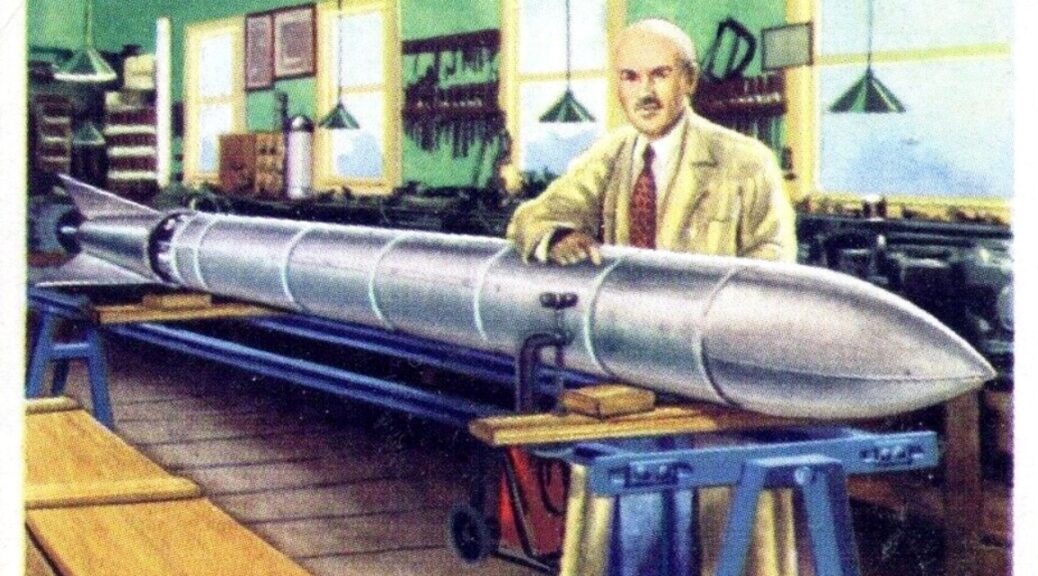
When Robert Goddard launched the first liquid-fueled rocket in a farm field in Auburn, Massachusetts, on March 16, 1926, it flew 2.5 seconds and reached only 12 meters (41 feet) in altitude.
The short flight 100 years ago would eventually earn Goddard (1882–1945) recognition as the father of American rocketry. But the significance of his work for space exploration was only fully recognized when the United States began sending astronauts into space in the 1960s and landed the first man on the moon on July 20, 1969.

In the years before his famous launch, Goddard’s theories that liquid-fueled rockets could operate in space and even reach the moon had drawn ridicule, with some mockingly calling him the “moon man.” The Clark University physics professor was secretive about his research and hid the news of his first successful rocket test.
Goddard’s critics argued that rockets needed air for propulsion and so could not operate in the vacuum of space.
Goddard’s first rocket used gasoline and liquid oxygen for propulsion, according to NASA .

While Goddard’s theories made him a controversial figure, they also inspired people to believe in the possibility of space travel, says Michael Neufeld, a retired senior curator at the Smithsonian’s National Air and Space Museum in Washington. The museum holds the largest collection of artifacts from Goddard’s work.
“He does inspire people to assume that space travel is real and the rocket is the way to go,” Neufeld says.
Why Liquid Fuel Was So Innovative
Goddard’s pioneering use of liquid fuel led to more efficient rockets that could lift larger payloads. Notably, the massive Saturn V rocket that took U.S. astronauts to the moon burned liquid fuel.
While the moon landing came years after Goddard’s death, NASA historian Brian Odom says Goddard’s work “proved what we had known in theory to be true in practice … And [that] it could be scalable.”
The launch of NASA’s Apollo 11 mission to the moon led the New York Times, on July 17, 1969, to issue what observers have called , “one of the most famous newspaper corrections in history.”
The paper that once called Goddard’s theories “a severe strain on credulity,” now acknowledged that rockets could operate in the vacuum of space and said, “the Times regrets the error.”
For the Silo, Charles Hoskinson/Share America.