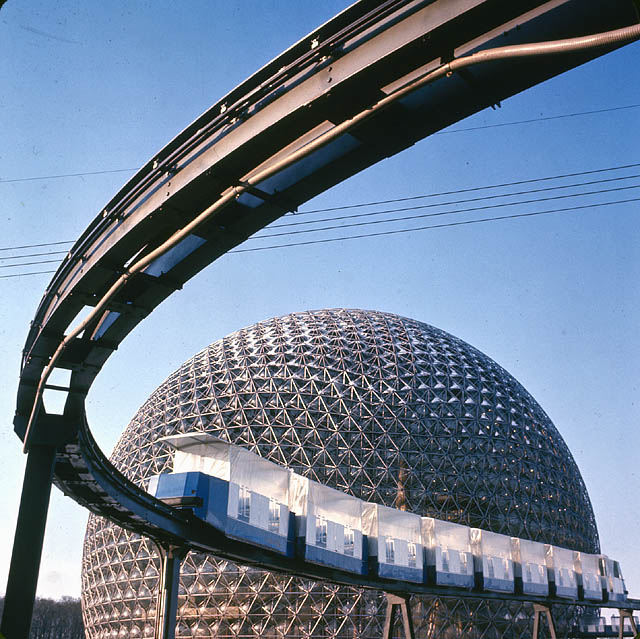
Buckminster was a genius and his geodesic dome buildings were not only revolutionary in their construction but were also incredibly unique and memorable. Perhaps your grandparents attended Expo67 in Montreal (you guessed it, waaay back in 1967) and visited the United States Pavilion- read this snippet for a time capsule account:
“The United States exhibit, entitled Creative America, is designed to illustrate technological and esthetic inventiveness in the U.S.A.A huge transparent geodesic “bubble” contains a multi-level system of exhibit platforms interconnected by escalators, and walkways. The platforms support a variety of exhibit components specially selected or designed for the new environment created by the structure. Situated on Ile Sainte-Hélène close to the Métro station from which there is Minirail connection with the Expo-Express, the bubble is 20 stories high and has a spherical diameter of 250 feet .By day, the bubble glistens as the sun highlights the structure and, by night, the bubble “glows” from interior lighting. The interior exhibits reflect different aspects of the United States and include folk art, cinema and fine arts displays, as well as a space exhibit which is reached by a 125 foot escalator and a simulated lunar landscape supporting full scale lunar vehicles. A 300-seat theatre features a 3-screen color film showing the games children play.”
Photo- National Archives of Canada
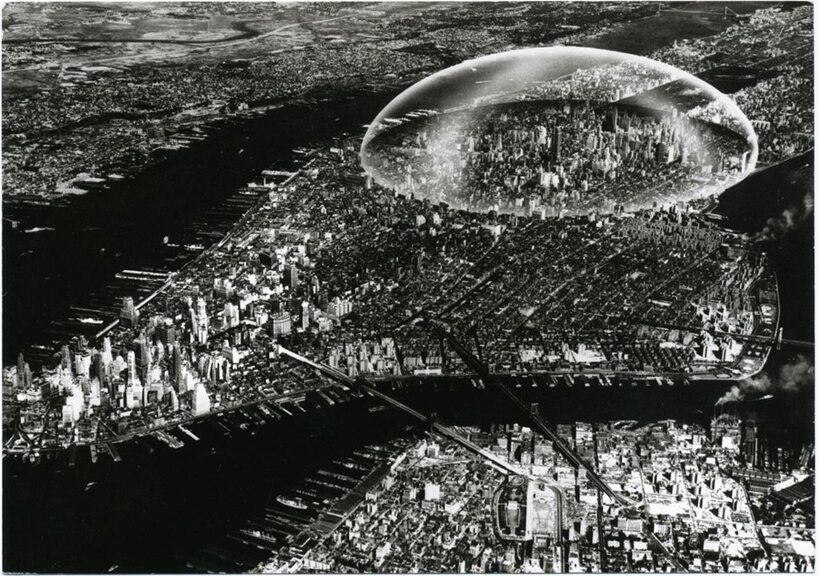
If you think that was pretty amazing check out some of Buckminster’s buildings that unfortunately didn’t make it past the planning stage.
In the late 1940s, the Upjohn Pharmaceutical Company was the largest employer in Kalamazoo, Michigan with a company emphasis on family and quality of life. It was a national leader in providing benefits to its employees including group life insurance and shorter work weeks. Also in the 1940s, Frank Lloyd Wright was the most famous architect in the world and was devoting much of his time to his Usonian homes for the middle class. About 60 of the Usonian homes were built between 1936 and his death in 1959.
In 1949, a group of twelve scientists from Upjohn sought out Wright to design a community of homes. With simplicity, form and function in mind, Wright’s Usonian designs met their criteria. They wanted houses that they could build themselves or with limited help and chose a 70-acre parcel of open and wooded land with a three-acre pond in Galesburg, Michigan. They originally named it Galesburg County Homes Acres but later shortened it to The Acres. Each scientist wrote a letter to Wright requesting his help to design the project. The Acres plat outline consisted of 22 homes on one acre each with 50 acres left natural for the enjoyment of the residents.
The Acres’ homes were Wright’s first foray into organic ranch-style architecture. They were affordable but tailor-made to the individual client’s needs – practical, functional and blended in with their surroundings. They were organic in that they appeared to come “out of the ground and into the light” as Wright was fond of saying. Access to nature, both physically from every room in the house and visually from inside the home interiors, played a major role in defining Usonian style. Homes were built with natural materials, walls of glass for winter passive solar collection, radiant-heated floors, flat roof lines with overhangs, carports and built-in furniture.
Although the project had many supporters at Upjohn, it was a bit of a drive from Kalamazoo before Interstate 94 was built and perhaps too unusual for midwestern tastes. Only four Wright homes were ever built at The Acres.
Samuel Eppstein was a research scientist and Dorothy a researcher at the Upjohn labs. They had only been married six months when they commissioned their new home and construction was completed in 1953. The 2,250-square-foot Usonian includes three bedrooms, two baths, two fireplaces, and a general purpose room used as an additional living room. Though the kitchen has been rebuilt by a local craftsman in the Wright style, the home has all of Wright’s built-ins including two tables that were reconstructed to exact specifications. Ten-foot walls of glass are positioned to capture idyllic views of valley and meadows. There is also a swimming pool that was added in later years.
Rare opportunity to own a Wright Usonian in a 70-acre, fully Wright-designed community kept completely intact since its inception. Asking $455,000 usd, it is the lowest priced Wright home currently on the market. The listing agent is Fred Taber of Jaqua Realtors in Kalamazoo, Michigan. For the Silo, Terry Walsh.
Baku, Azerbaijan, July—The city of Fuzhou (China) will host the next session of the World Heritage Committee in 2020. This decision concluded the work of the 43rd session of the World Heritage Committee, meeting in Baku since 30 June.
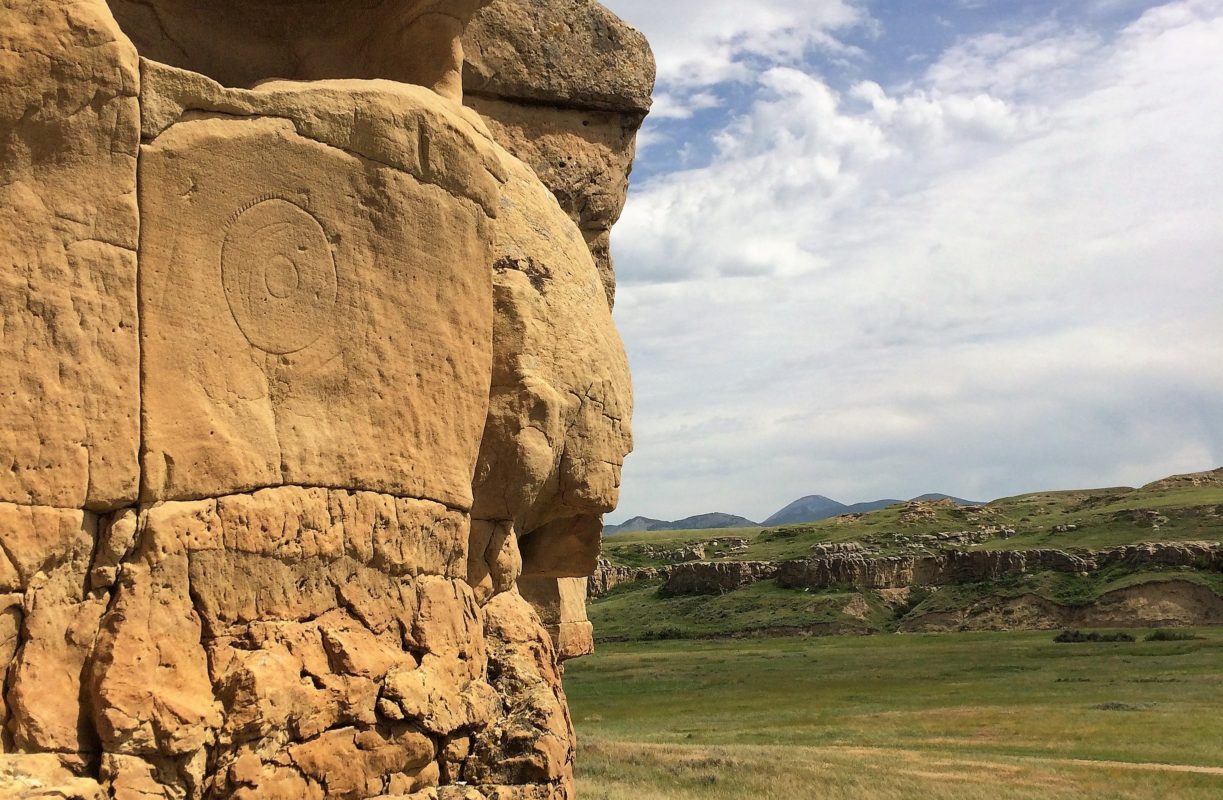
During this year’s session, the World Heritage Committee inscribed a total of 29 new sites on the World Heritage List (one in Africa, two in the Arab States, ten in the Asia Pacific region, 15 in Europe and North America including Writing-on-Stone Provincial Park in Alberta, Canada and one in Latin America).
The World Heritage List now features 1,121 sites in 167 countries.
The
Committee approved the removal from the List of World Heritage in
Danger of the sites of Humberstone and Santa Laura Saltpeter Works
(Chile) and Birthplace of Jesus: the Church of the Nativity and
Pilgrimage Route, Bethlehem (Palestine). One property has been added to
the List of World Heritage in Danger: the Islands and Protected Areas of
the Gulf of California (Mexico).
This
session reaffirmed the potential of heritage in strengthening
cooperation between States, with the inscription of the transboundary
site of the Erzgebirge Mining Region/Krušnohoří (shared by Germany and
Czechia) and the extension into Albania of the natural and cultural
heritage site of the Ohrid Region (Northern Macedonia).
Cooperation and mediation work on heritage also allowed for consensus on decisions regarding the Middle East thanks to constructive discussion with the delegations concerned, notably Israel, Jordan and Palestine.
Several
major archaeological sites were added to the List, including the Dilmun
Burial Mounds (Bahrain), the Ancient Ferrous Metallurgy Sites of
Burkina Faso and the iconic site of Babylon (Iraq), once the centre of
the Neo-Babylonian Empire and site of the Hanging Gardens, one of the
Seven Wonders of the Ancient World, which have inspired artistic,
popular and religious culture worldwide.
The
inscription of Babylon, combined with significant investment by Iraq,
contributes to UNESCO’s efforts to rebuild the country and its flagship
Reviving the Spirit of Mosul initiative.
Sites
essential for the preservation of global biodiversity have also been
inscribed. They include the Migratory Bird Sanctuaries along the Coast
of Yellow Sea-Bohai Gulf of China (Phase I) (China) and the site of the
French Austral Lands and Seas (France) with a record surface area of
over 67 million hectares that is home to one of the highest
concentrations of birds and marine mammals in the world.
Finally, the inscription of the sites of Budj Bim Cultural Landscape within Australia’s Gundijmara Aboriginal region, and of Canada’s Writing-on-Stone / Áísínai’pi, a sacred landscape of the Blackfoot (Siksikáítsitapi) people, recognizes the knowledge of indigenous peoples, essential for the preservation of cultural and natural heritage.
Significant
efforts are still needed to enhance and preserve African heritage,
which remains largely under-represented on the List. UNESCO also renewed
its call for unflagging rigour, integrity and responsibility in the
examination of nominations so as to ensure the credibility of the World
Heritage Convention and its future standing.
The new natural sites are:
Migratory Bird Sanctuaries along the Coast of Yellow Sea-Bohai Gulf of China (Phase I) (China)
French Austral Lands and Seas (France)
Vatnajökull National Park – dynamic nature of fire and ice (Iceland)
Hyrcanian Forests (Islamic Republic of Iran)
Mixed site:
Paraty and Ilha Grande – Culture and Biodiversity (Brazil)
Cultural sites:
Budj Bim Cultural Landscape (Australia)
Historic Centre of Sheki with the Khan’s Palace (Azerbaijan)
Dilmun Burial Mounds (Bahrain)
Ancient ferrous Metallurgy Sites of Burkina Faso (Burkina Faso)
Writing-on-Stone / Áísínai’pi (Canada)
Archaeological Ruins of Liangzhu City (China)
Landscape for Breeding and Training of Ceremonial Carriage Horses at Kladruby nad Labem (Czechia)
Erzgebirge/Krušnohoří Mining Region (Czechia, Germany)
Water Management System of Augsburg (Germany)
Jaipur City, Rajasthan (India)
Ombilin Coal Mining Heritage of Sawahlunto (Indonesia)
Babylon (Iraq)
Le Colline del Prosecco di Conegliano e Valdobbiadene (Italy)
Mozu-Furuichi Kofun Group: Mounded Tombs of Ancient Japan (Japan)
Bagan (Myanmar)
Megalithic Jar Sites in Xiengkhuang – Plain of Jars (Lao People’s Democratic Republic)
Krzemionki Prehistoric Striped Flint Mining Region (Poland)
Sanctuary of Bom Jesus do Monte in Braga (Portugal)
Royal Building of Mafra – Palace, Basilica, Convent, Cerco Garden and Hunting Park (Tapada) (Portugal)
Seowon, Korean Neo-Confucian Academies (Republic of Korea)
Churches of the Pskov School of Architecture (Russian Federation)
Risco Caido and the Sacred Mountains of Gran Canaria Cultural Landscape (Spain)
Jodrell Bank Observatory (United Kingdom of Great Britain and Northern Ireland)
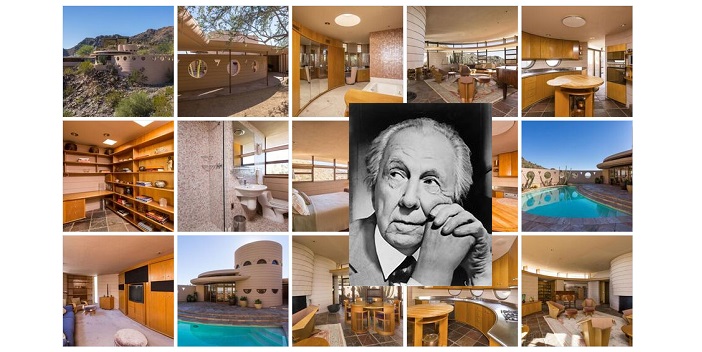
Frank Lloyd Wright designed over 1,000 structures (532 were completed) in his 70-years-plus career – mostly homes but also hotels, schools, churches, the Johnson Wax Headquarters and the Guggenheim Museum. This iconic American architect’s final design was the Norman Lykes House in Phoenix in the same year of his death in 1959. It is now for sale priced at USD$3.6 million and profiled at toptenrealestatedeals.com.
The Guggenheim cameo in Men In Black (1min 25secs)
Wright had been working with his apprentice, John Rattenbury, on the Lykes House sketches and had already chosen the building site for the home when he died. Having come full circle from his start in Prairie style, to textile block, to organic and, towards the end, the functional Usonian for the masses, his last designs showed a new interest in circles and curves as he created buildings in the round such as the Guggenheim and the house he built for his son, the David and Gladys Wright home also in Phoenix.
With a site on top of Palm Canyon with views of the valley, Wright began the Lykes design by replicating the curves of the mountainsides, making the home an integral part of its environment and providing big views for its owners and visitors. Though Wright passed away before finishing the working plans, the Lykes hired his apprentice, Rattenbury, to complete the plans according to the details set forth by Wright. The couple loved the completed plans, though it was another seven years before they started construction. When they did, Rattenbury oversaw the build and the home was completed in 1967. In addition to the structure itself, Wright also designed the furniture and built-ins for the home.
In 1994, new owners wanted some updating, so they called back Rattenbury to do the redesign by expanding the master bedroom, converting a workshop into a media room and combining two other bedrooms into a guest room – all without disrupting the overall design. Rather futuristic for its time, the circular and curvilinear design has become a timeless piece of architecture that continues to be copied by today’s designers and builders.
Now for sale and registered with the Frank Lloyd Wright Building Conservancy, the 2,849-square-foot home on one acre of desert plateau has three bedrooms, three bathrooms, the signature large living room fireplace intended to bring families and friends together, a lower-level media room, two home offices with built-ins of desk, cabinet storage and walls of shelving, a distinctive curved kitchen with Wright-designed island and unique under-cabinet windows and timeless stainless-steel counters, contemporary tiled large baths, and a privacy walled crescent pool patio viewed from inside through glass walls. There is also a separate large office in the round with all built-in furnishings encircled by half-moon windows. Views of valley and mountains can be seen from almost every room.
Classic last Wright design before his death, contemporary for today including lots of storage space with furniture and built-ins designed by the famous architect, the Lykes House is now for sale and priced at USD$3.6 million. For the Silo, Terry Walsh.

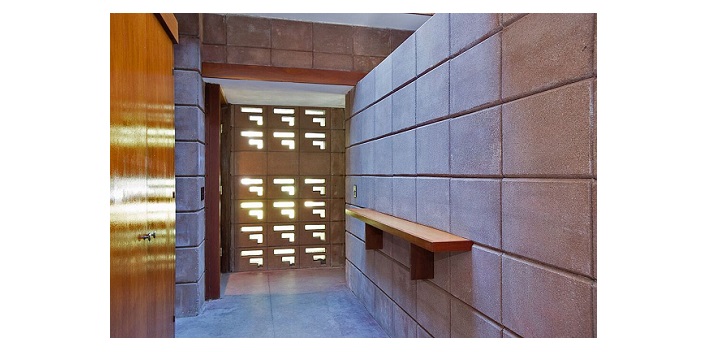
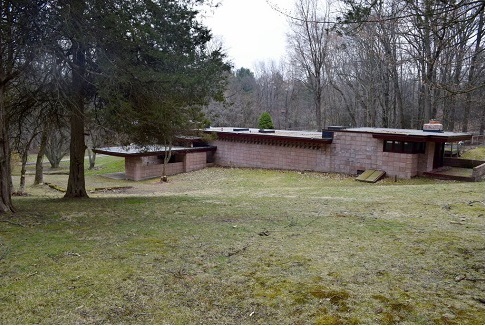
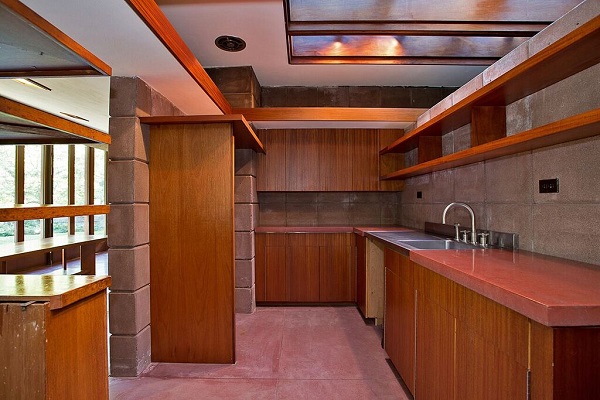
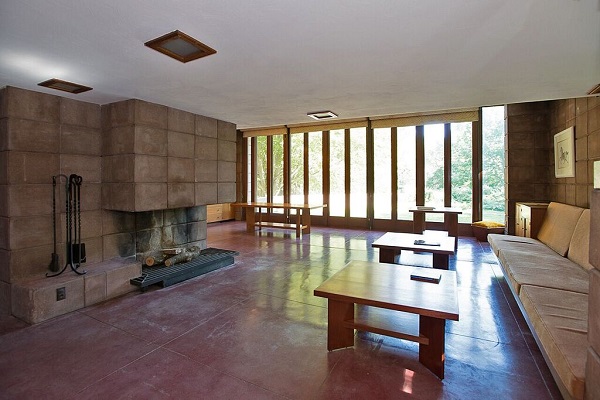 Samuel Eppstein was a research scientist and Dorothy a researcher at the Upjohn labs. They had only been married six months when they commissioned their new home and construction was completed in 1953. The 2,250-square-foot Usonian includes three bedrooms, two baths, two fireplaces, and a general purpose room used as an additional living room. Though the kitchen has been rebuilt by a local craftsman in the Wright style, the home has all of Wright’s built-ins including two tables that were reconstructed to exact specifications. Ten-foot walls of glass are positioned to capture idyllic views of valley and meadows. There is also a swimming pool that was added in later years.

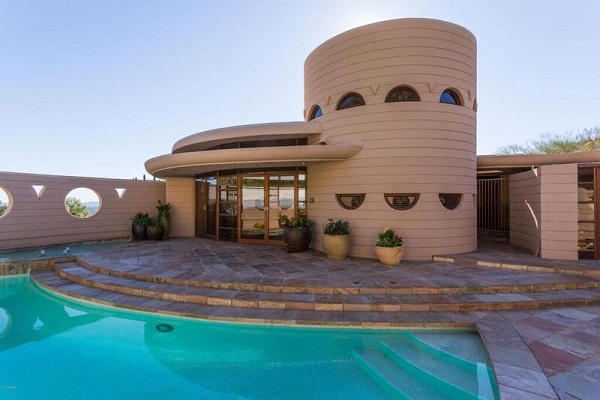 With a site on top of Palm Canyon with views of the valley, Wright began the Lykes design by replicating the curves of the mountainsides, making the home an integral part of its environment and providing big views for its owners and visitors. Though Wright passed away before finishing the working plans, the Lykes hired his apprentice, Rattenbury, to complete the plans according to the details set forth by Wright. The couple loved the completed plans, though it was another seven years before they started construction. When they did, Rattenbury oversaw the build and the home was completed in 1967. In addition to the structure itself, Wright also designed the furniture and built-ins for the home.
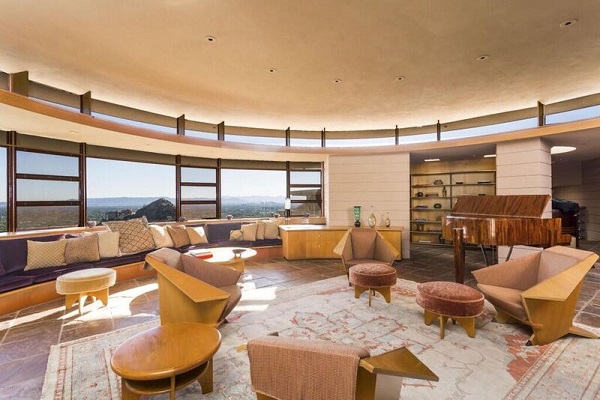 Now for sale and registered with the Frank Lloyd Wright Building Conservancy, the 2,849-square-foot home on one acre of desert plateau has three bedrooms, three bathrooms, the signature large living room fireplace intended to bring families and friends together, a lower-level media room, two home offices with built-ins of desk, cabinet storage and walls of shelving, a distinctive curved kitchen with Wright-designed island and unique under-cabinet windows and timeless stainless-steel counters, contemporary tiled large baths, and a privacy walled crescent pool patio viewed from inside through glass walls. There is also a separate large office in the round with all built-in furnishings encircled by half-moon windows. Views of valley and mountains can be seen from almost every room.
 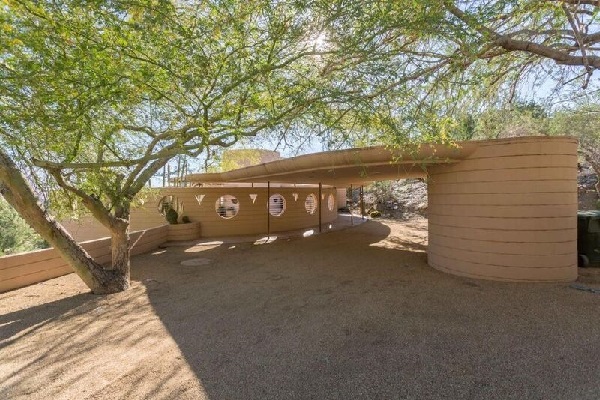 Classic last Wright design before his death, contemporary for today including lots of storage space with furniture and built-ins designed by the famous architect, the Lykes House is now for sale and priced at USD$3.6 million. For the Silo, Terry Walsh.