Hashtag Roundup App reaching 100,000,000 Twitter “Hashtag gamers” weekly

Have you been playing hashtag games on Twitter? Hashtag games are fun and free word games where Twitter users contribute funny or clever responses around a common theme, like #RejectedPrezCampaignSlogans or like #Things20SomethingsSay.
Rejected Prez Campaign Slogans Hillary
Hashtag games can often be found in the “what’s trending” area of Twitter but to discover all of them there’s a new app called Hashtag Roundup (www.hashtagroundup.com) that creates and hosts its own creative games, recruits comedians and Twitter celebrities to host live games, and aggregates the best trending games, making Twitter easy and accesible for everyone.

 The Hashtag Roundup app, now available for Apple and Android, provides game alerts, peer-to-peer awards, and exclusive leader boards to serve the rapidly expanding global hashtag gaming community. Hashtag Roundup is the leading creator, promoter, and aggregator of hashtag games in the US, Canada, and UK, with a cumulative weekly reach now exceeding 100 million Twitter users.

We ( @thesiloteam) had fun with a recent game called #MakeAFilmSkeptical

Hashtag games are word games where Twitter users contribute often clever or funny responses to a common theme. For example, a recent game promoted by Hashtag Roundup was #4BestWordsEver, and contributions included tweets like “Open bar, free food” (@2p2TrollCat), “School is finally out” (@trjx1d), “Mom got us pizza” (@Broganza16), and “You’re the best mommy” @darksidedeb).

Brands get in the game as well, with submissions like “We’re going to Universal” @UniversalORL), “No soup for you!” @Seinfeldtv) and “a dozen original glazed” @krispykreme). The “winners” are the ones with the most retweets and favorites. Hashtag games provide a fun diversion and creative outlet for individuals and a marketing channel for big brands.

Hashtag Roundup recruits comedians and Twitter celebrities to host and create games. Users download the app in order to see what games are running and what the best responses are. Hashtag Roundup shares both original games and trending games on Twitter.

Scott Fischler Cofounder HashtagGameHashtag Roundup is a joint venture of @TheHashtagGame and @absrdNEWS. In February 2012, @theHashtagGame was launched by Scott Fischler (@fastlaugh) and quickly established itself as the leading 24/7 hub of hashtag gaming. Meanwhile, @absrdNEWS and absrdCOMEDY.com were launched in February 2014 by Jeff Dwoskin (@bigmacher), immediately gaining recognition and followers for its sharp news parody and frequent, funny Top Ten Lists. Fischler and Dwoskin, both comedians, joined forces in 2014 to jointly develop the Hashtag Roundup app for iOS and Android. Hashtag Roundup delivers a consistently great Twitter experience, with engaging hashtag games and hosts.

“We love watching the hilarious and creative answers our fellow Twitter users come up with in hashtag games, but as hashtag addicts ourselves, we struggled to keep track of all the games, and all the responses,” said Jeff Dwoskin, founder of absrdCOMEDY.com.

“Hashtag gaming is rapidly becoming a significant marketing vehicle for brands, celebrities, major league sports teams… even political candidates. All are now frequently playing our games, and recognizing the massive positive exposure to new audiences that hashtag gaming provides,” said Scott Fischler, founder of @TheHashtagGame.

App  Download links

iPhone/iPad https://itunes.apple.com/us/app/hashtag-roundup/id985741893?ls=1&mt=8
Android https://play.google.com/store/apps/details?id=com.touchtitans.hashtag_roundup

Click to view on I-tunes

ArtyA’s Timepiece Will Be Exhibited In Swiss Musée d’Ethnographie de Neuchâtel

ArtyAlogo

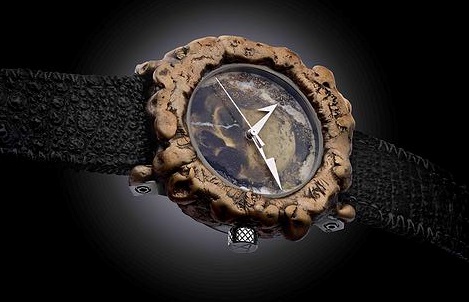
Skulls & Bones: Skulling the heights of perfection

The skull motif made popular in watchmaking by ArtyA has long been copied, resulting in a whole range of derivatives. Now, the fully independent brand has taken the helm once again. The Skulls & Bones is an extreme timepiece that pushes the creative concept to the limit.

Word has it that if you really can’t compare a Swiss watch to any other, it really is original. By that standard the Skulls & Bones is one original watch.

ArtyA’s latest creation doesn’t do things by halves, and it certainly isn’t a mass-market kind of timepiece. Critics might say that it’s rather extreme – and they wouldn’t be entirely wrong. But more objective minds will first and foremost note its wholly coherent style.

Sound of Sound Skull Watch Web

Back in the day, the Skull universe, popularized many years ago by Yvan Arpa, was decried in the world of watchmaking as being in frightfully bad taste. Since then, it’s become trendy and fashionable, as people started wearing this style of timepiece to try and stand out from the crowd – with varying degrees of success. But in most cases, the relevant styling doesn’t go much further than a dial illustration, some sort of ‘skull’ motif on the hands, and little else. Until now, that is.

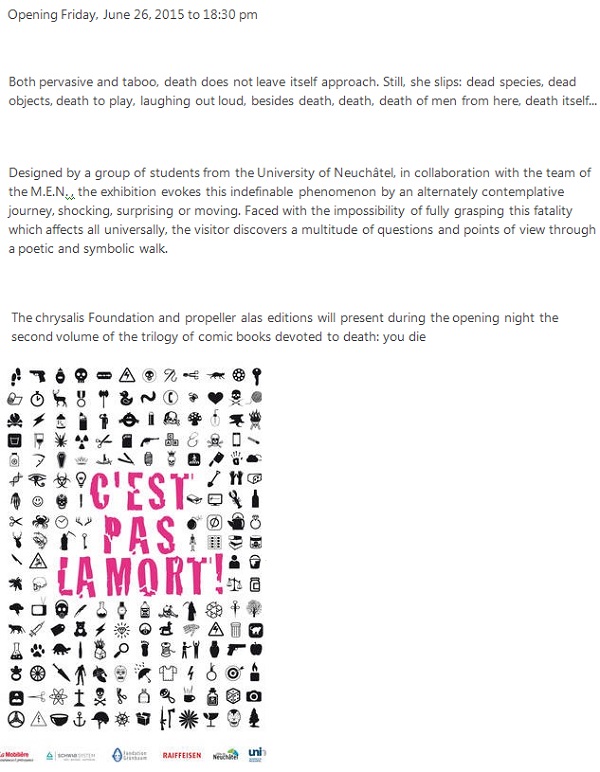
C'est Pas La Mort! Poster and Exhibition Description

Skull-tural!

With the Skulls & Bones, ArtyA has embarked once again on the style trajectory it was the first to pioneer (with many following in its wake), as ArtyA’s CEO and designer Yvan Arpa guides the concept to what must surely be its ultimate destination. The skull is much more than a simple drawing: sculpted and engraved, it’s been released from the two-dimensional representations to which it’s been confined elsewhere.  As is its wont, ArtyA has suffused the Skulls & Bones symbols with new meaning, taking concepts through to their logical conclusion, and once again placing the artistic dimension at the heart of its work. The dial is fully hand-made.

Crypt- price: 6,900 CHF

Every one of the new 47 mm models is unique, featuring hand-crafted engravings and sculptures. Each includes the brand’s own movement, frequently used in its Son of a Gun collections. This results in a reliable, high-performance caliber, the heart of which is incorporated within a small central space. Its surface is covered by a rough, seemingly unfinished steel plate surface, featuring a twitchy drawing of a skull, rather like a hastily spray-painted tag.

Full Skull- price: 19,000 CHF

This is surrounded by six hand-engraved skulls in polished steel outlined in black. The style is at once tribal and urban, modern and ancestral. ArtyA leaves the interpretation of this universal symbol to each individual’s imagination. By definition, each timepiece will be unique, with each person free to have their own take on the skull universe.

Gangs of skulls

Skulls And Bones BezelThe Skulls & Bones bezel sports another dazzling spectacle, exploring both “skulls” and “bones”. Here, ArtyA extends the core theme to encompass other graphic elements such as crosses, totems, barbed wire, guitars, and guns, expressing the whole gamut of the world of rock. Here too, ArtyA has not gone for simple cookie-cutter drawings, instead favouring genuine steel engravings. The shapes of the movement are seemingly drawn inexorably towards the bezel, each feature setting off the other.


Click to view on I-tunes

SipSup mobile linked Drinking Glass disrupts Conventions of Communication

SipSup3 SipSup  is a new beverage drinking glass that communicates with smart phones via app technology to become an interactive media display and storage unit. When you have finished drinking your beverage of choice, digital photos and videos you have dropped into your glass via the SipSup app are left behind. The SipSup app enables you to keep your special moments only for yourself (private) or to make them visible to every person who happens to tap their phone to your glass (public). The social interaction possibilities are endless- many of us already spend a lot of time at coffeehouses or pubs, consider bringing your glass along- it would be a great way to meet new people and discover new forms of interaction- all via your hi-tech SipSup glassware. SipSup1If that wasn’t enough, another feature called “post-it”, allows your guests to leave photos or videos on your glass and even write on a fun message. Hydration will never again be boring. SipSupLogoA Slovenian start-up that prides itself on ‘out of the box’ thinking, the SipSup team have taken an object we all use on a daily basis and given it new functions. SipSup will stand out from the other glasses in your kitchen because of it’s distinct curved shape designed to naturally fit your hand. It’s base resembles the ripple effect of a drop falling into water and was inspired by the notion of  “dropping moments into a glass”. You can get this great looking piece of smart glassware on Kickstarter. For more information email: marketingdirector@thesilo.ca



Click to view on I-tunes

Are More Native Children In Gov’t Care Today Than At Height Of Residential Schools?

Truth and Reconciliation Report – One Oneida Woman’s Perspective

Indian Residential Schools are a large part of Canadian History. I use the present tense. Every Canadian lives with the fallout of these schools which were to, “Kill the Indian in the Child.” Cultural Genocide the TRC [Truth and Reconciliation Commission CP] says in its opening paragraph.

In Canada, we think it a right and obligation for our children to come home safe. We kiss them on the first day of school, knowing that we will see them again when school is finished. How would you feel if your child never came home?

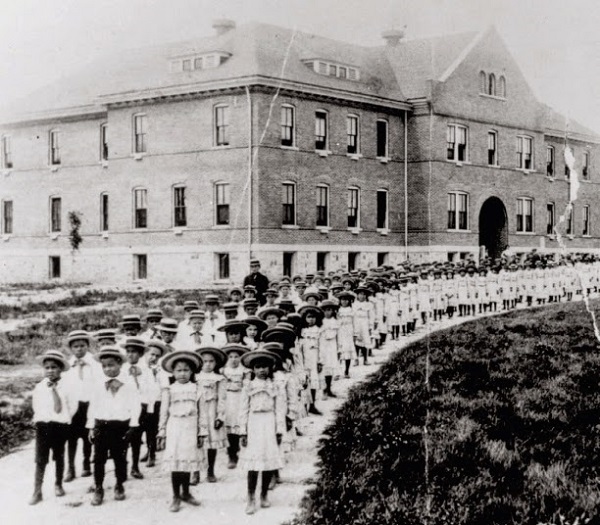
Mount Pleasant Indian Boarding School

This happens today.

Families who live in small, fly-in communities have to have their children flown south to attend high school. Some never return.  http://www.cbc.ca/news/canada/thunder-bay/first-nations-want-inquest-into-7-student-deaths-1.1239226

There are more Native children is the care of the government today than at the height of the Residential Schools. http://news.nationalpost.com/news/canada/a-lost-tribe-child-welfare-system-accused-of-repeating-residential-school-history-sapping-aboriginal-kids-from-their-homes

Rather than empathy or acknowledgement of the past, we are told to, “Just get over it.”

Wide Distribution And Remoteness of some Reserves

Before colonization, we had no abuse, no addictions. We had no poor. Our needs were met- meaning we were one of the richest people on earth (thank you, Professor John Milloy for pointing that out to me).

I have been told that, “Since the Jews got over the Holocaust that we should just get over it.” That is insulting to both me and those who are Jewish.

Get over it.

First Nations communities suffer from the effects of the Residential Schools by having Intergenerational Trauma. We alone are not the only people who have this. Those with a family history of addictions, or abuse, or neglect feel the same effects. We had a generation or two of people who did not see parenting. They saw institutionalized abuse. How could they possibly know how to parent when they left school?

Without proper healing sources in place, and without feeling stuck in the anger, hurt, and pain which comes from Trauma, no one recovers from it.

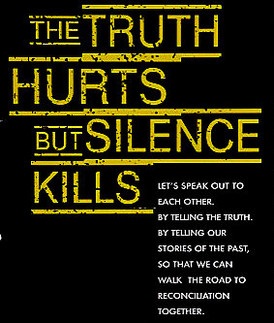
TRCPoster

I can only speak for myself. My grandfather went to the Mush Hole in Brantford, Ontario. He was a bright student, plus when home, he spoke a couple of the Native Languages on our Six Nations Reserve. I am very proud of that.

However, while he says he (personally) was not sexually abused, he had friends who were. He was not allowed to speak his languages at school. He was denied medical care while at school, which caused permanent damage to his brain. My bright and intelligent grandfather became stuck in the poverty cycle. And, the addictions cycle. He couldn’t cope without the structure which was forced on him at school. He couldn’t function well on the reserve. What the school taught his was agriculture. He worked the tobacco fields when he could. Then, he was on welfare.

On top of his mental capabilities, the alcohol killed him inside. Because of him, my mother was raised in a non-Native foster home, not knowing she was Oneida until she was 18. Her foster home denied her access to knowledge of her family on the reserve which was 10 minutes away.

My mom’s foster family did the best they could according to the times. In the 1940’s and 1950’s, it was best to be seen bringing up a little Indian girl in a good Christian family, a family which included a foster father who also had an addictions issue.

Her upbringing effected how I was raised. She also did the best she could. She tried her best to be a good mom, a mom who loved and cared for her own biological children. But also kept them at bay emotionally.  She did not know how to really bond as a mom.

Because of the Residential School, my mom did not learn how to properly parent. As for me, I looked for parents I could follow. I am doing the best I can. I hope I my kids do better.

I hope my kids see that while I am Oneida, that does not make me less-than a full person. I hope they see that the Oneida blood that we share is a privilege, something to be honoured and respected. I hope they see it as something that bonds us to other First Nations people around Turtle Island. We are a strong people. We didn’t die. We learned how to survive. Now, we are striving to learn how to live in peace again.

For, you see, the Residential Schools did not kill the Indian in the child. Even with the horrific events which happened, we did not die. We are blossoming as a rose. We will overcome and heal.

Anger needs to be let go. Treaties need to be upheld. If the Canadian government did not want to fulfill the treaties, why were they included in the Canadian Constitution? They are a matter of law. Deal with it, Harper. We don’t expect handouts. We need the highest levels of Canadian law respected and enforced. The government needs to honour their obligations which they proposed, agreed to, and reinforced in the Constitution in 1982.

There is Truth – they tried to kill us off. Now, please, let there be Reconciliation. We all need to acknowledge the past and present to make a future which honours the laws of Our Lands. We agreed to share our land for the benefit of all, not to be killed off. Let us all honour our agreements.  For the Silo, Stephanie MacDonald

Click to view on I-tunes

Elementary Forces By Timothy deVries

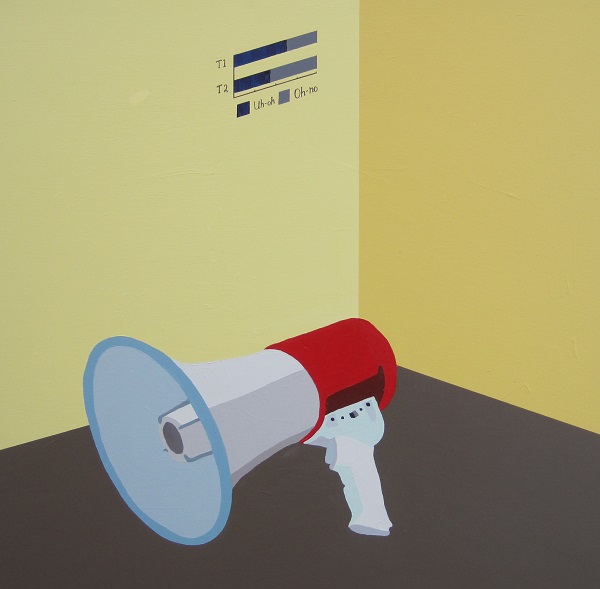
Apocalypse, Timothy deVries (2015) Acrylic on Panel, 30 x 30 inches
Click to buy
Click to buy

What is a corner? The corner represents a symbolic value. Children are told to stand in the corner when they are disobedient. The corner is a place where one meditates on one’s shortcomings. One can be ‘backed into a corner’ and left with few options or one can retreat into a corner for safety. Animals corner their prey. Corners are places where things get lost and are found. Corners are neglected and swept in the spring. Unfortunate artists can paint themselves into a corner if they are not aware of the space around them and the area beneath their feet. Corners are forgotten with the bustle of activity in the centre of the room.

Gilles Deleuze’s book on Francis Bacon contains a short chapter in which he describes some of the possible reasons for why Bacon consistently displayed his figures against a “round area or ring.”1 Deleuze asserts that the main reason for utilizing this “simple technique” is to create a “place” and to isolate the Figure.2 There is a progression and fatefulness in assigning the Figure to this place. Deleuze claims that the round area or ring relates the Figure to the setting and, in so doing, posits the Figure or painting as a kind of fact or isolated reality.3

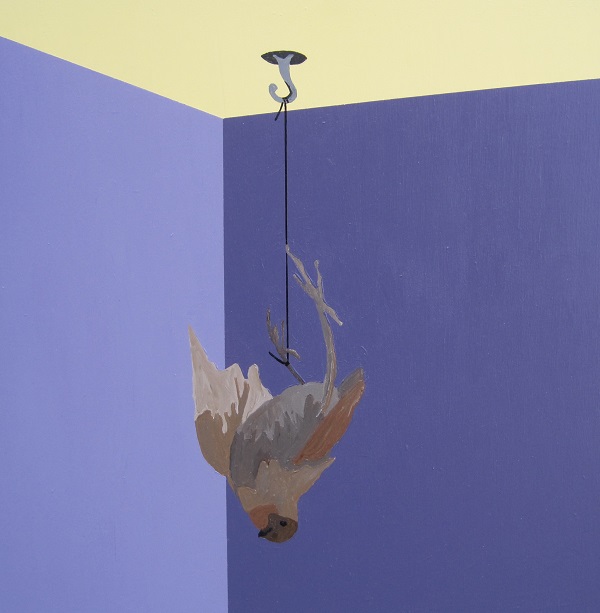
Bird on a Wire, Timothy deVries (2015) Acrylic on Panel, 18 x 18 inches

The horizon, ring, corner or wall is a painterly convention frequently revisited by contemporary artists. Although many painters have excluded these settings in favour of fields (e.g. a field of pure colour, or a field of refuse), such settings are useful constructs for displaying objects of value or inducing value within objects. Fields are distinct from settings in that they form a systematic or total (rather than operative or local) context for objects. Conversely, settings function by separating the object from its context so that the viewer can have an unmediated experience of that object. The setting recedes ‘into the background’ as a decorative relief or incidental support.

Jesus Bids Us Shine LyricsCorners are specific settings that feature the intersection of three planes (i.e. two walls and a floor). The intersection forms a point. The corner can function simply as the intersection of three planes or as a construct that creates depth and dimensionality. This bivalent nature hints at its duplicity as a setting. It creates a false depth. In this respect, the play of surfaces conspires to become a point of convergence or vanishing point. As a convergence of three surfaces it is a point of ‘agreement’, or perhaps a type of foreclosure; three colours and three lines converge to form a dimensional whole. The duplicity of the corner consists of its character as both a play of surfaces and as a convergence of three lines. The duplicity consists in the fact that the corner realizes both the idea of form and the Form itself through both a convergence (of surface and line) and a construction (of dimensionality).

Two of the most significant questions a painter may ask is, “What must I paint?” and “What is the painting about?” The idea of form contained in a painting is inevitably ‘about’ a sensation or perception. The painter’s nervous system is trained not only to recognize particular sensations and perceptions but to actualize them in the materiality of paint.4 Painters practice their art as a way of learning to live with a given set of perceptions and sensations. The act of representation in painting is therefore second to the sensations and perceptions which inaugurate it.

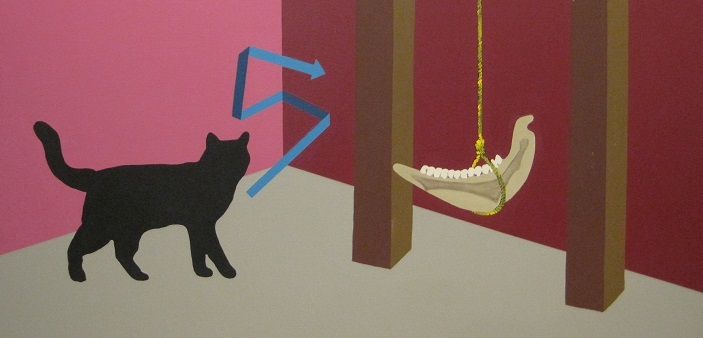
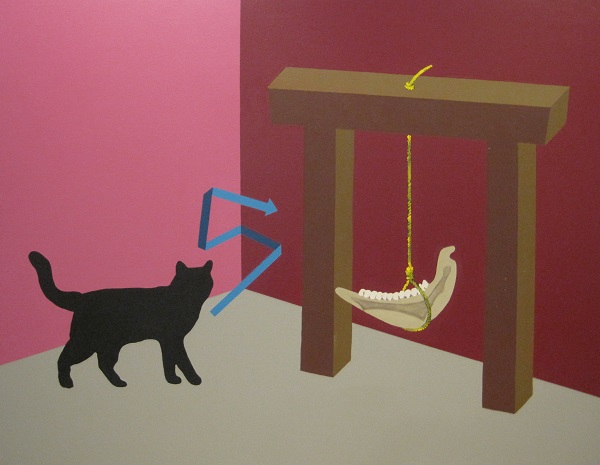
Black Cat and the Jawbone of an Ass, Timothy deVries (2007) Acrylic on Canvas, 46 x 59 inches

The critic’s judgment (i.e. the critique) is the genesis of painterly sensations and perceptions. Critique is the limit of art and limits art to what it alone can do. It functions as a form of violence that is inflicted, observed or endured and occurs when one form overcomes another or when a form is ‘deformed’ by a superior consciousness. The deformation heralds a new and hitherto unappreciated beauty. It is the beauty of a projection or displacement of the painter’s subjective point of view into the materiality of paint. The transformation of sensations and perceptions through the pure and practical reason of the painter reflects the painter’s critique of power. What power? The power of judgment. The critique is therefore absorbed into the very colour of the picture.

Ludwig Wittgenstein’s picture theory holds great explanatory appeal in these cases because it contains propositions regarding the logic and structure of a picture. The painter labels the painting with a title because it represents a state of affairs. There is a close correspondence between the fact represented by the title and the pictorial content of the painting. It is in this sense that the picture functions as a relation between the physical or material world and the thoughts of the painter. Within this context, pictures are criticological constructs. Their titles are statements or propositions that are endowed with sense. As a function of these statements the painting’s pictorial components correspond almost identically with a set of defined elementary forces.

The corner can therefore play several conscious roles within a painting. They are the place of an encounter between a convergence and a defined space. These corners embody a perception. Moreover, corners function as a limit. As the limit of pictorial space they set up a picture plane that functions as a limit to logical thought. By using corners in this way, painters can represent unusual objects with a degree of normative ‘factuality’ – even if they are only representations. Finally, corners function as a place or setting. These corners are settings in which something can take place as well as a destination for various ideas. They instantiate and materialize Form in unanticipated ways. For the Silo, Timothy deVries http://www.timothydevries.ca/


  1. Gilles Deleuze, Francis Bacon: The Logic of Sensation (New York: Continuum, 2003), 1
  2. Deleuze, Francis Bacon, 2
  3. Deleuze, Francis Bacon, 2
  4. Deleuze, Francis Bacon, 52


Click to view on I-tunes

COOPY handheld Smart Device launches Kickstarter Campaign

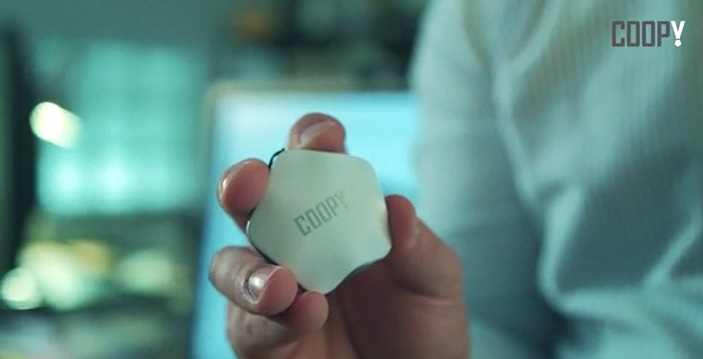
COOPY is a small, hand-held tool which provides users with a solution to complete multiple functions by simply clicking a button.

With the simple action of clicking one of three buttons included on this smart device, COOPY uses its own application to complete designated functions as set by the user. This includes, but is not limited to, sending predefined texts, alerting someone of your geographic location in the case of an emergency, locating objects and turning on home or office appliances, etc.

CLICK ME to watch HD VIDEO

Aleksander Preglej, Chief Technology Officer of Pentasens:  “COOPY is perfect for any type of user: a business professional, athlete, parent, young adult or even a child. We also designed this device to include time and location awareness, so the functions automatically change based on where you are and when. This is one of the major features that sets us apart from our competition.

With the ever-growing demands of our day-to-day schedules and the potential danger of multi-tasking at inopportune times, our company wanted to create COOPY as an easy-to-handle gadget that allows you to be as productive as possible without jeopardizing your safety or the safety of those around you. We know that everyone’s time is valuable and sometimes it could pose as a risk when you’re trying to do too much at one time.”

Pentasens rolled out its first product, SensMesh, a wireless sensor system (www.sensmesh.com) in 2014, which evolved into a smart modular solution for boats, BoatEye (boateye.io). Keeping up with the latest trends in technology, Pentasens strives to provide consumers with state-of-the-art products, safe to use and modern and sleek in design.

Kickstarter Pledge Kickstarter campaign for COOPY runs until July3rd and can be accessed here.

facebook.com/getcoopy

twitter.com/getcoopy