
UK’s “ICE Totally Gaming” A Must Visit In The Gaming And Technology Sector

ICE TweetThe ICE Totally Gaming exhibition returns to London in the UK next month, but it’s a huge event for the industry worldwide where innovation comes to the fore and the future is literally paraded in front of our eyes. The three-day event offers conferences, seminars, networking and much more from companies around the world, and, of course, Canada is represented.


There’s a reason why the reach of Totally Gaming is so vast, as it encompasses online casinos, sports betting, social gaming and street gaming amongst other areas, bringing together the best minds and freshest technology into one place. Last year there were 23,506 attendees from 156 countries, and although Canadians represented just 0.93% of that, the fact that 218 of us (yes, I did the math) were willing to make that trip shows just how important it is to the industry, even over 6,000km away.

But why is that trip worthwhile, and will 2015 be value for money if you’ve got vested interests in gaming, technology and the business behind it? With the amount of knowledge on offer for the ticket price, I’d have to say yes.

ICE Totally Gaming 2014 Recap
This year’s seminars – which are all free to attend – include information on emerging and growing markets such as Bitcoins and Cryptocurrencies, expert knowledge from the likes of the International Masters of Gaming, and informative start-up workshops which can help build networks with mentors and even open business-to-business dialogue. You can pitch your own business to ICE to get some floor time, and there are heads of industry there that make it a must for anybody with an idea or a business plan, or even just a desire to make it in the field.

One of the seminars sure to be a big hit is the aforementioned Bitcoins and Cryptocurrencies offering, with notable industry figures taking to the podium for various sessions. As the world of money online is constantly changing, arming yourself with knowledge is one of the best weapons. Jon Matonis, board director of the Bitcoin Foundation, will open things up and delve into why cryptocurrencies have been so well adopted. Further to that, you can learn about risk management, boosting business, regulation and more. Having all this information in one place would be invaluable.

The Bright Group's Raif Oymen
The Bright Group’s Raif Oymen

It’s not the only one sure to instill potentially revolutionary ideas on the attendees, however. The workshops and mentorship for start-ups feature some successful names already well embedded in the gaming industry, who will be dispensing advise on getting your business of the ground and, more importantly, keeping it afloat.  Martyn Evans of Unboxed Consulting talks lean start-ups, Phil Smith of Joelson Wilson will discuss the merits of London for a new business, and there are more workshops for crowdsourcing, licencing and finances. For more details on all of these information-packed seminars, you can look here.

Leading companies like IGT choose the event as a premiere for their freshest ideas, and the big internationals make sure it’s a part of their calendar. “ICE is a really good opportunity,” said The Bright Group’s Raif Oymen, who will be exhibiting after travelling all the way from Australia.

If you have to be at the forefront of emerging technology and know where the cutting edge of the gaming markets is then it should be a key date in your calendar. Even more importantly, if your career aspirations or business future relies on the gaming sector then there won’t be a bigger, more beneficial way to spend three days in the whole year.

Supplemental- Mapping the Future of Gaming

Augmented Reality Billboards Invading Google Streetview Maps

It’s an old story- at least in terms of internet “best before” dates. In 2010 sites began reporting on new Streetview Advertising patent applications submitted by Google . The complete details of the patents were not readily made available to the press but essentially it all boiled down to a new way for Google to generate advertising revenue by superimposing digital advertisements and billboards over top of existing “real world” advertising and structures. This was justified by Google by explaining that there is a need to update Streetview images that contained existing advertisements that are no longer current.

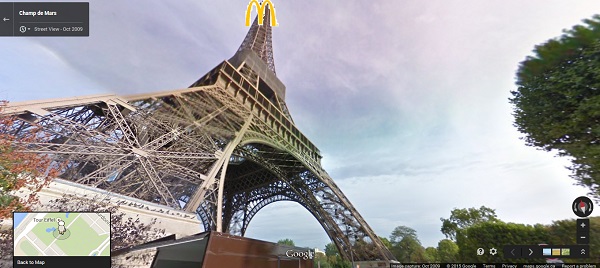
Fast forward to today and what we are seeing is this: not only are “real world” ads being updated but new digital ads are being superimposed over Streetview structures that do not contain advertisements in the “real world”.  This is interesting. It is a form of AR (augmented reality). It is ethically questionable and here’s why……

See that fence? See those ads? Do they exist in the "real world"? It doesn't matter to Google.
See that fence? See those ads? Do they exist in the “real world”? It doesn’t matter to Google.

Absolute power corrupts absolutely-

As virtual realty becomes claimed for advertising space there will more incentive to place AR ads on spaces that are in the “real world” off limits to billboards and marquee signage. What will prevent Google from selling AR ads that will appear on the side of the Eiffel Tower? Since they own the imagery presented on Streetview existing municipal bylaws are non-applicable.

EiffelTowerGoldenArch

As head worn AR devices such as Google Glass and Sony SmartGlass begin to enter the consumer kingdom this year- the future of AR advertising is clear.

googleGlass

Barrett: Ontario Invasive Species Act Still Needs More Work

When sea lamprey became entrenched in the Great Lakes, the impact on native fish was tremendous. Decades later, we are still battling lamprey, but Asian carp are waiting at the door with ramifications that will make lamprey look tame.

Fallout on ecosystems and native species is often severe, and sometimes irreversible. The damage Asian carp could do to our Great Lakes is unimaginable and the phragmites invasion is choking out wetlands across the province. Damage from invasive species is not just ecological, but also financial with estimates of $7.5 billion annually on forestry and farming.

When passed, the province’s new Invasive Species Act will make Ontario the first province to have such a law. Basically, the bill lays out how to help prevent invasive species, how to detect and respond rapidly to the presence of new invaders, and effectively manage those already established. The concept is admirable, but I do have a few concerns.

The bill has wide-ranging support from various stakeholders, but it is reactionary when in many cases a more proactive approach would be appropriate.

To start, the identification of invasive species will be done through a so-called black list. It requires harm from a species before it will be regulated. However this is reactive rather than preventative. To explain further, the approach to sea lamprey is reactive, whereas the present approach to Asian carp is preventative. It’s easier and less costly to deal with an invasive species before it’s established.

An approach that is frequently recommended, but not used in this bill, is the pathways approach. Using this approach, the regulation of invasive species is based on the risk of invasion via certain pathways so it can be regulated and the risks mitigated. One example is requiring the gutting of all Asian carp imported into Canada for food to make sure they are dead.

The bill does not outline a science-based approach to risk assessment and decision making. My concern is red tape to identify invasive species will hamper prevention efforts.

The act downloads the responsibility of implementation to landowners, but leaves little incentive for landowners to act. As a property owner, I have concerns the bill will be punitive and unfair.

The bill creates two classes of invasives – significant threat and moderate threat. Although there are tools to deal with moderate-threat invasives in provincial parks, there are no tools or authority for private landowners. I have seen this in my own battle against phragmites on our farm and the limited tool kit permissable.

Another concern is the act would create a heavy-handed regulatory scheme that will punish innocent persons who have the misfortune of having an invasive species on their land and download costs of dealing with it to the owner. I am also opposed to the warrantless entry provision for authorities to search property and buildings.

The penalties set out in the act are higher for corporations than individuals. While this concept seems sound, the government failed to take into account the fact many businesses and family farms are incorporated.

I have faith in the science personnel within the Ministry of Natural Resources and Forestry who provided the basis for the act. But I also believe there is a wealth of knowledge amongst anglers, hunters, naturalists, farmers and commercial fishermen and their associations that can be incorporated with more public consultation. Toby Barrett, MPP

Supplemental– Great Lakes Commerical Fisheries Michigan Fish Producers Conference

Bill 167 Ontario’s Invasive Species Act 2014