Ontario Wine Industry Focused On Global Marketplace

Professor Maxim Voronov during The Silo's exclusive Skype interview- "the Ontario industry needs to consider the construction of a “meta-image” for Ontario wine, an overarching “meaning structure,” including, perhaps, environmental sustainability, that will resonate with both domestic and international consumers, backed up by the consistently reproducible quality of the product."
Professor Maxim Voronov during The Silo’s exclusive Skype interview- “the Ontario industry needs to consider the construction of a “meta-image” for Ontario wine, an overarching “meaning structure,” including, perhaps, environmental sustainability, that will resonate with both domestic and international consumers, backed up by the consistently reproducible quality of the product.”


Maxim Voronov is Associate Professor of Strategic Management at the Goodman School of Business, Brock University, and is also a Fellow of the Cold Climate Oenology and Viticulture Institute (CCOVI), one of the principle academic research engines currently informing the Ontario wine industry; helping it find its rightful and deserved place in the global marketplace.

Oenology (pr. Een-ology) comes from the Greek root oinos, and essentially means “the study or science of winemaking.” Professor Voronov, along with fellow Brock colleagues Dirk De Clercq and Narongsak Thongpapanl, and with Bob Hinings of the University of Alberta School of Business, recently completed a 6 year study of the Ontario wine industry and its strategic positioning in relation to its international, and often more established competitors.

In an exclusive interview with The Silo via Skype, Professor Voronov outlined the overall methodology of his study. He and his colleagues conducted interviews with various stakeholders in the Ontario wine industry, including makers and growers, LCBO executives, wine critics, and they surveyed press coverage, websites, and over 250 restaurateurs regarding their attitudes toward Ontario wine. Their conclusions: the Ontario wine industry needs to adopt a two-fold focus in order to hold their own in a competitive global market. There are 3 distinct growing regions or “appellations” in Ontario (otherwise known as DVA’s or Designated Viticultural Areas). They are the Niagara Peninsula, our largest and arguably most “storied” region, Prince Edward County to the east, and the Lake Erie North Shore appellation to the south-west, beneficiary of the greatest number of heat-units per growing season, including Pelee Island and, hopefully soon, our own, relatively new “South Coast” growing region. But in spite of these localized differentiations, cautions Voronov, ultimately our industry represents a cool-climate production zone by international standards and needs to focus on grape varietals that can consistently and reliably perform in a somewhat unreliable climate.


Appellations of Ontario Origin. image: vqaontario.com


The second area of focus needs to be the conscious practice of exporting the best of Ontario fine wines to the “tastemaking” markets of the wine world, like New York and London. Commercial and critical success in these regions will not only cement Ontario’s legitimate place in the global wine industry, but also enhance the attractiveness of Ontario fine wines in our own, domestic market, somewhat akin to the phenomenon of the Canadian actor or musician who labours away in relative obscurity for years, until finally being “discovered” by some international authority and emerging as a hometown hero. A recent effort on this front was the “Rediscover Canadian Wines” trade and media tasting event at the Canadian Embassy in Trafalgar Square, London, England. Supported by Wine Country Ontario, in partnership with Foreign Affair and International Trade Canada, The Ontario Ministry of Agriculture and Food, and the Canadian High Commission in London, this was a major wine happening. Our own CCOVI  hosted and organized the wine submissions for the screening process.

About 100 Canadian wines were chosen for the high profile tasting. On May 16th, the day of the event, world renowned wine expert Jancis Robinson, author of The Oxford Companion to Wine, now in its third edition, tweeted: “Today’s Canadian tasting in London shd have dispelled a few prejudices” (@JancisRobinson). Still, Ontario remains one of the most open marketplaces in the world, which means that domestic wines must compete with a vast array of both new and established global brands without necessarily enjoying a home advantage. Ontario does not currently export significantly to other markets, and local wineries are caught in a kind of dilemma: that of establishing conformity with old-world traditions in a “New Age” of Ontario fine-winemaking, while at the same time trying to assert their distinctiveness in the context of international trade.


With grapes now leading the charge in terms of Fruit farm value- will more Ontario fruit farmers abandon or downsize their traditional operations and move towards establishing a winery? CP


A word here on price-point. Many Ontario consumers who would otherwise like to support the local industry wonder why they should pay more for an Ontario wine than a proven, reliable import. A good question. According to Voronov there is a simple answer: economies of scale. The greater number of product units generated, the lower the overall cost per unit to the consumer. Comparatively, most Ontario wineries are small and have to contend with fickle climates. Ontario simply cannot compete on a unit cost basis with international wineries boasting thousands of acres of land in relatively stable climates. And in a global industry currently fascinated with big, bold red wines—which flourish primarily in warm growing regions—Voronov believes Ontario needs to unapologetically embrace its cool-climate status and focus on light to medium-bodied reds which can be consistently and confidently produced, wines like Pinot Noir, Cabernet Franc and the Baco-Noir hybrid so successfully expressed by Niagara’s Henry of Pelham.

A notable exception came up in the April 27th edition of Vintages Magazine, where Norfolk County’s own Burning Kiln Winery’s “Strip Room Merlot/Cabernet Franc” was identified and praised as an “Ontario appassimento.” Burning Kiln is one of a number of Norfolk County Wineries to receive the VQA (Vintner’s Quality Assurance) stamp of approval. The VQA designation, similar to the AOC and DOC systems in France and Italy respectively, provides assurance that the consumer is purchasing quality “wines of origin” that have met strict guidelines for excellence (www.vqaontario.com). Now back to appassimento. The method is an ancient one and involves drying harvested grapes to the point of shriveling, in order to concentrate the fruit sugars and therefore the overall boldness and complexity of the wine. Italian Amarone is well known appassimento, but it exists in very elite class, with retail prices starting in the $40-$60 range and up.


A fitting metaphor? The Bunch of Grapes by William Adolphe Bouguereau 1868 in the style of Neoclassicism. CP

Coming in at $24.95 a bottle, Burning Kiln’s Strip Room appassimento is a bargain and may well be worth trying as a new, local expression of an ancient technique. There is debate over whether, in the long term, appassimento can be seen as an answer to Ontario’s problem producing bolder reds. According to Professor Voronov, we need to concentrate on what we do best, including aromatic whites like Riesling and Chardonnay, grapes whose character actually benefit from ample day to night temperature fluctuations and generally cooler conditions. An interesting side note: Australia, with its warm climate, has had little success in producing a Riesling of note. According to celebrated wine critic Ian D’agata, Director of the International Wine Academy in Rome: “Once wine lovers the world over realize that Ontario and parts of BC are some of the few viticultural areas in the world with the potential for truly memorable pinot noir, and that Canada is already one of the three or four best countries in the world for riesling, with more than adequate chardonnay, pinot gris and more, Canadian wines will become increasingly sought after.” As an example, Cave Springs Estates Riesling, of the Beamsville Bench Niagara sub-appellation, has gained a reputation as one of the world’s finest dry Rieslings. In the opinion of Voronov et. al, the Ontario industry as a whole needs to have a conversation about its identity, its image—its “symbolic value in the aggregate.”

Symbolic value refers to a sense of “specialness” above and beyond what is simply contained in the bottle. There are several recognized ways to create symbolic value for any experience-based product, one of which is called “rhetorical history.” Interestingly, big multinationals like Kellogg’s and IBM have begun to employ “corporate historians,” people with a knack for selectively engaging the “facts” in order to create value-laden narratives for the benefit of their brands. In other words, Ontario wineries need to tell compelling stories about their products: the generations of family who have worked the land, the continued utilization and restoration of historic buildings, connections to old-world practices and techniques, and meaningful innovations based on their particular terroir (which I will come back to shortly). Again, Burning Kiln asserts itself as a savvy business in this respect. It turns out that tobacco kilns maximize air flow and provide a perfect drying environment for the appassimento style. In this way, the winery can embrace its history of tobacco production on the land while at the same time profiting from historic structures (the kilns, not to mention the attractive main building, which is a repurposed pack barn) to create a novel, local innovation tied to a centuries-old Greek and Italian wine tradition.

This brings us back around to the concept of terrior  [April 2011 https://www.thesilo.ca/terroir-what-this-means-to-local-wine-and-cheese-by-scott-jensen/ CP] —I promised I’d return. Literally the word means “land,” but in the wine industry, terroir is an essential part of the story of any wine or wine region. It refers to the set of special characteristics that the geography, geology, soil conditions and climate of a particular place, interacting with plant genetics, add to agricultural products such as wine, coffee, chocolate, etc. You can visit the website of virtually any global winery and find a detailed discussion of its particular, and therefore inherently “special,” terroir. But put aside for a moment the individual soil characteristics of the various Ontario wine regions, dating back to glacial histories—which do indeed influence the personalities of individual wines—and  consider the overarching and, according to Voronov and associates, critical variable of cold and often fluctuating climate conditions.

And then consider a very interesting case study and global success story: New Zealand. New Zealand, as a cool-climate wine region, is producing some respectable reds like Pinot Noir and Syrah, a mellower version of the now famous Australian Shiraz (same varietal, different spelling). But the vintners of New Zealand, overall, seem to have consciously and intentionally hitched their wagons to the production of aromatic whites like Chardonnay, Pinot Gris and, most especially, Sauvignon Blanc. Now, I am no certified sommelier, but I can say that my experience of Kim Crawford’s Marlborough Sauvignon Blanc, one of the region’s leading and critically acclaimed exponents of the varietal, stands as an utterly distinct expression of the grape compared to European examples. Its full-mouth, fruity and floral character completely sets it apart from traditional European Sauvignon Blancs. It is absolutely worth the extra few dollars. It is unique, distinct: “special.” New Zealand has embraced its uniqueness, and, this point is instructive—so has the rest of the world. Because New Zealand, unlike Ontario, exports its wines prodigiously. The Ontario Wine industry could take a few pointers here.

Symbolic value, in the end, won’t mean much if the wine in the bottle doesn’t live up to its constructed narrative, no matter how enticing. Ontario’s climate, on the whole, lends itself to the production of some respectable light to medium- bodied reds, but, like New Zealand, our terroir, on the whole, is most amenable to producing exceptional aromatic whites. The Prince Edward County appellation, not to mention being uncommonly picturesque, is Ontario’s coldest wine region, with a shorter growing season and colder winters than Niagara, yet it still produces wines of both national and international distinction. According to Montreal Gazette wine critic Bill Zacharkiw, much like New Zealand, “PEC’s greatest strength, aside from its limestone soils, is that it seems to have accepted who it is and is comfortable with that.” In his six year study, Voronov found what he considers an over-emphasis on the part of Ontario wineries with conformity to “old-world” traditions, and not enough emphasis on our distinctiveness, our specialness—on what we and only we can do given the particularities of our unique terroir. For Voronov, the Ontario industry needs to consider the construction of a “meta-image” for Ontario wine, an overarching “meaning structure,” including, perhaps, environmental sustainability, that will resonate with both domestic and international consumers, backed up by the consistently reproducible quality of the product.


Think about it: wouldn’t it be great to see a day when more Ontario consumers pick up a bottle of locally produced wine and say, “Ya, this is worth the extra few bucks.”  For the Silo, Alan Gibson. 

Supplemental– Grape Growers of Ontario  http://www.grapegrowersofontario.com/ontarios-grape-and-wine-industry

Cool climate oenology and viticulture institute at Brock University http://www.brocku.ca/ccovi/
 

Green Party Emphatic No To Proposed ‘Tar Sands Oil’ Pipelines In Ontario

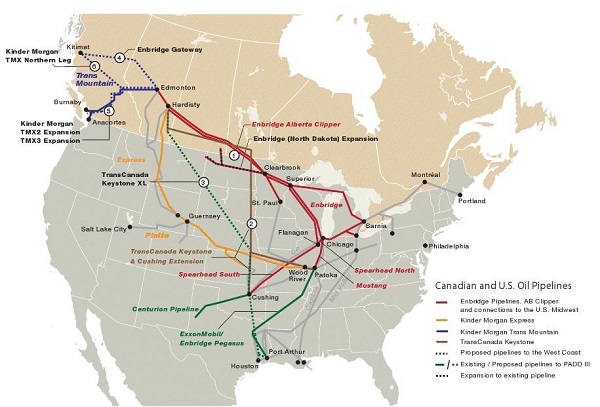
Oil pipelines already cross Canada and the United States- Ontario's Green Party stands opposed to a proposed Oil pipeline (using a modified natural gas pipeline) set to cross into and through Ontario. CP image: leadenergy.org
Oil pipelines already cross Canada and the United States- Ontario’s Green Party stands opposed to a proposed Oil pipeline (using a modified natural gas pipeline) set to cross into and through Ontario. CP image: leadenergy.org

Ottawa – Green Party leader Mike Schreiner is pledging to fight two oil pipeline projects through Ontario.  Joining Ottawa South candidate Taylor Howarth on a campaign tour, Schreiner and Howarth raised concerns about the health, environmental and economic effects of TransCanada Corp.’s proposed east coast pipeline, which travels through Ottawa, and Enbridge’s proposed Line 9 pipeline. Both projects
will pump tar sands oil east.

“Greens will fight for the health and safety of our communities,” says Schreiner. “If BC can say no to dirty oil pipelines, Ontario should too.”    TransCanada’s proposed Energy East pipeline could transport as much as 850,000 barrels of tar sands oil per day. The project would require retrofitting a 55 year old natural gas pipeline to handle the heavy, more abrasive and corrosive tar sands oil.

“I don’t want to see a tragedy in my community, and I will fight to prevent it,” says Howarth. “This pipeline was not built to handle tar sands oil, and as MPP, I will push the Ontario government to oppose the project. Every vote for the Green Party sends this message to Queen’s Park.”

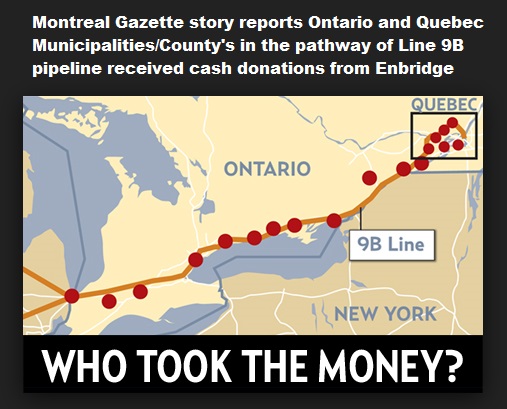
According to the Montreal Gazette- Municipalities and Counties strung along the Line 9b pathway received cash donations from Enbridge. CP


Studies in the U.S. reveal that pipelines carrying tar sands oil spilled almost three times as much crude oil per mile of pipeline between 2007 and 2010 compared to the U.S. national average. And heavy tar sands oil is more difficult and expensive to clean up than light crude or natural gas.    “Both of these pipeline projects are a bad deal for Ontario,” says Schreiner.

“These pipelines are all risk and no reward.”   Instead of projects that will increase pollution and greenhouse gas emissions, the Green
Party is calling for policies to support clean tech innovation.    “Ontario must invest in where the puck is going, not where it is, to create jobs and clean prosperity,” says Schreiner. “Ontario should commit to building electric cars that don’t pollute and support made in Ontario renewable energy, not pipelines that threaten our communities.”   For the Silo, Becky Smit.

Supplemental-  Ontario Energy Workers union backs proposed Line 9 Oil pipeline  http://business.financialpost.com/2013/07/09/energy-workers-union-backs-line-9-project-calls-for-stricter-oil-by-rail-regulation/?__lsa=6225-fce3

Enbridge Website Line9 Reversal Phase 1 Project Overview http://www.enbridge.com/ECRAI/Line9ReversalProject

Crop Circles And Sacred Sites Of England Tour

Most patterns in crop circle formations are not readily visible from ground level but details can be noticed and pathways lead to contemplation, relaxation and discovery. Did you know that in Summer 2011 The Silo visited a crop circle in Port Dover,Ontario, Canada? Check back later- we will upload a photo soon CP
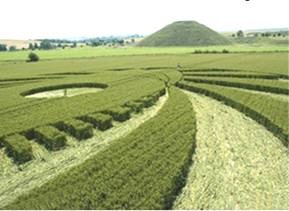
Most patterns in crop circle formations are not readily visible from the ground.

Most tangible of Earth mystery
Created anew each year
On underground currents of energy
By sacred sites do appear –
Bedazzle us with your beauty yet again!


There are few mysteries more accessible than crop circles. Each spring and summer these enigmatic patterns appear overnight in crop fields, particularly around the Avebury landscape temple in Wiltshire, England. Whenever possible we enter these beautiful creations within hours of their forming, when the energy of a genuine formation is at its strongest. Cosmic works of art, ET communications in sacred geometric format, pranksters’ hoaxes, spiritual guidance or a warning voice from Gaia, whatever your opinion crop circles are fascinating and truly remarkable.

We have access to the information network that provides breaking news on the latest formations. Some days expert researchers will join us in the circles to share their knowledge and perspectives with us, showing us what to look for or how to dowse for any energy present. You may want to sit quietly in meditation, try and discover what the pattern is (often difficult to tell from the ground inside a formation) or dance with the flow of the lain stalks. Everyone reacts differently to crop circles but no-one can ignore them.


This part of England is also home to some of the world’s most powerful ancient sacred sites including Stonehenge, Avebury and Glastonbury. We will take time to truly experience these places of power including exclusive access to the world famous Stonehenge for a private visit outside of normal hours. Being based close to the World Heritage Site of Avebury Landscape Temple we have daily access to such sites as Silbury Hill, West Kennet Long Barrow and the Sanctuary. In historic Glastonbury we will visit the Abbey, Chalice Well and the Tor.

We’re also offering a pre-tour extension to attend the prestigious Summer Crop Circle Lectures where you will hear fascinating presentations and meet the presenters as well as all the other ardent ‘croppies’.


May we recommend Track 7 Disc 2's "Trampled Underfoot" for listening to while walking through your Crop Circle? ;)
Track 7 Disc 2: “Trampled Underfoot”


Tour Highlights:

• Visits into crop circles
• An optional helicopter flight over these exquisite patterns
• Private out-of-hours access into Stonehenge
• Attendance at the world’s leading Crop Circle Conference with International researchers
• Visits to some of England’s most powerful sacred sites

Supplemental- Crop circles discovered West of Port Dover, Ontario?

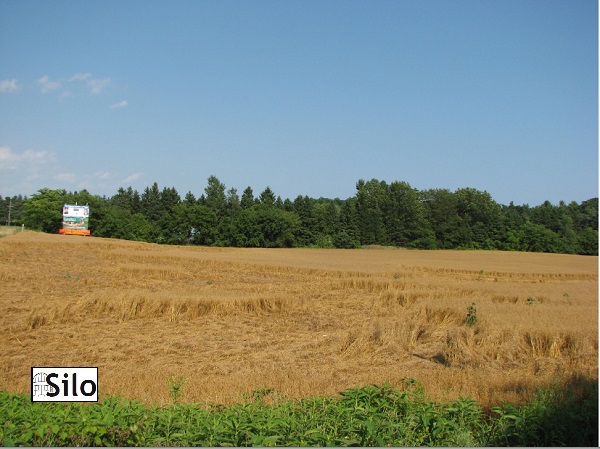
We would have liked a higher vantage point. We saw geometric patterns in the crops. These patters were not visible the day before. This field was cut within 24 hours of this photo being taken. image: Mith Media/The Silo all rights reserved


Writer Releasing Video Arcade Game Dragon’s Lair Book

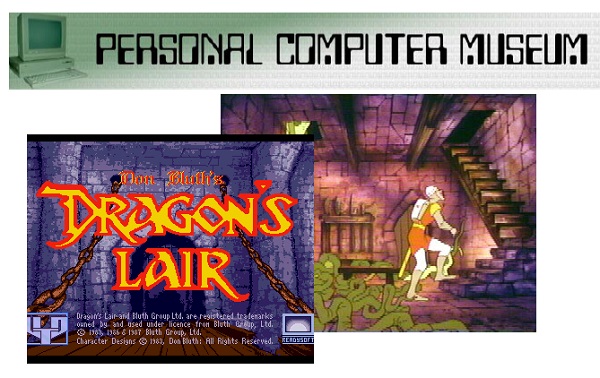
Collecting for Dragons Lair and Space AceBrantford, ON. The Personal Computer Museum is publishing a brand new book called “Collecting for Dragon’s Lair and Space Ace” (ISBN 978-1490383583) that covers two of the most loved LaserDisc video games ever made. Dragon’s Lair officially turned 30 years old on June 19, 2013.

Written by Syd Bolton, who (according to the CBC) has the largest collection of video games in Canada.

Collecting for Dragon’s Lair and Space Ace not only chronicles the hundreds of home releases of games, clothing, collectible merchandise, magazines, toys and more, but also includes an incredible amount of behind-the-scenes information on the development of the games which continue to see home releases right up until this year.

“Along with an introduction that’ll likely slap a nostalgic smile across your face, Syd Bolton has exhaustively aggregated and annotated virtually every Dragon’s Lair and Space Ace video game and merchandise known to modern man” says Marc Saltzman, syndicated gaming and technology columnist, author, TV and radio show host. “While it’s a specialist’s book, game enthusiasts, retro fans, and old folks will find it a fun read” says Steven Kent, noted video game historian and author of “The Ultimate History of Video Games”.

The book will ship next week (July 24, 2013) and can be ordered through the website

www.collectingfor.com, which will contain support materials for the book shortly. The book will also be available on Amazon.com next week. It is 170 pages, 8.5″x11″, full color and perfect bound.

Dragon’s Lair recently celebrated its 30th anniversary and was the first fully animated LaserDisc video game. It generated millions in sales and revived, for a short time, the ailing arcade industry. The follow-up, Space Ace, was released in the Spring of 1984. Unfortunately, the arcade business continued to decline. Both games have been available for home computers and game consoles since 1984 spanning hundreds of releases and also spawned many related items.


Interest in the franchise has continued to this day and there is even a new documentary film “Inside the Dragon’s Lair” in the works which is expected to release in 2014. For the Silo, by Syd Bolton. 


Ontario Greens- Inaction on Ombudsman recommendations puts Ontarians ‘at risk’

See the supplemental section below for more on this photo-

Green Party of Ontario leader Mike Schreiner made the following statement in response to the Ombudsman’s 2012-2013 Annual Report [search the report here at thesilo.ca CP ]:   “Whether it’s safe transportation for medical issues, our civil liberties or responsible, accountable government, the Liberal government has put people at risk by failing to act.

It is especially irresponsible that the Liberal government has failed to introduce legislation to address the appalling conditions of non-emergency medical transportation services.

The current Premier promised action two years ago when she was Minister of Transportation, yet nothing has happened. According to the Ombudsman, the current Transportation Minister was unaware of how serious this issue is and the need to take action now. Ontario can’t afford to wait for a tragedy to take action.

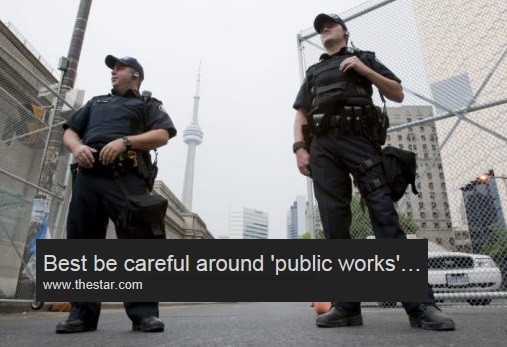
Three years after the Liberals violated our civil liberties at the G20 summit in Toronto, the outdated  Public Works Protection Act: http://www.e-laws.gov.on.ca/html/statutes/english/elaws_statutes_90p55_e.htm  has not been overhauled. All three status quo parties at Queen’s Park shoulder the blame for the delay in fixing this serious breach of our civil liberties.

Finally, it is embarrassing that Ontario remains the only province without Ombuds oversight of hospitals, long term care facilities, children aide societies and other MUSH sector public institutions.  With the Liberals third-rate cover up of the gas plant scandal, we’ve seen this government demonstrate a fear of proper oversight and accountability.


It’s unacceptable that they continue to fail to provide citizens with proper oversight of the MUSH sector.

The Ombudsman’s annual report once again shows the Liberals are a bait and switch government. They say one thing and do another or simply fail to act.”      For the Silo, Becky Smit


Supplemental- Little known Public Works protection Act grants Police Forces sweeping powers: http://www.thestar.com/opinion/editorialopinion/2010/07/14/best_be_careful_around_public_works.html

Ontario’s public watchdog office- The Ombudsman http://www.ombudsman.on.ca/home.aspx?lang=en-CA

Comic Auction Featured Jack Kirby Drawings Connected To Argo Film

Dynamic Duo: Finest Batman #1 Known, Frank Miller’s Dark Knight #2 Cover Art May Each Hit $500,000+ In Heritage Comics & Comic Art Event

Frank Miller Batman: The Dark Knight Returns #2 Iconic Cover Original Art (DC, 1986)A Dynamic Duo of Dark Knight treasures, led by the highest-graded copy of Batman #1, ever certified in 9.2 grade, and Frank Miller’s original cover art for The Dark Knight Returns #2, 1986, are expected to bring $500,000+ each in Heritage Auctions’ Comic and Comic Art Auction Aug. 1-3.

“Whenever you offer the highest-graded copy of one of the top comics in the hobby you can bank on fierce bidding,” said Barry Sandoval, Director of Comics Operations for Heritage Auctions. “This auction is an ideal hunting ground for elite collectors and the 9.2 grade example of Batman #1 represents the quality offered throughout the entire event.”

A landmark edition in the halls of American pop culture, Batman #1 features the first appearances of both the Joker and Catwoman, among the very few comic book villains to have attained true “household name” status. It is expected to reach $500,000+.

A worthy follow up to such an iconic comic book is Frank Miller’s iconic original cover art to The Dark Knight Returns #2, which also is expected to bring $500,000+. The instantly recognizable image of Batman, crippled with rage, is one of several pieces of original art from the groundbreaking Dark Knight series offered by Heritage in the last year.

Batman #1 (DC, 1940) CGC NM- 9.2 Off-white pages“For fans of Modern comics, this drawing is where everything really begins,” said Todd Hignite, Vice President at Heritage Auctions. “This moment defines Miller’s Dark Knight, and the modern day perception of Batman, like no other drawing. The only one that comes close, perhaps, is the iconic Splash page from Dark Knight #3, featuring both Batman and Carrie Kelley (Robin), which we sold two years ago for $448,125.”

Among the high-grade examples of the most coveted comic books ever produced comes a near pristine copy of an increasingly popular comic book, Avengers #1 — in stunning 9.4 grade — is expected to realize $175,000+; a 9.4 grade copy of Tales of Suspense #39, the first appearance of Iron Man, which is expected to bring $100,000+; a rare, 9.0 grade copy of Walt Disney’s Comics and Stories #1 may fetch $30,000+ as the finest copy in a remarkable run that also includes a 9.4 grade of issue #2 and a 9.2 grade of issue #3 from the series, both of which are the highest-graded copies.

A collector’s pick of high-grade examples continues as the only 9.8 grade copy of Marvel Spotlight #5, the first appearance of Ghost Rider, is expected to realize $25,000+.

Carmine Infantino and Joe Giella The Flash #117 Cover Original Art (DC, 1960)In addition to the dramatic cover from Dark Knight #2, the auction’s offering of original art includes a remarkable movie poster painted by Frank Frazetta for The Night They Raided Minsky’s. Frazetta usually worked in much smaller sizes, making this 38-inch by 28-1/2-inch poster from 1968 an extreme rarity expected to bring $150,000+.

Robert Crumb’s complete 1968 original art for a five-page story titled “City of the Future,” initially stolen from Crumb and slated for Zap Comix #1, is expected to reach $100,000+. Fresh-to-market original cover art from titans Carmine Infantino and Joe Giella from The Flash #117, from 1960, is expected to realize $50,000+ in its first appearance at auction.

Perhaps two of the most anticipated lots link to The King of Comics himself, Jack Kirby, to a covert Iranian rescue operation as depicted in the Academy Award-wining film Argo [ See a nod to Canada’s connection in Ben Affleck’s acceptance speech below CP].


The film tells the story of how the CIA used a fake movie production crew to conceal a daring rescue mission of six Americans held in Iran. The “movie within a movie” was at one time a genuine project titled “Lord of Light,” based on the novel by Roger Zelazny. Producer Barry Geller commissioned Jack Kirby to create a set of concept drawings for the film, but the project stalled and was mostly forgotten, until the CIA used it in their top-secret mission. Two of Kirby’s original oversized concept scene drawings for the project — “Pavilions of Joy” and “Planetary Control Room (Interior)” — remain testaments to his signature style and are expected to bring $10,000+ each.