Tag Archives: Vogue Magazine

Poland Signs Fur Ban Law to End Reign as EU’s Largest Producer

WARSAW, Poland (Dec., 2025) — In a monumental victory for animals and a devastating blow to the global fur trade, Poland has officially enacted a ban on fur farming. The legislation, signed into law by President Karol Nawrocki, marks the end of an era for the European Union’s largest remaining fur producer.

The victory comes after intense international pressure, including a campaign by In Defense of Animals, which rallied supporters to write thousands of letters to President Nawrocki and Marshal of the Senate Małgorzata Kidawa-Błońska. While initial reports suggested leadership might block the ban, the overwhelming global outcry helped ensure the measure was signed into law.

The timing of this legislation sends a shockwave through the fashion industry, arriving just days after activists across the U.S. rallied for Fur Free Friday, and as major fashion institutions, including Vogue, increasingly pivot toward coverage of ethical, cruelty-free alternatives.

Anti-fur demonstrators rally outside the Louis Vuitton flagship store in Beverly Hills, California, on Fur Free Friday, Nov. 28, 2025

“This is a watershed moment in the history of animal protection. By dismantling the fur industry in its largest European stronghold, Poland has effectively dealt a devastating blow to the global fur trade,” said Katie Nolan, Wild Animals Campaign Specialist for In Defense of Animals. “Just last week, Americans marched for Fur Free Friday, and today, we see the results of that global momentum. Whether it is the pages of Vogue or the halls of the Polish Parliament, the message is clear: the future of fashion is fur-free.”

Poland’s exit from the industry holds significant weight for the American market. As the European Union’s largest producer, the country’s ban will drastically reduce the volume of animal pelts available to global fashion houses, disrupting the supply chain and accelerating the industry’s decline in the United States and abroad.

Beyond economics, the ban addresses severe public health risks that transcend borders. Polish fur farms have recently been identified as hotspots for COVID-19 and avian influenza, posing a global threat that this legislation helps mitigate. This victory also reinforces the ethical momentum building stateside, aligning with legislation already passed in California and bans in major fashion cities to further isolate the few remaining supporters of the fur trade.

The new law mandates a phase-out of the industry, ending the confinement of millions of mink, foxes, and raccoon dogs. These animals, in particular the semi-aquatic mink, have historically been forced into barren wire cages, denied their natural needs, and subjected to gruesome deaths via gassing or electrocution.

In Defense of Animals celebrates this victory with its supporters and coalition partners who refused to let this ban die in the US Senate.
The Many Cultural Charms Of Buenos Aires Argentina

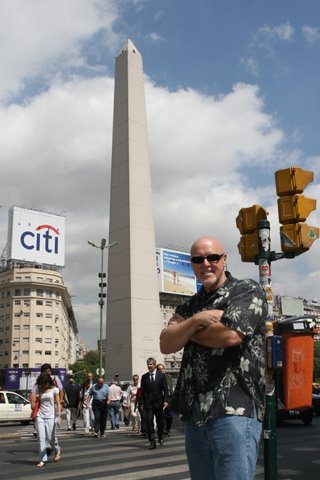
Obelisk in Buenos Aires
George at the obelisk…

Feel Cooler Than You Really Are. If you want to learn to dance the tango the place to be is Buenos Aires, Argentina. This is a city that expresses its passion and national pride through their music, soccer, dancing, horses, and writing earning it the title of “City of Cool”.

Buenos Aires, (English meaning Fair Winds) Argentina.
With a population of 2.7 million people this capital city of Argentina is a place oozing with charm and things to do. From the moment you begin wandering downtown streets you know it’s going to be interesting. It’s a place to be cool even if you aren’t. Okay, let’s make it clear, I’m not cool, but for some unknown reason I started to feel this way when I mingled with the Argentineans. They spoke, what sounded like to me, an exotic language (Castilian Spanish), and looked and dressed like they were right out of the pages of Vogue magazine. It’s a city that never sleeps, populated by residents obsessed with fashion and image. Slim is beautiful is an established and largely uncontested fact.

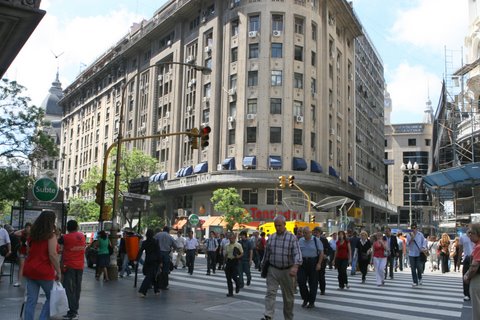
Curvy architecture emphasizes the ‘tango’ speed and ‘coffee’ streamlining of Buenos Aires culture

Architecture
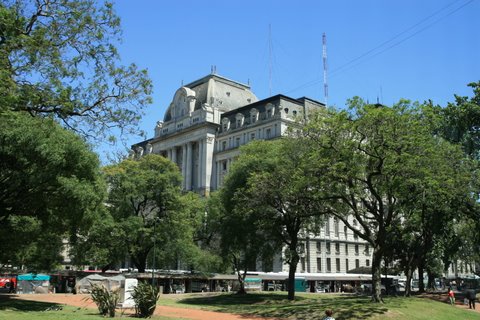
The downtown architecture is quite different from the rest of Latin America. It is strongly influenced by European styles with more than the half of the city buildings being French style. Countless museums, historical buildings, shopping centres, and hotels are yours to discover. And if you do get the urge to learn to tango there are plenty of tango-dancing schools (known as academias) throughout the city.

Bueons Aires is also known as a “city of buildings”

The Tango
Tango music was born in the suburbs, notably in the brothels of poorer suburbs. Its raw sensual dance moves were not seen as respectable until adopted by the Parisian high society in the 1920’s and then all over the world. There are loads of places with free tango shows in restaurant-bars such as Gitanos, where you can also try the national drink. I found it more like herbal tea than anything and its drunk out of a pot-like container through a metal straw. Even though it was foul-tasting, Argentineans say, it’s more addictive than coffee. To each their own.

Walking and Safety
When you walk in any largely populated area don’t be silly and carry an expensive camera slung over your shoulder and don’t ever wear an expensive watch that sets you apart from the crowd. It’s like saying rob-me, rob-me. Use common senses; err on the side of caution. I hid my camera in a plastic shopping bag. Always cross street at crosswalk. I’ll say it one more time to be sure it sinks in…Always walk at crosswalks and don’t begin until all vehicles have come to a stop.

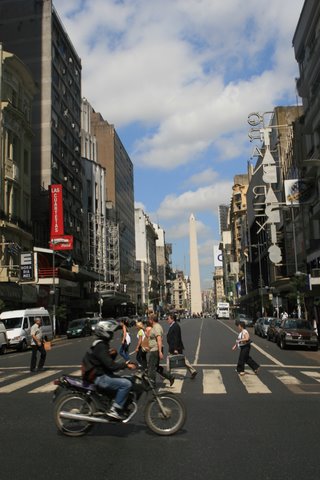
Streets are busy but have marked crosswalks and are well laid out

Recoleta Cemetery
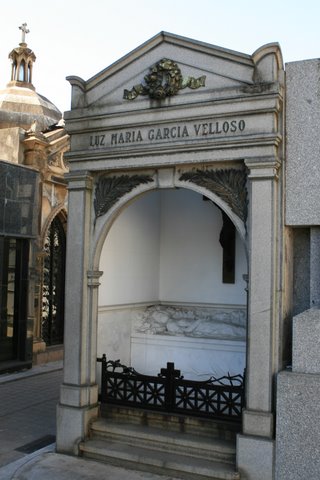
Don’t pass up the chance to visit to the Recoleta Cemetery established in 1822. It’s the final resting place for Argentina’s wealthiest and most famous families and people. The mausoleums are fairly small, befitting the size of the cemetery in an urban setting, and it’s common for many members, and generations even, of the same family occupying one mausoleum. One grave that I did seek out was that of Eva Peron who was the wife of Juan Peron, 3 time president of Argentina. Both are idolized for their efforts to eliminate poverty and to bring dignity to the labour movement. Because of this they were despised by the oligarchy of Argentina’s wealthy and powerful. I found it strange and a bit sad that her neighbours in death are those that despised her in life. Her husband is buried in another cemetery in the city.

Mausoleum at the Recoleta Cemetery

Art and Craft Museums
These museums are all the rage here, with the top attraction being the Malba, which is dedicated to Latin American modern art, the Museo National de Bellas Artes (National Museum of Fine Arts) and Recoleta’s Cultural Centre.  You’ll find the general atmosphere in most of these places is more snooty than sincere. If art and crafts is not your thing, you’ll want to bypass all of these places and scout out somewhere to eat or sit on the grass in Plaza Francia. It’s easy to while away a few hours people-watching. I did both.

Where ever you travel, remember to take time to meet the local people. You will learn much about the culture of a place by watching and talking with citizenry.

The Obelisk
Another must see is to join the gaggle of tourists (and pigeons) that flock to the Plaza de Mayo. This is the site for some of the country’s most important historical occasions, including the revolution in 1810 which led Argentina gaining independence from Spain .If your legs are willing, take a stroll along Avenida Corrientes. When you get to the junction with Avenida 9 de Julio, which claims to be the world’s widest road where you can’t miss the famous Obelisk monument. For goodness’ sake use the pedestrian crossing if you don’t want to die! It’s the cities icon and the place the very spot where the Argentina flag was raised for the first time.       For the Silo, George Bailey.