An 8 MINUTE READ via our friends at Share Ameria
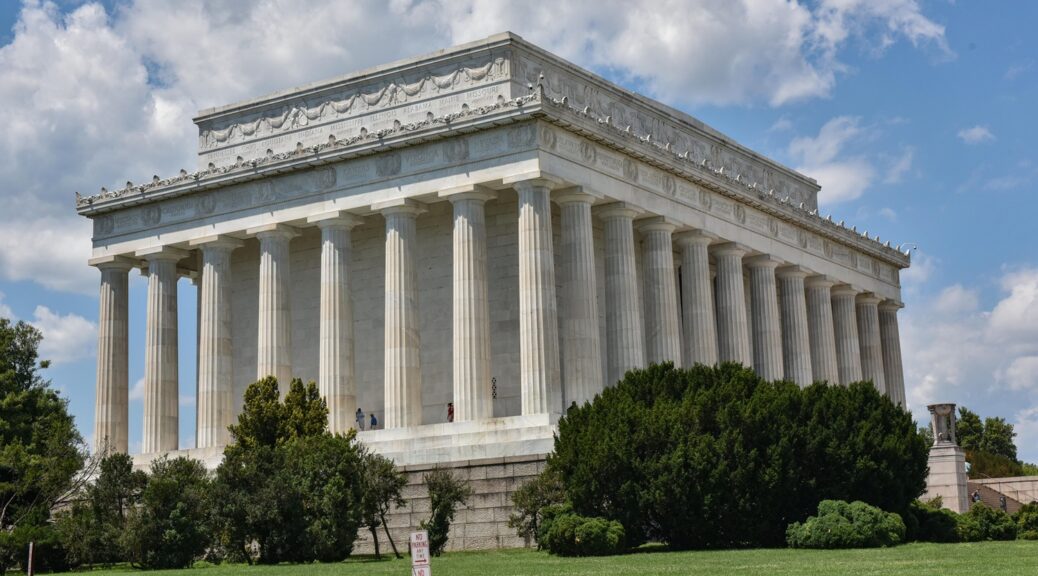
With its marble columns and towering dome, the U.S. Capitol is one of Washington’s most beautiful structures and a striking example of how classical architecture has influenced America’s civic buildings.
President George Washington, who laid the Capitol’s cornerstone in 1793, and Secretary of State Thomas Jefferson saw the architecture of ancient Greece and Rome as emblematic of their new nation’s democratic ideals. To Jefferson, classical architecture’s large entrances and symmetrical layouts symbolized openness and equality, values embodied in the U.S. Constitution. Washington commissioned French architect Pierre L’Enfant to create a classical design for the nation’s capital city.
“They sought to use classical architecture to visually connect our contemporary Republic with the antecedents of democracy in classical antiquity,” President Trump says in an August 28, 2025, executive order on restoring classical designs to American architecture.

The National Civic Art Society, which promotes meaningful public design, finds that 72% of Americans prefer traditional designs derived from classical architecture over modernist styles for federal buildings.
To David Gobel, a professor of architectural history at the Savannah College of Art and Design, those results aren’t surprising. “Classical architecture is a universal language,” Gobel says. “People don’t have to know their Doric, Ionic and Corinthian orders [of Greek architecture] to recognize that this is familiar, that it is the architecture of the ages.”
Classical architecture’s influence extends across America, most notably in state capitol buildings from coast to coast. American architects introduced stylistic variations, creating civic buildings that reflect both American culture and its natural landscape.
Richmond, Virginia

The U.S. Capitol wasn’t the first civic building in the United States to evoke Greek and Roman antiquity. That distinction belongs to the Virginia Capitol building designed by Jefferson in 1785.
Jefferson’s design recalls the Maison Carrée, an ancient Roman temple in Nîmes, France. Both buildings have a triangular pediment atop a wide, columned entryway. Yet Jefferson took a more streamlined approach, choosing simple Ionic columns, rather than the elaborate Corinthian columns seen on the Roman temple in France.
Montpelier, Vermont

The Vermont State House in Montpelier, constructed in 1859, departs from classicism’s traditional use of white marble in favor of local gray granite, bringing a more rugged look tailored to its setting in the Green Mountain range.
The main lobby highlights national and local leaders with statues of Abraham Lincoln, the 16th U.S. president, and Revolutionary War hero Ethan Allen, who was one of Vermont’s founders.
Lansing, Michigan

The Capitol building in Michigan, built between 1872 and 1878, combines classical design with American practicality. Artisans in the iron-producing state painted the interior using trompe-l’oeil techniques to trick the eye and make iron and pine wood materials resemble more expensive marble and walnut.
Salt Lake City, Utah

Constructed between 1912 and 1916, the Utah Capitol combines granite building material with classical styles, including Corinthian columns and a dome. The building’s interior murals depict the state’s history and geography, with images of Mormon pioneers and covered wagons, as well as Utah’s famed Great Salt Lake and red-rock canyons.
American architects continue to add new flourishes to classical designs, says Gobel, the architectural history professor. Recent examples include the Federal Building and Courthouse in Tuscaloosa, Alabama, and the Charleston Gaillard Center, a performing-arts venue in Charleston, South Carolina. The Gaillard Center, completed in 2015, features interior columns crowned with palmettos, a nod to South Carolina’s state tree. Completed in 2011, the Federal Building in Tuscaloosa has a metal roof, a feature commonly used in southern architecture for durability and heat resistance.
“It’s a tradition dating back thousands of years, and it’s never stopped,” Gobel says of classical architecture. “Its purpose is not to represent a particular age or place, but something higher and greater to which we can aspire.”
For the Silo, Lauren Monsen.