Tag Archives: population

Canada Joins World’s Impending Population Crisis

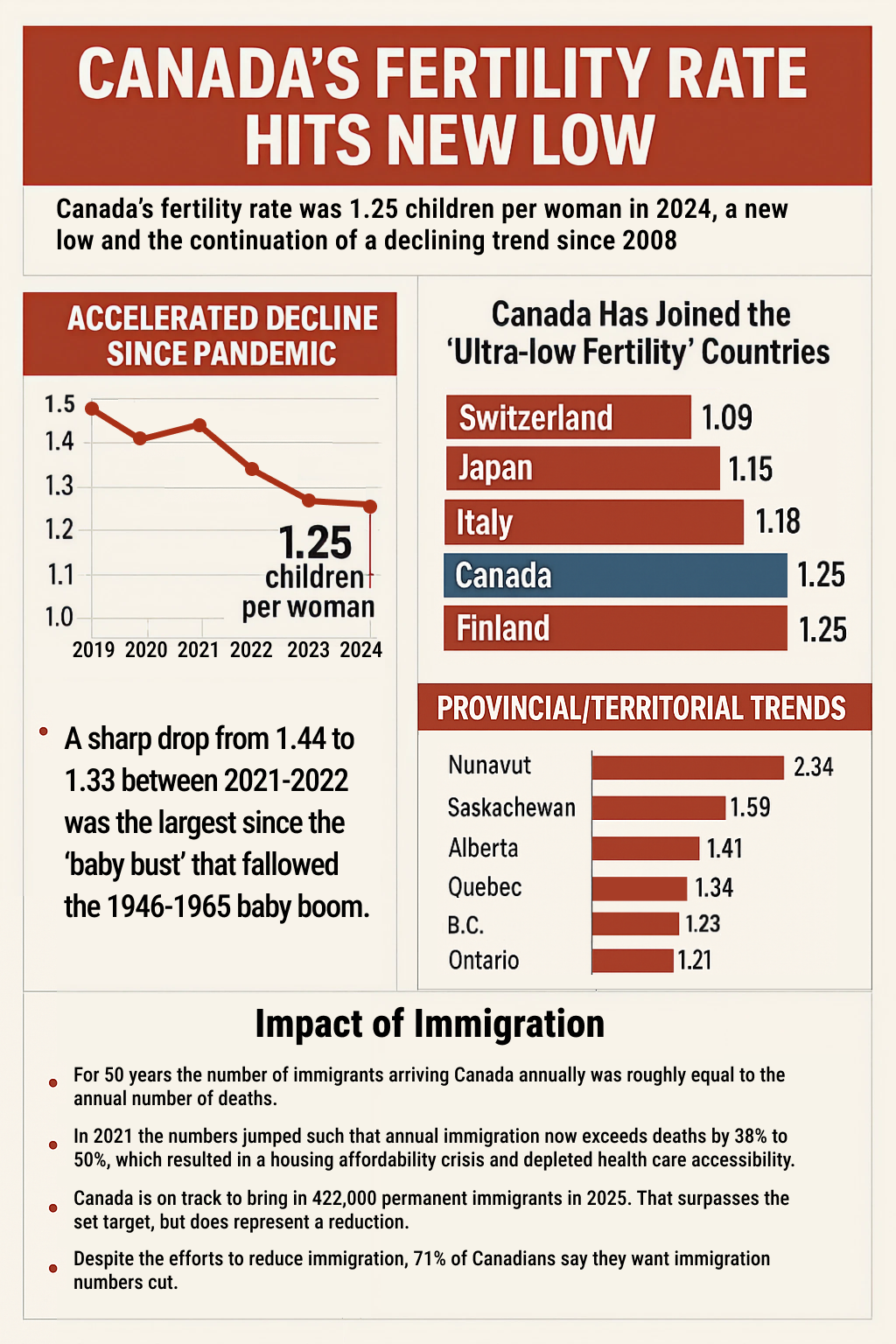
Canada’s fertility rate has just hit a record low.
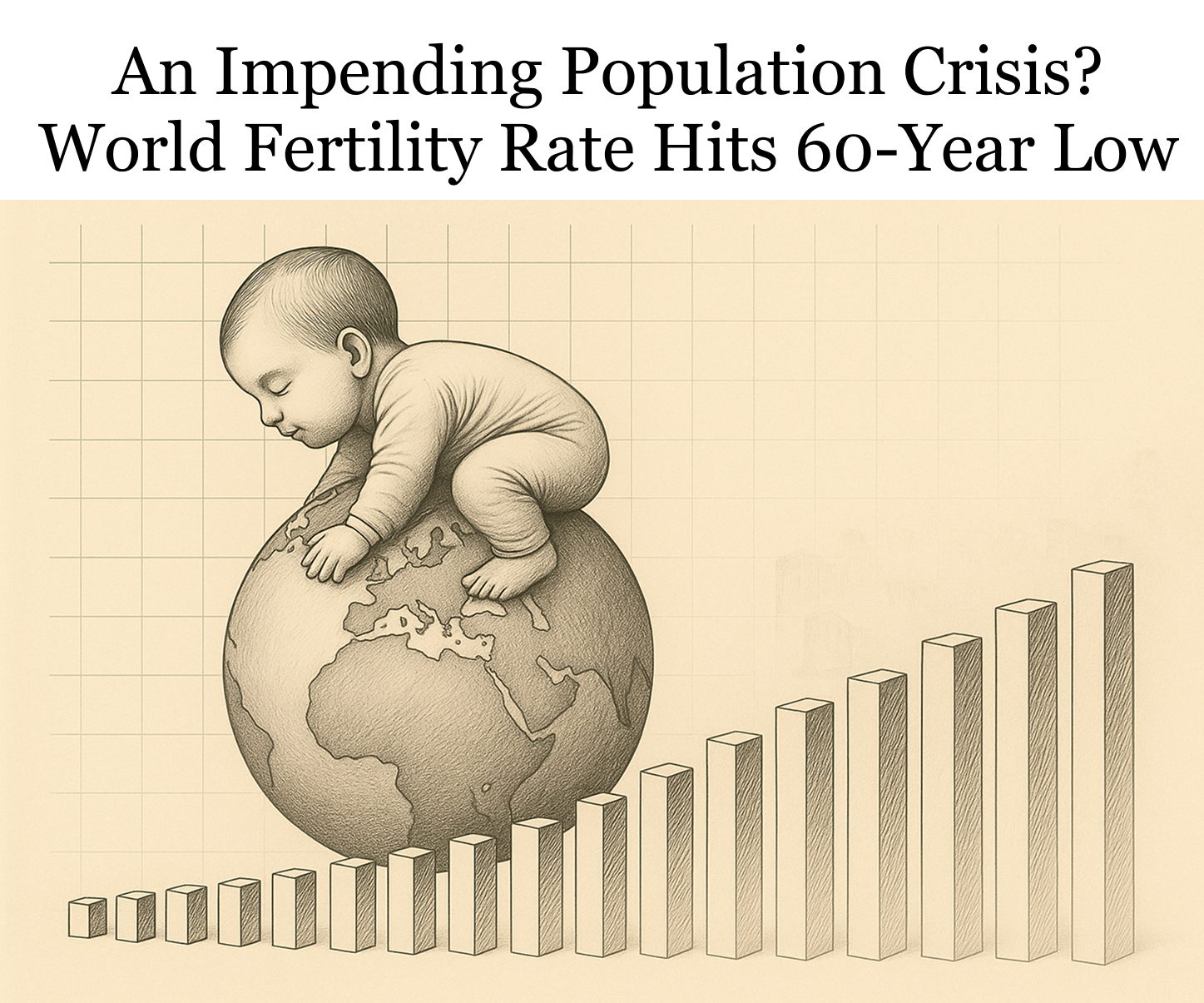
In case you missed it- the world is quietly entering a population crisis. Global fertility rates have plunged to their lowest level in 60 years, raising profound questions about how societies will sustain themselves in the decades ahead.
In Canada, births have fallen to just 1.25 children per woman, the lowest in our history. Behind the numbers are shifting values, economic pressures, and growing uncertainty about the future.
This week, let’s examine the global decline in birth rates and explore what’s driving it—and what it means for the economy, family, and national identity.
An Impending Population Crisis? World Fertility Rate Hits 60-Year Low
For the Silo, By Sylvia Xu / Epoch Times.

Fertility rates have plummeted worldwide over the past six decades, leading experts to warn of dire consequences as the downward trend continues.
Continued low fertility rates will cause “a gradual implosion of the world’s economy as the population ages and dies,” Steven Mosher, president of the Population Research Institute.
Mosher is an expert on population control, demography, and China.”
This will not occur overnight, of course, but once it is well underway, it will be difficult, if not impossible, to reverse course,” he said.
The fertility rate is the average number of children born to a woman in her lifetime; the birth rate is the number of live births per 1,000 people in a population over a given period.
Macroeconomist Jesús Fernández-Villaverde called low fertility rates “the true economic challenge of our time” in a February report for the American Enterprise Institute.
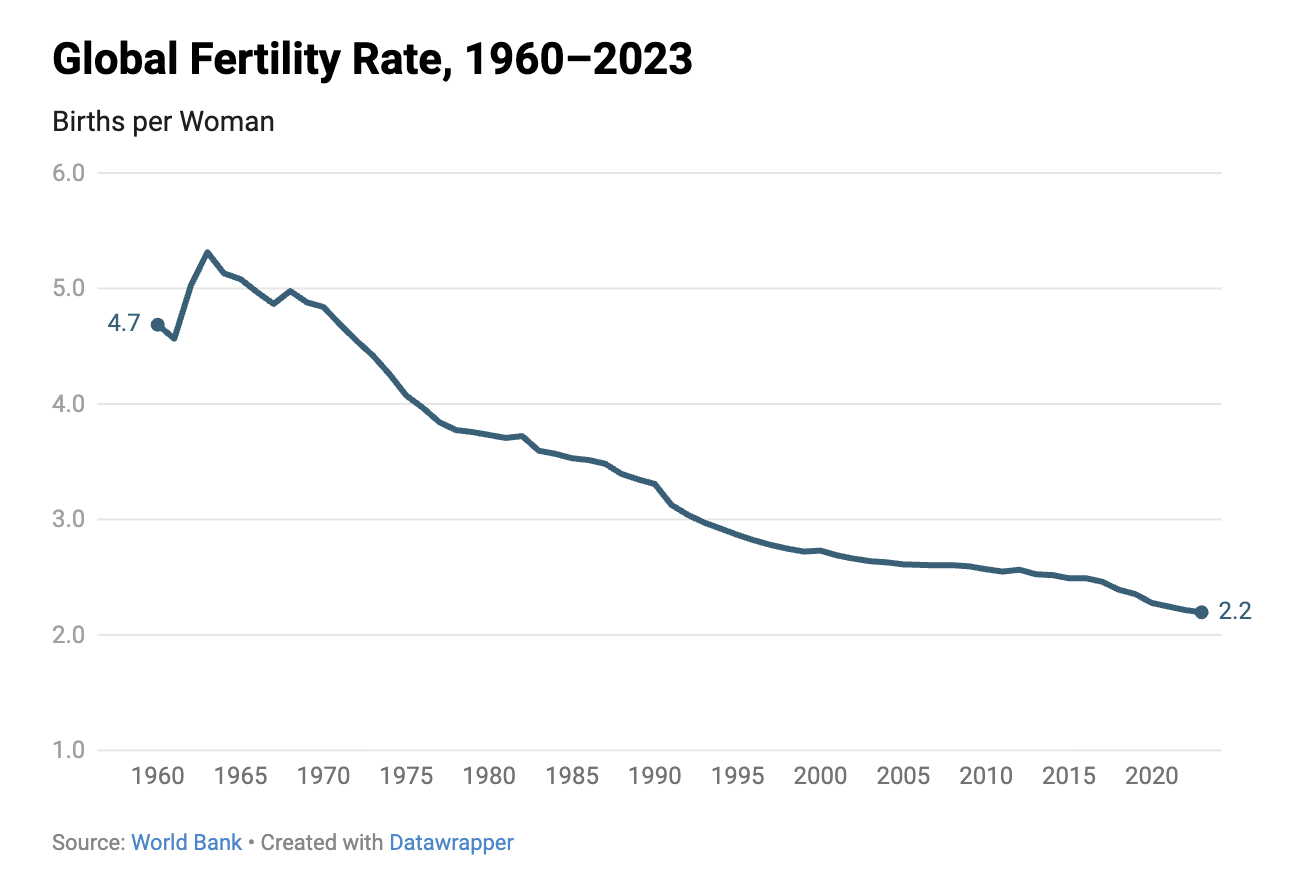
In 1960, the fertility rate was between four and five. By 2023, that number had halved to 2.2, approaching 2.1, the level at which a population replaces itself from one generation to the next.In July, the U.S. Census Bureau projected that the world’s population will reach 8.1 billion this year. Experts say that although the figure has grown from 3 billion in 1960, the number to watch is the pace of population growth.”
The rate of growth peaked decades ago in the 1960s and has been declining since and is projected to continue declining,” the Census Bureau stated.
Fernández-Villaverde warned that although the sagging rate of growth may not have immediate consequences, in less than 50 years, declining fertility will affect the world economy. Countries with low or negative birth rates will contend with a shrinking workforce and the ballooning costs associated with an aging population.
Global Fertility Rates
Only about 4 percent of the world’s population is in countries with high fertility rates—more than five children per woman—and all of those nations are in Africa, according to the Census Bureau. Even in those countries, fertility rates are generally lower than they once were.
The Census Bureau reported that nearly three-quarters of the world’s population is in countries where fertility rates are at or below the replacement level.
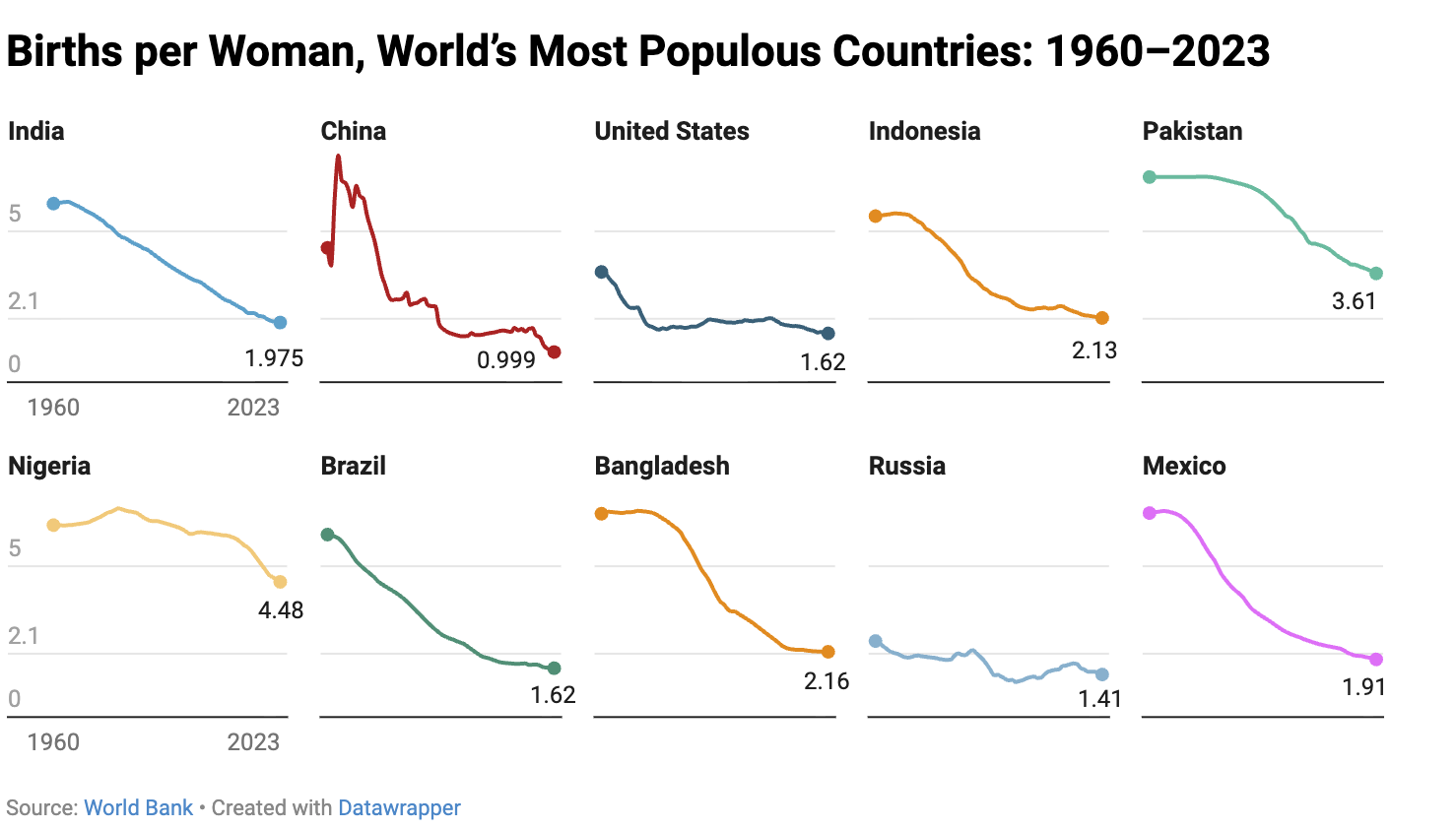
The fertility rate in India, the world’s most populous country, has steadily declined over the past six decades. In June, the U.N. Population Fund reported that India’s fertility rate stood at 1.9 children per woman, down from five or six children in 1960. In Canada, fertility rate fell to 1.25, well below the replacement level of approximately 2.1 children per woman needed to maintain a stable population.
In 1990, China’s fertility rate was 2.51, despite its one-child policy. By 2023, it had dropped to less than one birth per woman, according to the U.N.’s population division.In the United States, fertility has undergone a persistent decline. It fell below the replacement level in 1972, and in 2023, it reached 1.62—a historic low.Asian and European countries have the lowest fertility rates in the world, and South Korea (0.72), Singapore (0.97), Ukraine (0.977), and China (0.999) all have rates below one.  (Read More →)
Key Data & FactsSource: Statistics Canada

Canada & World Birth Rate At Historical Low

 Image and article via our friends at The Epoch Times
The world is quietly entering a population crisis. Global fertility rates have plunged to their lowest level in 60 years, raising profound questions about how societies will sustain themselves in the decades ahead. In Canada, births have fallen to just 1.25 children per woman, the lowest in our history. Behind the numbers are shifting values, economic pressures, and growing uncertainty about the future. Let’s examine the global decline in birth rates and explores what’s driving it—and what it means for the economy, family, and national identity.
Fertility rates have plummeted worldwide over the past six decades, leading experts to warn of dire consequences as the downward trend continues. Continued low fertility rates will cause “a gradual implosion of the world’s economy as the population ages and dies,” Steven Mosher, president of the Population Research Institute, told The Epoch Times in an email. Mosher is an expert on population control, demography, and China.
“This will not occur overnight, of course, but once it is well underway, it will be difficult, if not impossible, to reverse course,” he said. The fertility rate is the average number of children born to a woman in her lifetime; the birth rate is the number of live births per 1,000 people in a population over a given period. Macroeconomist Jesús Fernández-Villaverde called low fertility rates “the true economic challenge of our time” in a February report for the American Enterprise Institute. In 1960, the fertility rate was between four and five. By 2023, that number had halved to 2.2, approaching 2.1, the level at which a population replaces itself from one generation to the next.In July, the U.S. Census Bureau projected that the world’s population will reach 8.1 billion this year. Experts say that although the figure has grown from 3 billion in 1960, the number to watch is the pace of population growth. “The rate of growth peaked decades ago in the 1960s and has been declining since and is projected to continue declining,” the Census Bureau stated. Fernández-Villaverde warned that although the sagging rate of growth may not have immediate consequences, in less than 50 years, declining fertility will affect the world economy. Countries with low or negative birth rates will contend with a shrinking workforce and the ballooning costs associated with an aging population.
Global Fertility Rates
Only about 4 percent of the world’s population is in countries with high fertility rates—more than five children per woman—and all of those nations are in Africa, according to the Census Bureau. Even in those countries, fertility rates are generally lower than they once were. The Census Bureau reported that nearly three-quarters of the world’s population is in countries where fertility rates are at or below the replacement level. The fertility rate in India, the world’s most populous country, has steadily declined over the past six decades. In June, the U.N. Population Fund reported that India’s fertility rate stood at 1.9 children per woman, down from five or six children in 1960.In Canada, fertility rate fell to 1.25, well below the replacement level of approximately 2.1 children per woman needed to maintain a stable population. In 1990, China’s fertility rate was 2.51, despite its one-child policy. By 2023, it had dropped to less than one birth per woman, according to the U.N.’s population division .In the United States, fertility has undergone a persistent decline. It fell below the replacement level in 1972, and in 2023, it reached 1.62—a historic low.Asian and European countries have the lowest fertility rates in the world, and South Korea (0.72), Singapore (0.97), Ukraine (0.977), and China (0.999) all have rates below one.
Key Data & FactsSource: Statistics Canada

For The Silo, Sylvia Xu/ Epoch Times.

Nashville Population Rise Sparks Demand for Condo Development

Meg Epstein, founder of CA South Development and Condo Queen of Nashville, has funded over $200 million usd in the expansion of condo projects aimed towards bridging the gap of disproportionate construction of properties in Downtown Nashville.

According to the U.S Census Bureau, Nashville, Tennessee has witnessed a steady hike in population within the metro area as it’s averaging approximately 100 new residents per day. Forbes lists the city as the 7th on America’s Fastest Growing City List. The resulting and overwhelming demand for housing in the metro area has lead to an influx of rental properties, leaving a shortage of condos and townhomes despite an increasing demand for them. Another report projects the supply to increase but will still fall short of the overall demand within the city for 2018, consisting of only a two-month supply of condo units. 

Nashville Condo Shortage
GERMANTOWN WATERFRONT CONDOS, NASHVILLE, TN – IN PROGRESS. Boutique new construction development of 35 luxury, waterfront condos nestled between the historic neighborhood of Germantown and Downtown. River Tower offers a relaxed balance between the natural elements of the Cumberland River and the eclectic destinations, venues, restaurants and professional office spaces of downtown Nashville. Features will include spacious balconies that cantilever over the water, superior modern interior architecture and finishes, and Wolf-Subzero appliances.

Per Meg Epstein, founder of CA South Development, Nashville’s disproportionate emphasis on apartment construction is unsustainable. Even with the increased demand to build properties to accommodate the population increase, Epstein points out the issue of banks favoring apartment projects for construction instead of condos or townhomes.

Banks favor apartment projects, since they don’t mind recouping their investment over a period of years,” said Epstein. “However, market trends indicate condos are a far better investment option.”

The Wall Street Journal reports that millennials have “flocked to downtowns to live closer to jobs, transit and urban amenities, and the National Realtors Association reports that millennials now represent 36% of recent homebuyers. The fact that 29% of Nashville’s population falls into the 20 to 39 age group may help to explain the rising demand for urban condos. Epstein anticipates a continued population surge in Nashville and believes residential development will remain a smart bet. PwC ranks Nashville #9 for “Overall Real Estate Prospects” and #5 for “Investment”, and Forbes lists it at #6 in its “Where to Invest in Housing in 2018” analysis.

Today, Epstein is in the process of constructing condo homes to not only correct the supply imbalance in the region but to serve the consumer needs of millennials.

Meg Epstein

In fact, one of Epstein’s projects, River Tower, a 35-unit development, emulates urban centers from all-across the United States with its modern design and proximity to the Cumberland River and Germantown, mirroring real-estate paradigms of Brooklyn, Boston and Tampa. Nashville’s “Condo Queen” is putting her ardent vision for Nashville’s condo market to the test as her decade of construction expertise is being applied to blossoming the city’s residential neighborhoods with the development of a mixed-use, retail and 312-unit condo development in Downtown and two mid-rise condo homes south of the Gulch and in range of 8th Avenue South.  For the Silo, Ashley Richardson. Featured image- mixed use condo living Downtwon. 77-Unit Condo building with retail below. Modern aesthetic appointments & amenities blend seamlessly with sustainable design elements to shine a light on the benefits of a home based in form & function. Delivery Fall 2019.