| The Metropolitan Museum of Art Launches New Immersive Virtual Reality and Online Feature with Iconic Works from Its Collection The Temple of Dendur and works from the Arts of Oceania galleries have been transformed for virtual reality (VR) experience and on the web The Met’s new features, created in collaboration with the platform Atopia, introduce a new way for cultural institutions around the world to build their own VR and online exhibitions(New York, November, 2025)— The Metropolitan Museum of Art has launched two new virtual reality (VR) features, Dendur Decoded and Oceania: A New Horizon of Space and Time, that explore the Museum’s beloved Temple of Dendur and monumental works from the Oceanic art collection in the newly reopening Michael C. Rockefeller Wing—such as the Ceremonial House Ceiling from the Kwoma people of Papua New Guinea, the Asmat bisj poles, and Atingting kon(slit gongs) from Vanuatu—in 3D. The experiences will allow global audiences to view these treasured galleries and works using a personal VR headset or on The Met’s website. Designed in collaboration with Atopia, a platform for immersive art and culture, The Met’s virtual experiences introduce a new way for art institutions to create and publish their own VR and web features, providing more digital access to VR innovations across the museum field. The Met’s first VR experiences, Dendur Decoded and Oceania: A New Horizon of Space and Time were developed in close consultation with Met curators. They feature original, innovative storytelling and high-resolution 3D scans created by The Met’s Imaging team. This experience allows virtual visitors to delve into artworks through movement, sound, interaction, and play. From stepping inside the Temple of Dendur to bringing the 17-foot bisj poles to eye level, these virtual experiences offer a singular opportunity to explore these iconic works. “The Met collection is enjoyed by millions of visitors a year, and by exploring the vast possibilities of virtual spaces, we can offer unparalleled cultural experiences to audiences no matter where they are located,” said Max Hollein, The Met’s Marina Kellen French Director and CEO. “These two new VR and web features foreground compelling storytelling and curatorial scholarship, and they provide immersive, participatory access to some of The Met’s remarkable works of art.” Annabell Vacano, founder of Atopia, said, “Until now, immersive exhibitions were bespoke and expensive. We created Atopia so museums of all sizes could design, publish, and scale interactive storytelling so their collections can be accessed from anywhere in the world. The Met has been an incredible partner in designing Atopia’s storytelling tools, and it’s been an honor to work with their world-class teams.” Dendur Decoded The Dendur DecodedVR and web experience is organized as a vividly detailed adventure arranged in four “acts” and includes over 150 newly presented pieces of content, including materials (images and video) from archives at The Met and UNESCO. The content was created in collaboration with Isabel Stünkel, Curator, Department of Egyptian Art, and Erin Peters, Assistant Professor, Art History & Visual Culture at Appalachian State University; with support from Diana Craig Patch, Lila Acheson Wallace Curator in Charge of Egyptian Art, and Janice Kamrin, Curator in Egyptian Art at The Met. It begins with “Act I: Explore Dendur,” which introduces the Temple and helps visitors learn how to read aspects of the temple’s decoration, and continues with “Act II: Dendur in Nubia,” presenting a 3D and 360-degree film about the Temple of Dendur’s original location along the West bank of the Nile River and how it was dismantled as part of the international UNESCO Campaign to Save the Monuments of Nubia to protect it from being submerged beneath Lake Nasser and then awarded to the United States in 1967. “Act III: Reconstructing Dendur” invites visitors to virtually rebuild part of the temple and learn how The Met reassembled it in New York in a new gallery that was opened to the public on September 27, 1978. “Act IV: Reflection” showcases past MetLiveArts performances and the ways in which contemporary artists have been inspired by the Temple. There is also an optional opportunity to leave a personal contemplation or observation through a voice note. Oceania: A New Horizon of Space and Time Oceania: A New Horizon of Space and Time celebrates the dazzling Oceanic works in the Museum’s newly reopened Michael C. Rockefeller Wing. Fifteen objects are contextualized with sound, story, and a spatial design inspired by an outdoor environment that evokes the Pacific Islands. Within the space, these objects are accompanied by illuminating content such as immersive original audio and Pacific storytelling, archival imagery, 360-degree video, and high-resolution 3D models. Featuring works from across The Met collection of Oceanic art, highlights in the VR and web experience include The Met’s impressive Ceremonial House Ceiling, which evokes the polychrome interior of a men’s ceremonial house in the Sepik River region of Papua New Guinea five soaring upright spirit poles (bisj) from the Asmat people of Western New Guinea; and the 14-foot-tall Atingting kon (slit gong) from Vanuatu. In this exploratory environment there is a lush virtual gallery populated by the 3D-scanned objects and immersive soundscapes. Examples include the Sawos Ancestor Figure, which invites close looking through a compelling audio story about a battle in which the ancestral figure came to life, paired with an interactive 3D model. The Ceremonial House Ceiling includes a game where visitors discover motifs across the 270 pangal (painted panels), including crocodiles, insects, and cassowaries. The Body Mask, created by an Asmat artist, includes contemporary photography by Joshua Irwandi, a documentary photographer based in Jakarta, Indonesia, showing how these masks are made and worn by the Asmat people of southwest New Guinea. For the Silo, Jarrod Barker. Developed along with Maia Nuku, The Met’s Evelyn A. J. Hall and John A. Friede Curator for Arts of Oceania, and Sylvia Cockburn, Senior Research Associate for Arts of Oceania, the experience will be animated with voices from across the Pacific Islands, including a greeting by Michael Mel (PhD, performance artist, lecturer, curator, and teacher and currently Senior Lecturer and Head of Expressive Arts Department at the University of Goroka), and a concluding sunset ceremony by Che Wilson (Ngāti Rangi-Whanganui, Tūwharetoa, Mōkai Pātea, Ngāti Apa, Ngā Raurua), a Māori leader with a career that spans cultural advocacy, governance, and leadership. VR and Online Innovations for the Cultural Sector For The Met’s virtual experiences, the Museum’s Emerging Technology and Digital department worked collaboratively with Atopia to develop a feature that will enable museums of all sizes to design and publish similar immersive exhibitions in-house. Through a “no-code” editor available on the platform, museum curators and designers can drag and drop images, 3D scans, and didactic information from their collections into virtual spaces. These can then be launched on the platform, becoming instantly available on the web and in VR. Access and Availability The two immersive exhibitions are available now for free on The Met’s website and on Meta Quest 2/3/3s Audio across the experience is closed caption. Atopia is compatible with both standard web browsers on a desktop and laptop and on personal VR headsets. It also supports both individual and invite-only multiplayer visits. Related Programs These VR and web features will also be activated through several events, including Met Expert Talks. These talks include the opportunity for Museum visitors to interact with the virtual experiences on headsets provided by The Met for a deeper and more contextualized viewing. There will also be VR pop-ups at Teens Take The Met on May 15, 2026, as well as during an upcoming Teen Friday Career Labs, where teens can hear directly from the VR creative team. For homebound audiences unable to visit the new Arts of Oceania galleries in person, special Collection Tours will be offered for Oceania: A New Horizon of Space and Time via headsets provided by the Museum. More details and VR events at The Met will be announced. Credits Dendur Decoded and Oceania: A New Horizon of Space and Time were created with a cross-disciplinary team from across The Met, led by Brett Renfer, Senior Project Manager of Emerging Technologies, along with Curatorial, Education, Imaging, and Digital. This project is made possible by the Director’s Fund. About The Metropolitan Museum of Art The Met presents art from around the world and across time for everyone to experience and enjoy. The Museum lives in two iconic sites in New York City—The Met Fifth Avenue and The Met Cloisters. Millions of people also take part in The Met experience online. Since it was founded in 1870, The Met has always aspired to be more than a treasury of rare and beautiful objects. Every day, art comes alive in the Museum’s galleries and through its exhibitions and events, revealing both new ideas and unexpected connections across time and across cultures. Discover more at metmuseum.org. About Atopia Atopia is a new way to experience culture online. From any web browser or VR headset, audiences can step inside immersive exhibitions designed by leading museums worldwide. Our no-code platform empowers cultural institutions to create and share virtual experiences at scale—bringing exhibitions to global audiences beyond physical walls. Our mission: to open access to culture everywhere. Discover more at https://atopia.space |
Tag Archives: Oculus Quest
Colossal Cave Modernized And Rereleased
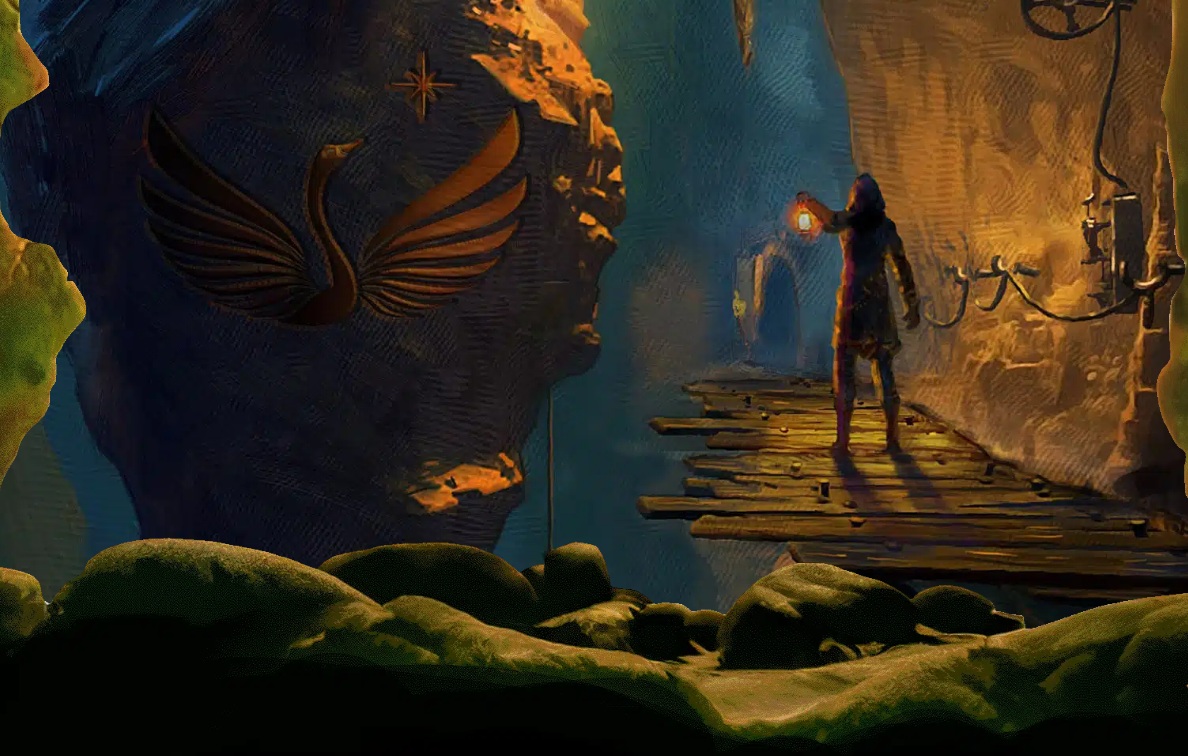
Acclaimed game designer Roberta Williams revives Colossal Cave as a retro, point-&-click, cave exploration puzzler. Based on the original 1970’s design by Will Crowther & Don Woods this 3D update maintains its vintage charm, while revitalizing it for modern gamers.
Colossal Cave is a reimagining of the original text-based adventure game, first introduced in 1975 by Will Crowther and Don Woods, as a fully immersive 3D VR experience.
Colossal Cave is already well known to tens of millions of gamers worldwide. Several elements of the game, such as the codewords “Xyzzy” and “Plugh”, are recognized instantly by many gamers.
Roberta Williams, who has received widespread industry recognition including several “Hall of Fame” awards, and who is the designer of several industry leading hit games, including King’s Quest, Phantasmagoria, Black Cauldron, and many more, is adapting the game for the VR world and bringing to life its many characters.
In the game, players explore a vast and extensive cave, seeking treasures within. Along the way, they will encounter a variety of characters, some of whom will attack and some of whom will entertain. For instance, there is a Troll (at the troll bridge), a bear, a snake, dwarves (seven, of course), and a pirate. The player’s quest is to find all the treasure. The challenge is not easy, and there will be a wide variety of puzzles to overcome.
Though the audio is only in English provisions have been made for many other languages via text subtitles: French, Italian, Spanish, Japanese, Chinese (Simplified), Arabic, German, Polish, Portuguese, Korean, Russian, Thai

Free demo for every system- click here to try it out.
Ars Technica stated that Williams was “one of the more iconic figures in adventure gaming”. GameSpot named her tenth in their list of “the most influential people in computer gaming of all time” for “pushing the envelope of graphic adventures” and being “especially proactive in creating games from a woman’s point of view and titles that appealed to the mainstream market, all the while integrating the latest technologies in graphics and sound wherever possible.” In 1997, Computer Gaming World ranked her tenth on the list of the most influential people of all time in computer gaming for adventure game design. In 2009, IGN placed the Williams 23rd on the list of top game creators of all time, expressing hope that “maybe one day, we’ll see the Williams again as well.” She was also a source of inspiration for the character of Cameron Howe in the AMC television drama Halt and Catch Fire.
The Original Colossal Cave was a vintage gaming icon
Williams was given the Pioneer Award at the 20th Game Developers Choice Awards in March 2020 for her work in the graphical adventure game genre and for co-founding Sierra On-Line.
SOME OF THE GAMES BY ROBERTA WILLIAMS


Ken Williams
Ken started his career as an IBM mainframe software engineer in the Los Angeles area, specializing in databases and networked systems, while consulting with a wide variety of companies, including McDonnell Douglas, Electra Records, Bekins Moving and Storage, Los Angeles Children’s Hospital, Financial Decision Systems and others.
Ken, alongside his wife Roberta, co-founded Sierra On-Line in 1979. Ken ran the company as its CEO for nearly twenty years. During Ken’s tenure at Sierra the company, Sierra regularly topped bestseller charts worldwide, releasing over 200 titles for a variety of hardware platforms and languages. Sierra became a public company on Nasdaq in 1987, grew to one thousand employees, and was sold in 1996 for one billion dollars.
Sierra was known for its technology leadership, and pioneered such technologies as vector graphics, sound and music in computer games, avatars, and network games.
In his role as Sierra’s CEO, Williams focused on innovation: “I’m not sure how typical I am of other CEOs. Most of my time is spent looking at product. To me, everything is about being able to build awesome product. Any game which does not push the state of the art leaves an opportunity for a competitor’s game to look better.”
Sierra’s extensive list of hit products include: Leisure-Suit Larry, King’s Quest, Phantasmagoria, Space Quest, Red Baron, Nascar Racing, Hoyle’s Card Games, Dr. Brain, Mickey’s Space Adventure, Half-Life, Ultima, and many more.
After selling Sierra, Ken and Roberta retired to Mexico where they lived for over twenty years. They also purchased a small, rugged, ocean-crossing capable yacht and used it to explore the world, visiting over twenty-five countries and crossing both the Atlantic and the Pacific. Their adventures include crossing the Bering Sea as part of a three-boat group calling themselves “The Great Siberian Sushi Run”. Ken and Roberta enjoy a “second 15 minutes of fame” as world cruisers and Ken wrote four books about their travels.
In 2021, while locked down by the Pandemic, Ken found time to write about the “Sierra days” and captured the history in the bestselling book, “Not All Fairy Tales Have Happy Endings”. With a renewed interest in games, Ken decided to dig into how modern games are produced and spent time learning the Unity 3D Engine. In a loop back to their earlier history, Roberta suggested Ken program a game. Thus, was invented their new company: Cygnus Entertainment.



VR Sailing At Night
Back in February we wrote about the superb Oculus Rift virtual reality sailing app MarineVerse Cup. This fully immersive and accurate simulation surprised us with its physics based playset and incredibly realistic sense of actually sailing. (Add a fan moving air into your face and body for an even more visceral experience.) It is a most welcome virtual reality experience.

MarineVerse started development with a focus on regattas while aiming to create what the developers called “a chill sailing game”. Like all robust apps, the developments and updates continued and I wouldn’t be surprised if one day we might see knot tying or rigging etc. as part of their sailing school.
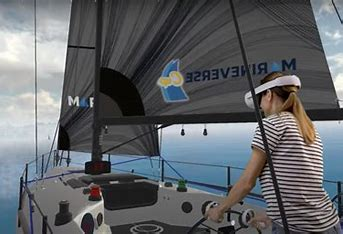
Night Sailing!
The latest update allows VR mariners to try night sailing & boating and experience relaxing sailing under the stars at Akalana Island while testing navigation skills like never before.
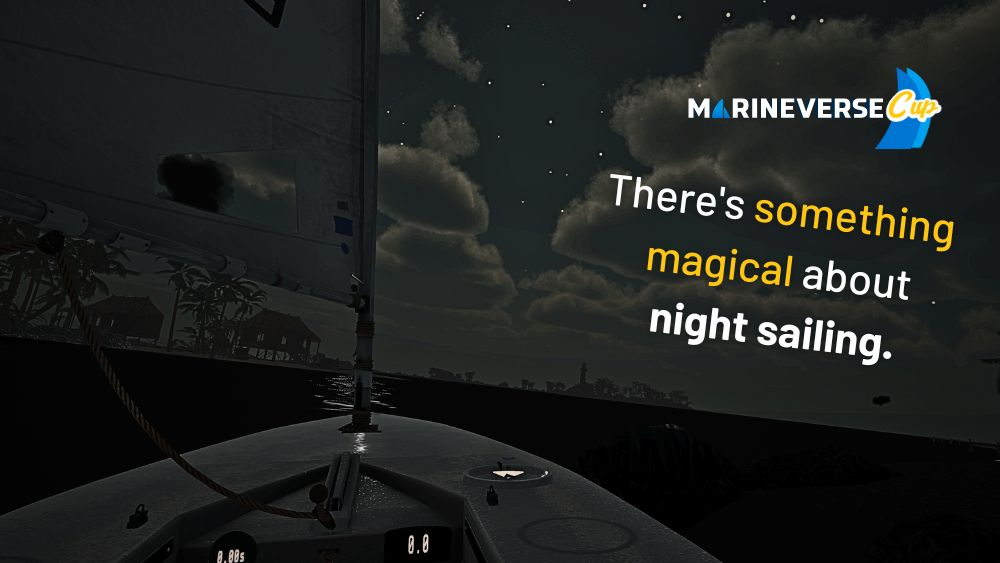
Night Navigation Practice
Have you ever sailed at night? Can you distinguish safe water from an isolated danger mark by just looking at its lights? Often a feared outing for a novice sailor in the real world, you can learn safely, at your own pace, and without the fear of grounding your boat and risking your life.
Test your skills in MarineVerse Cup:
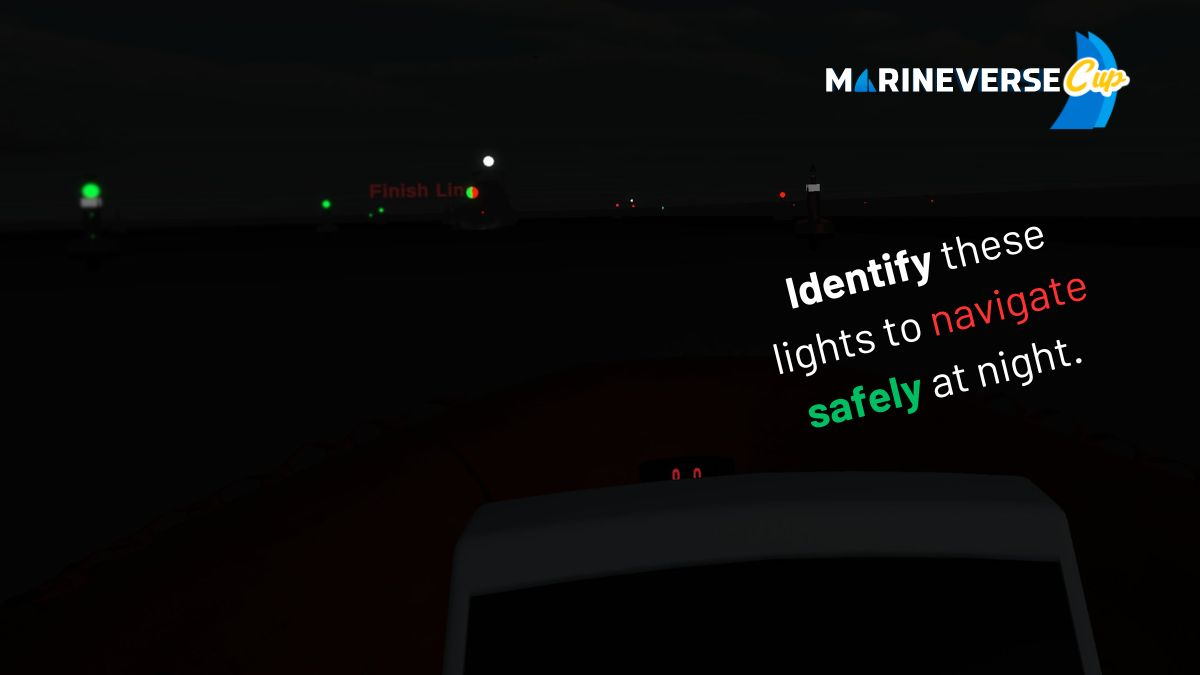
( The video doesn’t do it full justice; make sure to try it in VR yourself. )
To access – visit NauticEd Training Room in the MarineVerse Cup and select Navigation Rules. ( If you need a general refresher on Nav Rules, don’t miss this free NauticEd course )
Are you a MV VR skipper or a real world sailor interested in joining MarineVerse? Let them know via Discord. https://discord.gg/marineverse